A History of the County of York North Riding: Volume 2. Originally published by Victoria County History, London, 1923.
This free content was digitised by double rekeying. All rights reserved.
'Parishes: South Kilvington', in A History of the County of York North Riding: Volume 2, ed. William Page (London, 1923), British History Online https://www.british-history.ac.uk/vch/yorks/north/vol2/pp40-43 [accessed 1 May 2025].
'Parishes: South Kilvington', in A History of the County of York North Riding: Volume 2. Edited by William Page (London, 1923), British History Online, accessed May 1, 2025, https://www.british-history.ac.uk/vch/yorks/north/vol2/pp40-43.
"Parishes: South Kilvington". A History of the County of York North Riding: Volume 2. Ed. William Page (London, 1923), British History Online. Web. 1 May 2025. https://www.british-history.ac.uk/vch/yorks/north/vol2/pp40-43.
In this section
SOUTH KILVINGTON
The parish, which includes the townships of South Kilvington, Thornbrough and Upsall, lies to the north of Thirsk and covers about 2,920 acres. Of this 1,300 acres are pasture and about an equal area is in cultivation. (fn. 1) The subsoil is lower lias, and the chief crops grown are wheat, barley and turnips.
The parish is bounded by the Cod Beck on the west, and by two of its tributaries, Spital Beck and Whitelas Beck, on the north and south.
The highway from Thirsk to Yarm runs northward alongside of the Cod Beck through the village of South Kilvington, leaving the parish by the Spital Bridge over the Spital Beck. Near the entrance to the village this road is met by Hag Lane, which leads eastward to the farm which was once the manor-house. At the junction is the village green, where stands the church of St. Wilfrid with the rectory to the north.
A road branching from Hag Lane runs north-east to the south bank of the Spital Beck, where stand the farms forming the hamlet of Thornbrough. At some distance past Thornbrough the road joins the 'Pale Dike,' the old boundary of the park of Upsall, which has a paved way on one side of it. It is uncertain at what date this park was first made. It is said to have been disparked in 1599, (fn. 2) but from a petition of the rector of South Kilvington in 1641 (fn. 3) it appears that it was then still inclosed and was of the yearly value of £200.
The road by the Pale Dike runs on to the northeast till it reaches the village of Upsall on a slope of the Hambleton Hills. On the east of the road at the entrance to the village are the ruins of Upsall Castle. The castle was probably begun by the Geoffrey Scrope who bought the manor from the Upsalls in 1327, (fn. 4) and the work was continued by his son Henry. (fn. 5) The site of the capital messuage is mentioned in 1392, (fn. 6) and in 1576–7 the Crown made a grant of 'the old site of the castle of Upsall.' (fn. 7) The castle is mentioned in a conveyance of 1607, (fn. 8) and is said to have been demolished at the time of the Civil War. It is last mentioned in 1660, when it was probably in ruins. (fn. 9)
The only old part is a corner tower at the southeast with walls about 10 ft. high above the lower lawn. It is about 36 ft. square inside. From this the foundations of the south wall run westward for about 130 ft., then turn north for another 140 ft. till they reach another tower with a semi-octagonal western face. In two of these faces are window jambs remaining. This part stands up some 10 ft. to 12 ft. above the upper lawn, which is about 10 ft. higher than the lower lawn. There are a few cinquefoiled heads of square-headed windows lying about, and a plain pinnacle with the arms of Scrope of Masham and Upsall. The modern castle is a short distance to the east of the old site; it was built in 1876 by Mr. Edmund H. Turton. It was near this castle that a former inhabitant of Upsall is said to have dug up three 'crocks of gold.' Farther up the village street, which runs north from the castle, is a Methodist chapel, built in 1887. North of the village is Quarry Wood.
Nevison House, a large farm, standing just outside the park on the south, is supposed to have been the home of a famous Yorkshire freebooter, Will Nevison, who was hanged in 1685. (fn. 10)
Manors
The manor of SOUTH KILVINGTON followed the descent of the manor of Upsall (q.v.) to the 16th century. In the 13th and 14th centuries a family called Kilvington held lands here (fn. 11) of the Upsalls, then lords of the manor. From the fact that in 1322 William son of Adam de Kilvington complained that his father had been unjustly disseised by the grandfather of Geoffrey de Upsall of a common of pasture in Upsall (fn. 12) it is evident that the families had existed side by side for some time. In 1348 Geoffrey Upsall and John and William Kilvington held the lands in Upsall, Kilvington and Thornbrough which had been held by Michael Upsall and others. (fn. 13)
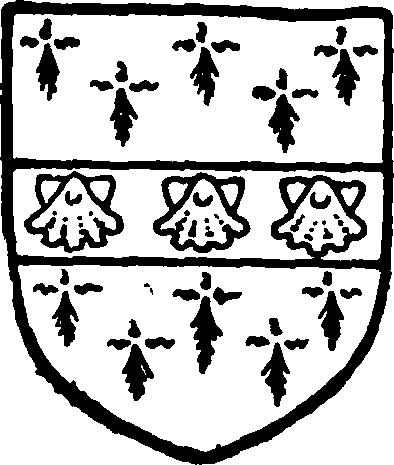
Ingram, Viscount Irvine. Ermine a fesse gules with three scallops or thereon.
The manor was transferred to the Scropes with Upsall, to which it seems to have been considered appurtenant, and must have been included in the sale of Upsall Manor by Thomas Tancred to the Earl of Rutland. (fn. 14) He died seised of it in 1587, (fn. 15) leaving it with other manors to his daughter Elizabeth Lady Roos. At her death they were held by her second husband, Sir William Cecil Lord Burghley, for life, (fn. 16) and then descended to her son William Lord Roos. In 1623 South Kilvington was sold by Robert Hooke and Dorothy his wife, who had purchased it from Lord Roos, to Sir Arthur Ingram, senior. (fn. 17) From Sir Arthur Ingram the manor descended to Henry Viscount Irvine, (fn. 18) who conveyed it in 1663 to Ralph Tancred. (fn. 19) Eight years afterwards South Kilvington was in the possession of Francis Morley and Jane his wife, and was sold by them to Richard Sterne, (fn. 20) who in 1684 sold it to Richard Taylor. (fn. 21) His great-grandson Taylor White conveyed it to Christopher Johnson in 1795 for the purpose of cutting off the entail. (fn. 22)
Nothing more is heard of it till 1859, when it was held by the trustees of Sir Matthew Dodsworth, bart. (fn. 23) His son Sir Matthew Blayney Smith-Dodsworth, bart., (fn. 24) was holding it in 1905. The present lord of the manor is Mr. E. R. Turton.
The Prior of Newburgh held 1 carucate of land here in the 14th century. (fn. 25)
There was a mill in South Kilvington in the 17th and 18th centuries. (fn. 26)
The manor of THORNBROUGH (Thornbergh, xiii cent.; Thornbargh, xvii cent.) followed the descent of South Kilvington (q.v.) till Henry Viscount Irvine and Essex his wife conveyed it in 1665 to Michael Pickering. (fn. 27) From this date its history becomes obscure and it ceases to be treated as a manor.
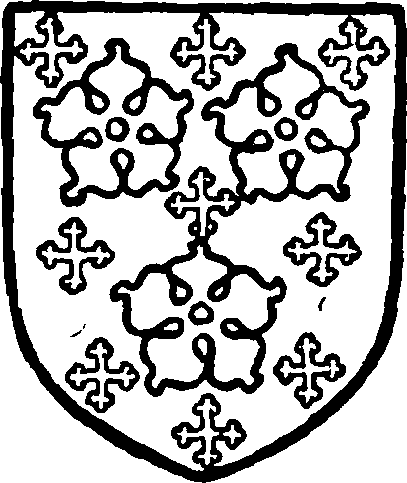
Saltmarsh. Argent crusilly with three cinqfoils gules.
In 1717 (fn. 28) a moiety of the estate was in the hands of Philip Saltmarsh of Newby Wiske (q.v.). John and William Saltmarsh appear to have held it jointly in 1728, (fn. 29) and William Saltmarsh sold his moiety in 1757 to John Roper and Thomas Strangways. (fn. 30) In 1829 Thornbrough was in the hands of the Vicomte de Quelen, the Comte de Châteaubriand and others (fn. 31); they sold it in the following year to Nathaniel Milne. (fn. 32) Thirty years afterwards the chief landowners were John Young and Charles Cook. (fn. 33) Mr. Edmund Russborough Turton, lord of the manor of Upsall, is the present owner.
Free warren in these manors was probably included in the grant to Geoffrey Upsall in 1244. (fn. 34) Later tenants certainly enjoyed it. (fn. 35)
A market and fair in the manor of Kilvington were granted to Geoffrey Upsall in 1257, (fn. 36) but are not again mentioned.
UPSALL (Upsal, xi cent.) was for centuries the head of the Scrope fee in this neighbourhood, and has always been the chief of the three manors in the parish. Before the Conquest it had been held by Waltef. In 1086 it was among the lands of the Count of Mortain, (fn. 37) and was held of him by Richard Surdeval, one of his chief sub-tenants. (fn. 38) When forfeited after the battle of Tenchebrai, (fn. 39) it seems, with many other lands in Yorkshire, to have been granted to the Mowbray family, the overlordship following the descent of their manor of Thirsk (fn. 40) (q.v.).
Four carucates here and at Thornbrough must have been among the lands granted to the Stutevills, lords of Kirkby Moorside (q.v.), the descent of which was followed by a mesne lordship here. (fn. 41)
In the late 14th century the manor was said to be held of Sir Andrew Luttrell. (fn. 42)
Geoffrey de Upsall received a grant of free warren here in 1244 (fn. 43); he was succeeded by his son (fn. 44) Hugh, tenant in 1284–5. (fn. 45) Hugh died without issue and was succeeded by his brother William. (fn. 46) William also apparently died without issue, for in 1294 his widow Joan claimed dower against Isabel wife of Michael de Upsall, who had succeeded to his brother William's lands in Upsall and South Kilvington. (fn. 47) Geoffrey de Upsall, son of Michael, (fn. 48) in 1327 sold the manor to Geoffrey Scrope of Bolton, (fn. 49) who in 1329 granted it back to him for life for an annual rent of one rose at the Nativity of St. John the Baptist. (fn. 50) Upsall subsequently followed the descent of the manor of Masham (fn. 51) (q.v.) until on the division of the Scrope lands among the three daughters of Thomas, the fifth baron, (fn. 52) it fell to the share of Alice wife of Sir James Strangways; in 1533 it was in the possession of Sir James Strangways, junior, (fn. 53) the son of her son Thomas. (fn. 54) As in the case of Ainderby Steeple (q.v.) the reversion of the manor was conveyed by James Strangways in 1541 to Leonard Dacre. (fn. 55) On the death of James Strangways about three months afterwards, apparently before the transaction was made valid, a dispute arose between the Dacres and his heirs. Finally an appeal was made to the king, whose award was confirmed in Parliament in 1544. Upsall was allotted to Robert Roos, the grandson of the elder Sir James Strangways, (fn. 56) but the Dacres insisted on their right. A suit of intrusion was brought by the Crown against Leonard Dacre in 1562. (fn. 57) His attainder for treason (fn. 58) in 1570 finally put an end to his claim.
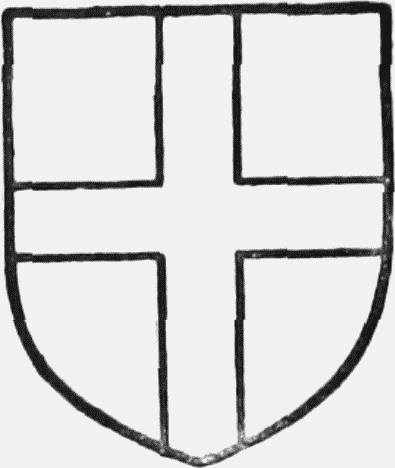
Upsall. Argent a cross sable.
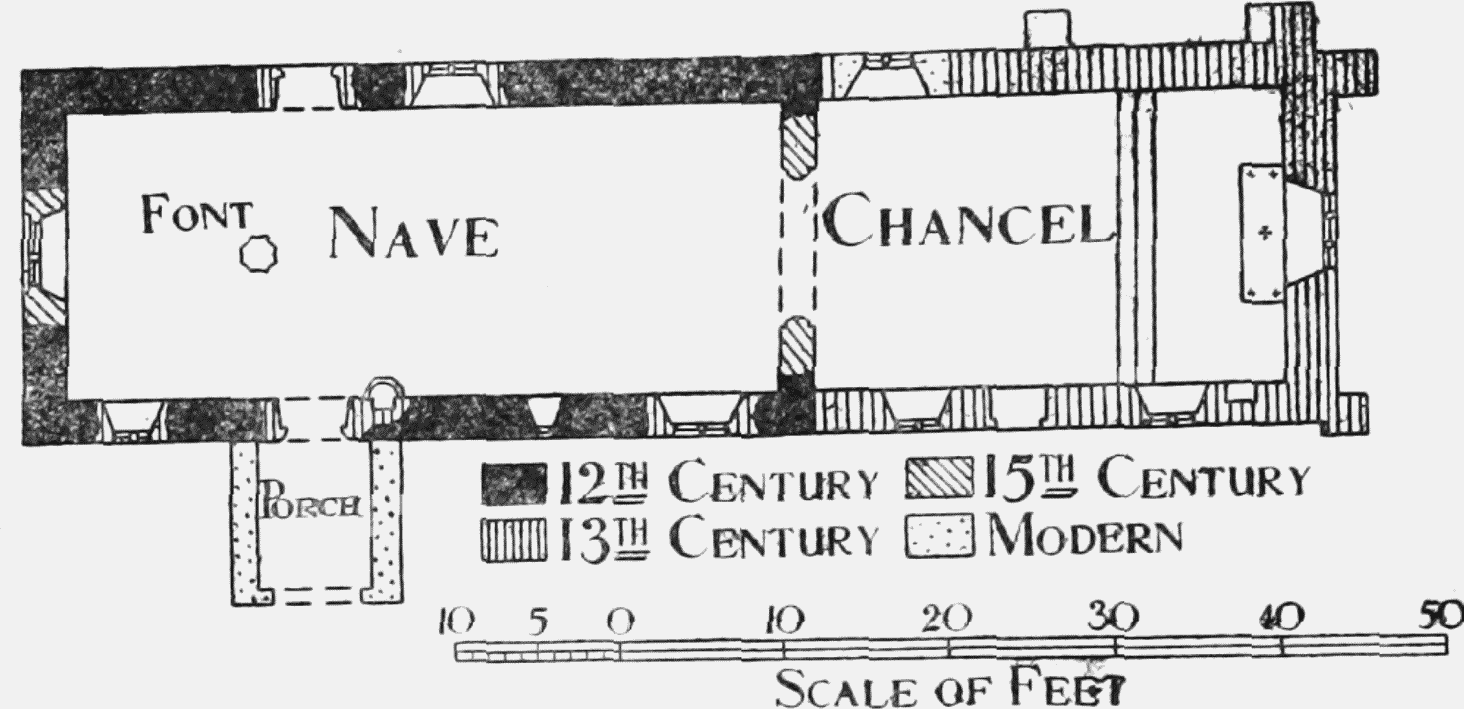
Plan of South Kilvington Church
In 1569 Robert Roos alienated the manor to Thomas Sowerby in trust for William Tancred and his heirs, (fn. 59) who held it till 1575, when Thomas Tancred sold it to the Earl of Rutland. (fn. 60) Three years afterwards the earl conveyed it to Sir John Constable. (fn. 61) John was succeeded in 1579 by his son Henry, (fn. 62) whose son, another Henry, was created Viscount Dunbar in 1620. (fn. 63) The estates of Viscount Dunbar were sequestered in 1654. (fn. 64) He had apparently raised money just before the Civil War by granting several rent-charges on the estate. (fn. 65) After the Restoration John Constable Viscount Dunbar conveyed the manor to Christopher Shawe and Ralph Kerton, (fn. 66) presumably trustees for his son Robert, a minor. They were parties to an agreement with Robert in 1672–3. (fn. 67) William Viscount Dunbar, brother and heir of Robert, died without issue in 1718, (fn. 68) and his estates passed to his nephew Cuthbert Tunstall, who adopted the name of Constable. (fn. 69) He was succeeded by his son William, who in 1768 sold Upsall Manor to William Chapman. (fn. 70) The latter sold it almost immediately to John Turton, (fn. 71) a distinguished physician and a friend of the Royal family. He died without issue, (fn. 72) leaving his estate to his wife, by whose will it passed to Edmund Peters, (fn. 73) who took the name of Turton. At his death in 1857 Upsall was inherited by his son Edmund, who was succeeded by another Edmund Turton, (fn. 74) the present lord of the manor.
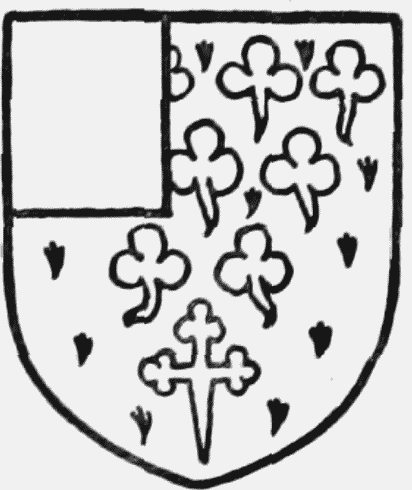
Turton of Upsall. Ermine nine trefoils alternately vert and azure with a crosslet fitchy sable in the foot and a quarter gules.
Church
The church of ST. WILFRID consists of a chancel measuring internally 28 ft. 4 in. by 17 ft. 11 in., nave 44 ft. 1 in. by 17 ft. 7 in. and south porch.
A small round-headed window in the south wall points to the 12thcentury origin of the fabric, but this window is the only detail remaining of the date, unless the rear arch of the south-west window is earlier than its monial. The earlier of the other windows date from about 1260, when the chancel was probably rebuilt. The porch is comparatively modern.
The 13th-century east window is of three trefoiled lights, over which are three quatrefoils but no containing arch. The two windows in the south wall are contemporary, and are each of two trefoiled lights (the middle foil quite small) with a quatrefoil over. The window in the north wall is a modern copy of these. The piscina in the south wall has apparently been retooled and may be as early as the windows, though the basin is modern; the head was probably trefoiled. The chancel arch has been rebuilt. The lower parts of the jambs are modern, the upper parts are old, and apparently the old bases of the semi-octagonal responds have been raised. The capitals are of a coarse section and probably of 15th-century date. The two-centred drop arch is of two chamfered orders.
The only window in the north wall of the nave and the first of those in the south are similar to those of the chancel. The second window from the east in the south wall of the nave is the 12th-century light already mentioned. The jambs and head have a continuous internal splay. The south doorway has jambs of a sunk quarter-round order, like those of the windows, and a two-centred drop arch. East of it is a holy water stoup with a large projecting basin and a plain ogee head. The south-west window has a wood frame dividing it into two ogee-headed lights, and a plastered half-round rear arch difficult to date. The north doorway has a round head and is moulded with a sunk quarter-round. The west window is of two trefoiled lights under a square head; it was probably inserted in the 15th century, but the head looks like a modern restoration. In the west wall near the south angle outside is a shallow trefoiled niche.
Over the roof at the west end is a plain wood bellturret with a pyramidal roof; it contains two bells, one with no inscription and the other, which is cracked, is inscribed 'Jesus be our speed 1695, E.G., C.W.,' but with no maker's mark; both are of the same note. The south porch is modern or of the late 18th century; all the walls are cemented outside and plastered inside. The roofs have flat plaster ceilings.
The font dates from the latter part of the 15th century; it is of grey marble and is octagonal in plan with concave sides. On the base are squares inscribed 'Dñs Thom[a]s le Scrōp et Elizabeth uxor ejus,' referring to Thomas Lord Scrope, who married Elizabeth Nevill and died in 1494. On the sides of the bowl are shields with Scrope heraldry.
There is a large amount of modern carved furniture in the church, including a very large organ; much of the carving was done by the present rector, the Rev. W. T. Kingsley, who has held the living since 1859. Two old pieces of panelled work have been adapted in a chair in the chancel. At the west end are still remaining some 18th-century box pews, and at the east end is a large late 17th-century square pew. In the east window tracery is some old stained glass, including a shield with the arms of Upsall and Mauleverer. There are a few other fragments, chiefly of canopy work, in the north window of the chancel and in the west window. In the chancel are the fragments of a 13th-century cross.
The plate includes a silver cup, bearing the Newcastle mark of 1760, a silver paten, bearing the Newcastle mark of 1814, presented by the Rev. John Green, rector, and a brass almsdish of Nuremberg manufacture.
The registers begin in 1572.
The churchyard is partly bounded by a yew hedge.
Advowson
In 1233 Geoffrey Upsall, lord of the manor of Upsall, claimed the advowson of South Kilvington against Oliver and Robert Buscy. Robert Buscy declared that he held the church of the gift of the Archbishop of York, who gave it to him by the authority of the council, but he did not claim any right in the advowson. (fn. 75) Two years afterwards Oliver quitclaimed the advowson to Geoffrey, (fn. 76) and in 1327 it was sold with the manor, (fn. 77) which it followed in descent till the 16th century. In 1544 it was probably awarded to Robert Roos with the manor, but the other claimant, Leonard Dacre, seems to have retained possession of it, as he presented in 1559. (fn. 78) During the early part of the 17th century it passed through various hands. Thomas Tancred presented in 1615, (fn. 79) Robert Roos having apparently sold his right in this advowson with the manor of Upsall. Francis Barker presented in 1633. (fn. 80) In 1638 the patron was William Lee, and the advowson remained in the possession of his family till 1714, when it passed, probably by sale, to Sidney Sussex College, Cambridge, the present patrons.
Geoffrey de Upsall in 1316 granted a messuage and 8 oxgangs of land in Upsall and Thornbrough to a chaplain, to celebrate divine service daily for his soul in the chapel of St. Mary Magdalene at Upsall. (fn. 81)