
A History of the County of York North Riding: Volume 2. Originally published by Victoria County History, London, 1923.
This free content was digitised by double rekeying. All rights reserved.
'Parishes: Huntingdon', in A History of the County of York North Riding: Volume 2, (London, 1923) pp. 145-150. British History Online https://www.british-history.ac.uk/vch/yorks/north/vol2/pp145-150 [accessed 19 April 2024]
In this section
HUNTINGTON
Huntindune (xi cent.); Hunteindune near York (xii cent.); Huntenton, Huntington (xiii cent.); Huntyngdon in the forest of Galtres (xvi cent.).
The parish of Huntington, which includes the townships of Earswick and Towthorpe, lies about 3 miles north of York. Huntington itself covers nearly 3,018 acres, while the areas of Earswick and Towthorpe are 751 acres and 1,074 acres respectively. The proportion of arable (where cereals are chiefly grown) to pasture land is about 3 to 5. In most parts of the parish the elevation is 50 ft. above ordnance datum. The soil is principally clay on a subsoil of bunter sandstone.
The principal road in the parish enters it from Strensall on the north and leads southwards through Towthorpe and Earswick to Huntington village. A considerable part of Towthorpe, which lies in the north-west of the parish, is incorporated in the great military encampment on Strensall Plain. Here are the Queen's Parade, officers' quarters and rifle ranges, east of which Towthorpe Common stretches to the borders of Stockton-on-the Forest, whilst the little village with its manor-house and moat stands southwest of the camp on a branch road leading to Stockton and separating Towthorpe from Earswick on the south. There are now two villages in this last township. Earswick, the older, lies west of the highway and is built on both sides of a branch road leading from it to the River Foss, which here forms the boundary between Earswick and Haxby on the west. The other village, New Earswick, belongs to Messrs. Rowntree and is inhabited by their workpeople and the employes of other York firms. (fn. 1)
From Earswick the highway bears past Huntington North Moor and Wood on the east to the village of Huntington, which stretches on either side of it. Huntington possesses a Wesleyan Methodist chapel, built before 1857, enlarged in 1867 and rebuilt in 1900. At the north end of the village is Huntington Hall, possibly occupying the site of the first home of the Holmes, which stood on the east side of the Foss (fn. 2); the Manor House is at its southern extremity. Near the centre Church Lane, crossing the Foss by Church Bridge, to which in 1435 Margaret Darell left two torches and her best gilded girdle, (fn. 3) leads to the church of All Saints and West Huntington Hall. (fn. 4) In the churchyard is the base and shaft of a mediaeval cross, re-erected with a new head in 1874, and at the corner of Church Lane is the base and part of the shaft of another stone cross.
Below the village the highway forks; one branch, as Huntington Road, leads to Earswick station on the York, Market Weighton and Beverley branch of the North Eastern railway and thence to the southwestern corner of the parish, crossing the Foss at Yearsley Bridge, close to the fever hospital for York city, opened here in 1902. The other, which, as Huntington New Lane, runs due south with Huntington South Moor on its right, is crossed by the railway a mile below the village, and soon after passing Huntington Grange joins the high road from York to Malton. In 1606 the inhabitants of Huntington were presented at the quarter sessions for neglecting to repair this part of the king's highway, (fn. 5) which falls within their borders for but a short distance. Similar charges were brought against them and the townsfolk of Earswick somewhat later (fn. 6) with reference to other roads, one only a footpath from Earswick village to the moor, another 'the road east of the Foss,' which seems to be Huntington New Lane.
The Foss, once believed to be an artificial work of the Romans, and now rather a canal than a river, (fn. 7) flows through all three townships, dividing Huntington proper into East and West Huntington, a distinction which probably existed in the 15th century, when certain landowners held 'on both sides of the water.' (fn. 8) From 1606 to 1625 the name of Istle, Isell or Essell Bridge occurs, (fn. 9) and in 1697 and 1715 grants were made for the repair of Huntington Bridge, on the first occasion on the ground that it was 'of great use to the county.' (fn. 10) The fishery of the Foss from York to the mill of the Abbot of St. Mary's, above Earsley, now Yearsley Bridge, is said to have belonged to the king. (fn. 11) A little stream, the South Beck, possibly identical with the River Fossett named with the Foss itself amongst the boundaries of Huntington Manor in 1656, (fn. 12) here empties itself into the larger river.
Huntington, as one of its 16th-century names denotes, was in the forest of Galtres, (fn. 13) and it was once the custom to set a light in the lantern tower of its church as a beacon for wanderers there. (fn. 14) Very little woodland now remains. Land called 'the New Intack' was inclosed by the elder Sir Arthur Ingram, (fn. 15) probably about 1629, when he entered into an agreement with the king for disafforesting the lands belonging to his manor which fell within the forest, (fn. 16) and the inclosure of a common in Earswick, 600 acres in extent, took place in 1770. (fn. 17)
Among Huntington place-names of the 13th century are Whyteker and Langelondes (fn. 18); of the 16th and 17th centuries Haxbie feld or Hercrike More, later Arcricke alias Harcricke Moore and Smithgate; of the 17th, Butcher Ynge, Batchler Close, Milne Crookes, Smythie Gavells, Thisete Close, Fogge Close, Pillie Close, the Scarrs Close, Kilne Garth, Jedwell Close, and, of special interest as preserving the memory of two families long resident in this part of the county, Seath Agars Close and Lazenby Close. (fn. 19)
Manors
Two 'manors' in HUNTINGTON, containing 5 geld carucates and owned by Torchil and Tormord under the Confessor, came before 1086 to the Count of Mortain. (fn. 20) It is probable that here, as in Sheriff Hutton (q.v.), the overlordship passed through Niel Fossard, the count's sub-tenant at the Survey, to the Mauleys, of whom this land was held until 1384. (fn. 21) By the next century their rights seem to have fallen into abeyance, (fn. 22) and in 1588 the manor of Huntington was found to be held of the queen as of her manor of Sheriff Hutton. (fn. 23)
In the reign of Henry III the Mauley lands in Huntington were occupied by three sub-tenants, Anketin Mallory, Richard de Barnby and Walter de Towthorpe. (fn. 24) No other mention of the tenure of Richard and Walter survives, and though the name of Anketin (fn. 25) is found in connexion with Huntington as late as 1384, (fn. 26) it is difficult to determine what his heirs held here. Neither of his sons Anketin and Nicholas left issue, (fn. 27) and when Nicholas died in 1275 his possessions, which in Huntington were inconsiderable, passed to his four sisters. (fn. 28) John Langton was the heir of Nicholas Salvin, who, as great-grandson of Margery the eldest, inherited her purparty and that of her sister Avis. (fn. 29) A settlement of a messuage and 8 oxgangs in Huntington made in 1376 by John Keulay and his wife Katherine with remainder, in default of Katherine's issue, to John son of John Langton of York and his heirs (fn. 30) suggests that the elder Anketin's lands here passed to his daughters, and that Katherine Keulay's holding represents the share of Margery and Avis.
John Keulay and his sons joined the Percy rebellion, and in 1405 a life grant of their forfeited lands in Huntington was made to the king's esquire, Gerald Herun. (fn. 31) In 1428, however, one of these sons, William Keulay, appears amongst the tenants who held the Mauley fee in separate portions. (fn. 32) Another tenant, William Darell, a landowner also in 1412, (fn. 33) held land with his son Richard in 1428. (fn. 34) After the death of Richard in 1439 or 1440 (fn. 35) Thomas Higham, his kinsman, sued Robert Ingleby, Richard's executor, (fn. 36) for the manor of Huntington, which, as he alleged, Richard had settled on Robert in trust for himself and his heirs. (fn. 37)
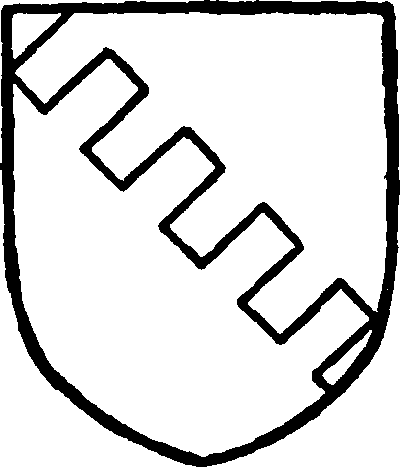
Keulay. Party bendwise and battled argent and sable.
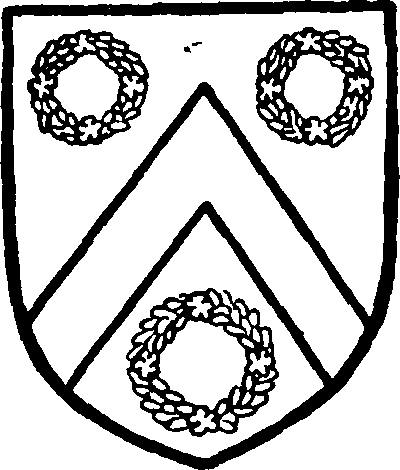
Holme. Argent a cheveron azure between three chaplets gules.
In the absence of evidence to the contrary it may be assumed that this portion of the Mauley fee was acquired by the Holme family, who were established in Huntington before the close of the 15th century. (fn. 38) Their tenure probably began with the marriage of Katherine daughter and heir of John Keulay of York with Robert Holme. (fn. 39) John Holme their son was succeeded at his death in 1490 by his son Thomas, (fn. 40) who made a settlement of the manor on the marriage of his son and heir Wilfrid Holme with Elizabeth Constable in 1511. (fn. 41) Wilfrid, who inherited in or before 1522, died in 1538, (fn. 42) probably 'in Huntington in Yorkshire commorant patrimonial,' where he wrote in 1537 his poem on the Pilgrimage of Grace. (fn. 43) From his only son Seth, whose wardship and marriage were in 1544 granted to John Genyns, groom of the Privy Chamber, (fn. 44) the manor descended in 1588 to his son and heir another Seth Holme, (fn. 45) lord in 1594, (fn. 46) by whom with his son Robert it was sold thirteen years later to Richard Burrell. (fn. 47) Richard and his wife Jane sold Huntington in 1612 to Arthur Ingram, (fn. 48) lord in 1629 and 1638. (fn. 49) In the latter year he held the estate in conjunction with his elder son Arthur; but in 1647 the manor was in the possession of his younger son Sir Thomas Ingram with his wife Frances. (fn. 50) It was sold nine years later by Thomas Ingram, the second Sir Arthur's son, to Leonard Weddell and his nephew the younger William Weddell, both of Earswick, (fn. 51) who had already acquired the site of one, probably the older, manorhouse with some land. (fn. 52) The inheritance of William's sons, Metcalfe and Thomas, seems to have descended to their sister Margaret's son, Richard Elcock, who took the surname of Weddell. Richard's surviving son William was in 1770 lord of the manor of Huntington (fn. 53); in 1792, on his death without issue, it passed to Thomas Philip Robinson, great-grandson of the Sir William Robinson whose aunt Margaret Robinson had married William Weddell of Earswick. (fn. 54) As Thomas Philip Weddell, Lord Grantham, he held Huntington in 1804 (fn. 55) as he did as Earl De Grey in 1857. (fn. 56) After his death in 1859 (fn. 57) it came to his daughter Lady Mary Vyner, whose son Robert Charles De Grey Vyner is now lord of the manor. (fn. 58)
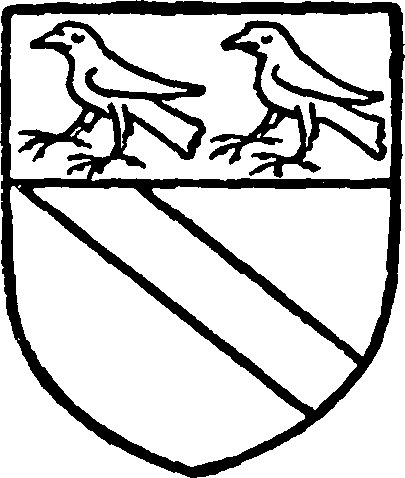
Vyner. Azure a bend or and a chief argent with two choughs therein.
Two carucates and 6 oxgangs in Huntington held by Fredgist and Arnegrim before the Norman Conquest as two 'manors' belonged to the king in 1086. (fn. 59) Some part of this land seems to have remained in the Crown until 1267, when Henry III granted the rent of the vill of Huntington to his son Edmund. (fn. 60) In 1392 Sir Henry Scrope died seised of land in Huntington held of the king (fn. 61); this is probably the land which he had acquired in 1351, and which his son Sir John Scrope recovered in 1424. (fn. 62)
At the time of the Domesday Survey the soke of a carucate and 2 oxgangs in Huntington, then waste, belonged to Count Alan's manor of Foston. (fn. 63)
A considerable amount of land in Huntington held by the brothers of the hospital of St. John of Jerusalem in 1189 (fn. 64) was increased during the following century (fn. 65) until by 1303 they owned 4 carucates here, (fn. 66) and their prior was the only landowner whose name was returned for the parish in 1316. (fn. 67) In 1456 Sir John, in 1475 Sir Thomas, Scrope of Masham were amongst the prior's tenants, (fn. 68) and when a bailiff was appointed for the lands of St. John of Jerusalem's Preceptory of Holy Trinity, Beverley, in 1543, Huntington was one of the manors in his charge. (fn. 69)
Agnes Agar, who at her death in 1592 held land of the queen as of her manor of Huntington in free socage 'by fealty and the payment of one rose in the time of roses' was perhaps one of the tenants of this land, but its later history is unknown. (fn. 70)
The abbey of St. Mary, York, to which the Conqueror granted a carucate in Huntington, (fn. 71) held land here from that time until its surrender. (fn. 72) Other religious houses enjoying possessions in this parish were the hospitals of St. Leonard and St. Nicholas and Guisborough Priory. (fn. 73)
A fifth of a windmill was part of the tenement in Huntington held by Emma Bacon of Peter Mauley in 1322. (fn. 74) There was a windmill also in 1460. (fn. 75) In 1607 a capital messuage on the west bank of the Foss, fishing, court leet and view of frankpledge were appurtenances of Huntington Manor, (fn. 76) but the site only of a capital messuage is mentioned in the conveyance of 1656. (fn. 77)
Three geld carucates in EARSWICK (Edrezwyc, Edresuuic, xi cent.; Etheirwike, Etherswyk, Ersewyk, xiv cent.; Erstewycke, Estwyk, Arswiche, xvi cent.) held of St. Peter by Sasford and Godric before the Conquest belonged to the see of York in 1086 and afterwards formed part of the manor of Strensall (fn. 78) (q.v.).
A fee in this township consisting of a carucate and 2 oxgangs and unaccounted for by the Domesday surveyors, unless it was then included in St. Peter's fee, was held of Peter Mauley in 1303. (fn. 79) By 1322, however, the overlordship had been transferred to Ranulph de Nevill, (fn. 80) and henceforth descended with Sheriff Hutton (fn. 81) (q.v.), the manor of Earswick being in 1567 held of the queen as of her manor of Sheriff Hutton, but by socage instead of by military service as in the 14th century. (fn. 82)
In 1303 the sub-tenant here was Bartholomew Bacon, (fn. 83) who was dead in 1322, when the keeper of the lands of certain Yorkshire rebels received orders not to intermeddle with the possessions which he had held jointly with his wife Emma, (fn. 84) those in Earswick being described as a manor in 1328, when Emma's possession was disputed by Emma widow of Walter de Scorby. (fn. 85) There is no evidence that Bartholomew's son John, who was living in 1348, (fn. 86) inherited his father's estates, the tenants of which were Hugh atte Water and Robert de Huntington in 1367, and in 1389 John Sadington and his wife Margaret. (fn. 87) Nothing relating to the history of Earswick from 1389 to 1543 has been found in the public records. In the latter year Sir William Gascoigne settled the manor, which may have come to him through his grandmother Joan Nevill, (fn. 88) for life on his younger son John with remainder to his elder son and heir William. (fn. 89) John Gascoigne was in possession in 1557, after the death of his brother, (fn. 90) whose son, the third Sir William Gascoigne, died seised in 1567. (fn. 91) Margaret, his only child and heir, was then the wife of Thomas Wentworth of Wentworth, and their son Sir William Wentworth was selling land in Earswick and Towthorpe at the close of the 16th century. (fn. 92) It is not clear at what date nor by what steps the manor passed from the Wentworths to the Weddells. Probably it was acquired by the son of Leonard Weddell of Clifton, (fn. 93) described in 1633, 1649 and 1650 as William Weddell of Earswick. (fn. 94) From 1656 it possibly remained in the same hands as Huntington Manor (q.v.), with which it has descended from 1770 to the present day.
In 1323 Emma Bacon owned a capital messuage and rent from a windmill in Earswick. (fn. 95) A capital messuage with land here was held by John Foster of the prebendary of Strensall at the end of the 16th century. (fn. 96)
In TOWTHORPE (Touetorp, xi cent.; Touthorp, Towthropp, xiv cent.; Thorlesthorpe, xv cent.; Thowthorpe, xvi cent.), as in Earswick, 3 geld carucates, held by Sasford of St. Peter before the Conquest, belonged to the see of York, (fn. 97) and were afterwards included in the prebendal manor of Strensall (fn. 98) (q.v.)
Another carucate, mentioned only in the 'Recapitulation' was owned by the Count of Mortain in 1086, (fn. 99) and seems to be one of the two held at the beginning of the 14th century of the Mauleys. (fn. 100) Their rights, which survived until 1347, (fn. 101) seem to have lapsed before 1428, when several tenants occupied, in separate portions, the 6 carucates in Huntington and Towthorpe described as once of Peter Mauley. (fn. 102) From the middle of the 15th until the beginning of the 17th century this fee was classed amongst the lands held as of the manor of Sheriff Hutton (fn. 103) (q.v.) and was called parcel of its demesne in 1603, (fn. 104) after which the lordship seems to have fallen into abeyance. The name of only one early sub-tenant, Walter de Towthorpe, who held in 1303, (fn. 105) has been preserved. By the early Tudor sovereigns the fee was let out to farm until 1540, when Henry VIII granted a lease of the manor of Towthorpe for thirty-one years to Sir George Lawson. (fn. 106) Elizabeth granted it to Lancelot Turner in 1603, (fn. 107) and twenty-six years later it was sold by William Turner and his wife Thomasine to Thomas Bowles and his wife Mary. (fn. 108) Anne, their daughter, brought the manor in marriage to Sir William Dalston, bart., (fn. 109) who, compounding with the Long Parliament in 1645, asked leave 'to produce proof of the charges on his lands at Towthorp.' (fn. 110) Together with his father Sir George Dalston, Sir William in 1673 settled Towthorpe on his son and heir John, (fn. 111) who held with his wife Margaret and their son Charles in 1708. (fn. 112) From Charles Dalston, lord in 1709, (fn. 113) the manor afterwards passed to John Smyth of Heath, who owned it in 1745 and 1774. (fn. 114) It was in the possession of his grandson John Henry Smyth in 1810 (fn. 115) and of John George Smyth in 1859, (fn. 116) but since 1872 Mr. Riley Briggs of Osgodby Hall has been lord.
Court leet and view of frankpledge were included in the grant to Lancelot Turner. (fn. 117) One dovecote belonged to the manor in 1647, (fn. 118) six in 1810, when four corn-mills and free warren, besides court leet and view of frankpledge, were enumerated as appurtenances. (fn. 119)
Church
The church of ALL SAINTS consists of a chancel, nave with north aisle and tower on the south side and an organ chamber. The structure, with the exception of parts of the chancel, is modern, but the re-erected south door is evidence of the existence of a church here in the 12th century. The chancel, where ancient, is apparently of 15th-century date. The nave and tower were rebuilt in 1874.
The chancel has a three-light 15th-century east window, and in the south side are two windows of similar character, each of two lights, the western, however, with the surrounding wall, being modern restoration. There is also a priest's door on this side with a low-side window, having a cusped head, immediately to the west of it. The triple sedilia with a small piscina in the south wall have all pointed arches. The western bay of the chancel is modern, as are the chancel arch and the two arches in the north wall opening into the organ chamber. The nave is designed in the 13th-century Gothic style and has a north aisle of three bays, the arcade resting on red granite columns. The old south door re-erected under the modern tower has a late 12th-century round arch recessed in two orders, of which the inner is modern. The jambs have each a single side shaft, the caps having volutes at the angles and square abaci. The stone bowl of the old font now lies in the churchyard. The communion table with turned legs is Jacobean, as is the handsome pulpit. The latter is hexagonal with diminishing pilasters at the angles and an arcaded panel in each face. The cornice is carved and the base bears the inscription 'Where there is no vision the people perish. Prov. 29, 18.' The stem is of the same period, but the stand is much later. At the west end of the nave are two stone coffin lids with incised floreated crosses, probably of the 13th century.
The modern tower stands on the south side of the nave, the base forming a porch. It is surmounted by a stone spire, and contains six bells, five of which were cast or recast in 1881 and the remaining one in 1884.
The plate includes a cup (York, 1783) given by the Rev. James Brooke, vicar in 1784, and a modern flagon and paten.
The registers before 1812 are as follows: (i) mixed entries 1590 to 1715; (ii) baptisms and burials 1716 to 1768, marriages to 1753; (iii) marriages 1754 to 1813; (iv) baptisms and burials 1768 to 1812.
Advowson
The church of Huntington, which since 1432, if not earlier, has been under the invocation to All Saints, (fn. 120) belonged in 1086 to the Count of Mortain's manor. (fn. 121) The advowson afterwards came to the abbey of Evesham, whose abbot Roger granted it to Richard Abbot of Whitby in 1159 or 1160 (fn. 122) on the understanding that a pension of 10s. should be paid from the church to Evesham. (fn. 123) In 1267 the abbot's presentation of William Potto was disputed by Hugh de Lisle, who had been rector since 1241, but Lisle was induced by the archbishop to resign, and a pension of £10 was assigned him. (fn. 124) It seems that the transference of this church to the see of York had been proposed before 1291, when it was described as 'appropriated to the vicars of the church of York,' (fn. 125) but sixty years elapsed before licence was granted for its alienation by the Abbot of Whitby to the warden and vicars of the church of St. Peter and its appropriation by them, (fn. 126) which is said to have been completed in 1353, a vicarage being ordained in the following year. (fn. 127) Since 1351 the advowson and rectory of Huntington have remained in the possession of the sub-chanter and vicars-choral of York. (fn. 128)
A dwelling-house and 2 oxgangs belonged to the vicarage in 1535, (fn. 129) but three centuries later there was no glebe-house here. (fn. 130) In 1432 William Darell willed to be buried in Huntington Church before the crucifix. (fn. 131) The images of St. Mary and St. John the Evangelist are also mentioned, to which, with the image of St. John the Baptist, John Duk, the vicar, left 13s. 4d. in 1476. (fn. 132) Another bequest of this testator was for making a glass window to light the rood-loft. (fn. 133) A later vicar, William Appelton, in 1517 left beehives to maintain the lamp hanging before the altar of our Lady in the body of the church. (fn. 134) It seems from a grant made by the parish of Ingleby Arncliffe in 1610 that Huntington Church was rebuilt, at least in part, about this date. (fn. 135)
In 1333 there was in the parish a chapel of St. Augustine, whose hermit, Robert de Skitheby, then received a safe conduct whilst seeking alms for making a safe way at a dangerous spot in the forest of Galtres. (fn. 136)
Charities
In 1641 John Vaux, by will, gave £1 a year for the poor and £1 a year to the vicar for sermons. The payments are made by the corporation of York.
In 1710 William Harrison, by will, gave 12s. a year to the poor out of his estate near the church. The annuity was formerly received from Mr. W. Driffield and applied to the relief of the sick poor.
A sum of 17s. a year is paid out of the church funds in respect of £17 given by the Rev. — Bailey and others, and distributed among the poor in sums of 1s. 6d. to 4s. to each person.
John Hodgson, by will proved in 1891, bequeathed £250 for the benefit of the poor. The legacy is invested in £252 0s. 6d. Belfast Corporation 3½ per cent. stock; the annual interest is applied in the distribution of coal.
Mrs. Mary Ann Gibson in 1898 bequeathed £200 invested in £201 6s. 9d. like stock. The interest is distributed among the poor in groceries at Christmas. The stock is held by the official trustee.