A History of the County of York North Riding: Volume 2. Originally published by Victoria County History, London, 1923.
This free content was digitised by double rekeying. All rights reserved.
'Parishes: Myton-upon-Swale', in A History of the County of York North Riding: Volume 2, ed. William Page (London, 1923), British History Online https://www.british-history.ac.uk/vch/yorks/north/vol2/pp157-160 [accessed 1 May 2025].
'Parishes: Myton-upon-Swale', in A History of the County of York North Riding: Volume 2. Edited by William Page (London, 1923), British History Online, accessed May 1, 2025, https://www.british-history.ac.uk/vch/yorks/north/vol2/pp157-160.
"Parishes: Myton-upon-Swale". A History of the County of York North Riding: Volume 2. Ed. William Page (London, 1923), British History Online. Web. 1 May 2025. https://www.british-history.ac.uk/vch/yorks/north/vol2/pp157-160.
In this section
MYTON-UPON-SWALE
Mitune, Mitona (xi cent.); Miton, Mitton (xii-xv cent.).
Myton is a small parish to the south of Helperby; it is watered by the River Swale, which here forms a junction with the Ure. The united rivers, henceforth known as the Ouse, continue their course in a south-easterly direction and form the southern boundary of the parish, separating it from Lower Dunsforth.
The parish contains 1,672 acres, of which 650 are arable land, 885 grass and 80 woodland. (fn. 1) The soil is deep loam with a subsoil of sand and clay. Turnips, barley and oats are the chief crops grown and the grassland is very good. As a whole the parish is flat and low-lying, especially in the west and south near the rivers, but the riverside scenery is picturesque. Nowhere does the land rise to more than 105 ft. above the ordnance datum.
The village is built from east to west along the high road from York, which here turns sharply north to cross the Swale by Myton Bridge; it is not continued on the other side as a main road. The village contains no buildings of any antiquity. The iron bridge was built by Major Stapylton in 1870, near the foundations of an older bridge which was probably of ancient date. A bridge was in existence here in the time of Niel Daubeney, (fn. 2) who died in the reign of Stephen. (fn. 3) It was destroyed by his son (fn. 4) Roger de Mowbray, (fn. 5) who granted to the abbey of St. Mary at York a ferry-boat to be used (fn. 6) until such time as the bridge should be repaired. About 1270 'Stephen, (fn. 7) Earl of Richmond,' gave to the abbey land in Ellingthorpe to make and maintain a bridge across the Swale at Myton, or to find a boat there to convey people across the river, free of charge. (fn. 8) The monks neglected to make the bridge till the time of Abbot Alan de Nesse (elected 1313). (fn. 9)
A ferry over the Swale was an appurtenance of the manor at the Dissolution (fn. 10) and in 1591, and had been leased separately by the Crown to Leonard Gourley. (fn. 11) A free passage across the Swale was in the hands of the Stapyltons in 1676. (fn. 12) In the 19th century there was a ferry for cattle, carriages, &c., over the river here. (fn. 13)
It was no doubt owing to the bridge that Myton was the scene of the 'White Battle' or the 'Chapter of Myton,' which took place in 1319 on a site just outside the parish boundary and now known as Ellingthorpe Ings. (fn. 14) Edward II was besieging Berwick, which had been taken by the Scots, when, to create a diversion, the Scots sent a force of 15,000 men under the Earl of Murray and James Douglas, who marched on York, burning and pillaging the country. An attempt is said to have been made by them to capture the queen, then resident near York. To withstand them an army was hastily collected by William de Melton, Archbishop of York, the Bishop of Ely, the Abbot of Selby and Sir Nicholas Fleming, Lord Mayor of York. They pressed into service priests and peasants and 'such unapt people for the wars,' and pursued the invaders. The two forces met near the bridge at Myton on 12 (fn. 15) or 20 (fn. 16) September, and the Scots utterly routed the English, who fled in disorder, leaving a large number of dead on the field, many of whom were the priests in full canonicals who gave the skirmish its distinctive names; many of the fugitives were drowned in the river, and of the leaders Fleming was slain. On the side of the Scots the loss was trifling.
In 1820 the remains of Roger de Mowbray were removed from Byland Abbey and buried at Myton. (fn. 17)
The Hall, the seat of Mr. Miles Stapylton, stands near the river bank, having a large park on its eastern and northern sides. It is said to have been built by Sir Henry Stapylton in 1693, (fn. 18) but more probably was built by his father, Brian Stapylton, who in 1626–39 brought a suit against one Robert Staninge concerning the bricks used to build his new house and buildings at Myton. (fn. 19) South of the Hall is St. Mary's Church with a churchyard stretching to the river bank; near it is the vicarage. A little southwest of the vicarage, down a by-lane, is the Old Hall, possibly the country house of the Abbots of St. Mary's, York, at which the abbot stayed in 1534–5. (fn. 20) Near the Old Hall and on the river bank is the district of Mill Hill. The eastern part of the parish is known as Myton Moor.
The following 13th-century place-names have been found: Gategynela, Guwylandes, Banco, Fenerdale, Ravenessyk, Hendikedale. (fn. 21)
Manor
In the time of Edward the Confessor Ligulf had a 'manor' in MYTON gelded at 4½ carucates, while Gospatric and Alverle had another 'manor' of 3 carucates 2 oxgangs. In 1086 these lands were held by the Count of Mortain and the king (fn. 22) respectively. Niel Fossard was perhaps tenant of the lands of the count, who forfeited them for rebellion in 1088. (fn. 23) Robert son of Niel (fn. 24) would thus become tenant in chief of part of Myton, while the rest was apparently granted to Robert de Stutevill and afterwards formed part of the barony of Mowbray. (fn. 25) On the foundation of St. Mary's Abbey, York, (fn. 26) Robert de Meynell (sonin-law of Robert Fossard) (fn. 27) and Robert de Stutevill gave to the abbey the vill of Myton, containing 8 carucates of land. (fn. 28) This gift was confirmed by Stephen de Meynell, son of Robert, (fn. 29) and lord of one fee of Myton, and later Roger de Mowbray confirmed the vill to the monks. (fn. 30) The abbey continued in possession (fn. 31) until it was dissolved in 1539, when the lordship of Myton was valued at £64 12s. 5½d. (fn. 32)
The manor was granted in 1591 to William Cecil Lord Burghley and John Fortescue, (fn. 33) who seem to have alienated it in the same year to Richard Lewkenor and others. (fn. 34) They would seem to have sold it to the Stapyltons, (fn. 35) probably in or about 1610 when Sir William Ingilby and others conveyed it to Sir John Mallory and others, all of them possibly trustees. (fn. 36) In 1614 Brian, son of Sir John Stapylton of Wighill, who is said to have bought Myton, (fn. 37) had licence to alienate a messuage and land here to Philip Stapylton and others. (fn. 38) In 1621–5 Brian is mentioned as lord of the manor. (fn. 39) In 1633 he was a justice of the peace for the North Riding (fn. 40) and Receiver General of the North, (fn. 41) but he was 'convented' for refusing to allow his men to pay the muster fee of 12d. (fn. 42) Brian married Frances daughter of Sir Henry Slingsby of Scriven; he died in 1658, (fn. 43) and was succeeded by his son Henry, (fn. 44) created a baronet in 1660. (fn. 45) He had been elected M.P. for Boroughbridge about 1647. (fn. 46) He married Elizabeth daughter of Conyers Lord Darcy, on whom this manor seems to have been settled in 1650, (fn. 47) and died in 1679. (fn. 48) His son Sir Brian Stapylton (fn. 49) was M.P. for Aldborough in 1679, (fn. 50) and for Boroughbridge from 1690 to 1715. (fn. 51) He was Sheriff of Yorkshire in 1683–4 (fn. 52) and died in 1727. (fn. 53) His son Sir John Stapylton, M.P. for Boroughbridge 1705–8, (fn. 54) died in 1733, succeeded by his son Miles, (fn. 55) M.P. for Yorkshire 1734–50. (fn. 56) He died in 1752, leaving an only daughter Anne, who died unmarried in 1770; on his death the title and estates passed in succession to his three surviving brothers Brian, (fn. 57) John and Martin. (fn. 58) Sir John Stapylton served in the Navy, and distinguished himself at the taking of Havannah. (fn. 59) Sir Martin, who was in holy orders, died in 1801, leaving a son Martin. (fn. 60) He died unmarried in 1817, when the title became extinct. (fn. 61) The Myton estates passed to his nephew Martin Bree, son of the Rev. John Bree by Anne daughter of Sir Martin Stapylton the seventh baronet, who took the name of Stapylton (fn. 62) and was Sheriff of York in 1821–2. (fn. 63) His son Stapylton Stapylton died in 1864, and was succeeded by his son Henry Miles, (fn. 64) a major in the 2nd Dragoon Guards, who died without issue in 1896, when Myton passed to his nephew Mr. Miles John Stapylton, the present owner. (fn. 65)
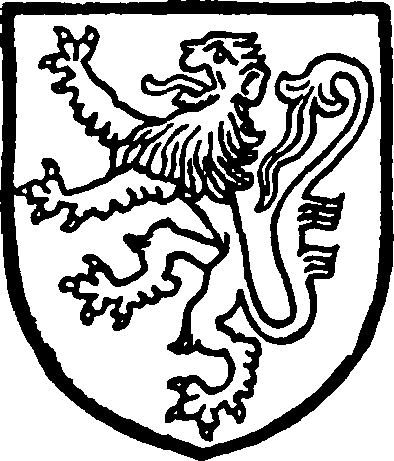
Stapylton of Myton. Argent a lion sable.
In 1545 the site and capital messuage of the manor of Myton, in the tenure of William Dent, late Abbot of St. Mary's, York, was granted in fee to William Romesden of Longley and others. (fn. 66) They were, perhaps, fishing grantees, for William Dent died in possession in 1546; his heirs were his sister Cecily Dobson, widow, his nephew Christopher Watson, and his two nieces Alice wife of James Tyndall and Joan wife of John Chace. (fn. 67) They dealt with the capital messuage by fine in 1547. (fn. 68) It seems to have been acquired by the Watsons, for one Edmund Watson died in January 1595–6 seised of the site of the manor here. (fn. 69) He was succeeded by his son Edward, who died in 1603, and was followed by his cousin Thomas Watson, who had livery in 1607. (fn. 70) In 1617 the site of the manor of Myton was conveyed by John Wythes and Dorothy his wife to Arthur Aldbroughe, (fn. 71) who in 1619 conveyed it to William Bell and William Clarke and the heirs of William Bell. (fn. 72)
Roger de Mowbray granted to the monks of St. Mary's Abbey leave to have a mill, a dam, and a fishery at Myton. (fn. 73)
In 1086 certain lands in Myton were soke of the 'manor' of the Archbishop of York at Helperby (fn. 74) (q.v.), which the overlordship probably followed in descent. It was possibly this land in the Liberty of St. Peter that was held at the close of the 12th century by the treasurer of the cathedral, who claimed a mill on the River Foss and the church. (fn. 75) The situation of this land is indicated by a clause in the settlement made at this time by which the abbot and convent secured the fishery from their mill to the bridge, while the fishery from the bridge on the north was assigned to the treasurer.
Church
The church of ST. MARY consists of a chancel 26 ft. by 17 ft. 3 in., with organ chamber on the north, nave 40 ft. by 17 ft. 3 in. with north aisle, making the total width 24 ft., western tower and vestry to the north of it occupying the west end of the nave and a south porch. The total length of the building is about 76 ft. All measurements are internal.
The chancel and nave of the existing building date from the early years of the 13th century. Assuming that the modern restoration work follows the old lines, three windows, including that in the east wall, were inserted in the chancel in the 15th century. The church has been extensively restored in recent times, and the modern western tower and the adjoining north vestry stand within the limits of the old nave. The most recent addition to the church is the south porch. The chancel is a 13th-century building with a modern three-light east window of 15th-century character. At the east end of the north wall is a plain 13th-century lancet, and at the east and west ends of the south wall are blocked lancet windows with detached side shafts, having moulded capitals and bases. There are also two modern windows on this side, both of two lights and of 15th-century character.
The nave is structurally undivided from the chancel, the south wall being of one build, and supported by small flat pilaster buttresses, two to the chancel and three to the nave. At the south-west angle of the latter is a massive buttress added in the 15th century. The north aisle was originally four bays long, but with the nave it has been shortened to three and a half bays by the tower and vestry already mentioned. The arcade consists of pointed arches of two chamfered orders, supported on piers, two circular and one octagonal, with moulded capitals and bases. The western respond (now included in the vestry) has three attached shafts and a capital of transitional character, with square abaci and nail-head ornament. The base rests on a square plinth. In the spandrels of the arcade are trefoil and quatrefoil sunk panels with floreated points to the cusping. The nave windows are all modern, as are the west tower and south porch. The roofs and fittings of the church are all modern, but against the east wall are two paintings on canvas of the Crucifixion and Ascension, perhaps dating from the 18th century. Under the tower is the head of a 13th-century slab, bearing a well-preserved cross in high relief. The tower is built of brick faced with stone and is not square, being wider from north to south. It contains three bells, all dating from 1805.
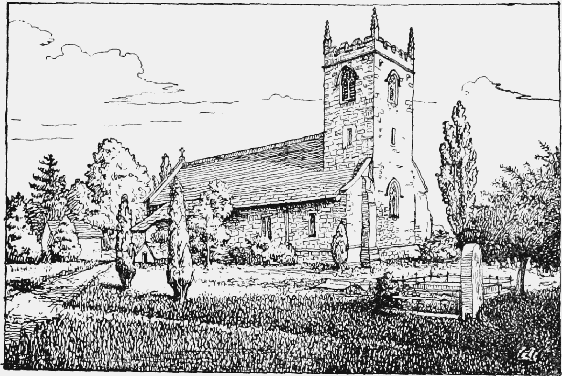
Myton Church from the North-west
The plate consists of a cup (London, 1688), engraved with the arms of Stapylton of Myton, a paten of the same date with the same arms, a small paten (London, 1688) and a modern flagon.
The registers before 1812 are as follows: (i) baptisms 1654 to 1783, marriages 1654 to 1755, burials 1658 to 1783; (ii) marriages 1756 to 1812; (iii) baptisms and burials 1783 to 1812.
Advowson
The early history of the church is obscure and was disputed at the close of the 12th century, when the treasurer of St. Peter's claimed it as in his fee and as a chapel dependent on the church of Alne, while the Abbot and convent of St. Mary's, York, maintained that it was itself a mother church and within their fee. Whatever the truth, a compromise was arrived at by which the monks paid an annual pension of 3s. to the treasurer in return for the release of his rights. (fn. 76) The church was appropriated to St. Mary's and a vicarage ordained in 1301. (fn. 77)
At the Dissolution the patronage fell to the Crown, and in 1545 the rectory and church with the advowson of the vicarage were granted in exchange to Robert Archbishop of York. (fn. 78) This grant was renewed to Nicholas Archbishop of York in 1555–6, (fn. 79) and his successors have since collated to this living. (fn. 80)
Charities
Glauber's charity is a rent-charge of £1 paid out of the Myton estate, the property of Mr. Miles John Stapylton, lord of the manor.
In 1802 William Melmerby by will left £60, the interest to be applied in teaching four poor children of the parish to read and say their catechism. The trust fund now consists of £77 15s. 6d. consols with the official trustees. By a scheme of the Board of Education dated 17 June 1904 the annual dividends, amounting to £1 19s., are applied in prizes or rewards, not exceeding 10s. in value, for religious knowledge, for scholars at a public elementary school, and in the Sunday school of the parish church.