A History of the County of York North Riding: Volume 2. Originally published by Victoria County History, London, 1923.
This free content was digitised by double rekeying. All rights reserved.
'Parishes: Whenby', in A History of the County of York North Riding: Volume 2, ed. William Page (London, 1923), British History Online https://www.british-history.ac.uk/vch/yorks/north/vol2/pp211-214 [accessed 30 April 2025].
'Parishes: Whenby', in A History of the County of York North Riding: Volume 2. Edited by William Page (London, 1923), British History Online, accessed April 30, 2025, https://www.british-history.ac.uk/vch/yorks/north/vol2/pp211-214.
"Parishes: Whenby". A History of the County of York North Riding: Volume 2. Ed. William Page (London, 1923), British History Online. Web. 30 April 2025. https://www.british-history.ac.uk/vch/yorks/north/vol2/pp211-214.
In this section
WHENBY
Quennebi (xi cent.); Qwheneby (xv cent.).
The parish of Whenby covers just over 1,000 acres of nearly level ground to the south of Dalby and Skewsby. It is separated from that parish on the north and east by the little stream which runs from Brandsby to Terrington. On the west it is bounded by another stream, which becomes Farlington Beck when it reaches Farlington, the neighbouring parish on the south. No stream runs through Whenby parish, and it is quite without woodland. Nearly half the total area is devoted to grassland, on which the pasture is very good. On the 623 acres which are under cultivation (fn. 1) the chief crops grown are corn and turnips. The soil is clay and loam on a subsoil of lower lias, with alluvium near the stream in the north-east. The general level of the parish is about 200 ft.
The village street runs north-west and south-east, nearly parallel to this stream, at a distance of about a quarter of a mile. It is built along a by-road about 2½ miles north-west of Sheriff Hutton; at the west end stands the manor-house, now the Manor Farm, a substantial building of 18th-century date. Near the manor-house is the village school, and further down the street St. Martin's Church. The only other building of interest is the Wesleyan Methodist chapel. These and a few cottages make up the existing village.
The village street continued becomes a lane leading past Pradcar Farm to Well Field Farm and Dikelands, two farms in the south-east corner of the parish. The only other habitations in the parish are in the hamlet of Foulrice, half of which is in Whenby, half in Brandsby parish, which borders it on the west. Foulrice is reached from the village by a lane leaving the street at its north end and running west across Bodner Hill, passing a gravel-pit on the way.
In the 15th century Christopher Barton left to his son John 'a house called Temple House in Quenby.' (fn. 2) All trace of it is now lost.
Manor
Eight carucates in WHENBY in 1086 were in the king's hands. (fn. 3) They were subsequently held of the Crown by the Mauley family, whose lordship followed the descent of their manor of Mulgrave in Lythe parish. (fn. 4)
The tenants of the Mauleys were the lords of Sheriff Hutton; the manor was held in 1282 (fn. 5) of Robert de Nevill, the first of his name to appear in connexion with it. Their mesne lordship subsequently followed the descent of their manor of Sheriff Hutton (q.v.), and reverted to the Crown (fn. 6) when it was forfeited among the lands of Richard Earl of Warwick in 1471. (fn. 7) Edward IV granted it to Richard Duke of Gloucester, afterwards Richard III, and it subsequently remained in the possession of the Crown. (fn. 8)
From a very early date the family of Haget was holding land in Whenby. The William Haget who in 1166 held a sixth part of a knight's fee of the heirs of Bertram de Bulmer (fn. 9) was probably tenant of Whenby. In 1202 Robert Haget held an oxgang of land here of Gericus de Gilling, (fn. 10) and twenty-three years later William Haget accused the Prioress of Moxby of taking into the 'Court Christian' a plea touching his lay fee in Whenby. (fn. 11) Half a carucate of land was held here of Walter Haget in 1235, (fn. 12) and in 1240 William Haget was party to a fine which concerned a carucate of land in Whenby. (fn. 13) He or another William Haget was enfeoffed of 4 oxgangs here by Richard le Breton and Roger de Eskyres and their wives in 1271, (fn. 14) and in 1282 Robert Haget was holding Whenby of Robert de Nevill for half a knight's fee. (fn. 15)
The manor was settled on Robert and Ellen his wife by Stephen de Bolingbroke in 1299–1300. (fn. 16) Robert was still in possession in 1301, (fn. 17) but died before 1316, when his widow Ellen was holding the manor (fn. 18) and 5 carucates. It is not clear whether Ellen Haget had a second husband, or in what way the next lord of the manor, John Moryn, became possessed of it. (fn. 19) Ellen was still holding Whenby in 1318, when she complained that William de Hauterive with many others had entered her manor, broken the doors and chests, and carried away her goods. (fn. 20) Nine years later this William quitclaimed to John Moryn all his right in the manor of Whenby, (fn. 21) but there is nothing to show what this right was or how he acquired it.
John Moryn entered into possession, (fn. 22) and in 1332 the manor was settled on him, with remainder to his son John, by John Wykeham and John Snainton. (fn. 23) The younger John Moryn died without male issue. He had two daughters, Isabel and Alice, the one married to John Newland and the other to Thomas Barton. (fn. 24) Isabel and her husband succeeded first to the manor of Whenby, (fn. 25) which John Newland was holding of Ralph de Nevill in 1367, (fn. 26) and of John de Nevill in 1388. (fn. 27) William son of John Newland succeeded, and died seised in 1408–9, leaving a sister and heir Ellen wife of William Halgate. (fn. 28) Ellen presumably died without heirs, for the manor next passed to the Barton family, descendants of Alice Moryn. (fn. 29) Her son and heir (fn. 30) was John Barton, (fn. 31) who married Christian Aske. He was succeeded by a son and heir Conan, who died in 1436. (fn. 32) The will of Conan's son Richard was dated 1455. (fn. 33) In it he settled the manor of Whenby and his other lands on his mother for her lifetime, 'for the sustentacion and mareyng of his childre.' (fn. 34) Of these there were several, the eldest being Christopher, the next lord of the manor. He left his estates to his son John Barton in 1479. (fn. 35) John died in possession in or about 1506, (fn. 36) when he was succeeded by his son John Barton, jun. This younger John held the manor till his death in 1553 (fn. 37); his heir was his brother Thomas, who died in 1565. (fn. 38) Four years later Edward Barton, son and heir of Thomas, took possession of his estates, which had been in the hands of the queen during his minority. (fn. 39) He was returned in 1588 as one of the gentlemen of Yorkshire who were able to lend her Majesty £25. (fn. 40) In 1610 he was succeeded by his son Thomas, (fn. 41) with whom the male line of Barton ended.
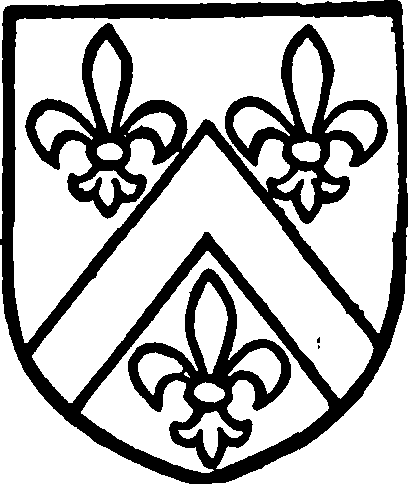
Moryn. Argent a cheveron sable between three fleurs de lis gules.
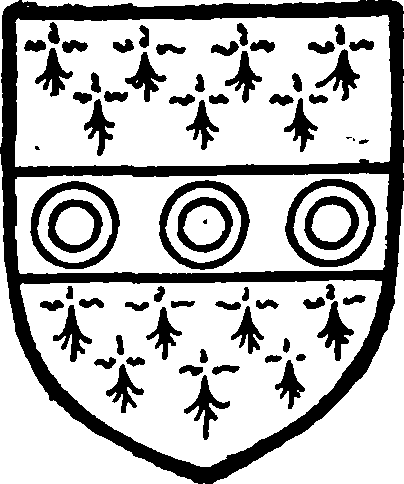
Barton. Ermine a fesse gules with three rings or thereon.
Thomas Barton and his wife Alice had a daughter Elizabeth, who was married before 1615 to Sir Edward Radclyffe, bart., of Derwentwater. (fn. 42) To this Royalist family the manor of Whenby now descended. It was sequestrated under the Commonwealth for the delinquency of Sir Edward, and bought from the treason trustees by Major John Wildman and Samuel Foxley. (fn. 43) In 1653, however, Sir Edward Radclyffe compounded for the manor, (fn. 44) and at his death in 1663 it came into the hands of his son and heir Francis. (fn. 45) This Francis was created Earl of Derwentwater in 1688. (fn. 46) He was succeeded by his son Edward in 1697, (fn. 47) and from Edward the manor descended to the unfortunate James, third earl, in 1705. (fn. 48) Ten years later the earl was marching into Lancashire at the head of a Jacobite army. (fn. 49) He surrendered, was attainted and executed, and Whenby was forfeited along with his other lands. (fn. 50)

Radclyffe, Earl of Derwentwater. Argent a bend engrailed sable.

Garforth. Sable a bend between six goats passant argent.
The manor was put into the hands of the commissioners for forfeited estates, and was by them put up to auction. It was acquired in 1722 by William Garforth for the sum of £7,240. (fn. 51) The Garforth family continued to hold the manor (fn. 52) till late in the 19th century, when it followed the descent of their manor of Wigganthorpe (fn. 53) into the hands of the present owner, the Hon. W. H. WentworthFitzwilliam.
A close called Foggy Close, late the possession of Moxby Priory, was leased in 1539–40 to William Harrison of London. (fn. 54) Other lands were granted to the Archbishop of York. (fn. 55) Peter Mauley confirmed 2 oxgangs of land in Whenby to the Prior of Marton, (fn. 56) who had a grant of free warren here in 1333. (fn. 57)
The Templars also held land in Whenby. (fn. 58) In 1328 a return was made that 'the king had no right in . . . certain tenements in Whenby which belonged to the master and brothers of the Knights Templars in England at the time of their cessation, whatever any charter of Edward II may say.' (fn. 59)
Certain tenements here belonged to the chapel of St. George near York in 1373. (fn. 60)
Church
The church of ST. MARTIN consists of a chancel 18½ ft. by 14½ ft., with north chapel, nave 30 ft. by 14½ ft. with north aisle 13½ ft., south porch, and western tower 6 ft. by 6¾ ft. It was apparently entirely reconstructed in the 15th century, and, though the rubble masonry of the north aisle contrasts with the ashlar facing of the rest of the building, there is no evidence that it is earlier in date. Though small in actual dimensions, the elaborate south porch and the general proportions take from the building any appearance of insignificance.
The chancel belongs entirely to the 15th century. It is lit by a three-light traceried east window, and two windows with depressed segmental heads and two lights each in the south wall. On the same side is a plain pointed piscina, and in the east wall to the north of the altar is an arched recess in the form of a small doorway. It does not appear on the outside and its use is quite problematical. There is no structural chancel arch, the nave roof being continued over the quire. The north chapel is conterminous with the chancel and is separated from it by a 15th-century arcade of two bays somewhat restored. The two-light east window is a modern restoration of 14th-century type, but the two-light window in the north wall is original 15th-century work.
The nave, of the same date as the chancel, is divided from the north aisle by an arcade of two bays, the pier and responds being octagonal with moulded capitals and bases of circa 1480. The capital of the western respond is further ornamented with carved heads. The windows of the nave and aisle are all of two lights with depressed heads and of the same date, except the western aisle window, which is a modern restoration similar to that in the east wall of the chapel. There is a 15th-century north door in the aisle wall. The tower arch springs from rudely sculptured corbels and the west window is of two lights.
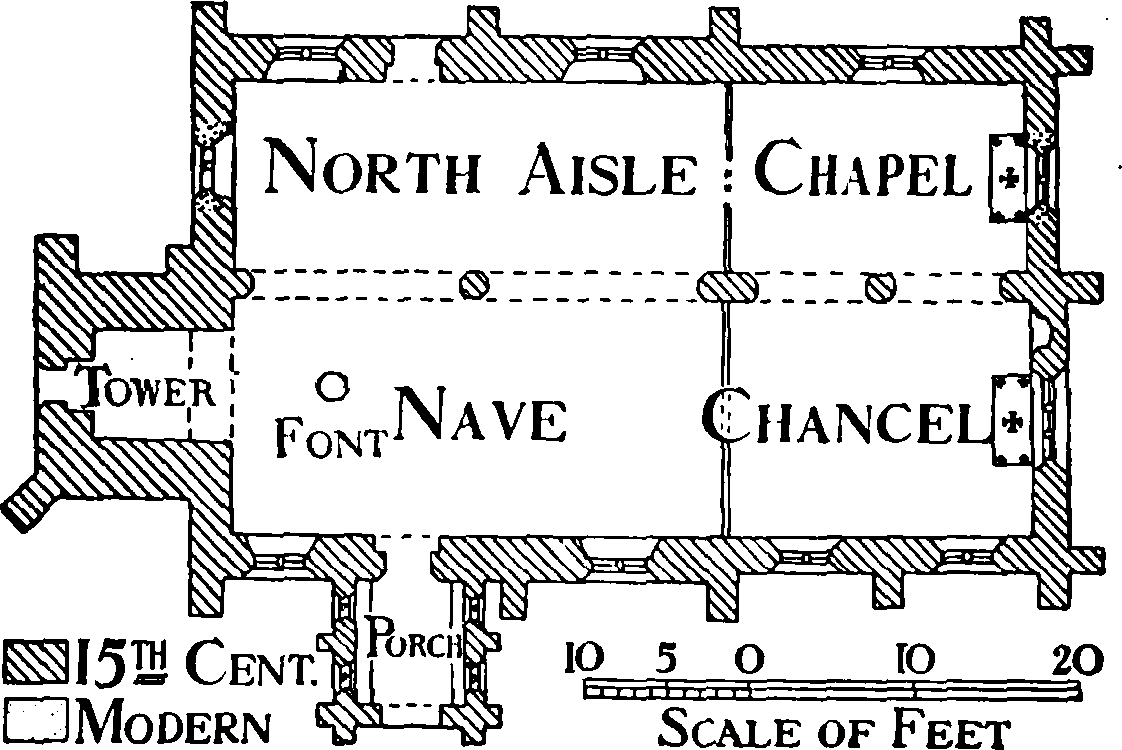
Plan of Whenby Church
The western tower is two stages high and finished with an embattled parapet, the belfry being lighted by a single-light square-headed window on the north and similar two-light windows on the other three sides. The tower contains three bells. The south porch is unusually elaborate for so small and remote a church. It projects two bays from the main building, the bays being divided by buttresses and pierced by small two-light windows. The parapet is embattled, and above the outer doorway is a shield bearing the sacred monogram. The exterior of the main building is faced with ashlar and embattled throughout; the buttresses have three offsets, and those to the chancel were formerly carried above the parapet with small pinnacles. The north aisle and chapel are built of rubble with 15th-century buttresses, the roof being eaved.
The ancient fittings of the church include a font with an octagonal moulded 15th-century bowl and two oak screens across the chancel and aisle. The chancel screen dates from the 15th century, and has a plain base with a doorway in the centre, the sides being divided by moulded mullions into compartments (five on the north and seven on the south) with traceried heads. The work, however, is poor. The screen across the aisle is of Jacobean character, boarded in below the rail, but open above with turned balusters and a doorway in the centre. The roofs throughout the church are modern. Under the tower is an ancient parish chest and in the nave are a number of massive oak benches probably of 16th-century date. Beneath the chapel altar is a slab with the casement of a brass inscription.
The church plate is of little interest. It includes a cup inscribed 'Whenby Church 1825,' a modern paten and a pewter almsdish inscribed 'C. Warden.'
The ancient registers are bound in two books: (i) mixed entries 1556 to 1812; (ii) marriages 1757 to 1812.
Advowson
The first recorded presentation to the church of Whenby was made by the Prioress and nuns of Moxby in 1250. (fn. 61) In 1269–70, however, it was discovered by an inquisition that the lawful patron was William de Boghale, who accordingly presented on that occasion. (fn. 62) Whatever right the Prioress and nuns of Moxby had had in the advowson was established firmly in 1283, when the church was granted to them, presumably by William de Boghale, and appropriated to the priory by the Archbishop of York. (fn. 63) The archbishop ordained a vicarage there, the collation to which he reserved for himself and his successors. (fn. 64) The nuns were to have 'in the name of the parsonage of the chapel of St. Martin at Quenby, all the tythe corn to the same belonging, in those lands already reduced, or hereafter to be reduced to tillage, and also 1 oxgang of land out of 3 oxgangs with which the chapel is endowed, with the hay to the same oxgang belonging.' The vicar was to have the rectory-house and the remaining oxgangs of land, and 'tithes of hay, lambs, wool, calves, pigs, pigeons, brood geese, hens, foals, bees, orchards, mills, line and hemp, with all greater and smaller oblations and mortuaries, with the carucate pennies and all other profits whatsoever.' He was also to have 4 marks a year, and to 'bear all ordinary burdens of the chapel.' (fn. 65)
The archbishops accordingly presented to the vicarage till the 16th century. (fn. 66) At the Dissolution, however, the advowson seems to have reverted to the Crown as part of the possessions of the prioress, for Elizabeth granted it with lands and tithes in Whenby which had belonged to Moxby Priory to Edward Downing and Peter Ashton, and no mention is made in the grant of the Archbishop of York. (fn. 67)
These grantees must have sold the advowson to the lords of the manor, for Edward Barton presented in 1602. (fn. 68) Thomas Crofts and John Cook, probably lessees of the Radclyffes, were patrons in 1639–40 and 1690–2 respectively. (fn. 69) The trustees for the forfeited estates of the Earl of Derwentwater presented in 1720, (fn. 70) and two years later sold the advowson to William Garforth, (fn. 71) who exercised his right of presentation in 1724. (fn. 72) He came at the same time into possession of the manor (q.v.), and the two followed the same descent into the hands of their present owner.
Charities
An annual payment of 20s. issuing out of a small farm in the parish of Dalby cum Skewsby is received under the name of Bolton's Gift, and appropriated as to 10s. to the vicar for preaching an annual sermon on 14 January, and as to 10s. for the benefit of the poor. The payment is made by the Hon. W. H. Wentworth-Fitzwilliam of Wigganthorpe.