A History of the County of York North Riding: Volume 2. Originally published by Victoria County History, London, 1923.
This free content was digitised by double rekeying. All rights reserved.
'Parishes: Ingleby Arncliffe', in A History of the County of York North Riding: Volume 2, ed. William Page (London, 1923), British History Online https://www.british-history.ac.uk/vch/yorks/north/vol2/pp240-243 [accessed 30 April 2025].
'Parishes: Ingleby Arncliffe', in A History of the County of York North Riding: Volume 2. Edited by William Page (London, 1923), British History Online, accessed April 30, 2025, https://www.british-history.ac.uk/vch/yorks/north/vol2/pp240-243.
"Parishes: Ingleby Arncliffe". A History of the County of York North Riding: Volume 2. Ed. William Page (London, 1923), British History Online. Web. 30 April 2025. https://www.british-history.ac.uk/vch/yorks/north/vol2/pp240-243.
In this section
INGLEBY ARNCLIFFE
Engelbi and Gerneclif (xi cent.); Ernesclive (xii cent.); Ingelby and Erneclive (xiii cent.); Engelby juxta Erneclyf, Ingelby cum Erneclif, Ingleby subtus Erneclyf (xiv cent.); Arnecliff (xv cent.).
The parish of Ingleby Arncliffe lies at the foot of the Cleveland Hills, in the south-west corner of the wapentake of Langbaurgh. It covers 1,893 acres of what is for the most part low and level ground except for one high rocky hill in the south-east, from which the parish takes its name. In the hills to the south rises the River Wiske, which flows north and forms the western boundary separating Ingleby Arncliffe from the parish of East Harlsey. The northern boundary is the little stream called Trenholme Stell, which flows into the Wiske in the north-west corner of the parish, forming with it a wedge-shaped piece of land called Pierrepoint Nook. Another stream called Carr Beck runs south-west round the hill, forms part of the southern boundary and joins the Wiske at Staddle Bridge, where the great highway from Thirsk to Yarm enters the parish. Here is the Cleveland Tontine Inn, built by subscription in 1804 to provide more accommodation for travellers and coaches on the improved Thirsk road. (fn. 1) It is now known as Ingleby House and is the residence of Mrs. Punshon. Its licence was transferred after the opening of the railways to the 'Little Tontine,' but the latter also is now disused as an inn.
At Staddle Bridge the road to Stokesley and Guisborough branches off from the high road in a northeasterly direction. Between the two roads, to which it is joined by lanes, is the village of Ingleby Arncliffe. The village street runs north-east and southwest and is on a slight rise. There is no building worthy of note except a Wesleyan chapel.
From the south end of the village street a lane runs eastward to the Stokesley road. At the cross roads so formed is the hamlet of Ingleby Cross. From Ingleby Cross the lane is continued across the Carr Beck till it reaches the church and Hall, which stand very near each other. They were once surrounded by a moat, the remains of which can still be traced.
The Hall was rebuilt in 1754 by Thomas Mauleverer from designs by Carr of York. It takes the place of a late 16th-century house (fn. 2) erected by William Mauleverer, the principal front of which faced north and had three equal gables, mullioned and transomed windows and a flight of steps to the front entrance. The present building is a dignified stone structure of two principal floors with high basement and attic, the middle part of the south or principal front being slightly advanced and the entrance approached by a double flight of steps. In the pediment above are the Mauleverer arms with crest and motto and the date 1754, together with the initials T.S.M., which also occur on one of the lead down pipes. 'On the ceiling of the entrance hall is a representation of the goddess of plenty raining affluence over Cleveland typified by Roseberry Topping.' (fn. 3) An east wing was added in 1843. Much damage was done to the building by fire on 4 May 1912.
Behind the Hall the ground rises sharply up to a height of nearly 1,000 ft. The side of the hill is covered with oak trees. From the summit, known as Beacon Rocks, there is a wide prospect westward. Along the ridge a little to the north is a large 'rocking' stone known as Cop Loaf.
There is no vicarage-house in the parish, as the vicar combines the living with that of East Harlsey and has a house there. Once there was a chaplain's house in Arncliffe 'on the east side going out of the vill to the south,' (fn. 4) but it is not mentioned after the beginning of the 14th century.
The soil of the parish, surrounded as it is with streams, is for the most part alluvial; 506 acres are under cultivation (fn. 5) and the chief crops grown are barley, oats and potatoes.
Manor
In 1086 INGLEBY ARNCLIFFE was Crown land. (fn. 6) Malgrin had held there 6 carucates in Ingleby and 2 in Arncliffe. Not long afterwards Robert Brus received Ingleby and Arncliffe as part of his fee in Yorkshire (fn. 7); the date of the grant is uncertain, but it was probably made at the end of the 11th or beginning of the 12th century. Ingleby Arncliffe (fn. 8) was held of the Brus family by knight service as of their castle of Skelton, and the overlordship followed the descent of Skelton (fn. 9) (q.v.) into the families of Fauconberg (fn. 10) and Conyers. (fn. 11) Before the 16th century the service due for the manor had been commuted to a rent of a pair of gilt spurs or 8d. (fn. 12)
During the 12th and 13th centuries the tenants of Arncliffe under the Brus family were the Ingrams, who are chiefly known as liberal benefactors to the neighbouring monasteries. The first of the family who was certainly lord of Arncliffe was Walter Ingram; he granted land here to Rievaulx and Guisborough in or about 1170. (fn. 13) He mentions a paternal uncle William Ingram, (fn. 14) but the name of his father is unknown. (fn. 15)
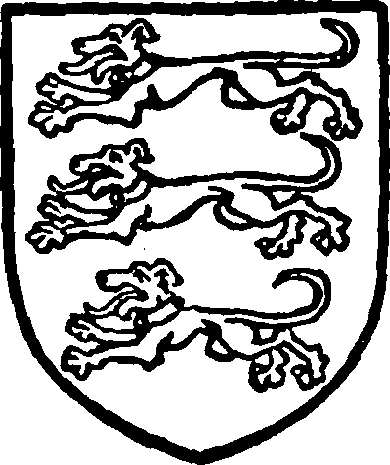
Mauleverer of Arncliffe. Gules three running leverers argent with golden collars.
This manor followed the descent of that of Daletown (fn. 16) (q.v.) through the Colvills to the Mauleverers. Here as there Edmund Mauleverer succeeded to the estate at his grandfather's death in 1551. (fn. 17) The fortunes of the family fell very low at this period, and Sir Edmund was further impoverished by his 'great cost and damages' incurred in service in the Scotch wars. (fn. 18) He was forced to borrow money from, among others, his brother-in-law Thomas Wentworth, who lent him £490 on the manors of Arncliffe and Dale. Sir Edmund made default, and though he declared that there was a friendly arrangement by which the claim would not be pressed, his brother-in-law entered into possession of his lands. (fn. 19) Litigation followed, and apparently Edmund Mauleverer recovered the manor. He died seised of it in 1571, (fn. 20) and was succeeded by his son and heir William, a minor at the time of his father's death. (fn. 21) William married Eleanor daughter of Richard Aldbrough, and had fifteen sons and daughters. (fn. 22) His second son James survived him, (fn. 23) and succeeded to the estate in 1618. (fn. 24) He was heavily fined in the reign of Charles I for resisting the king's summons to receive knighthood or pay a composition, (fn. 25) and subsequently became a colonel in the Parliamentary army. (fn. 26) He died a prisoner for debt in York Castle in the year 1664. (fn. 27) His eldest surviving son Timothy (fn. 28) had taken over the estate in 1651. (fn. 29) The manor was burdened with a mortgage to the Earl of Kingston in 1684, (fn. 30) and was not free from it until the middle of the 18th century. (fn. 31) Timothy's son and heir Timothy succeeded him and died in 1702–3. (fn. 32) He was succeeded by another Timothy, (fn. 33) who married an heiress, as did his son and successor Thomas (fn. 34); so that at the death of Thomas in 1785 (fn. 35) the fortunes of the family were somewhat restored.
Thomas Mauleverer was the last male representative of his family, all his sons having predeceased him. (fn. 36) He left five daughters and co-heirs: Jane, who married Robert Lindsay, Sarah, who married Arthur Worsop, Anne wife of Clotworthy Gowan, and Frances and Mary, unmarried. (fn. 37) The share of Frances passed on her death to her sister Mary, who thus held two-fifths; these she bequeathed to her nephew William Gowan, son of Anne. (fn. 38) William acquired the rest of the estate by purchase from his cousins, and assumed the name of Mauleverer in accordance with his aunt's will. (fn. 39) He died in 1857, (fn. 40) and the estate descended to his daughters and co-heirs Jane wife of Thomas Meynell, and Georgina Helen wife of Douglas Brown. (fn. 41) The latter purchased her sister's share of the estate, which descended to her son and heir Mr. William Brown, F.S.A. (fn. 42) He sold it in 1900 to Sir I. Lowthian Bell, bart., (fn. 43) whose son Sir Hugh Bell, bart., (fn. 44) is the present lord of the manor.
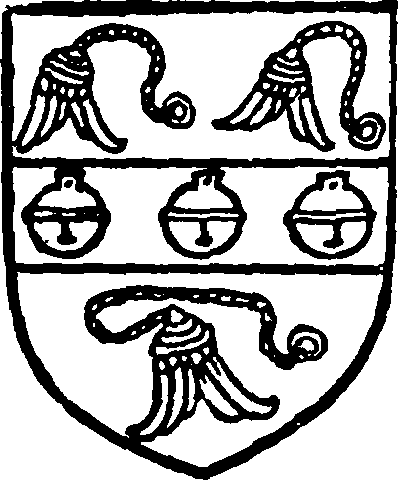
Bell of Rounton, baronet. Argent a fesse between three hawks' lures azure with three hawks' bells argent on the fesse.
Robert Ingram had a grant of free warren in Arncliffe in the reign of Henry III. (fn. 45) In 1317 Robert Colvill obtained licence to make a park here, (fn. 46) and had done so before 1331. (fn. 47)
The priory of Guisborough held in Ingleby Arncliffe, besides the 2 oxgangs granted by Walter Ingram with the church, various lands granted by his son William. They included half a carucate containing 60 acres held of him by William son of Norman, 5 acres of meadow belonging to this halfcarucate, and 19 acres in Fowgill (Fulekeldeflath). Moreover, the priors had common of pasture in the vill of Arncliffe and shared all the common rights of William Ingram's tenants there. Finally, William granted them one toft in Arncliffe between the pool and the burying ground. (fn. 48) At about the same time John son of Adam de Rounton granted to the priory a meadow called Neuton Ker next Ingleby. (fn. 49) Robert son of Ralph son of Lefsy and Agnes his sister and heir quitclaimed to the priory all their right in the foregoing lands. (fn. 50)
Walter Ingram granted to Rievaulx Abbey a meadow in Arncliffe which belonged to the halfcarucate held by Hugh son of Acce. (fn. 51)
Church
The church of All SAINTS stands about a quarter of a mile to the southeast of Ingleby Cross on a site slightly to the north-west (fn. 52) of that of the old church close to Arncliffe Hall. The old church was pulled down about 1821, in which year (fn. 53) the present building, which is in the Gothic style of the period with pointed sash windows, was erected. 'From a penand-ink drawing of the old hall made in 1718 in which it appears, and from a sketch on a last-century plan of the Arncliffe estate, the old church would seem to have had a low tower at the west end. The east window, which has been transferred to the present church, is quite distinguishable in the sketches, as is also a perpendicular window on the south side since destroyed.' (fn. 54) Graves describes the building about 1808 as 'an ancient structure of a simple form and small dimensions,' (fn. 55) but gives no description of it. A round-headed 12th-century doorway of two plain orders and outer angle shafts with scalloped capitals has been reproduced in the present building as the west entrance below the tower, the original Norman capitals alone being retained, and three fragments of pre-Conquest stones have been preserved, two built into the walls of the tower and the other in the vestry. (fn. 56) A hog-back stone (fn. 57) found about fifty years ago in a hedge bank and a later coped gravestone are now in the Cathedral Library, Durham. A parish book which gives details of expenditure from 1588 to 1628 records the erection of a new roof in 1595 and repairs to the steeple and porch in 1599.
The building, which is of stone with slated roofs overhanging at the eaves, consists of chancel 19 ft. by 15 ft. 3 in., with north vestry, nave 46 ft. by 19 ft. 6 in. and west tower 6 ft. by 7 ft., all these measurements being internal. The tower is of two stages with straight parapets and angle pinnacles. The belfry windows are of two round-headed lights, and over the west doorway in a circular panel, apparently intended for a clock, is the inscription 'Domus mea Domus Orationis Vocabitur cunctis populis. (fn. 58) a.d. 1822.' The walls are plastered internally, and there is a flat plaster ceiling and elliptical chancel arch. The fittings all date from 1821, and include a three-decker pulpit in the north-east corner. The old east window is of three trefoiled lights with tracery in the head and is apparently of 14th-century date. It contains two pieces of old heraldic glass, one with the arms of Fauconberg, and the other those of St. Quintin, in reference to the two wives of Sir William Colvill. The doorway on the south side of the chancel is now built up.
The principal objects of antiquarian interest in the church are the two recumbent stone effigies (fn. 59) which lie on either side of the altar and are said to represent Sir William Colvill and his brother Sir Robert. Both figures are in chain armour and surcoat, the feet resting on a lion with an animal in its mouth, and have helm and shield. The shield of the figure on the north side bears the Colvill arms, but the other shield is broken. 'There is one feature which is very unusual and in one respect unique, that is the ailettes.' (fn. 60) The unique feature exists on the effigy on the north side and consists in the use of the ailettes on the left shoulder as a peg on which to hang the helmet. The ailette on the right shoulder, which is only visible on the effigy on the south side, though broken, shows the Colvill arms. The bordure round the stones on which the figures rest has a quatrefoil ornament. At the head and feet of each figure are two stones with coats of arms, eight in all, the connexion of which with the effigies, if any, is not established. They probably belong to some other monument in the old church. (fn. 61)
The font is circular and apparently of the same date as the church. The original 12th-century font is now at Newton. (fn. 62)
There are two bells in the tower without inscriptions.
The plate consists of a cup and cover paten of 1570, with the usual floral band, and with the maker's mark H.S., probably for Henry Sutton, and a paten of 1868, inscribed 'Arncliffe Church.' There are also a pewter flagon inscribed 'Arncliff Church 1699,' and a pewter almsdish 'Arncliff Church T.M. 1699.' (fn. 63)
The registers begin in 1659. (fn. 64)
To the south-east of the building, occupying the site of the chancel of the old church but enlarged in recent years, is the burial-place of the owners of Arncliffe. It contains a brass plate with rhyming inscription to Elizabeth Mauleverer, who died in 1674. (fn. 65)
Advowson
The church is first mentioned in a 12th-century grant made by Walter Ingram to Guisborough Priory of the church of Arncliffe with 2 oxgangs of land and the dwelling-house adjoining it (fn. 66); the grant was confirmed by Henry II (fn. 67) and Walter's son William. (fn. 68)
In 1309 the church was already appropriated to the priory. (fn. 69) In that year the Archbishop of York, after holding a preliminary investigation into the title of the priors to the church, declared that they were not compelled to institute a vicarage there. (fn. 70) Consequently in the 16th century the living was held by stipendiary priests, (fn. 71) and the profits of it went to the priory of Guisborough. After the Dissolution the advowson seems to have remained in the possession of the Crown until the reign of Elizabeth, who first leased it in 1569 for twenty-one years to John Carvell, farmer, (fn. 72) and eighteen years later granted it to Sir Francis Walsingham, kt., and Francis Milles. (fn. 73) They seem to have sold it soon afterwards to William Bate of Westlathes in Whorlton parish, (fn. 74) who died seised of it in 1603. (fn. 75) His 'kinsman and heir,' William Bate, (fn. 76) quitclaimed the advowson in 1617 to two officials of the Court of Chancery, (fn. 77) by whom it was conveyed in 1628 to Henry Stockton. (fn. 78)
In 1634 Henry Stockton conveyed the rectory and tithes of Ingleby Arncliffe to Edward Stockdale. (fn. 79) From the latter they passed to the family of Allenson. In 1655 the tithes were received by Ralph Allenson, (fn. 80) and in 1680–1 Marmaduke Allenson quitclaimed the rectory to William Cooper, a merchant of Scarborough. (fn. 81) The descendants of William Cooper continued to hold the advowson. (fn. 82) In 1764 it had descended to the Rev. Cooper Abbs. (fn. 83) Bryan Abbs was the patron in 1842 and the Rev. George Cooper Abbs in 1859. (fn. 84) Before 1900 Mr. Henry Cooper Abbs sold the right of patronage to his sister Mrs. Punshon, (fn. 85) who now presents to the living.
Sir John Colvill, in his will dated 1418, gave directions for a chantry to be established in the parish church of Arncliffe, where a priest should sing each day for his soul. (fn. 86) There is, however, nothing to show that the chantry ever existed.
There do not appear to be any endowed charities in this parish.