A History of the County of York North Riding: Volume 2. Originally published by Victoria County History, London, 1923.
This free content was digitised by double rekeying. All rights reserved.
'Parishes: Seamer', in A History of the County of York North Riding: Volume 2, ed. William Page (London, 1923), British History Online https://www.british-history.ac.uk/vch/yorks/north/vol2/pp291-293 [accessed 9 May 2025].
'Parishes: Seamer', in A History of the County of York North Riding: Volume 2. Edited by William Page (London, 1923), British History Online, accessed May 9, 2025, https://www.british-history.ac.uk/vch/yorks/north/vol2/pp291-293.
"Parishes: Seamer". A History of the County of York North Riding: Volume 2. Ed. William Page (London, 1923), British History Online. Web. 9 May 2025. https://www.british-history.ac.uk/vch/yorks/north/vol2/pp291-293.
In this section
SEAMER
Semer (xi cent.); Semare (xiii cent.); Semere (xiv cent.).
This parish is at its greatest extent about 4 miles from east to west and covers 2,650 acres, of which 1,271 acres are arable land, 12 acres woods and plantations and 1,313 acres permanent grass. (fn. 1) It is separated from Stokesley by the Tame, a small brook which joins the Leven a mile to the west below Stokesley. The country is undulating and wooded. The soil is a rich sandy loam on a subsoil of Keuper marls. Brick and tile works established in the south of the parish are now disused.
The village is small and irregularly built on an angle of the road from Stokesley to Yarm. It is on higher ground than most of the surrounding country, and a distant view of the sea may be obtained from the churchyard on the edge of the hill at the north end of the village. A cottage opposite the church which is said to be the glebe-house is the birthplace of Brian Walton, Bishop of Chester (1600–61) and editor of the English Polyglot Bible. (fn. 2) The houses are grouped about a green which has been broken up by inclosures. The public elementary school stands in the main street. It was built by Colonel Wyndham in 1840 and belongs to Lord Leconfield. (fn. 3) In 1346 the Archbishop of Canterbury granted his gaol here to John Darcy, (fn. 4) lord of the manor, and Elizabeth his wife, but all trace of this building has disappeared. The manor-house, now a farm, stands at the southern end of the green.
North of the church is the West End Well. Well Lane leads past Low Field to a ford over the Cold Pool Beck, which forms part of the northern boundary of the parish. About half a mile south of the village is Seamer Hill, the Ranbourn Farm being further south on the edge of Seamer Moor. North of the moor the land drops to the Carrs, low-lying grounds, which were drained before 1859. (fn. 5) Seamer Grange is situated between them and the village.
An Inclosure Act for Seamer was passed in 1708. (fn. 6) Between Seamer and Newby is How Hill, a tumulus, and in an adjacent field are traces of earthworks.
Manor
Before the Conquest a 'manor' and 13 carucates in Tanton (fn. 7) and SEAMER were held by Gospatric, and afterwards passed to the Count of Mortain. (fn. 8) Later it formed part of the Canterbury fee. (fn. 9) In 1086 Richard was the tenant, (fn. 10) and it was afterwards held by the Meynells. From Robert de Meynell, who died in 1206, (fn. 11) it passed to the successive lords of Whorlton (q.v.) until Sir James Strangways in the spring of 1540–1 conveyed it to his cousin (fn. 12) William Lord Dacre for the purpose of a settlement on himself with contingent remainder to Leonard son of William and his brothers in tail-male. (fn. 13) At the death of Sir James Strangways in 1541 (fn. 14) his right heirs through his aunts, Joan wife of Sir William Mauleverer and Mary wife of Robert Roos, (fn. 15) seem to have disputed the claim of the Dacres. In 1557 Robert Roos, son of Robert Roos who married Mary Strangways, and one of the co-heirs of Sir James, (fn. 16) made a conveyance of the manor to Christopher Lascelles of Breckenbrough in Kirkby Wiske, (fn. 17) and in 1562 Elizabeth widow of Sir James Strangways, (fn. 18) with her husband Francis Nevill, quitclaimed it to Leonard Dacre. (fn. 19) Leonard Dacre was attainted in 1570 (fn. 20) for joining the Northern Rebellion, (fn. 21) and his lands were forfeited. (fn. 22) In 1577 the manor was granted by the Crown in socage to John Farnham, (fn. 23) who in the same year sold it to Edward Earl of Rutland. (fn. 24) He died seised in 1587, (fn. 25) leaving one daughter Elizabeth Lady Roos, (fn. 26) who afterwards married William (Cecil) Earl of Exeter. (fn. 27) She died in 1591 and her husband then held the manor by courtesy of England; her heir was her son William Lord Roos (fn. 28); he in 1616 made a conveyance of the manor to Sir Thomas Lake, (fn. 29) whose daughter Anne he married. (fn. 30) Lord Roos died without issue in 1618, (fn. 31) when the Roos barony devolved upon his cousin Francis Earl of Rutland, (fn. 32) while the heir to the earldom of Exeter was his father's brother, Sir Richard Cecil. (fn. 33) In 1622 Francis Earl of Rutland conveyed the reversion of the manor to Sir Richard Cecil, (fn. 34) who in 1627 settled it on his son David on his marriage with Elizabeth daughter of the Earl of Bridgewater. (fn. 35) Sir Richard Cecil was still in possession of the reversion of the manor in 1631 (fn. 36) and died in 1633. (fn. 37)
The Dacres meanwhile had not relinquished their claim on the family estates forfeited by Leonard Dacre in 1570. They claimed that the lands had been settled by William Lord Dacre on his sons in successive tail-male, (fn. 38) and that therefore Leonard's attainder did not affect the right of the rest of the family. About this time they appear to have been reinstated. Randolph Dacre, son of Francis Dacre and nephew of Leonard, (fn. 39) died unmarried in 1634, (fn. 40) his heirs being the heirs of his cousins Anne and Elizabeth, daughters of Thomas Dacre and nieces of Leonard. (fn. 41) Anne had married Philip (Howard) Earl of Arundel (fn. 42); she died in 1630, leaving a son Thomas. (fn. 43) Elizabeth was the wife of Lord William Howard, brother of Philip Earl of Arundel. (fn. 44) Early in 1639–40 Thomas Earl of Arundel sold the manor to James Morley, lord of Hawnby (fn. 45) (q.v.), which it followed in descent until 1687, when Bernard and Anne Grenville conveyed the manor of Seamer to Sir Thomas Meres, kt. (fn. 46)
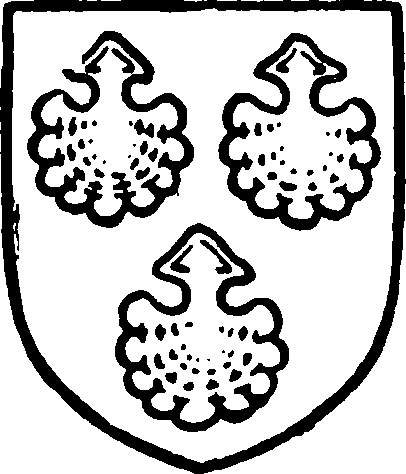
Dacre. Gules three scallops argent.
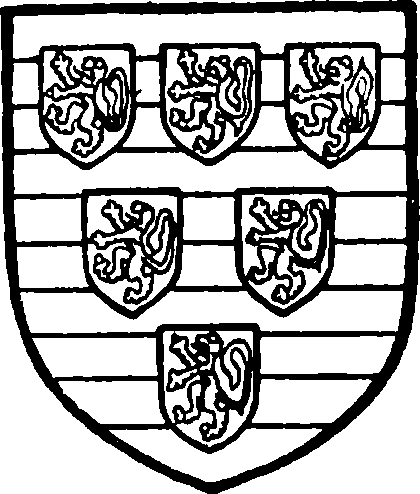
Cecil. Barry of ten pieces argent and azure with six scutcheons sable each charged with a lion argent.
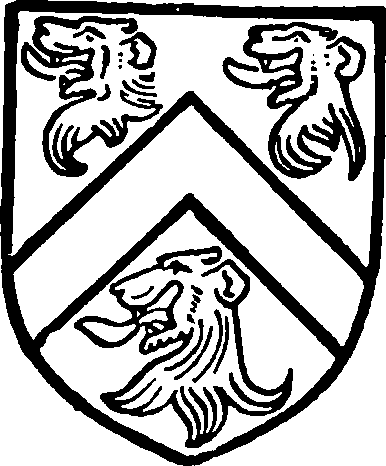
Wyndham, Earl of Egremont. Azure a cheveron between three lions' heads razed or.
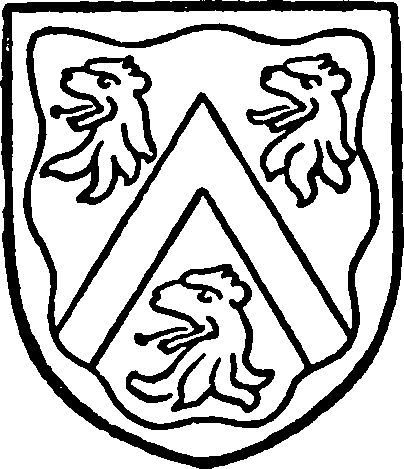
Wyndham, Lord Leconfield. Wyndham with the difference of a border wavy or.
The next reference to the manor occurs in 1759, when Charles Earl of Egremont bought it from Henry Earl of Deloraine, (fn. 47) but how it came to the latter remains obscure. (fn. 48) Charles Earl of Egremont died in 1763, (fn. 49) and was succeeded by his son George. From this time the manor of Seamer followed the descent of that of Topcliffe in the wapentake of Birdforth (q.v.), Charles third Lord Leconfield being the present lord of the manor. (fn. 50)
In 1466 Thomas and Beatrice Maltby conveyed 'half the manor of Seamer' with that of Maltby to John and William Sayer. (fn. 51) No further reference to either of these families has been found in connexion with this place, but at the beginning of 1562–3 lands in Seamer which may represent this manor were settled on Richard Gascoigne and his wife Jane, (fn. 52) who in 1565 conveyed lands in Seamer and Maltby to Thomas Layton, afterwards lord of Sexhow. (fn. 53) In 1578 Francis Nevill and his wife Elizabeth, formerly wife of Sir James Strangways, and Thomas Layton were jointly seised of a manor (fn. 54) here which had been settled on Charles Layton, son of Thomas. (fn. 55) Like Sexhow (q.v.) it descended to Sir Thomas Layton, who early in 1655–6 conveyed it to William Blackett. (fn. 56) In 1719 it was in the possession of John Wilkinson, (fn. 57) and in 1772 it was held by Anthony Wilkinson, (fn. 58) who died unmarried (fn. 59) and was succeeded by Thomas his brother. (fn. 60) Thomas in 1785 conveyed it to Francis Wayne. (fn. 61) In 1812 Henry Walker Yeoman held this manor, (fn. 62) and was succeeded by a son of the same name who was archdeacon of Cleveland from 1883 to 1896. His trustees are landowners in Seamer at the present day.
Nicholas de Meynell in 1269 obtained a grant of free warren (fn. 63) which was confirmed in 1337. (fn. 64) In 1346 the Archbishop of Canterbury, as overlord, granted to John and Elizabeth Darcy and their issue view of frankpledge, the gaol and all other jura regalia of the archbishops' fee in Yorkshire. (fn. 65)
Courts leet and baron were held for the manor in 1410–11. (fn. 66) A water-mill was appurtenant to the manor in 1341 and 1368 (fn. 67); it is again mentioned in 1562, 1683 and 1687. (fn. 68)
Church
The church of ST. MARTIN stands on high ground on the north side of the village and consists of chancel 25 ft. by 16 ft., nave 38 ft. by 19 ft. 9 in. and small west tower 4 ft. square, all these measurements being internal. The structure is of no antiquarian or historical interest, having been entirely rebuilt in 1821–2 in the Gothic style of the day. (fn. 69) On the north side, where the work is generally of a much plainer description, there is an old square-headed window of two trefoiled lights in the nave, apparently of 15th-century date, but no other ancient work remains. The seating dates from 1822, but most of the other fittings are of more recent date.
The font was presented in 1822 and bears a small brass plate inscribed 'The gift of Sir Cuthbert Heron, Baronet, to the parish of Seamer, county of York. This marble pillar was taken from the ruins of a church at Alexandria, in Egypt, at the glorious battle of the Nile, in the year 1798, and brought to England in the ship Antelope, Captain William Rayne.'
There is a good marble tablet, with bust, in memory of Stephen Attlay, 'late of Jamaica,' who died in 1786 at Cheshunt, Herts.
The tower has an embattled parapet and contains two bells.
The plate consists of a silver cup of 1757, made by John Langlands of Newcastle and inscribed 'Seamer Church. H. Eliff,' and a pewter paten and flagon, each inscribed 'A gift to Seamer Church 1822 from the Rev. W. D. Willis.' (fn. 70)
The registers begin in 1638.
Advowson
The chapel was dependent on the church of Rudby (fn. 71) and is said to have been given with that church to Guisborough (fn. 72); its dedication is mentioned in 1460 (fn. 73) and in 1517. (fn. 74) The cure was augmented by Queen Anne's Bounty (fn. 75) and was made parochial probably under the Act of George I. (fn. 76) The living is a vicarage. The patronage remained in the hands of the lords of the rectory manor of Rudby (q.v.) until 1801, (fn. 77) when it was sold by Lady Amherst to Sir George Russell, bart. He bequeathed it to Robert Greenhill, but by 1839 it was in the hands of the lords of the manor of Seamer. (fn. 78) Lord Leconfield is the present patron.
In 1546 one-third of the tithes in Seamer belonged to Rudby, the mother church, and twothirds to a chantry in the free chapel of Whorlton. (fn. 79)
Charities
Township of Newby.—By the will of Christopher Coulson, 1640, and of his son John Coulson, 1674, provision was made for the payment out of certain lands in Great Ayton of £5 a year to the schoolmaster of Newby for his salary, £3 a year to the schoolmaster to purchase clothing for children in the school, and £6 10s. to the curate of Seamer for preaching thirteen sermons in the year. The annuity of £14 10s. was duly paid and applied in 1822, when the Commissioners made their inquiry concerning charities, (fn. 80) but no payment is now apparently made.