
A History of the County of York North Riding: Volume 2. Originally published by Victoria County History, London, 1923.
This free content was digitised by double rekeying. All rights reserved.
'Parishes: Upleatham', in A History of the County of York North Riding: Volume 2, (London, 1923) pp. 410-413. British History Online https://www.british-history.ac.uk/vch/yorks/north/vol2/pp410-413 [accessed 25 April 2024]
In this section
UPLEATHAM
Upelider (xi cent.); Uplium and Uplithum (xiii cent.).
The parish of Upleatham, which lies south of Marske, contains about 1,402 acres, of which 276 acres are arable land, 784 acres pasture and 215 acres woods and plantations. (fn. 1)
The soil is clay or fertile loam upon lias and, in the north, on inferior oolite, and wheat, barley, oats and beans are grown. There is abundance of free-stone, and iron-stone has been worked for some years. In the north of the parish on Beacon Moor the ground attains a height of 550 ft., but declines towards the south, rising again, however, in the south-west to over 500 ft.
It was here that Sir Thomas Dundas, bart., in the latter part of the 18th century made his experiments in stock breeding, effecting a decided improvement in sheep. (fn. 2) The road from Guisborough runs from the south-east in a north-westerly direction to the centre of the parish, where it turns abruptly to the east and proceeds north-east to Marske and Saltburn, and it is along the portion of the road running west and east that the village of Upleatham is situated.
Upleatham Hall had a fine position on high ground at the west end of the village. It was a plain classic stone building of three stories, built in the early years of the 19th century from the designs of Sir Robert Smirke. In 1897 the walls giving way owing to the subsidence of the ground caused by the iron-stone mining, the house was dismantled and afterwards pulled down.
Further to the west on the north side of the road to Saltburn is the church, erected in 1835, (fn. 3) the vicarage, however, lying at some little distance to the south-west. Opposite the church on the south are the schools built by the Earl of Zetland, (fn. 4) and on the same side of the road is the Wesleyan chapel; the Primitive Methodists in 1849 already had a place of worship here, (fn. 5) but this has been demolished on account of the subsidence of the ground. (fn. 6) On the east of the village a lane branching south-east from the main road leads to the old church, now used only as a mortuary chapel, which lies on the slope of the hill-side overlooking the Skelton Beck. Just beyond the junction of the road and the lane is Capon Hall Farm, possibly on the site of the dwelling-place of the Capons, an important family of Upleatham in the Middle Ages. The name survives also in Capon Wood, which skirts the left bank of Skelton Beck at the south-east corner of the parish.
An almost continuous belt of woodland extends from the village wood on the north-east of the parish, through Errington Wood on the north, Soap Well Wood and Fir Rigg Wood on the west to Raisbeck, and Tocketts Dump Woods on the south, while to the south-east of the site of the hall there is a stretch of wood called The Dale.
Among place-names which occur in Upleatham in 1206 are 'Wulgarestan,' 'Carebrigge,' 'Felebrigge at Benhil,' 'Grucros,' 'Grenwal,' 'Catteflat,' 'Felebrigge at Brokes' and 'Rabec.' (fn. 7) Of these the last may perhaps be represented in Raisbeck Wood; Cat Flats, north, and Fell Briggs, west of New Marske, 'Grucros' (evidently Grewgrass Farm) and Brocks, further north, are all now in the parish of Marske, a proof that the boundary between the two parishes was not always clearly defined. A detached portion of the parish near the sea in 1867 was included in the parish of Redcar then formed. (fn. 8)
The station nearest to Upleatham is Marske on the North Eastern railway, about 2 miles to the north.
Manor
In 1086 Earl Hugh of Chester held in UPLEATHAM 10 carucates of land as soke of Loftus, but it was then all waste. (fn. 9) Soon afterwards the earl's lordship here must have fallen to Robert de Brus, to whom about 1119–24 the church belonged. (fn. 10) On the death of the third Peter de Brus in 1272 Upleatham was assigned, apparently as an appendage of Marske Manor, which it follows in descent, to Agnes and Walter de Fauconberg. (fn. 11) Most of the property now belongs to the Marquess of Zetland.
Shortly after 1086 William de Percy had a mesne lordship in Upleatham, for in the reign of William Rufus he gave to Whitby Abbey a portion of the tithe of his demesne here. (fn. 12) Upleatham is also included among his lordships in the more definite grant made by his grandson the second William de Percy. (fn. 13) Henry de Percy, lord of Topcliffe, at his death in 1314 was overlord of 2 carucates of land in Upleatham held by knight service, (fn. 14) and in 1442 homage and fealty were due to Henry Percy Earl of Northumberland for lands in Marske and Upleatham. (fn. 15) The descent of the overlordship is the same as that of Topcliffe (q.v.).
In the 12th century this manor was in the holding of a family named Argentein. William de Argentein in 1166 held a knight's fee of William de Percy, (fn. 16) who, no doubt as overlord, confirmed a grant of land in Upleatham made to Whitby Abbey by Robert de Argentein, William's father. (fn. 17) William de Argentein's heir was his daughter Agnes, (fn. 18) and Roger de Argentein who lived early in the 13th century was probably her son. (fn. 19) Roger had two daughters, Agnes and Elizabeth, (fn. 20) of whom the former made over all her property in Upleatham and Marske to her relative John Herbald. (fn. 21) The services then ceded comprised those due from Peter de Brus for a carucate of land, from Albert de Craster (Craucestria) (fn. 22) for 6 tofts and 13 oxgangs, from Roald son of Roald for a carucate, (fn. 23) from the Abbot of Jervaulx for 3 oxgangs and from Agnes's sister Elizabeth for 3 tofts and 4 oxgangs of land. The heirs of William de Argentein in 1284–5 held a lordship in Upleatham, (fn. 24) and in 1308 Thomas de Kirkby-Wiske and Agatha de Carlton his wife received rent for land in Upleatham and Marske of the fee of William de Argentein. (fn. 25)
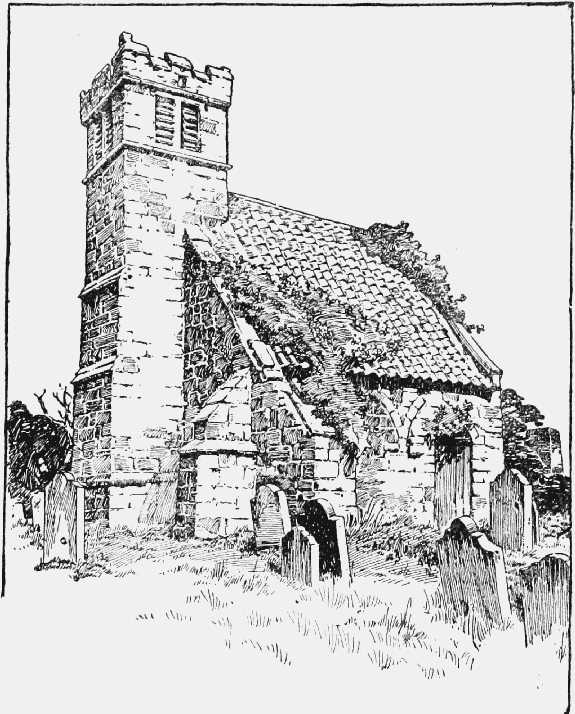
Upleatham Old Church from the South-west
In 1314, however, the land in Upleatham held of the Percys was in the hands of John de Fountains and Robert Capon, who each had 1 carucate. (fn. 26) The connexion of the Capons with Upleatham dated before Robert's time: Geoffrey Capon and his son William had witnessed the charter of Agnes de Argentein to John Herbald, (fn. 27) and Cuthbert Capon, who in 1284–5 had land in Upleatham (fn. 28) apparently inherited from William, (fn. 29) seems in 1301–2 to have been the richest man in the parish. (fn. 30) Sir Robert Capon, kt., probably Cuthbert's son, was appointed in 1322 one of the two commissioners of array for Langbaurgh Wapentake, (fn. 31) and as a reward for his military services he was exempted in 1333 from serving on juries and assizes, &c., against his will. (fn. 32) He died towards the end of 1346, (fn. 33) leaving five sons, of whom Robert was possibly the eldest, while another may have been Cuthbert Capon mentioned in 1386 as of Upleatham. (fn. 34) In the Lay Subsidy Roll of 1428 (fn. 35) there is another record of the holdings, here said to be in Marske in which Upleatham was evidently included: Robert Capon then had the carucate held by an earlier Robert Capon, and John Fountains that formerly held by John his father. From this time nothing more is heard of the Capons or Fountains.
An estate in Upleatham which belonged to William Burgh, and was settled in 1518 by his daughter Anne on her sister and co-heir Elizabeth, wife of Sir Thomas Tempest, (fn. 36) is sometimes called a manor. It was inherited in 1545 by Tempest's daughter Anne, wife of Sir Ralph Bulmer, kt. (fn. 37) She died in 1555 and her husband in 1558, and the land was then divided among their eight daughters and coheirs. (fn. 38) The parts of Frances, Joan, Millicent, Dorothy, Bridget, Barbara and Mary were all the subject of fines between 1564 and 1574, (fn. 39) but no trace of them is subsequently found. If this 'manor' was really held of the queen, as the inquisition of 1559–60 (fn. 40) states, it was of the Percy fee, and therefore probably either the Capon or the Fountains holding or both of them. Unfortunately the overlordship is uncertain, for in 1545 the land was said to be held of Lord Conyers, (fn. 41) and in that case must originally have been in the fee of Brus.
In the 17th century the Colthursts and Smalwoods appear to have had considerable standing in the parish. Robert Colthurst, freeman of the Merchant Taylors' Company of London, died in 1631, (fn. 42) leaving a son and heir Robert, (fn. 43) of whose three daughters, Anne married Robert Cooke, and Dorothy, George Smalwood, both of Upleatham. (fn. 44) To judge from a Subsidy Roll, (fn. 45) George Smalwood about 1666 must have been the most important resident here.
Churches
All that remains of the old church is a portion of the west end, including a small embattled tower, and some fragments of masonry further east. The original building, which appears to have been of late 12thcentury date, (fn. 46) consisted of chancel and nave with south aisle, with a bellcote over the west gable. An aisle seems to have been added to the chancel at a later date. (fn. 47)
From the existing portions now above ground the nave seems to have been about 36 ft. in length by 18 ft. 9 in. wide and to have been separated from the aisle by a low arcade of four semicircular arches. Two of these arches built up are still standing in what is now the south wall of the building, the later filling-in being pierced by a doorway and window. The aisle has entirely disappeared and a wall has been built across the middle of the nave forming the east wall of the building as now standing, the internal dimensions of which are 18 ft. by 18 ft. 9 in. The tower was built in 1664, (fn. 48) the stones of the old bellcote being used in its erection. There are buttresses at the west end, and on the north side about 14 ft. from the west end is an original pointed doorway with hood mould and plain chamfered jambs and head. The roof is now covered with modern red pantiles, but on the north side the original 12thcentury corbel table exists below the eaves, consisting of ten carved stones and one at the angle with the representation of a beast; the others have human heads. (fn. 49) Two mediaeval grave slabs with floreated crosses, and the head of a third, remain. (fn. 50)
The new church of ST. ANDREW was erected in the village in 1835. It is built in the Norman style (fn. 51) and is in plan a plain rectangle measuring internally 42 ft. 6 in. by 25 ft. 6 in. with a western tower and recess at the east end for the altar 10 ft. 6 in. wide by 3 ft. 6 in. deep. The interior was restored and a vestry built on the north side of the tower in 1877.
The only object of antiquarian interest is the unmounted rectangular font, which is a relic of the old church, of 12th-century date similar in type to that at Marske. It is 2 ft. 3 in. square by 2 ft. 1 in. high, and has a shaft at each angle with scalloped capital and moulded base, each of the four sides being carved with diaper or star ornament of various forms. The top edge is chamfered on the underside and the font stands on a modern plinth. The tower contains one bell, formerly in the old church.
The plate consists of a cup of 1750, made at Newcastle by Isaac Cookson, and a modern paten and flagon each inscribed, 'Presented to the Parish Church of Upleatham in memory of Thomas Dundas 2nd Earl of Zetland K.G. Born 5th February 1795. Died 6th May 1873.' (fn. 52)
The registers begin in 1654.
Advowson
The church is first mentioned about 1119–24 when Robert de Brus gave it to Guisborough Priory, (fn. 53) and it figures in the list of the property of this house in 1535 (fn. 54) as a chapel annexed to the rectory of Guisborough. At the dissolution of the priory in 1539 the right of appointing the curate of Upleatham Chapel passed to the Crown, and was given by Henry VIII in 1545 to the Archbishop of York and his successors, (fn. 55) with whom it has since remained.
Charities
In 1864 Thomas Earl of Zetland by deed gave £1,874 3s. 4d. consols for the benefit of the schools.
The parish is in possession of 3 r. 23 p. known as the Poor Folks' Close, let at £2 a year, and a sum of £334 9s. 8d. consols arising from the sale of ironstone is held by the official trustees. The charity is regulated by a scheme of the Charity Commissioners, 1875.