A History of the County of York North Riding: Volume 2. Originally published by Victoria County History, London, 1923.
This free content was digitised by double rekeying. All rights reserved.
'Parishes: Westerdale', in A History of the County of York North Riding: Volume 2, ed. William Page (London, 1923), British History Online https://www.british-history.ac.uk/vch/yorks/north/vol2/pp413-417 [accessed 5 May 2025].
'Parishes: Westerdale', in A History of the County of York North Riding: Volume 2. Edited by William Page (London, 1923), British History Online, accessed May 5, 2025, https://www.british-history.ac.uk/vch/yorks/north/vol2/pp413-417.
"Parishes: Westerdale". A History of the County of York North Riding: Volume 2. Ed. William Page (London, 1923), British History Online. Web. 5 May 2025. https://www.british-history.ac.uk/vch/yorks/north/vol2/pp413-417.
In this section
WESTERDALE
The parish is composed of the township of Westerdale and hamlets of Baysdale (fn. 1) and Esklets, all lying in lofty, narrow valleys among the Cleveland Hills. Its area is 9,914 acres of land, of which 663 acres are arable, 1,570 acres permanent grass, 9 acres woods and plantations, (fn. 2) and the rest grouse moor covered with heather and bracken, rising from the dales where the height is about 600 ft. to a height of 1,500 ft. above ordnance datum. An Inclosure Act was obtained in 1810–11. (fn. 3)
The earliest recorded lords, the Balliols of Barnard Castle, (fn. 4) held the forest called first Westerdale, then Baysdale and finally Stokesley. The second Bernard de Balliol held this in the latter half of the 12th century, (fn. 5) and between 1240 and 1251 (fn. 6) Ada de Balliol granted half the forest of Baysdale (fn. 7) to Hugh de Eure. (fn. 8) This moiety subsequently descended with the manor of Stokesley (fn. 9); it was described in 1716 as 'a large forest or moor called Stokesley and Stockdale Moor,' extra-parochial, containing 2,500 acres, (fn. 10) and still appears as the forest of Stokesley in 1790. (fn. 11) Between 1154 and 1181 the second Bernard de Balliol granted to Rievaulx Abbey 2 oxgangs of land in Westerdale, pasture for 120 animals throughout his forest of Westerdale, and in connexion with this pasture a house and close near Wooddale Beck (Wulvedalebec) by 'Hogthaith.' (fn. 12) With the consent of his forester the canons might set snares to entrap wolves, and their shepherds when threatened by wild beasts or thieves might freely blow their horns. (fn. 13) The abbey was assessed for 11s. 4d. subsidy in Westerdale in 1301–2. (fn. 14)
Barrows here have been opened and in two an axe-hammer and other prehistoric remains have been found (fn. 15); there are earthworks on Crown End. (fn. 16)
The subsoil is upper and lower lias and inferior oolite, the soil peat and clay. There is no record of iron mining, but this was carried on by Rievaulx Abbey in the adjacent parish of Danby, (fn. 17) and besides the Hole Pits there are eight slag or 'Cinder' hills in Westerdale. (fn. 18) Jet of inferior quality was worked for a short time. (fn. 19)
The population is entirely agricultural, the products of the district being butter, cheese, cattle and wool. (fn. 20) Of late years great attention has been paid to the breeding of horses, sheep and cattle.
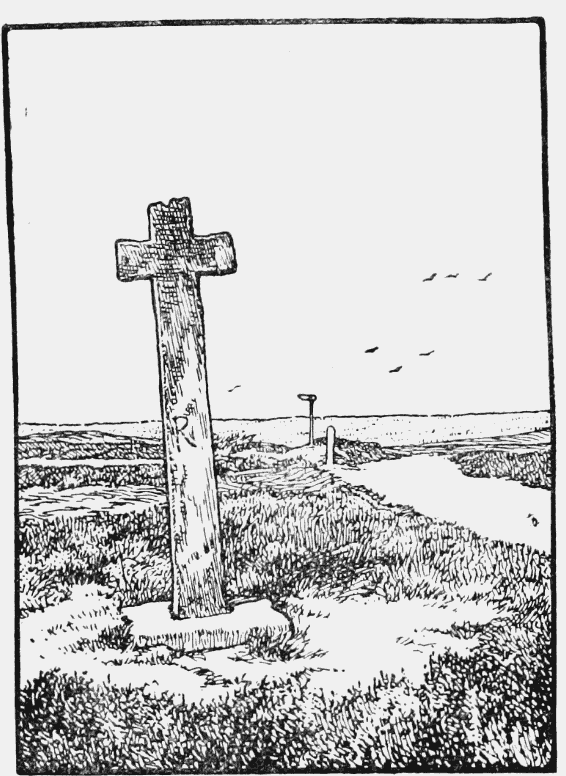
Ralph Cross on the Moors near Westerdale
At Esklets on Westerdale Moor is the source of the River Esk, which flows through some of the wildest scenery in the county on its way to the North Sea at Whitby. Descending northwards as a mountain torrent, it skirts the village of Westerdale, which lies at about 650 ft. above ordnance datum. South of the ribbed mediaeval bridge, over the stream, is the village street with the church, which stands on high ground half-way down. There are a Wesleyan chapel and a Church of England school. Close to the bridge but almost concealed by woods is Westerdale Hall, the shooting box of Col. Duncombe. A cross standing at the lower end of the village early in the 19th century was destroyed by a farmer whose cart had been upset by it through the carelessness of one of his servants. (fn. 21) Westerdale Mill, higher up the rivulet, belonged to the Templars in 1307, (fn. 22) and afterwards descended with the manor, as did their capital messuage here, which had at that time a hall (aula) chamber, kitchen, stable, oxen shed, grange and chapel. (fn. 23) At either Westerdale or 'Braithwayt,' a hamlet then apparently adjoining Westerdale, (fn. 24) the knights had a great yard (curia) for brewing, a small yard and two chambers (kemena). (fn. 25)
Among the moors nearly 4 miles to the west is the site of Basedale Priory by Baysdale Beck. At this spot, to which the Cistercian nuns of Thorpe (afterwards Nunthorpe) moved in the late 12th century, (fn. 26) is a farm residence called Baysdale Abbey, the occasional residence of Viscount Boyne.
From a survey of Basedale Priory made at the time of the Dissolution (fn. 27) it appears that it consisted of a church 65 ft. long and 20 ft. wide with fourteen glass windows, and having the high altar and two other altars in the quire with one beneath, evidently in a crypt. On the south side of the church was the cloister, which measured 50 ft. square and had walks 7 ft. wide, on the east side of which, occupying its whole length, was the dorter, 50 ft. long and 16 ft. wide, with the chapter-house, 'a little chamber called the mylke house, and the larder house, under the said dorter.' The arrangement is peculiar, as the warminghouse and parlour would more naturally have occupied this portion of the east range, but the placing of the kitchen, which measured 16 ft. square, at the 'southeste corner of the cloyster' no doubt governed this departure from the normal type of plan. On the south side of the cloister was a range of buildings 50 ft. in length and 16 ft. wide, containing the frater and 'a chamber wt a chymney' (perhaps the warming-house). Under the frater was 'a bedde chambre and one other litle chamber.' The walls were of timber and the roof was of slates and thatch. The materials of the church and the dorter block are not specified, but were probably stone. The buildings on the west side of the cloister comprised 'the Prioresse chambre, wt a fayre rounde bay wyndow glasid and a chymney, and one other chamber wtyn the same . . ., iij other chambres undir one roofe by the same, callid geste chambres, and a chymney in the bigger . . . a litle low parler under the geste chamber conteyning xvj ffoote square, a chimney . . . and a baye wyndow unglasied . . . the low halle by the Prioresse chamber conteyning 18 ffoote square' and two butteries under the prioress's chamber, with a brew-house at the upper end of the hall. The survey is not sufficiently explicit to make the position of these various rooms at all certain, but from the sequence in which they are described it is probable they were contained in one range, the 'low halle' being perhaps at the south, with the butteries at the north end, and possibly a passage between them communicating with the 'low parlour,' the prioress's chamber over the butteries, and to the north of this the three 'geste chambres,' with the 'low parlour' beneath them. The placing of the prioress's chamber between the hall and the guest chambers seems unavoidable from the fact that these latter are both said to be 'by the prioress' chamber.' The upper end of the hall would then be the southern end, and the brew-house, the dimensions of which are not given, might have formed part of a second court, either to the south-west or south of the claustral block. The walls of the 'low parlour' were of stone, those of the prioress's chamber and the guest chambers on the upper floor of timber, while those of the 'low hall' were of stone on one side and timber on the other. Immediately after the description of the kitchen is mentioned 'the prestes chamber conteyning in length xviij ffoote and xij foote brode wt a litle side chambre in th' ende of same, and a chymney of tymbre, and tymbre walles.' This was probably situated somewhere to the east or south-east of the dorter blocks. No mention is made of an infirmary block, but of the remaining buildings described, which must have included a second court quite independent of the claustral block, the most important are 'the garnar,' 24 ft. by 14 ft., with a store-house beneath it, 'the kylne house wt a litle maltynge flore and a litle garnar in th' one ende,' 30 ft. by 16 ft., the bakehouse, 25 ft. by 16 ft., a chamber over 'the gate at the goynge in,' a stable, and water-mill by the gate, and a cow-house, 23 ft. by 14 ft. The survey concludes with the description of the ox-house 'in the utter yard,' 28 ft. by 16 ft., a hay-house 22 ft. by 14 ft., 'the house wher they ley turves,' 27 ft. by 13 ft., and a barn, 30 ft. by 18 ft.
Nether House, a close called Nun Park, Middle Head House, Whitethwayte, Hall flat and Skalethwayte alias Lodge Green (fn. 28) are among the placenames in Baysdale that occur in 1538. The priory had also a capital messuage called Monk House. (fn. 29)
Manors
Though probably identical with the Camisedale of 1086, (fn. 30) WESTERDALE belonged when first mentioned in the latter half of the 12th century to the fee of Bernard de Balliol, (fn. 31) being a member of his lordship of Stokesley. (fn. 32)
It was granted by the under-tenant Guy de Bovincourt, with the permission of Hugh de Balliol, to the Knights of the Temple, the grant being confirmed in 1203 by King John. (fn. 33)
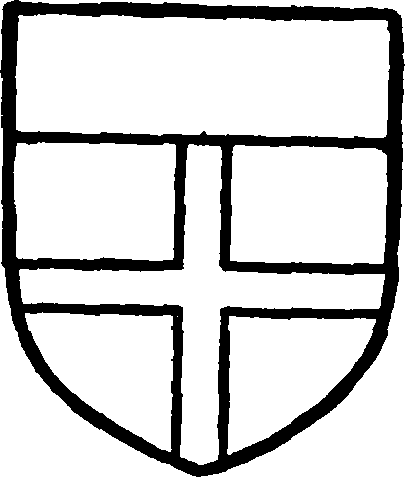
The Knights Templars. Argent a cross gules and a chief sable.
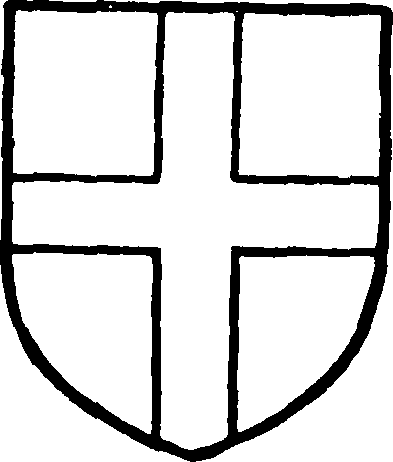
The Knights Hospitallers. Gules a cross argent.
Despite the overlordship of the barons of Stokesley (fn. 34) the manor, with other Yorkshire possessions of the Templars, was in the king's hands from 1310–12, (fn. 35) when the order was suppressed, and seems to have remained in his custody until it was granted to the Hospitallers. (fn. 36) The manor subsequently descended as a member of the Commandery of the Holy Trinity, Beverley, (fn. 37) until the suppression of the order, after which, in 1545, the manor with the woods of 'Barwykerowe' and 'Hanyiestrete' in Westerdale was granted to George and Edmund Wright, the king's servants, in fee. (fn. 38) George Wright obtained licence to sell the manor to Ralph Yoward (Yowarth, Eward, Ewart) in March 1549–50. (fn. 39) It was restored to the order by Philip and Mary (fn. 40); but the order was suppressed by Queen Elizabeth immediately after her accession, (fn. 41) and Ralph Yoward died seised in 1567, leaving a son and heir Robert Yoward of Stokesley, (fn. 42) who was in 1601 succeeded by Henry his son. (fn. 43) Henry died in February 1605–6, leaving an infant son Ralph, (fn. 44) who attained his majority in 1622 (fn. 45) and died in 1641. His son Richard (fn. 46) in 1659 conveyed, perhaps in trust, (fn. 47) the manor to his kinsman, (fn. 48) Sir James Pennyman (fn. 49) of Ormesby, and died in 1664, his son Ralph, aged seventeen, being described as of Westerdale in 1666. (fn. 50) A conveyance of the manor was made in 1736 by William Moorcroft and his wife, (fn. 51) and in 1772 it was sold by Moorcroft Wastell to Charles Turner (fn. 52) of Kirkleatham; Westerdale from this time till at least 1808 descended with Kirkleatham (fn. 53) (q.v.). Col. the Hon. Octavius Duncombe, son of the first Lord Feversham, was the owner in 1857, and dying in 1879 was succeeded by his son Col. Walter Henry Octavius Duncombe, (fn. 54) the present lord of the manor.
The Templars received a grant of free warren in their demesne lands here in 1248, (fn. 55) and the vill being in their liberty was exempt from taxation, (fn. 56) and was a peculiar. (fn. 57)
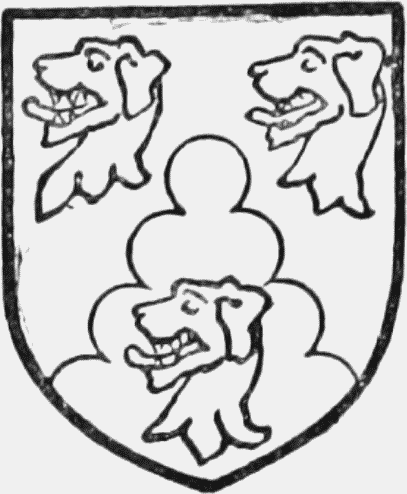
Duncombe. Party cheveronwise engrailed gules and argent with three talbots' heads razed and countercoloured.
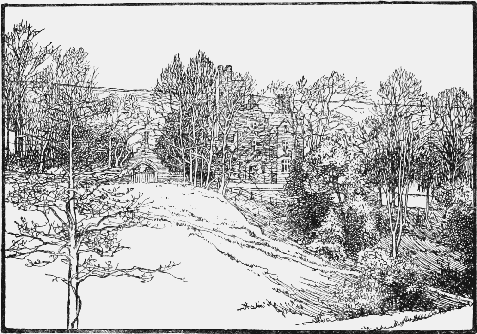
Westerdale Hall
Like Westerdale, BAYSDALE (Basedale, xii–xix cent.; Beasdaile, xvi cent.; Baisdale, Baysdale, xvi–xvii cent.) was probably part of the Balliol fee. Guy de Bovincourt, who granted Westerdale to the Knights of the Temple, established the Cistercian nuns of Thorpe at Basedale, granting them 'all the land between Redemire and Hawkemire, with the whole wood and mountain ridge as far as Basedale Beck, and Redemire from the point where Hassokemire (fn. 58) falls from the mountain ridge to Basedale Beck,' 2 oxgangs of land in Westerdale and wood for building and burning at their place in Westerdale, (fn. 59) the meadow 'sub Refholes,' and pasture for animals specified. These grants made for his soul and the souls of Robert de Bovincourt and Bernard de Balliol (fn. 60) were confirmed by Henry III in 1236. (fn. 61)
Basedale Priory was dissolved in 1539, (fn. 62) the nuns then possessing besides their house 12s. rent from one tenement in Westerdale. (fn. 63) The reversion after a lease was sold by the Crown to Sir Ralph Bulmer the younger of Wilton and John Thynne in 1544. (fn. 64) Sir Ralph Bulmer died seised in 1558 of the monastery or 'manor' (for the first time so-called), leaving eight daughters co-heirs, Joan, Frances, Millicent, Dorothy, Bridget, Barbara, Mary and Anne, the eldest Joan already married to Francis eldest son of Sir Richard Cholmley. (fn. 65) Frances afterwards married Marmaduke Constable, (fn. 66) Millicent, Thomas Grey of Barton in Ryedale. (fn. 67) Robert Yoward of Baysdale, who died in 1577, and his younger son Ralph held fifteen twentyfourth parts of the manor at that time and settled this in tail-male on Ralph. (fn. 68) Thomas Grey and Millicent conveyed a moiety of tenements and a water-mill to Thomas Yoward in 1578, (fn. 69) and Francis Cholmley and Joan and Anthony Welbury and Anne his wife granted two twenty-fourth parts of tenements and a mill to Ralph Yoward in 1582–3. (fn. 70) Ralph Lord Eure, however, died seised of the site in 1617. (fn. 71) It afterwards became the property of the Fotherleys of Castleton (fn. 72) and in about 1729 was purchased by Ann daughter of William Peirson of Stokesley, (fn. 73) who, dying unmarried, was succeeded by her brother Bradshaw. (fn. 74) The site or manor then descended with Stokesley (q.v.) until 1808 (fn. 75) or later. By 1833 it was in the possession of William Russell of Brancepeth Castle, (fn. 76) who died in 1850 and was succeeded by his sister Emma Maria wife of Gustavus Frederick John James Hamilton. (fn. 77) She died in 1870 and her husband (who in 1850 took the additional name of Russell, succeeded as seventh Viscount Boyne in 1855, and was created for his political services Lord Brancepeth in 1866) died in 1872. (fn. 78) Their son Gustavus Russell was succeeded in 1907 by his son Gustavus William, the present Viscount Boyne. (fn. 79)
Church
CHRIST CHURCH was rebuilt in 1838 in the Gothic style of the day and consists of chancel, nave and west tower, the chancel, however, dating from 1875, in which year the interior was restored and reseated. The building was again restored and a porch added on the south side of the tower in 1896, and the chancel was renovated in 1911. There is a vestry on the south side of the chancel and an organ chamber on the north.
The tower contains three bells. All the fittings are modern. Some fragments of masonry belonging to the old church are preserved under the tower and in the churchyard is the base of a cross. No authentic record of the appearance or plan of the former structure has been preserved. (fn. 80)
The plate consists of a cup of 1627, with cover paten, made by F. Terry of London, the cup inscribed 'Capella de Westerdale Com. Ebor. Ex dono Ricardi Willis xxijdo die Maij 1628,' and engraved with arms and crest, and a modern flagon. (fn. 81)
Advowson
The living, a chapelry annexed to Stokesley (q.v.), became a new vicarage under the Act of 1868 (fn. 82); it is in the gift of the Archbishop of York. The chapel always had the right of marriage and burial. (fn. 83)
Tenements in Westerdale and Braythwaite were burdened with a rent-charge of 16s. 6d. to the chantry in the Templars' chapel ('the chapel of the manor of Westerdale'); and a rent of 1 lb. of wax, price 6d., from lands in Ingleby Greenhow was paid yearly to this chapel. (fn. 84)
There was a conventual chapel at Baysdale; Robert de Longchamp, Abbot of St. Mary's, York, (fn. 85) and the parson of Stokesley granted to the nuns the privilege of having a churchyard for barying the nuns and brothers (fratres) who took their habit; but their servants and men were to receive burial and all other sacraments from 'the mother church' of Stokesley. For this concession the priory was to pay yearly to St. Mary's Abbey half a pound of incense. (fn. 86)
Charities
The free school, founded by will of Miss Jane Duck, 1734, and deed of Mrs. Mary Fish, 1741, is endowed with a sum of £294 5s. 9d. consols with the official trustees, arising from sales of land and with a rent-charge of £3 payable out of a house and farm in Westerdale. The school, which is subject to the North Riding education authority, is regulated by a scheme under the Endowed Schools Acts.
The poor are entitled to annual payments of 10s. out of a farm in Commondale in respect of the charity of Joseph Dunn, 1716; 10s. out of a close called Stubblewhite in the parish of Danby, in respect of Roger Bell's charity, will 1721, and to £2 out of a farm in Westerdale, given (as is understood) by will of Mary Duck, 1734.