A History of the County of York North Riding: Volume 2. Originally published by Victoria County History, London, 1923.
This free content was digitised by double rekeying. All rights reserved.
'Parishes: Brompton', in A History of the County of York North Riding: Volume 2, ed. William Page (London, 1923), British History Online https://www.british-history.ac.uk/vch/yorks/north/vol2/pp424-430 [accessed 30 April 2025].
'Parishes: Brompton', in A History of the County of York North Riding: Volume 2. Edited by William Page (London, 1923), British History Online, accessed April 30, 2025, https://www.british-history.ac.uk/vch/yorks/north/vol2/pp424-430.
"Parishes: Brompton". A History of the County of York North Riding: Volume 2. Ed. William Page (London, 1923), British History Online. Web. 30 April 2025. https://www.british-history.ac.uk/vch/yorks/north/vol2/pp424-430.
In this section
BROMPTON
Bruntune (xi cent.); Brumton (xii-xiii cent.); Brunton, Brumpton, Brompton (xiii cent.).
This parish was composed in 1831 of the townships of Brompton, Sawdon, Snainton and Troutsdale, (fn. 1) of which Sawdon was amalgamated with Brompton by a Local Government Order coming into operation in 1886. Its area is 11,361 acres of land, of which 5,182 are arable, 2,832 permanent grass and 816 woodland. (fn. 2) The soil of Oolitic Limestone, gravel and loam rests on Corallian Beds and Kimmeridge Clay; alluvium is found by the River Derwent, which forms the southern boundary of the parish. Limestone and gravel are worked, the stone from Troutsdale Moor being of excellent quality. Slate from Sawdon Moor was ordered to be used for the repair of Scarborough Castle in 1538. (fn. 3) The chief crops raised are wheat, barley, oats and turnips. At the close of the 16th century the joint owners of one of the manors of Brompton were paying a new rent for their licence to inclose the wastes of Brompton, Snainton and Sawdon. (fn. 4) The lords of the same manor wished in 1757 to inclose Brompton Carr, the Pitts, the Broates, Sawdondale, the Moor and Troutsdale or Troutsdale Brow, all common or waste grounds (containing about 2,221 acres) in the manor of Brompton, (fn. 5) and an award was made for the inclosure of eight common fields in Brompton and Sawdon in 1758. (fn. 6)
The old course of the River Derwent, some distance south of the present stream, is the southern boundary of the parish. The river is crossed by Foul Bridge, near which is the site of the manor of Foulbridge, once belonging to the Knights of the Temple and their successors the Knights of St. John of Jerusalem. (fn. 7)
The height of the parish above the ordnance datum varies from 75 ft. in the Vale of Pickering to 700 ft. on the moors. The village of Brompton, though not large, is beautifully situated on the lowest slopes of the hills and lies along the road from Scarborough to York, which here widens to form the High Street. Brompton Green lies on the north side of this street at the eastern extremity of the village. In the centre of the village is Castle Hill, the reputed site of an early fortification (fn. 8); it is protected on the west by a large pool. The whole village is well wooded, and fine grounds are attached to the High Hall, a stone-built Georgian house, the residence of Mr. J. W. Coulthurst. The Hall, which stands north of the church, is probably on the site of the older capital messuage mentioned in the spring of 1561–2. (fn. 9) At the south-east corner of the park is Malpas, (fn. 10) while in a similar position in the south-west is the Low Hall, an old building largely remodelled in the 18th century and now used as a farm-house. This must be the manor-house of Brompton belonging to the duchy of Lancaster and mentioned in 1651. (fn. 11) The other houses in Brompton are of no great antiquity.
At some distance north-east of the village a lane leads from the main road to Gallows Hill Farm, at the foot of Gallows Hill (Gallyhill, xvii cent.). Here Mary Hutchinson lived, and here Wordsworth stayed before his marriage; the house is still very much as it was in their time and quite unspoilt. They were married by the Rev. John Ellis in Brompton Church on 4 October 1802, in the presence of Thomas, Joanna and John Hutchinson. As the artist who has described this district remarks, it is an ideal spot for a poet's wedding. (fn. 12)
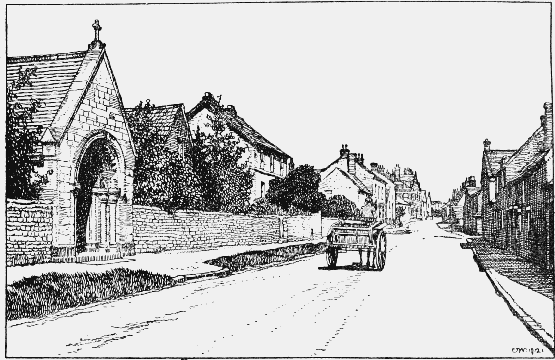
Snainton Village, Brompton
Snainton is an uninteresting village lining the main Pickering and Scarborough road about 1½ miles west of Brompton. The church stands by the road, but the Hall lies down Croft Lane to the south. It is perhaps on the site of the capital messuage mentioned in 1558. (fn. 13) Near Stainton station, half a mile to the south of the village, is Carr House, a modern farm incorporating some portions of 17th-century work and formerly surrounded by a moat filled in in recent years. Sawdon, with its park, lies to the north of Snainton; a capital messuage stood here in 1289. (fn. 14) The township of Troutsdale is on the moors.
There are now mills at Brompton and Troutsdale. The mill at Brompton, belonging in 1086 to Berenger de Toni, (fn. 15) was in 1235 appurtenant to the Vescys' manor of Brompton. (fn. 16) The corn-mill of Troutsdale, on Troutsdale Beck, seems to be first mentioned in 1619–21, (fn. 17) and was held in the 17th century with the capital messuage by the families of Isons of Troutsdale, (fn. 18) Theakston and Constable. (fn. 19) A mill at Snainton belonged to Ingram de Boynton (Bovington) in 1272 (fn. 20) and there was a water-mill at Foulbridge in March 1326–7. (fn. 21)
All the townships in this parish were formerly in the forest of Pickering (q.v.), and it was stated in 1276 that Agnes de Vescy, lady of Brompton, had for a long time had her wood of Troutsdale [called Ayclif (fn. 22) ] outside the regard of the forest and held pleas of vert in her court. (fn. 23) The lord of the manor of Brompton claimed the right to appoint a woodward for his wood in 1334. (fn. 24) This claim to hold the wood of Troutsdale outside the regard was disallowed by the justices in 1334. (fn. 25) Sir Henry Brounflete, a successor of the Vescys, (fn. 26) was granted a free park in the north part of Troutsdale in 1438. (fn. 27) In 1608 there were said to be only sixty old trees in Troutsdale Wood, held in common by the tenants of Brompton. (fn. 28)
Some 13th-century names are Halfhundrythes and Scotgate in Snainton, (fn. 29) Fukedale (fn. 30) in Sawdon; Williams Cross is mentioned in 1317, (fn. 31) Stonecross in 1651. (fn. 32)
There are stations at Sawdon and Snainton on the Seamer and Pickering branch of the North Eastern railway. Brompton and Snainton have Wesleyan and Primitive Methodist chapels, and a public elementary school at Brompton was erected in 1879.
The classical scholar Francis Wrangham (1769– 1842) married, in 1801, at Brompton, Dorothy daughter and co-heir of the Rev. Digby Cayley, (fn. 33) and Arthur Cayley, writer of biographical works, was son of Arthur, third son of Sir George Cayley of this place. (fn. 34)

Mowbray. Gules a lion argent.

Bigod. Or a cross gules.
Manors
Three carucates of land in BROMPTON were soke of the king's manor of Pickering in 1086, when I carucate 6 oxgangs of land formerly held by Ulf as a 'manor' were also in the king's hands. (fn. 35) In the summary of the Domesday Survey the king was said to hold 9 carucates of land in Brompton, (fn. 36) but this must have included Sawdon and Westhorpe. (fn. 37) The holders of the honour of Pickering (q.v.) have always been overlords of Brompton, and have also had and still have a manor there. (fn. 38) Gamel held a 'manor,' assessed at 6 carucates before the Conquest; this was in 1086 among the possessions of Berenger de Toni. (fn. 39) Roger de Mowbray was overlord in the reign of Henry I, (fn. 40) possibly by grant of his uncle William Daubeney, one of the heirs of Berenger. (fn. 41) This overlordship followed the descent of the manor of Thirsk (fn. 42); in the 16th century the manor was held of the Crown as of Pickering Castle. (fn. 43)
The Mowbray fee in this district was composed of 12 carucates of land which made one knight's fee in Brompton and Sawdon, while the Bigods had a fee, mentioned in 1284–5, (fn. 44) of 10 or 8 carucates of land, making one knight's fee in Snainton, Westhorpe and Brompton. (fn. 45) Although Adeliz sister of Berenger de Toni married Roger Bigod, (fn. 46) his heir was the child of another wife (fn. 47); but the Bigods sometimes followed Berenger. (fn. 48) This fee came to the Mowbrays in 1398. (fn. 49) The two fees formed what was sometimes called the Vescy 'honour of Brompton.' (fn. 50)
Eustace son of John was tenant of Brompton under Roger de Mowbray in the reign of Henry I, (fn. 51) and from him it descended, as did the manor of Malton, (fn. 52) through the Vescys (fn. 53) to the Aytons. (fn. 54) On the death of William de Ayton in the 14th century the manor became divided into moieties; one descended to the Conyers of Sockburn and was sold in the spring of 1613–14 by George Conyers to Ralph Lord Eure with a warranty against the heirs of his father John and his grandfather George Conyers. (fn. 55) The later descent of this moiety cannot be traced.

Vescy. Gules a cross paty argent.

Ayton. Barry or and azure with a quarter of the arms of VESCY.

Conyers. Azure a sleeve or.

Clifford. Checky or and azure a fesse gules.

Dakyns. Argent a cross between four lions gules.

Pollard. Ermine a cross engrailed sable.
The moiety of Anastasia de Ayton passed to the Cliffords, Earls of Cumberland, and early in 1561–2 Henry Earl of Cumberland conveyed it with the manor of West Ayton to George Dakyns and his heirs and Ralph Pollard, in return for an annual rentcharge of £84. (fn. 56) This moiety became subdivided between the Dakyns and Pollards.
George Dakyns and George son of Ralph Pollard of Pollard Hall, Bishop Auckland, (fn. 57) made settlements of tenements and the water-mills in Brompton and half the manor of Ayton in 1569, (fn. 58) but part of the Cumberland lands in Brompton, Sawdon and Snainton sold to Dakyns and Pollard were shortly before 1591 purchased by Edward Hutchinson, lord of the neighbouring manor of Wykeham. (fn. 59) Sir William Mallory, kt., and Ursula his wife conveyed tenements in Brompton to Christopher Hutchinson early in 1578–9, (fn. 60) and in 1619–21 Stephen son and heir of Edward Hutchinson had the Dakyns' part of the manor. (fn. 61) This part subsequently descended (fn. 62) with the manor of Wykeham, (fn. 63) in which it now seems to be merged.
Leonard son of George Pollard died seised of the 'manor' of Brompton in 1589, leaving a son and heir Ralph, (fn. 64) who in 1624 with Susan his wife and Thomas Bosvile and Anne his wife conveyed half the manors of Brompton and Ayton to John Fairfax and Richard Marris. (fn. 65) The Pollard estate was perhaps divided between two co-heirs, for in 1634 John Farrer and Susan his wife conveyed to William Cayley a quarter of the manors of Brompton and Ayton (fn. 66); little trace of the remaining quarter has been found, but it was in the hands of Richard Langley in 1743. (fn. 67)

Cayley. Quarterly argent and sable a bend gules with three molets argent thereon.
William Cayley was knighted in March 1640–1 and created a baronet in 1661. (fn. 68) He conveyed half the manors of Brompton and Ayton to Arthur Cayley and his heirs in 1656 (fn. 69) and died in 1681. (fn. 70) His eldest son Sir William, Mary his wife and Arthur Cayley made a settlement of these moieties in 1699, (fn. 71) and the moiety descended to the heirs of Sir William, who died in or before 1708, leaving a son and heir Arthur. (fn. 72) Sir Arthur died in 1727, and his son Sir George, (fn. 73) with Richard Langley, the owner of the other fourth part, appointed a gamekeeper for the manor in 1743. (fn. 74) Sir George died in 1791, his son and heir Thomas in the following year. (fn. 75) Sir George son of Sir Thomas was in 1857 succeeded by his son Digby; Sir Digby in 1883 left a son George Allanson, whose son Sir George Everard Arthur Cayley, bart., succeeded in 1895 (fn. 76) and is now owner.
John Moryn, lord of Whenby, was described as of Brompton in 1334, when he and Denise his wife settled 34 oxgangs 50 acres of land, a messuage, &c., here on themselves and the issue of John, with remainders to John son of John and various other persons. (fn. 77) Twelve oxgangs of this land were proved in 1342 to be ancient demesne of the Crown and therefore not impleadable at common law. (fn. 78) Litigation on this point was followed in 1343 by a quitclaim by John son of John Moryn of all right in 7 oxgangs in Brompton, Snainton and Sawdon to his overlord, Sir William de Ayton. (fn. 79)
Henry I granted soc and sac, toll and team and infangentheof, and all waters, mills and fisheries to Eustace son of John and his heirs in his manor of Brompton. (fn. 80) William de Vescy in 1284–5 claimed that his ancestors time out of mind had had their courts and gallows and amendment of the assize of ale. (fn. 81) Sir Henry Brounflete claimed view of frankpledge in 1439–40, (fn. 82) and the lord did justice to thieves by suit (fn. 83); Sir Henry Brounflete obtained a confirmation of all these rights in 1438. (fn. 84) Henry III in 1253 granted to William de Vescy and his heirs a weekly market on Monday at Brompton and a yearly fair on the vigil, feast and morrow of All Saints and the five following days. (fn. 85) The market was suppressed during the same reign as injurious to the market at Scarborough, (fn. 86) and, although the fair continued, it was probably in the joint possession of the lords of both manors of Brompton. The overlord was said to hold it as an escheat in 1326, (fn. 87) but in 1619–21 and 1651 the picage and toll were leased by the owner of the honour of Pickering, (fn. 88) and in 1656 and 1754 the Cayleys had half the fair. (fn. 89) Among public officials in 1895 were market toll collectors and waywardens. (fn. 90) Agnes de Vescy was said in 1276 to have lately appropriated warren. (fn. 91) Her successor Gilbert de Ayton claimed in 1334 the right of hunting hares, foxes, wild cats and badgers within the Acredikes in Brompton, (fn. 92) and warren afterwards descended with this manor. (fn. 93)
In 1177–81 (fn. 94) and 1189–90 (fn. 95) FOULBRIDGE (Fuchebruge, xii cent.; Fulkebridge, xii, xvi cent.; Feukebrigg, xiii–xiv cent.; Foukebrigg, xiv cent.; Fowbridge, xiv–xvi cent.) was a member of Settrington, but it afterwards passed into the overlordship of the Percys, Earls of Northumberland, and of the Mowbrays. (fn. 96) John Lord Mowbray died seised of the moiety of the manor, which must have escheated to him, in 1322, and in 1327 the demesne lands were said to have lain fallow since the Conquest. (fn. 97)
Foulbridge was probably the 'manor of Snainton' about which Ingram de Boynton and the Knights of the Temple made an agreement before 1226. (fn. 98) John de Knapton also granted to that order rent and services in Snainton in the spring of 1240–1. (fn. 99) In 1273 the knights held the manor and the 'empty windmill' of Foulbridge, (fn. 100) and in 1307 the manor, windmill and 260 acres in 'waynage.' (fn. 101) A claim was made by the Earl of Lancaster in 1334 that on the suppression of this order the manor had escheated to him, the liberties of the Templars having become extinguished. Judgement, however, was given for the Hospitallers, to whom Edward II had confirmed the Templars' lands in 1324. (fn. 102)
On the ground that he was diverting its revenues from the hospital, the custody of the manor was ordered to be taken from Thomas Salkeld in 1359 and given to English members of the order. (fn. 103)
Sir Ralph Eure's 'place' here is mentioned in 1537, (fn. 104) and the manor, late the possession of the Hospitallers and in the tenure of Sir Ralph Eure, was in 1555–6 granted to the Archbishop of York, (fn. 105) but no later mention of it has been found. The Templars were said in 1273 and 1307 to give alms to every pauper who came, for three days weekly, whether by right or charity the jurors did not know. (fn. 106)
In 1334 the bridge and road of Pul (fn. 107) within the forest, which were highways for 'carriages, carts, drifts and packsaddles,' were in decay and broken. It was proved that the repair of the bridge with the road to the east was incumbent on the Hospitallers by reason of their tenements at Foulbridge; the road to the west was reparable by the nuns of Yedingham. (fn. 108)
The manor of SAWDON (Salden, xii–xiv cent.) seems to have been a member of Brompton (q.v.), with which it is coupled in 1284–5. (fn. 109) It belonged to the Vescys, (fn. 110) and has descended to Sir George Everard Arthur Cayley, bart.
Eustace de Vescy granted to Robert de Percy of Carnaby 3 carucates of land in Sawdon, (fn. 111) but no further mention of the Percys in Sawdon has been found. William de Mesnehermer in 1242 held 3 carucates of land in Sawdon of Aline de Bolom and Alice wife of James de Cauz, who held under William de Vescy. (fn. 112)
In 1086 SNAINTON (Snechintune, xi–xiii cent.; Snayton, Sneynton, xiii–xv cent.) was in the hands of the king, Berenger de Toni and William de Percy, who held 3½, 5, and 1½ carucates respectively. (fn. 113)
The Crown was still returned as joint tenant in 1316, (fn. 114) but its lands here subsequently merged in the honour of Pickering. Edmund Earl of Lancaster held 2½ carucates in 1284–5, (fn. 115) and the manor, which has descended with the honour of Pickering, (fn. 116) is now the property of the duchy of Lancaster. Various settlements of the manor, probably by lessees under the honour of Pickering, were made during the 16th and 17th centuries. (fn. 117)
The Boyntons of Boynton, lords of Acklam, (fn. 118) held tenements in Snainton, (fn. 119) and perhaps the manor of Foulbridge. (fn. 120) Thomas de Boynton obtained a grant of free warren in 1365, (fn. 121) and in 1565 Thomas Boynton, Frances his wife, John Norton and Ann his wife conveyed the 'manor' to Robert Pursglove, clerk. (fn. 122)
Ignald de Furneaux held 5 carucates as half a knight's fee; he married the daughter of Gilbert de Ayton and was murdered for ill-treatment of her by her brother William. They had two daughters, of whom Agatha married Drew de Harum, the other Richard de Percy. Drew and Agatha had a son William and a daughter who married Albert the clerk of Scarborough; the daughter received half a carucate of land in Snainton which her son Robert sold to William Prior of Malton, a sale confirmed by the grandfather and Drew. (fn. 123) Drew de Harum released all his fees, customs and services in Snainton to Agnes de Vescy in 1316. (fn. 124)
The Percy lands continued to be held of that family and followed the descent of their manor of Topcliffe, (fn. 125) with which they were granted to the Archbishop of York in February 1542–3. (fn. 126) Francis Selowe, of an old Snainton family, (fn. 127) held the capital messuage of the Earl of Northumberland as of his manor of Topcliffe (fn. 128) in 1558. (fn. 129)
Thomas de Ingleby obtained a grant of free warren here in 1365. (fn. 130)
A 'manor' and 2 carucates in TROUTSDALE (Truzstal, xi cent.) were held by Archil before the Conquest, when they came into the king's possession, (fn. 131) and became a member of the honour of Pickering. (fn. 132) Troutsdale is now in the possession of the duchy of Lancaster.
WESTHORPE was occasionally coupled with Brompton (q.v.), and in the last mention found (1334) was said to be a vill in Brompton of the fee of Mowbray. (fn. 133) A family of Westhorpe, how ever, held tenements sometimes called the 'manor of Brompton' until the 16th century. (fn. 134)
Churches
The church of ALL SAINTS consists of a chancel 28 ft. 9 in. by 19 ft., with north chapel, making the total width 37 ft. 3 in., nave 42 ft. 3 in. by 19 ft. 3 in., with north and south aisles (total width 50 ft. 6 in.), west tower and south porch. The total length of the church is 85 ft. 6 in., all the measurements being internal. A church existed on this site before the 12th century, and fragments of this date are built into the present structure, but the earliest work remaining in situ is of the 14th century. To this date belong the tower and spire and the west end of the north aisle, but the rest of the church was completely rebuilt in the following century, when a vice was added to the earlier tower. The church was extensively restored in 1878, all the roofs being renewed, and a south porch was added in 1895.
The chancel has a restored three-light east window and two three-light traceried windows in the south wall. An arcade of two bays and 15th-century date separates the chancel from the north chapel, which is conterminous with it. The pointed chancel arch is also 15th-century work. Built into the east wall of the north chapel, externally, are two carved stone female figures, one seated and probably representing the Virgin. The nave, which is of unusual width, is three bays long with 15th-century arcades of pointed arches resting on octagonal piers with moulded capitals and bases. The south aisle has a two-light 15th-century window at the east end and two large traceried windows of three lights and similar date in the south wall. The south doorway retains its original oak door, with good traceried panels, and is inclosed under a modern porch with embattled parapet.
The north aisle is of the same date as the south and is lighted by small square-headed two-light windows. These are set high in the wall owing to a considerable rise in the ground on which the church stands. This aisle is continuous with the north chapel and has a two-light west window of 14th-century date, similar to those in the bell-chamber. The line of the earlier nave roof is visible on the east face of the tower. Set in the east wall of the south aisle, as brackets, are portions of two 12th-century capitals.
The west tower is three stages high and dates from the 14th century. The ground stage has the springers for a stone vault, but this was apparently never completed. The stages are divided externally by moulded string-courses and the angles are supported by diagonal buttresses terminating in gablets at the base of the spire. The second stage is lighted by simple loops and the bell-chamber by a two-light pointed 14th-century window in each face with external hood. The octagonal broach spire is set immediately upon the tower without a parapet and is devoid of lights.
Externally the nave and quire, except the north aisle, are finished in ashlar with gabled buttresses. The nave has an embattled parapet, but that to the chancel is plain, and the main roof is externally continuous.
The tower contains three bells; the tenor inscribed 'Jesus be our speed 1621,' the second 'In honorem Dei vox mea sona (vi ?) t,' the third 'Deum cōle.'
The moulded circular font dates from the 14th century. The church contains a few monuments of interest. On the north wall of the north aisle is an incised stone inscribed 'I.W. 1580, E.W. 1541, Here lieth James Westrop who in wars to his greit charges sarved oin kyng and tow quenes with du obediens and died with owt recumpens.' It bears the arms of Thweng of Cornbrough impaling Lepton of Kepwick. (fn. 135) In the north chapel is a brass inscription to Elizabeth wife of Arthur Cayley of Brompton, who died in 1688, and on the south wall of the quire is a mural monument to Sir William Cayley, bart., who died in 1681.
The plate consists of a York cup of 1685, by Robert Williamson, a second cup inscribed 'Brompton Communion plate anno 1703,' a paten (London, 1729) inscribed 'Brompton Church 1729,' a modern cup (1893) and almsdish and a plated flagon given in 1851. There are also a pewter paten and two plates of the same material.
The registers are as follows: (i) mixed entries 1584 to 1649 and baptisms 1653 (the years 1601 to 1608 are missing); (ii) mixed entries 1653 to 1678; (iii) mixed entries 1678 to 1729; (iv) mixed entries 1730 to 1812, marriages to 1754 only; (v) marriages 1754 to 1810; (vi) marriages 1810 to 1813.
The present chapel of ST. STEPHEN at Snainton stands on the north side of the street and is a debased rectangular building erected in 1835. It has recently been decorated internally with an elaborate colour scheme and an effective fumed oak screen has been erected to form a chancel. The plain circular font probably dates from the 12th century. The chapel destroyed in 1835 was a small 12th-century building consisting of an aisleless nave and quire, the former being roofed with stone slabs. On the western gable was a bellcote for two bells and the south door was a remarkably rich example of late 12th-century work. Much of the masonry of this door was preserved and re-erected in the churchyard wall, next the street, from which it forms the chief entrance. It is now recessed in three orders, the middle one being ornamented with cheverons and the outer with a series of carved beak heads. A water-colour sketch in the possession of the present vicar, the Rev. L. F. B. Knight, B.A., gives an excellent idea of the old chapel previous to its destruction. Belonging to this chapel is a silver cup with the York mark for 1695, maker's mark, William Busfield, and two modern patens.
Advowson
The church and the priest of Brompton are associated with Berenger de Toni's lands in 1086, (fn. 136) and the advowson descended with the manor to the Vescys. William de Vescy in 1295 granted it to Malton Priory, (fn. 137) and in 1352 the priory had licence to appropriate. (fn. 138) Leases were made of the rectory, late a possession of Malton Priory, with reservation of the advowson, in 1583, 1585 and 1592, (fn. 139) and in 1608 the rectory, mansion-house and advowson were granted to Francis Phillips and Richard More, (fn. 140) presumably on behalf of the Cayleys, for Edward Cayley presented in 1615, (fn. 141) and from this time the rectory and advowson have belonged to this family. (fn. 142) The vicarage was ordained 1 March 1518. (fn. 143)
In 1327 John Moryn (fn. 144) had licence to settle three messuages, land and £4 yearly rent in Ayton, Hutton Bushel and Brompton for two chaplains to celebrate service daily in Brompton Church for his soul and that of his ancestors. (fn. 145) This was the chantry of our Lady mentioned in 1547, (fn. 146) and was granted to Edward Downing and Roger Rant in 1590. (fn. 147)
Robert Gest of Brompton, yeoman, bequeathed in 1528 10s. and a beehive to find a light before the image of All Saints in the parish church, 3s. 4d. to the church works, and 12d. to the works of Sawdon chapel. (fn. 148) The Templars had a chaplain to celebrate divine service in their manor of Foulbridge. (fn. 149)
John de Snainton, rector of Rudston, had licence in 1300 to cause mass to be celebrated for the soul of Isabel Thurnef, his mother, in the manor of his kinsman William Thurnef at Snainton. (fn. 150)
Charities
In 1813 Mrs. Ann Smith by deed, dated 20 April (enrolled), conveyed 2 acres at Swine in this parish upon trust that the rents and profits should be applied on Christmas Eve equally amongst eight poor men and women being householders in the hamlet of Swine. The land is let at £4 a year, which is duly applied by the vicar and churchwardens, who were in 1888 appointed trustees.
In 1840 Mrs. Margaret Pierson by will, proved at York 15 January, devised two cottages for the occupation of two widows, each of whom receives an annuity of £1 1s., charged by the testatrix on the same property.
The Wesleyan chapel, founded by deed, 1816, is regulated by a scheme of the Charity Commissioners, 1870.
In 1851 William Stericker by will, proved at London 1 October, left £200 to the rector and churchwardens of Brompton upon trust to be invested and the income distributed among the poor of the village of Sawdon. The sum of £204 1s. 7d. consols, representing the investment of the bequest, was in 1888 transferred to the official trustees.
The Wesleyan chapel at Sawdon, founded by deed 1823, is regulated by a scheme of the Charity Commissioners, 1887.
The Common Right Lands consist of 6 a. 2 r. 33 p. acquired under an award dated 15 April 1772 (enrolled at Northallerton) made under the Inclosure Act of 8 George III, and cottages, occupied by poor widows. The official trustees also hold £24 0s. 9d. consols arising from the sale in 1892 of land to the North Eastern Railway Company. The land is let in allotments, and the cottages are in course of being put in repair. The income of the trust property amounts to about £8 a year, which is distributed in coals.
The new National school was opened in 1892. For the old National school see under Ebberston.
The Wesleyan chapel, founded by deed 1798, is regulated by a scheme of the Charity Commissioners, 22 May 1896, whereby the trust estate is held upon the trusts of the Skircoat (Halifax) model deed of 1832.