A History of the County of York North Riding: Volume 2. Originally published by Victoria County History, London, 1923.
This free content was digitised by double rekeying. All rights reserved.
'Parishes: Ellerburn', in A History of the County of York North Riding: Volume 2, ed. William Page (London, 1923), British History Online https://www.british-history.ac.uk/vch/yorks/north/vol2/pp437-440 [accessed 30 April 2025].
'Parishes: Ellerburn', in A History of the County of York North Riding: Volume 2. Edited by William Page (London, 1923), British History Online, accessed April 30, 2025, https://www.british-history.ac.uk/vch/yorks/north/vol2/pp437-440.
"Parishes: Ellerburn". A History of the County of York North Riding: Volume 2. Ed. William Page (London, 1923), British History Online. Web. 30 April 2025. https://www.british-history.ac.uk/vch/yorks/north/vol2/pp437-440.
In this section
ELLERBURN
Elreburne, Elrebrune (xi cent.); Alrebrune (xii cent.); Ellerton (1252, 1316).
The parish contains the township of Wilton. Ellerburn itself has only one farm-house and a few cottages; it formed from the 14th century to the 17th century a joint township with Farmanby, which by Local Government Order coming into operation in 1866 was amalgamated with that of Thornton Dale (q.v.). The area of Wilton is 1,785 acres, of which 942 are arable land, 779 permanent grass and 15 woodland. (fn. 1) An award was obtained for the inclosure of 700 acres in Wilton in 1773 (fn. 2) and an Inclosure Act for Ellerburn in 1795–6. (fn. 3) The subsoil is Kimmeridge Clay, the soil clay and limestone. There are several quarries and gravel-pits, some now disused. The chief crops raised are wheat, barley and oats. The parish gradually rises from 70 ft. above the ordnance datum by the River Derwent, its southern boundary, to 550 ft. in the north.
The church stands in a deep wooded valley on the west bank of the Thornton Beck, and near it are a few cottages and the old vicarage. The present vicarage is a modern building at Thornton Dale.
Near the church is the old fulling-mill, mentioned in 1650, (fn. 4) and perhaps on the site of the mill in existence in 1227 (fn. 5); it lies by Ellerburn Beck where it runs into Thornton Beck. Five hemp yards in this district, one belonging to Ellerburn vicarage, are also mentioned in 1650. (fn. 6) A little higher up Thornton Beck are Paper Mill Farm, Musdale House, a fishpond and Ellers Wood. Ellerburn Wood, stretching south to Thornton Dale village, is perhaps the wood called Skewthwaite, appurtenant to the manor in 1436 and 1650. (fn. 7)
Wilton, at a height of 200 ft., lies on the Scarborough and Pickering road, about 3 miles from Pickering. It is a small hamlet of comparatively modern cottages with the church standing at the southern end. Immediately east of it is the site of Wilton Hall, with remains of a roughly rectangular moat; it was a house here that John de Heslerton had licence to crenellate in 1335. (fn. 8) It is mentioned by Leland (fn. 9) as 'a manor place with a tower longging to Chomeley,' and Dodsworth (1619–31) calls it Wilton Castle. (fn. 10)
The nearest railway station is that of Ebberston, 1½ miles to the south-east, on the North Eastern railway. A public elementary school was erected by Lord Hotham in 1836. (fn. 11)
Manors
Before the Conquest Gospatric held a 'manor' and 3 oxgangs (fn. 12) at ELLERBURN, and it was probably from him (fn. 13) that the Hastings subsequently derived their title, (fn. 14) they being in possession of Farmanby, (fn. 15) in which Ellerburn lay, in 1272.
In 1086 1 carucate in Ellerburn was soke of the king's manor of Pickering, (fn. 16) and was still a member of the honour of Pickering in 1619–21. (fn. 17)
A mesne lordship (fn. 18) was held by the hospital of St. Leonard, York, (fn. 19) to which Norman Bushell and Osbert his brother had granted 6 oxgangs of land in Ellerburn and 4 in Farmanby, a grant confirmed by Henry III. (fn. 20)
Alan de Kingthorpe died in or before 1275 seised of the above 6 oxgangs, 20 tofts, a water-mill and the capital messuage. (fn. 21) His granddaughter Parnel (fn. 22) sold the manor for £100 to William de Yeland in 1300. (fn. 23)
Ellerburn and Farmanby were coupled together in 1316 (fn. 24) as one vill in the possession of the heirs of Nicholas de Hastings of Allerston (fn. 25); this family retained it until 1504, (fn. 26) when Sir Edward Hastings founded a chantry in the chapel of St. George's, Windsor, and gave his lands in Ellerburn as part of the endowment. (fn. 27) Ellerburn and Farmanby, belonging to the Dean of Windsor, formed one manor in 1619–21, (fn. 28) and when the Parliamentary Commissioners conveyed Farmanby to merchants of Hull in 1650 Ellerburn was said to be a township or hamlet in the manor of Farmanby. (fn. 29) The two estates united now form the manor of Ellerburn. They were in the possession of the Rev. John R. Hill in 1859 and have followed the descent of his manor of Thornton Dale, (fn. 30) being now in the possession of Captain Richard Hill of Thornton Dale.
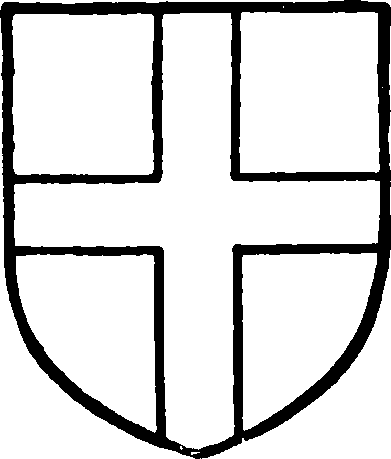
Dean and Chapter of Windsor. Argent a cross gules.
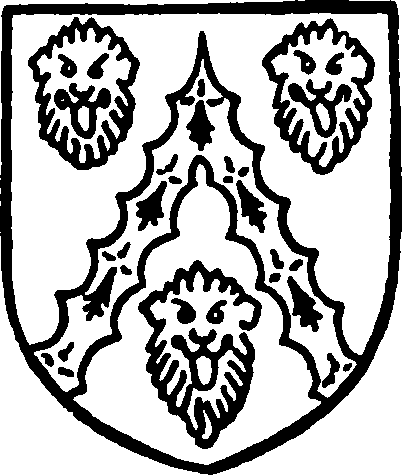
Hill of Thornton Dale. Sable a cheveron engrailed ermine between three leopards' heads argent.
Like Ellerburn, WILTON (Wiltune, xi cent.; Wilitun, xiii cent.) was soke of Pickering in 1086. (fn. 31) Until the 14th century the Bigods held a mesne lordship, (fn. 32) Wilton being said to be a member of their manor of Settrington (fn. 33); in the 14th century it was adjudged to be a member of the honour of Pickering. (fn. 34) Roger de Clere was tenant of Wilton as of Sinnington in the reign of Henry II, (fn. 35) and his descendants (fn. 36) had a mesne lordship here throughout the 13th century. (fn. 37) Roger enfeoffed John Maunsell, provost of Beverley, (fn. 38) who died without issue in about 1264–5. (fn. 39) Roger Bigod claimed the fee as escheat on the ground that John was a bastard, but it was also claimed by Richard and Alice de Bruys, who granted it to William their son. (fn. 40) William was returned as tenant of 7 carucates here in 1284–5, (fn. 41) but in the summer of 1285 the case came into the courts and was decided in favour of Earl Roger. (fn. 42) In 1293 Alice endeavoured to recover the manor on the pretext that the first jury had sworn falsely, but the former judgement was upheld. (fn. 43) Roger Bigod in 1302 alienated Wilton (fn. 44) to John Lovell, (fn. 45) who afterwards conveyed it to John de Heslerton (knighted in 1331), (fn. 46) Margery his wife and their heirs. (fn. 47) John settled the manor on his son Walter, also a knight, who married Eustacia, a congenital idiot, daughter and heir of Peter de Percy, and died in 1349, leaving a son and heir Walter, a minor. (fn. 48) Until the point as to the overlordship was settled Edward III gave the custody to Walter's uncle Thomas, eldest son of John de Heslerton. (fn. 49) Alice widow of Thomas had dower from the manor three years later, (fn. 50) and Walter, nephew of Thomas, died seised in 1367, when his heir was his uncle Sir Simon de Heslerton, kt. (fn. 51) Simon and Katharine his wife in 1375 settled the manor on themselves in tailmale with successive remainders to Sir John de Hotham of Scarborough, kt., and John de Driffield of Lund in tail-male. (fn. 52) They evidently left no male issue, and the distinguished Yorkshire family of Hotham have held the manor of Wilton until the present day. Sir John Hotham, kt., grandson of the above John, (fn. 53) died seised in 1419, leaving a son and heir John, aged eight, (fn. 54) who was Sheriff of Yorkshire in 1456 and died in 1460. (fn. 55) His son John came of age in or about 1480, (fn. 56) was sheriff in 1499, fought at Flodden, (fn. 57) and died in 1524. His son and heir Francis, (fn. 58) then aged four, was knighted in 1544, (fn. 59) died in 1547, and left a son John, who was sheriff in 1584. (fn. 60) John Hotham died in 1609 and was succeeded by his son John, (fn. 61) created a baronet in January 1621–2, (fn. 62) several times member of Parliament for Beverley, and sheriff of the county in 1634. (fn. 63) He at first took the part of the Parliament in the Civil War, holding Hull, of which he was governor, against the king; but in 1644 he had changed to the losing side, and 'for betraying his trust to the Parliament' was beheaded on 2 January 1644–5, his son Colonel John Hotham having suffered the same fate on the preceding day. (fn. 64) Colonel John's son John succeeded his grandfather, (fn. 65) was member for Beverley in six Parliaments and died in 1689. (fn. 66) His son Sir John Hotham of South Dalton died childless in 1691 and was succeeded by his cousin Charles son of Charles Hotham, rector of Wigan (co. Lanc.). (fn. 67) Sir Charles was member for Scarborough in five, and for Beverley in seven, Parliaments and died in January 1722–3. (fn. 68) His son Charles, groom of the bedchamber to George II and member for Beverley in three Parliaments, died in January 1737–8, (fn. 69) and left an only son Charles, who died childless in 1767, having been groom of the bedchamber to George III. He was succeeded by his uncle Beaumont Hotham, the seventh baronet, who died in 1771, (fn. 70) leaving a son and heir Charles, who assumed the name of Thompson on succeeding to the estates of that family. (fn. 71) He died without male issue in 1794, and his brother and heir the Right Rev. Sir John Hotham, Bishop of Clogher, was in 1795 succeeded by a son Charles, who died without issue in 1811. Another brother, William, who had distinguished himself and won the rank of admiral in the French war, was created Lord Hotham of South Dalton in 1797, and became eleventh baronet in 1811; he died unmarried in 1813 and was succeeded by Beaumont his brother. (fn. 72) Beaumont died in 1814 and was succeeded by Beaumont Lord Hotham, son of his son Beaumont; he served in the Peninsular War, was at the battle of Waterloo, and died unmarried in 1870, (fn. 73) when his nephew Charles, son of RearAdmiral George Frederick Hotham, succeeded. He also died unmarried in 1872, when his brother John became fifth baron. (fn. 74) He had served in the Baltic and Crimean war and died unmarried in 1907, when his cousin Frederick William Lord Hotham, the present owner, succeeded him. (fn. 75)
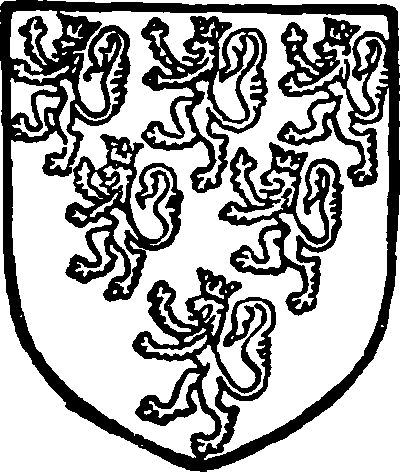
Heslerton. Gules six lions argent having golden crowns.
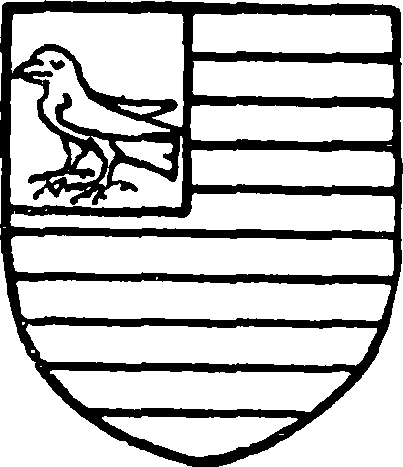
Hotham. Barry of ten pieces argent and azure a quarter or charged with a Cornish chough.
The Earl of Norfolk was summoned in 1278–81 to show his title to amendment of the assize of ale in Settrington, Wilton and elsewhere, but though he gave his title in the other places he did not say why he claimed, or if he claimed, in Wilton. (fn. 76)
Churches
The church of ST. HILDA is a small building consisting of chancel 19 ft. by 12 ft. 8 in., with north vestry, nave 30 ft. 6 in. by 17 ft. 3 in., with western bellcote and south porch. The measurements are all internal.
The fabric of the church is apparently of early Norman date, but the unusual height of the nave walls may be indicative of a pre-Conquest origin. Little alteration appears to have been made to the building till the 15th century except the insertion of a 13th-century lancet in the south chancel wall and the reconstruction of the chancel arch. At the later date, however, buttresses were added where necessary, a chapel was built out south of the nave, and several windows inserted. Early in the 19th century the existing bellcote was erected and the south porch, north vestry and organ chamber are recent additions.
The chancel has a three-light 15th-century east window, and in the north wall is an ancient door leading to the modern vestry. The first window in the south wall is a 13th-century lancet cutting into an early Norman blocked window, of which the arch can be traced rather further to the west. At the west end of the same wall is a two-light squareheaded 15th-century window, and east of it is a blocked priest's door with a segmental external head. In the south wall is a rough square-headed piscina and an aumbry. The chancel arch is of 13th-century date, but the responds are early Norman or perhaps pre-Conquest. They are square on plan and have each an attached shaft on the western angle with rude cushion capitals and bases. The former are ornamented with the volute or spiral pattern found also at St. Mary, Whitby, and on the font at Sneaton, and possibly inspired by St. Hilda's serpents. The imposts have rough carving of the same period, now much defaced. The chancel roof is mainly modern, but some of the old timbers remain.
The nave has a modern three-light window in the north wall and the blocked north door has the appearance of very early work. At the east end of the south wall are traces of an arch of 14th or 15thcentury date, opening into a chapel which has now entirely gone. Immediately above this arch are remains of the head of the original Norman window. The south porch is a modern gabled stone structure, and high up in the south wall two plain squareheaded two-light windows, also of modern date, have been inserted. The ugly square stone bellcote at the west end containing one bell rests on two buttresses against the wall and was built in the early 19th century. The nave roof is entirely modern. The walls are built of fairly large rubble, wide jointed and roughly coursed.
The font is a rough circular bowl, probably of the 12th century, on a modern base. Of the woodwork the Jacobean pulpit is octagonal with a sounding board having an inlaid soffit, and the nave pews are Jacobean and similar to those at Sinnington but much repaired. Built into the walls of the church are several fragments of pre-Conquest sculpture, including a mutilated cross head with knotwork, another plain and also mutilated, and two 'hog-backs,' all in the porch; a little stone with two human demi-figures, a cross head and part of a shaft with a bound serpent in the south nave wall, and other fragments.
The plate consists of a cup (Newcastle, 1755) inscribed 'Ellerburne 1756,' a paten presented in 1888 and a pewter flagon and plate.
The registers are as follows: (i) baptisms and burials 1691 to 1770, marriages to 1754 only; (ii) marriages 1754 to 1813; (iii) baptisms and burials 1771 to 1812.
The church (dedication unknown) at WILTON was completely rebuilt in 1911, the south arcade being ancient work re-used. The old church was a barn-like structure consisting of a chancel about 16 ft. 3 in. long and nave 42 ft. 8 in. by 17 ft. The destruction of this building revealed the existence of a 13th-century arcade in the south nave wall, and excavation on the north side showed that an aisle had formerly existed there also, giving a total width to the nave of 32 ft. 8 in. The chancel was quite a featureless building, apparently of late date, with square-headed 17th or 18th-century windows and roofed with slate.
The nave appeared equally uninteresting, having a three-light square-headed 17th-century window in the south wall with a small single-light opening further west and a flat-pointed south door probably of the 17th century. In a recess in the wall hung two bells. The nave roof was tiled. The arcade discovered in the south wall was four bays long with two circular and one octagonal pier and a half-round eastern respond. The piers had moulded bell capitals and bases of the 13th century. No trace was discovered of the arcade on the north side, which was probably destroyed in mediaeval times.
The plate consists of a mid-17th-century cup with the mark of John Thompson of York, 1635, modern paten and a pewter flagon and two plates of the same material.
Advowson
Ellerburn and Wilton form one benefice, the advowson of which has descended with that of Pickering (q.v.) and is now in the gift of the Archbishop of York. When the vicarage of Pickering (q.v.) was ordained in 1252 it was enacted that in the dependent chapels of Ellerburn and Wilton there should be one vicar who should find the necessary ministers for each chapel. (fn. 77) Complaint was made in 1596 that the vicar had not preached the four sermons he was supposed to administer yearly to his flock, that he was not resident, offered no hospitality and gave no alms to the poor. (fn. 78)
Charities
In 1895 Robert Champley, by his will proved at York 15 June, left £100 to be invested and the income to be applied by the minister and churchwardens in the distribution of money or coal. The legacy is represented by £92 14s. consols with the official trustees. In 1906 the dividends, amounting to £2 6s. 4d., were distributed on St. Thomas's Day among twenty poor people.
Township of Wilton.—A sum of £23 under the title of Poor's Money, the amount of some small benefactions for the poor of this township, was in 1843 distributed among the poor.