A History of the County of York North Riding: Volume 2. Originally published by Victoria County History, London, 1923.
This free content was digitised by double rekeying. All rights reserved.
'Parishes: Wykeham', in A History of the County of York North Riding: Volume 2, ed. William Page (London, 1923), British History Online https://www.british-history.ac.uk/vch/yorks/north/vol2/pp498-501 [accessed 2 May 2025].
'Parishes: Wykeham', in A History of the County of York North Riding: Volume 2. Edited by William Page (London, 1923), British History Online, accessed May 2, 2025, https://www.british-history.ac.uk/vch/yorks/north/vol2/pp498-501.
"Parishes: Wykeham". A History of the County of York North Riding: Volume 2. Ed. William Page (London, 1923), British History Online. Web. 2 May 2025. https://www.british-history.ac.uk/vch/yorks/north/vol2/pp498-501.
In this section
WYKEHAM
Wichame, Wicam (xi-xiv cent.).
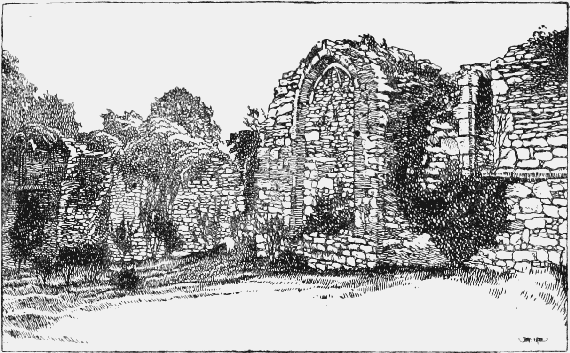
Wykeham Abbey Church: Remains of the North Wall
This parish is composed of the township of Wykeham with Ruston and covers a narrow strip of land running 11 miles from north to south. Its area is 8,199 acres, of which 1,683 acres are arable, 1,034 acres permanent grass and 542 acres woodland. (fn. 1) The village of Wykeham and hamlets of Ruston and Langdale End are situated on alluvial ground by the River Derwent; to the north the subsoil is Corallian Beds, Oxford Clay and Inferior Oolite, the soil gravel, clay and lime; gravel and stone are worked. The chief crops are wheat, barley, oats and turnips. Two thousand acres of land were inclosed in Wykeham and Ruston in 1785, (fn. 2) and a partial award for Wykeham was filed in 1787. (fn. 3) The 'ancient boundary of Wykeham and Ruston,' sworn to in 1619–21, (fn. 4) coincides with the present parish boundary. The village is on the Scarborough and Malton road, which skirts the north of the park, and is connected by two lanes with Ruston close by.
The remains of the Cistercian priory of St. Mary the Virgin closely adjoin the modern house called Wykeham Abbey, the seat of Viscount Downe. The present house is a handsome modern structure surrounded by extensive gardens and a park of 160 acres. The only relic of the monastic building is the north wall of the priory church. It dates from the close of the 12th century, the eastern portion being somewhat the earlier in date and probably contemporary with the foundation. The church appears to have been an aisleless cruciform building, but, as there are no traces of either the eastern or western walls, the length of the building is indeterminate. The wall of the eastern arm contains one deeply splayed blocked 12th-century window with traces of a second, also blocked, further west. A string-course is carried along the wall internally at the level of the sill. The responds and springing of the north transept arch of similar date still remain, but the opening is built up. The north nave wall appears to date from c. 1200 and retains two blocked lancets at the western end and a three-light 14th-century window further east. According to a survey taken at the Dissolution (fn. 5) the church was 90 ft. long by 22 ft. wide and had a high altar and three altars in the quire and two in the body of the church. From the absence of any mention of transepts they were evidently disused or destroyed at this time. The conventual buildings stood on the south side of the church, as the north was occupied by the parish church and churchyard. From the survey already mentioned, it appears that the cloister was 60 ft. square, with alleys 8 ft. wide, two of which were lead covered, and that the chapterhouse was 20 ft. long Numerous other buildings are detailed. The churchyard is still kept up and contains a mutilated stone cross. A tombstone (dated 1691) near the centre of the plot is formed of a solid block of stone almost square in section, and near the west wall is a narrow coped slab with a defaced Lombardic inscription.
The old parish church of All Saints, which stood within the churchyard, was pulled down in 1853. It consisted of nave and quire without structural division, a north aisle and chapel, a western tower and south porch. The nave appears to have been of late 12thcentury date, and was separated from the aisle by an arcade of four bays resting on heavy cylindrical piers with sculptured capitals. The tower was a 14thcentury structure three stages high with an embattled parapet and the quire showed 13th-century features. No trace of any part of the building now remains. (fn. 6)
The hamlet of Langdale End consists of a few scattered farms near the head of the well-wooded valley of the Derwent.
Wykeham has a station on the Pickering and Seamer branch of the North Eastern railway and a public elementary school. Wesleyan services are held in a room at Ruston, and a Primitive Methodist chapel was built in 1904 on a site given by Viscount Downe.
Manors
Ten carucates in Marton, (fn. 7) Wykeham and Ruston were soke of the king's manor of Falsgrave in 1086, (fn. 8) but these places were subsequently held of the honour of Pickering, (fn. 9) and, in March 1559–60, in chief. (fn. 10)

Wykeham Abbey: The South Front

Hutchinson. Party azure and gules crusily or a lion argent.

Langley. Paly argent and vert.

Dawnay. Argent a bend between cotises sable with three rings argent on the bend.
In the early 12th century Pain de Wykeham, son of Osbern or Osbert, granted his house to WYKEHAM PRIORY; Theobald, Pain's son, gave the nuns 48 acres of land here, while 'the younger King Henry,' eldest son of Henry II, granted them 103 acres in Wykeham and the seat of the mill 'in Raddak or Radal.' (fn. 11) The priory held the manor of Wykeham until the Dissolution, (fn. 12) after which, in 1544, the site and grange (1½ miles north) were granted to the king's servant Francis Poole. (fn. 13) Francis in the same year alienated the manor to Richard Hutchinson, his heirs and Helen his wife. (fn. 14) Richard died seised of the rectory and demesnes in March 1559–60. (fn. 15) His son and heir Edward, (fn. 16) who obtained a grant of arms in 1581, (fn. 17) died seised of the site, grange, rectory, advowson and a capital messuage called Leake Close in February 1585–6, leaving a son and heir Stephen. (fn. 18) Stephen died in 1648 (fn. 19); in his will he disinherited his son Edward, who was a colonel in the royal army, 'as I conceive he hath beene disaffected to ye state, and thereby hath incurred my displeasure,' in favour of his infant grandson Edward. (fn. 20) The Royalist compounded with the Parliament in 1649 (fn. 21) and died in 1653. (fn. 22) His son Edward made settlements of the manor, site and rectory early in 1665–6 (fn. 23) and in 1691. (fn. 24) Richard Hutchinson was dealing with property here in 1706. (fn. 25) Richard Hutchinson of Wykeham Abbey assumed the name of Langley on succeeding to the estates of his uncle Thomas Langley at North Grimston. He died between 1752 and 1757 (fn. 26) and was succeeded by his son (fn. 27) Boynton Langley, (fn. 28) who died in 1772, leaving a son Richard. (fn. 29) Richard died childless in 1817, having bequeathed his estates to his cousin the Hon. Marmaduke Dawnay, younger son of the fourth Viscount Downe, who in 1824 assumed with royal licence the name of Langley. (fn. 30) He died unmarried at Wykeham Abbey in 1851, (fn. 31) and Wykeham has since descended with Danby. (fn. 32) Viscount Downe is the present owner.

St. Helen's Tower and All Saints' Church, Wykeham
A 'manor' assessed at half a carucate in Marton and Wykeham in 1086 was subsequently given to Robert de Brus. (fn. 33) Pain de Wykeham granted it to Whitby Abbey for the soul of Osbern his father, Thomas his son, his lord Robert de Brus and Robert's wife Annis, a grant confirmed by King Stephen. (fn. 34)
RUSTON (Rostun, Roston, xi-xiv cent.; Royston, xiii cent.) seems to have been an appurtenance of the manor of Wykeham. As 'Ruston cum Wykeham' it belonged to the priory in 1316, and in 1619–21 it was returned among the manors in the honour as 'Wykeham and Ruston,' which was thought to belong to Stephen Hutchinson and James Harton. (fn. 35) James Harton had made a settlement of Ruston (fn. 36) early in 1617–18, and conveyed the 'MANOR OF WYKEHAM alias WYKEHAM RUSTON' in Wykeham and Ruston in 1637 to William Chapman in fee. (fn. 37) John Chapman made settlements of the manor of Ruston in 1671, (fn. 38) 1697 (fn. 39) and 1711–12. (fn. 40) In 1716–17 Stephen, Edward, James, Eleanor and Dorothy Chapman and others conveyed it to John Moyser and John Ward. (fn. 41)
Churches
The church of ALL SAINTS, built in 1853 on the destruction of the old church by Wykeham Abbey, is a modern Gothic structure consisting of an aisled nave, a quire and south porch. The west window is filled with modern heraldic glass representing the connections and descent of the Dawnay family. The roofs are remarkable for their steep pitch.
Immediately to the south of the modern church is the site of the chapel said to be that of ST. HELEN, built by John de Wykeham in 1321. The western tower of this building remained in ruins until 1855, when it was restored and practically rebuilt in its present form by Mr. Butterfield, architect. The old tower (fn. 42) was evidently of the 14th century. It was three stages. high and retained the base of a broach spire of stone. Nearly all the ancient features have disappeared, the spire is quite modern and a ribbed vault has been inserted to the lowest stage. It now forms an entrance gate to the modern churchyard, and in it are hung five bells cast by Taylor & Co. in 1900.
Under a small lych-gate between the churchyard and the vicarage garden is hung a small bell inscribed, 'Peace and good neighbourhood 1784.'
The plate of Wykeham is all modern. It includes a cup and flagon (London, 1851) and a paten (London, 1852) presented by Viscount Downe, 1852.
The registers previous to 1812 are as follows: (i) mixed entries 1653 to 1671, burials missing for 1670; (ii) mixed entries 1671 to 1710; (iii) mixed entries 1710 to 1727; (iv) baptisms 1727 to 1768, marriages 1727 to 1757, burials 1727 to 1772; (v) baptisms 1768 to 1773, marriages 1758 to 1773, burials 1773 to 1775; (vi) baptisms 1773 to 1790, marriages 1775 to 1799, burials 1775 to 1790; (vii) baptisms and burials 1790 to 1812; (viii) marriages 1799 to 1812.
LANGDALE END CHAPEL was built in 1884 by Mary Isabel Viscountess Downe. It is a plain rectangular building of stone with a shallow chancel and south porch in the 13th-century Gothic style. The bellcote on the west gable contains one bell. In the churchyard is a large cross erected in memory of the Hon. G. C. Dawnay, who died in 1889. It is a chapel of ease to All Saints.
Advowson
The church was given by Pain son of Osbert and 'three others' to Wykeham Priory. (fn. 43) Perhaps the three others were Wlmar, priest of Wykeham, Urca son of Karl and Gamell, who surrendered to Bridlington Priory all their right in the church, and this Bernard Prior of Bridlington (circa 1145) (fn. 44) surrendered to the nuns of Wykeham. (fn. 45) It was appropriated by 1292. (fn. 46) After the Dissolution it was granted in 1546 (fn. 47) to William Ramsden and Richard Vavasor in fee. William Ramsden shortly afterwards had licence to alienate it to Richard Hutchinson. (fn. 48) It has since descended with the manor (q.v.). The living is a perpetual curacy.
A chapel of St. Helen belonged to the priory 'time out of mind'; it was pulled down because in ruins by 1321, when John de Wykeham erected a new chapel at his own cost in honour of the Virgin and St. Helen. (fn. 49) John de Wykeham endowed the priory with lands and rents for finding two perpetual chaplains to celebrate service daily herein for the soul of himself, his ancestors, heirs and all faithful departed. (fn. 50)
Charities
An annual sum of £1 is distributable among the poor in bread in respect of a charity known as the poor's money. In 1824 the Hon. Mrs. Dorothy Langley, by will proved in the P.C.C. 2 June, bequeathed £1,027 consols, the dividends to be applied for the benefit of the poor. In 1906 the dividends, amounting to £25 13s. 6d., were divided among eighteen recipients.
In 1906 a sum of £175 17s. 2d. was on deposit in the Scarborough Savings Bank in respect of a charity known as the Cockerill charity, founded about 1831, of which trustees were appointed by an order of the Charity Commissioners of 9 March 1906.
The Wesleyan chapel at Langdale End, founded by deed, 1822, is regulated by a scheme of the Charity Commissioners, 1893.