A History of the County of York North Riding: Volume 1. Originally published by Victoria County History, London, 1914.
This free content was digitised by double rekeying. All rights reserved.
'The honour and castle of Richmond', in A History of the County of York North Riding: Volume 1, ed. William Page (London, 1914), British History Online https://www.british-history.ac.uk/vch/yorks/north/vol1/pp1-16 [accessed 30 April 2025].
'The honour and castle of Richmond', in A History of the County of York North Riding: Volume 1. Edited by William Page (London, 1914), British History Online, accessed April 30, 2025, https://www.british-history.ac.uk/vch/yorks/north/vol1/pp1-16.
"The honour and castle of Richmond". A History of the County of York North Riding: Volume 1. Ed. William Page (London, 1914), British History Online. Web. 30 April 2025. https://www.british-history.ac.uk/vch/yorks/north/vol1/pp1-16.
In this section
TOPOGRAPHY
THE HONOUR AND CASTLE OF RICHMOND
The great honour subsequently known as the honour of Richmond may be said to date from the time when William the Conqueror gave an extensive district in Yorkshire—some if not all of which had belonged to Edwin Earl of Mercia—to his kinsman and supporter Alan Rufus of Britanny in return for his services at the Conquest. (fn. 1) The date of the grant is uncertain, and no charter remains to bear witness to it. The miniature preserved in the Register of the honour (fn. 2) is clearly not a copy of a genuine document and has the value only of representing tradition. (fn. 3) If, however, this tradition may be credited the gift was made at the siege of York. The most likely date in that case would seem to be 1069, (fn. 4) when Edwin was still living, but had probably forfeited his lands as a consequence of his rebellion in 1068. If the evidence of the so-called charter is inaccurate on this point as on others the grant may have been delayed until after the death of Edwin in 1071. It is clear, at all events, that Count Alan was in possession of the district later known as Richmondshire when the Survey of 1086 was made. (fn. 5) But no territorial entity of that name is to be found in Domesday Book. The vast possessions which were afterwards known as the liberty, honour or earldom of Richmond are therein described as 'the land of Count Alan' and the Yorkshire nucleus is divided under the two chief manors of Gilling and Catterick. (fn. 6) The first mention of the 'honour of Richmond' does not occur until 1203, (fn. 7) and in the early part of the 13th century it was quite as often called the honour of Britanny. (fn. 8)
The full and permanent extent of the honour of Richmond is probably given in Domesday Book. But its limits cannot be established with absolute certainty until two difficult problems have been solved.
In the first place it is necessary to know if the name 'Count Alan' represented one or more tenants in chief. No less than three contemporary members of the house of Britanny then bore the name of Alan. One, Alan Fergant, was the reigning count; Alan Rufus and Alan Niger were his cousins. (fn. 9) Until the publication of the Recherches sur le Domesday in 1842 it seems to have been generally assumed that only one of these was a tenant in chief of the Conqueror. (fn. 10) The authors of that work (fn. 11) were, however, convinced that all three occupied that position. They also professed to know the exact territory which had been assigned to each, (fn. 12) and their views have met with some acceptance. (fn. 13) But they gave no reasons for their assurance on this point, and there is evidence that they erred in some at least of their conclusions. (fn. 14) The older view that there was but one tenant in chief of that name is the more acceptable, and, pending further evidence to the contrary, the extent of the honour of Richmond in 1086 may be held to comprise all the territory attributed to him in Domesday Book. In 1086 'Count Alan' held land in Cambridge, Dorset, Essex, Hampshire, Lincolnshire, Hertfordshire, Norfolk, Northamptonshire, Nottinghamshire and Suffolk, as well as in Yorkshire. (fn. 15) These vast and widely-distributed territories made him one of the chief landowners in England. He had 199 manors in his Yorkshire castlery alone, (fn. 16) and they formed less than half of the whole number.
It is also necessary to inquire how far the limits of the honour were permanent. If an 'honour' is 'a mass of lands which from of old have been held by a single title,' (fn. 17) its extent cannot in strictness be variable. The evidence of documents would at first sight seem to show that the limits of the honour of Richmond changed in some measure with the holder. But it is clear that the tale of its lands set down in these documents is not always complete, (fn. 18) and also that other lands belonging to various lords of the honour were often loosely and inaccurately described as a part of it. (fn. 19) On the whole therefore it is safe to conclude that an honour could not be increased or decreased at will. (fn. 20)
In the Middle Ages the honour of Richmond was usually in royal or semi-royal hands.
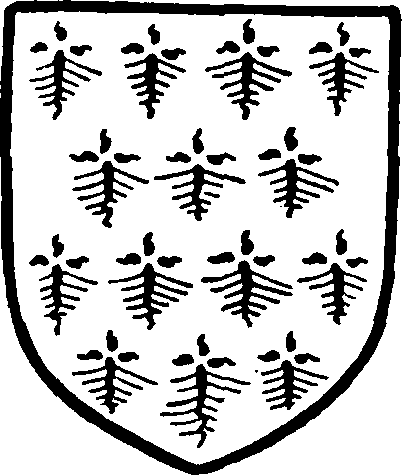
Arthur of Britanny. Ermine.
Alan Rufus, first lord of Richmond, was a younger son of Eudes Count of Penthiévre and a second cousin of the reigning Duke of Britanny. (fn. 21) Through his grandmother Hawise, sister of Richard II of Normandy, he could also claim relationship with William the Conqueror. He was probably the builder of Richmond Castle. He died in 1089 (fn. 22) and was succeeded by his brother Alan Niger, who died without issue about four years later. (fn. 23) The successor of Alan Niger, Stephen Count of Penthiévre, is usually believed to have been another brother. (fn. 24) He died at Begar 13 April 1137 (not in 1144, as stated in the 15th-century genealogy of the lords of Richmond) (fn. 25) and his heart was buried at York. (fn. 26) Stephen's heir was his son Alan, (fn. 27) the third of Richmond, the second to bear the surname of Niger. (fn. 28) This Alan was notorious for his cruelty even in that cruel age. He was a supporter of King Stephen against the Empress Maud, and he is said to have tried to avenge the king's capture at Lincoln by laying an ambush for the Earl of Chester. Instead he was himself taken prisoner and compelled by torture to deliver up the county of Cornwall, which Stephen had committed to his charge. (fn. 29) Through his marriage with Bertha, the daughter and heiress of his second cousin Conan III of Britanny, he prepared the way for the union of Britanny and Richmond. (fn. 30) He was possibly the first lord of the honour to be called Earl of Richmond, (fn. 31) but it is doubtful if he was an earl in the true sense of the word at that date. (fn. 32) In his charters he usually styled himself Count of Britanny and England. (fn. 33) He died about 1146 (fn. 34) and was succeeded by his son Conan. (fn. 35) Conan the Little, as he was called, (fn. 36) lacked both courage and determination. In 1166, finding it difficult to defend Britanny, which he had inherited in 1164, (fn. 37) against his step-father Eudes Count of Porhoët, he betrothed his infant daughter Constance to Geoffrey son of Henry II and resigned his duchy to that ambitious monarch. (fn. 38) As the reputed builder of Richmond Keep, (fn. 39) Conan holds a prominent place in the annals of the town. He was the first lord of the honour to style himself Earl of Richmond (Richmundiae). (fn. 40) He married Margaret sister of Malcolm IV, King of Scotland, and died in February 1170–1, leaving as his sole heir his daughter Constance, (fn. 41) aged about nine years. (fn. 42) For some twelve years after the death of Earl Conan, Henry II, as her guardian, kept the honour in his own hands. (fn. 43) Though he married her to his son Geoffrey in 1181, (fn. 44) he did not apparently relinquish Richmond until 1182 or 1183. (fn. 45) It is not improbable, moreover, that he retained the castle even after he had parted with the honour. (fn. 46) Geoffrey of Anjou, Duke of Britanny and Earl of Richmond, died in 1186, being killed in a tournament at Paris. (fn. 47) The second husband of Constance, forced upon her, it is said, by Henry II, in February 1187–8, was Ranulph de Blundevill Earl of Chester. (fn. 48) In 1196, at the instigation of Richard I, and while under the influence of jealousy, Ranulph arrested his wife and kept her in prison for a year. But when her son Arthur made peace with Richard in 1197 she recovered her liberty (fn. 49) and not long afterwards repudiated her second marriage. (fn. 50) Her third husband, whom she married in 1199, was Guy, second son of William Vicomte de Thouars; he survived her some years. (fn. 51) Constance died in 1201, leaving one son and three daughters. Her son Arthur and her daughter Eleanor were the offspring of her first marriage; her two other daughters, Alice and Catherine, the children of the third. (fn. 52) Arthur, who, according to modern ideas of inheritance, should have been heir to the English Crown, to Britanny and to Richmond, was murdered in 1203 by his uncle John.
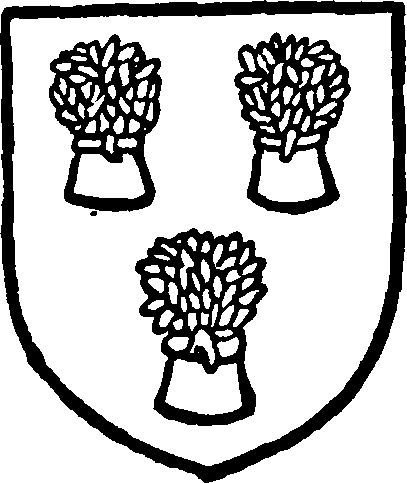
Ranulph of Chester. Azure three garbs or.
The history of the honour between the death of Geoffrey and the accession of Henry III is rather obscure. Constance appears, however, to have remained in more or less undisturbed possession while she lived. (fn. 53) In December 1201, some three months after her death, her widower Guy de Thouars was undoubtedly recognized as tenant of the honour. (fn. 54) Whether he held as guardian of Arthur or at farm does not transpire. (fn. 55) At some uncertain date, moreover, in the reign of John the 'Count of Britanny' (fn. 56) obtained a writ exempting him from scutage. (fn. 57) In 1202 'Guy de Thouars, Count of Britanny,' received a licence from the king to sell his wood of Richmond on condition that half the proceeds went to the Crown, (fn. 58) and on 2 April 1203 a ratification of the farm which he paid annually from the honour. (fn. 59) On the following day Arthur of Britanny disappeared and his stepfather subsequently played a leading part in the war against King John. (fn. 60) It is not surprising, therefore, that the honour of Richmond was forfeit in the following autumn. On 11 September the king ordered one of the manors in Norfolk to be delivered to the Bishop of Norwich (fn. 61) and eight days later he announced that the whole land of Richmondshire as the Count of Britanny used to have it with the forest and knights' fees had been granted to Robert de Beaumont fourth Earl of Leicester, and Geoffrey Fitz Peter was ordered to give him seisin. (fn. 62) The Earl of Leicester died a few months later without issue, (fn. 63) and his lands lapsed to the Crown. (fn. 64) In March 1204–5 the Richmondshire portion was granted with certain reservations to the Earl of Chester (formerly husband of Constance). King John retained 6½ knights' fees of Roald Constable of Richmond and 3¼ fees of Henry son of Hervey. (fn. 65) It is possible, therefore, that the documents which indicate that the honour was held by the Crown almost to the close of the reign refer to the portion outside Richmondshire and to the fees mentioned only. (fn. 66) The Earl of Chester appears at all events to have had an interest in Richmondshire, probably in consideration of his exceptional fidelity to the Crown, (fn. 67) for many years longer. (fn. 68) The castle was apparently in John's hands throughout this period. (fn. 69) It was perhaps the royal part only (fn. 70) which the king offered to Peter de Braine towards the close of his reign. In 1215 John proposed to restore the honour to the house of Britanny if Peter, who was then duke in right of his wife Alice, elder daughter of Constance and Guy de Thouars, (fn. 71) would come to England with horses and arms to aid him in his war against the barons. (fn. 72) From later evidence it is clear that a partition of the honour was then arranged. The Earl of Chester seems to have kept his part of Richmondshire, while the southern portion of the honour was divided between the king and Peter. (fn. 73) When, however, Peter landed in England in 1217 he is said to have come as an ally of Prince Louis, not of the King of England, (fn. 74) and his wife's territory must have been forfeit to the Crown. But Henry III (fn. 75) was eager to buy his goodwill with grants from the honour of Richmond, and in October 1217, after the conclusion of peace, he gave him the manor of Cheshunt in Hertfordshire. (fn. 76) In November, on the other hand, the land of the honour in the eastern counties was bestowed upon Ranulf Earl of Chester. (fn. 77) In the following month, however, the king resumed possession of the demesnes in Norfolk and Suffolk, (fn. 78) and in January he ordered that all those in the county of Lincoln, except the knights' fees, were to be delivered to the Earl of Chester and the seneschal of the Duke of Britanny jointly. (fn. 79) Henry's next step was to order an extent to be made of the demesne lands and an inquisition into the knights' fees. (fn. 80) He then selected thirty fees south of the Humber for his own use, (fn. 81) and Peter, after undertaking not to claim any of the lands in this part of the honour except those which had been assigned to him, (fn. 82) received seisin of the rest in January 1218–19. (fn. 83) The Earl of Chester apparently retained the Richmondshire part of the honour, but, by order of the Crown, he surrendered to the Duke of Britanny the castle guard of Richmond from fees south of the Humber, obtaining in compensation £23 from the issues of the market of Boston, Lincoln. (fn. 84) In March 1220–1 he was further compensated for 25 librates of land which he had lost through the partition of the honour. (fn. 85) The Duke of Britanny's portion of the honour was temporarily confiscated in 1223 for omission to perform his military service with the army in Wales. (fn. 86) A year later he forfeited it (fn. 87) for the more serious offence of joining the French king in an attack upon the English in Poitou and Gascony. (fn. 88) But this breach between Henry and Peter was, like the former, soon healed. Henry III wanted the duke's aid for an invasion of France, while Peter cherished the hope of rendering Britanny independent of the French king with the help of the English. In March 1224–5, therefore, Peter received a safe conduct to England, (fn. 89) and in April Henry required him to make immediate amends for his transgression of the previous year in occupying the castle of Theobald Crespin and doing homage to the King of the French. (fn. 90) Peter appears to have satisfied Henry, for the order to give him seisin of his lands in the counties of Lincoln, Cambridge, Hertford, Norfolk and Suffolk was issued in May of the same year. (fn. 91) The new alliance was very close. In return for the support of the duke, Henry promised to marry his daughter Yoland, and, in the event of Peter losing his territory in France by reason of this compact, to give him the whole honour of Richmond, whoever might be in possession of its lands. (fn. 92)
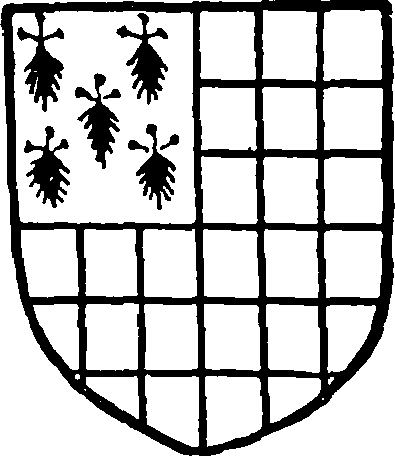
Peter of Britanny. Checky or and azure with a quarter ermine.
Later events suggest that Peter received the whole of the honour about this time or shortly afterwards. (fn. 93) If so, he did not keep it long. After the successful campaign in Gascony he was compelled to come to terms with Louis IX at Vendôme in March 1226–7. (fn. 94) Regardless of his pre-engagement to Henry III, he betrothed Yoland to John Duke of Anjou, brother of the King of France, and was in consequence once more deprived of his lands in England. (fn. 95) Henry III is said to have bestowed them upon his brother Richard Earl of Cornwall in 1227. This statement would, however, seem to be erroneous, and to have been due to a confusion between the Duke of Britanny and his brother Robert Count of Dreux, (fn. 96) In May of this year the Earl of Chester received a grant of the whole of that part of the honour of Richmond which he had formerly had from King John. The grant was for life, unless the king should admit the Duke of Britanny to his peace once more or the Earl of Chester should recover the lands in Normandy which he had lost in the service of John. (fn. 97) In June the king appointed a custodian of all the duke's lands and fees except the manor of Cheshunt, (fn. 98) which he gave to the Bishop of Carlisle in the following month to hold until it should be returned to Peter or his heirs. (fn. 99) About the same time the manor of Washingborough in Lincolnshire was committed to the Earl of Chester to be held during pleasure. (fn. 100) It is clear from the temporary nature of these grants that Henry III hoped for an early renewal of his alliance with the Duke of Britanny. He needed his aid, as a matter of fact, for another attempt to recover the English possessions in France. In 1230, therefore, he gave him back the honour of Richmond, and on this occasion there can be little doubt that the grant included Richmondshire. (fn. 101) The new enterprise was not very successful, and after Henry's return to England Peter, being deserted by his Breton vassals, was compelled to ask Louis for a truce. (fn. 102) When it expired, three years later, the King of France invaded Britanny, and though Henry III sent aid to the duke it proved inadequate. (fn. 103) In 1234 Peter was obliged to make a complete submission to Louis, (fn. 104) and for this he finally forfeited the honour of Richmond. (fn. 105) Henceforward he remained faithful to the King of France, who permitted him to rule his duchy until his son John came of age in 1237. (fn. 106) He seems to have made no further attempt to recover Richmond, and, having twice taken the cross, died at sea in 1250. (fn. 107)
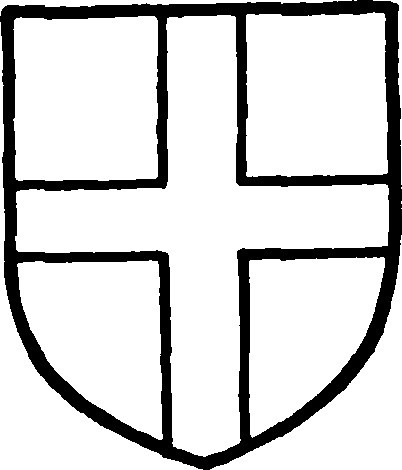
Peter of Savoy. Gules a cross argent.
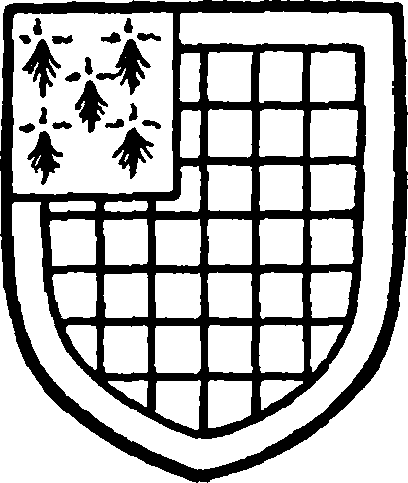
John I and II, Earls of Richmond. Checky or and azure with a quarter ermine and a border gules.
Henry III kept the honour of Richmond in his own hands for a short time after its escheat in 1234. (fn. 108) In September 1235, however, he granted Hinton in Cambridgeshire to Alan de Nevill, (fn. 109) and in the following year he committed the rest of the lands of the Duke of Britanny to William Bishop-elect of Valence, (fn. 110) an uncle of the queen, to hold during pleasure. William died three years later, (fn. 111) and in 1240 the king gave the honour to Peter of Savoy, (fn. 112) another uncle of Queen Eleanor. (fn. 113) In 1242 John I Duke of Britanny petitioned for its restoration to his house. Henry thereupon asked what aid John and his father Peter would give him towards the recovery of his own rights if he granted their request. (fn. 114) The reply, if received, must have been unfavourable, for in the following year the king complained that the duke, by attacks on the English at sea, had broken the truce between England and France, and he ordered the men of the Cinque Ports to be ready for reprisals in case the duke refused to make amends. (fn. 115) Friendly relations were restored by 1245 at latest. In that year a marriage was probably first proposed between John, heir-apparent of Britanny, and the king's daughter Beatrice, (fn. 116) and Henry undertook to give the former 2,000 marks a year in compensation for the honour of Richmond. (fn. 117) Fourteen years later commissioners were appointed to arrange the union, (fn. 118) and the Duke of Britanny once more prayed for the restoration of his hereditary lands. Henry expressed his readiness to comply with his request if Peter of Savoy could be induced to relinquish the honour of his own free will. (fn. 119) Peter evidently refused, whereupon Henry's former grant of 2,000 marks a year in compensation was repeated. Part of this sum was to be paid by the King of France out of money due from the land of the Agenais and the rest from the Exchequer. Meanwhile the honour of Richmond was to be extended, and the grant was ultimately to be increased or decreased in accordance with the value thus revealed. (fn. 120) The marriage between John of Britanny and Beatrice had taken place in January 1259–60. (fn. 121) The king thereupon obtained a quitclaim to the honour from the Duke of Britanny, which he promised should stand good in favour of Peter of Savoy, undertaking at the same time not to disseise Peter except with his consent and to remove the existing limitation on his power to dispose of it. (fn. 122) In 1262, therefore, he gave him the famous licence, apparently unique in English history, (fn. 123) which enabled him to bequeath it to whomsoever he would. (fn. 124) Later in the year Peter restored to the king for the use of Prince Edward certain manors in Norfolk and Suffolk, part of the honour of Richmond, in exchange for the honour, castle and rape of Hastings and other lands in Sussex. (fn. 125) During the constitutional disturbances which followed Peter of Savoy seems to have lost his lands for a time. In January 1263–4, however, the king ordered that the issues therefrom should be paid to him, (fn. 126) and in 1265 that the honour of Richmond should be restored. (fn. 127) In the following year Peter appears at last to have agreed to a complete exchange of the honour, and an order was issued for its restoration to the Duke of Britanny, (fn. 128) who immediately conveyed it to his son John. (fn. 129) But when Peter of Savoy died in 1268 it was found that he had bequeathed the honour to Queen Eleanor, and the queen had to be compensated for her loss. (fn. 130) John (II) of Britanny had already done homage for the honour of Richmond, (fn. 131) and he now relinquished all claim to compensation for it. On the day of this surrender Henry III directed Prince Edward to order the knights and free tenants of the earldom to render obedience to John of Britanny, (fn. 132) and for twenty-six years afterwards the honour of Richmond remained in his possession. (fn. 133) In 1269 he obtained a licence from the king to let certain lands and tenements belonging to the honour to farm during his absence in the Holy Land with Prince Edward. (fn. 134) In January 1278–9 when going to Rome, and thence to the Holy Land, (fn. 135) he received five years' exemption from personal service with the king's army. He became Duke of Britanny on the death of his father in 1286. (fn. 136) Three years later he was pardoned for failure to do service in the last two wars in Wales and acquitted of £200 scutage for the same. (fn. 137) When war broke out between England and France in 1294 he found himself in the difficult position of owing fealty to both combatants. Though Edward I was his brotherin-law he took the part of France, whereupon his lands in England escheated to the Crown. (fn. 138) They were, however, restored to him in April 1298, to be held during the truce between England and France. (fn. 139) In October of the same year he received permission to levy the arrears which were due to him before the war. (fn. 140) A year later he had a grant of all the wardships in the earldom of Richmond that had come into the king's hands during the war, (fn. 141) and in 1300 he was acquitted of service in Scotland, the king declaring himself well content with that of his son. (fn. 142) The castle of Richmond and his lands were finally restored to him in 1304 in conformity with the terms of peace between England and France. (fn. 143) On 14 November the following year, while assisting at the coronation of Pope Clement V at Lyons, the Duke of Britanny was mortally injured by the sudden collapse of a wall which had been overburdened with spectators. After his death, four days later, (fn. 144) Edward I kept the honour in his own hands for some months. (fn. 145)
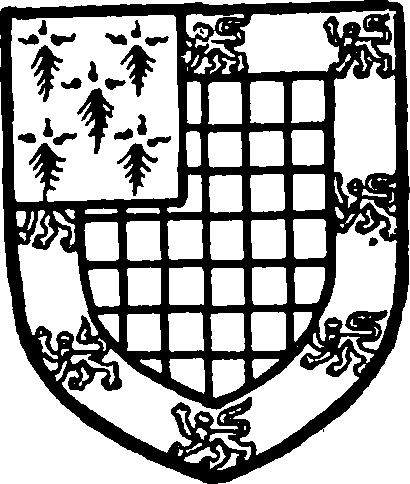
John III and IV, Earls of Richmond. Checky or and azure with a quarter ermine and a border of ENGLAND.
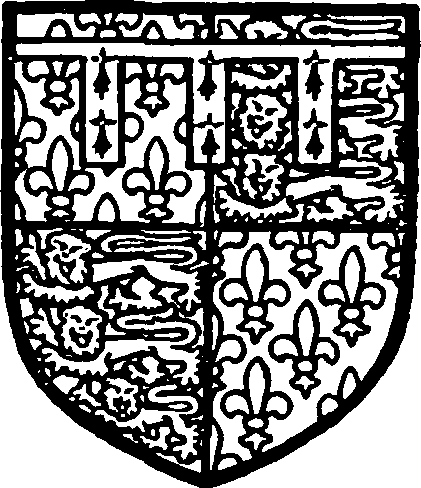
John of Gaunt. The royal arms of EDWARD III with a label ermine.
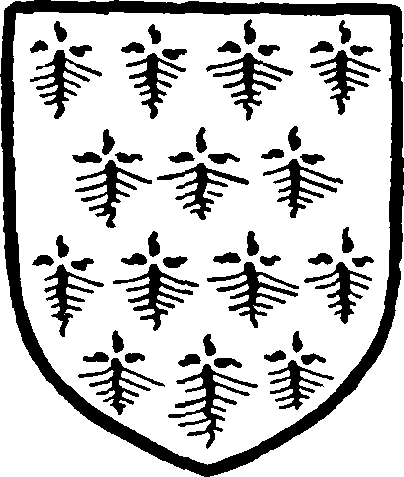
John I and II of Montfort. Ermine plain.

Anne of Bohemia. Argent an eagle sable with two heads.
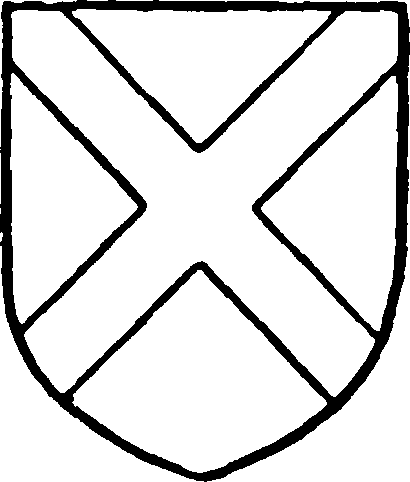
Nevill, Earl of Westmorland. Gules a saltire argent.
The new Duke of Britanny, Arthur, is said to have petitioned for Richmond soon after his father's death. (fn. 146) But Edward I, doubtless for political reasons, preferred to give it to John, the late duke's second son. He had, it seems, been educated at the English court; he owed no dangerous allegiance to the King of France, and he had already rendered Edward service in Gascony and Scotland. (fn. 147) He received a grant of the honour in 1306, (fn. 148) and for many years afterwards he served Edward II as faithfully as he had served his father, in Scotland, in Parliament, and as ambassador to France. (fn. 149) In 1310 he received a licence from Edward II enabling him to grant all his lands and tenements in England to his brother Arthur Duke of Britanny. (fn. 150) Arthur was licensed at the same time to give them to John III, so that if John died without lawful issue they might revert to Arthur and his heirs. (fn. 151) In 1322 John Earl of Richmond was taken prisoner by the Scots, (fn. 152) and only released two years later, when a heavy ransom was exacted. (fn. 153) In 1325–6 he seems to have given up the cause of Edward II as hopeless. Having been sent on an embassy to France, he ignored the king's summons to return and make a report. (fn. 154) Edward thereupon complained to the pope of his infidelity and confiscated his lands. (fn. 155) The queen's subsequent victory brought him the restoration of his property. (fn. 156) The rest of his life, however, he spent abroad, receiving from Edward III on more than one occasion leave to postpone the homage due from him for the honour of Richmond. (fn. 157) In November 1333 he obtained from the Crown confirmation of a grant for life of the honour and all his other lands in England to his niece Mary (de Chatillon) Countess of Pembroke. (fn. 158) But immediately afterwards she acquitted him of this obligation. (fn. 159) In January 1333–4 he died, (fn. 160) and the honour fell into the king's hands. (fn. 161) By March, however, Edward had decided to give it to the earl's nephew and heir, John III (John IV of Richmond), Duke of Britanny. (fn. 162) The duke did fealty, paid relief, and received seisin in May. (fn. 163) In July the escheators were commanded to pay the duke the issues of these lands from the day on which his fealty was taken. (fn. 164) The new lord of Richmond received a respite from the payment of Crown debts and reliefs on several occasions, and seems to have remained on good terms with Edward III throughout his life. (fn. 165) In 1341 he died, and the honour of Richmond fell once more into the hands of the Crown. (fn. 166) The claimants to the dukedom of Britanny were the late duke's half-brother John I Count of Montfort (fn. 167) and his niece Joan Countess of Penthiévre, wife of Charles of Blois. (fn. 168) Edward III made an alliance with the Count of Montfort, and Philip of France, who supported Joan, (fn. 169) thereupon seized the county of Montfort. Edward III then compensated John by giving him the earldom of Richmond to hold (fn. 170) until he obtained lands of equal value in France. (fn. 171) John of Montfort was taken prisoner at Nantes in December 1341 (fn. 172); by July Edward had resumed possession of the honour, and, though the count subsequently escaped to England, Richmond was not given back to him. (fn. 173) In September 1342 Edward III created his infant son, John of Gaunt, Earl of Richmond, (fn. 174) and in November the custody of the honour was bestowed upon Queen Philippa. The queen held the honour as guardian of her son for many years after this date. (fn. 175) But John of Gaunt himself came into full possession of it when he attained his majority. (fn. 176) By this time the Count of Montfort was dead, and his claims had passed to his son John II of Montfort, who on 19 January 1359–60 surrendered to John of Gaunt all his right in the honour. (fn. 177) For twelve years after this date John of Gaunt remained in undisturbed possession. In 1372 Edward III was in close alliance with the Count of Montfort, then recognized as Duke of Britanny by France as well as by England, (fn. 178) and as the king desired to restore the honour of Richmond to the house of Britanny, John of Gaunt relinquished it in June, receiving compensation in rent and other lands. (fn. 179) The honour was bestowed in 1373 upon the Duke of Britanny and Joan Holand his second wife, with reversion to the Crown should they die childless. (fn. 180) The new Earl of Richmond was connected by marriage with the royal family of England. His first wife had been Mary, fourth daughter of Edward III; his second was Joan daughter of Thomas Earl of Kent, and, through her mother, half-sister of Richard II. (fn. 181) The duke was so impoverished by his adherence to the cause of England against France that he was compelled to mortgage his lands in the county of Richmond to John Lord Nevill, a burden from which Richard II helped to release him as soon as he came to the throne. (fn. 182) In 1378 he delivered up his castle of Brest to the King of England, (fn. 183) receiving certain manors in exchange. (fn. 184) For this offence the King of France confiscated his duchy of Britanny. To recover it John did homage to Charles V in September 1381, (fn. 185) and was thereupon deprived of the honour of Richmond, which by November 1381 at latest was in the possession of the English Crown. (fn. 186) In the following year, however, there was a truce between Richard II and the Duke of Britanny, and in 1383 the revenues of the earldom were granted for a term to the Duchess Joan. (fn. 187) But at the close of the year John was again described as an adherent of the king's enemies, and the honour was still Crown property. (fn. 188) In 1384, moreover, it was declared by Parliament to be legally forfeit because of the duke's alliance with France, (fn. 189) and before the end of the year Richard II granted it to Queen Anne for life (fn. 190) as part of her dower. (fn. 191)
In April 1386 the Duke of Britanny was still an 'enemy.' (fn. 192) But a commissioner had already been appointed by Richard to treat with him concerning the castle of Brest and the earldom of Richmond. (fn. 193) As a result the honour was returned to the duke to hold as fully as Queen Anne had held it. (fn. 194) The new alliance must, however, have been very short. The queen was evidently once more in possession of the honour in 1388, for in that year she leased her castles of Richmond and Bowes and all her other possessions in Richmondshire to Henry Fitz Hugh for twelve years. (fn. 195) In 1391 the castle, town and honour were restored to the Duke of Britanny, and Queen Anne was promised in compensation lands and tenements of equal value in England and Wales. (fn. 196) But by the following year the honour was apparently once more in the hands of Queen Anne, who held it for the rest of her life. (fn. 197) On the death of the queen, Richard II granted her possessions to Thomas Archbishop of York, Edward Earl of Rutland and Cork and John Earl of Salisbury in survivorship, (fn. 198) and in September 1395 the two former as survivors leased the castles of Richmond and Bowes and the rest of Richmondshire to Ralph Nevill, lord of Raby, for a term of twelve years after the expiration of Lord Fitz Hugh's lease. (fn. 199) In April 1396 King Richard ordered an inquiry to be made into the wastes and dilapidations. (fn. 200) In 1398 the honour of Richmond was granted to Joan widow of Ralph Basset of Drayton and sister of the Duke of Britanny, to Anthony Ricz and to Nicholas Alderwych. (fn. 201) Joan and her brother appear to have held the honour jointly as a result of this grant. In December of the same year King Richard ordered the rents from the lordship to be returned to the Duke of Britanny, (fn. 202) who in June 1399 was definitely stated to be Earl of Richmond. (fn. 203)
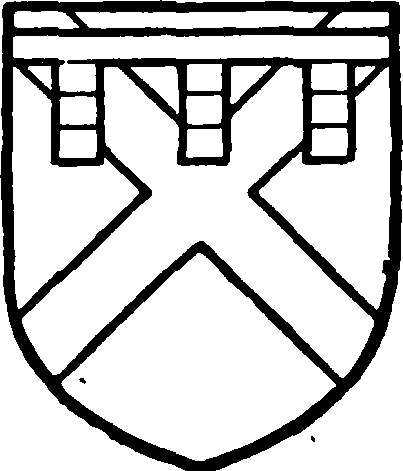
Nevill, Earl of Salisbury and of Warwick. Gules a saltire argent with a label gobony argent and azure.
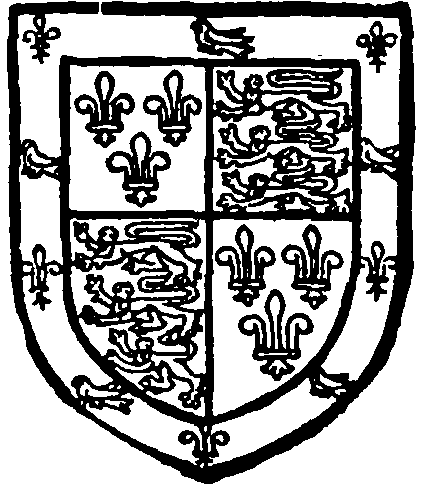
Edmund of Hadham. FRANCE and ENGLAND quarterly in a border azure with martlets and fleurs de lis or alternately.
When in October 1399 (fn. 204) the new king, Henry IV, granted the honour to Ralph Earl of Westmorland, (fn. 205) the long and troublesome connexion of Britanny and Richmond was broken at last. The Earl of Westmorland kept the lands (though he never had the title) for his life. (fn. 206) But in 1414 Henry V granted the reversion of it, together with the title, to his brother John Duke of Bedford, (fn. 207) and upon the Earl of Westmorland's death in 1425 (fn. 208) the duke entered into possession. (fn. 209) The Duke of Bedford died in 1435 (fn. 210) without male issue surviving, whereupon the honour once more lapsed to the Crown. (fn. 211) For many years afterwards Henry VI kept it more or less in his own hands. During this time he made many grants of offices, annuities, manors, liberties and lands in the honour, (fn. 212) the most important of which was the grant to Richard Earl of Salisbury, father of the Kingmaker, of two parts of the castle, of the knights' fees and castle ward pertaining thereto, and of the mill and dye-works of Richmond in tail-male, with the reversion of the third part, then held by Jacquetta Duchess of Bedford in dower. (fn. 213) In the Act of Resumption of 1455 the claims of the Earl of Salisbury were carefully safeguarded, but the king reserved to himself the castle and town of Richmond and the fee farm after the deaths of the said earl and of his son Richard Earl of Warwick. (fn. 214) Before this date the honour of Richmond had already been given to Edmund of Hadham, half-brother of Henry VI. (fn. 215) He was created Earl of Richmond in March 1452–3 and received at the same time a grant to himself and his issue male of the whole county, honour, and lordship, with the castle, vill and all reversions. (fn. 216) He died in November 1456 possessed of two parts of the honour and lordship of Richmond and the reversion of the third part. His heir was an infant son, the Henry Tudor who afterwards became King of England. (fn. 217)
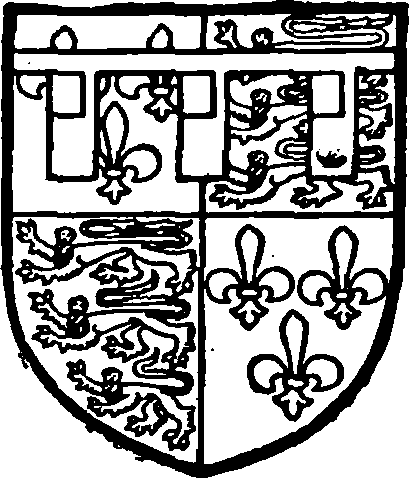
George, Duke of Clarence. FRANCE and ENGLAND with the difference of a label argent having on each pendant a quarter gules.
When Edward IV ascended the throne he took possession of the honour of Richmond. At first he was to all appearance holding it merely as the guardian of Henry. (fn. 218) But the young Earl of Richmond belonged by birth to the Lancastrian party and Edward IV soon began to treat the honour as his own property. In August 1462 he bestowed the castle, county and honour upon his younger brother Richard Duke of Gloucester and his issue. (fn. 219) The grant cannot, however, have been executed, for in the following month an exactly similar gift was made to the king's other brother George Duke of Clarence, (fn. 220) and it is clear from later documents that the Duke of Clarence was actually in possession. (fn. 221) The victory of Henry VI in 1470 doubtless involved a confiscation of the honour, for the subsequent return of Edward IV meant a renewed grant to the Duke of Clarence. On this occasion it was given to him for life only. (fn. 222) In August 1472 the duke also received a licence to enter freely into the part of the honour which had been held by the Duchess of Bedford, deceased, in dower. (fn. 223) Two years later, when Henry VI was dead and Edward IV finally established on the throne, the grant of the honour to the Duke of Clarence was repeated, and on this occasion it was to be held in tail-male. (fn. 224) In 1475 the duke was licensed to make a settlement of the honour as he was about to cross the sea on the king's service. (fn. 225) Three years later, however, he was attainted and executed and the honour was again forfeit to the Crown. (fn. 226) In March 1477–8 Richard Duke of Gloucester, the king's brother, received a grant of the castle of Richmond, the fee farm of the town and liberties in Richmondshire. (fn. 227) He had in 1475 been given a mill at Richmond and the knights' fees and castle ward belonging to the castle, and all other premises formerly held by the Kingmaker. (fn. 228)
Edward IV appears to have kept the rest of the honour in his own hands for the remainder of his life. (fn. 229) Richard III also held it, (fn. 230) and he, doubtless, made his possession of it the more secure by the Act of Attainder which was passed against 'Henry callyng himself Erle of Richemound' in 1483. (fn. 231) With the accession of this same Henry to the throne in 1485 the honour was restored to the Tudors and their heirs. It was, indeed, only separated from the Crown once more.
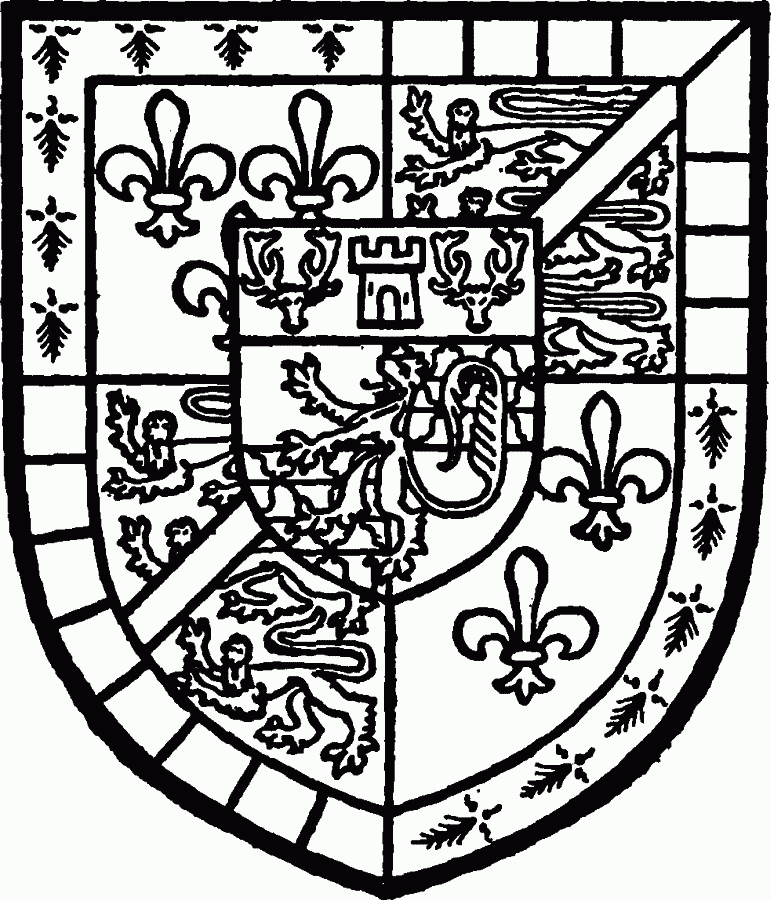
Fitzroy, Duke of Richmond. The royal arms of HENRY VIII with the difference of a sinister baston argent in a border quarterly ermine and checky or and azure and over all a scutcheon quarterly gules and vairy or and vert a lion argent and a chief with a castle between two harts' heads caboshed or therein.
In 1525 Henry VIII bestowed the title of Duke of Richmond upon his illegitimate son Henry Fitzroy. (fn. 232) The young duke seems to have been, in name at least, lord of the honour (fn. 233) also, but Henry VIII was probably holding it as guardian during this time. By 1532 the king had recovered entire possession, having apparently effected an exchange with his son, (fn. 234) and the honour of Richmond has ever since remained the property of the Crown.
The castle has, however, had a different history. In 1623, when James I created Ludovic Stuart, Lord Lennox, Duke of Richmond, he also gave him the site of the castle. (fn. 235) The duke died a few months later, leaving no lawful heir, whereupon the castle again reverted to the Crown. In 1641 it was granted by Charles I to James Stuart Earl of Lennox, with special remainder to the heirs male of his younger brother. (fn. 236) But in 1672, on the death of Charles fifth Duke of Richmond without issue, (fn. 237) it passed once more into the possession of the Crown. Charles II did not retain it long. He gave it in 1675 to his illegitimate son Charles Lennox, whom he created at the same time Duke of Richmond, (fn. 238) and from him it has descended in the direct male line to the present Duke of Richmond and Gordon. With the consent of the duke the castle was taken over in 1910 by H.M. Office of Works under the Ancient Monuments Protection Acts, and it is now being repaired. For many years past the War Office has been permitted to make use of it for military purposes. (fn. 239)
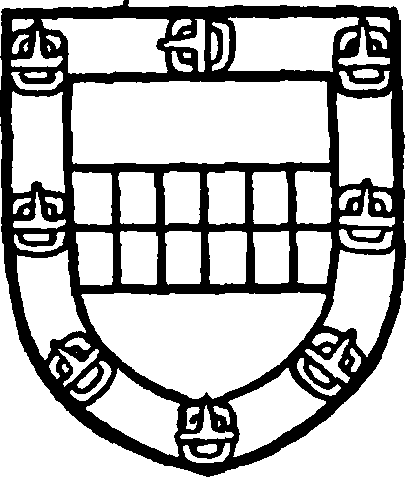
Stuart, Duke of Richmond. Or a fesse checky argent and azure with a border gules and eight buckles or thereon.
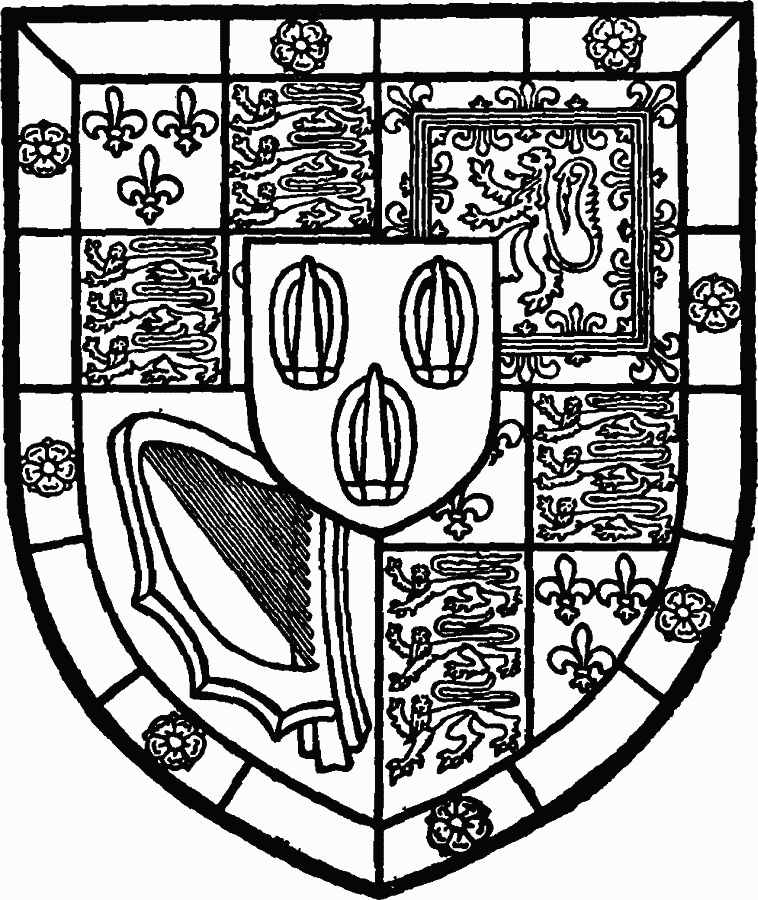
Lennox, Duke of Richmond and Gordon. The royal arms of CHARLES II with the difference of a border gobony argent and gules with roses gules in the argent, and over all a scutcheon gules with three buckles or, for Aubigny.
At the close of the 12th century the honour of Richmond was assessed at 140 knights' fees, (fn. 240) of which fifty seem to have belonged to Richmondshire. (fn. 241) But in the latter part of the 13th century Peter of Savoy stated that he was holding the honour by the service of five knights only. (fn. 242) He and his contemporaries had by this time clearly 'succeeded in effecting a very large reduction in the number of fees for which they answered to the king.' (fn. 243)
It is difficult to say what liberties the holders of Richmond held of ancient right as lords of the honour and what by separate grants, for the frequent escheats of the honour gave the Kings of England unusual opportunities for claiming that old liberties were forfeit and renewable only by royal favour. The lords of Richmond enjoyed among other liberties return of writs (fn. 244) and execution of the same, (fn. 245) placita de namio vetito, (fn. 246) free warren (fn. 247) and view of frankpledge. (fn. 248) In the reign of Edward I the Earl of Richmond claimed to have infangentheof throughout the whole liberty of Richmondshire and a gallows at Richmond and Bowes (fn. 249); they had also outfangentheof. (fn. 250) The tenants of the honour were said, in the 13th century, to be free of the shire court and of common amercement. (fn. 251) They were also quit of toll throughout England and claimed to have been so since the Conquest. (fn. 252)
A 'Court of Richmond' is mentioned in the beginning of the 13th century. The court leet is first mentioned in 1341 when it was being held every three weeks and was worth 20s. annually and no more, owing to the poverty of the inhabitants. (fn. 253)
In the 16th century the tenants of Richmondshire claimed to hold their estates by border service and to have a tenant-right of renewal. Though the Lord Treasurer, on behalf of Queen Elizabeth, maintained that there was no record of such a right, the Earl of Northumberland, as steward of Richmondshire, was 'importunate' on the tenants' behalf, (fn. 254) and he eventually obtained from the queen some recognition of their custom. In 1565, 'on account of the pretended title of tenants' rights,' Elizabeth agreed to let the land in the lordships of Middleham and Richmond on customary leases for forty years, two years' rent being paid as a 'gressom' on the death of every prince and every tenant. All repairs were to be done by the tenant, who was also to find a horse and armour when required for border service. Eldest sons were to have the preference in leases. (fn. 255) Lands of 40s. in value and under might be let by copy of Court Roll. (fn. 256) Since the tenants, according to report, had formerly paid 1d. fine on the death of lord or tenant, this arrangement would seem to have been, as indeed it was said to be at a rather later date, 'a very greate improvement and augmentacion to the Revenewe of the Crowne.' (fn. 257)
Castle
According to the 14th-century Genealogia of the lords of Richmond, Alan Rufus began to make a stronghold here, (fn. 258) and this statement has usually been accepted as correct. But the early poem which contains the first mention of it yet discovered says that William the Conqueror gave Count Alan Richmond 'a good castle fair and strong.' (fn. 259) This statement may, however, be due to poetic licence. The castle is not mentioned in Domesday Book, but there is a reference to Count Alan's 'castlery,' which suggests that it was already in existence at that date, (fn. 260) and the architectural evidence carries it almost as far back as his time. It is possible, moreover, that the grant of the castle chapel to the abbey of St. Mary, York, was made by Alan Rufus, but the evidence on this point is ambiguous and the chapel may have been the gift of Count Stephen. (fn. 261) The keep is said to have been begun by Earl Conan. If so it was probably completed by Henry II. (fn. 262) In 1206, 1209 and 1212 King John visited Richmond; in 1216 he ordered the Earl of Chester to demolish the castle of Richmond if he could not hold it, but such extreme measures were clearly unnecessary. (fn. 263) In 1278 six chaplains were appointed to pray in the chapel of the castle for the souls of John [Earl] of Richmond and Beatrice his wife. (fn. 264) Considerable repairs were done in 1294–5, when planks were obtained for the drawbridge and stone for the gateway and keep; an order for further repairs was issued in 1297, (fn. 265) but the castle was apparently already in a state of dilapidation before the middle of the next century. (fn. 266) Leland described it as a 'mere ruine' in his time. (fn. 267) It included in 1538, among other things, the port lodge, the inner-gate house, 'the sware house, the mantill wall' and five turrets, 'the great dongeon,' two wells, the hall, pantry, buttery, kitchen and other offices, the privy chamber, a little tower for 'draughtes,' the great chamber, a chapel next it, and a chapel in the castle garth. Evidently the masonry and timber were much decayed at this time. (fn. 268)
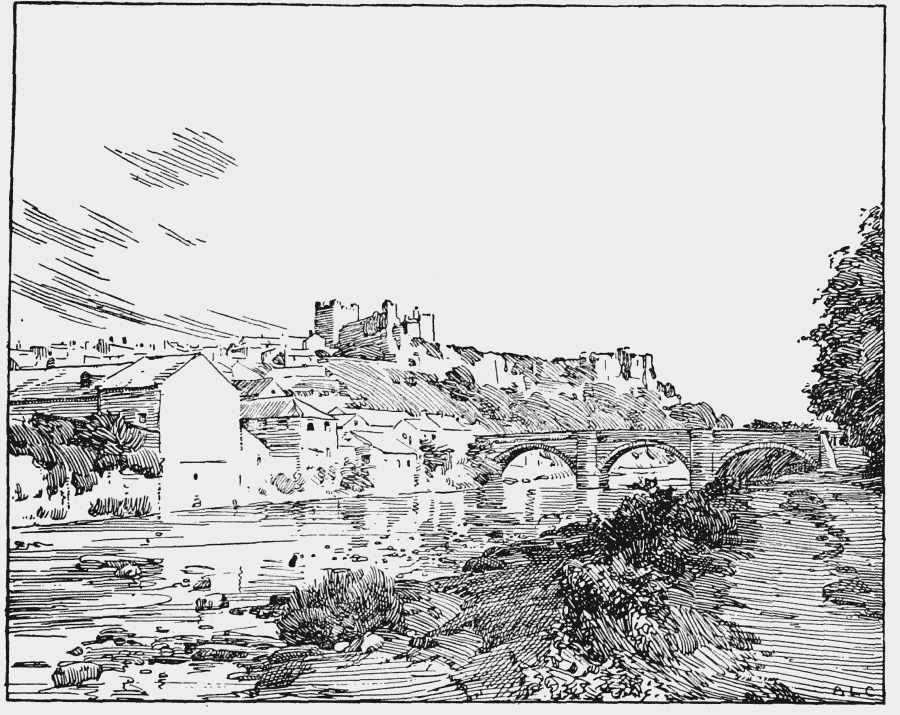
Richmond Castle
Richmond Castle played little part in history. It served as a prison for the district, (fn. 269) and if used for public purposes it was as a place of confinement for prisoners of war, William the Lion, King of Scotland, being imprisoned there in 1174 and ten Welsh hostages in 1295. (fn. 270) It is possible that Richmond Castle saw some actual fighting against the Scots at the close of the 13th or the beginning of the 14th century. (fn. 271) It seems to have played no part in the Wars of the Roses or the Civil War. The castle occupies a site of great strength, with a steep fall to the River Swale on the south, and more gradual slopes on the east and west; the part of the town lying to the north is completely dominated by the keep. The main entrance is from the north, through a small outer court or barbican, from which a gate opens to the principal court, a large triangular area, with its base on the cliffs above the river, containing nearly 4 acres. To the south-east is a second and smaller court, at a lower level, now known as the cockpit and entered by a gateway on the north-west.
The massive curtain wall surrounding the principal court remains in a very fair state of preservation, except on the south or river front where a great deal has fallen or been cut down, and on the west where a length of it has been destroyed. It is of exceptional interest from the early character of its masonry, which is particularly evident on the west side, in the courses of herringbone, and there can be little doubt that it dates from the time of Alan of Britanny. Nor is the early work confined to the wall; the tower known as Robin Hood's Tower and the Gold Hole Tower, together with Scolland's Hall and the building east of it, in the south-east angle of the castle, all belong to the 11th century, and the arch leading into the basement of the keep is the arch of the original gateway of the castle and probably had a gatehouse on the inner side. The keep itself dates from c. 1150, and its addition closed this gateway, another being made in the curtain wall immediately to the east of the keep.
The later buildings of the castle, being less massive than those already mentioned, have for the most part been destroyed; the gateway to the south-east court is of later 12th-century date, and the walls of this court are probably in part coeval with it, while the range of buildings along the curtain to the north of Scolland's Hall are of late 13th-century date.
The 14th-century drawing of Richmond Castle, reproduced in Gale's Register of the Honour of Richmond, shows in a sufficiently realistic way several of the buildings now destroyed and gives notes by which they may be identified. The kitchen and brew-house are shown as set against the south wall, towards the west, and the 'larger chapel of the canons on the walls' is also shown further to the west on the same wall, though it is more probable that its actual site is marked by the large blocked round-headed archway in the west curtain. At the south-west angle of the castle was and still is a small square tower, which is probably 13th-century work. The whole of the area of the principal court has been levelled and turfed, and on the west side runs a range of modern buildings used as military quarters.
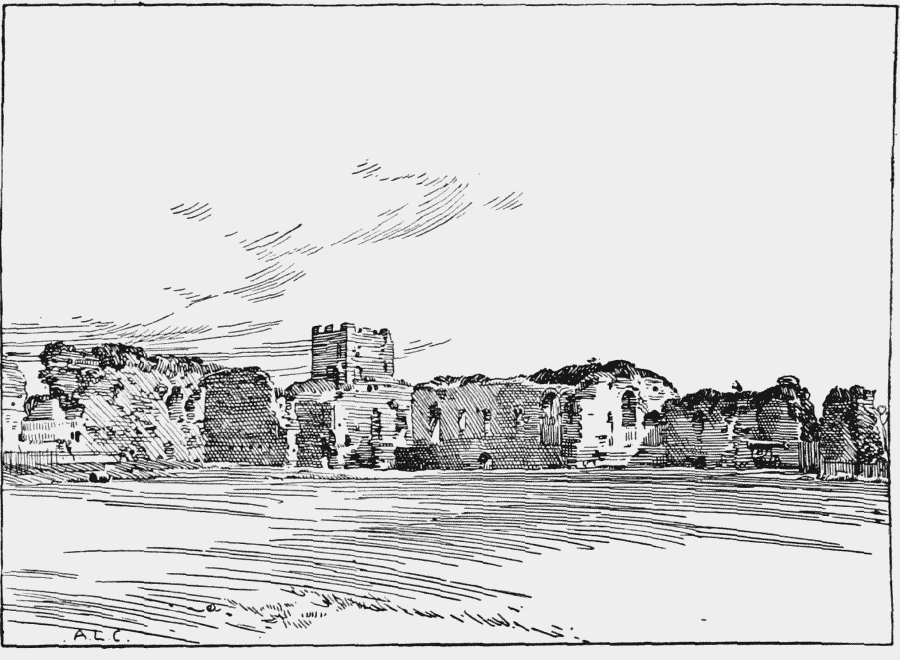
Castle, Richmond
The barbican through which the main gate of the castle is reached has lost practically all its old walls, and its outer gate with the flanking turrets shown in the drawing referred to is quite destroyed. The entrance to the great court is also modernized, and is flanked on the east by modern work. Southward from this along the wall is the small rectangular tower known as Robin Hood's Tower; it is of three stories, the topmost being ruined; this is of later date than the rest, and seems to be late 13th-century work, but the two lower stories are part of the original 11th-century building, and both are roofed with barrel vaults in stone. The upper of the two has no remarkable features, but the lower is the chapel of St. Nicholas and has at the east a roundheaded altar recess 4 ft. 6 in. wide by 2 ft. 4 in. deep, lighted by a narrow round-headed window, while on either side of the recess are small circular double splayed windows. The entrance door is at the south-west, and the north, south and west walls are ornamented with an arcade of plain round-headed arches with early cushion capitals from which the arches spring without an abacus: the shafts and bases are gone, and the floor is now covered with some 18 in. of rubbish. Between this tower and the next, which is completely ruined and broken away from the wall, is a small passage through the wall, and there are other openings at present covered by the piling of earth against the inner wall face. This part of the curtain is in a very unsafe condition and leans outward in several places; near the Robin Hood tower this failure has been corrected by the very inadequate process of cutting back the wall face to a vertical line. South of the site of the second tower, now marked by a gap in the wall, the north wall of the second court abuts against the curtain, the latter being here preserved nearly entire, the level of the alure and the lower parts of the battlements being yet to be seen. The remains of late 13th-century buildings here set against the wall are much damaged, but evidence of two stories exists, and the upper story of one room was clearly a chapel, the piscina remaining in the south wall; this chapel must have been lighted entirely from the west.
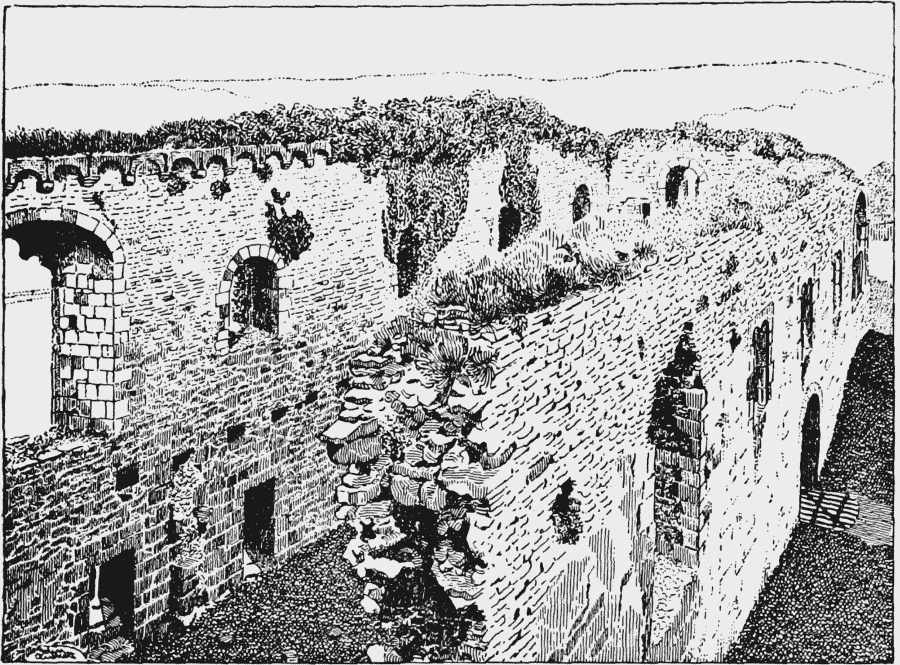
Richmond Castle: Scolland's Hall
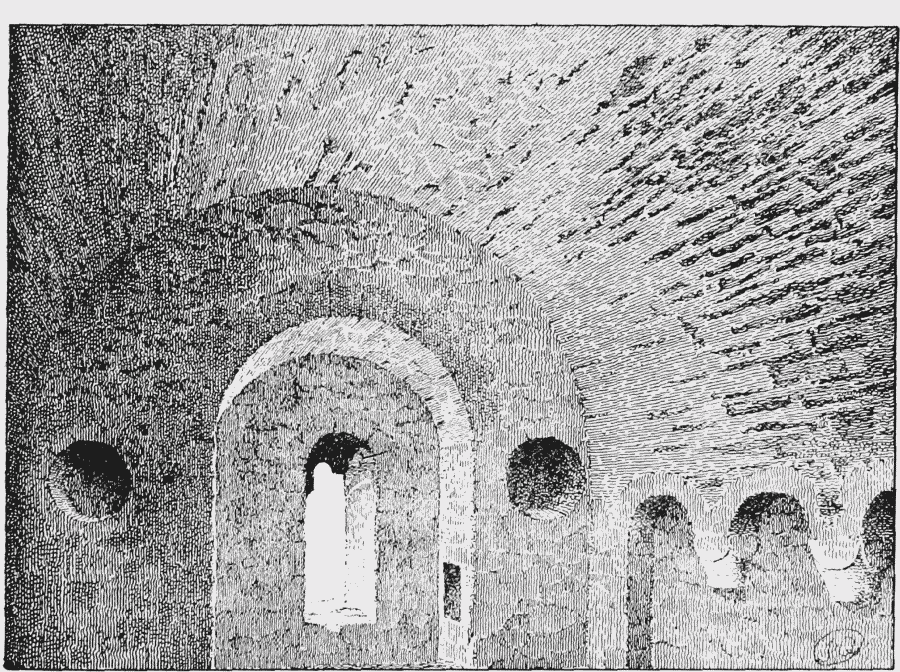
Richmond Castle: St. Nicholas's Chapel
The group of buildings adjoining, at the southeast angle of the castle, is of the greatest interest. It formed the living rooms of the lord of the castle, his hall, solar, &c., and had at the west the domestic offices, now destroyed. In spite of alterations and evident traces of burning, great part of the work is of 11th-century date, the hall, known as Scolland's Hall, being a very remarkable survival, earlier than anything else of its kind in the country. It had a basement, lighted on the south by rectangular slits, through which a wooden hoard along the outer face of the wall could be reached, and on the upper floor was the hall proper, entered from the northwest by a round-headed doorway with shafted jambs and roll-moulded inner order, the roll being returned in a curious way round the sill. The foundations of a large porch, from which steps led up to this doorway, have recently been uncovered. It appears to be 12th-century work, and perhaps replaced an original wooden stairway. The capitals have the classic block under the abacus, and angle volutes, with foliage on the lower half of the bell. The hall was lighted by a range of windows on each side, of which those on the north side appear to be original work, while those on the south have probably been rebuilt with the outer wall late in the 12th century, to which date belong the remains of the cornice which crowns the walls. The windows are of two round-headed lights with a central circular shaft, and half-round shafts in the jambs which have neither base nor capital and are carried round the soffit of the head. The central shaft has a plain chamfered base and cubical capital, with a square chamfered abacus which has either been cut away on the inside for the fitting of shutters or has never had an inner return. There is no rebate for a frame in the windows, and their inner jambs are square through the wall, with a semicircular rear arch. Many of the shafts and capitals are now missing. At the west end of the hall is a round-headed doorway, originally opening towards the offices, of which only the south wall remains, and ffanked by two other openings broken through the wall at a later date. In the north-west corner was a newel stair, of which very little now remains. At the east end of the hall are two stories of rooms of original work, but showing many traces of fire and subsequent alteration, and the cellar adjoining them on the west is at a lower level than the rest of the ground floor of the hall and evidently had rooms over it. It formed a passage of communication with the second court, having a large doorway in its north wall; the entrance to the second court being in the east curtain, flanked by barrel-vaulted rooms. The Gold Hole Tower, immediately to the north, and projecting from the curtain wall, is in its lower part of 11th-century date, while the upper part is 14thcentury work.
The recent excavations have revealed the position of the former entrance to the great hall. The doorway at the west end of the north wall appears to have opened on to an external platform 19 ft. 3 in. by 13 ft. 6 in. and approached by a flight of stone steps on the north. The two lowest of these steps still exist, but only the base of the platform remains, and, while the latter is later in date than the hall, the staircase is evidently a still more recent addition. Adjoining the hall at the west end was an apartment some 23 ft. long by 24 ft. 6 in. wide, of which the northern wall has been uncovered. It was entered by a large door in the centre of this side, of one plain chamfered order, and the same wall was continued westward, parallel to the outer curtain, and implying a continuous range of buildings on this side.
The rest of the south front of the castle has lost all evidence of the buildings. kitchen and brew-house. which were built against it, but the square tower at the south-west angle remains in good condition. To the north of it a large round-headed arch in the west curtain marks the site of a building, probably the 'capella major' already mentioned, in which case the arch must have spanned a western recess like that in the chapel of Farnham Castle in Surrey. At this point the curtain wall is well preserved, but further north it has been much mutilated, and is in places represented only by a thin boundary wall of brick. Near the keep it is better preserved, and the entrance to the basement of the keep is by a fine roundheaded arch of 11 ft. 3 in. span towards the court and 10 ft. towards the outside. This has been the outer gateway of an original gatehouse, and has pairs of engaged shafts on the inner and outer faces, with plain or foliate capitals of the same early character as those in Scolland's Hall. A curious detail is that the capitals and bases of the east jamb are at a lower level than those of the west.
The south wall of the keep is built on the 11th-century curtain, but its other three walls are of one date from the ground. It measures 45 ft. by 52 ft. by about 100 ft. high, and, owing to its situation and somewhat slender proportions, gives a great impression of loftiness. It is in four stories, the lowest having an inserted stone vault of the 14th century, the central pillar of which is a circular wellshaft coeval with the keep, like that in the keep of Rochester Castle. The second stage has a central stone pillar of much smaller size, carrying a wooden floor. There is a stone newel stair, also an insertion, in the south-west angle of the ground story, and above this point the stair to the top of the tower consists of straight flights in the thickness of the south wall, lighted by narrow round-headed windows. The entrance to this staircase from the curtain is at the south-east corner of the second stage and another at the south-west, and in the third stage is a blocked doorway at the south-west, but in the south face. In the third stage are wall-chambers on the east and west, but the north wall is solid up to the fourth stage. The elevations are very simple, with shallow clasping buttresses at the angles, dying on to the plinth, two intermediate buttresses on the north and south faces, and one on the east and west faces. The keep finishes with battlements, those at the angles rising higher than the rest. There is no fireplace in the keep and no garderobe.