
A History of the County of York North Riding: Volume 1. Originally published by Victoria County History, London, 1914.
This free content was digitised by double rekeying. All rights reserved.
'Parishes: Easby', in A History of the County of York North Riding: Volume 1, (London, 1914) pp. 51-64. British History Online https://www.british-history.ac.uk/vch/yorks/north/vol1/pp51-64 [accessed 24 April 2024]
In this section
EASBY
Asebi (xi cent.); Essebi (xii cent.); Esebi (xiii– xv cent.).
This parish is composed of the townships of Aske, Brompton-on-Swale, Easby and Skeeby, of which Brompton is in the wapentake of Gilling East. Its area is 5,581 acres of land, of which 58 acres are covered by water; 1,736 acres are arable and 795 woods and plantations, but the greater part of the land is laid down to permanent grass. (fn. 1) The principal crops are wheat, barley, oats and turmps. The subsoil is Yoredale Rocks with recent alluvium in the valley of the Swale where the pasture lies. There were stone quarries at Aske 'near Ruchedic,' the tithes of which Nysan son of Other granted in 1135 to St. Agatha's Abbey. (fn. 2) In the same century Torphin son of Robert (de Manfield) granted to the abbey the quarry at Easby. (fn. 3) There were also old quarries at Skeeby, where stone is still occasionally worked.
The parish is partially bounded on the east by Watling Street, which crosses the Swale south of Easby and goes north towards Scotch Corner, and part of the way on the west by the Scots Dike, a portion of an ancient earthwork which started south of Easby and ran parallel to the Roman road as far as Barforth on Tees. (fn. 4) The southern boundary is formed by the Swale, on the bank of which are the ruins of St. Agatha's Abbey, picturesquely situated among fields and woods sloping down to the river.
There is practically no village at Easby, and the hall, the ruins of the abbey, the vicarage and the church are surrounded by park land. Easby House, the residence of Mr. Leonard Jaques, J.P., stands at the top of the grass slope above the river a short distance south-east of the church. Here is preserved a portion of the shaft of an early cross, having on one face a figure of our Lord seated with an angel on either hand, on the back a bird and an animal in a frame of interlacing ornament, and cable-moulded angles with knotwork patterns on the sides. It is perhaps the 'Houthelos Cross in the territory of Easby' mentioned in the abbey chartulary. (fn. 5) William at the Cross had land in Brompton in 1286–7. (fn. 6) In the garden are several fragments of bases, shafts, &c., which have been brought from the abbey.
A footpath through the Abbey Wood leads by the stream towards the village of Brompton-on-Swale, where the Skeeby Beck is crossed by Brompton Bridge, which has existed since the 12th century. (fn. 7) In 1328 the hermit of Skeeby went in search of carriage and alms for the construction of a bridge over the beck at Skeeby, (fn. 8) where there is still a bridge.
Roads from Richmond to the south-west run north to Aske and Skeeby in this parish, which, like Easby and Brompton, where there is a chapel of ease, are agricultural villages with few inhabitants. Aske, the seat of the Marquess of Zetland, is an extensive building of various dates standing some 3 miles to the north of Richmond in a fine position 500 ft. above the ordnance datum. It is said that Talbot Bowes here entertained King James. (fn. 9) The older portions of the house form an E-shaped block with the wings projecting towards the south. The central portion together with the east wing date from the end of the 16th century, but at the junction of these two parts stands the massive 15th-century peel tower of the Askes. The west wing may also be Elizabethan, but there is now no evidence of this, and a modern embattled tower balances that of the Askes on this side. Extensive modern additions have been made at the rear and a new block, containing the chapel, built out to the east. The central portion of the old building is occupied by two apartments—the billiard room and the hall. The latter occupies its original position, and is entered by a modern porch at the 'screens' end. All the internal fittings, including the fireplace and the plaster ceiling, are modern, but ancient windows and an early frieze have been found on the north side. The billiard room, occupying the site of the earlier butteries and offices, has rich panelling and a handsome carved fireplace of the 18th century. The tower of the Askes is not quite square, the larger dimension being from north to south. It is three stages high and finished with a modern embattled parapet and angle turrets. The recent removal of the ivy has revealed a number of original blocked window openings on the east and south faces. They are at the first-floor level and the two on the east are of two lights each with square heads. Otherwise the tower presents no features of interest and has been pierced with several late windows and otherwise much cut about and restored. The east wing has a range of barrel-vaulted cellars beneath it lit on the east side by small windows of 16th-century date. Above this level the walls are probably original, but all the external features are of 18th or early 19thcentury date. The west wing is exactly similar outside and the ends are ornamented with pseudoJacobean cresting, which also occurs on the parapet of the hall with the arms of the second Earl of Zetland (Dundas impaling Williamson), whose marriage occurred in 1823.
The staircases (both with wrought-iron handrails) are comparatively modern, and the private chapel is a recent erection with a semicircular apsidal east end. Preserved here is an octagonal stone mortar inscribed 'In the yeare 1660 H.B.M.'
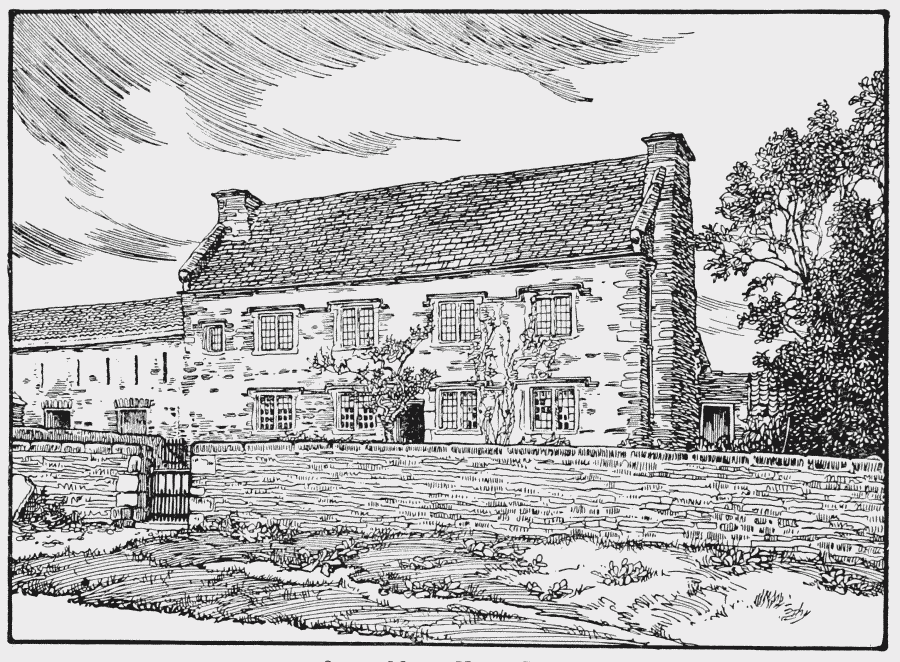
Skeeby Manor House, Easby
Some of the 18th-century work has been ascribed to Sir Conyers Darcy, who purchased the estate in 1727. The house is surrounded by a large park, to which are attached extensive gardens laid out in what were once swampy fields. (fn. 10)
Skeeby village has a chapel of ease, and at the north end of the village is a small but complete and typical manor-house dating from the 17th century. The building is T-shaped, the projecting rear gable containing the stair. On each side of this gable are pent roofs, giving two extra rooms at the back of the house on each floor. The front has a well-preserved doorway and two-light mullioned windows, all with labels. The kitchen on the left of the entrance has a fireplace 12 ft. long by 7 ft. high, with moulded mantelshelf and jambs. The fireplace is partly filled in, but the corner seats are preserved in the cupboards on each side. A remarkable feature is that all the four principal rooms, two on each floor, show traces of fireplaces almost as large as that in the kitchen.
Torphin son of Robert endowed the abbey with its mill, (fn. 11) the dam of which still runs through part of the ruins. Brompton possessed a mill in 1086, (fn. 12) Skeeby two in the 12th century, (fn. 13) and both places have still a mill. At Aske there were two mills in 1594 (fn. 14) and a water-mill and dovecote in 1723. (fn. 15)
The place-names Braythewath, Coupemanestaynes, Neugresflath and Raholm occur in Brompton in the 12th century, (fn. 16) and the following names occur in the 13th century: Roaldeshou in Easby, (fn. 17) Eglesgard, Cumbrehou, (fn. 18) Diclandes, Asegot henge, Underselburg, Estlangeselburg, Threlow, Under stibel, Est Langscort, Gretgard, Godwynhoulandes, (fn. 19) Wyseapeltre, Finegalgraft, Kirkegathe, Calnewath, (fn. 20) Ovenhou or Houenhou, (fn. 21) all in Brompton; and Staynhou. Huwerranes, Ashou, Blyche, Brackanberg, Orummorbittes, Blaberyrane, Beremor, Sculphode, Rollandescroft and Alf hou in Skeeby. (fn. 22) These names seem to be all now lost. The 16th-century names Ladie flatt, Roodedike, and Dovecote flatt in Easby (fn. 23) are interesting. The grange called St. Trinians belonged to St. Agatha's Abbey, (fn. 24) and is now the residence of Col. Charles Edward Stack. There are Wesleyan chapels at Brompton-on-Swale and Skeeby and public elementary schools in the same places.
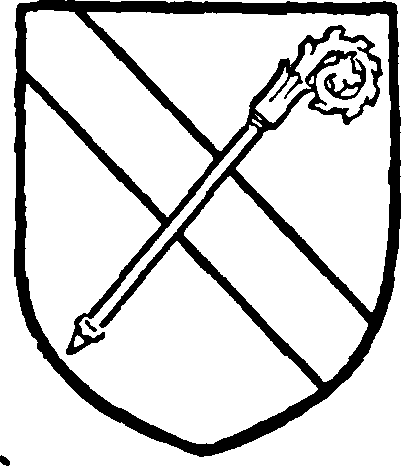
Easby Abbey. Azure a bend or, which are the arms of Scrope, with the difference of a crozier argent bend sinisterwise having a golden crook.
The ABBEY OF ST. AGATHA at Easby, about 1 mile south-east of Richmond, was founded in 1152 by Roald, constable of Richmond Castle, for canons regular of the Premonstratensian order, and during the reign of Edward II came under the patronage of the family of Scrope. (fn. 25) The abbey was suppressed in 1535.
Excavations by the Yorkshire Archaeological and Topographical Association in 1886 have established all the important features of an unusual plan.
The buildings are disposed on the north, south and south-west of the church; the cloister occupies the usual position on the south, with the sacristy, parlour and chapter-house on its east side, the frater on the south, and on the west the cellarer's buildings, together with the dorter and guests' wing. On the north side of the church is the infirmary. The parish church, which existed as a building long before the foundation of the abbey, lies to the south-east of the cloister in its own cemetery, and the gate-house, 50 ft. further to the eastward, opens into the outer court of the monastery. The mill is to the north-west of the abbey. The unusual disposition of the monastery buildings is largely dictated by the proximity of the river and the parish church.
The original abbey church was cruciform in plan, consisting of a short quire without aisles, north and south transepts, with eastern aisles of three bays and containing three chapels, and a nave of seven bays, with north and south aisles. There was also probably a low central tower.
The only vestige of the building of 1152 is a round arch with a double row of beak-heads, now reset on much later jambs at the foot of the dorter stairs. The church appears to date from about 1180. Its very scanty remains seem to indicate that the whole building was then laid out, but that progress was slow. The quire and south transept were first completed about 1180, the north transept about ten years later. The tower was next built, then the nave and the aisles, beginning with the outer wall of the south aisle, to admit of the north alley of the cloister being erected against it.
Late in the 13th century a large chapel was added on the north side in the angle of the transept and the aisle and lining on the north with the north wall of the transept; about 1340 the quire was extended to its present length and a chapel or sacristy erected on its south side.
In its latest form the quire is six bays long. The western half of the north wall is ruined to the level of the plinth, and the eastern half, though standing about 6 ft. high, shows no remains of the window sills; the east wall is of the same height. The eastern third of the south wall stands to a course or two above the plinths, the middle third is ruined to the base and the western third is about 18 ft. high and retains one side of a window.
The extent of the original quire is shown by a break in the plinths at about half the existing length, which is more easily discernible on the north side. The buttresses of the older portion are broad, flat pilasters, 4 ft. broad and about 10 in. deep, but the newer work has buttresses 2 ft. in width by 3 ft. deep, and those at the angles were set diagonally. The plinth of the newer portion shows a variation on the south side, where the upper member has an ogee section, whereas on the north and east this is a plain chamfer, like that of the lower member, all round.
Of the arrangement of the quire little can be traced. In the north wall, at the western end of the new work, are two shallow recesses with low pointed arches and hood moulds, popularly supposed to be the tombs of the founder and his wife, but too narrow for either a sepulchral slab or an effigy. In the second bay on the south side is a similar recess, and to the west of it a long slab in the wall, with a chamfered edge, indicates the position of the sedilia. Below the sedilia are two interments, and immediately westward of these are two graves, one in the thickness of the wall and the other to the north of the first and only separated from it by a 6-in. partition of ashlar. These when discovered contained human bones mingled with rubbish.
In the fourth bay are the remains of the door leading to the sacristy or chapel on the south side, which is ruined to the lower plinth. The base of an altar and part of a step remain, running across the whole width.
To the west of this are the sill and west jamb of a window, shown to be a later insertion by the interruption of two string-courses. Pieces of tracery found during the excavation show that the windows of the quire are of about 1340.
In the original church the stalls must have stood in the crossing and may have extended one or two bays into the nave. When the quire was lengthened they were moved wholly east of the crossing, as is shown by the chopped string-course in the south wall and the extent of the pavement eastwards.
In the parish church of Richmond are some remains of sixteen stalls, with canopies and misereres, removed from the abbey at the Suppression; with them are two shields with the rebus of Robert Bampton, Abbot of St. Agatha from 1515 to the Suppression.
The central tower is completely lost and nothing is left of the south transept but a fragment of the plinth of the south wall, though the excavations of 1886 showed it to be the same size as the north transept, of which more remains are standing. The eastern aisle of the south transept was of three bays of the late 12th century, each bay being lighted by a simple three-light 14th-century window, inserted at the time of the extension of the quire. At the same time the flat pilaster buttresses between them were altered to a bolder projection, the plinths of the earlier buttresses being visible behind the later work. Of the bays of this eastern aisle nothing remains but the plinth of the north respond, and the south respond to its full height; the latter is a large keeled shaft with a half-octagon capital, flanked by two smaller circular shafts having capitals with square abaci. The aisle had a quadripartite vault with wall-ribs and good mouldings, their springers resting on circular vaulting shafts with semi-octagonal capitals; on the east side these shafts stood on a ledge in the wall between 5 ft. and 6 ft. from the ground. The three chapels in the bays, with their altars, were screened from the transept and from one another. The northernmost window sill was cut down for the reredos of the altar.
The north and west walls of the north transept are fairly perfect, though not to their full height. At the south end of the west wall are the base and part of the respond of the arch opening into the north aisle. High up in the same wall are the sills of two windows, blocked when the north chapel was built. At the west end of the north wall is a large hole cut right through the masonry, where a staircase opened from the transept to the upper floor of the building to the north. From this staircase a window with a segmental head opened into the transept about 15 ft. from the pavement, and a narrow loop also opened into the north chapel. Eastward, also in the north wall, is a large doorway, with shafted jambs on the outside, leading into the northern buildings. Above it is the sill of a large five or six-light window. The eastern aisle, of which only the north wall remains to any height, closely resembled that of the south transept, and had added buttresses on the east, but the plan of the arcade was different.
Nothing remains of the nave and aisles but the plinth of the north aisle wall for four and a half bays, with a single stone in the fifth bay showing that there was a door here, and a tomb-recess cut in the wall between the third and fourth bays. There is a fragment of rough walling at the west end of the south aisle.
The north chapel is of three bays, each containing a three-light window of simple intersecting tracery with cusped openings. There was a similar window in the west wall. Remains of the altar, its platform and step, exist at the east end. Over the altar a clumsy bracket has been inserted. A gap in the wall, high up at the north-east angle, marks the position of the loop opening from the transept stair.
In the nave, aisles and transept are considerable remains of the original pavement consisting of alternate broad and narrow courses running from north to south; most of the stones have a mason's mark like a Lombardic [L] which also occurs on the oldest work in the church.
The evidence of John, Abbot of St. Agatha, in the Scrope v. Grosvenor case, 1385–90, shows that there were many Scrope tombs east of the quire, near the high altar. (fn. 26) There is no evidence to support the modern naming of the north chapel as the 'Scrope chapel.'
The irregular group of buildings to the north form the infirmary, the church and a public road occupying the more usual position east of the cloister. Thus the only way from the cloister to the infirmary is through the church, and the north door of the transept opens into a long corridor leading to the infirmary proper. This corridor (59 ft. by 15 ft.) runs north and south, and has a small room projecting from the east side and another larger room on the west. It had an upper floor.
Next to the church wall, on the ground floor, are the remains of a doorway on each side of the corridor. These afforded passage from the north-west of the church to the inclosed ground on the north-east. Next to the east door is a small recess for the porter. On the same side were three windows and a door into the east room (about 12 ft. by 8 ft.), which was lighted by small narrow windows on the east and south, and was probably the prison mentioned in the visitation of 1488, when Brother John Yonge was ordered in carcere recludi for incorrigible disobedience and rebellion.
The southern half of the west side of the corridor is ruined almost to the plinth, but it certainly had one window, probably two. The northern half is perfect and contains a door into the western room (57½ ft. by 16½ ft.), which was probably the misericorde, though it may have been provided for the use of canons who had been let blood. This room has a blank west wall, and the north and south walls are gone. In its south wall, where it abutted on the west wall of the corridor, there was a doorway, of which one jamb still exists in situ, and a pentice, of which the corbels remain outside the corridor wall, afforded a covered way to the door in its west side next the church. There is a straight joint at the junction of the south wall of the room with the corridor wall.
The upper floor of these buildings followed the same lines. Over the corridor was the gallery, whose floor was supported on beams resting on corbels. The east wall sets back 4½ in., and is fairly perfect. In it is a fireplace next to the church wall without jambs or hood. The chimney is carried on corbels outside, which appear to be early. Beyond is a door leading up steps to a garderobe, the shaft of which descends to the ground, forming an external projection. The garderobe is lighted by a small loop on the north. Further on was a window, now a gap, and beyond it is another fireplace with one jamb remaining. It has a lofty chimney, still fairly perfect, which rises from the ground, diminishing by a series of set-offs. North of the fireplace is a gap, possibly representing a window, and to the north again is a doorway with a shouldered arch opening into the eastern chamber over the 'prison.' This room is lighted by a single small window at the east. Between the doorway and the north wall of the gallery, now wholly disappeared, was another window. On the west side there were two windows towards the southern end. One jamb remains. Above the door into the west chamber on the ground floor was another door opening into a similar chamber, which had a lofty gabled roof running east and west. The east wall is fairly perfect and retains its southern skew-stone. The fragment of the west wall has no windows and the north and south walls are gone. There was, however, almost certainly a fireplace. On the gallery side of the east gable are three great corbels, part of the series which carried the gallery roof, whose wall-plate was about 12 ft. from the floor.
The main approach to the gallery was by a stair starting from the north end of the west wall of the corridor, where a remarkable jamb supports a sloping slab and cuts through the plane of the gallery floor. The stair was thus placed at the north end because the southern third of the gallery was partitioned off so as to form a room adjoining the transept, with its own garderobe and fireplace, and having direct access to the church by the stair into the transept. This room from its position was most likely the abbot's room, while the gallery and eastern chamber may have been his solar and oratory respectively. Down two steps at the north end of the corridor is a wide and important doorway leading into a large hall, whose west wall lines with that of the corridor. The doorway is set a little to the east to leave room for the main stairway.
This hall (64 ft. by 27 ft.) is much ruined. In the west end of the north wall, about 10 ft. from the floor, is a row of large joist-holes, one still containing a portion of a wooden beam. They continue for about 24 ft. from the west wall, where there is a large corbel, which marks the line of partition dividing the screens from the main hall. The joists supported the floor of the loft over the screens. The hall was lighted by two two-light windows on the north, of which the sills remain, and probably by three on the south. There was a large fireplace at the east end with a door on either side, that on the north opening into a group of rooms of two stories, probably those of the infirmarer. The ground story apparently consisted of low cellars lighted on the east by narrow loops and on the north by a larger window. The upper story, which had a garderobe on the north, was reached by a stair, probably from the small room entered by the doorway on the south side of the hall fireplace.
Across the angle at the north-east, formed by the hall and the northward projection ending in the garderobe, was an arch, of which only the springers remain. As late as 1821 this arch supported the remains of a very beautiful oriel window. (fn. 27)
The walls of the hall abut upon the main building at their western end with a straight joint, which indicates a rebuilding, and their comparative thinness suggests a late date, so that this hall is probably the nova aula mentioned in the visitation of 1482.
The screens are unusually wide, the partition having been set well to the east to allow space for a window in the south wall. This window was made as wide as possible by chamfering back the east wall of the corridor where it abutted on the hall outside, this chamfer being the only existing evidence of the arrangement.
There are the base and part of the shaft of a small column against the west wall, not quite centrally placed. There may have been a stair from the screens to the loft above, or the latter may have been approached from the upper floor only. A rude doorway at the north end of the screens opens into the buttery (16 ft. long by 12 ft. wide), partly occupying the space of the two doors divided by a pillar which were the original arrangement. A corresponding pair of doors in the north wall of the buttery open into a smaller room with a low lean-to roof and a wide fireplace. A single north door in this room opens into a large square kitchen, the northernmost room of the range. Originally a partition ran between the central pillars of each pair of doors and on to the west jamb of the kitchen door, forming a passage direct from the screens to the kitchen and shutting off the buttery and inner room. The kitchen (24 ft. square) has all the walls but that on the east fairly perfect to a considerable height. It has a large fireplace on the north, with an externally projecting chimney, and a large segmentalheaded window on either side of it. There were two similar windows on the east. In the south-west angle on the south wall was a second fireplace with a hood, now destroyed. The angle buttresses indicate that the roof was pyramidal, terminating in a louvre. (fn. 28)
Three doorways, one in the north-west angle of the screens and one each in the west walls of the buttery and the room beyond it, opened into a long low cellar (57 ft. 6 in. long by 16 ft. 6 in. wide), lighted on the west by narrow loops and by a wider one on the north, and had at its north end a narrow slip alongside the west wall of the kitchen, in which there was probably a doorway for bringing in stores. Over this cellar, and only 5 ft. above the level of the hall floor, was an upper room of the same size having one window on the north and one or more on the west and approached by a wooden stair from the door in the north-west corner of the screens; this was the dorter for the sick and bedridden brethren. On the east is a 'turn' or hatch opening into the room beyond the buttery at 9 ft. from its floor, which would be reached by wooden steps, and was for passing food from the kitchen to the infirmary. Over the buttery is a chapel opening directly out of the sick-dorter, and having the east window arch perfect with enough tracery to show that it was of three lights and of the same date and pattern as the 14thcentury windows of the south transept aisle. Below the sill are the holes for the altar corbels. In the south wall is a small pointed piscina with a projecting bowl. At the north-east corner of the sickdorter a narrow passage led to a garderobe, of which the north wall lines with that of the kitchen and has two small loops, one to light the passage, and the other, about a yard higher in the wall, to light the garderobe itself. An old wall running from the north-east end of the quire of the church to the south-east corner of the infirmarer's buildings incloses a piece of ground which was probably the infirmary garden.
The fragmentary walls to the west of the infirmary buildings are the remains of outbuildings, possibly a water conduit.
The buildings on the south side of the church are ranged round the cloister, which is trapezoidal in shape, instead of the usual rectangle. (fn. 29) This irregularity is probably due to the enlargement of an original scheme for a small square cloister, the proximity of the parish church on the south-east necessitating the massing of the buildings on the west and the consequent canting inwards of the western side of the cloister.
The north wall of the cloister (i.e. the south wall of the abbey church) is gone, together with most of the east wall, but the south and west walls are fairly perfect. The ashlar wall inclosing the garth has almost disappeared, except on the east side, where excavation has revealed nearly the whole length of it; it is here reinforced by another wall built close to it, increasing the thickness from 2 ft. 10 in. to 4 ft. 11 in. Along its east front is a row of corbels, about a yard apart from one another, which may have supported the carrels. The cloister had a wooden roof resting on corbels, and its line is plainly visible on the frater wall. The east alley was 8 ft. 7 in. wide and the west 10 ft. 6 in.
On the east side of the cloister, from north to south, were the south transept of the church, the sacristy, the chapter-house and the common parlour. There was a door from the south transept to the sacristy, which was originally 22 ft. long, 14 ft. wide at the east and 17 ft. wide at the west end, and was vaulted in two bays. It had a door into the cloister and an east window which, before the completion of the range, was cut down to form a door into a room built to the east and roofed with wood. The plinths of the transept and chapter-house in the room so inclosed were subsequently cut into for presses and the like. Underneath an old wall at the east end which was removed in 1886 were found the base of the sacristy altar, and in the south wall the remains of the shaft of a piscina, whose mutilated bowl, carved with birds and foliage, was found in the débris, together with several tall, slender octagonal pinnacles. In the south-western corner of the eastern chamber is a later vice to the upper floor. There is a diagonal buttress at the external north-east corner, and between it and the transept wall is a trefoiled loop to light the sacristy altar.
The chapter-house (46 ft. by 21 ft.) had a vault of four bays with plain chamfered ribs, on corbels of small triplets of filleted shafts, and was originally lighted by an east window and two south windows. The east and south-east windows were widened in the 15th century. All the tracery is gone and the sill of the east window is cut down, but it was probably of five lights. The south-east window was of two lights, and the south-west, which was blocked by a garderobe tower when the others were altered, has been thus preserved and is a chamfered lancet. The door into the cloister was a fine one, 4 ft. wide, with triple shafts having dog-tooth between them, and a richly-moulded arch with foliage in two wide cavettos. On either side of it was a similar window.
Next to the chapter-house is a room (22 ft. by 16 ft. 6 in.), not quite rectangular and vaulted in two bays, which underwent much alteration in the 15th century, but was originally the auditorium or conversation room. It also formed a slype from the cloister to the canons' cemetery, having a door at each end and also one on the south to the frater sub-vault. The whole of this range dates from about 1260, but was extensively altered in the mid-15th century, when the whole of the upper floor and the space above the south transept aisle were reconstructed. The original first floor, from the weather moulding of its south gable on the frater wall, cannot have been more than 8 ft. high. The alterations on the ground floor in the 15th century included the building of a large circular stair inside and against the west wall of the parlour, whose west door became the door of the stair, and the insertion of a window to the south of it, looking into the cloister; the destruction of the west bay of the vaulting, the blocking of the south doorway into the frater sub-vault and the piercing of a new doorway to the east of it; the door opening to the cemetery was also blocked up and a garderobe built up against it externally, while a window was inserted to the south of it. The garderobe blocked the southwestern window of the chapter-house, entailing the widening of the remaining windows. A little way up the new staircase a doorway opened to a bridge into the frater.
In the new upper floor was a single lofty room, reached by the new stairway, which opened into its south-west corner. This room was about 60 ft. long and covered the whole range except the eastern portion of the sacristy, which had another small room over it. The east side is fairly complete, but the north and west sides are destroyed. In the portion over the parlour is a 15th-century east window of four lights in a square head, and to the north of it a four-centred doorway opening to the garderobe, in which the grooves for the seat remain. The garderobe is lighted by a small square-headed loop. In the south wall of the portion over the eastern part of the chapter-house is a large fireplace with a lamp locker in its west jamb, and to the eastward a square-headed window of two cinquefoiled lights with a segmental rear-arch. In the east wall was a large square-headed window of four lights with a transom, the lower lights trefoiled and the upper cinquefoiled. A squareheaded door in the north wall opened into the room over the east half of the sacristy, and this room opened northwards into a new room over the south transept aisle, probably the sacrist's room, which had two windows on the east, with a fireplace between them. In the south-east corner was a door to a turret stair. The room over the east half of the sacristy was reached by a separate stair from below and may have been the treasury. A gap in the west wall was probably originally a window converted into a door when the eastern half of the sacristy and this room were built. The great stair from the parlour was continued to a second floor, which consisted of a loft, covering the major portion of the great room, but not the part over the east half of the chapter-house.
This loft has a window over that of the parlour and like it, and a door into the garderobe, with a fireplace between. The garderobe, which retains its seatgrooves, is divided vertically and is lighted at this level by a small lancet. There are marks of partitions against the south gable of the loft.
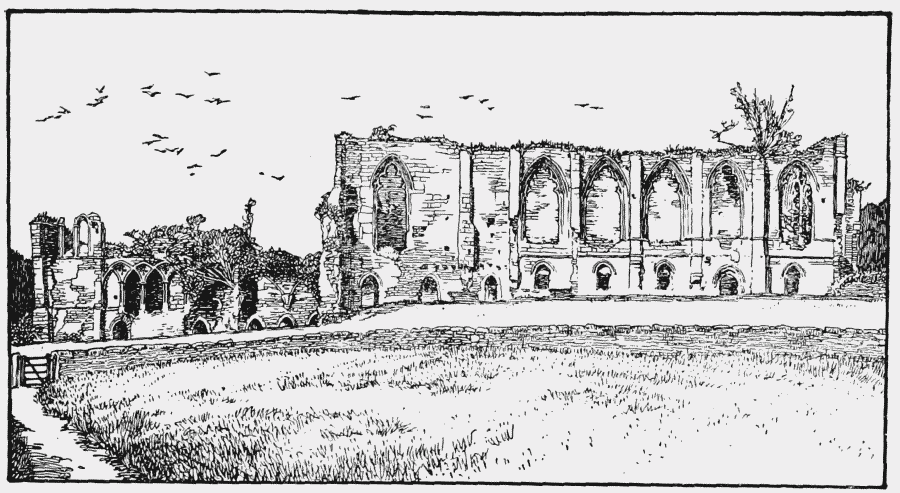
Easby Abbey: The Guests' Solar and the Frater from the South
On the south of the cloister and overlapping the south end of the eastern range is the frater (106 ft. by 37 ft.), the shell of which remains complete from the subvault to the wall-plate of the upper floor. The subvault was roofed by eight bays of two spans, with a central row of octagonal pillars, now destroyed. The semicircular wall-ribs sprang from moulded corbels, but on the east wall and in the five first bays on the south the ribs were altered from semicircular to pointed, to form the dais at the east end and to clear the windows in the south wall, in a reconstruction, c. 1300, when the upper floor was almost wholly rebuilt, the south wall was recased outside and new windows were inserted of two trefoiled lights, with a blind quatrefoil in the head, owing to the lowness of the segmental rear-arches.
In the second bay on the north is the blocked original door to the parlour and in the first the later door. The six bays to the west of these formed the abutment of the south cloister. The frater buttresses are carried down to the cloister floor and are boldly chamfered to save space. in the first of these bays is a low pointed doorway, in the second and third a bench table between the buttresses and in the fourth another similar door; in the fifth is the frater door, with good mouldings and shafts; in the sixth is a segmental-headed doorway and to the west of it a round-headed recess. The frater door was of two leaves, with a draw-bar.
On the south side the first, third, fourth and fifth bays contain windows, the second, which projects southward to support the frater-pulpit, has a good doorway with jamb shafts and the last three have each a plain pointed doorway. The last two of these led to a building of which the only traces are the uncased wall (now external) of the frater, with a row of joist holes and a gable-mark above. This building led to the kitchens, of which nothing remains. On the west wall of the subvault are the remains of a large fireplace, and to the north of it is a segmentalheaded doorway approached by steps down and opening to the guest-hall.
The subvault was partitioned into a number of rooms. The first three bays formed an outer parlour, the next three, cellars; a flight of stairs in the north half of the seventh bay led to the frater above; the south half was a lobby between the cloister and the kitchens and the eighth bay was probably the cellarer's checker.
The frater on the upper floor was lighted on the north by two small two-light trefoiled windows in the third and seventh bays, on the east by a fivelight window with fine geometrical tracery in a pointed head, and on the south by six high threelight windows, each with three cusped circles in the head, in the first five and the eighth bays. The second south bay projects 33 in. to make room in the thickness of the wall for the pulpit. The window here had a screen of tracery, with circular shafts at the jambs and in place of mullions, and the pulpit was between this screen and the window. It was approached by a small doorway and two or three steps from the frater, and had a seat against the west jamb, above which is a pointed recess with a crocketed hood mould for the reader's book. The window in the first bay is narrower than the rest, owing to the space occupied by the pulpit. In the sixth and seventh bays, on to which the kitchen buildings abutted, there are no windows, but between the two bays is a recess (fn. 30) and out of it a hatch opens to the outer face of the buttress, running first obliquely and then straight again. The opening is rebated all round, with holes for hinges and a bolt. In the east jamb of the recess is a locker, (fn. 31) also rebated all round. A little to the west of the large recess is a smaller hatch with a right-angled turn, opening through the wall. Both these hatches communicated with the kitchen wing.
The west wall of the frater is earlier than the rest of the upper floor, whose walls abut on it with a straight joint. In the centre is a fireplace and some height above it a corbel table of early appearance. Along this wall, and for about a bay along the side walls, are joist holes for a loft or gallery, reached by a very narrow vice in the south-western angle, which continues to the roof. A gap in the north-west corner marks the place of a door. The last south window is cut down 3 ft. 7 in. to light the space under the gallery, which was shut off by the partition in the fifth bay, forming the screens, as shown by an alteration in the corbels of the roof on the north wall at this point, those to the east being carved and those to the west plain. At the eastern end of the frater was the dais for the high table, with the pulpit at its south end.
On the west of the cloister was a long range extending southward from the west end of the church and extending about 10 ft. beyond the south-west corner of the frater. (fn. 32) About the middle of the west side a block of buildings projects to the west, (fn. 33) and, owing to a sudden fall in the ground, is built on a vaulted basement, and is three stories high. The southern half only of the main block has a similar basement, but the three stories of the west block are only equal in height to the two stories of the main portion. From the south-west corner of the cloister a doorway opened to a broad flight of steps down to the guest-hall, which occupied the southern portion of the range. This doorway is made as wide as possible by cutting back the north wall of the frater to receive the opened door, and the jambs project from the face of the wall. North of this door is the lavatory with an arcade of trefoils with dog-tooth ornament, standing on carved brackets. To the north again is the Norman doorway, with a double beak-head ornament, which constitutes the only trace of the original building. It was the entrance to a broad flight of stairs leading to the dorter and other rooms used by the canons. North of the dorter door and occupying the rest of the range is an apartment about 75 ft. by 25 ft., originally vaulted in six bays of two spans with a central row of pillars, of which only the lower part of one pillar remains. The wall-ribs were semicircular. This apartment had four doors to the cloister and was divided into four compartments, the southernmost with one door to the cloister, another at the southwest corner, and a third, afterwards blocked on the west, consisted of one bay and served as a passage between the cloister and the guests' wing; the door at the south-west had a draw-bar to ensure privacy. The second compartment of two bays has a wide segmental-headed doorway from the cloister and no windows, and was probably the beer-cellar. The next compartment was of one bay, with a low pointed door from the cloister and a small round-headed window in the west wall. The fourth compartment was the calefactorium or warming house, consisting of two bays. It is well lighted on the west and has a large fireplace in the thickness of the east wall, which is gradually increased from 3 ft. 9 in. thickness at the south end of the cloister to 5 ft. at this point, probably to avoid the projection of a chimney into the cloister. There is a door at the north end of the east wall into the south aisle of the church and another in the north wall to the open.
The cloister side of the east wall had a bench table, on which the buttresses rested, running its whole length between the doorways.
South of the dorter stair the ground level is lower than in the northern half, and the ground floor apartment, the guest-hall, was consequently a fine lofty room (61 ft. by 25 ft.) vaulted in five bays of two spans with pointed wall-ribs, resting on moulded corbels and a central row of four octagonal pillars, of which three lowest portions of bases remain. The room was entered from the outside at the north-west corner by a wide door with jamb shafts, opening into the screens, which occupied the northernmost bay. The west and south walls are destroyed to the foundation and only a portion of the north jamb of the northernmost window remains. The two middle bays of the hall proper abut on the western frater wall; the northern of these contains a door to the frater subvault, and the other a large fireplace with recesses for lockers on either side. Within the screens, opposite the main door, was originally a square-headed doorway to a narrow wall stair up to the cloister, abandoned later, when a wide stair was built up out of the hall itself to the door at the south-west angle of the cloister. In the middle of the north wall is a pointed door, which had a draw-bar, to a stair up. To the east of it is the lavatory, in a wide but shallow roundheaded recess, in the back of which is a narrow loop lighting a room under the dorter stairs with a wagon vault and a small recess at its eastern end. This room is entered by a door inside the stair-door immediately up several steps, and probably contained the tank for the lavatory.
A door to the west of the stair-door opens into a passage running at right angles into a small square lobby with a window on the south and a door on the north opening into a long cellar, originally lighted on the north by two loops, now destroyed and the gap blocked. This cellar was for the guests' wine. In the east wall, just inside the entrance, is a blocked hatch, originally intended to open into a subvault to the east, which was never constructed.
A door in the west side of the lobby opens directly into a servants' hall, about 50 ft. by 20 ft, vaulted in five bays of two spans, with semicircular wall-ribs; the vault, now destroyed, rested on corbels and four central pillars. There were two large windows on the south and a loop on the north; a door at the northwest corner opens into a passage to the domus necessaria, or great privy.
The stair from the north of the guest-hall has two doors on the landing, one to the north being the private door between the cloister and the guests' wing, already mentioned, and the other opening into a lobby like that below, originally vaulted and with the same arrangement of window and doors. The north door of this lobby opens into a long room over the cellar below, lighted at the north end by two loops and originally vaulted in four bays. It was the cellarer's room for the storage of linen and had a door to the dorter subvault and so to the cloister. The western door of the lobby leads to a room the same size as the servants' hall beneath, once covered by a semicircular vault of five bays, with pointed wall-ribs, springing from corbels. This was the guests' solar. It was lighted by two large windows at the south end, which form the centre of an external intersecting arcade of four pointed arches, with foliated shafts and sunk blind quatrefoils in the solid heads. The outside blind arches of the arcade are narrower than the window openings, throwing the two main arches from centre to flanks out of the true. In the north end of the room is a window of two lights, divided by a circular shaft, with a quatrefoil over, which was shuttered and unglazed; there is a seat in each sill. In the east wall are two lockers and a large gap, which marks the position of a fireplace. In the north-east corner is a passage to the garderobes, like that below.
An upper floor covered the whole of the western range, containing rooms solely used by the members of the convent, and so approached directly by the dorter stairs. The room above the guest-hall is destroyed; in the east wall was a fireplace and the roof was of wood. The canons' and novices' dorter covered the range north of the dorter stairs, and had windows on the east, north and part of the west sides and was fitted with cubicles. At the north end were the night stairs to the church, either inside the south aisle or built up in the north end of the warming house.
The top floor of the western block is much ruined, but contained a passage at the north end to the domus necessaria, lighted by two small pointed loops, which are still perfect. At the south end the line of the dorter stairs was continued westward to form a similar passage. The domus necessaria was divided among the three floors, but the exact arrangement is obscure, as only the top floor is lighted. This has at the south end a fine group of three lancets with an external moulded arcade on attached shafts, of which the two eastern lights contain part of a mediaeval blocking, and the west wall, which is reduced by half its thickness at this stage, has small lancets between the buttresses, with a good corbel table above. To the east of the southern triplet is a shaft with a foliated capital, the westernmost of a destroyed arcading. All this block was built c. 1230. The domus necessaria was kept clean by the mill-race, which still runs through its basement and is covered by a tunnel from the abbey mill, whose site is occupied by a modern mill, to within a few yards of rejoining the river.
Almost all the doorways throughout the abbey have raised and chamfered sills, to exclude draughts. The offices of the outer court are now only represented by a long building, much modernized, close to the river. The gate-house is very well preserved and is of two dates, the lower stage being contemporary with the earliest monastic buildings and the upper stage somewhat later (c. 1290). The gateway proper is set about midway along the entrance passage, dividing it into an outer and inner porch, and has a greater and a lesser doorway, which are round-headed. Both the inner and outer porches are vaulted. The arch ways at each end of the passage are of three orders, the two outer pointed and the innermost semicircular. There is nailhead ornament on the capitals of the jamb shafts. On the south side of the gatehouse are traces of a door to the porter's lodge. An external stair on the north leads to the upper story, which is lighted by an east window of two lights with good 'geometrical' tracery, and above this, in the gable, is a similar but somewhat shorter window. There is also a two-light window in the western end.
Manors
EASBY MANOR, composed of 6 carucates of land, belonged before the Conquest to Tor and was granted by the Conqueror to Count Alan, (fn. 34) from whom the overlordship, like that of other manors held by Enisan in this parish, descended to succeeding owners of Richmond. (fn. 35)
Enisan held the 'manor' under Count Alan in 1086. (fn. 36) The vill was composed of 8 carucates in 1286–7, 2 carucates 6 oxgangs of which had descended like other lands (fn. 37) from Enisan to Roald de Richmond, who was then mesne lord of this part. (fn. 38) From him the mesne lordship descended to succeeding lords of Constable Burton. (fn. 39)
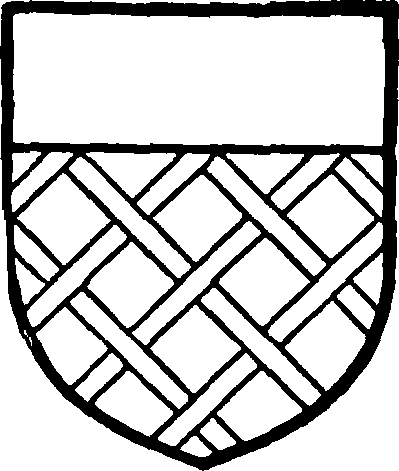
Fitzhugh. Azure fretty and a chief or.
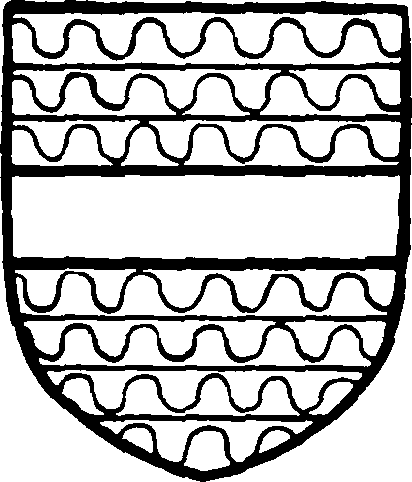
Marmion. Vair a fesse gules.
These lands were held in demesne by Geoffrey son of Geoffrey de Hudswell, who in 1199 paid a fine for having the right of 6 carucates 2 oxgangs in Easby, Hudswell and Dalton against Thomas de Helbeck. (fn. 40) In 1238 Geoffrey son of Geoffrey granted all his lands in Easby to St. Agatha's Abbey, (fn. 41) which by this time had acquired the remaining 5 carucates 5 oxgangs. These were held of Roald the Constable by Torphin son of Robert de Manfield, (fn. 42) whose name occurs before 1171. (fn. 43) Torphin's descendants, the Marmions and Fitz Hughs, (fn. 44) were afterwards mesne lords of this part immediately under the Earl of Richmond. (fn. 45) In the early 16th century, however, only I of these 5 carucates was held of the Fitz Hughs, 4 being held of the king. (fn. 46) Torphin, with the assent of Agnes his wife, in whose right he was presumably seised granted 2 acres of land and the mill near the abbey and the mill-pool to the Abbot of St. Agatha's; this grant was confirmed by Henry Murdac, Archbishop of York (1147–54), and Henry II. (fn. 47) In 1231 Maud de Morville, one of the daughters and heirs of Torphin, (fn. 48) granted the manor to the abbey, (fn. 49) to which on her petition Roald the Constable confirmed her whole demesne, (fn. 50) and at some time Agnes the other daughter and heir of Torphin granted to the abbey the service of half a carucate in Easby. (fn. 51) Thus the abbey acquired the whole vill in demesne and continued to hold it until the dissolution of the monasteries. (fn. 52) Afterwards, in 1537, the king leased the house, site and demesne lands of the abbey to John Lord Scrope of Bolton for thirty years; in 1551 Edward VI leased the same to Edmund Boughtell for thirty years, and in 1557 the reversion was granted to Ralph Gower, his heirs and assigns. (fn. 53)
In 1567 Ralph Gower died seised of the manor, leaving a son and heir John, (fn. 54) who was attainted. His lands were forfeited, but Anne widow of Ralph Gower apparently had a life interest in this manor. In 1571 it was leased for thirty-one years to John Stanhope, (fn. 55) who in the following year received a grant of the reversion of the lease in fee. (fn. 56)
Henry Lord Scrope in 1579 had licence to acquire the manor from John Stanhope. (fn. 57) The manor descended among the Scropes of Castle Bolton (q.v.) until 1630, when Emanuel Scrope Earl of Sunderland died without legitimate male issue, having made a settlement, dated 20 May 1629, of, among other things, the messuage called Scrope Noble in Easby on his natural children by Martha Janes of Buckingham. (fn. 58) Annabel, one of his daughters, was married to John Grubham Howe, to whom in 1674–5 the manor of Easby was granted. (fn. 59) In 1700 their son Sir Scrope Howe and his wife Julia conveyed the 'manors' of St. Agatha, St. Trinian and Easby (St. Agatha being the demesnes and St. Trinians a grange) (fn. 60) to Bartholomew Burton, (fn. 61) in possession in 1726. (fn. 62) In 1729 William Burton (of North Luffenham, co. Rutland) sold the same to Rev. William Smith, rector of Melsonby, (fn. 63) who in 1734 demised the manor and abbey to his nephew William Smith in tail-male. (fn. 64) The entail was barred and in 1746 William Smith and his son Layton conveyed the manor to William's brother Thomas, (fn. 65) who bequeathed the estate to his natural son Thomas Smith alias King and died in 1775. (fn. 66) Thomas the younger sold it in 1786 to Robert Knowsley of Wighill Park, who sold it in 1788 to Cuthbert Johnson of London. (fn. 67) Cuthbert Johnson and his son Cuthbert sold the manor and abbey in 1816 to Robert Jaques, grandfather of the present owner, Mr. Leonard Jaques. (fn. 68)
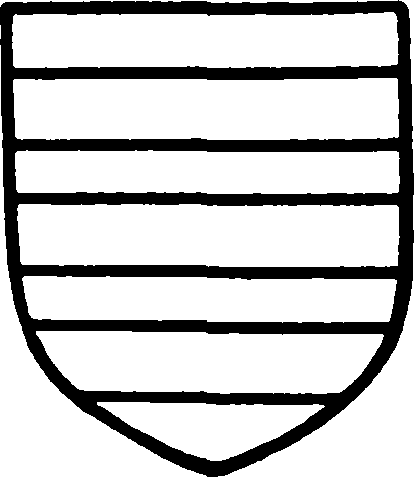
Aske of Aske. Or three bars azure.
ASKE (Hasse, Ascam (?), xi cent.; Ascha, xii cent.), composed of 6 carucates of land, was a 'manor' belonging to Tor before the Conquest and in 1086 belonged to Count Alan, under whom Wymar (Wihomarc) his steward (fn. 69) held it in demesne. (fn. 70) That the descendants of Wymar took the territorial name of Aske (fn. 71) has not been proved; the office of steward apparently descended to the Askes, but may have been the service due from this manor. (fn. 72) Both Warner the Steward son of Wymar and Roger the Steward were witnesses to an undated charter of Count Stephen, while Roger son of Wymar was among the men of Count Stephen in 1131 (fn. 73) and was possibly Roger his steward. (fn. 74) Warner son of Wymar, also steward, (fn. 75) was mesne lord of Aske in the reign of Henry II. (fn. 76) Then the Askes follow. Conan de Aske, kinsman of Earl Conan, (fn. 77) was steward (he 'had care of the wapentakes') in 1183–4. (fn. 78) Roger de Aske, with the assent of his lord, Warner son of Wymar, founded Marrick Priory between 1154 and 1171. (fn. 79) He had a wife Wihtmai and sons Conan, Thomas and Bernard. (fn. 80) Conan had a wife Agnes and sons Alan, Roger, Thomas (fn. 81) and Walter. (fn. 82) Conan was succeeded by his son Roger (fn. 83) and he by a son Roger who was lord in 1268. (fn. 84) Roger son of the last-named was dead in 1280 and was succeeded by his son Hugh, (fn. 85) who was lord in 1286–7. (fn. 86) A Roger de Aske was lord in 1302–3, (fn. 87) 1307 (fn. 88) and 1316, (fn. 89) Hugh, seised of one fee in Aske and Marrick, in 1317–18, (fn. 90) Thomas in 1347–9, (fn. 91) Conan 1373–91. (fn. 92) Conan had a wife Eleanor and was succeeded by his son and heir Roger, who was lord in 1428 (fn. 93) and died in 1440, leaving a son and heir Conan. (fn. 94)
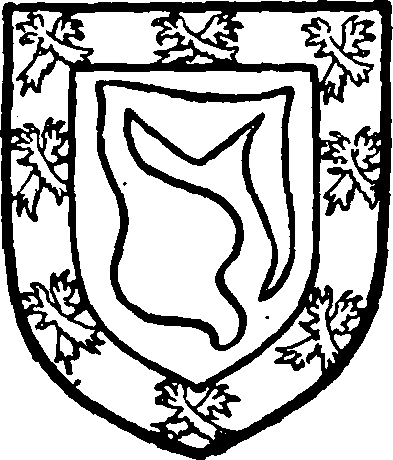
Wharton, Lord Wharton. Argent a sleeve gules in a border sable charged with eight pairs of lions' paws or crossed saltirewise.
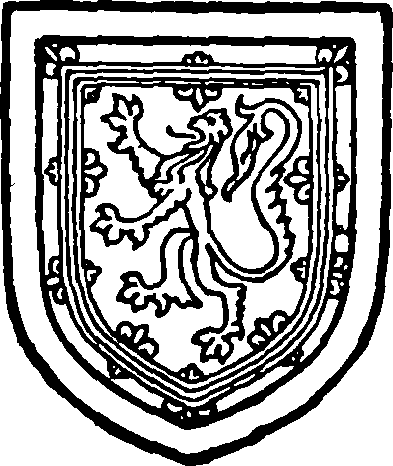
Dundas, Marquess of Zetland. Argent a lion in a double tressure counterflowered gules with a border azure.
In 1512 William Aske died seised of the manor, leaving as heirs his granddaughters Anne and Elizabeth, daughters of his son Roger. (fn. 95) Elizabeth was married to Richard Bowes of South Cowton, fourth son of Sir Ralph Bowes of Streatlam, (fn. 96) to whom the manor was allotted. (fn. 97) It must afterwards have been settled on their fifth son Robert, whose son Ralph Bowes (fn. 98) and Joan his wife sold the manor to Thomas son and heir of Philip Lord Wharton in 1611. (fn. 99) The Whartons continued in possession until 1727, (fn. 100) when, the estates of Philip Duke of Wharton being vested in trustees to pay his debts, (fn. 101) Aske was sold to Sir Conyers D'Arcy. (fn. 102) Sir Conyers before his death in 1758 bequeathed the manor to his nephew Robert Earl of Holderness, (fn. 103) who sold it in 1763 to Sir Lawrence Dundas, bart., (fn. 104) of Upleatham. Sir Lawrence died in 1781 and was succeeded by his son and heir Thomas, (fn. 105) created in 1794 Baron Dundas of Aske, (fn. 106) who died in 1820, leaving a son and heir Lawrence, created in 1838 Earl of Zetland. (fn. 107) He died at Aske in 1839. (fn. 108) His son and successor Thomas died childless in 1873 and the manor descended to his nephew Lawrence son of his brother John Charles Dundas. Lawrence, created in 1892 Earl of Ronaldshay and Marquess of Zetland, (fn. 109) is now owner.
BROMPTON-ONSWALE (Brompton - brigg, xiii cent., sometimes called Burton) was composed of 10 carucates of land and before the Conquest Tor had a 'manor' here. In 1086 Enisan (fn. 110) held it of Count Alan and had fourteen villeins and two bordars here. (fn. 111) From Enisan the mesne lordship of the 8 carucates of which the place was composed in 1286–7 descended to Roald de Richmond, (fn. 112) but here as elsewhere possession was for a time disputed by the family of Rollos. Henry II 'by his will and without judgment' disseised Roald the Constable, Enisan's successor, (fn. 113) and gave Brompton and Skeeby (fn. 114) Manors, among others, to Richard de Rollos (fn. 115) son of Richard de Rollos, (fn. 116) who was a tenant-in-chief in Leicestershire at the time of the Domesday Survey (fn. 117) and brother of William lord of Bourne in Lincolnshire in the time of Henry I. (fn. 118) Brompton and Skeeby after the death of Richard de Rollos descended to his son William, who held them 'till the Normans returned to Normandy,' when they were seized by the king and restored to Roald the Constable, grandson of the above Roald, on his payment of £100 and two palfreys, although they were claimed by Robert Cotele son of an aunt of William de Rollos. (fn. 119)
This manor was not held in demesne by Roald de Richmond (fn. 120) in 1286–7, when the Abbot of St. Agatha held 2 carucates under him, Robert Lascelles 5 oxgangs and Peter Greathead 1½ carucates. (fn. 121) In 1316 the Abbey, John de Lascelles and John Greathead were returned as joint lords of the vill. (fn. 122) Then in 1371 William de Whyten and Katharine his wife and her heirs sold the manor to Richard le Scrope of Bolton. (fn. 123) Richard le Scrope had in 1380 licence to alienate it to St. Agatha's Abbey, (fn. 124) and the abbey held it until its dissolution. (fn. 125) This part of Brompton seems to have been composed of 6 carucates.
By 1380 St. Agatha's Abbey had also acquired the remaining 2 carucates. In the 12th and early in the 13th (fn. 126) century lived Wynoch de Brompton, who held under the Rollos and the constables of Richmond, and granted to St. Agatha's Abbey all he held in Brompton. Hamo (called Rugeface) son of Wynoch granted to the abbey 1 carucate (half of which Agnes his mother held and half of which was given him for his 'pacification of the dispute about Croft'), and afterwards gave to it all his land of Brompton, these grants being confirmed by his nephews Elias de Rylestone and Adam his kinsman son of William son of Wynoch. (fn. 127) Richard de Rollos before 1206 granted to the abbey half a carucate and other lands in Brompton, (fn. 128) and Harald grandson (nepos) of Richard de Rollos granted them two parts of the cultivated land of Brompton Moor. (fn. 129) In 1286–7 the abbey held 2 carucates in Brompton in demesne of Roald de Richmond, and in 1316 was returned as one of the owners of the vill. (fn. 130)
Queen Elizabeth granted the lordship to Henry Lord Scrope for twenty-nine years in 1579–80 (fn. 131); in 1732 John Lodge of Brompton-upon-Swale, son and heir of Anthony Lodge by Anne his wife, sole daughter and heir of Mary Peirson deceased, sold one-third of the manor to Bacon Morritt (fn. 132); and the Hon. Bryan Stapleton of the Cedars, Park Town, Oxford, was lord in 1857. The manorial rights have now apparently been lost.
SKEEBY (Schireby, xi cent. ; Scythebi, Scideby, xii cent. ; Schideby, Skitteby, Skytheby, xiii, xiv cent.; Skeitby, Skeby, xvi cent.) was composed of 6 carucates of land in the fee of Count Alan in 1086, (fn. 133) and afterwards, like Brompton, belonged to the Rollos and the Roalds. Richard de Rollos in the 12th century had sac and soc, toll and team and infangenthef here, (fn. 134) and presumably in all his lands. Richard de Rollos gave Skeeby to Harsculph Rufus, lord of Cleasby (fn. 135) (q.v.), and Harsculph's descendants seem to have enfeoffed St. Agatha's Abbey and Egglestone Abbey, but Harsculph de Cleasby in 1303 still had a court here. (fn. 136) The two abbeys were joint tenants of Skeeby in 1316, (fn. 137) and had acquired their lands in the following way: Before 1171 (fn. 138) Richard de Rollos gave 1 carucate in Skeeby to Odulf son of Peter de Richmond. (fn. 139) Conan son of Odulf granted half this carucate to St. Agatha's Abbey, (fn. 140) the gift being afterwards confirmed by Ivetta daughter of Conan and Robert de Aton her son. (fn. 141) Richard de Rollos further granted to Harald his grandson (nepos) the tenements in Skeeby which he had granted to Harsculph Rufus, to hold of Robert son of Harsculph and his heirs. (fn. 142) This Harald, who took the name of Skeeby, was son of Aldred de Richmond, (fn. 143) and not only related to Richard de Rollos but also brother-in-law of Harsculph Rufus. (fn. 144) His grant of half a carucate in Skeeby to St. Agatha's was confirmed by his daughter Maud, (fn. 145) whose son William also granted tenements in Skeeby to the abbey. (fn. 146) In the 12th century Robert son of Alexander Musard (fn. 147) granted the mill of Skeeby to St. Agatha's Abbey, (fn. 148) and later Nicholas de Stapleton, with the assent of Alina his wife, granted half a carucate. (fn. 149) Altogether the abbey held 2 carucates, partly in demesne; and the remaining 2 of which Skeeby was composed in 1286–7 (fn. 150) were held by Egglestone Abbey of Roald. Egglestone Abbey must have been enfeoffed by the Cleasbys, to whose heirs they still paid a rent for land here at the time of the Dissolution. (fn. 151) In 1205 the abbot gave 10 marks and a palfrey for having seisin of 2 carucates of land and a mill in Skeeby, of which Roald son of Alan disseised him, and which he held 'before Roald had the grant of William de Rollos,' and while William's land was in the hands of the king. (fn. 152)
There is no longer a manor of Skeeby, and the manorial rights seem to have become extinct early.
In the 14th century the chase of Skeeby belonged to the Earl of Richmond. (fn. 153)
Church
The church of ST. AGATHA stands a little to the south of the abbey buildings and was in existence shortly after 1152. At that time it probably consisted of a chancel and nave, both shorter than at present, and the former narrower. The nave seems to have been rebuilt about 1200, and about the same time or a little later the chancel was lengthened and widened by taking down its north wall and rebuilding it on the line of the north wall of the nave; a chapel of two bays was added at the south-east of the nave later in the century. In the early part of the 14th century the north transept was added, the two arches opening to the south chapel rebuilt, and later in the same century the chapel was lengthened westwards and a south porch built of equal width, its west wall ranging with that of the nave. The east and south walls of the aisle were altered and perhaps rebuilt in the 15th century.
The church consists of a chancel 43 ft. by 17 ft., a nave 62 ft. by 20 ft. with western bellcote, north transept 18 ft. by 10 ft. 6 in., and south aisle 50 ft. by 12 ft. 6 in., with a two-story porch at the west. The chancel has an east window of three wide uncusped lights under a round head, looking like re-used 13th-century work. To the north and south of it are small recesses in the wall, the north recess having been fitted with a wooden door hinged at the bottom to open outwards. On each side of the chancel are four windows, one of which is a low-side window inserted in the wall. Of the rest all but the southeast window are plain round-headed lights, the two on the south being original 12th-century work with semicircular rear arches, while those on the north have been moved at the rebuilding of the wall and have 13th-century segmental rear arches. The northwest window is noticeable for having been set inside out, as far as regards its wrought stone jambs and head. The south-east window is of the 15th century, square-headed, and of two cinquefoiled lights with tracery over; below it are three 13th-century sedilia and a piscina. On the opposite side of the chancel is a tomb recess containing a lidless coffin; in the wall by the recess are several iron eyelets, which may be ancient and connected with the fitting up of the frame for an Easter sepulchre. The south door of the chancel is plan, with a pointed head, and the chancel arch is an insertion in 13th-century style by Sir G. Scott, 1869.
The nave has a south arcade of three bays, with a small modern arch cut through the eastern respond. The two eastern bays have pointed arches of two chamfered orders; the east respond is semi-octagonal, brought out to a square face at the top, with a chamfered abacus above it, and the base is an octagonal plinth with a chamfered top. The first column is octagonal, placed diagonally, having been, as it seems, cut down from a circular column; it has a very shallow capital moulded with a fillet and roll, and an octagonal base; the second column, of much smaller diameter, is also octagonal, and has a capital and base which fit it badly; the former is shallow, and appears to be the upper member of a capital of normal proportion. The third bay, which, as already noted, is later than the other two, has an arch of different radius from the others, of two hollow-chamfered orders, with a label of different section; its west respond is like the east respond and of the same date, and has been removed from the position of the second octagonal column at the time the bay was added.
The north transept opens to the nave by an arch springing from responds like those of the south arcade, the east respond being also in the same relative position as regards the east wall of the nave. In the transept are some 15th-century screen work, an old chest and a pitch pipe. There is a three-light 15th-century window in the north wall with a square head, and above it a small arched opening, the wall face setting back at the level of the head of the three-light window.
In the north wall of the nave are two early 13thcentury round-headed windows and in the west bay a plain round-headed doorway, now blocked, the division between the bays being marked by shallow buttresses. The west gable has a tall central pointed light between two similar buttresses, and above it a bell-turret with two bells. Along the inner face of the west wall runs a stone bench, which is returned for a short distance on the north and south. The south doorway of the nave, also in the west bay, like the north doorway is of 13th-century date, of two orders, the outer moulded and resting on shafts with moulded capitals and bases; close to its east jamb, within the nave, is a holy water stone, and to the west of the doorway is an arched entrance to the stair leading to the upper story of the porch.
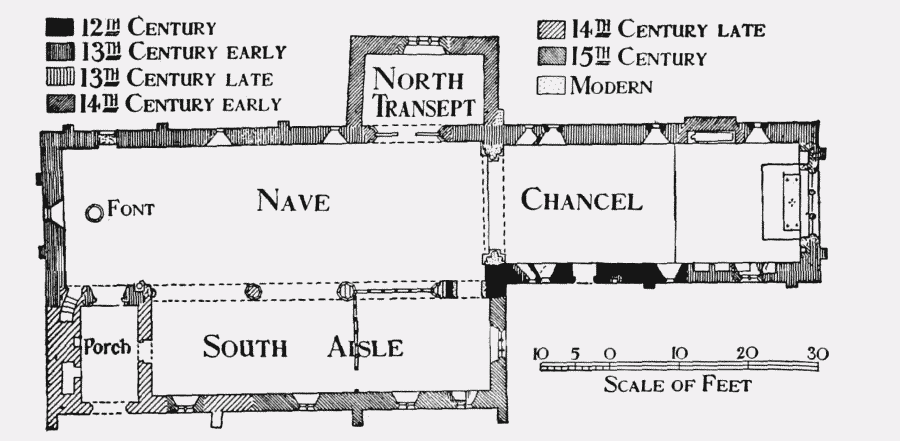
Plan of Easby Church
The door is old, with its wrought-iron hinges, and perhaps of the 14th century.
The porch has a barrel vault, its west wall being very thick, and containing the stair already mentioned and two cupboards, one a small recess, the other 5 ft. long and 2 ft. deep. The east wall of the porch, in which is a doorway to the south aisle, is of normal thickness, and the outer archway of the porch, which is arranged to suit the passage, is not central with the gable above it. Its label has two shields as dripstones, with the arms of Aske and Conyers respectively. Above is a niche with a shield of the arms of Scrope on its sill, and a small squareheaded window, set centrally with the gable, to light the parvise over.
The south aisle, which has been divided from the nave by wooden screens, with a separate entrance from the porch, retains 15th-century screens in its east bay on the north and west; its east window is of the 15th century, with three cinquefoiled lights, and has an image bracket to the north. A large bracket in the south wall to the west of the first bay has perhaps carried one end of a loft crossing the aisle at this point; the stonework at the springing of the arcade opposite to the bracket shows no traces of colour, as if it had been covered by woodwork at this point. In the south wall are a 13th-century piscina with a trefoiled head, perhaps re-used, and four windows, two in the eastern bay, the first being made up of 15th-century fragments, its square head being in reality a transom, while of the other three two are of the same character as the east window of the aisle, but of two lights, and the third seems to be a later copy of them.
The roofs and wooden fittings of the church, with the exceptions noted, are modern, the most interesting remains of its old decoration being the wall paintings. In the nave the south arcade preserves a painted cheveron pattern on arches and labels, and in the chancel a more ambitious scheme of decoration is in part preserved. The north and south walls have two tiers of figure subjects separated by narrow bands of ornament, those on the north wall being taken from the Old Testament and those on the south from the New. The heads of the windows and their splayed jambs are also treated, all the work being very well drawn and designed with spirit and feeling. Its date must be c. 1280–1300. The subjects remaining on the north wall are the Creation of Eve, Adam and Eve in the Garden, the Temptation, their shame and expulsion from Eden, Adam delving and Eve spinning. On the south wall are the Annunciation, the Nativity, the taking down from the Cross, the Entombment, and the Women at the Tomb.
In the backs of the sedilia are painted large figures of three bishops, seated, in mass vestments, and in the splays of the north windows are secular subjects, hawking and digging in the first window from the east, pruning and sowing in the next, while in the third window the paintings have been destroyed.
In the glass of the east window are two small incomplete 14th-century figures, one being that of our Lady, probably from an Annunciation, and in the middle light an angel from a canopy, of 15th-century work.
The font, at the west end of the nave, has a round 12th-century bowl with an arcade of round-headed arches and shafts, alternately plain and ornamented with cheverons, flutes, &c. The stem is circular, and rests on a base which looks like 14th-century work.
In the south wall of the nave towards the east may be seen part of a very pretty early cross-shaft with knot work and floral scrolls, and there is another early fragment over the west window. In the south wall of the chancel outside, close to the south doorway, is a small recess containing a mutilated seated figure of early date, possibly of Christ enthroned between angels, and near to it is part of a second figure of later date. Two mediaeval coffin slabs are built into the plinth of the south aisle.
In the chancel floor are two large blue slabs, with indents for brass shields and inscription plates, but the oldest monument now preserved is the brass plate of Eleanor wife of Robert Bowes of Aske, 1623, in the south aisle.
There are two bells: the first, of ancient date, is without inscription; the other is inscribed '+ Ave Maria Gracia Plena,' and was probably cast in the 14th century.
The plate includes two chalices and a paten dated 1881. There is also a partly-restored shell-shaped bowl, probably a wine taster, with an uncertain datemark. It may be the work of Thomas Mangy of York (1664–82).
The registers begin in 1670.
Advowson
The parish church existed at the time of the construction of the abbey (fn. 154) and was appropriated before 1292 to the Abbot of St. Agatha's, (fn. 155) who continued to hold it till the Dissolution. (fn. 156) In 1400 the pope granted that on the death of the perpetual vicar the church might be served by a canon of the monastery or by a secular priest. (fn. 157) After the Dissolution the vicarage was retained by the Crown, which presented until 1862, (fn. 158) when the advowson was sold by the Lord Chancellor to Mr. Leonard Jaques under the Act passed to enable him to sell the poor livings in his patronage. (fn. 159)
In 1537–8 John Lord Scrope was granted the rectory at farm, (fn. 160) and in 1560 his son Henry Lord Scrope had a grant of the same for twenty-nine years. (fn. 161) The rectory was granted in 1612–13 to Morrice and Phillips, (fn. 162) who conveyed it nine days afterwards to Thomas Greenwood and others. (fn. 163) George Greenwood was said in 1674 to have held it for over forty years. (fn. 164) From him it passed to his son John, and then to his grandson Charles, who was in possession in 1719 (fn. 165) and 1726. (fn. 166) Clarkson in 1821 wrote: 'When the abbey of St. Agatha was dissolved the canon who was then vicar had the stipend allowed him by the Crown. This stipend with the impropriation was passed to the family of Greenwoods in Oxfordshire; but that family having been long abroad and till lately supposed to be extinct, the tithes have not for many years been claimed, and are perhaps for ever lost.' (fn. 167)
The Abbot of St. Agatha granted to Torphin son of Robert a chapel in his mansion of Easby where he and his family and visitors (except the parishioners of St. Agatha) might hear divine service; and he and his heirs were to present the chaplain to the canons. (fn. 168) This is, however, the only mention of this chapel According to the Register of the Archdeaconry of Richmond, Conan de Aske in 1465 obtained a special licence from the archdeacon of the period to have mass celebrated by his chaplain at his manor of Aske. (fn. 169) There was in 1328 a hermitage of St. Augustine at Skeeby. (fn. 170)
A contention regarding mortuaries arose in the 13th century: the parish church claimed a third part of the third part of the goods of the lords of Aske in the parish; but in 1281 Hugh de Aske, on behalf of himself and his successors, commuted this charge for a payment of 16s. (fn. 171)
Charities
The hospital was founded by the Rev. William Smith, by deed poll dated 29 September 1732, for four poor persons, with directions to his heirs to place in two of the rooms a schoolmaster; it was endowed with an annual rent-charge of £12 issuing out of certain closes called the Western Leazes, now paid by Mr. Leonard Jaques, lord of the manor. The charity is regulated by a scheme of the Charity Commissioners dated 4 February 1907, and the net income is applied in the maintenance of alms-people or pensioners, being poor men or women of good character.
George Harrison, by will proved in 1867, left £100 Caledonian Railway ordinary stock (with the official trustees), the income to be distributed among the deserving poor of the township of Easby. The income of about £4 a year is given to the inmates of the hospital.
Charity of William Browne.—See under Boltonupon-Swale, wapentake of Gilling East.
Township of Brompton-on-Swale.—An annual payment is made by the trustees of the Old Maids' Hospital, York, out of an estate in this township under the will of Mrs. Mary Wandesford, 1725, for the use of the poor. In 1906 £1 10s. was given to eight widows.