
A History of the County of York North Riding: Volume 1. Originally published by Victoria County History, London, 1914.
This free content was digitised by double rekeying. All rights reserved.
'Parishes: Forcett', in A History of the County of York North Riding: Volume 1, (London, 1914) pp. 64-71. British History Online https://www.british-history.ac.uk/vch/yorks/north/vol1/pp64-71 [accessed 25 April 2024]
In this section
FORCETT
Forset (xi–xvi cent.); Forsate (xv cent.).
Forcett parish was composed in 1831 of the townships of Barforth, Carkin (now included in Forcett), Forcett and Ovington (fn. 1) and the hamlet of Little Hutton. (fn. 2) The township of Eppleby was added before 1857, (fn. 3) Little Hutton transferred to Wycliffe parish in 1884, (fn. 4) Ovington in 1899. (fn. 5) Barforth and Ovington are geographically detached from the parish.
The area of the present parish is 5,132 acres of land, of which 83 acres are covered by water. For part of the parish there are 1,053 acres arable land, 1,485 acres permanent grass and 81 acres woods and plantations, (fn. 6) the chief crops being barley, wheat and turnips. The subsoil is Yoredale Rocks with recent alluvium by the River Tees. At Forcett there are an old clay-pit and brick kilns. Large quantities of limestone are sent from Forcett to the ironworks at Middlesbrough, the stone being conveyed from the goods station at Forcett by a single line of rail to the works.
Forcett Park is the property of Mr. Algernon Percy Michell and the residence of Capt. P. Maitland French. The house, built in the Italian style, was praised by Lord Harley in 1745. (fn. 7) It is situated in a well-wooded park about a mile long containing a large fish-pond. Outside the park is the church of St. Cuthbert (fn. 8) and about a dozen scattered farm-houses. Half a mile to the west between Forcett and Stanwick St. John (q.v.) are the great Stanwick earthworks.
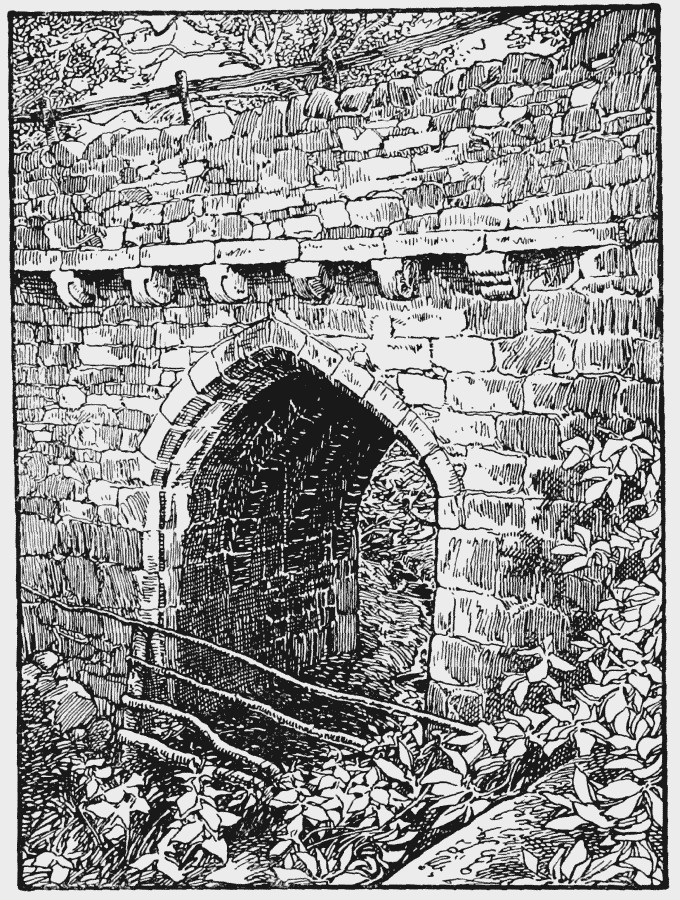
Barforth Bridge, Forcett
The Scot's Dike, an earthwork reaching from Barforth on the Tees to Grinton, can now hardly be traced in this parish, but there is an almost perfect inclosure round Forcett Park. (fn. 9) Barforth, called Old Richmond in the 18th century, (fn. 10) is a deserted village, with only its ancient manorhouse, Barforth Hall, now a farm-house, remaining. It is said that the outline of the main street can be traced and that coins of Elizabeth's time have been found there. (fn. 11) Close by, Chapel Gill Beck runs through a wood by the ruined chapel of St. Lawrence, where it is crossed by a small single-span bridge which has four chamfered ribs on the soffit of its arch. A line of corbel stones below the parapet seems to date the bridge as 14th-century work. Close by is a very perfect specimen of a domed stonebuilt pigeon-house. The stream then becomes Hell Hole Black Beck, and from this point, where it takes a sharp curve, the views both up and down the valley are very striking. Barforth Wath is probably the ancient ford that gave its name to two hamlets on either side of the Tees. To the west of Barforth is Ovington, (fn. 12) the birthplace in 1791 of James Raine, the northern historian. The village is built round a long green, in the middle of which is a maypole made of a single larch tree stripped of its bark. The present pole has only been erected recently, and replaced a smaller one which it was the custom to lower to the ground with due ceremony on certain occasions. In a garden at the west end of the village are several upper stones of querns which were dug up in a neighbouring hedgerow. Forcett water-mill was parcel of the manor in 1282. (fn. 13) Among the local names are Low and High Fuster Gill, Scot Cuts, and Sandwath. 'Marketesgath' in Barforth is mentioned in the 13th century. (fn. 14) Edward II was at Forcett in 1322, (fn. 15) the year of the battle of Boroughbridge.
There was a public elementary school at Forcett, but it is now removed to Eppleby.
Manors
Eight carucates of land in FORCETT formed a berewick of the manor of Gilling at the time of the Domesday Survey, (fn. 16) and was retained in demesne by the lords of Richmond, with the exception of periods of leases, (fn. 17) until 1494, (fn. 18) after which the manor continued to be held of the honour of Richmond. (fn. 19)
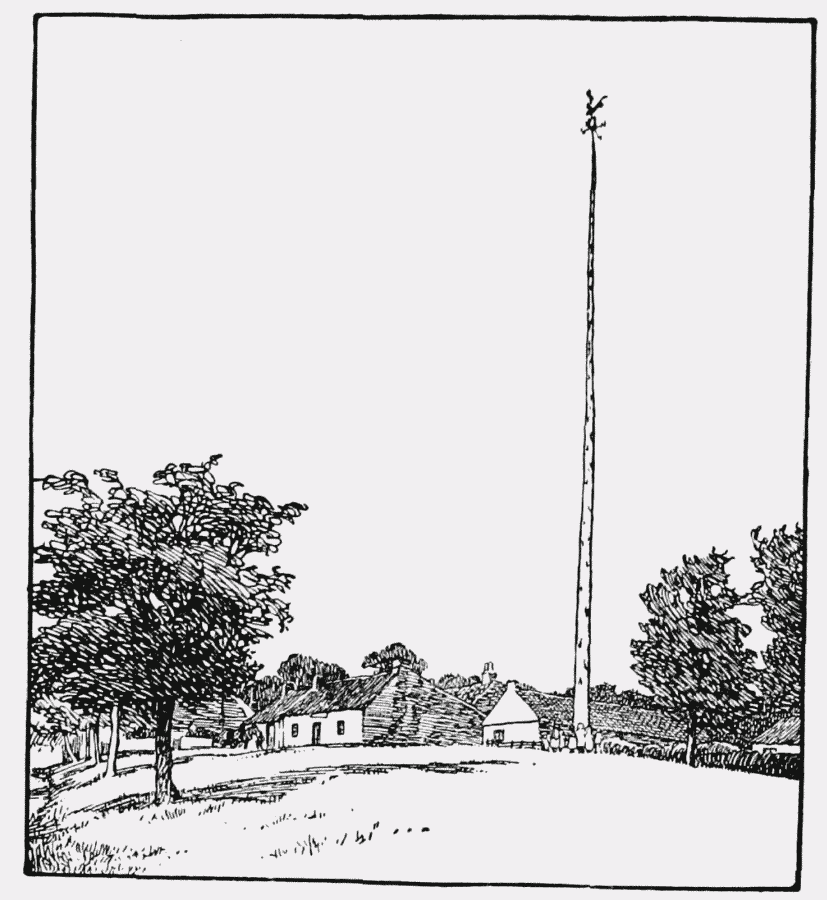
Forcett: Ovington Maypole
Henry VII, Earl of Richmond (q.v.) before his accession to the throne, granted the manor in 1494 to Richard Cholmley, knighted in 1494, (fn. 20) and the heirs male of his body. (fn. 21) On Sir Richard Cholmley's death without male issue in 1521 (fn. 22) the manor reverted to the Crown and was granted in 1522 to Sir Henry Wyatt, kt., and his issue male. (fn. 23) Sir Henry Wyatt died in 1537, his son Sir Thomas in 1542, and Sir Thomas son of the latter was attainted in 1554 for endeavouring to raise Kent against the queen's marriage with Philip of Spain. (fn. 24) Whether the Wyatts alienated Forcett or it was forfeited to the Crown is uncertain.
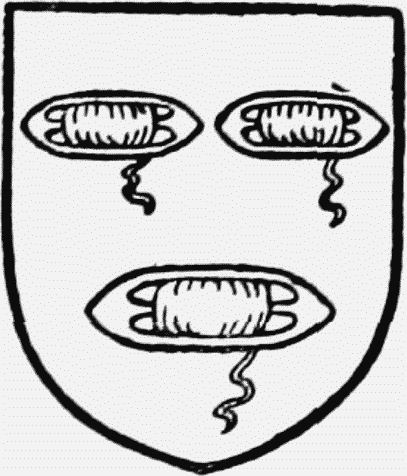
Shuttleworth. Argent three shuttles sable with the yarn or.
In 1566 John Zouch granted the manor under royal licence to Robert Lambert (fn. 25) of Owton, Durham, who was attainted for his share in the rising of 1569 (fn. 26) The manor was leased in 1571 for twenty-one years to Brian Fitzwilliam, who in 1573 surrendered his interest in exchange for other lands. (fn. 27) In 1576 it was granted to Thomas Boynton, Nicholas Brooke and Percival Gounson of Aske, their heirs and assigns, (fn. 28) and again in 1590 to Thomas Shuttleworth. (fn. 29) In 1593 it was held by Sir Richard Shuttleworth, serjeant-at-law, (fn. 30) who in 1596 settled it on himself and his heirs male, with contingent remainders successively to Richard, Nicholas and Oughtred sons of Thomas his brother, and finally to Lawrence Shuttleworth of Whichford (co. Warwick), another brother of Richard. He died in November 1598 or 1599 without issue, (fn. 31) and in 1616 Richard Shuttleworth, who succeeded under the above settlement, surrendered the manor to the king, probably for assurance of title, and received a regrant to himself and Robert Shuttleworth, his heirs and assigns. (fn. 32) Nicholas Shuttleworth, aged 77, (fn. 33) was owner in 1665 when his elder brother Richard, of Gawthorpe, was dead (fn. 34); he himself died in the following year and was succeeded by Richard Shuttleworth. (fn. 35) The manor descended to Robert Shuttleworth, eldest son of James, eldest son of Richard Shuttleworth, who in 1785 sold it, with the manors of Carkin and Eppleby, to Frances widow of John Michell of Boston (co. Lincoln), (fn. 36) ancestress of Mr. Algernon Percy Michell, the present lord of the manor.
In the 14th century there is a reference to a warren. (fn. 37) In 1566 a dovecote is mentioned. (fn. 38)
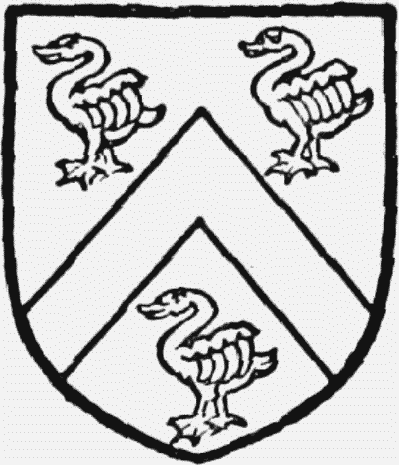
Michell of Forcett. Party cheveronwise gules and sable a cheveron between three swans argent.
Wymar, steward of Count Alan, in the 11th century (fn. 39) held I carucate of land in Forcett, which he granted to St. Mary's Abbey, York. (fn. 40) This land remained in the possession of the abbey until its dissolution, (fn. 41) and was afterwards granted to the owner of the manor of Forcett. (fn. 42)
BARFORTH (Bereford, xi–xv cent.) was among the possessions of the see of Durham pledged by Bishop Aldun (990–1020) to Ughtred 'Eorl' of Northumbria and the Danish chieftains Ethred and Northman. (fn. 43) Like Forcett, Barforth was in 1086 a berewick (composed of 3 carucates of land) to the manor of Gilling, and another carucate of land here was soke of that manor. (fn. 44) The manor of Barforth was held of Richmond Castle. (fn. 45)
The early history of the mesne tenancy is complicated, and made still more confused by the fact that another Barforth adjoins this place on the Durham side of the Tees. Robert de Perham was mesne lord of at least 3 carucates of land 'in both Barforths' in 1202 (fn. 46); Geoffrey Scales held half a knight's fee (i.e. 6 carucates) (fn. 47) in Carlton (in Stanwick parish) and Barforth in 1211–12 (fn. 48); and Master John de Popelint was dealing with half a knight's fee in Barforth in 1233. (fn. 49) By 1286–7, however, 3 carucates of land in the Yorkshire Barforth (the place had extended to 6 carucates since the Domesday Survey) were held immediately of the earl by the undertenant, and the remaining 3 carucates were held of Roald de Richmond. (fn. 50) Probably because Roald's under-tenants subsequently acquired the whole of the vill, the whole 6 carucates were in 1521 and 1536 held of his successors (fn. 51) the Scropes of Bolton. (fn. 52)
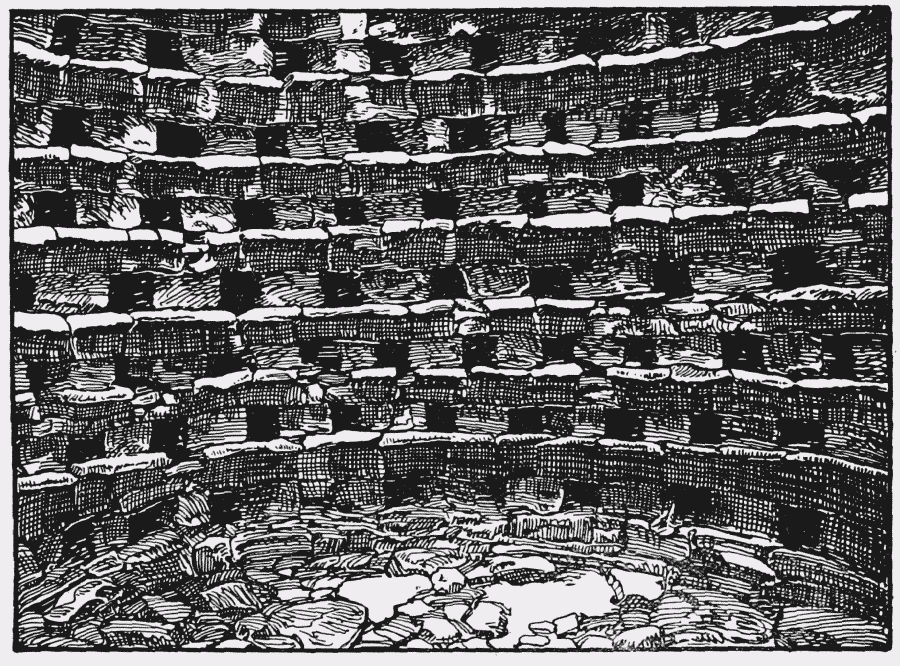
Stone Pigeon-house at Barforth: Interior
The family of Barforth were in the 13th and probably in the 12th century tenants of the 3 carucates held of Roald in 1286–7. Waldief de Barforth owed the king a mark in 1165–6, (fn. 53) and in 1171–2 was one of the commissioners for the works of Bowes Castle. (fn. 54) In 1224 the manor of Barforth was in the possession of Robert de Barforth, (fn. 55) probably son of Waldief. (fn. 56) This Robert had sons Richard and Elias, of whom Richard died in his father's lifetime, (fn. 57) leaving a daughter and heir Emma. Robert was dead by 1226–7, when Julia his widow claimed dower from the land which Siritha widow of Richard held in dower. (fn. 58) Emma daughter of Richard and Siritha married first John de Barforth, (fn. 59) who (fn. 60) had children Robert and Felise. Robert was holding Barforth, probably as locum tenens of Emma, in 1256 (fn. 61); he died without issue before 1278–9, when his sister Felise, who had married (fn. 62) William de Barningham, was said to be his heir. By 1263 Felise had married Thomas de Cleasby, who then held Barforth. (fn. 63) Emma, however, was still alive, and now married Harsculph de Cleasby, lord of Cleasby, by whom she had a son Robert. (fn. 64) Harsculph was dead by 1280, (fn. 65) and Emma was returned as sole tenant of these 3 carucates in 1286–7. (fn. 66) She was alive in 1292, (fn. 67) but seems to have died before 1304, (fn. 68) and was certainly dead in 1314, when her daughter-in-law Amabel, lady of Cleasby (q.v.), Amabel's daughter Emma and her husband Robert de Hastings had a grant of free warren here. (fn. 69) Amabel was holding Cleasby in 1316, but her son-in-law was returned as lord of Barforth at that date, (fn. 70) and still paid the subsidy here in 1327–8. (fn. 71) On his death without issue Emma married Henry Fitz Hugh of Ravensworth (fn. 72) (q.v.), who joined with her in the spring of 1337–8 in settling Cleasby, Barforth and other manors on their issue with remainder to his right heirs. (fn. 73) Christina, possibly heiress of Henry, married the son of Sir Thomas de Layton, who in 1338 settled tenements in Barforth and Cleasby on John his son and Christina his wife, (fn. 74) and in 1348 the Laytons quit claimed the manor of Cleasby (q.v.) to the Fitz Hughs. In 1353 the manor of Barforth was settled on John Layton and Christina and their heirs male with contingent remainder to their daughter Elizabeth. (fn. 75) Elizabeth married Henry son of John Pudsey of Bolton in Craven, and died in 1424. (fn. 76) She brought the manor of Barforth to the Pudseys, who held it until the middle of the 17th century. (fn. 77) Sir John Pudsey, who was owner in 1428, also held the other 3 carucates of Barforth, (fn. 78) and these subsequently descended with the manor.
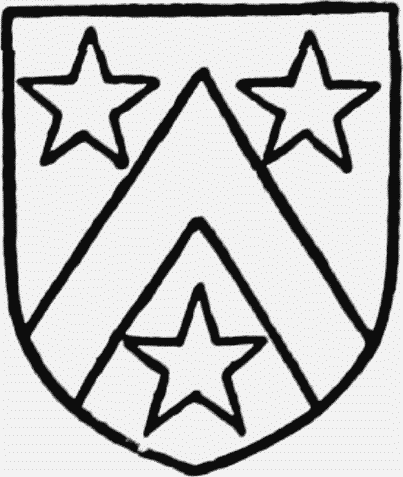
Pudsey. Vert a cheveron between three molets or.
Three carucates of land 'in both Barforths, formerly in the tenancy of William le Norris, were in 1202 confirmed to Hugh le Norris by the mesne lord Robert de Perham. (fn. 79) A Geoffrey le Norris held 3 carucates of land in the Yorkshire Barforth from 1256 to 1290, (fn. 80) but it was in the hands of the earl in 1302–3, (fn. 81) and in 1428 John Pudsey was said to hold the quarter fee (3 carucates) here which the Earl of Richmond formerly held. (fn. 82)
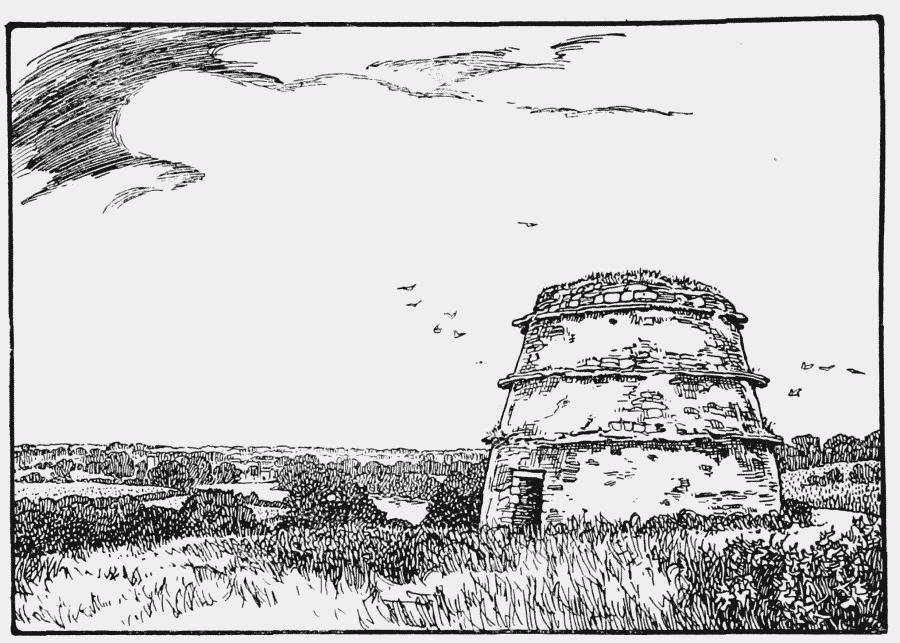
Domed Stone Pigeon-house at Barforth
The Pudseys from 1651 made various conveyances, (fn. 83) and in 1660 the manor was conveyed to Sir Barrington Bourchier of Beningbrough, kt., Sheriff of Yorkshire, (fn. 84) and followed the descent of the manor of Beningbrough (fn. 85) (q.v.) until 1778, when Giles and Margaret Earle conveyed it to trustees, who in 1782 sold it to Francis Fawkes of Farmley Hall. Francis Fawkes appears to have settled the manor on his son Walter Fawkes and his issue. In 1796 a Private Act of Parliament was obtained vesting certain outlying parts of Francis Fawkes's estates (including the manor of Barforth) in trustees for sale. The trustees, with consent of Walter Fawkes son of Walter Fawkes above mentioned, conveyed the property in 1802 to Edward Lord Harewood, from whom it has descended to the present Earl of Harewood. (fn. 86)
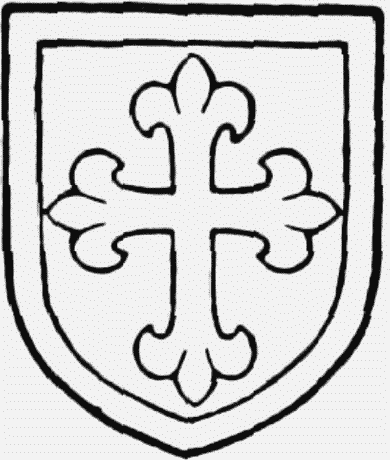
Lascelles, Earl of Harewood. Sable a cross paty in a border or.
The Barforths' court at Barforth is mentioned in 1256 and 1263. (fn. 87)
CARKIN (Kercham, xiii cent.; Kerkan, Karkin, xiii– xvii cent.; Kirkham, xv cent.) is not called a manor until the 16th century. (fn. 88) It was a member of the honour of Richmond. (fn. 89)
In 1211–12 Pain Orbelinger was mesne lord. (fn. 90) In 1286–7 Michael de Layton, Maud Were and Reginald de Carkin held tenements of Matthew de Carkin, (fn. 91) and Matthew held tenements of the Knights Templars, and they of the earl, the overlord. (fn. 92)
From the Templars Carkin passed with their other lands to the Hospitallers, of whom it was held in 1493. (fn. 93) Of the under-tenants the Laytons kept their interest until 1564. (fn. 94) At the end of the 16th century the Hutchinsons had an interest in the manor (fn. 95) and held the manor till the middle of the 18th century, (fn. 96) when they sold it to the Shuttleworths. The Shuttleworths held it till 1785, (fn. 97) when Robert Shuttleworth sold the manor with Forcett to Mrs. Michell, ancestress of the present owner. (fn. 98) It is now absorbed in the manor of Forcett.
OVINGTON (Ulfeton, xi cent.; Ulvington, xiii–xvi cent.).—The soke of the 3 carucates of land of Ovington belonged to Count Alan's manor of Gilling in 1086, (fn. 99) and in 1494 Ovington (then only 1 carucate of land) was still held of the honour of Richmond. (fn. 100)
Scolland lord of Bedale (q.v.) in the early 12th century gave the great tithes of his demesnes here to the Priory of St. Martin at Richmond. (fn. 101) His successors the Fitz Alans, Greys and Stapletons (fn. 102) were afterwards mesne lords of Ovington. (fn. 103)
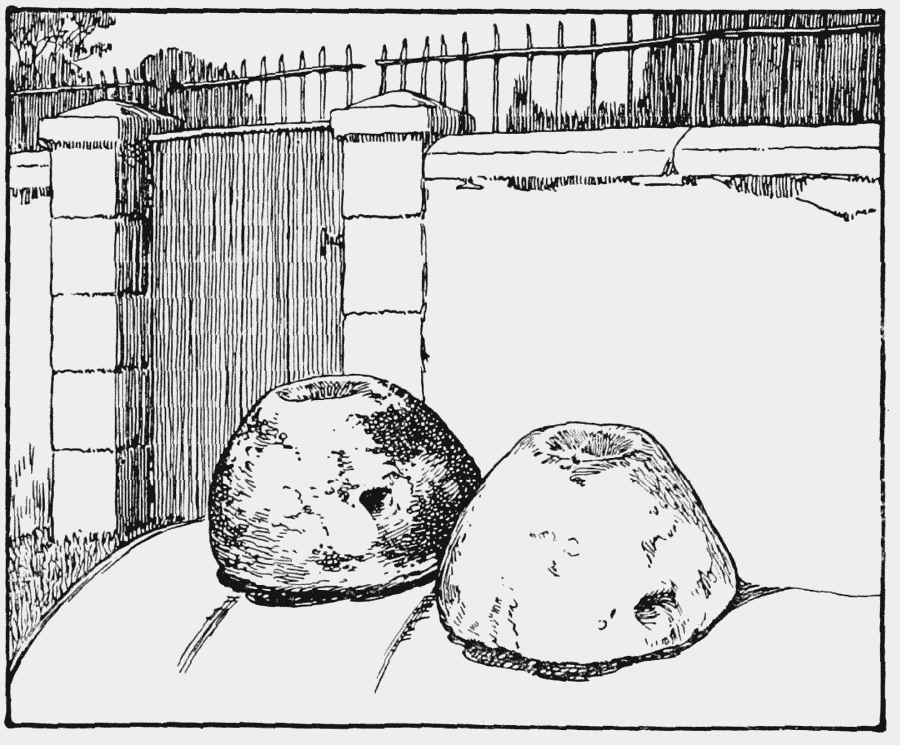
Old Querns at Ovington
In the early part of the 13th century Sir Walter Bisset (lord of Lovat in Scotland) held Ovington in demesne of the lords of Bedale. (fn. 104) In 1253, before his death—'far away in Scotland'—he sent a messenger to Gerard de Bowes, his bailiff of Ovington, with letters patent directing that Thomas Bisset his nephew should be put in seisin of his manor of Ovington. Gerard was away and the messenger waited, but on Gerard's return in a fortnight he refused to give seisin to anyone but Thomas in person, so Thomas Bisset came to Ovington and lodged there and demanded seisin. Then two free men, one villein and the reeve of the town being at once called together, Gerard gave him seisin, saving the right of everyone. (fn. 105) Sir Walter's estates, however, were forfeited for the murder of the Earl of Athol, (fn. 106) and Ovington was seized by the king's escheators. (fn. 107) In 1316 it was coupled in the return with Wycliffe, and the lords of Wycliffe (q.v.) have continued to hold it to the present time. (fn. 108)
Churches
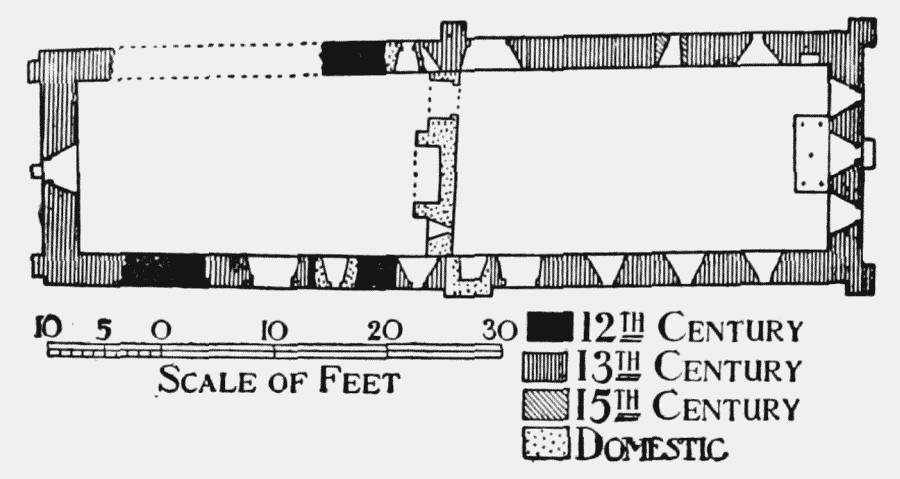
Plan of St. Lawrence Chapel
The church of ST. CUTHBERT was practically rebuilt in 1859 and consists of chancel with south vestry, nave with north aisle, south porch and west tower. A good deal of old work is re-used in the tower and elsewhere, but the building as a whole has little historical interest. A number of early carved stones and architectural details have been built into the south porch. Its outer and inner doorways are both of 12th-century date, the former c. 1180, with foliate capitals and engaged shafts, the latter c. 1130, with a cheveron ornament on the outer order and a broad reeded label. The capitals have angle volutes and flutes above the necking and the shafts and bases are modern. There are stone seats on each side of the porch and above the east seat an arched recess containing the 14th-century effigy of a priest in mass vestments. The best of the early carved stones are (1) a stone 11 in. by 9 in. with a human figure standing among knotwork with a four-legged beast on his left; (2) two figures carefully chiselled with a twist and a saltire knot having rings at the centre and angles; (3) part of the head and shaft of a richly ornamented cross, with three beasts round the head of the cross, which has rings at the centre and ends of the arms; on the shaft are panels of knotwork and beasts and a large spiral coil below; (4) the arm of another crosshead with knotwork; (5) a spiral coil forming one corner of a square design. There are several early grave-slabs, two set into the east bench being probably of the 11th century.
There are two brasses in the south wall of the nave, one to Nicholas Shuttleworth, 1666, the other to Mrs. Anne Underhill, daughter of Richard Lever of Little Lever, Lancashire, 'late wife of Thomas Shuttleworth,' who died 1637; on the brass is engraved her figure lying beneath an arch with Ionic columns, with figures of Labour and Rest in the spandrels.
The font, of 15th-century style, is modern, as are the three bells.
The communion plate consists of a plain silver flagon and cup presented to the church in 1859. There is also a fine old silver paten. None of the plate bears a date or inscription.
The registers begin in 1595.
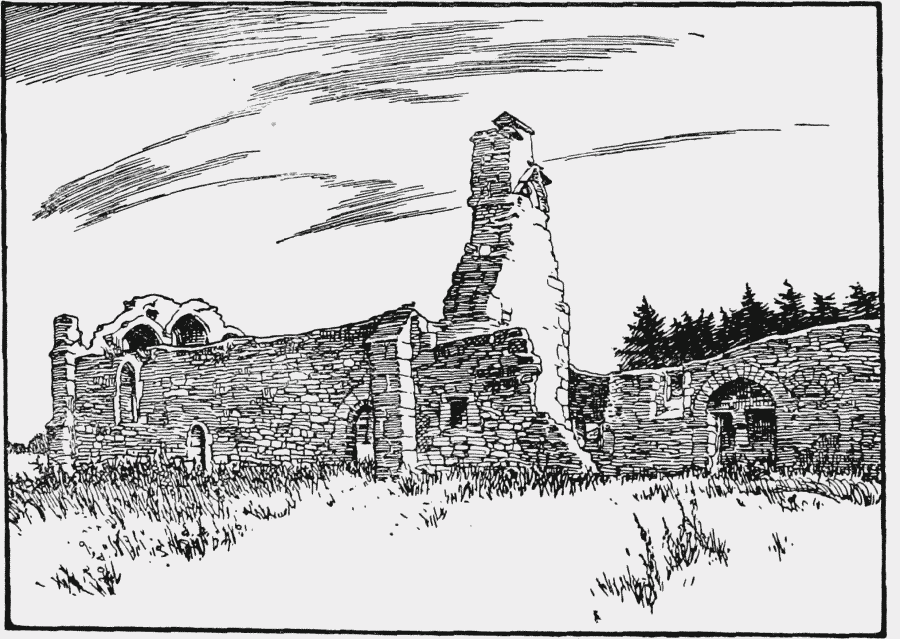
St. Lawrence Chapel, Barforth, from the North-west
The chapel of ST. LAWRENCE is a rectangular building 66 ft. long by 16 ft. at the east end and 15 ft. at the west inside, and is now divided into two almost equal chambers. The western part of the structure was built in the 12th century; the only remaining detail of that date is a blocked south doorway. It was lengthened apparently about 1220 and the chapel remained in use thus until some time in the 16th century, when it was desecrated and used for domestic purposes and the dividing wall was built. Additional floors were put in to form an upper story and the place served as a dwelling-place until modern times, but it is now in ruins.
The east wall is pierced by three lancet windows, with clasping buttresses at the angles, above which are the stumps of octagonal pinnacles. The 13th-century altar-slab now lies on the ground; it is a heavy piece of stone with crude leaf ornament carved on its chamfered edges. In the north wall is a 13th-century lancet near the east end; below it is a small plain recess, and further west a small lancet of later date. In the middle of the north wall, against the later dividing wall, is a buttress, apparently original, the upper half of which has chamfered edges. To the east of it is a 13th-century pointed doorway, and to the west part of one jamb of another 13th-century lancet, below which is a 16th-century square-headed light. Near the west wall are the remains apparently of the jamb of another doorway. In the south wall to the east is a range of three 13th-century lancets, and to the west of them a small doorway with the remains of a pointed trefoiled head with a double chamfered label, retaining one defaced human head stop. West of this is a later window, now blocked. Next are the inner jambs of a 13th-century lancet with a small and later square-headed light, the rest being blocked; another small square-headed light pierces the wall west of this, next to which is a 13th-century doorway partially occupying the space of one of the 12th century. The former has jambs of two orders, slightly chamfered; the angle shafts have disappeared, but their capitals remain; these are moulded and enriched with nail-head ornament. The arch is pointed with a small hollow chamfer and a double-chamfered label. This doorway is now blocked and occupied inside by two small cupboards. Only the face stones of the round-headed 12th-century doorway are visible inside and out. A lancet window is inserted in the middle of the west wall. This wall is strengthened by three buttresses, one below the window. Above the gable of the cross wall is a small bellcote.
Advowson
Forcett Church is under the invocation of St. Cuthbert, whose bones are said to have rested here. (fn. 109) It was granted as an ecclesia to the abbey of St. Mary, York, by Count Stephen, (fn. 110) but was afterwards held by the abbey as a dependent chapel of their church of Gilling. Perhaps it was originally a dependency of Gilling and only held the rank of a parish church after Alan Niger had granted the mother church of Gilling to St. Mary's.
The living, a perpetual curacy, (fn. 111) designated a vicarage since 1870, is in the gift of the vicar of Gilling. G. 'Dean of Forcett' is mentioned in 1313. (fn. 112)
The chapel of St. Lawrence, Barforth, was dependent on Gilling Church (q.v.).
Charities
In 1680 Richard Shuttleworth by his will bequeathed to the poor of the town of Forcett £10 a year, to be distributed to the poor and to bind out apprentices. In 1788 the estate originally charged came into the possession of Charles Michell, who to exonerate the estate invested a sum of £160 in consols. The stock was subsequently sold out, and in 1815, by the direction of the court, the sum of £100, remaining after payment of costs of suit and expenses, was invested in the purchase of a plot of land at Woodland in the parish of Cockfield in the county of Durham, containing 6 acres. The land is let at £5 a year, which is distributed amongst poor persons of the townships of Forcett and Eppleby in sums of 10s. to £1 5s. to each recipient.
An annual payment of 10s. was formerly distributed among the poor out of the estate at Forcett belonging to the Michell family. In 1906 Captain Charles Michell by deed gave £100, the income to be applied by the owner of Forcett Park and the vicar of Forcett for the benefit of deserving and sick poor on the Forcett estate; it is invested in £114 15s. 6d. consols with the official trustees. The annual dividends of £2 17s. 4d. are duly applied.