A History of the County of York North Riding: Volume 1. Originally published by Victoria County History, London, 1914.
This free content was digitised by double rekeying. All rights reserved.
'Parishes: Romaldkirk', in A History of the County of York North Riding: Volume 1, ed. William Page (London, 1914), British History Online https://www.british-history.ac.uk/vch/yorks/north/vol1/pp117-127 [accessed 4 May 2025].
'Parishes: Romaldkirk', in A History of the County of York North Riding: Volume 1. Edited by William Page (London, 1914), British History Online, accessed May 4, 2025, https://www.british-history.ac.uk/vch/yorks/north/vol1/pp117-127.
"Parishes: Romaldkirk". A History of the County of York North Riding: Volume 1. Ed. William Page (London, 1914), British History Online. Web. 4 May 2025. https://www.british-history.ac.uk/vch/yorks/north/vol1/pp117-127.
In this section
ROMALDKIRK
Rumoldescherce (xi cent.); Rumbaldekirk, Villa Sancti Reginaldi, Villa Sancto Romaldo, vill of St. Rumald, vill of St. Rinald (1286–7); Rumbaldkirk (xiii–xiv cent.).
Romaldkirk parish, one of the largest in England, comprised in 1831 over a quarter of the whole wapentake of Gilling West, the area being 53,302 acres of land, 318 acres covered by water. Of this nearly all is open moorland, scattered over which are several small lakes and rocky scars or rugged masses of rock which rise often very steeply from the usually unbroken slopes of grass and heather. In the present parish, composed of the townships of Romaldkirk, Lartington, Cotherstone and Hunderthwaite, there are 15,686 acres of permanent grass, 878 acres of woods and plantations, and 182 acres arable land (fn. 1); while Mickleton, Holwick and the extensive township of Lunedale, which were formed in 1844 into the district chapelry of Lune and into the separate ecclesiastical parish of Laithkirk in 1845, are entirely pasture land. In the whole there were in 1546 only 1,400 'houseling people.' (fn. 2) The entire population in 1901 was 2,584. Under the Act of 1811 6,840 acres were inclosed in Holwick, Lune (fn. 3) and Romaldkirk, (fn. 4) the awards for Holwick and Lune being in 1826 and 1827 respectively. (fn. 5) An award for the inclosure of Hunderthwaite Moor was made in 1858 (fn. 6) and for Cotherstone Moor in 1867. (fn. 7) The subsoil is eruptive basalt in the north, then Yoredale Rocks with tracts of Coal Measures and Millstone Grit. There were iron forges and smelting furnaces in the forest of Lune in 1235, when Ranulf son of Henry subenfeoffed Thomas son of William of half the iron, (fn. 8) but iron has not been recently worked. In the same district lead was worked throughout the 18th century. (fn. 9) Veins of coal and slate at Cotherstone belonging to the manor were described as of no value in the 16th century (fn. 10); there are now slate quarries and pencil works on the banks of the Tees. Barium is obtained from the mines of Lunehead and Mickleton, of which Mr. John G. Reynoldson is owner. (fn. 11) Romaldkirk parish is the Alpine district of Yorkshire. Mickle Fell, the highest peak in the county, rises to a height of 2,550 ft., and around Mickle Fell there are no less than thirty summits which rise to a height of over 2,000 ft. above sea level. (fn. 12) The River Tees, here called Maize Beck, forms the whole northern boundary. It descends from the Westmorland hills into Yorkshire in the north-west of the parish at a height of 1,644 ft., and for 8 miles its bed is over 1,000 ft. above sea level. It is joined by numerous becks from the hills on either side. Cronkley Bridge, the first bridge over the Tees, is about 2 miles above the High Force, a waterfall formed by the river plunging sheer over 50 ft. into a deep pool shut in by wooded cliffs. The rock here is of greenstone and limestone, but round the fall is much blackened and contrasts well with the white spray and the rich brown colour of the water. Usually the greater volume of water falls on the left or western side of the great buttress of rock which rises in the middle of the fall, but in times of flood another cascade is formed on the right side and sometimes the whole of the central rock is hidden in a sheet of water. The next bridge is Wynch Bridge, said to be the first suspension bridge of its kind and to have been designed and built by the miners in 1704. The original suspension bridge spanned the river a few yards eastward and at a higher level than the present structure. (fn. 13) To the east of Wynch Bridge is Scoberry Bridge and some miles lower down the bridge of Middleton in Teesdale, Durham. West of Middleton the Tees receives the Lune, which rises far away among the Westmorland hills and traverses under various names the wildest and most solitary tracts of country before joining the Tees. Further on is Egglestone Bridge, in Durham, which was standing in Leland's time, (fn. 14) by means of which Romaldkirk village is connected with the County Palatine. South of Romaldkirk the river passes a farm-house called Woden Croft, formerly a well-known school at which Richard Cobden was a pupil. (fn. 15) Just below Woden Croft is Balder Beck, which runs through Baldersdale to the Tees. (fn. 16) Baldersdale, a valley well wooded though not so picturesque as Deepdale further south, has two large reservoirs for supplying water to Stockton-onTees, Thornaby and Middlesbrough. Below the junction of its waters with the Tees is Cotherstone.
Before the Tees leaves the parish it is crossed by the Tees Viaduct of the Barnard Castle and South Durham railway, which has a station at Lartington. The Tees Valley line of railway that runs through this parish has stations at Cotherstone, Romaldkirk and Mickleton.
A road leads from Cotherstone to Romaldkirk and through Romaldkirk to Mickleton and north-west of Mickleton crosses the Lune by Lune Bridge, a county bridge in 1678. (fn. 17) Laithkirk Bridge, mentioned in Holinshed's Chronicle in 1577, (fn. 18) was probably that now called Lune Bridge.
Upper Teesdale was laid waste by the Scots in 1070: An 'infinite multitude' under King Malcolm entered Yorkshire from Cumberland and may have saved William I the trouble of devastating Romaldkirk village, which was waste in 1086, for they slew in battle several English nobles at a place in Teesdale 'called in English Hundredeskelde, in Latin Centum fontes.' This was probably Hunderthwaite, a hamlet half a mile south-west of Romaldkirk, that still might be called the Hundred Springs. (fn. 19) King Malcolm, retaining part of his army, sent the other part home 'with countless booty.' (fn. 20) Romaldkirk parish naturally suffered considerably in border warfare, and in 1340–1 40 carucates were said to have been wasted by the Scots. (fn. 21) The boundaries between Yorkshire and Westmorland at this point were probably placed in the middle of the 14th century, following a perambulation made in consequence of cross cattle raids and assizes of novel disseisin made by the lords of Mickleton in Teesdale, Yorkshire, and of Brough and Stainmore in Westmorland in 1335–8. (fn. 22)
The village of Romaldkirk is small, with a pretty green at the east round which its houses are grouped, the church and rectory being on the north side. To the west of the green more houses line the wide road and form three sides of a square on the west of the churchyard. The rectory is close to the church on the east and has a north gable with two 16th-century windows, the lower of the two being square headed and of four lights with a hollow chamfer on the jambs and mullions and a square label with a curious terminal in the form of a tapered stop. The upper window is of two lights with plain jambs and no label, and above it in the top of the gable is a small trefoiled opening in a square frame. There are also other squareheaded windows in this part of the house, but some have been altered.
At Grains o' the Beck is an oval socket stone with the stump of a cross. By the side of the road opposite to the church is a house, formerly an inn, with the inscription:—
'If by you go And dry you be The fault's in you And not in me.'
South of the village is the small hamlet of Hunderthwaite with some cottages provided with high-pitched thatched roofs intended to prevent the snow lying.
Two miles south-west is Cotherstone village, a long line of houses on either side of the winding road with the new church of St. Cuthbert at the east. The houses are all stone built, but are of no particular interest. Several have 18th-century dates on their door-heads, and there are several of the older style with very steep pitched thatched roofs. The village is mostly inhabited by Quaker families who are occupied with dairy farming, Cotherstone cheese being well known. At the north end of the village is a steep descent to the wooded bed of Balder Beck, which flows down from Baldersdale, forming an artificial lake at the waterworks and joining the Tees at a point half a mile east of the village. At this point the wooded banks rise very steeply to a considerable height and form an effective natural moat and escarpment to Cotherstone Castle, which lies at the angle south of this junction of the streams. This fortress was apparently fortified, if not erected, under a licence of King John in 1200–1 by Henry son of Hervey, (fn. 23) and continued with his descendants the Fitz Hughs, passing like the manor of Cotherstone (q.v.). Nothing is known of its history nor when it became a ruin. There seems to have been a 'motte,' with evidence possibly of a masonry keep on it and some lower defensive works. Apparently the original approach follows a track which leads east from the village and as it enters the outworks becomes a mere causeway defended on the north by a very steep escarpment where the natural fall of the ground has evidently been increased by artificial work. On the south side there is also a considerable fall.
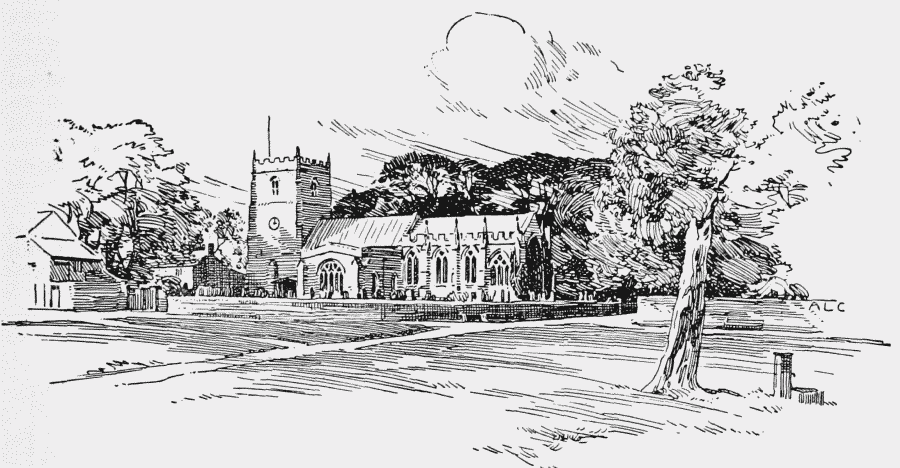
Romaldkirk: Church and Green
The chief traces of the castle buildings lie in a field to the north of the track, and consist of grasscovered mounds forming the foundation of two concentric lines of defence, and on the summit of the hill a large flat-topped mound still retains a short length of wall, of which nothing can be said except that it is an external wall. West of the keep a well constructed with good masonry supplies water for the neighbouring cottages, and was evidently the original source of supply for the castle. Of the large quantity of masonry which composed the castle few traces are now to be seen, though doubtless much of it passes unrecognized in the building and walls of the neighbourhood. A cottage on the north side of the track to the village has some fragments of worked stone built into its south wall. These include the double head of a small two-light round-headed window, a single head, a portion of the cusped head of a small window, a portion of a thin octagonal shaft and capital, a section of a string-course and some other smaller fragments. Some pieces of worked stone which came from the site of the castle are now in the rectory garden. Amongst them is a rudely cut grotesque head, probably the terminal of a label; two of a similar type are in position on the north door of Hutton Magna Church.
A mile south-west of Cotherstone is the small village of Lartington, situated on a bend of the road with the hall at the west end. The hall, now unoccupied, contained until recently a large museum, chiefly of minerals and geological specimens collected by Mr. Henry Thomas Witham. Near the hall is the chapel of St. Lawrence, opened in 1700 for Roman Catholic service, the lords of Lartington having been Roman Catholics since the middle of the 17th century. William Maire, fifth son of Thomas Maire of Lartington, was professor at Douay from 1742–67, served the Durham Mission, was appointed coadjutor to Francis Petre, vicar-apostolic of the northern district of England in 1767, and was consecrated Bishop of Cinna in partibus infidelium. He was buried in 1769 in the family vault at Lartington. (fn. 24) The owner of Lartington from 1847 to 1897 was a Roman Catholic prelate, the Right Rev. Monsignor T. E. Witham. (fn. 25)
There is a Friends' meeting-house at Cotherstone; a Presbyterian conventicle at Lartington was licensed in 1672, (fn. 26) and there are now Wesleyan Methodist chapels at Romaldkirk, Cotherstone, Mickleton and Lunedale, Primitive Methodist at Holwick and Mickleton, and a Congregational chapel (1748) at Cotherstone.
In the reign of Edward VI there was a grammar school in the parish, the master of which received a yearly stipend of £2 6s. 8d. from a stock in the hands of the parishioners. (fn. 27) No further reference to it has been found. There are now public elementary schools at Romaldkirk, Lartington, Cotherstone, Hunderthwaite, Mickleton, Holwick and Lunedale. Hagwormehall in Baldersdale is mentioned in 1539– 40, (fn. 28) and a deed of 1693 gives the following names: Girsegarth, Riddings, Longgarth, Low-Ings, Coatflatt, Brunt Walls, Cross-of-Hill, Bryer-flat, Terne flat, Burtry Stubb, Stong Bottom, Dike Reane, Collingworth Bank. (fn. 29)
There are now seven mills in the parish: one at Cotherstone on the Tees, Hury Mill at Hunderthwaite, an old smelting-mill at Lunedale, Grassholme Mill on the Lune, a saw-mill at Lonton, a mill at Mickleton, and Low Mill near Mickleton. At Mickleton and Holwick there were two watermills in the 16th century (fn. 30); at Crossthwaite a watermill was in ruins in 1359 (fn. 31); from 1639 (fn. 32) to 1811 a water corn-mill is mentioned as belonging to the lord of the manor at Lartington. There were also twenty dove-houses at Lartington in 1811. (fn. 33)
Manors
ROMALDKIRK belonged, like all other places in this parish mentioned in Domesday Book, to the fee of Torphin before the Conquest, (fn. 34) and became a member of the honour of Richmond. In 1086 Mickleton, Lonton, Romaldkirk, Hunderthwaite, Lartington, and Cotherstone were all held of Count Alan by Bodin, (fn. 35) and the mesne lordships descended either to the Fitz Alans or to the Fitz Hughs. (fn. 36) The only exception to this was the RECTORY MANOR of Romaldkirk. One carucate was returned as the endowment of the church in 1286–7. (fn. 37) The customary tenants of this manor owed various suits and services, including the carriage of eighty horse-loads of pit coal to the rectory. (fn. 38)
The carucate held by Bodin at the time of the Domesday Survey was held in 1286–7 by Brian Fitz Alan, (fn. 39) from whom tenements in the vill descended to the lords of Bedale (fn. 40) (q.v.), and passed during the 15th century to the Fitz Hughs, George Fitz Hugh being said to have died seised of the manor. (fn. 41) This land followed the usual descent of the Fitz Hugh lands, (fn. 42) and was quitclaimed by the Dacres to the Crown in 1583. (fn. 43)
Possibly it afterwards passed into the hands of the lords of Cotherstone (q.v.), but all manorial rights appear to have lapsed. (fn. 44)
BALDERSDALE (Bardersdale, (fn. 45) xvii cent.).— There was formerly a vill here, (fn. 46) which was presumably a member of the neighbouring manor of Hunderthwaite, of the lord of which the family of Appleby held land in Baldersdale valued at £20 yearly in 1584. (fn. 47) In 1526 Sir Ranulph Piggot, kt., settled tenements called the 'manor' of Baldersdale to uses under his will (fn. 48); and in 1546–7 the messuage called Baldersdale fell to the share of Sir Charles Brandon and Elizabeth his wife, daughter and co-heir of Thomas Piggot. (fn. 49)
Henry son of Ranulf obtained in 1251 a grant of free warren in his demesne lands in BRISCOE (Birscou, xiii cent.; Buscogh, xiv cent.; Briscoughe, xvi and xvii cent.) (fn. 50); his descendant Henry Fitz Hugh was mesne lord in 1326–7, but by the close of that century the mesne lordship had passed to the descendants of the Fitz Alans. (fn. 51) Briscoe is now a hamlet of Cotherstone. The Eures had a vaccary here in the 14th century, (fn. 52) and in 1577–8 William Lord Eure held a capital messuage and lands 'in Briscoughe in the vill of Baldersdall,' and settled it with other lands on Mary Dawney, the betrothed of his son (fn. 53) and successor Ralph, who died seised in 1617. (fn. 54) Perhaps these were the lands in Romaldkirk said in 1576–7 to be parcel of the duchy of Lancaster, (fn. 55) as the Eures were elsewhere tenants of the duchy. (fn. 56)
COTHERSTONE (Cuthbertestun, Codreston, xi cent.; Cuderstone, Cothereston, xiii–xv cent.; Coderston alias Cotherston alias Goderston, xvi–xviii cent.) was, with Barforth and Lartington, pledged by Bishop Aldhun of Durham to Ughtred 'Eorl' of Northumbria between 990 and 1020. (fn. 57)
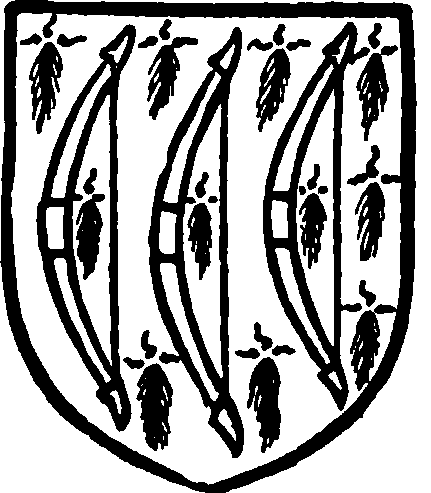
Bowes. Ermine three long-bows gules.
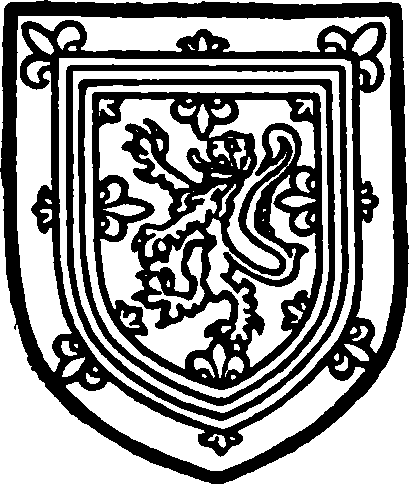
Lyon. Argent a lion azure in a double tressure counter flowered gules.
There have been from the Conquest two manors of Cotherstone, one of which descended from Bodin to the Fitz Hughs (fn. 58) : Henry son of Hervey had licence in 1200–1 to fortify his house here, which became Cotherstone Castle, (fn. 59) and in 1251 Henry his grandson (fn. 60) was granted free warren in his demesne lands of Thringarth, Mickleton, Cotherstone, Briscoe, and Holwick. (fn. 61) Hugh son of Henry (from whom the Fitz Hughs take their name) was summoned in 1278–81 to substantiate his claim to have free chase in Teesdale, free warren and park at Cotherstone, and gallows in his lands. Hugh pleaded his ancestors' right to chase from the first grant of their lands, warren he claimed by a charter of Henry III, and gallows he only claimed at 'Barwick on Tees and Stanck.' (fn. 62) This manor followed the descent of Ravensworth (fn. 63) until the 16th century, when it escheated to the Crown. (fn. 64) In 1600 the queen granted the manors of Cotherstone and Lartington in fee to Alexander Edward and Richard Prescott, (fn. 65) who in 1602 conveyed them to Elizabeth Countess of Shrewsbury, (fn. 66) then in her third widowhood. 'Building Bess of Hardwick,' as this lady was called from the series of marriages by which she raised her status, settled them the same year on her son (fn. 67) Lord William Cavendish in tail-male. (fn. 68) Her descendants the Earls of Devon and Dukes of Devonshire were lords of Cotherstone until 1841, when the Duke of Devonshire sold it to John Bowes, from whom it has descended to the present Earl of Strathmore. (fn. 69)
COTHERSTONE with HUNDERTHWAITE (fn. 70) was the other manor of Cotherstone and held by the Fitz Alans. In 1278–81 Brian Fitz Alan alleged that he had free warren at Cotherstone by grant of King John to Brian son of Alan his ancestor in all his demesne lands outside the king's forest, and that Brian had his private woods in his manors and had inclosed them and made the park (fn. 71) in which he had warren. (fn. 72) After the death of Brian Fitz Alan without male issue early in the 14th century his daughters and their descendants the Stapletons and the Greys of Rotherfield held some of his manors jointly, (fn. 73) but Cotherstone was held by the Stapletons in severalty. (fn. 74) In 1354 Miles Stapleton settled the manor of Cotherstone and his moiety of Bedale on his heirs male by Joan his wife and in default on the heirs male of his brother Brian. (fn. 75) When, however, Sir Miles Stapleton died without male issue in 1466, although there still existed male descendants of Brian, the manor passed to Joan younger daughter of Sir Miles, married first to Christopher Harcourt, and secondly to Sir John Huddleston of Millom Castle, Cumberland. (fn. 76) In 1470 Brian Stapleton, descendant of Brian, sued Richard Harcourt, son of Sir Christopher and Joan, (fn. 77) for this manor, basing his claim on the settlement of 1354. (fn. 78) He recovered Bedale, but not Cotherstone, of which Sir John Huddleston, kt., second husband of Joan, died seised in right of his wife in the reign of Henry VII. (fn. 79) The Huddlestons of Millom Castle continued in possession until 1741–2, when William Huddleston sold the manor of Cotherstone with Hunderthwaite to George Bowes of Streatlam, (fn. 80) ancestor of the present owner, the Earl of Strathmore.
CROSSTHWAITE (Crostwayte, xiii–xv cent.) is not mentioned in Domesday Book, but it was apparently part of Bodin's fee, as it was held of Ranulf son of Henry in 1235 (fn. 81) and the Fitz Hughs were still mesne lords in 1497. (fn. 82)
Under the Fitz Hughs the manor was held from early times by the lords of Greystock. (fn. 83) Thomas son of William held it in 1235 under Ranulf as above. In 1278–81 William his son, summoned to show his right to free chase at Crossthwaite, said all his ancestors had had it from the Conquest, (fn. 84) and in 1285 he obtained a grant of free warren in his demesne lands here. (fn. 85) On his death about 1289 he was succeeded by John his son and heir, (fn. 86) who in 1299–1300 settled Crossthwaite with his barony of Greystock on himself for life with remainder to Ralph son of William and his heirs. (fn. 87) From John's death in 1305–6 (fn. 88) Crossthwaite followed the descent of the manor of Henderskelfe, (fn. 89) the chief Yorkshire seat of his descendants, until 1766, when the Earl of Carlisle conveyed it with the moiety of Holwick Manor in this parish to Mrs. Mary Bowes, widow of George Bowes, (fn. 90) and from her it has descended with the other possessions of the Bowes in this parish to the Earl of Strathmore.
HOLWICK, again, is not mentioned in Domesday Book, but seems to have been part of the fee of Bodin. Holwick—apparently the moiety—was granted by Ranulf son of Henry to Thomas son of William in 1235 to hold with his lands in Crossthwaite. (fn. 91) This moiety descended with the manor of Crossthwaite.
The Fitz Hughs retained a moiety of the manor, which was sold with Mickleton and Lune by the Marquess of Northampton, who had been re-enfeoffed by the Crown in fee simple, to Sir George Bowes in 1561, (fn. 92) and so descended to the present Earl of Strathmore. (fn. 93) Henry son of Ranulf received a grant of free warren in Holwick in 1251. (fn. 94)
HUNDERTHWAITE (Hundredestoit, xi cent.; Hunderthwayt, Hundredesthwayt, xiii cent.), like the Fitz Alan manor of Cotherstone, seems to have belonged to that family in the reign of John, for in 1246 Alan son of Brian complained that Henry son of Ranulf entered his free warren of Hunderthwaite and captured hares and wild goats there, although Alan had free warren by the charter of King John; Henry quitclaimed his right. (fn. 95) The Abbot of St. Agatha's claimed the manor in 1251–2 in right of his church, which, he said, was seised in the time of Henry II, (fn. 96) but in the same year he quitclaimed the manor to Alan son of Brian in return for lands in Scruton. (fn. 97) The immediate history of Hunderthwaite is slightly obscure. In 1286–7 it was coupled with Romaldkirk as Romaldkirk cum Hunderthwaite, the Hunderthwaite part being held by Brian Fitz Alan, (fn. 98) and a return of the time of Henry VII couples them in the same way as belonging to the Fitz Hughs. (fn. 99) The latter return, however, probably only referred to services, as Hunderthwaite seems always to have belonged to the descendants of the Fitz Alans. It was held by the dowager Maud of Bedale in 1316, (fn. 100) and the Grays of Rotherfield held it at the end of this century. (fn. 101) The Grays and Stapletons seem to have shared it, for it passed ultimately to the Huddlestons, (fn. 102) being held in 1677–8 with Cotherstone by Ferdinand Huddleston (fn. 103) as one manor, and these two estates have continued to be manorially united.
LARTINGTON (Lertinton, xi cent.; Lertingeton, Lyrtyngton, xiii cent.; Lirtington, xiii–xv cent.), between 990 and 1020, was pledged with Barforth (fn. 104) by the Bishop of Durham to 'Eorl' Ughtred of Northumbria and two Danes. (fn. 105)
It was one of the manors of the Richmond fee that in the middle of the 15th century became part of the fee of Middleham (q.v.), and ceased to be a member of the honour of Richmond. (fn. 106)
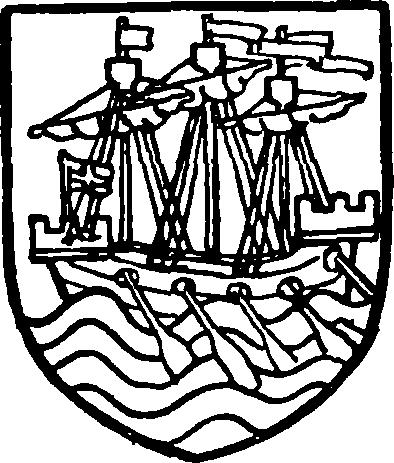
Maire of Hardwick. Argent a ship with three masts sable on waves of the sea in their proper colours.
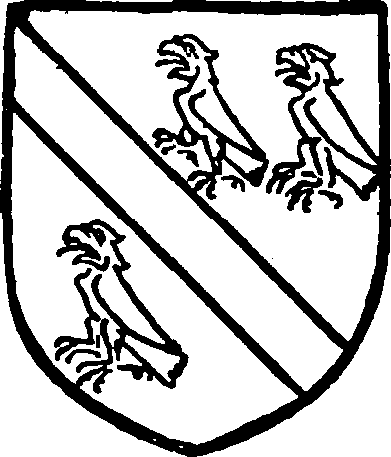
Witham of Cliffe. Or a bend gules between three eagles close sable.
The mesne lordship descended from Bodin to the Fitz Hughs, though in 1286–7 Brian Fitz Alan held half a carucate of the earl. (fn. 107) The Fitz Hughs at first held Lartington in demesne, and it ultimately returned to them after having been granted to a succession of under-tenants. Some time at the close of the 12th or beginning of the 13th century Henry son of Hervey, lord of Ravensworth, gave to Robert de Lascelles and his heirs the whole vill with its demesnes, services and all appurtenances, saving to himself and his heirs hunting rights in the forest; Robert and his family dwelling at Lartington might hunt, but they must send a servant to the door of Cotherstone to notify their intention, so that Henry's forester might accompany them. Moreover, if they were ever impleaded for hunting without the view of the forester they might be cleared by the oath of this servant in Henry's court of Cotherstone. (fn. 108) Robert de Lascelles was lord in 1208. (fn. 109) He or a successor of the same name enfeoffed Henry Spring of Houghton le Spring, Durham, and the manor was still held by Henry Spring in 1291–2. (fn. 110) Henry left a son and heir Humphrey, (fn. 111) presumably a minor, for John Spring had a grant of free warren in Lartington in 1301. (fn. 112) Humphrey was lord in 1313, (fn. 113) and was dead by 1328, when he left a widow Elizabeth and sons Henry and John, both under age. Henry's brother, still a minor, had succeeded by 1340. (fn. 114) From the Springs the right in Lartington descended by an heiress Elizabeth to Henry Headlam. Henry and Elizabeth were seised in 1403, (fn. 115) and in 1414 they made a settlement (fn. 116) which seems to have been a conveyance to the Fitz Hughs, for in 1427 Elizabeth widow of Henry Fitz Hugh died seised of two parts of the manor, (fn. 117) and the Fitz Hughs and their descendants continued to hold Lartington until the death of the Marquess of Northampton in 1571. (fn. 118) After this Lartington followed the descent of the manor of Cotherstone (q.v.) until 1639, when William Earl of Devon sold it to Francis Appleby. (fn. 119) In 1648 Francis Appleby of Lartington begged for a discharge of or leave to compound for the estate of his uncle Francis Appleby, who died during his appeal from sequestration, (fn. 120) and in 1654 Mary Appleby widow appealed in the same way. (fn. 121) Margaret daughter and sole heir of Francis Appleby married Thomas Maire of Hardwick, and died in 1672 in giving birth to her son Thomas, (fn. 122) who succeeded his father in 1685 and himself died in 1752. (fn. 123) Francis eldest son of Thomas (fn. 124) died in his father's lifetime, and he was succeeded by his second son Thomas, who in 1762 was succeeded by his brother John. John had no children, and his remaining brother and two sisters having died without issue (fn. 125) he in 1764 conveyed his estate to the husband of his sister Anastasia, (fn. 126) Sir Henry Lawson of Brough Hall, bart., and John Lawson, (fn. 127) his son, presumably in trust for Sir Henry's younger son Henry, who succeeded his uncle at Lartington in 1771 and took the name of Maire, but resumed his patronymic on succeeding, in 1811, to the baronetcy, his brother John dying without male issue. Sir Henry died childless in 1834, when this manor passed to his sister Katharine, widow of John Silvertop. On her death it descended to her second son Henry Thomas Maire Lawson, who married Eliza daughter of Thomas Witham of Headlam, Durham, and niece and heir of William Witham of Cliffe, (fn. 128) Yorks. Henry subsequently assumed the name of Witham. He died in 1844. His elder sons Henry and William had died in his lifetime, and he was succeeded by his third son George, who died unmarried in 1847, and then by his fourth son the Rt. Rev. Monsignor Thomas Edward Witham. This prelate died in 1897 and was succeeded by his great-grandnephew Francis Somerled Silvertop of Minster Acres, Northumberland. (fn. 129) He sold it in 1912 to Mr. M. D. Spence of Shotley Bridge.
LONTON belonged to Torphin before the Conquest, afterwards to Bodin. (fn. 130) Like Crossthwaite, it was held in 1235 by the ancestors of the barons of Greystock, and the manor was granted by William son of Thomas de Greystock in 1262 to Henry son of Ranulf, (fn. 131) whose descendants were afterwards mesne lords. (fn. 132) The lords of Rokeby (q.v.) were undertenants in 1286–7, (fn. 133) and continued in possession (fn. 134) until 1571, when Robert Rokeby sold the manor to Sir George Bowes. (fn. 135) After this Lonton followed the descent of the manor of Mickleton, and is now in the possession of the Earl of Strathmore.
LUNEDALE.—In 1201 the king confirmed to Henry son of Hervey the lands against the valley of the Lune granted him by Robert de Rokeby and Agnes his wife. (fn. 136) It is not until the 16th century that a manor of Lune is referred to, but after that time it always passed with Mickleton. In 1235 Thomas son of William de Greystock granted to Ranulf son of Henry common of pasture and mast in the valley of the Lune, chase in the forest of Lune, the cowshed on Horresate, half the iron coming from the forges and half the smelting furnaces in the forest, and cow and pig shelters in the valley. (fn. 137) Lune Forest was granted by the Marquess of Northampton to George Bowes with the manors of Mickleton and Lune. (fn. 138)
MICKLETON (Micleton, xi cent.; Mikelton, xiii–xv cent.) descended from Bodin to the Fitz Hughs. In 1251 Henry son of Ranulf had a grant of free warren here (fn. 139); in 1262 William son of Thomas de Greystock, whom he had probably subenfeoffed, granted him the manors of Mickleton, Thringarth and Lonton. (fn. 140) Hugh son of Henry held Mickleton in demesne in 1286–7, (fn. 141) and the Fitz Hughs continued so to hold it (fn. 142) until the attainder of the Marquess of Northampton. Regranted to the marquess in 1558 in fee simple, unlike his other estates, the manors of Mickleton and Lune, the forest and parks and tenements in Holwick were sold by him in 1561 to Sir George Bowes and Robert Bowes. (fn. 143) Sir George Bowes died in 1580, and in 1583–4 Gregory Fiennes Lord Dacre and Anne his wife (fn. 144) quitclaimed these manors to Jane widow of Sir George (fn. 145) and Talbot Bowes her son. (fn. 146) Sir George was succeeded in the family estates by his eldest son William, knighted in 1586, (fn. 147) who died at Walton near Chesterfield in 1611. By an entail made in 1569 the estates were divided between Sir Talbot Bowes above mentioned, eldest son of Sir George by his second marriage, and his nephew Sir George Bowes of Biddick, son of George third son of Sir George Bowes. Sir Talbot Bowes, who received the Lunedale estates, died without issue, and was buried at Barnard Castle in February 1637–8; his share in the estates passed to his younger brother Thomas, whose widow purchased the share of Sir George Bowes of Biddick from his assigns. Talbot eldest son of Thomas Bowes died in 1654; his brother and heir Thomas succeeded him and died in 1661. He was succeeded by his son William, (fn. 148) who represented the county of Durham in various Parliaments (fn. 149) between the years 1679 and 1705, and was knighted by James II in 1684. (fn. 150) He died in 1706, leaving three sons—William Blakiston, who died without issue in 1721, Thomas, who died without issue in 1722, and George, who died in 1760, leaving an only daughter and co-heir Mary Eleanor. (fn. 151) In 1767 she married the Earl of Strathmore, (fn. 152) and from that time these lands have remained in the hands of her descendants, the successive Earls of Strathmore, and are now held by the present owner of the title.
THRINGARTH (Thirngarth, xiii–xvi cent.), when it is first mentioned, belonged to the ancestors of the Fitz Hughs. In 1251 Henry son of Ranulf received a grant of free warren here. (fn. 153) The place seems to have been only a hunting-lodge, (fn. 154) though in 1287 (fn. 155) and 1424–5 (fn. 156) it is called a manor. It always belonged to the Fitz Hughs. In 1424–5 there were two parks here, called West Park and Thringarth Park, each stocked with game. (fn. 157) Thringarth Park descended to the Marquess of Northampton, and was granted by him in 1561 to George Bowes of Streatlam, Durham, (fn. 158) to whose descendant the Earl of Strathmore it now belongs.
Churches
The church of ST. ROMALD consists of a chancel 41 ft. by 17 ft., with a vestry on the north side 18 ft. by 9 ft., a nave 43 ft. by 14 ft., with north and south aisles 11 ft. wide, a north transept 14 ft. by 28 ft., south transept 18 ft. by 26 ft., and west tower 13 ft. square, all measurements being internal.
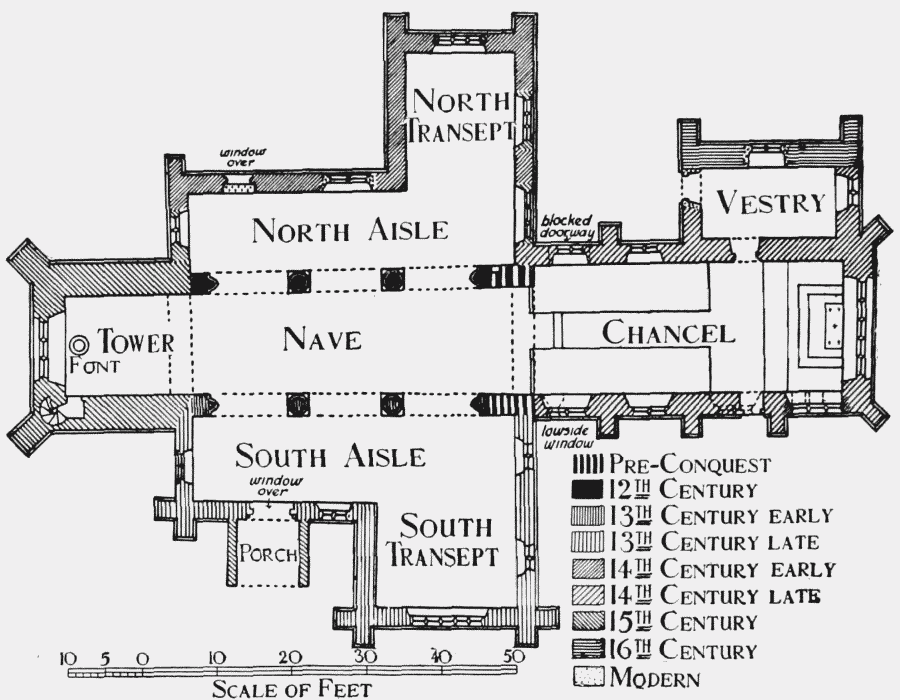
Plan of Romaldkirk Church
The earliest part of the building is to be seen in the masonry at the north-west angle of the chancel, and shows the heavy north-east quoins of what was probably a pre-Conquest nave, aisleless and of the same width as the present nave, its internal dimensions having perhaps been 30 ft. by 14 ft., with a chancel about 12 ft. square. The line of the north eaves of the steep-pitched roof of this chancel is yet to be seen on the upper part of the wall. The nave walls are unusually high in proportion to the span, and some of the early walling may still remain behind the plaster above the present arcades. In the latter end of the 12th century this nave received the addition of a north aisle, an arcade of three bays being set up, and the nave was probably lengthened at the same time. The south arcade appears to be a 13th-century copy of that on the north, and the south aisle and transept date from c. 1280. The windows at least, which do not seem to be insertions, are of this date, and, although the south doorway and arcade look a good deal earlier than this, it is possible that they are not so, but owe their early look to an idea of harmonizing with the 12th-century detail. About 1330 the north aisle was rebuilt and the north transept added, and in 1360–70 the chancel was entirely rebuilt, with a north-east vestry. The early chancel had doubtless given way to another, built round it after the usual fashion, at some time between the 12th and 14th centuries, and this in its turn was succeeded by that which now exists. Its south wall is on the same line as that of the south arcade of the nave, but its north wall is just outside the corresponding line on the north, thus exposing the north-east angle of the early aisleless nave. The south wall also is 3 ft. 1 in thick, and the north 2 ft. 9 in., and if an explanation of these irregularities is to be deduced from existing evidence it may be that while the south wall retains the line and thickness, and perhaps part of the masonry, of its predecessor, the north wall was set out on new foundations outside the line of the former north wall.
In the 15th century the west tower was added and new windows inserted in the north transept, and perhaps in the 16th century the north wall of the vestry was rebuilt. This latter has evidently suffered a good deal of alteration, but still preserves the evidence of having had two stories when first built.
The chancel is faced externally with wrought stone, and has a large east window of five cinquefoiled ogee lights with curious, awkwardly designed tracery in the head, which may be in part the result of some later repair. There are four windows on the south side, set rather close together with stepped buttresses between. Three of them are each of two ogee cinquefoiled lights with cusped openings over, and contemporary with the last rebuilding of the chancel, but the fourth, in the east bay, is of three trefoiled lights with net tracery, dating from c. 1320, and may be a relic of the former chancel. Below the west window on this side is a small square-headed low-side window, the external masonry of which is now modern, but enough remains to show that the old window was an insertion and not contemporary with the wall. It has a wide westward splay internally and a square jamb on the east side. The eastern half of the north wall is blank on account of the vestry, save for a small square-headed opening from the former upper story of the vestry. It is unevenly splayed within the vestry, with a very wide angle on the west side, so that a person at the west end of the upper room could command the east end of the chancel. In the west half of the north wall are two square-headed windows of cinquefoiled ogee lights of very plain detail, set very high in the wall as if to avoid the roof of some low building set against the outer face of the wall. Under the most western of these two windows is a wide blocked fourcentred opening, its head and jambs in modern masonry, showing on both faces of the wall. The chancel has a low-pitched roof with an embattled parapet, the buttresses ending in weathered heads from which spring small crocketed pinnacles. The parapet and plinth details are the same on both sides, but the south windows, as being the more conspicuous, are more carefully treated, with double-chamfered mullions and a 'casement' moulding in the jambs and head. On the east gable is a modern cross copied from part of an old one. The south doorway of the chancel, below the second window from the east, has a square head with a shallow arched sinking in its outer face, with chamfered abaci which look like 12th-century work re-used. The vestry has a square-headed east window of two lights, and above it a single square-headed light with the returned ends of a label like those of the chancel. In the north wall is another window with two cinquefoiled lights, clumsy work which is probably of no great age, and in the west wall is a plain arched doorway, of which the same may be said. The plinth on the east and north walls, with the two north buttresses, is of a different section from that on the west wall. Perhaps the former existence of a low building against the north wall of the chancel to the west of the vestry is the reason for this. The lower part of the chancel wall, where covered by the vestry, is thickened to make a set-off for the floor of the now destroyed upper chamber, the opening from which towards the chancel has been already noted. The vestry has been, in part at least, rebuilt since the 14th century.
The chancel arch, which dies out at the springing, is of the date of the chancel, of two moulded orders, and shows the marks of the fittings of the rood screen, the mutilated base of which still remains nearly hidden by pews. The nave is of three bays, both arcades having semicircular arches of two square orders with a label, all covered with plaster. The columns are circular, but the abaci are octagonal, as are the upper members of the capitals. The responds have keeled engaged shafts with moulded capitals and bases, and the first column of the north arcade has plain foliage of the 'water-leaf' kind on the bell. In the south arcade the capitals of both columns have an undercut member above the bell of 13th-century character, quite unlike any 12th-century detail.
The north transept, which contains the organ, has two inserted three-light windows at the east with square heads and septfoiled lights with a late form of net tracery over. They are curious but effective work of the 15th century. The north window, which seems to retain its 14th-century jambs, has an arched head, but is filled with tracery like that in the other windows, the square head becoming an embattled transom and the space over it being awkwardly filled in with repetitions of the same form of tracery. At the south-east is a 13th-century piscina, a projecting conical bowl with fluted sides; the small pointed recess over it has been mutilated.
The north aisle has a blocked doorway c. 1320, with a moulded two-centred head below a square outer order. Its north windows are both modern, one a copy of the 13th-century work opposite, and the other a lancet head put in at some time to light a west gallery. The west window is of two lights, of 15th-century style. The south transept has two east windows, each of two uncusped lights with an uncusped piercing in the head, and the south and west windows of the south aisle are of the same character. They belong to the latter part of the 13th century, and contrast with the fine south window of the transept, which is of the same date. It is of five trefoiled lights with geometrical tracery of two cusped circles and a trefoil under a broad three-centred arch. At the south-east is an arched piscina recess almost hidden by the pews. The south doorway of the aisle is a good specimen of two orders with nook shafts, having moulded bases and capitals. Above it is a modern lancet window like that in the north aisle, and the south porch, which has no south wall, is probably a 15th-century addition and has a lowpitched roof with a leaded barge-board. Externally the transept and aisle have buttresses with gabled heads, and plain plinths and parapets with low-pitched roofs.
The west tower is of three stages in plain 15thcentury style. It has diagonal angle buttresses and a tall plinth, and is finished with an embattled parapet; the stair is in the south-west angle. The belfry windows are of two cinquefoiled lights with transoms and a blank quatrefoil in the head; and on the ground stage is a large three-light west window with tracery under a segmental head. The tower arch is of two chamfered orders, and the ground stage has a ribbed stone vault with a central bellway, the ribs springing from small human heads. In addition to the piscinae already noted in the transepts there is, at the south-east of the chancel, an interesting specimen with two cinquefoiled openings under a crocketed hood with a finial, and flanked by pinnacles. It is contemporary with the rebuilding, and has a drain in a projecting carved and moulded bowl in the east opening but none in the other. The work is in part unfinished, some of the crockets being merely blocked out, and the pinnacles are almost without detail. In the east wall is a small square recess on the south of the altar, rebated for a door. The roofs of the church are of flat pitch and modern, and beyond the remains of the screen there is no ancient woodwork. The pulpit at the south-east of the nave is, however, a fine specimen of 18th-century woodwork with its canopy and panelled front and clerk's and reading desk below. The body of the church is full of high pews of early 19th-century Gothic style. In the vestry is a 17th-century altar table.
The font stands under the tower and has a circular bowl carved with three bands of reversed leaf pattern, like that at Bowes, but on a larger scale, and stands on a stem with four engaged shafts with moulded capitals and bases, with a hollow between two fillets alternating with the shafts. It is good 13th-century work and very effective.
The second pair of columns in the nave arcades have remains of paintings on a white ground on their southern sides. That in the north arcade represents the lion of St. Mark, and is probably of 14th-century date, while that in the south arcade is more damaged and has the remains of a figure with long hair and a nimbus, too indistinct to be identified.
In the north transept is a raised tomb with the effigy of a knight in complete mail, with cap, hauberk and arm and leg defences with gloves and shoes of mail; at the knees are leather knee-cops. He wears a long surcoat reaching below the knee and an ornamental sword-belt. He draws his sword and carries a large shield on which the arms of Fitz Henry appear. The effigy is said to be that of Hugh son of Henry, 1303–4.
At the east end of the nave is a coffin slab in the floor about 6 ft. by 3 ft. with two crosses, a pair of shears and a sword, and in the tower are fragments of other slabs. In the north wall of the chancel is set a blue marble slab, which seems to have been on a raised tomb, about half of the slab having a moulded edge, while the other half is square. It has the matrix of a brass half-figure (of a former rector) and of part of the marginal inscription. In the south aisle is a slab to John Raine 'vintiner,' 1689, in fine Roman capitals.
There are three bells: the treble of 1711 by a York founder, inscribed 'Voco veni precare,' the second of 1630, and bearing merely the initials rh. tw. tt. vb. and ts., and the tenor, also by a York founder, inscribed 'Robert Rodham parson Gloria in altissimis deo 1688.'
The plate consists of an ancient silver-gilt continental chalice, recently acquired, with fine pierced and repoussé work and a plain modern silver-gilt paten.
The registers begin in 1578.
The church of LAITHKIRK, of unknown dedication, stands in a lonely position on high ground to the north of the River Lune and about a mile from its confluence with the Tees and is a plain rectangular building 60 ft. by 20 ft., with a small south vestry and porch.
It is probable from the character of the masonry that the walling of the present building is of considerable antiquity, but all the architectural details (except perhaps the east doorway of the vestry which may be old work re-used) are modern and poor in character, probably dating from 1826, when the church was repaired.
The east window is a single round-headed light and in either side wall are four pointed single lights, the doorway from church to vestry being also pointed. The south entrance doorway is square-headed and absolutely plain and the south porch has a pointed doorway and in its east wall a small lancet head, apparently ancient, re-used as the head of a holy water stoup. The vestry has a small round-headed south window and on the east a pointed doorway apparently older than the rest, but probably of no great age. The west wall of the church is unpierced, but upon it is a square bellcote with a small bell. The font is modern, with an octagonal bowl on a round stem surrounded by four marble shafts. About 15 ft. from the east wall is a modern wooden screen inclosing a space for a chancel; all the fittings of the church are likewise modern. The roof is gabled and of low pitch, put on in 1826 in place of a lead roof.
The plate consists of a cup and a flat paten inscribed 1809; the latter formerly had a stem, but this was removed and fixed to the cup, which was originally beaker-shaped.
The registers begin in 1845.
Advowson
The church is not mentioned in Domesday Book, but the name Romaldkirk points to an early foundation. The place was often called the vill of Romald, whose identity is doubtful. (fn. 159) Between 1154 and 1181 the chapter of Gilling certified that Hervey son of Acharis, an ancestor of the Fitz Hughs, was the true patron and that none but he and his ancestors had ever had any right in this church. (fn. 160) Some time in the lifetime of Henry son of Hervey— that is, late in the 12th or early in the 13th century— a vicar was presented by Henry, (fn. 161) and the advowson descended with the Fitz Hugh manor of Cotherstone (fn. 162) until both escheated to the Crown in 1571. The advowson was granted by Queen Elizabeth in 1575–6 to John Dudley and others, (fn. 163) but she afterwards gave it to Lord Burghley, who died seised in 1598. (fn. 164) His grandson William Earl of Exeter granted it in 1635 to Francis Appleby. (fn. 165) From this time the advowson followed the descent of the manor of Lartington, (fn. 166) and it now belongs to the Earl of Strathmore.
There was in the reign of Edward VI a chantry of St. Thomas the Apostle in the parish church. (fn. 167) In 1349 Miles de Stapleton had licence to grant 5 marks rent to a chaplain to celebrate divine service daily in the chapel of his manor of Cotherstone. (fn. 168) Henry Headlam and Elizabeth his wife obtained permission in 1414 to found a chantry of one chaplain to celebrate divine service daily in the chapel of St. Mary, Lartington, for their good estates and souls after death and the souls of Elizabeth's ancestors, and also for trustees to grant the chaplain a messuage in Lartington called Presteplace and 8 marks rent from the manor. (fn. 169) The advowson of the chantry descended like the manor to the Fitz Hughs, (fn. 170) but the Applebys obtained the chapel before they held the manor. Thomas Appleby in 1619 conveyed the 'free chapel' to Gabriel Appleby, his heirs and others, (fn. 171) but a Thomas Appleby died seised in 1623, leaving a son and heir Ambrose. (fn. 172) The 'chapelgarth' was mentioned in 1728. (fn. 173)
There was a chaplain of Thringarth in the late 12th or early 13th century, and Whitaker (1824) remarks that the Fitz Hughs had a chapel here 'which had probably dilapidated when they gave the barn or laith for public worship, which denominates the present chapel of Laithkirk.' (fn. 174)
The chapel of Laithkirk is the parish church of the new ecclesiastical parish of Laithkirk. The living is a vicarage in the gift of the rector of Romaldkirk.
Charities
The almshouse and school were founded by the will of William Hutchinson, dated 30 September 1693. (See parish of Bowes.) Two-fifths of the rents of lands belonging to the Bowes and Romaldkirk Charity are applicable to this branch of the charity. In 1906 this proportion amounted to £210, of which £121 is applicable for the purpose of the almshouse. The official trustees also hold a sum of £173 2s. 7d. consols in trust for this foundation. (fn. 175)
The Cotherstone and Three Chimneys Charity, founded by Abraham Hilton by deed poll dated 2 May 1898, consists of about 90 acres in Cotherstone, producing a rental of about £130 a year. The charity is regulated by a scheme of the Charity Commissioners of 24 March 1899, whereby the net yearly income is applicable in the granting of twelve pensions or annuities for the benefit of deserving and necessitous resident inhabitants of the parishes of Romaldkirk and Bowes in this county, and of the parishes of Kirkby Stephen and Brough, and the township of Hilton in Appleby St. Michael (otherwise Bongate), in the county of Westmorland, who are unable to maintain themselves by their own exertions.
Township of Cotherstone.—The Poor's money, formerly £30 in hands of parish officers, has been lost sight of for many years.
Poor's allotments.—On the inclosure of Cotherstone Moor in 1867, 8 acres were allotted for the use of the poor. In 1897 the land, being unsuitable, was sold, and the proceeds invested with the official trustees. In 1898 the stock, with accumulations, was sold for £131 2s. 3d., and applied towards the purchase of 1 acre, part of a field in the township, which is let at £6 a year to twelve allotment holders; 5 acres were also awarded as a recreation ground.
Church of England school.—The original site and school, conveyed by deed 1834, were sold and the proceeds laid out towards the erection of school buildings on a site conveyed by deed of 1893. In 1853 John Bourne by deed conveyed 5 a. 2 r. 34 p., the rents to be applied for the benefit of such school. The land was let at £18 a year.
This township is entitled to participate in the Bowes Cross Charity, founded in 1878 by Abraham Hilton. (See parish of Bowes.)
Township of Holwick. The Poor's money.—Two sums of £13 and £4, benefactions by persons unknown, in respect of which 17s. was formerly distributed annually among the poor, have been lost sight of for some years.
Township of Hunderthwaite.—The Poor's money, formerly consisting of £10, donor unknown, has been lost sight of.
The township is in possession of 4 acres near to Hury, allotted for the purposes of a recreation ground, and 8 acres for the school, producing about £12 a year. By an order made under the Board of Education Act, 1899, the portion applicable for educational purposes was determined to be the rent of two parcels of land containing respectively 7 a. 2 r. 16 p. and 1 r. 24 p., to be called the Allotments Educational Foundation.
Township of Lartington.—The school was for many years carried on at the expense of the Right Rev. Monsignor Witham of Lartington Hall. (fn. 176)
The returns to Parliament of charitable donations in 1786 mention that a benefaction of £10 was given by Thomas Bowran, in respect of which 10s. a year was distributed among the poor. The charity has for many years been lost sight of.
Township of Lunedale.—Carlbeck School was founded in 1822. The lord of the manor paid voluntarily £10 a year towards the expenses.
The Poor's money now consists of £27 13s. 4d. India 3 per cent. stock held by the official trustees, the annual dividends of which, amounting to 16s. 4d., are distributed amongst the poor of the township. In 1905 three widows and one old man participated in the benefits of the charity.
Township of Mickleton.—John Dent the elder, 1728, and John Dent the younger. The official trustees hold the sum of £5 9s. 8d. consols in trust for these charities. The dividends are accumulated.
John Blarton, by will dated 23 April 1725, devised a house and premises at Middleton in Teesdale for the benefit of the poor of this township. The property now consists of three houses and shops let at £38 5s. a year, the net rents of which are, under a scheme established by the County Court of Durham of 25 October 1860, distributed among the poor.
Township of Romaldkirk.—The Free School. (fn. 177)