A History of the County of York North Riding: Volume 1. Originally published by Victoria County History, London, 1914.
This free content was digitised by double rekeying. All rights reserved.
'Parishes: Middleham', in A History of the County of York North Riding: Volume 1, ed. William Page (London, 1914), British History Online https://www.british-history.ac.uk/vch/yorks/north/vol1/pp251-257 [accessed 9 May 2025].
'Parishes: Middleham', in A History of the County of York North Riding: Volume 1. Edited by William Page (London, 1914), British History Online, accessed May 9, 2025, https://www.british-history.ac.uk/vch/yorks/north/vol1/pp251-257.
"Parishes: Middleham". A History of the County of York North Riding: Volume 1. Ed. William Page (London, 1914), British History Online. Web. 9 May 2025. https://www.british-history.ac.uk/vch/yorks/north/vol1/pp251-257.
In this section
MIDDLEHAM
Medelai (xi cent.); Midelham, Middilham (xiii cent.); Midlam (xvi cent.).
Middleham is picturesquely situated in Wensleydale between the Rivers Ure and Cover, which unite just beyond the parish. The banks of the Cover are beautifully wooded. The valley of the Ure is not more than 325 ft. above ordnance datum, but the town stands at a height varying from 400 ft. to 500 ft., and the hills rise to 850 ft. in the south-western corner of the parish. The upper soil is mixed. There are modern alluvial terraces and gravel deposits in the valley, but the subsoil, though intersected here and there by sandstone with plate, is chiefly limestone. There is a vein of lead in the north-west, and the Braithwaite lead mine stands just within the southern border of the parish. Coal is found near the Cover. Both lime and stone are worked. Middleham contains about 2,155 acres of land, which is for the most part permanent pasture, not quite 145 acres are arable, and only 28 are wood. (fn. 1)
The town lies upon the road from Ripon to Hawes. Another road, leading up the Cover valley, connects Wensleydale with Wharfedale. 'Midleham,' said Leland, 'is a praty market toun, and standith on a rokky hille, on the top wherof is the castel meately welle dikid.' (fn. 2) It is built round an upper and a lower market-place, the ground rising rapidly towards the south. With the exception of the rectory, which contains some mediaeval work incorporated into the structure, few of the houses are of any antiquity or interest. The 'Golden Lion,' a small inn in the lower square, is dated 1682. On the south side of the upper square is a house with stone-mullioned windows dated 1719, and adjoining it another with a 17th-century chimney stack. Opposite is the modern schoolhouse with a square tower built in 1869, and near it is an 18th-century stone-fronted house of some pretensions. The post office bears a circular sundial of 1778, with the motto 'Sic Labitur Aetas.'
In the lower market-place stand the shaft and steps of a mediaeval cross, now surmounted by a modern cross-head of Celtic type. From here roads lead north, east and west. In the middle of the upper or swine market is an oblong line of steps, the remains of a 15th-century market cross, at one end of which is a much-worn effigy of a recumbent animal and at the other what is apparently a moulded capital. Adjoining the swine market is a house known as Neville Hall. Middleham Hall, which was burnt down in 1889, only the stables remaining, stood at the south-west corner of the swine market. Middleham House, just south of the church, is the residence of Mr. Lupton Topham. Near by are the almshouses, built in 1752. The houses in Middleham are varied in construction, but are mostly of plastered stone; they include some of the larger 18thcentury classical type. Close by Middleham House is the well of St. Alkelda, (fn. 3) who is joined with the Virgin Mary in the dedication of the church. The church is prominently placed by the road (fn. 4) leading north from the lower market-place. There are Wesleyan and Primitive Methodist chapels. (fn. 5) The 'litle hospital with a chapel of Jesus,' mentioned by Leland, may have stood in the Chapel Fields, (fn. 6) on the south-east of Middleham. In this direction, near Straight Lane, were discovered the remains of a hypocaust. (fn. 7)
Castle
The castle, as Leland said, 'joynith hard to the toun side' on the south. (fn. 8) The earliest castle was built to command the road through Coverdale from Richmond to Skipton. Its motte, known as William's Hill, lies in Sunskew Park to the south of the village. (fn. 9) It was superseded by a castle on the mount and bailey plan built on rather lower ground north of the early castle by Robert (fn. 10) son of Ralph son of Ribald. (fn. 11) It is mentioned in the Mappa Mundi, written about 1200. (fn. 12) King John ordered Nicholas de Stapleton to occupy it in his name in 1216, (fn. 13) but it followed the descent of the manor (q.v.). It was afterwards added to by the Nevills. (fn. 14)
Though never within the reach of events more stirring than a Scottish raid or a short-lived rebellion, Middleham derives historic fame from its lords, passing as it did from the great family of Nevill to the Crown. Henry IV visited it in 1410 and Edward IV in 1461. (fn. 15) Under Richard III, and under his fatherin-law Warwick the King-maker, the town had a brief experience of mediaeval pomp and luxury, (fn. 16) and also of the horrors incidental to warfare. (fn. 17) Edward, the only child of Richard III and Anne Nevill, was born in Middleham Castle. (fn. 18)
The castle remained Crown property until 1604, when James I granted it to Sir Henry Lindley, (fn. 19) who died in 1609, and was succeeded by his brother John. (fn. 20) John Lindley died in 1613, his heir being his son Arthur. (fn. 21) Jane, daughter and co-heir of Arthur, married Edward, afterwards second Viscount Loftus and Marquess of Ely, (fn. 22) and inherited Middleham. (fn. 23) In 1652 Lord Loftus declared that mortgagees had foreclosed on the castle. (fn. 24) He retained an interest in it, however, until 1661 or 1662, when he, his wife and Alice Lindley, widow, appear to have sold it, (fn. 25) probably to the lord of the manor, who was in possession by 1695. (fn. 26) From this time it again followed the descent of the manor (q.v.).
In 1538, when the castle was surveyed, it consisted of a portcullis, a tower over the gate-house, 'the mantill wall,' a chapel and revestry, a round tower overgrown with 'yvinge,' the privy or lady chamber, whence a gallery led to the 'chamber of presens,' the 'nursee' in the south-west tower, the 'sware house' in the north-west tower, the 'dongion at the hall doyre,' the great hall, the great chamber, a little tower over the garderobe, the bell-house tower, the audit chamber with its kitchen, 'a fair well,' houses of offices within the fortress, &c. There were great iron gates at the going in of the castle. (fn. 27) In 1609 mention is made of the 'Crosse house,' one part of it called the 'Auditt house,' 'wherein it seemeth the Auditor lodged,' and the other called the Exchequer, wherein the rents were received. (fn. 28) While in the hands of the Crown the castle was inhabited by keepers only, who neglected and despoiled it. (fn. 29) In April 1537, after the Pilgrimage of Grace, orders were given to repair it 'to receive the king.' (fn. 30) In 1609 it was stated that it had not been lived in for 140 years. (fn. 31) But it was subsequently occupied by the Lindley family. (fn. 32) Four tenements with gardens had been built just outside the moat before 1619, when a wall divided them from it. (fn. 33) The low wall on the east and south is said to have been built by Col. Wood towards the middle of the 19th century. (fn. 34) Middleham Castle has never, so far as is known, suffered a siege, (fn. 35) but it was fortified in 1654 and garrisoned twice during the Civil War. (fn. 36) In 1655 a Royalist attempt on it was anticipated, and Col. Lilburne garrisoned it with thirty men. Prisoners of war were also confined there about the same time. (fn. 37)
The present castle consists of a rectangular keep of the second half of the 12th century, with a 13thcentury chapel projecting at right angles from its east face, the whole standing in an irregular four-sided inclosure, with angle towers, a north-east gateway, and ranges of buildings on the north, south and west, no part of which is earlier than the 14th century. The chapel, or a building running eastward from it, seems to have extended beyond the east wall of this inclosure, but of this extension foundations only remain. The whole castle is roofless, but a great deal of its masonry remains, and has of late years been carefully repaired and cleared of rubbish and fallen stone.
The keep has its greatest dimensions north and south, and is of two stories, divided longitudinally into two divisions by an internal wall. The main entrance is by a staircase along its eastern wall, starting near the north-east angle and landing at the upper floor level, opening into the screens at the south end of the great hall. The stair, except for its lower steps, was covered by a forebuilding of which only traces now remain. In the south-east angle of the keep a fine circular stair leads upward to the parapets and downward to kitchens and offices in the basement. The hall was lighted at the south end by two large round-headed windows, and by one at the north end; at its north-east angle a door leads to a small vaulted oratory with piscina and credence. On the east are three large windows, coming nearly to the floor level, and one which is narrower and higher in the wall, with traces of steps in its south jamb. Over the windows is a corbel course, from which the original roof sprang, but at a later date a clearstory has been added, c. 1350, with three wide segmental-headed windows on each side. At the south-west of the hall is a passage to a garderobe in a turret projecting from the south face of the keep. The south end of the hall was divided off by a tall wooden screen with a loft over it, reached by a stair from the parapet. The chamber below the hall was vaulted with a barrel vault of two spans, having a row of five round pillars down the middle, and was lighted from the north and south only. It was used doubtless for storage, the kitchen being in the western half of the keep at this level at the south end, occupying about half the length of this division. In it is a well. It was covered with a ribbed vault in three bays, and to the north of it three more vaulted bays, divided into two chambers, took up the remaining space, the northern of these, which was a wine cellar, containing a second well. The rooms on the hall level in this half of the keep were the great chamber and living rooms, and in a turret projecting on the west side were garderobes; there was also at this point a bridge connecting the keep with the west range of the inclosure, which at this point was carried up as a second garderobe tower. There was another bridge from the keep, at its south-west angle, to the first floor of the south range.
The chapel, on the east side of the keep, opened at the hall level from the head of the stairs opposite to the entrance door into the hall, and was added to the keep in the 13th century, the windows of its vaulted basement being round-headed, as if to harmonize with the appearance of the neighbouring windows in the keep. The eastern part of the chapel is completely destroyed with its basements.
There was doubtless some inclosing wall round the keep from the first, but nothing of it remains, the present irregularly built ranges having been set up at three different dates, all apparently in the 14th century. At first they consisted of the gate-house at the north-east, the towers at the other three angles, and comparatively low curtain walls connecting them, with buildings against its inner face. The curtain walls have been twice heightened and the buildings altered in various ways which their ruinous condition has considerably obscured. Of late years they have been cleared of rubbish and earth, exposing various dividing walls till then hidden, but too little is left to make the original dispositions clear. The ordinary domestic offices, together with lodgings or sets of rooms for guests, were contained in them, and remains of ovens and fireplaces in the south and west ranges give some evidence of use. The gate-house is the most interesting part architecturally, with its vaulted gate-hall and the guard room on the east. The round tower at the south-west angle of the castle, known as Prince's Tower, though a mere shell, is externally well preserved, though partly hidden by wooden buildings which have encroached on the line of the castle ditch at this point. On the south side, which is free from buildings, the line of the ditch is better preserved.
The history of the parks of Middleham is complicated by the fact that in numerous documents no distinction is drawn between those within the parish and those in other parts of the lordship. (fn. 38) This lordship seems to have been connected with the forest of Wensleydale. In 1607 it was stated that 'all tenants and inhabitants within the said forest . . . are subject and compellable to answere all actions, suits and plaints, in his Majesty's courts of Richmond or Middleham.' (fn. 39) Its customs were those of the honour of Richmond (q.v.). In 1534 it was valued at £800 a year, and said to contain 'seven goodly parks and as many forest chases.' (fn. 40)
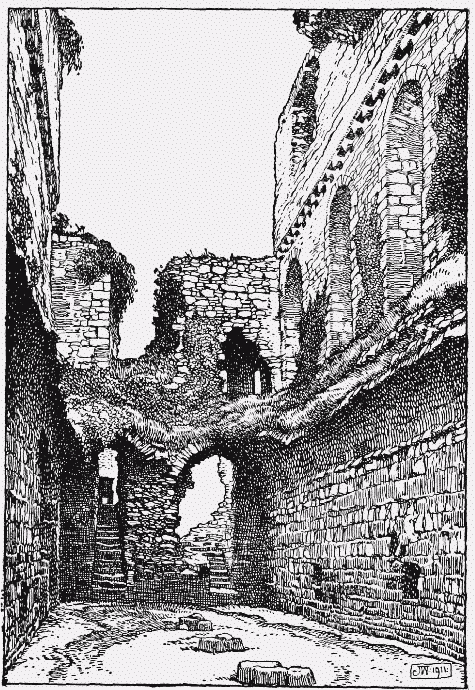
Middleham Castle: Interior of Eastern Part of Keep
On the south-west of the town lies the Low Moor, a celebrated training ground for race-horses. The East, or Sunskew, Park is on the south; 'the Parks' are on the north-west and include the West Park noticed by Leland in the 16th century. (fn. 41) The East and West Parks were probably made by Ralph Nevill, who obtained licence to impark his wood of Middleham in 1335. (fn. 42) By 1367 (fn. 43) there were two parks and a pasture called the West Field. Both Sunskew (Ulgrescogh, Sonscough, xv cent.) and the West Park are mentioned in 1465–6. (fn. 44) The West Park was leased by Edward Loftus to Miles Stapleton in 1653 for a term of ten years. (fn. 45)
Thornis Breeres, Brushell and Gedpoyle are placenames in Middleham mentioned about 1480, (fn. 46) Helpoole, Wysings, Burgh close, Burgha mead, Huggerscue, a close in the East Field called Chappell Close, Chequer Hill and Close, Kild-pool, Kylmers and Rayles occur in the 17th century. (fn. 47)
The two mills mentioned in 1541 (fn. 48) may possibly have been Ulshaw Mill in East Witton parish, and Middleham or Leaz alias Leaze Mill, at one or other of which the tenants were bound to grind their corn in the 17th century. Before 1672 Leaze Mill had been pulled down owing to frequent shortages of water and replaced by two mills under the roof of Ulshaw Mill. (fn. 49) From this date there was probably no mill in Middleham.
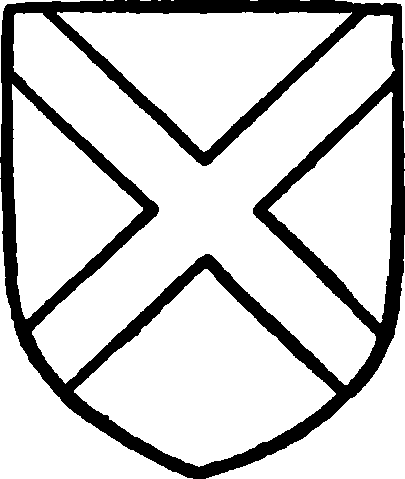
Nevill of Middleham. Gules a saltire argent.
Manor
MIDDLEHAM formed part of the land of Count Alan in 1086 and became parcel of the honour of Richmond (q.v.).
In the time of Edward the Confessor a 'manor' and 5 carucates were held by Ghilepatric, (fn. 50) and these, with other of his lands, were given by Count Alan to his younger brother Ribald, tenant in 1086. (fn. 51) Middleham was then waste. Ribald was succeeded by his son Ralph, to whom Middleham was confirmed by Count Stephen of Britanny. (fn. 52) Ralph is mentioned in 1130, and was still living in 1167–8. (fn. 53) Robert son of Ralph, the reputed builder of the castle, seems to have succeeded by 1177 at latest; he received the forestry of Wensleydale from Earl Conan. (fn. 54) His heir is generally believed to have been Ranulph son of Robert, (fn. 55) a minor at the time of his father's death. (fn. 56) He was in a sense the founder of Coverham Abbey. (fn. 57) Ralph son of Ranulph did homage for his land in 1252 (fn. 58) and died in 1270. (fn. 59) His lands were thereupon divided between his three daughters and co-heirs, Mary wife of Robert Nevill son of the lord of Raby, Joan wife of Robert de Tateshall, and Anastasia, a minor in the wardship of the king. (fn. 60) The homage of Robert and Mary de Nevill was taken in 1270. (fn. 61) The 'Lady of Middleham,' (fn. 62) as Mary was called, settled the castle and manor of Middleham upon herself, with remainder to her son Ranulph for life, with reversion to his son Robert and his heirs, and died in 1320. (fn. 63) Robert her grandson, the 'Peacock of the North,' (fn. 64) died without issue in his father's lifetime, and Ranulph, first Lord Nevill of Raby, (fn. 65) dying in 1331, was succeeded by his son Ralph. (fn. 66) He died in 1367. (fn. 67) His heir was his son John, who won renown in the French and Scottish wars, (fn. 68) married a wealthy heiress and died in 1388. He was succeeded by a son Ralph, aged twenty-four. (fn. 69) To win Ralph's support Richard II created him Earl of Westmorland in 1397 and gave him the royal honour of Penrith, but his second marriage with Joan Beaufort kept him a staunch Lancastrian. (fn. 70) He died in 1425, and was found to have held Middleham jointly with Joan. (fn. 71) During her widowhood Joan let Middleham to her eldest son by Ralph, Richard Earl of Salisbury, (fn. 72) and she took care that it should pass to him after her death and not to her husband's heirs. (fn. 73) The prolonged feud between the descendants of the two wives of the first Earl of Westmorland had no small influence on the politics of the day, the elder branch being as strongly Yorkist (fn. 74) as the younger was Lancastrian. The Earl of Salisbury was executed in 1460 after the Yorkist victory of Wakefield, and when his son Warwick the Kingmaker fell at Barnet in 1471 (fn. 75) Middleham was confiscated by Edward IV. In the same year the king granted the manor and castle to his brother Richard Duke of Gloucester, (fn. 76) who afterwards married the younger co-heiress of Warwick. With the accession of Richard III in 1483 Middleham again became Crown property, and so remained until Charles I sold it to the City of London about 1628. (fn. 77) In 1661 the City sold the manor to Thomas Wood of Littleton, afterwards Ranger of Hampton Court. (fn. 78) It descended to his son Edward in 1723 and to Robert son of Edward in 1743. Robert's heir in 1748 was his brother Thomas Wood. Thomas Wood son of Thomas inherited it in 1799. He died in 1835, and was succeeded by his son Thomas, who died in 1860. It then descended to Thomas, son of the last-named. On his death in 1872 he was succeeded by a son Thomas (fn. 79); he sold Middleham in 1889 to Mr. Samuel Cunliffe Lister, later Lord Masham, whose son, the second Lord Masham, is the present owner of the manor.
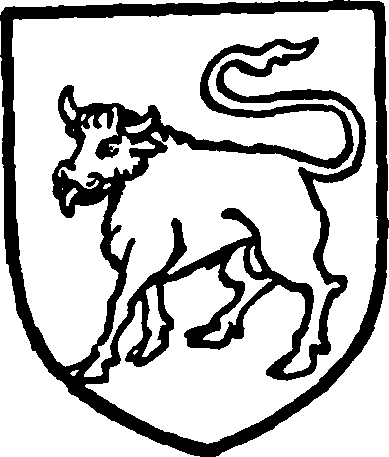
Wood of Littleton. Sable a bull passant argent.
Various liberties were possessed by the lords of Middleham. Mary of Middleham claimed free warren in Middleham under a charter of Henry III (fn. 80); the liberty was confirmed to Ralph Nevill in 1331. (fn. 81) Their successors had also common of pasture throughout the whole of Wensleydale. (fn. 82) Free chase in Coverdale was claimed by Mary of Middleham, (fn. 83) and free chase in Wensleydale was granted to Richard Duke of Gloucester in 1475. (fn. 84) A free fishery was also claimed. (fn. 85)
In 1389 Ralph Nevill received a grant of a market every Monday and a yearly fair on the feast of St. Alkelda the Virgin. (fn. 86) In 1479 Richard Duke of Gloucester obtained a court of pie-powder and a fair on Thursday in Whitsun week and the three days following and another on the feast of St. Simon and St. Jude and the three subsequent days. (fn. 87) Fairs were held in Middleham in 1849 on Easter Monday, on Whit Monday and on 5 and 6 November. (fn. 88) The weekly market has fallen into disuse, but the annual fair, which is one of the most important fairs for cattle, sheep and horses in the north of England, (fn. 89) takes place on 5 and 6 November. Shops, shambles, market tolls and a farm, called 'shewing silver,' were among the possessions of the lordship leased to Lord Paget in 1574. (fn. 90)
A court of Middleham is mentioned in about 1466. (fn. 91) The regard of the forest of Middleham is alluded to in 1539 (fn. 92) and the manor court in 1616. (fn. 93) A court baron is mentioned in 1633 (fn. 94) and court leet and court baron in 1672. (fn. 95)
Church
The church, formerly the collegiate church of ST. MARY AND ST. ALKELDA, consists of a chancel 27 ft. by 16 ft. 8 in. with north organ chamber and vestry, and a south chapel, nave 55 ft. 6 in. by 19 ft. 5 in., north aisle 9 ft. 9 in. and south aisle 9 ft. 4 in. wide, south porch and west tower 14 ft. 2 in. square, all internal measurements.
A few stones indicate the existence of a 12thcentury church upon the site, but none of its walls are standing at the present time. The earliest church of which the plan can be traced dates from about 1280 and consisted of a nave with narrow aisles and a chancel of the same length as at present, but of less width. The capitals of the nave arcades are of comparatively poor section, but they appear to be of an early date much recut. In the 14th century (about 1340) the chancel was widened, its north and east walls being retained and its south wall being moved out to line with the south arcade; the buttress at the east end of the new south wall was built against the older buttress. Later a chapel was added on the south side of the chancel by continuing the aisle eastward; the east window of this chapel is somewhat earlier in style and is presumably a re-used one from another part. It may have been in the south wall of the chancel before the chapel was built, but one is tempted to believe that it originally formed the east window of the 13th-century chancel. (fn. 96) The side windows of the aisles appear to have required renewing late in the 15th century, for the present windows all date from that period. The clearstory is also of the same date. The tower is perhaps a few years earlier. The vestry and organ chamber are a modern addition, replacing a sacristy said to have been of 14th-century date, (fn. 97) and there have been several modern restorations in which the piers with their capitals and bases, besides other parts, have been scraped or retooled, not always to their advantage. The chancel was widened in 1901 on the north side, when a new arch was inserted in the north wall.
The east window is of four trefoiled ogee-headed lights with reticulated tracery under a two-centred arch. It has two sunk quarter-round orders and is all of 14th-century date except the sill and a few other stones which have been renewed in modern times. Below the window are two small blocked rectangular lights, which look as if they had lighted a crypt, for which the fall of the ground would give space. The buttresses of the 13th-century chancel are still in place and the south 14th-century buttress is built against the older one. A small buttress stands below the east window; it is midway between the other 13th-century buttresses (and therefore not central with the window) and is contemporary with them. The chancel is lighted high up on the north side by four small modern quatrefoil windows, and a modern two-centred archway opens into the organ chamber. The south wall has a square-headed window of three trefoiled lights with sunk spandrels over; the section of the jambs is similar to that of the east window, but the window is somewhat later in date, being probably an insertion of the 15th century. Its label, which differs from the other, is more characteristic of the later style. The window-ledge inside is low enough to form a seat. A wide double-chamfered three-centred arch without labels opens from the chancel into the south chapel; it dies on to the wall on its east side and on the west springs without break from an octagonal pier, which also acts as the respond of the chancel arch. The latter is of the same detail as the south arch and both are old, but have been scraped or recut. The north jamb of the chancel arch is 1 ft. further north than the chancel wall, which slopes back to meet it.
The modern north vestry and organ chamber is lighted by a two-light modern east window with trefoiled ogee heads under a two-centred arch of 14thcentury style and a pair of two-light windows in the north wall with trefoiled half-round heads; the head of the western window is old (of the 15th century), and presumably was taken from the former east wall of the aisle, which is now replaced by an arch to the new part.
The south chapel has an east window of three trefoiled lights, over which are three trefoiled spherical triangles, all under a two-centred arch of two chamfered orders with a simple label. The window is old (except the restored mullions and sill), and, as mentioned above, is evidently earlier than the chapel. The south window of the chapel is of two trefoiled ogee-headed lights with a quatrefoil over; it is of 14th-century date, but the mullions and sills are modern renewals.
The two nave arcades each have four bays with arches of the same detail as the chancel arch and octagonal columns with moulded capitals and bases. The former have abaci, square-edged above, with a roll below, a plain hollow-chamfered 'bell' and a round necking; the bases have a chamfer below a roll mould, the roll mould follows the octagonal form of the pier and changes in the chamfer to a square bottom member. A great deal of retooling has been done to both arcades. Above the arcades is a clearstory lighted on both sides by three windows of two trefoiled lights each under a square head.
The north wall of the north aisle contains three windows; each is of two trefoiled round-headed lights (similar to those of the clearstory) with hollow-chamfered jambs, continuous mullions and sunk spandrels in a square head, over which is a label chamfered above and hollowed below. They are all old (of the 15th century), but have been renewed in parts. The west window of the aisle has two trefoiled ogee-headed lights, above which is a quatrefoil in a two-centred head. There is a blocked doorway between the north-west window and the end buttress. It has old jambs of a small chamfered order and a restored pointed arch. The windows in the south wall consist of a three-light window between two of two lights; all are of the same design and date as those opposite. The west window differs only from that of the north aisle in that the quatrefoil in its head reaches to the apex of the arch, while the other does not.
The south doorway has 13th-century jambs of three somewhat undercut rolls dying into a square abacus; the arch is of later date, with an old label re-used. Over this doorway is a 14th-century carving of the Crucifixion with our Lady and St. John. This stone was formerly in a cottage in the town and was brought here some years ago. In the east wall of the porch is an old perished corbel capital evidently not in its original place. The porch is modern.
The opening into the tower has a double-chamfered two-centred drop arch. The west window is of 15th-century date, but has been partly restored; it has three cinquefoiled lights with tracery. The tower is of two stages externally, but has three floors. The first floor has a single modern trefoiled light on the south side. The bell chamber is lighted in each wall by a plain square-headed window of two cinquefoiled lights; they have been greatly restored. At the west angles are diagonal buttresses of six stages reaching to about half-way up the belfry stage. The embattled parapet is modern. The stair-turret rises in the south-west corner and is lighted by three slits in its lower part. The walling of the church generally is of rubble with wrought quoins; in the east wall of the chancel is built an ancient carved stone with interlaced work, and a bit of cheveron ornament of the 12th century can be seen in the north wall of the aisle. The roofs are modern and low pitched.
The font is modern and has marble shafts to its stem. The old one was recently recovered and stands now in the north aisle; it is octagonal, of a fairly simple section and probably of 14th-century date. Over the font in use is a fine wood canopy, partly of 15th-century date and partly modern, the older part having been found some years ago in a stable. It is of three traceried stages, of which the lowest one is new; the upper stages have two trefoiled piercings in each face, crocketed and finialled, while there are crocketed pinnacles at the corners. In the west window of the north aisle are fragments of the 14thcentury glass which was formerly in the east window and represented the strangling of St. Alkelda.
In the tower, built into the north wall, is a gravestone brought from Jervaulx Abbey. On it are a mitre and crozier, the head of the latter between two shields of late form, on one of which are the letters ? and on the other an ? with the crossed spears and sponge on a reed. Below the mitre are the initials R T and a tun; the ground is covered with foliage in low relief, usually called thorn leaves, to make the rebus, but bearing no resemblance to the natural leaf. The inscription around reads: 'Orate pro anima domini Roberti Thorneton Abbatis hujus domus Jorevallis vicesimi secundi.' At the four corners of the slab are quatrefoils inclosing M. Under the altar steps is said to be a brass with an almost obliterated black-letter inscription to 'Thomas Byrnham gent. MCCCC . . . .' There are several other monuments of 18th and 19th-century date of more or less interest. A plate in the first pillar of the south arcade of the nave records the supposed discovery of the bones of St. Alkelda in 1878. The silver image of the saint was evidently hidden from the royal commissioners at the Reformation, for in 1559 William Wyll, dean and parson of Middleham, bequeathed to his 'paryche churche of Mydelham to wearkyng of a bell, the thyrde bell and smaillyste, a boylle of sylver, the greateste, and all the sylver in the . . . in the churche of Mydlam that was of Saynt Alkyld heyd, and a peice of Saynte Alkyld head that is in my chyst in y . . . yf that they wyll by a bell or els not.' (fn. 98)
There are eight bells, all cast by Taylor of Loughborough in 1911. Six of these are recastings of the former ring of six bells, cast in 1824.
The plate consists of a plain communion cup and paten presented 1775, but with no date stamp, and a small silver-gilt cup of 1786.
The registers begin in 1604.
Advowson
The church is first mentioned in 1281, when Mary of Middleham was the patron. (fn. 99) The lords of the manor had the patronage until the sale of Middleham to the City of London, when the advowson of the rectory was retained by the Crown. (fn. 100) It was transferred to the Bishop of Ripon in 1874, having been endowed in 1857 with all the land and tithes formerly belonging to the deanery. (fn. 101) Middleham Church was made collegiate (fn. 102) by Richard Duke of Gloucester, with a dean, six chaplains, four clerks and six choristers, (fn. 103) in 1479, under a licence of 1478 (fn. 104); and in 1481 the first dean obtained a charter of exemption from episcopal jurisdiction. (fn. 105) A charter of exemption from archidiaconal jurisdiction was subsequently secured. (fn. 106) Less than a century later, however, Leland said of Middleham 'It hath beene, as sum wene, a collegiate chirch,' and stated that Henry VII took the new college land away. (fn. 107) Its privileges appear to have been revived in the reign of Charles II. (fn. 108) The collegiate foundation was finally suppressed by Act of Parliament in 1845. (fn. 109)
Perhaps the most remarkable Dean of Middleham was the eccentric but public-spirited Dean Nickolls appointed in 1786. (fn. 110)
The chantry of our Lady in the parish church was established by John Cartmell, clerk, under a licence in 1470, (fn. 111) to pray for the souls of the founder, Richard late Earl of Salisbury and Alice his wife at the altar of St. Mary the Virgin. The chantry house was granted in fee to Francis Morrice and Francis Phillips, the 'fishing grantees,' in 1610–11. (fn. 112)
Charities
The Poor's estate, known as the Doles Charity, was, as appeared from the table of benefactions, acquired in part from the gift of John Holdsworth, 1696, and in part purchased with legacies and donations of Christopher Todd, 1722, and others. The trust property consists of about 5 a. and cattle gates, producing £25 10s. a year. In 1904 the sum of £21 11s. was distributed at Easter and Christmas among twenty-nine recipients, and £2 was paid as an apprentice fee apparently in respect of the nextmentioned charity.
In 1706 Robert Dixon by will charged a close in Middleham with 40s. a year for putting out a poor boy apprentice.
In 1792 William Tennant by will left £50, the interest to be paid to the schoolmaster for instructing two boys in reading, writing and accounts. The principal sum has, it is understood, been invested in railway stock.
The Bridge Trust, founded in 1829–30, is regulated by a scheme of the Charity Commissioners 1887, whereby the income of a house and 26 p., amounting to £5 10s., is directed to be applied for any useful purpose.
In 1850 Mrs. Jenny Sewell, by deed dated 9 October in that year, founded a charity for the benefit of Wesleyan ministers in the Middleham circuit. The trust property consists of the manse at Middleham, a cottage adjoining let at £4 a year, a sum of £90 2s. 3d. consols, and of £422 10s. India £3 10s. per cent. stock, held by the official trustees, producing in annual dividends £17 0s. 8d.
By an order of the Charity Commissioners of 16 May 1905 the superintendent minister of the Wensleydale mission circuit and the circuit stewards of the Middleham section of the said circuit were appointed to be the trustees for the administration of the charity.
For the charity of Francis Walker towards the support of Wesleyan ministers of Middleham circuit see under Spennithorne, Bellerby township.
The National school was conveyed by deed, 1868, as a memorial to the Rev. J. A. Birch, a former rector.