
A History of the County of York North Riding: Volume 1. Originally published by Victoria County History, London, 1914.
This free content was digitised by double rekeying. All rights reserved.
'Parishes: Well', in A History of the County of York North Riding: Volume 1, (London, 1914) pp. 348-355. British History Online https://www.british-history.ac.uk/vch/yorks/north/vol1/pp348-355 [accessed 14 April 2024]
In this section
WELL
Welle (xi cent.).
The ecclesiastical parish of Well includes the townships of Well and Snape, and comprises an area of 6,690 acres, of which 3,343 are permanent grass, 2,615 arable land and 595 woods and plantations. (fn. 1) The land lies about 100 ft. above the ordnance datum in the lowest part of the parish, which is the northeast corner, and rises gradually towards the southwest till it reaches a level of 475 ft. in some places. The high ground commands a splendid view of a considerable part of the fertile Vale of Mowbray. The upper soil of the parish is clay and limestone on a subsoil which is chiefly Magnesian Limestone; there is some alluvium. Limestone is worked for agricultural purposes. Barley, oats and turnips are among the crops grown. The inhabitants are chiefly engaged in agriculture.
To the west of the parish is Watlass Moor, intermixed lands of which two thirds belong to Snape and one to Well. Application was made for the inclosure of the moor in 1793. (fn. 2) There was a select vestry in Well in 1823–6, and probably earlier. (fn. 2a)
The village of Well lies at some little distance from the main road from Thirsk to Masham. It is said to take its name from St. Michael's Well, near the entrance on the west. The village is built round cross roads, the houses being mostly rough-casted with tiled or slated roofs. It contains the hospital of St. Michael, founded by Ralph de Nevill in the 14th century, re-endowed after the Reformation by the Cecil family, and restored by Sir F. A. Milbank, bart., in 1883. The almshouses are in two stories, eight sets on each floor, the men on the ground, the women above. There are some remains of the original buildings, and to the west of them is a little rectangular chapel with a pointed door and two round-headed windows on each side of it. On the hospital are sculptured the arms of Nevill and Cecil of Burghley. The church is situated at the east end of the village, and at the west there is a Wesleyan chapel.
Well Hall stands immediately to the west of the churchyard. It consists of two wings; the northern, lying east and west, dates from the early 13th century, while the southern, standing north and south, is an 18th-century addition. The early portion is a plain rectangular structure two stories high and built of rubble. The ground floor, now divided up into rooms, is four bays long with a row of circular columns down the centre, supporting a ribbed quadripartite vault, which springs from moulded corbels on the walls. The columns have moulded capitals, but the bases are buried below the floor level; the corbels are bell-shaped and one on the south wall has simple foliations; the massive ribs are chamfered. In the south wall at the eastern end are the remains of a door and window both blocked, the former having a segmental pointed rear arch. Access to the upper floor was apparently obtained by a straight staircase in the thickness of the east wall lighted by a square-headed light at the south end. The first floor must once have formed one apartment and the upper parts of two windows remain in the west end. They are similar and have semicircular arches inclosing two plain pointed lights with a vesica-shaped piercing in the spandrel forming a curious example of plate tracery. The moulded label is returned and voluted at the spring and the upper surface is cut with a simple cheveron ornament. The lower portions of these windows have been cut away and 18th-century frames inserted. The deeply splayed head of a blocked window remains in the south wall at this level. The whole building has been heightened a few feet, probably in the 16th century, to form a story in the roof, and the low-pitched roof with heavy unsquared tie-beams of this date remains in position. The only trace of adjoining early buildings is to be found on the north face where the lines of the steep pitched roof of a low building are discernible. The 18th-century south wing of the house is two stories high and has a good early Georgian staircase. The farm buildings near the house are of various dates and include an 18th-century barn and stables which may be earlier.
Snape to the north is approached by an avenue of lime trees which opens upon a view of the ruins of Snape Castle. Leland describes it as 'a goodly castel in a valley longing to the Lorde Latimer, and ii or iii parkes welle woddid abowt hit.' (fn. 2b) The twentysecond Earl of Oxford in 1725 called it 'a good old house belonging to his Honour Cecill, in which are several good pictures and some fine paintings by the hands of Signor Verrio.' (fn. 3)
Snape Castle is said to have been built by George Nevill, first Lord Latimer (d. 1469). It passed to Thomas Cecil, second Lord Burghley (afterwards Earl of Exeter), in 1577 through his marriage with Dorothy co-heir of John Nevill, fourth Lord Latimer; he is said to have enlarged the building about 1587. The building was presumably in good repair till after the end of the 17th century, but the greater part of it is now in a ruinous condition. The south range was saved and restored for use in the 19th century, and is now divided into two residences; it has been much altered inside and out. Restorations of the chapel are said to have taken place in 1837 and 1887.
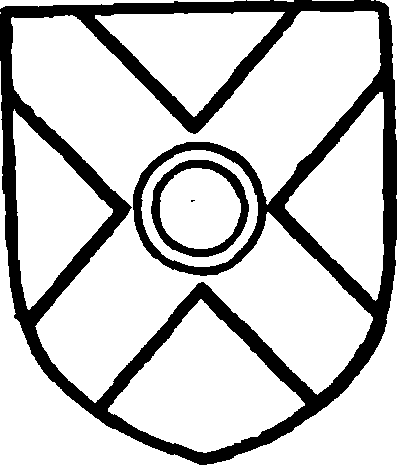
Nevill, Lord Latimer. Gules a saltire argent with the difference of a ring sable.
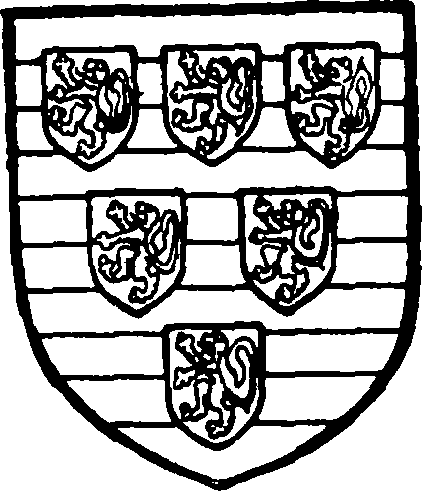
Cecil, Earl of Exeter. Barry of ten pieces argent and azure six scutcheons sable with a lion argent in each.
The house was of courtyard plan, about 140 ft. north to south by about 180 ft. east to west; the oldest parts are the chapel in the south-east corner, part of the fabric at the east end of the south range, and the ruinous buildings on the east and north sides of the courtyard. The 16th-century enlargements began with the remodelling of the east half of the south range and the addition of the north-east and south-east towers, and were followed very shortly afterwards by Cecil's work, which appears to have been the west half of the south range, the north-west and south-west towers, and a western range, most of which has now disappeared. The two northern towers, although still standing, are gutted and partly ruinous. The walls generally are of rubble with hard stone dressings. Such parapets as remain are embattled, those of the chapel having return copings.
The south front is of three stories in its eastern half and two in the western; the former has large square windows, all fitted with modern wood frames except one on the third floor which retains the original 16th-century stone transom and mullions dividing it into three lights; the western half has taller and narrower windows with moulded architraves and keystones; they also have modern wood frames. In this part is the principal entrance with a round arch and square entablature; in the spandrels are shields carved with the arms of Cecil and Nevill. Above the doorway is an oval cartouche inclosing a Cecil shield of six quarters. The two towers at the ends of this front project southwards and are of four stories, the third story of the south-west tower being unlighted. The windows generally have transoms and mullions; many of them are blocked and others have modern frames. A square bay in the main south wall, next to the south-west tower and flush with it, appears to be a slightly later addition; it has a wide oriel window on the first floor, carried up to the parapet; the middle light has a modern frame and the two side lights are blocked. The west end of the south range, which is flush with the western side of the tower, has another three-sided bay, the large windows of which have been blocked or altered for modern frames. The back of this range has been generally modernized. The rooms are altered to suit modern requirements, but a panelled plaster ceiling in the east half is of late 16th-century date and has a shield with the arms of Cecil impaling Nevill and the crest of Cecil; in the western half is some 17th-century oak panelling and a staircase of the same date. The chimneys are plain and probably much modernized.
The south-east tower adjoining the chapel has a straight joint on its east side and the north part of it is probably of 15th-century date; it has smaller windows and a plain parapet. The chapel, (fn. 4) which is set back considerably from the south front, has been much restored; its east window is modern. In the south wall are two 15th-century windows of three lights and tracery. In the north wall are three similar windows, but only the westernmost, which is blocked, retains the original stonework. Below this is the entrance by a flight of steps from a modern doorway. Most of the internal fittings are modern, but the flat ceiling, painted with scenes from the Revelation, is attributed to Verrio, and there is some interesting carved panelling with Biblical subjects and an inscription in Dutch. At the north-east angle are the remains of a vice, and north of it the remains of a vaulted passageway. The vault below is entered by a 15th-century north doorway, but contains nothing of note.
The eastern range is ruinous and ivy-covered and reduced to one story in height, except a fragment against the north-east tower; it has three barrelvaulted chambers and at the south end a narrow passage, formerly vaulted, all four entered from the courtyard by 15th-century pointed doorways. The two middle chambers have each the remains of a contemporary two-light square-headed window, and on the east side are several narrow rectangular lights. A still more ruinous projection near the north end is, perhaps, the remains of a turret. Some of the internal doorways between the chambers retain traces of arches, and one chamber has a recess which may have been a fireplace. The north end of this range has a rectangular loop to the cellar and on the first floor is a moulded jamb of a former window.
The north-east tower sets back about 30 ft. from the east face of the eastern range and projects from the main north face. It is almost of its original height of four stories, but has been gutted and is roofless, and has a large gap from top to bottom on its western side. The large windows in its walls had moulded jambs, mullions and transoms, but they are all ruinous.
Only the eastern half of the north range remains, now reduced to one story; the one complete cellar, vaulted like the others and entered by a 15th-century doorway from the courtyard, has in its north wall a rectangular loop, a gap which may have been a doorway, and a recess, possibly a fireplace. The next chamber westwards has rectangular lights in the north wall and is also of the 15th century, but little beyond the north wall is left of it. The westernmost chamber of this range meets it with a straight joint and marks Cecil's work; only the original north wall remains, containing two blocked windows.
The north-west tower resembles that at the southwest in design, but is out of repair. All the towers have moulded string-courses, dividing them into two stages externally.
The western range has almost entirely disappeared. A rebuilt wall on its west face contains a number of late 16th-century worked stones and a round-headed doorway; among the stones is a defaced shield of arms with lion supporters and a helm with the crest of Cecil, also two caryatid consoles, and next the doorway a semicircular recess with a shell head. The wall is higher against the south range, and has on the upper floor a blocked round-headed window with projecting abaci and keystone.
Probably some of the garden wall on the south side against the road incorporates old stonework; the two entrances with ashlar gate-posts are part of the late 16th-century work.
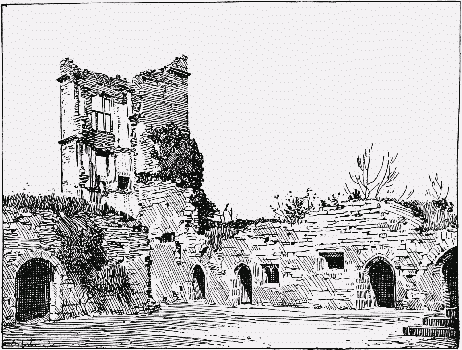
Snape Castle: Eastern Range and North-east Tower from the Courtyard
The village with its Wesleyan chapel, founded in 1799 and rebuilt in 1835, (fn. 5) is built round and about a green east of the castle. Thorpe Perrow, the seat of Mr. William C. Gray, is a fine house overlooking two lakes and surrounded by a large park and plantations. It is about half a mile north of Snape village. Langwith contains only two farm-houses.
Interesting place-names found in connexion with the parish are Depeeng de Farwald, Le Flattsyde, Braythwayt, Farwaldeng, Gebdykes, Folde Heade and Snape Mires.
There was a capital messuage with its dovecote and two water-mills at Well in the 13th century, as well as a wood called 'Chauntwith.' (fn. 6) The mills were dilapidated in 1375. (fn. 7) A brew-house and common bake-house are mentioned in 1367. (fn. 8)
Two windmills went with the manors of Well and Snape in the 18th century. (fn. 9)
Manors
In 1086 WELL, where Torchil had had a 'manor' and 8 carucates, was among the lands of Count Alan, (fn. 10) whose successors retained the overlordship. (fn. 11) Bernulf was tenant in 1086. Well had berewicks in Burton upon Ure, 'Opetone' and 'Achebi' in Snape, each assessed at 4 carucates. (fn. 12)
Well was held by Ribald (fn. 13) and his successors, the lords of Middleham (q.v.), with which at the division of 1270 it formed part of the share of Joan wife of Robert de Tateshall. (fn. 14) On the division in 1577 between the co-heirs of John Lord Latimer (fn. 15) Well with Snape (q.v.) came to Dorothy wife of Sir Thomas Cecil, kt., created Earl of Exeter in 1605 (fn. 16); the manor continued with their heirs until 1793, (fn. 17) when the ninth Earl of Exeter dying without children left it by will to his nephew Charles Chaplin. It was sold between 1850 and 1860 to the family of Milbank, and in 1901 Sir Powlett Milbank, bart., sold the manor to Mr. Thomas Arton, the present owner. (fn. 18)
Ralph de Nevill obtained a grant of free warren here in 1331. (fn. 19)
In the reign of Edward I Helewise de Perrow, then a widow, released to Mary de Nevill for 100 marks her right in all lands in FAGHERWALD (Farwald, xiv cent.) that had belonged to John de Fagherwald or to any other of her predecessors. (fn. 20) Fagherwald in 1286–7 was assessed at 1 carucate and was held by Mary de Nevill direct of the earl. (fn. 21) The heirs of Stephen Vace and Thomas Freman were tenants here in the late 14th century. (fn. 22) No manorial history of Fagherwald is known.
The history of SNAPE (Snapp, xiii cent.) is the same as that of Well, with which it may have been included in Domesday Book, except for a short period after 1270 when on the division of the Middleham lands Snape was assigned to Anastasia, (fn. 23) who was then a minor and in the king's wardship. (fn. 24) Anastasia died shortly afterwards, (fn. 25) and the manor passed to her eldest sister Mary de Nevill, who was in possession in 1286–7. (fn. 26) The manors of Snape and Well followed the descent of Middleham (q.v.). They were settled by Ralph Earl of Westmorland on his second wife Joan, and after her death in 1440 passed to their third son George Nevill, who succeeded to most of the lands of his uncle John Lord Latimer and was summoned to Parliament as a baron in February 1431–2. (fn. 26a) George Nevill, Lord Latimer, died in 1469 and was succeeded by his grandson Richard, then one year old; he died at Snape Castle in 1530 and was followed by a son John Lord Latimer. (fn. 26b) John was implicated in the Pilgrimage of Grace in 1536–7, and was one of the four nobles who treated with the king on the part of the rebels. (fn. 26c) He died early in 1542–3 and in July his widow, Katharine daughter of Sir Thomas Parr, married Henry VIII. (fn. 26d) John son and heir of John died in 1577, leaving four daughters and co-heirs. (fn. 26e) From this time the manorial descent followed that of Well until about 1798, when the manor was sold to William Milbank of Thorpe Perrow partly by the Chaplins and partly by tenants who had bought their holdings. (fn. 27) The descent of the manor has since followed that of Thorpe Perrow (q.v.).
Ralph de Nevill obtained a grant of free warren in Snape in 1331. (fn. 28) Hugh le Forester of Snape is mentioned in 1310. (fn. 29)
In 1086 THORPE PERROW (Torp, xi cent.; Thorpe Pirrowe, Thorpe Pirrom, xiii cent.; Thorppirrow, xiv cent.) comprised 4 carucates of land, the possession of Count Alan, and were then waste. (fn. 30) The mesne lordship descended with Well to the Tateshalls, Nevills and Earls of Exeter, who held under the Earls of Richmond. (fn. 31)
The vill took its distinctive name from the lords of Pirhou (Pirou, Pirho) in Ditchingham, co. Norfolk, who were the earliest known tenants here. Helewise de Perrow, tenant of 2 carucates in 1286–7, was probably a daughter of William de Perrow. (fn. 31a) She seems to have married Hugh de Swillington, who received a grant of free warren in all his demesne lands there in 1283. (fn. 32) In 1298 Adam son of Hugh de Swillington granted the manor to Hugh de Swillington for life. (fn. 33) Hugh probably died in or before 1309, as in that year a grant of free warren was made to Adam de Swillington, (fn. 34) who was in possession of Thorpe Perrow in 1316. (fn. 35) This may have been the Sir Adam de Swillington who was summoned to Parliament as a baron from 1326 to 1328, (fn. 36) and obtained another grant of free warren in the later year. (fn. 37) In 1330 Adam son of Sir Adam granted this manor to his brother Robert de Swillington. (fn. 37a) Thorpe Perrow passed, evidently through marriage, to Peter de Routh, who was holding it in right of his wife Elizabeth in 1367. (fn. 38) It remained with this family for about a hundred years, being held by Sir Thomas de Routh, kt., in 1388, (fn. 39) and by William Routh in 1448. (fn. 40) Sir Robert Danby, kt., a younger son of the family of Danby of Yafforth, (fn. 41) purchased the manor, probably in this year, (fn. 42) and his grandson (fn. 43) Sir Christopher Danby, kt., (fn. 44) was seised of it at his death in 1518. (fn. 45) His heir was his son Christopher, who died in 1571 and was succeeded by his son Sir Thomas Danby, kt. (fn. 46); he died in 1590, (fn. 47) his heir being his grandson Christopher, a minor. He died in 1624 and was succeeded by his son Thomas, (fn. 48) who fought for Charles I and compounded for his estates in 1645 (fn. 49); he died in 1660. His eldest son and successor Thomas died in 1667, (fn. 50) and both his sons were dead by 1683, when the estate was inherited by his brother Christopher, who in that year conveyed Masham (q.v.) to his son Abstrupus. Sir Abstrupus sold it for £10,300 in 1688 to Sir William Blackett, bart., whose mortgagee sold it to John Milbanke, younger son of Sir Mark Milbanke of Halnaby, (fn. 51) in 1699. John died in 1713, leaving a son and heir John, who in 1759 was succeeded by his son Mark. Mark's son William, of Thorpe Perrow and Barningham (q.v.), died in 1802, leaving a son Mark Sheriff of Yorkshire in that year, who died in 1881. His elder son Mark William Vane was succeeded in 1883 by his brother and heir male Sir Frederick Acclom Milbank, who had been created a baronet in 1882 and died in 1898. The manor was purchased from his executors by Mr. H. C. Allfrey in 1902 and sold by him two years later to Mr. William C. Gray, the present owner. (fn. 52)
A park called Thorpe Park went with the manor of Thorpe Perrow in the latter part of the 16th century and early 17th century. A grant of the office of keeper of the park with an annuity was made to Thomas Thackeray, sen., and Thomas Thackeray, jun., in 1577. (fn. 53)
Church
The church of ST. JAMES, formerly ST. MICHAEL, consists of a chancel 37 ft. 5 in. by 16 ft., north-east vestry 16 ft. 6 in. by 10 ft. 3 in., north chapel 19 ft. 6 in. by 9 ft. 9 in., south chapel 37 ft. 7 in. by 14 ft. 6 in., nave 41 ft. 5 in. by 16 ft. 4 in., north aisle 9 ft. 9 in. wide, south aisle 14 ft. 10 in. wide, south porch and west tower 13 ft. 10 in. by 13 ft. 6 in. These measurements are all internal.
The south doorway of the nave and the bases of the nave arcades and chancel arch are late 12thcentury work, and probably the columns and capitals of the arcades and chancel arch are of the same date recut and repaired. The arches appear to be 14thcentury work, and the nave clearstory and west tower are also of that period. The tower was heightened in the 15th century. The chancel was enlarged and rebuilt about 1320, and the south chapel was probably added at the same time or shortly afterwards. In the same century the north chapel was built, and the vestry is probably the site of the chantry founded in 1399. (fn. 54) The south aisle has been widened and made of equal width with the south chapel, but it is not quite clear whether this is a 14th or 15th-century alteration. The stonework of the 12th-century doorway has been reset in the wall of the widened aisle, and the south porch is of the 15th century.
The fabric has suffered from 'restorations' since then, and a modern arcade now divides the chancel and south chapel; it is said to have replaced one of wood, and the western arches of both chapels are modern. Most of the stonework of the arcades has been retooled, with the result that many of the details are more or less altered in section. The original steep gabled roofs have been lowered for the almost flat roofs of later date.
The east window of the chancel is of 14th-century date, and has three trefoiled lights with ogee heads under a two-centred arch containing flowing tracery; to the south of it in the same wall is an image bracket with a hollow in the chamfered under-edge. Another stone bracket in the north wall has a sloping front with a check at the bottom, and serves as a book rest, but whether it is in its original position is doubtful. Above this is a small window of two plain rectangular lights, which looks from the former chamber over the vestry. The entrance to the vestry has a shouldered arch, which if old has been retooled. Next to the westward is a plain rectangular squint from the north chapel. The arch to the chapel has a doublechamfered pointed arch, the inner order of which springs from moulded corbels of good 14th-century style. The south arcade of the chancel is of three bays and is all modern; the columns are octagonal with moulded capitals, and the arches pointed, of two chamfered orders. The responds of the chancel arch are formed by three engaged filleted shafts separated by pointed bowtels. The bases are roughly of two rounds, the capitals are plain; the arch is pointed and of two orders, a wave mould and chamfer. The stonework of the arch has been much retooled.
The north vestry is lighted by an east window of two plain rectangular lights, the outer jambs with a single large chamfer, the inner widely splayed. There is now no floor to the room over, but its position is marked by a set-back in the north wall and two stone corbels. The room was lighted by a window, also to the east, of two lights with four-centred heads; the entrance to the room was through its north wall, but the doorway is now filled in and the outside stair to it removed; part of the top landing remains in position. The jambs of the window looking into the chancel are carried down to the former first-floor level.
The north chapel is lighted by two north windows; the first is of three trefoiled ogee-headed lights under a low head with tracery, while the second window is taller, with two cinquefoiled lights and tracery; both windows are 15th-century insertions, although the first is evidently the earlier. In the east wall of the chapel a wide and shallow plastered recess probably indicates the presence of a blocked east window. On either side of it is an image bracket, the north one square with a roll edge on the front, the south square on plan and unmoulded.
A small piscina, semicircular on plan, projects from the south wall at the level of the squint.
The east window of the south chapel has four trefoiled ogee-headed lights with cusped net tracery above in a pointed arch of two chamfered orders with a plain label; the mullions are modern, the rest of the stonework old, c. 1330. On the north internal jamb is a bracket in an unusually high position. Of the three south windows the first is of two trefoiled lights with leaf tracery above in a pointed head with a moulded label on carved head stops and a wavemoulded outer order to the jambs. The tracery and head are of 14th-century work, the mullion modern. The jambs inside are splayed, but are stopped out to the square just below the springing line. The second window is a little smaller than the first, but apparently of the same date; it has two trefoiled lights with a single large quatrefoiled piercing over in a pointed head. The label is moulded with carved stops, the western a human head, the eastern a grotesque beast. To the west is a small priest's doorway, evidently a later insertion, with a flattened round head of a single chamfered order. The third window of the chapel has a new head and restored jambs.
The nave has arcades of three bays a side. The columns and responds are of similar section to those of the chancel arch. The bases on the north side have a hollow between two rounds, the upper filleted, the lower somewhat flattened. The capitals are plain and have a roll neck mould and a chamfered abacus. The arches are pointed and of two orders, a wave mould and a chamfer. The section of the bases of the columns of the south arcade is more pronounced, while those of the responds as well as their capitals are of a more simple section; the arches are similar to those of the north arcade. The clearstory has three windows a side, each with two pointed ogeeheaded lights under a square head. Over the chancel arch is a similar window, but of three lights.
The archway opening from the north aisle into the chapel is a modern copy of the chancel arch. The easternmost window in the north wall of the aisle has a square head within a segmental arched outer order; it is of three lights with tracery, not unlike that of the window next to it in the chapel, but deeper. To the westward is a similar window, the stonework of which is modern. Immediately to the west of it is a small blocked doorway with a slightly arched lintel. There is no west window.
The two south aisle windows, both original, are each of three ogee-headed trefoiled lights under a square head within a segmental-arched outer order; the jambs are of two chamfered orders. The south doorway is of late 12th-century date. The jambs are of three orders, the innermost with two rolls on the splay, the outer two square with detached shafts in the angles having moulded bases partly buried and, in the case of the western jamb shafts, carved capitals. The eastern capitals are modern; the rest of the stonework is old. The arch is semicircular and of three orders, the innermost moulded with two rounds, the middle one with a bowtel between two hollows, and the outer with a keeled round also between two hollows. The label is enriched with cheveron carving. The west window resembles those in the south wall.
The tower is of three stages, the arch into it from the nave having jambs and a pointed arch of two continuous chamfered orders with a plain chamfered abacus at the springing line, perhaps 14th-century work retooled. The centre line of the tower is to the north of the axial line of the nave and it is set at a different angle. In the south wall of the ground stage is a narrow square-headed light and on the west a window of two trefoiled lights; the latter has a square head within a segmental arched outer order. The window has suffered in later attempts at repair and the head tracery, the central part only of which is cusped, is of a peculiar character. Above the west window is a narrow rectangular light below the first offset. The second stage is a narrow one of plain ashlar with wide jointing; the string-courses above and below it are each chamfered above and below and in two courses. The bell-chamber is lighted in each wall by a pair of two-light windows, each of two ogee-headed trefoiled lights divided by transoms below a three-centred head. Below these windows is a small window in each wall of two trefoiled pointed lights. These probably lighted the former belfry before the additional 15th-century work was erected. From the level of the belfry windowsills upwards the plan of the tower is modified by the chamfering off of the angles, and upon the diagonal sides thus formed are small buttresses. The parapet is embattled with returned copings. To the north of the tower is a modern addition inclosing a wood stair by which access is obtained to the upper stages.
The south porch is 15th-century work. It has stone benches on either side, which come partly in front of the jambs of the south doorway. Its outer archway has a pointed head and continuous moulded jambs of three hollows in a splay both inside and out. The label outside is moulded but much perished. On the gable head over is an old sundial.
The walls generally of the church are of rubble, excepting the porch, clearstory and the two upper stages of the tower, which are of ashlar. Both the clearstory and the aisles have plain parapets. The former has square pinnacles at the angles with thin finials upon trefoiled gablets. Over the low gable at the east of the nave is the old sanctus bellcote; it has a single pointed arch in a gable surmounted by a cross. An old buttress of four stages supports the south aisle wall at its junction with the south chapel. At the south-east angle of the chapel are two buttresses, one diagonal and the other square to the south. Both are old, but the diagonal one (of five stages) from its position appears to be earlier than the other, which is of six stages. Above them is a pinnacle, somewhat perished, similar to those on the clearstory. Above the low gable-head on the east face of the chapel is a coped stone, upon which stands a shield of late form charged with the saltire of the Nevills. Though there is no actual straight joint between the chapel and the chancel, a vertical row of larger stones suggests the junction of later work with earlier. Above this, over the outlet from the gutter, is a curious stone on which are carved two beasts.
All the roofs are modern and of low pitch. On that of the north chapel is a late shield with arms of three covered cups impaling a cheveron between three leopards' heads.
The font, which stands in the tower, is probably old, but has been recut; it is octagonal in plan and has modern shields on the sides of the bowl. Above it is a very fine and tall canopied wood cover of 15th-century date covered with modern paint. Each side is traceried, gabled and crocketed, with traceried and crocketed angle shafts, and it terminates in a tall crocketed finial.
Under the east window of the vestry is a stone altar tomb, looking very like an altar, on which is a slab with a floreated calvary cross, on the stem of which is a chalice.
In the east window of the south chapel is some 14th-century glass, including three shields of Roos, Nevill and Percy. Below are figures of four Nevills, but it seems doubtful if any part of them is ancient. The window was 'restored' in 1852.
Below this window is an altar tomb with the effigy of Sir John Nevill, fourth and last Lord Latimer of Snape, who died in 1577. He is in full plate armour with a sword and poniard, a ruff about his neck, and his hands in prayer. The date on the tomb is 1596, and it has on the front four shields with the alliances of his daughters and co-heirs with Percy, Cecil, Cornwallis and Danvers.
To the north is a shield of eighteen quarters, and an inscription, belonging to the same monument, which has been mutilated. The inscription gives the date of Lord Latimer's death, and the shield bears (1) Nevill with a ring for difference; (2) Nevill ancient; (3) Beauchamp; (4) Newburgh; (5) Berkeley and thirteen other quarterings. The crest and supporters are griffons, and above, in letters inlaid in black composition, is 'Sic Transit Gloria Mundi.'
Below the middle south window of the chapel is a small altar tomb of grey marble, in which is inserted a brass plate to Dorothy second wife of John Nevill, afterwards third Lord Latimer; she was sister and co-heir of John fourteenth Earl of Oxford and died in 1526.
In the floor of the chapel are several cross slabs, one with an almost illegible inscription; another has part of an incised cross, on the left of which is a sword and on the right a hammer and horse-shoe. (fn. 54a)
In the chancel floor is a very large blue marble slab with pinholes for the attachment of what must have been a large brass with a marginal inscription; the stone is not countersunk for the brass as usual.
Part of a floor of Roman mosaic is preserved in the south chapel.
South of the south chapel is the base and very tall plain stem of a churchyard cross, the shape of which looks early.
There are three bells: the first, of 1656, recast in 1895; the second, 1656; and the third of 1617, with the initials G. B.
The plate consists of a cup by Robert Williamson of York, 1670, and another cup the gift of Mrs. Anne Green with the inscribed date 1706. This is also a York-made vessel, the date letter being a courthand I, which Mr. McCall assigns to the year 1704. The paten is a domestic waiter, 1765, given by John Raikes, vicar, in 1770, and there is a pair of very fine and tall tankards by Walter Shrive, London, 1627. These latter were given by Mr. Mark Milbank in 1816.
The registers date from 1558.
Advowson
There was a church at Well and a priest as early as 1086. (fn. 55) The advowson was in the hands of the lords of the manor in or before 1298, (fn. 56) and in 1342 Ralph de Nevill obtained licence to found a hospital in the vill and endow it with lands and the advowson of the church. (fn. 57) In the following year the church was appropriated to the hospital of Well by the Archbishop of York and a vicarage ordained. (fn. 58) After the Dissolution the advowson seems to have been granted back to the lords of the manor. (fn. 59) The last Lord Latimer presented in 1569, and Sir Thomas Cecil and his wife Dorothy dealt with the advowson by fine in 1580. (fn. 60) The descent followed that of the manor until 1901, when the farm of Mowbray Hill with the advowson were bought by Mr. Thomas Arton. The presentations were sometimes made in the 17th and 18th centuries under the name of the Hospital of St. Michael the Archangel. (fn. 61)
In 1399 licence was granted to Robert de Coverham and John de Nottingham to endow a chantry in the parish church of Well. (fn. 62) No certificate for it has been found, but the chantry of Well was consigned to Theophilus and Robert Adams and the heirs of the former in 1583. (fn. 63) At the time of the Suppression there were two stipendiary priests in the parish. One, Robert Beckwitt, had been nominated for forty years, of which five had then expired; the other, Robert Bancke, who played 'the organs,' helped in divine service and instructed children, had been appointed to sing for a term of twenty-one years by the last will of Richard Lord Latimer. (fn. 64)
John third Lord Latimer, who died in 1543, (fn. 65) gave certain rents and profits to the master of the hospital of Well and the vicar to found a grammar school for forty years. (fn. 66) There is a certificate for it in the return of 1548. (fn. 67)
Charities
There was in early times a house for setting the poor on work, known as Nevill's Workhouse, owing its origin probably to the Nevill lords of Snape Castle. In 1605 the institution was converted into a school by Thomas Earl of Exeter and Dorothy his wife for maintaining and instructing twelve girls. In 1788 four free schools were established for the instruction of a boy and a girl out of each house in Well and Snape. The present endowment consists of two fields and a small paddock containing 6 acres or thereabouts, let at £18 a year, and £3,002 13s. 8d. consols with the official trustees, arising from the investment of proceeds of sale in 1871 of lands at Nunwick and Sharrow in the parish of Ripon. The net income of £90 a year is divided equally between Well school and the school at Snape.
Poor's Land or Richard Benson's charity, founded by deed of 1 March 1670.—The present endowment consists of 20 a. 2 r. 21 p. in the township of Carthorpe in the parish of Burneston let at £15 a year. The charity is administered under a scheme of the Charity Commissioners dated 14 August 1891, whereby the net income is divisible into six equal parts, five-sixths for the poor of the township of Well and one-sixth for the poor of Snape, in aid of the funds of any dispensary, convalescent home, provident club, or in the supply of coal, clothing or other necessaries, or in the provision of nurses for the sick poor. In 1906–7, after payment of tithes and expenses of management, a sum of £11 8s. was distributed in the two townships in the specified proportions.
John Hutchinson's charity, will 1719.—A sum of £1 is received annually from Admiral Oxley of Ripon, and divided equally between five poor persons in respect of this charity (see also parish of Masham).
Hospital of St. Michael the Archangel for eight poor men and eight poor women.—The earliest deed extant relating to the institution would appear to be an indenture dated 24 July 1742, made between the Right Hon. Brownlow Earl of Exeter of the one part and the Rev. John Raikes, the then vicar of St. Michael's Church, and John Clarkson and Edward Hare, the then churchwardens, of the other part, whereby for the better endowment of the hospital a yearly rent-charge of £132 11s. 4d. issuing out of the hospital farm and other lands in Well or in Snape was settled for its support. The lands charged are more particularly specified in a schedule to an Act of 35 George III, whereby the lands became vested in Charles Chaplin, by whom the emoluments were increased to £180 a year. The lands were until recently vested in the Milbank family, but upon the sale of the Milbank estates in 1901–3 are now vested in several owners, Mr. Thomas Arton of Tanfield Lodge, Bedale, being the principal owner. The men receive 4s. each and the women 3s. 6d. each as a weekly stipend, a Scripture reader 6d. a week, the vicar's fee is £1, and in 1906 £9 was expended in garments for the sixteen inmates, and 24 cwt. of coals for each at a total cost of £14 7s. 8d.