A History of the County of York North Riding: Volume 1. Originally published by Victoria County History, London, 1914.
This free content was digitised by double rekeying. All rights reserved.
'Parishes: Kirkby Hill or Kirkby on the Moor', in A History of the County of York North Riding: Volume 1, ed. William Page (London, 1914), British History Online https://www.british-history.ac.uk/vch/yorks/north/vol1/pp367-371 [accessed 30 April 2025].
'Parishes: Kirkby Hill or Kirkby on the Moor', in A History of the County of York North Riding: Volume 1. Edited by William Page (London, 1914), British History Online, accessed April 30, 2025, https://www.british-history.ac.uk/vch/yorks/north/vol1/pp367-371.
"Parishes: Kirkby Hill or Kirkby on the Moor". A History of the County of York North Riding: Volume 1. Ed. William Page (London, 1914), British History Online. Web. 30 April 2025. https://www.british-history.ac.uk/vch/yorks/north/vol1/pp367-371.
In this section
KIRKBY HILL or KIRKBY-ON-THE-MOOR.
Chirchebi (xi cent.).
The ecclesiastical parish of Kirkby Hill comprised in 1831 the townships of Kirkby-on-the-Moor, Langthorpe and part of Humburton with Milby. It now includes the civil parishes of Langthorpe (with the hamlet of Brampton) and Kirkby Hill and parts of those of Humburton and Marton le Moor. The townships of Ellingthorpe and Milby (with part of Humburton) belong to the ecclesiastical parish of Aldborough (West Riding).
The parish of Kirkby Hill is situated between the River Ure, which forms the southern boundary of Langthorpe, Milby and Ellingthorpe, and the River Swale, which forms the eastern boundary of Humburton. The land is not more than from 50 ft. to 100 ft. above ordnance datum, rising in a few places to 125 ft.
The subsoil of the parish is Keuper Marl with alluvium in the river valleys; the top soil is sandy. The area of Kirkby Hill civil parish is rather over 1,213 acres, that of Ellingthorpe 610, Humburton 1,060, Langthorpe 1,025, and Milby 758. Agriculture is the main industry, the chief crops being wheat, oats, barley and turnips.
Kirkby Hill and Langthorpe Commons and other waste grounds were inclosed under an award of 1812. (fn. 1)
The Knaresborough, Boroughbridge and Pilmoor section of the North Eastern railway passes through the parish, Boroughbridge station being partly in Langthorpe and partly in Milby.
From Boroughbridge two roads run northward side by side through this parish. The most westerly of these is Leeming Lane, and it is along this road that the greater part of the village of Kirkby Hill is built, though some of the houses lie along the green which ends in Milling Lane, joining Leeming Lane to the other main road. The Wesleyan chapel lies on Leeming Lane. The church of All Saints stands where Milling Lane forks north-east and south-east, this last branch leading to the hamlet of Milby. Humburton consists of a few houses grouped round a green. It lies near the Ure, as does the scattered hamlet of Ellingthorpe. Also near the Ure, and built along the road to Ripon, is Langthorpe, the largest of this group of villages, where there is a Baptist chapel. Some of the low-lying fields by the river suffer from floods, the land in this part of the parish being for the most part only 50 ft. above ordnance datum.
Among the place-names in the parish of Kirkby Hill are Fairy Hill, Cover Beggar Field, Hill Hole and The Barughs.
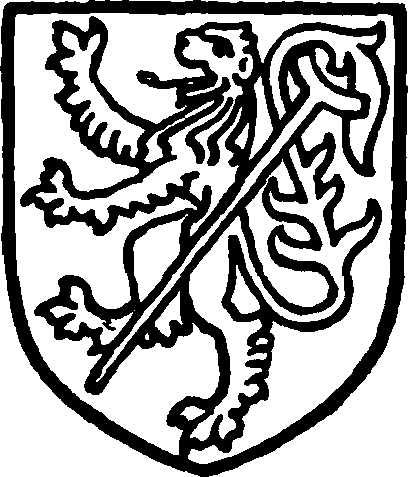
Newburgh Priory. Gules a lion or with a pilgrim's crutch or bend sinisterwise athwart him.
Manors
At the time of the Domesday Survey a 'manor' and 6 carucates at KIRKBY HILL belonged to Gospatric. (fn. 2) The overlordship was afterwards held by the Mowbrays, (fn. 3) who acquired it probably from Henry I, (fn. 4) and certainly before 1145, as the church and 1 carucate of land were included in their foundation charter to Newburgh Priory. (fn. 5) In 1253 John de Curtenay transferred the mesne lordship of a third part of one knight's fee in Kirkby Hill to the Prior of Newburgh. (fn. 6) Under this grant the prior became the mesne lord of the whole vill, which consisted in 1286–7 of 5 carucates, 2 of which he held in demesne, the remaining 3 being held of him by Alexander de Leeds, who had been the tenant of John de Curtenay. (fn. 7) The priory retained its rights until the Dissolution. (fn. 8) In 1334 Boniface de Leeds settled the manor of Kirkby Hill on his son Alexander and his issue. (fn. 9)
From this date this manor followed the descent of the manor of Thornton Bridge (q.v.) until 1522, when Ralph Nevill of Thornton Bridge died, leaving three daughters and co-heirs. (fn. 10) Kirkby Hill fell to the share (fn. 11) of the third daughter Clara, who married Thomas Nevill of Holt, and followed the descent of her manor at Leckby (fn. 12) (q.v.) until 1672, when Sir Thomas Nevill, bart., Thomas Nevill and Samuel Hinton sold it to Sir Robert Long, (fn. 13) who had been created a baronet in 1662. (fn. 14) In 1775 it was in the possession of Sir James Long, (fn. 15) seventh baronet, whose only son Sir James succeeded him in 1794, and died while still a child in 1805. (fn. 16) His estates passed to his eldest sister Catherine; she married William Wellesley-Pole, who in 1812 assumed the additional names of Tylney-Long and was afterwards fourth Earl of Mornington. (fn. 17) He dissipated the greater part of his wife's estates, this manor being purchased in about the middle of the 19th century by Thomas Rawson of Nidd Hall, (fn. 18) whose only daughter Frances Penelope married Henry Edmund thirteenth Viscount Mountgarret in 1844. (fn. 19) Their grandson Viscount Mountgarret is the present lord of the manor.
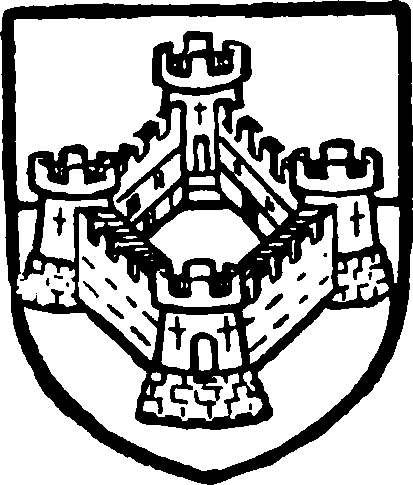
Rawson of Nidd. Party fessewise azure and sable a castle with four towers argent.
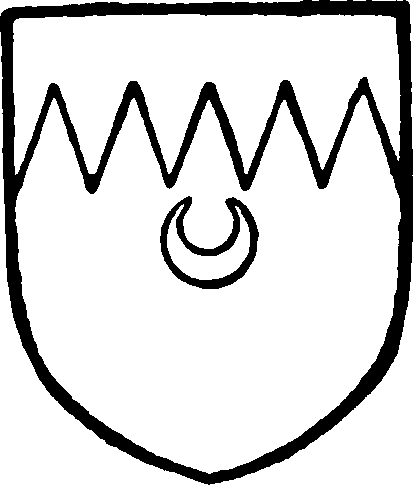
Butler, Viscount Mountgarret. Or a chief indented azure with the difference of a crescent.
In the reign of Edward I the Prior of Newburgh claimed free warren in his demesne lands here by charter of Henry III, (fn. 20) and Alexander de Leeds obtained a similar grant in 1305. (fn. 21)
The soke of 6 carucates in ELLINGTHORPE (Adelingestorp, xi cent.; Edelingthorpe, xii cent.; Ellyngthorpe, xvi cent.; Ellinthorpe, Ellenthorpe, present day) belonged to the king's manor of Aldborough at the time of the Domesday Survey. (fn. 22) At an early date it seems to have been subinfeudated to Wymar the Steward, (fn. 23) who in or about the year 1100 granted 4 carucates of land here with the chapel of St. Martin, Richmond, to the abbey of St. Mary, York. (fn. 24) By 1286–7 the whole vill was in the possession of the abbey, under which land here was then held by Richard de Butterwick, Goram, John Steynley and Michael Crokedayke. (fn. 25) The manor of Ellingthorpe came into the hands of the king at the Dissolution, (fn. 26) and is still Crown property.
Richard Aldborough was seised at his death in 1476 (fn. 27) of a capital messuage and tenements in Ellingthorpe, held of the Abbot of St. Mary's, York. This holding, afterwards called Ellingthorpe Hall, (fn. 28) followed the descent of Humburton (fn. 29) (q.v.).
In 1086 HUMBURTON (Burtone, Burton, xi cent.; Hundeburton, xiii cent.) belonged to Gospatric, and 4 out of the 6 carucates there were soke of the king's manor of Aldborough, (fn. 30) which was afterwards included in the honour of Knaresborough. The remaining 2 carucates were probably also Crown land. (fn. 31) By the reign of Henry III, and probably from the time of Henry I, the lordship of this portion was held by the Mowbrays, who retained it until the 16th century. (fn. 32)
The tenant under the Mowbrays in the reign of Henry III was Hugh de Arderne, (fn. 33) and in or before 1275 Alan son of John de Walkingham held land in Humburton of the Knaresborough fee. (fn. 34) In 1276 William de Arderne, the elder son of Hugh, died without children. His brother Richard should have succeeded him, but was an idiot, and as Roger de Mowbray was then a minor the Arderne lands in Humburton came into the king's wardship, (fn. 35) and their custody was granted by him during pleasure to Alan de Walkingham in 1279. (fn. 36) The actual lands were committed during the king's pleasure to Queen Eleanor, of whom Alan de Walkingham held them at farm. (fn. 37) In the mean time Henry son of Thomas de Woodhall had either acquired or usurped rights in Humburton, and in 1278 he granted his own lands there to Alan de Walkingham as well as the mesne lordship of both the Walkingham and Arderne fees. (fn. 38) Although Alan, in return, promised a yearly rent to Henry, the justice of the latter's claims seems questionable, and no mention of him occurs in the king's grant of custody to Alan de Walkingham in the following year. Alan died in or before 1284, leaving a son who was a minor. (fn. 39) After the death of Richard de Arderne, evidently about the same time, (fn. 40) the inheritance of all the Arderne lands reverted to the descendants of the two sisters of Hugh de Arderne, Olive wife of Robert de Megre, and Hawise wife of Richard Pecche. (fn. 41) Humburton Manor formed part of Olive's share, and her granddaughter Margery, with her husband Philip le Lou, received a direct grant of it from Queen Eleanor in 1285 for the service of a fourth part of a knight's fee. (fn. 42) In spite of this, John Pecche, the descendant of Hawise, was in possession of the lands in 1301, (fn. 43) and there may have been some dispute about them, as in 1313 Margery le Lou quitclaimed the manor of Humburton to John Pecche. (fn. 44) In 1316 that part of Humburton which is entered under the liberty of Richmond was held by John Pecche, and that part within the liberty of Knaresborough by the king, (fn. 45) under whom the Walkinghams were tenants. (fn. 46) After this date the Pecches lost their interest in Humburton, and appear to have been succeeded by John Moryn, who held land there of John de Mowbray in 1327. (fn. 47) In 1325 John son of Alan de Walkingham conveyed the 'manor' of Humburton to Richard Aldborough. (fn. 48) This evidently represented the Walkinghams' original property only, as it is said to have been held of Knaresborough. Richard Aldborough probably acquired the rest of Humburton from John Moryn. (fn. 49) In 1334 Richard Aldborough granted one messuage and 2 oxgangs of land in Humburton, held of John Moryn, to a chaplain to celebrate divine service in the church of St. Andrew, Aldborough. (fn. 50) He entailed the manor upon himself and his heirs (fn. 51) in 1336. In 1480 John Aldborough died seised of two messuages and 2 carucates of land here, and was succeeded by his son Sir Richard Aldborough, kt., (fn. 52) who was seised of the manor at his death in 1514, and left a son and heir Richard. (fn. 53) He died in 1537, leaving a son and heir another Richard, then a child, (fn. 54) who at his death in 1614 is said to have been seised of a capital messuage and land in Humburton. (fn. 55) This property, however, was still called the manor in 1650, when William Aldborough, his great - great - grandson, begged for its discharge from sequestration for the delinquency of his father Richard, at whose death William had become responsible for the debts of his grandfather Arthur Aldborough. (fn. 56) After this date there seems to be no material for the history of Humburton, which now consists of three farms, and is a Crown estate.
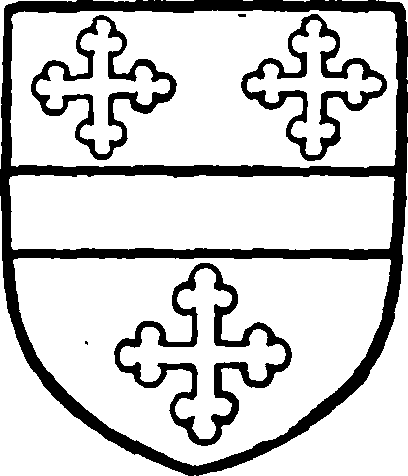
Aldborough. Azure a fesse argent between three crosslets or.
The township of Humburton includes MILBY (Mildebi, xi cent.; Milneby, xvi cent.), which was called a manor in the 18th century. In 1086 6 carucates in Milby were soke of Aldborough. (fn. 57) With Humburton it was in 1316 divided into two portions, (fn. 58) and the overlordship of one was in the hands of the Mowbrays. (fn. 59) Milby was early split up into several small holdings. In 1275 Alan de Walkingham acquired land there, (fn. 60) which passed with Humburton to Richard Aldborough in 1325. (fn. 61) In 1286–7 John de Breton was holding 2½ carucates of Roger de Mowbray, (fn. 62) and his heir was a tenant in 1327. (fn. 63) In 1309 the priory of Newburgh obtained some land from Simon de Stutevill, who held of the Mowbrays, (fn. 64) and the priory's possessions there were confirmed by John de Mowbray in 1389. (fn. 65) The Mowbrays also confirmed land in Milby to the abbey of Fountains. (fn. 66) Both these religious houses, as well as the monasteries of St. Leonard and Jervaulx, held tenements in Milby at the Dissolution. (fn. 67) Land here which had belonged to Newburgh and St. Leonard was granted by the king to William Ramsden, Ralph Wyse and his sons John and Roger Wyse in 1545. (fn. 68)
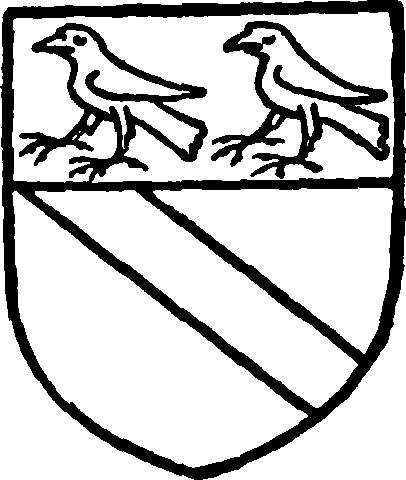
Vyner of Gautby. Azure a bend or and a chief or with two Cornish choughs therein.
Early in the 18th century the 'manor' of Milby was held by Henry Viscount Lonsdale, (fn. 69) by whom it was sold to Miles Smith (fn. 70); it was in the possession of Miles Smith in 1745. (fn. 71) Lord Grantham, afterwards Lord De Grey of Wrest, held it in 1804, (fn. 72) and his grandson Mr. Robert Charles De Grey Vyner is now the sole proprietor.
Other lands in Milby, formerly held by the abbey of Jervaulx, were conveyed in 1544 to Mathew Earl of Lenox and Margaret his wife, whose property went to the Crown with their grandson James I. (fn. 73) This part of Milby was granted by Charles II to William Stanley, Sir John Monson, kt., and Henry Wilkinson for twenty-one years in 1661. (fn. 74)
No mention of LANGTHORPE (Langlythorp, xiii cent.; Langethorn, xiv cent.), which was apparently never a manor, occurs in the Domesday Survey. (fn. 75) In the reign of Henry III Langthorpe formed part of the fief of Niel de Mowbray, lord of Thirsk, (fn. 76) of which this place was held. (fn. 77)
John de Selford is said to have held 3 carucates here in the reign of Henry III, (fn. 78) but early in the reign of Edward I the Prior of Newburgh held 2 carucates, (fn. 79) presumably granted by the Mowbrays, (fn. 80) and had free warren in his demesne lands here. (fn. 81) In 1286–7 Langthorpe consisted of 3 carucates, of which 2 were held by the prior and I by Thomas de Weston. (fn. 82) The successor of the latter was probably Simon de Stutevill, who held a quarter of a knight's fee in Langthorpe of Roger de Mowbray in 1301, (fn. 83) and in 1309 obtained licence to alienate land there to the Prior of Newburgh, who seems to have held the whole of Langthorpe in 1316, (fn. 84) as at the Dissolution. (fn. 85)
In 1545 this land in Langthorpe with the land of the priory at Milby was granted to William Ramsden of Longley, Ralph Wyse and his sons John and Roger Wyse. (fn. 86) It seems to have followed the descent of Milby. Lord Grantham was the chief landowner in 1806 (fn. 87) and Lady Mary Vyner, the second daughter of Lord De Grey, in 1861; her son Mr. Robert Charles De Grey Vyner (fn. 88) is now the principal proprietor.
Church
The church of ALL SAINTS consists of a chancel 25 ft. 6 in. by 13 ft. 4 in., nave 24 ft. 3 in. by 15 ft., north chapel 22 ft. 5 in. by 12 ft. 6 in., north aisle 37 ft. by 13 ft. 10 in., west tower 10 ft. 5 in. by 10 ft. 7 in. and south porch; these measurements are all internal.

Plan of Kirkby Hill Church
The nave is that of a little early church built with large irregular stones, some of which are parts of early carved slabs and cross shafts. It may date from the latter part of the 11th century, and the west tower before its recent rebuilding (1870) was of little later date. The chancel of this church has been destroyed, except, perhaps, a little of its north wall. A north aisle was added about 1160, and late in the 13th century a north chapel. In the 15th century the chancel was lengthened and widened southwards to the line of the south wall of the nave, and in modern times the north aisle has been rebuilt. The porch is also modern, and the roofs have been renewed.
The east window of the chancel is of the 15th century, of three cinquefoiled lights under a threecentred arch. In the north wall is a squint from the chapel into the chancel; it is a rather wide rectangular opening, and west of it, near the floor, is the socket stone of a cross built into the wall. The archway into the chapel is of good late 13th-century detail, the jambs being of three engaged shafts with a fillet in the middle shaft. The bases are of two rounds, the capitals are moulded, and the arch is a pointed one of two chamfered orders; the stonework of the archway is reddened as by fire. The chancel arch is a modern copy of this, but has a few old stones. The first window on the south side of the chancel is flush with the east wall and is a plain rectangular light of a single chamfered order; its stonework is old but of uncertain date. Adjoining it, but set lower in the wall, its sill serving as a seat, is a squareheaded window of two trefoiled lights with modern tracery. The priest's doorway is of the 15th century, and has a four-centred external head with a flat internal lintel. The third window, west of the doorway, is an old rectangular light like the first, and set low enough to be a low-side window. The walling of the south wall of the chancel is of coursed squared rubble, but it is more irregular in the east wall and has large quoins at the angles. The parapets are embattled and modern. A band of large stones marks the rebuilding of the upper part of this wall; one of these stones is carved with an interlacing pattern.
The north chapel has a modern east window of 14th-century character; the north window is similar, but retains an old stone or two in the inner jambs. A modern arch spans the west end of the chapel, but in its south jamb is a carved 12th-century impost with hatched and sunk star ornament and a cable mould in the hollow chamfer on its under side. It is, perhaps, taken from the former chancel arch.
The arcade between the nave and aisle is of two bays; the responds are semicircular with small shafts, which have been renewed, against the inner face. The middle pier is of unusual section, being a round column with engaged semi-octagonal shafts on its east and west faces. The base moulds are modern, but the capitals are original, though restored in parts; those of the circular columns are scalloped, but those of the smaller shafts are hollow chamfered or fluted in rather a rough manner. The arches are round, and of two square orders; the eastern one has been much restored, the other is old and retains traces of painting of 13th and 14th-century dates, one over the other. The stone here is very red, as in the north arch of the chancel.
The south window of the nave is of three trefoiled ogee-headed lights of 14th-century date; the east jamb inside has several new stones, and the rear arch is modern. The south doorway has a plain round head of a single chamfered order; it occupies the position of a larger and earlier doorway of which the east jamb and a few stones of the outer arch remain in position. In this jamb is a large stone carved in low relief with circular interlacing patterns. The wood door is an old one of plain detail but carefully restored, and has fine wrought-iron hinges which may be of considerable age. In the wall above the doorway are two stones carved with interlacing patterns, parts of the head and shaft of a cross. The arch from the nave into the tower is a plain round one with chamfered abaci. The porch, which is a modern rebuilding, has a pointed outer archway and two side lights. It contains several ancient worked stones in its walling; one is a part of a small octagonal shaft, another is a small early moulded capital, a third a base, a fourth a piece of edge roll mould, a fifth a Saxon stone with interlacing pattern, while the sixth and largest is a 13th-century coffin slab.
The north aisle of the nave is all of modern date; it is lighted by three north windows of two lights and a west one of three.
The tower was reconstructed in 1870, but the old stones were re-used and the lower part was undisturbed. The west window is modern. No external break or string-course divides the lowest story from the second, which is lighted by small lancets, but a moulded string divides the second from the third or bell-chamber. This is lighted by modern two-light windows. The plain projecting parapet, carried on a corbel table, is modern. The plinth on the west side of the tower is of unusually large projection, and there are some large stones in the lower walling; one of these at the south-west angle is clearly Roman and has a sunk panel which once contained an inscription. The south wall of the nave also contains some very large stones, particularly in the former southeast angle where it now forms a straight joint with the chancel. One of the largest stones in the body of the wall looks like the inverted head of a small round-headed light.
The open-timber roofs are of modern date; those of the nave and chancel are of very low pitch, while those of the north chapel and aisle are high pitched. The font is a round one of 13th-century date; the bowl has sloping sides and the base a plain mould. There are some 15th-century bench ends with carved poppy heads in the nave mixed with others of modern workmanship. In the aisle at the west end stands a cupboard made up of 17th-century panelling; on its doors are the initials and date 'ec wc 1699.' The altar table is probably of the 18th century and the altar rails of the 17th. The other furniture is modern.
There are no monuments in the church earlier than the 18th century. In the churchyard are parts of two Saxon crosses used as headstones to modern graves.
There are six bells: the treble, second and third by Warner, 1869; the fourth by Samuel Smith of York, 1713; the fifth by the same founder, 1718. The tenor is inscribed in black letter 'Scā trinitas unus deus,' and bears the maker's mark, a shield charged with a cinquefoil on a saltire.
The plate consists of a silver cup and paten, both of 1709, and a modern base metal chalice.
The registers begin in 1740.
Advowson
In 1145 Roger de Mowbray granted this church to the priory of Newburgh, which held it until the Dissolution. (fn. 89) The rectory was appropriated by 1292, and a vicarage seems to have been ordained before 1318. (fn. 90) In the reign of Mary the rectory was held by Cardinal Pole, and was leased by him to William Knyvett (fn. 91); in 1558 the queen granted the advowson of the vicarage and all her rights in the church to the see of York, (fn. 92) but they were in the hands of the Crown in Elizabeth's reign. Leases of the rectory for twenty-one years were granted in 1567 to Roland Clarke and in 1589 to Richard Aldborough. (fn. 93) Richard Aldborough surrendered his Letters Patent in 1595, when the queen granted the rectory and church to William Mauleverer, William Aldborough and Oswald Diconson for their lives, reserving to herself the advowson. (fn. 94) The rectory and church came again into the hands of Richard Aldborough in 1610, (fn. 95) but the advowson remained in the Crown (fn. 96) until 1874, when the patronage was transferred by the Lord Chancellor to the see of Ripon, (fn. 97) to which it now belongs.
In the reign of Henry VIII mention is made of 'one cottage, lately a chapel, with one small garden adjoining' in Milby. (fn. 98)
Charities
The site of the present elementary school was conveyed by deed, 1867. The erection of the school buildings was aided by the proceeds of the sale of the old school under order of the Charity Commissioners in 1868.
Priscilla Brooke, by will dated 11 December 1691, proved at York, left £500 upon trust for investment, the income to be paid to the Nonconformist minister at Ellingthorpe chapel preaching every Sabbath Day, with a trust over for other charitable purposes in certain contingencies. In 1821 a sum of £20 a year was paid to the minister of the chapel by the then Lord Grantley, presumably as interest on this legacy. (fn. 99) Apparently no payment has been made for many years.