A History of the County of York North Riding: Volume 1. Originally published by Victoria County History, London, 1914.
This free content was digitised by double rekeying. All rights reserved.
'The wapentake of Allerton or Allertonshire', in A History of the County of York North Riding: Volume 1, ed. William Page (London, 1914), British History Online https://www.british-history.ac.uk/vch/yorks/north/vol1/pp397-398 [accessed 30 April 2025].
'The wapentake of Allerton or Allertonshire', in A History of the County of York North Riding: Volume 1. Edited by William Page (London, 1914), British History Online, accessed April 30, 2025, https://www.british-history.ac.uk/vch/yorks/north/vol1/pp397-398.
"The wapentake of Allerton or Allertonshire". A History of the County of York North Riding: Volume 1. Ed. William Page (London, 1914), British History Online. Web. 30 April 2025. https://www.british-history.ac.uk/vch/yorks/north/vol1/pp397-398.
ALLERTONSHIRE OR THE WAPENTAKE OF ALLERTON
The wapentake of Allerton (Alvretun, xi cent.; Alvertonschyre, xiii cent.) contains the following parishes:—
Birkby; Hutton Conyers; Kirkby Sigston; Leake; Northallerton; Osmotherley; North Otterington; West Rounton; Sessay; Sockburn; Thornton-Le-Street
It is practically identical with the 'Alvretun Wapentac' of the Domesday Survey, (fn. 1) except that the parish of Sessay appears in the Survey under Gerlestre (fn. 2) Wapentake, and North Kilvington (in Thornton-le-Street), Holm (in Pickhill) and Norton Conyers (in Wath) are there entered under Hallikeld, while the parish of Hawnby, and the townships of Kepwick in Over Silton and Harlsey in East Harlsey, which were entered under Allerton in 1086, (fn. 3) subsequently formed part of the wapentake of Birdforth.
Practically the whole of the Domesday Wapentake was included in the berewicks and soke of the vill of Northallerton. (fn. 4) This was granted by William Rufus to the Bishop of Durham, (fn. 5) and gradually developed into what was known as the 'Liberty of Alvertonshire.' (fn. 6) For a period extending probably from the end of the 11th century to the year 1268, however, Allertonshire was included in the wapentake of Birdforth for purposes of jurisdiction. In 1166 the 'Soca de Alvertun' in the wapentake of Birdforth owed 10 marks for putting a man to the ordeal of water without the presence of a servant of the king, (fn. 7) and in 1276 it was recorded that the free tenants of Allertonshire used to appear with the jury of Birdforth, four men coming from Allertonshire and eight from Birdforth, up to the time of John de Oketon, then sheriff and seneschal of the Bishop of Durham. (fn. 8)
At this date the bishop had acquired considerable powers of jurisdiction over the manors of Allertonshire. He had the return of writs, estreats and pleas de namio vetito and assize of bread and ale (fn. 9) —similar rights to those which were held by John of Britanny in his liberty of Richmond and the Brus family in their liberty of Langbaurgh. (fn. 10)
From this time the liberty of Allertonshire was regarded as a judicial unit independent of the wapentake of Birdforth. The chief official was the bishop's bailiff, known as the bailiff errant of the manor and lordship, who held his courts and settled disputes. (fn. 11) In 1293 the liberty was taken into the king's hands because the bishop's bailiff did not execute a judgment rendered by the king's justices at York. (fn. 12) The bailiff himself was indicted in 1313 at the sheriff's tourn for confiscating waifs and strays within the liberty, though this was claimed as a right of the bishop. (fn. 13) The bishop appointed his own justices of the peace and gaol delivery (fn. 14) for the liberty and had his own receiver and steward. (fn. 16)
The liberty remained the possession of the bishops till the 19th century, following the descent of their manor of Northallerton. The courts they held there included at one time a forest mote. (fn. 16)
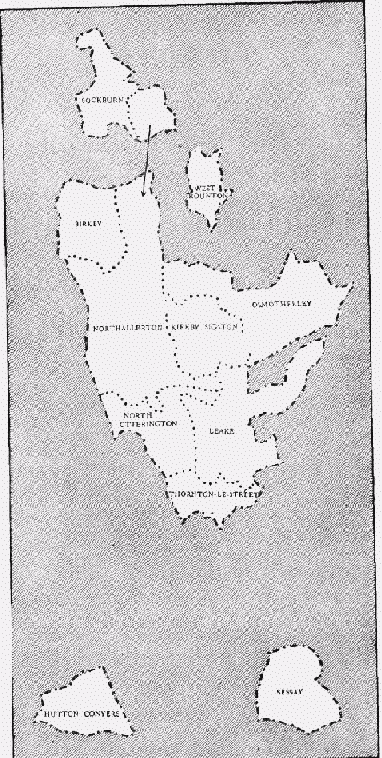
Index Map to Allertonshire
In 1837 the manor of Northallerton and the manors of Allertonshire were transferred to the see of Ripon, (fn. 17) and all rights connected with them are now exercised by the Ecclesiastical Commissioners.