
A History of the County of York North Riding: Volume 1. Originally published by Victoria County History, London, 1914.
This free content was digitised by double rekeying. All rights reserved.
'Parishes: North Otterington', in A History of the County of York North Riding: Volume 1, (London, 1914) pp. 439-444. British History Online https://www.british-history.ac.uk/vch/yorks/north/vol1/pp439-444 [accessed 26 April 2024]
In this section
NORTH OTTERINGTON
Ostrinctune, Otrinctune (xi cent.); Otherington, Otrynton (xiii–xv cent.); Little Otterington (xvii and xviii cent.).
This parish, with its townships of North Otterington, Thornton-le-Beans and Thornton-le-Moor, covers about 4,000 acres to the south of Northallerton parish. The western boundary is formed by the River Wiske, and the ground rises slightly from the banks of the stream towards the north-east of the parish, where Crosby Cote, the residence of Mr. Albert de Lande Long, J.P., stands among parks and plantations. It nowhere, however, reaches a point higher than 275 ft. above the ordnance datum.
There is no village of North Otterington. The few houses in the township, of which the most important is Otterington House, lie chiefly along the Boroughbridge Road.
Thornton-le-Beans has a village street running east and west, at the west end of which is the chapel of ease. It was rebuilt in the latter half of the 18th century (fn. 1) on the site of a chapel which existed in 1208, (fn. 2) and some fragments of the old walls were incorporated. The village consists of a considerable number of dilapidated cottages with deep gardens in front. On the north side is a half-ruined block, with primitive pedimented window openings, and inscribed above the door 'Cuthbert Brittain 1774.' The old school of Thornton-le-Beans, which dated from before 1777, has now been superseded by a new county council building. There is a Wesleyan chapel at the east end of the village.
A footpath leading north from Thornton-le-Beans to Crosby Cote passes on the southern boundary of the park the fish-ponds which gave to the village its ancient name of Thornton in Vivario. Common here was granted to St. James's Hospital by Nicholas de la Laund in 1300. (fn. 3)
Thornton-le-Moor, the largest village in the parish, lies on the road from Otterington station, about a mile south of Thornton-le-Beans. A lane branches off from the road at the plantation of Thief Hole, and runs towards the village. Thief Hole has been known by this name since before 1657, when the way over Purgatory by Thief Hole was in want of repair. (fn. 4) Purgatory is the name given to the southeast corner of the parish east of the road. A messuage and farm called Purgatory are mentioned among the property of the see of Durham in 1739, (fn. 5) and there was a toll-bar here known as Purgatory Bar. Thief Hole Lane enters Thornton-le-Moor at the east end of the village street. In a field called Stokeld's Well is an ancient open bath, and the base of an old boundary cross is also to be seen near the village. At the west end of the street is the church, which in 1868 became the parish church of North Otterington. According to local tradition the church was begun in what is known as 'the Church Field,' but the stones were removed by the Devil to the present site 2 miles away. There is a Primitive Methodist chapel here dating from 1856. From the west end of the street Endican Lane runs north into the Corpse Road, so connecting Thornton-leMoor with the church of St. Michael. Near the village, but within the parish of South Otterington, is Otterington station, which serves for all three villages.
The traditional date for the inclosure of the common fields in this parish is 1652. The name Priest's Acre is still given to part of the vicar's glebe.
About forty years ago the weaving industry flourished in Thornton-le-Beans and Thornton-le-Moor. It has now entirely died out. There are traces of sand and gravel workings in North Otterington, and the name Salt Kiln Farm in Thornton-le-Beans suggests the existence of another industry there. At the present day the greater part of the population is engaged in agriculture. The North Eastern railway and two large breweries in Thornton-le-Moor provide employment for the rest. 1,395 acres of the parish are under cultivation. (fn. 6) The soil is light on a subsoil of Keuper Marl, and the chief crops are wheat, barley, oats and beans.
Manors
In 1086 (fn. 7) NORTH OTTERINGTON was in the soke of the king's manor of Northallerton. (fn. 8) The extent is not given at this date, but in 1284–5 the whole vill was assessed at 4 carucates. (fn. 9) Colbrand and Ilving (fn. 10) were holding North Otterington when it was granted by William Rufus with the rest of the soke to the Bishop of Durham. (fn. 11)
Certain land held by the bishops in demesne (fn. 12) remained in their possession till the 19th century, when they exercised manorial rights. (fn. 13) In 1836 it was transferred with the other lands of the bishopric in Allertonshire to the see of Ripon, (fn. 14) the lands of which were vested in 1857 in the Ecclesiastical Commissioners, (fn. 15) the present owners. Of the tenants of the rest of the vill in the 13th century the most important was the family of Otterington, heirs of Hugh de Otterington. (fn. 16) At the beginning of the 13th century Thomas son of Hugh held here 1 carucate and 2 oxgangs. (fn. 17) Other tenants were John de Romanby, who held a fourth part of a knight's fee in Otterington and Romanby, and Guy de Helbeck, who had a holding of 7 oxgangs. (fn. 18) Thomas son of Hugh was succeeded by his son Thomas, who was in possession of lands in North Otterington in 1267–8. (fn. 19) In that year John de Croft, who claimed to be a grandson of one Gregory de Otterington, impleaded Thomas son of Thomas and William de Holtby for one messuage and 7 acres of land there. (fn. 20) Thomas was holding 1 carucate 2 oxgangs in 1284–5, when the other tenants were Alan Norris, Thomas Helbeck and Richard de Romanby. (fn. 21) He must be identified with the Sir Thomas de Otterington who witnessed a charter of Roger de Mowbray to Guisborough Priory in or about 1299. (fn. 22)
At about this date the family of Hornby makes its earliest appearance in the vill. In 1296 Agnes widow of Alan Norris claimed dower in North Otterington against Thomas son of Hugh de Otterington (fn. 23) and Richard de Hornby. (fn. 24) Four years later Richard de Hornby became the chief tenant in the vill through a quitclaim from Thomas son of Thomas de Otterington of two messuages, 24 tofts and one mill, with land and rent here and in Thorntonle-Moor. (fn. 25) Robert de Hornby, presumably his heir, paid subsidy in 1302 for his lands in North Otterington, (fn. 26) as did Hugh de Hornby, Alan and Roger Norris and Thomas de Otterington. (fn. 27) The Romanby family was still in possession of its holding. (fn. 28)
Robert de Hornby was returned as lord of the manor of North Otterington in 1316. (fn. 29) In 1330 lands and tenements in Hornby, North Otterington and Thornton-le-Moor were settled upon Robert and his wife Christine, with remainder to Thomas de St. Quintin and Margaret his wife, (fn. 30) who appears to have been a Hornby. (fn. 31) At the same time Philip Bekard and John de Croft quitclaimed to them the reversion of a messuage and land in North Otterington, which were held for life by John le Gerneter of the inheritance of John de Croft. (fn. 32) Robert de Hornby was dead in the next year and his widow Christine, with Thomas de St. Quintin and Margaret, was in possession. (fn. 33) Margaret is in all probability to be identified with the Margaret de Hornby who with John de Romanby held 2 carucates 2 oxgangs in North Otterington in 1347–8. (fn. 34)
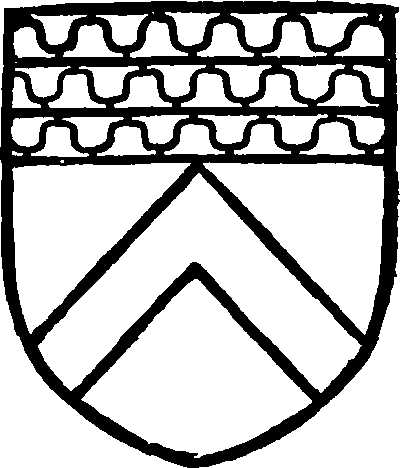
St. Quintin. Or a cheveron gules and a chief vair.
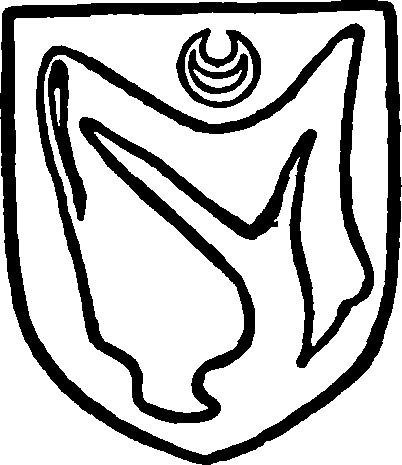
Conyers, Lord Conyers. Azure a sleeve or with the difference of a crescent on a crescent.
From the death of Robert Hornby North Otterington followed the descent of Hornby Manor (q.v.), coming through the marriage of the St. Quintin heiress with John Conyers into the possession of the Conyers family. Christopher Conyers, son of John, increased his estate here by purchase, (fn. 35) probably from the Romanbys, for in 1428 he was in possession of the land which had been held by Richard de Romanby. (fn. 36) The estate remained in the Conyers family, (fn. 37) and in 1556–7 (fn. 38) was inherited by the four daughters of John Lord Conyers: Margaret, Anne, Elizabeth and Katherine. (fn. 39) Margaret died unmarried (fn. 40) and her share passed to her sisters, who married respectively Anthony Kempe, Thomas Darcy and John Atherton. (fn. 41)
After the death of Anne her husband conveyed her share of the estate to John Jackson and Harsculph Cleasby, (fn. 42) who in 1575 sold it to William Waller. (fn. 43) Four years later William Waller conveyed it to the Metcalfe family. (fn. 44) John Metcalfe died seised of a third of the manor in 1588 and was succeeded by his son Michael, (fn. 45) who paid £4 as subsidy here in 1625. (fn. 46) His lands were sequestered during the Commonwealth for the delinquency of another Michael Metcalfe, (fn. 47) whose wife Elizabeth and son Thomas successfully claimed them. (fn. 48) Thomas paid hearth tax for twelve hearths in North Otterington in 1663. (fn. 49) In 1711 Henry Metcalfe of Naburn, grandson of Thomas, (fn. 50) was in possession, (fn. 51) and returned a messuage in North Otterington among his lands in 1717. (fn. 52) His daughter Mary Metcalfe left it to trustees for sale. The purchaser was Richard Middleton. (fn. 53) After passing from the Middletons to George Smith, the Metcalfe estate was acquired in the middle of the 19th century by Mr. J. Hutton. (fn. 54)
The shares of Elizabeth and Katherine Conyers in the manor of North Otterington were acquired before 1614 by Thomas Harbert of York. (fn. 55) Christopher son and heir of Thomas (fn. 56) quitclaimed them in 1624 to Francis Ireland, (fn. 57) by whom they were conveyed to Godhelpe Cowper. (fn. 58) They were purchased from the latter by Henry Best of Middleton, (fn. 59) who settled them in 1625 on his son William and Isabel Grant his wife. William died in possession in 1630, his heir being his daughter Ann, an infant five months old. (fn. 60) Isabel Best, widow of William, was still in possession in 1634. (fn. 61) Her daughter Ann, who married Christopher Fulbourne, sued her in 1647 for an annuity of £40 and the profits of the estate. (fn. 62) It seems to have passed from the Bests to a family named Selby; Thomas William Selby of York and Barbara his wife sold it in 1712 to Sir Hugh Smithson, bart., of Stanwick. (fn. 63) His grandson and successor Hugh Smithson was created Duke of Northumberland. (fn. 64) A later duke sold it in 1778 to a Mr. Holt, from whom it was purchased by Mr. John Hutton of Sowber. (fn. 65) His son Mr. J. Hutton is now the principal landowner. Some of his land has passed by exchange to the North Eastern Railway. (fn. 66)
One capital messuage in North Otterington was held by the Otterington family for a rent of 4d. or 1 lb. of cummin of the Priory of Durham. (fn. 67)
The hospital of St. James had a grant of 8 oxgangs in North Otterington in 1208. (fn. 68) This land followed the descent (fn. 69) of the advowson (q.v.).
THORNTON-LE-BEANS (Gristorentun, xi cent.; Thornton in Vivario, Thornton in Vivar, xiii cent.; Thornton Beans, xiv cent.) was a berewick of Northallerton in 1086. (fn. 70) Five carucates here were included in the grant of Northallerton (q.v.) to the Bishop of Durham at the end of the 11th century. (fn. 71) The vill remained in the possession of the bishops as part of the manor of Northallerton until 1836, when it was transferred with that manor (q.v.) to the see of Ripon. (fn. 72) The Ecclesiastical Commissioners now exercise the manorial rights.
Robert de la Laund held 1 carucate here of the bishop at the beginning of the 13th century and was succeeded by his son Robert, who was living in 1251. (fn. 73) In 1284–5 it was in the hands of Nicholas de la Laund, (fn. 74) who in 1300 quitclaimed to the hospital of St. James at Northallerton all his common in a fish-pond near Thornton. (fn. 75) He was followed by John, (fn. 76) whose heir was another Nicholas. (fn. 77) The latter was an adherent of Joscelin Dayvill and consequently forfeited his estates in 1322, but they were granted to John de la Laund in 1360 in consideration of his good service in the Scottish wars and of the losses he had sustained on account of them. (fn. 78) In 1428 Nicholas de la Laund held 1 carucate here for a twelfth part of a knight's fee. (fn. 79)
The families of Bretton, Prest, Cuthbert and Cotes appear in connexion with Thornton-le-Beans from the 15th to the 17th century. (fn. 80)
THORNTON-LE-MOOR (Torentun, xi cent.; Thornton in Mora, Thornton super Moram, xiii–xv cent.) is probably to be identified with the Thornton which was held before the Conquest by Edmund and at the time of the Domesday Survey was in the hands of Robert Malet. (fn. 81) Of the 5 carucates here (fn. 82) 2 were in the latter part of the 13th century an appurtenance of the barony of Greystock, (fn. 83) and were held by William son of Ralph. (fn. 84) Ralph son of this William, and cousin of John Lord Greystock, succeeded to the barony and the whole of the Greystock estates under a settlement. (fn. 85) Thornton-le-Moor followed the descent (fn. 86) of the manor of Morton on Swale (q.v.). The present Earl of Harewood is lord of this manor.
A second fee in Thornton-le-Moor consisting of 2½ carucates was part of the honour of Eye. (fn. 87) It was held of the Earl of Cornwall in the late 13th century by Richard de Malebiche. (fn. 88) Before 1312 he granted to the Abbot and convent of Fountains 9 oxgangs of land in Thornton, with his men here and their issues. (fn. 89) Walter de Beauvais, a tenant of Richard de Malebiche, added a grant of 1 oxgang. (fn. 90) More must have been added later, (fn. 91) for the Abbot of Fountains held 2 carucates of land here in the 15th century. (fn. 92) In 1319 the tenants of the Abbot in Thornton-leMoor were exempted from payment of an eighteenth because of damage they had sustained through the inroads of the Scots. (fn. 93) The property of the abbey here was worth £5 6s. 8d. at the Dissolution. (fn. 94) There is no record of a grant of this land, which was probably absorbed by purchase into the two other estates in the vill.
A third holding in Thornton-le-Moor belonged in 1300 to Thomas de Otterington, who quitclaimed it with his lands in North Otterington to Richard de Hornby. (fn. 95) It followed the descent of North Otterington, (fn. 96) and appears to have passed in the 16th century to a younger branch of the family of Conyers. Christopher Conyers quitclaimed two messuages with land here to John Talbot in 1561. (fn. 97) In 1579 Mary Lasingby died seised of half the manor, the reversion of which belonged to Thomas Conyers. (fn. 98) Nothing more is heard of it till 1627, when it was quitclaimed by John Constable and Dorothy his wife to John Talbot (fn. 99) with a warranty against John, his heirs and his father John Constable. John Talbot was lord of the manor of Thornton-le-Street, and from this date Thornton-le-Moor followed the descent of that manor (fn. 100) (q.v.), coming finally into the possession of the Earls Cathcart. The present earl is one of the lords of the manor.

Cathcart, Earl Cathcart. Azure three crescents each inclosing a crosslet fitchy argent.
Richard Malebiche had right of gallows in Thornton-le-Moor in the reign of Edward I. (fn. 101)
Churches
The church of ST. MICHAEL consists of a chancel 29 ft. 7 in. by 14 ft. 3 in., nave 39 ft. 2 in. by 19 ft. 4 in., south aisle 10 ft. wide, south porch and a small inclosed west turret. These measurements are all internal.
Both the nave and chancel are of 12th-century date, but the only details of this date remaining are the single jamb and part of the head of a small blocked light south of the chancel and the restored north window which was opened out about forty years ago when the church underwent restoration. The aisle was added probably about the end of the 14th century, but this again has been considerably altered at a later period. The bell-turret is modern.
The walls of the chancel were all 2 ft. 11 in. thick, but the east wall has been thinned down and is occupied by a modern three-light window with tracery of 15th-century character. Below this the thicker wall forms a shelf, while traces of two round-headed windows are still visible. The only window in the north wall is the small round-headed light opened out at the restoration of the church; the monial is modern, but the inner splayed jambs are old and have a two-centred drop rear arch of square section. Further to the east at the floor level is a low blocked recess with a modern stone lintel. There is evidence outside that it was higher, but hardly high enough for a doorway. It is perhaps the former entrance to a vault below the chancel floor. The first window in the south wall is apparently of the mid-14th century, and of three narrow trefoiled ogee-headed lights with widely splayed jambs inside. The priest's doorway, on the south side, is probably not older than the 17th century. The south-west chancel window, chancel arch and two north windows of the nave are modern. The south arcade is of three bays. The two pillars are octagonal with moulded bases, much repaired, and plain moulded capitals, all retooled. The corbels at the responds match the capitals and, except a female head below the west corbel, have also been reworked. The arches are pointed, and of two chamfered orders, with plain labels, but all retooled; the labels have human head stops over the pillars.
The south-east angle of the nave forms a straight joint with the east wall of the aisle. The east window of the aisle has three cinquefoiled lights under a half-round arch, and is of two chamfered orders. In the south wall is a piscina with a modern sill; the head is trefoiled and is either a modern renewal or has been retooled; west of this is a low recess which looks like a blocked single-light window. In the south doorway the only old parts are the two pieces of the stem of the western shaft. The head is a two-centred drop arch of two orders, of which the inner is new. The southwest window is modern and similar in detail to those in the north wall of the nave. A modern quatrefoil pierces the west wall. The bell-turret, which is built inside the west of the nave, is 8 ft. by 4 ft. 2 in. inside; it is entered by a doorway in its east wall. A former doorway to the north has been filled in. The turret is of stone and has the bell-chamber above the nave roof level; this is lighted by a single-light window in each wall, and is covered by a pyramidal roof. The west wall of the nave is strengthened by three buttresses, of which the north-west clasps the angle buttress, and no doubt the south-west did so before the addition of the aisle. There are also clasping buttresses to the chancel. The south porch has an outer archway of a single chamfered order with a semicircular drop arch. The walling of the church generally is of squared ashlar. The roofs and furniture are all modern. Lying at the east end of the aisle are several stones of the 11th century or earlier, carved with interlacing and knot-work patterns. These were found serving as wall-plates during a recent restoration; they are evidently pieces of cross-shafts.
Worked up in the screen, which closes off the space north of the bell-turret in the nave, are three traceried heads of a 15th-century screen of graceful appearance; they are now painted.
The few monuments that exist are of 19th-century date, the best of them being a mural one in white marble, carved in high relief with the recumbent effigy of a lady; it is inscribed to Margaret Hutton, who died in 1833, and stands in the south aisle, whence it was removed from the chancel.
There are two bells, the first inscribed in Roman letters 'Holines to the Lord 1658,' and the second 'iehove sanctitatem consonemvs soror parvvla r.g. i.p. i.c. 1689.'
The plate includes an early 18th-century cup by John Langwith of York, a chalice and paten of 1874, and a cup, paten and plate of plated metal.
The registers begin in 1591.
The modern church of ST. BARNABAS at Thornton-le-Moor, on the site of the ancient chapel, was built in 1868. It consists of a nave of four bays, quire, south porch and north vestry, and is in the late 13th-century style. The traceried east window is of three lights and the gabled western bellcote contains two bells. The building is of stone with a slate roof. The ancient chapel, before its destruction, was used as a school and also as a Nonconformist place of worship.
The chapel of THORNTON-LE-BEANS was already 'decayed and tumbled down' in 1566, when it was granted to Frances Barker and Thomas Blackway. (fn. 102) A new building was erected on the old site by Mrs. Heber in 1770, (fn. 103) and it includes a portion of the earlier chapel. It consists of a nave, quire, south porch and modern north vestry. The building has undergone considerable restoration, trefoil heads being inserted in the older side windows. The east window is a plain single light with a modern cinquefoil head, and in the south wall is a second singlelight window. The chancel arch is plain and semicircular. The communion rails, with balusters, date from the 18th century, but the table with turned legs appears to be somewhat earlier. The only mediaeval part of the present building is a portion of the north nave wall, which is considerably thicker than the 18th-century work. A deep break marks its western termination internally, and seems to imply that the early chapel was considerably shorter than the present building. The masonry is roughly built of large wide-jointed blocks, probably dating from the 12th century. The nave fittings include panelled pews and a polygonal pulpit with pilasters at the angles and a dentilled cornice; it rests on a large stone baluster stem and is of 18th-century date. The modern stone bellcote on the west gable contains one bell. The font was given by Dr. Pusey.
Advowson
The earliest mention of the church of North Otterington occurs in 1208–9, when King John confirmed to the hospital of St. James at Northallerton certain grants which had been made to it by Philip Bishop of Durham. (fn. 104) These included the church of North Otterington with its dependent chapels of Thorntonle-Moor and Thornton-le-Beans. (fn. 105) In 1246 Thomas de Otterington, the tenant of the bishop in North Otterington, quitclaimed to the master of the hospital all his right in the advowson of the church. (fn. 106) Before 1291 the rectory was appropriated and a vicarage ordained. (fn. 107)
The master of the hospital continued to present until the Dissolution, (fn. 108) when the rectory and advowson were granted with the rest of the possessions of the hospital to Sir Richard Morrison, ambassador and gentleman of the Privy Council. (fn. 109) He exchanged this property in 1545 for other lands, (fn. 110) and in 1547 it became part of the endowment of Christ Church, Oxford, (fn. 111) which retains the patronage.
The church of St. Barnabas, Thornton-le-Moor, was granted with North Otterington to the hospital of St. James. (fn. 112) Its advowson followed the descent of that of North Otterington. (fn. 113) In 1868 it was substituted for St. Michael's at North Otterington as the parish church. (fn. 114) The latter has remained as a chapel of ease.
The chapel at Thornton-le-Beans is a chapel of ease.
Charities
In 1857 Miss Ann Turner by her will bequeathed £200 to the rector and churchwardens, to be invested and the income divided on 1 January in every year amongst the poor of the township of North Otterington. The legacy, less duty, is represented by £189 4s. 6d. consols with the official trustees.
Charity of William Hutton (see Kirkby Wiske).
Jane Hutton, by her will dated in 1869, directed £3,000 to be invested in the name of the vicar of North Otterington, who should pay the dividends to the curate for the time being in augmentation of his stipend. The bequest is represented by £2,887 8s. consols.
Mrs. Heber left 60 guineas, the interest to be applied in educating poor children of the township of Thornton-le-Beans. Prior to 1781 a close of land called Fox Holes, containing 2 a. 2 r., was purchased, producing about £6 a year, which is applied for educational purposes.
Mary Musgrave, by deed 1851, settled £118 9s. consols for the repair of the chapel of ease at Thorntonle-Beans. The trust fund has been paid over to the Governors of Queen Anne's Bounty, who pay over £3 5s. a year for the purposes of the trust.