A History of the County of York North Riding: Volume 1. Originally published by Victoria County History, London, 1914.
This free content was digitised by double rekeying. All rights reserved.
'Parishes: Sockburn', in A History of the County of York North Riding: Volume 1, ed. William Page (London, 1914), British History Online https://www.british-history.ac.uk/vch/yorks/north/vol1/pp449-454 [accessed 30 April 2025].
'Parishes: Sockburn', in A History of the County of York North Riding: Volume 1. Edited by William Page (London, 1914), British History Online, accessed April 30, 2025, https://www.british-history.ac.uk/vch/yorks/north/vol1/pp449-454.
"Parishes: Sockburn". A History of the County of York North Riding: Volume 1. Ed. William Page (London, 1914), British History Online. Web. 30 April 2025. https://www.british-history.ac.uk/vch/yorks/north/vol1/pp449-454.
In this section
SOCKBURN
Soccabyrig, Sochasburgh (viii cent.); Socceburg (xii cent.); Socceburn (xiii cent.).
The parish of Sockburn includes the three townships of Sockburn, Girsby and Over Dinsdale, which cover altogether 2,757 acres. Of these the first is entirely in the county of Durham, the other two are in the wapentake of Allerton. Sockburn is mentioned as early as 780, when it was the scene of the consecration of Hygbald Bishop of Lindisfarne. (fn. 1)
The Tees forms the boundary between the two counties, and also the boundary between the townships, except at one point near the parish church where the boundary leaves the river and runs alongside it on the right bank. In this part of its course the Tees forms a series of long loops. At the south end of one of these and on the bank of the stream is the modern manorhouse built by Henry Collingwood Blackett in 1836, (fn. 2) and now the residence of Mr. W. H. Williamson.
The family of Conyers had a residence here for many generations. It was described in the 15th century as having a hall, chamber, kitchen, granary and stable. (fn. 3) Mill House and Mill Wood mark the site of the mill which is mentioned at the same time. The Thirstandale Wood of that date is now Staindale Wood. In 1470 Sir Christopher Conyers had licence to inclose with a wall and fortify his manorhouse. (fn. 4)
Leland describes it thus: 'the eldest house of the Coniers with the demains about it of a mile cumpace of exceding pleasaunt ground, is almost made an isle, as Tese ryver windeth about it.' 'At a little distance below the maner-place,' he adds, 'is a grete were for fish.' (fn. 5)
South of the hall are the ruins of the ancient church of All Saints, which has been partly pulled down. (fn. 6) In a field near the church is the celebrated Grey Stone where, according to tradition, the 'Worm of Sockburn' was slain by the valorous Sir John Conyers, first of his race. 'The scent of the poyson was soe strong that noe person was able to abide it, yet hee by the providence of God overthrew it and lyes buried at Sockburn before the Conquest, but before hee did enterprise it (having but one child) he went to the churche in compleate armour and offerd up his sonne to the Holy Ghost, which monument is yet to see and the place where the serpent lay is called Gray Stone.' (fn. 7) The falchion with which Sir John was said to have done this deed was preserved at Sockburn manorhouse, and was presented to the Bishop of Durham on his entry into the diocese by the Conyers of the day. This ceremony took place in the middle of the Tees at Neasham Ford, a little higher up the river. (fn. 8)
The village of Girsby, which lies rather less than a mile to the north-east of Sockburn, is reached by Girsby Bridge. On the bank of the river near the bridge is the parish church, which was built by the late Mr. Henry Collingwood Blackett and the Master of Sherburn (fn. 9) to replace the old building near Sockburn Hall. The modern church, though on the Girsby side of the river, is still in Sockburn township. The village of Girsby is very small and the only house of importance is Girsby Grange, the residence of the vicar.
North of Girsby and opposite Low Dinsdale in the county of Durham is the township of Over Dinsdale, a wedge-shaped piece of land bounded on three sides by one of the irregular loops of the River Tees. On the river just within its boundaries are fish-locks and a weir. Over Dinsdale Hall, which was rebuilt at the beginning of the present century by Mr. Thompson, is a mile to the north of this point. The lane leading from Girsby to Over Dinsdale crosses the river by a toll-bridge near the hall and Grange into the parish of Low Dinsdale. It then runs west to Neasham and so joins the road to Sockburn again.
The great high road from Catterick Bridge to Yarm runs across the south-eastern corner of Girsby township and crosses Staindale Beck by Staindale Bridge.
The only industry is agriculture; 1,055 acres are under cultivation, and a rather larger area is grassland. (fn. 10) The soil is sandy on a subsoil of Keuper Marls, and the chief crops are oats, potatoes and beans.
Manors
In the time of Aldhun Bishop of Durham (990–1018) (fn. 11) Snaculf son of Cykell granted 'Socceburgh and Grisebi,' with other lands, to the church of St. Cuthbert at Durham. (fn. 12) After the Conquest SOCKBURN became the seat of one of the great baronial families of the bishopric, the Conyers of Sockburn. There are two traditions as to the origin of the barony. A Sir John de Conyers, (fn. 13) probably apocryphal, is made the hero of one of those dragon-slaying exploits which are given as the explanation of various ancient tenures in the Palatinate, (fn. 14) and is said to have been buried in Sockburn Church before the Conquest. The legend that he received his lands (fn. 15) for his prowess in slaying the poisonous 'Worm of Sockburn' is supported by the serjeanty belonging to the manor which is mentioned above. It was the duty of the lord to meet the Bishop of Durham on his first entry into the diocese and present to him a falchion. (fn. 16) This was restored to him by the bishop, and he was then quit of all services. The custom was still observed in 1771. (fn. 17)
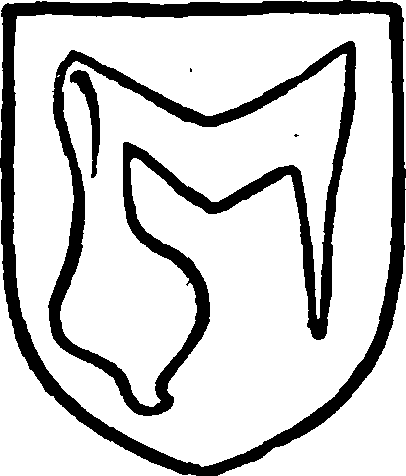
Conyers of Sockburn. Azure a sleeve or.
Another tradition makes the Conyers family hereditary constables of Durham Castle from the time of William the Conqueror, (fn. 18) and therefore presumably tenants of the Bishops of Durham in the Palatinate from that date. It seems probable, however, that the actual origin of the barony was the grant of land in Bishopton, Stainton, Sockburn, Dinsdale, Girsby, Hutton, Newton, Howgrave and Holme which Bishop Ralph Flambard made to Roger de Conyers, a member of his council, (fn. 19) at the end of the 11th or beginning of the 12th century. (fn. 20) This grant was confirmed by the Prior and convent of St. Cuthbert. (fn. 21) A later confirmation (fn. 22) states that Roger de Conyers was enfeoffed by Bishop Ralph 'in Hutton, Norton, Holme and Howgrave for one knight's fee. And Rounton, Girsby, and Dinsdale for one knight's fee, and Bishopton and Stainton and Sockburn for one knight's fee. And Elmshit which he holds of the honour of Brancepeth and West Auckland and Evenwood and Morley and Mayland for one knight's fee. And Bedlington and Bedlingtonshire for two knights' fees. And Finningham in Suffolk which he holds of the honour of Crayke for half a knight's fee.'
This Roger de Conyers was the chief defender of the bishopric in 1141–4 against the invasion of William Cumin. (fn. 23) He alone of the barons of the bishopric refused to do homage to the usurper, (fn. 24) and in 1144 he succeeded in compelling him to surrender Durham Castle. (fn. 25) Earlier in the struggle he had fortified his own estate of Bishopton, (fn. 26) and had used it as a place of refuge for the legally elected Bishop William de St. Barbara. (fn. 27)
Roger de Conyers, son and heir of the first baron, (fn. 28) had a confirmation of the grant of Bishop Ralph from Henry II, (fn. 29) and was holding three knights' fees of the Bishop of Durham in Yorkshire in 1166. (fn. 30)
Roger de Conyers had three sons, Robert, (fn. 31) Roger (fn. 32) and Geoffrey. (fn. 33) Robert was the eldest, and with his father made a confirmation of the grant of West Rounton Church to Bishop Hugh Pudsey. (fn. 34) Whether he actually came into possession of his father's lands is uncertain, but they were certainly acquired before 1195 by his brother Roger, (fn. 35) who appears to have had no legal claim. (fn. 36) Roger son of Robert (fn. 37) made various attempts to recover his inheritance. A preliminary settlement was made by fine in 1195, (fn. 38) when Roger de Conyers, the uncle, quitclaimed to his nephew lands in Hutton, Norton and Dinsdale, reserving the dower of Basilia widow of Roger de Conyers, and in return Roger, the nephew, quitclaimed his right in Bishopton, Sockburn, Girsby and Stainton, reserving the dower of Mabel widow of Robert de Conyers. (fn. 39)
In the next year, however, Roger son of Robert owed 40 marks for having right of his father's lands against his uncle Roger in Hutton, Norton, Girsby and Dinsdale. (fn. 40) The elder Roger nevertheless remained in possession of Sockburn and appears to have been succeeded by his brother Geoffrey. (fn. 41) In 1225 Geoffrey was dead, (fn. 42) and his son and heir John was under age and in the custody of Hubert de Burgh. (fn. 43) Two years later John de Bassingburn was his guardian (fn. 44) and had to meet a demand made by Leonard the Jew of York for the payment of a debt due from the estates of Geoffrey de Conyers. (fn. 45) In 1239 John de Conyers was in possession of the estate and took a further step in the settlement of the feud with the elder branch of the family, now represented by Robert son of Roger. (fn. 46) John complained that Robert had not kept the fine of 1195, and made a fresh agreement, by which he granted Robert the manor of Finningham in Suffolk and received in return the manor of Girsby and half a carucate in Dinsdale to hold of Robert and his heirs. At the same time Robert quitclaimed to John all his right in Bishopton, Stainton, Sockburn, Auckland, West Rounton, and a carucate in Dinsdale which John had previously held. (fn. 47) This was the end of the dispute as far as Sockburn was concerned, and the descendants of John remained in possession, while Robert founded the family of Conyers of Hutton Conyers (q.v.).
The heir of John was his brother Humphrey, (fn. 48) lord of Girsby in 1259. (fn. 49) He was dead in 1283, when his widow Parnel claimed dower. (fn. 50) His son John (fn. 51) succeeded him and proved his right to free warren in Girsby in 1293. (fn. 52) He married Scolastica daughter and heir of Sir Ralph de Cotum, (fn. 53) and was succeeded by his son John before 1304. (fn. 54)
The latter died in 1342 without male issue. (fn. 55) His daughter Elizabeth married Sir John Colvill (fn. 56) and carried some of the Conyers' estates into his family. Sockburn, which must have been entailed, passed to another John Conyers, (fn. 57) apparently a nephew. (fn. 58) He held the manor till February 1394–5, when he was succeeded by his son Robert. (fn. 59) Robert died in 1431, (fn. 60) leaving a son Christopher, who was under age. Christopher had livery of his lands in 1444, (fn. 61) and in 1470 had licence to fortify his manor of Sockburn. (fn. 62) His son William succeeded him in 1487 (fn. 63) and died in 1490, leaving a son Christopher. (fn. 64) This Christopher was succeeded six years later by his son Thomas, (fn. 65) who proved his age at Darlington in 1511. (fn. 66) He died in 1520. (fn. 67) His son and heir George (fn. 68) was the next lord of Sockburn, which he held till his death in 1567. (fn. 69) John Conyers his son succeeded him, (fn. 70) and was in his turn succeeded by another George, (fn. 71) his son and heir, who died in 1625–6. (fn. 72) William son of George (fn. 73) was the last of the male line of Conyers.
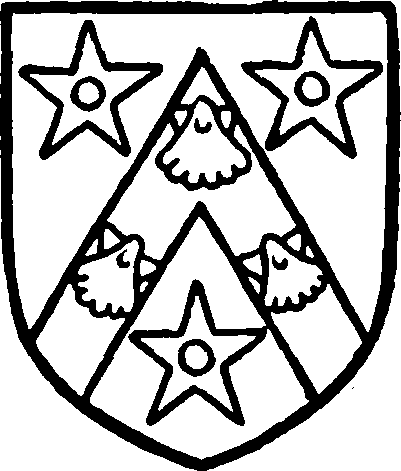
Blackett, baronet. Argent a cheveron between three pierced molets sable with three scallops argent upon the cheveron.
At his death in 1635 (fn. 74) his three daughters Katharine, Ann and Dorothy were all infants. (fn. 75) The second daughter Ann, the only one who reached maturity, married Francis Talbot Earl of Shrewsbury. (fn. 76) They had an only daughter Mary, (fn. 77) who became the wife of John Stonor of Stonor, Oxfordshire, (fn. 78) and inherited the manor of Sockburn, which she sold to Sir William Blackett, bart., of Newcastle. (fn. 79) He was succeeded by his son Sir Edward, who held the manor till his death in 1718. (fn. 80) A second Sir Edward, his son and heir, succeeded him and died without issue in 1756. His nephew Edward son of John Blackett was his heir. William son of Edward Blackett was the next baronet. (fn. 81) He gave or left the manor to his third son Henry Collingwood Blackett, who at his death without issue in 1856 left it to his elder brother Edward, the sixth baronet. From him it passed to Sir Edward William Blackett, who gave it to his second son, Mr. Arthur Edward Blackett, the present owner. (fn. 82)
Humphrey de Conyers granted to the Abbot and monks of Rievaulx a piece of ground and a fishery in the waters of the Tees extending to the boundaries between Dinsdale and Girsby. He also granted them as much brushwood from Thurstandale as two horses could draw. (fn. 83)
GIRSBY (Grisebi, xi cent.) was granted with Sockburn to the church of St. Cuthbert of Durham, (fn. 84) and in 1086 6 carucates here were returned among the lands of the bishop. (fn. 85)
Girsby was granted to Roger de Conyers with Sockburn (fn. 86) (q.v.) and for six centuries followed its descent. The long feud between the descendants of Roger de Conyers in the 13th century (fn. 87) seems to have centred in the manor of Girsby. The younger Roger claimed it against his uncle in 1196, (fn. 88) and in the settlement of 1239 his son Robert reserved a mesne lordship in this manor as his own right. (fn. 89) Twenty years later Roger son of Robert sued Humphrey de Conyers of Sockburn for not keeping this agreement. (fn. 90) The younger and more powerful branch of the family seems, however, to have made a successful resistance to this claim, for in 1284–5 the manor of Girsby was said to be held by John de Conyers directly of the bishop for a fourth part of a knight's fee. (fn. 91) No mesne lordship of the Conyers of Hutton Conyers is mentioned.
Girsby followed the descent of Sockburn (fn. 92) (q.v.) into the hands of the Blackett family, (fn. 93) and Sir Edward Blackett was holding it in 1710. (fn. 94) Shortly afterwards it must have been sold to James Nicholson of West Rainton (Dur.), whose daughters and coheirs, Jane, Anne and Mary, were in possession in 1736–46. (fn. 95) Mary died unmarried, (fn. 96) Jane married Thomas Earl of Strathmore in 1736, (fn. 97) and Anne married Patrick Lyon, brother of the earl. (fn. 98) The estate was never subsequently owned as a whole by any one person. In 1774 Ann Lyon, spinster, was holding a moiety. (fn. 99) She is apparently to be identified with the Ann daughter of Patrick Lyon who married John Clutterbuck of Warkworth, (fn. 100) and with her husband held half the manor in 1778. (fn. 101) The other half was held by Alexander Emerson and his wife Susanna, (fn. 102) who must also have been a Lyon and heir of the share of the Countess of Strathmore. Some manorial rights were retained by the Earls of Strathmore, for the manor of Girsby appears among their possessions as late as 1801. (fn. 103) In 1823 Henry Donkin was party to a fine with various members of the family of Raine concerning a fourth part of the manor. (fn. 104) The present landowners are Sir Henry HavelockAllan, bart., and Mrs. Wilson.
OVER DINSDALE (Dirnshala, Detinsale, Dinehale, xi cent.; Dalineshal, Ditneshal, Dedensall, xii cent.; Dedinsdale, xvii cent.) in 1086 was in the hands of Count Alan, but soke of Northallerton (q.v.); Elsi had held one 'manor' here with 3 carucates of land before the Conquest. (fn. 105)
Three carucates in Dinsdale previously held by Crinan son of Thorne passed with the rest of the soke into the possessions of the Bishop of Durham (fn. 106) and were granted with Sockburn (q.v.) to Roger de Conyers. (fn. 107) The dispute between the two branches of the Conyers family in the 12th and 13th centuries ended in the division of the Dinsdale lands; 2½ carucates were allotted to the elder branch of the family, while the Conyers of Sockburn had the remaining 1½, (fn. 108) of which half a carucate was to be held of the Conyers of Hutton Conyers. (fn. 109) This part of the agreement was not observed and in 1284–5 John Conyers of Sockburn was holding 1½ carucates of the Bishop of Durham. (fn. 110)
The land in both parts of the vill seems to have been held in small portions by sub-tenants, and its descent is difficult to trace. That some part of it followed the descent of Hutton Conyers for several centuries is apparent from the fact that the Mallorys, lords of Hutton Conyers (q.v.), held messuages and lands here in the 16th century. (fn. 111) It was possibly from them that John Maynard and Mary his wife, who held what was called the 'manor of Over Dinsdale' in 1625, (fn. 112) acquired their interest. They quitclaimed it in 1631 with a warranty against the heirs of Mary to John Conyers, (fn. 113) whose connexion with the other branches of the family is not clear. He married Alice Ascough, daughter of Christopher Ascough of Middleton one Row, (fn. 114) and was succeeded in the estate by her nephew Thomas Ascough, (fn. 115) on whom it was apparently settled. (fn. 116) He was succeeded by his son Alan, whose son, another Alan, was in possession of tenements here in 1714. (fn. 117)
Among the tenants in the other part of the township in the 17th century was the family of Ward. They perhaps acquired their estate here from the Girlingtons, who owned 12 oxgangs in 1606. (fn. 118) Robert Ward held two messuages and 12 oxgangs in 1625, of which half was held of Sir George Conyers of Sockburn. (fn. 119) His son Robert (fn. 120) held lands in Over Dinsdale in 1633, (fn. 121) and Richard and Thomas Ward answered for five hearths there in 1673. (fn. 122) During the 18th century this family seems to have acquired the greater part of the township, and the Misses Ward were the principal landowners in 1823. (fn. 123) Their estate was subsequently acquired by the Rev. W. S. Temple, who sold it to Mr. J. Emerson. It was purchased from him in 1871 by Mr. Charles Pease. (fn. 124) His executors (fn. 125) sold it to Mr. Thompson of Sunderland, whose son Mr. R. Thompson is the present owner. (fn. 126)
Church
The ruins of the church of ALL SAINTS (fn. 127) stand on a broad plateau of rich meadow land less than a mile square, inclosed within a loop of the River Tees at the southernmost point of the county of Durham, 2 or 3 miles below the village of Neasham. The ruins are situated a short distance to the south-west of Sockburn Hall, no other building being near, and are protected by a fence. The opposite bank of the river is clothed with forest trees which shut out any distant views.
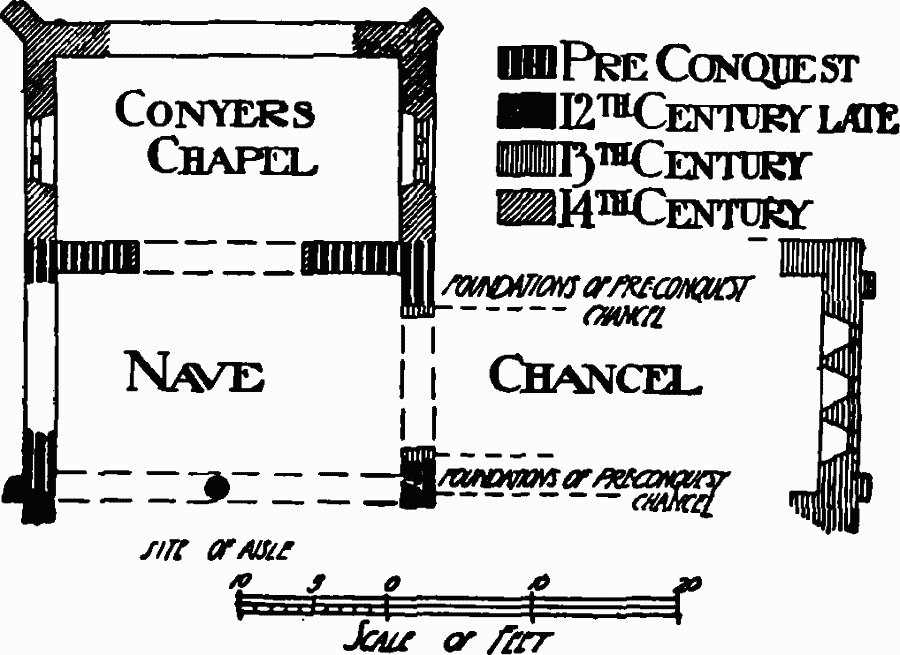
Plan of Sockburn Church
The building was in use down to the year 1838, when a new church was built at Girsby on the Yorkshire side of the river. It was then unroofed and allowed to go to ruin, but in 1900 the Conyers chapel was repaired and roofed, the ruins cleared of rubbish, and certain excavations made which led to the discovery of a large number of pre-Conquest stones. Nine fragments of ancient cross-shafts and horizontal grave slabs lay among the ruins before this date, and a complete hog-back in two pieces was at the hall. (fn. 128) No suspicion of pre-Conquest work in the structure itself, however, existed till the year 1891.
Previous to falling into ruin the church comprised a chancel 26 ft. 4 in. by 15 ft., nave 24 ft. 5 in. by 13 ft. 9 in., south aisle, south porch, and chantry chapel on the north side of the nave 12 ft. 6 in. wide, all these measurements being internal. (fn. 129) The many early sculptured stones found in 1900, some of them forming the foundations of the pre-Conquest chancel walls, indicate the existence of a cemetery, and therefore of an accompanying church of which no traces remain, and which may possibly have been of wood. This early building was followed in the pre-Conquest period by a church of stone, the nave of which has remained unaltered so far as its dimensions are concerned up to the present day. It is inclosed at its four angles with quoins of long and short work, the walls being more than 20 ft. in height. The foundations of the north and south walls of the chancel were uncovered in 1900, and showed the chancel to have been 10 ft. in width, but no remains of the east wall were found and its length can therefore only be conjectured, though the extent of the foundation of the south wall indicates at least an internal length of 11 ft. The chancel arch was no doubt of the usual tall and narrow type, the original jamb stones being re-used when the opening was increased in width.
The pre-Conquest church with its aisleless nave and chancel stood until the closing years of the 12th century, when an aisle was added by breaking through the south wall and inserting an arcade of two bays. The pier supporting the arches is a tall cylindrical shaft with square plinth and chamfered base and a moulded octagonal capital. The arches are of two slightly chamfered orders, the eastern one supported by a short corbelled respond and the western one dying into the wall. The width of the aisle was not revealed by excavation, its outer wall having entirely disappeared. The roof was probably a continuation of that of the nave supported by corbels still in situ over the arches.
Shortly afterwards, at the beginning of the 13th century, the chancel was rebuilt on a larger scale, its length exceeding that of the nave by 2 ft. and its width being increased 5 ft. The east wall is pierced by a triplet of lancet windows with slightly chamfered external jambs. Inside the openings are widely splayed in the usual manner, and the lights have chamfered hood moulds on both sides. Between the outer openings and the external angles of the east wall are flat buttresses with chamfered plinths terminating in simple weathering. The original narrow chancel arch gave place at this time to a pointed one, 9 ft. in width, of two chamfered orders springing at a height of about 10 ft. from corbels of two oversailing courses. The north and south walls of the chancel have entirely disappeared except for a short length on each side at the east end. The height of the existing east wall is about 16 ft.
The Conyers chapel was added on the north side of the nave in the 14th century to provide a mortuary chapel for the family and is 23 ft. 10 in. in length. It opens to the nave by a flat pointed arch 11 ft. in width of two chamfered orders dying into the wall at the springing. The chapel was lighted at each end by a three-light traceried window with double chamfered jambs, and the external angles have diagonal buttresses differing in design. There is a bold chamfered plinth on the north and west sides. The heads and mullions of both the windows and nearly the whole of the north wall had been destroyed before the restoration.
The stone effigy of a knight, four brasses and some grave-covers occupy their original positions in the chapel. The effigy belongs apparently to the middle of the 13th century, (fn. 130) and is represented in a suit of mail with sleeveless surcoat. The head rests on a square cushion and the feet on a lion and wyvern in combat. The legs are crossed and the left arm bears a plain triangular shield. The sword, held in the right hand, is suspended by a strap.
The brasses are inlaid in grave-covers in the floor of the chapel, on the first of which can be traced an incised cross, a shield with the Conyers arms and a sword. The stone has been made to do duty a second time when the brass, commemorating Sir John Conyers, who died in 1394, was inserted in it. The inscription, which, like all the others, is in Gothic characters, reads: 'Hic jacet Joh[ann]es Conyers Miles d[omi]nus de Sokburn qui obijt nonodecimo die Februarii ao d'ni moccc nonogesimo quarto cui[us] a[nim]e p[ro]piciet[ur] deus Amen.'
The second brass is to Sir Robert Conyers, his son, and is inscribed: 'Hic jacet Robertus Conyers armiger dominus de Sokbur qui obijt vicesimo quinto die Aprilis ao d'ni mocccco tricesimo iijo cui[us] a[nim]e p[ro]picietur deus Amen.'
The third is to Isabella wife of this Sir Robert Conyers; she was daughter and co-heir of William Pert: 'Hic jacet Isabella uxor Roberti Conyers armigeri qui obijt nono die Aprilis ao d'ni mocccco tricesimo iijo cui[us] a[nim]e propicietur deus Amen.'
The fourth brass is to Mary wife of Sir Christopher Conyers, and bears an inscription in rhyming hexameters, stating that she died in 1470.
At each corner of the last slab is the matrix of a shield which contained in coloured enamels the arms of (1) Conyers quartering Vescy, (2) and (3) Conyers impaling Eure, and (4) Eure, for Sir Christopher Conyers, son of Sir Robert, who married Mary daughter of Sir William Eure.
Other mediaeval fragments preserved in the chapel comprise a portion of a square-headed traceried window, a grave-cover with cross formed of four circles conjoined, portions of three other gravecovers, (fn. 131) the bowl of a circular font, and fragments of two panels possibly part of an altar tomb, on one of which within cusping is the upper part of a shield bearing two popinjays, and on the other the lower part of a shield bearing in the third quarter a checker and in the fourth remains of a scallop. There are also four stones 11 in. in height, discovered in the river bank some distance from the church, with lettering in sunk panels which read: 'Seculor'. 'Mortali'. 'Soli Deo'. 'Seculor.' These probably formed part of a motto which ran round the great hall of the Conyers manor-house in the 15th century. (fn. 132)
The chapel also contains the collection of preConquest sculptured stones brought together during the restoration and excavations of 1900. They comprise portions of twenty-two crosses and grave-covers of varied and characteristic design. (fn. 133)
The new church at Girsby is an uninteresting building with round-headed windows. It contains two small bells, evidently from Sockburn, one of which is inscribed in Lombardic letters 'Sancta Maria ora pro nobis.' The other is dated 1770.
The plate consists of a chalice of 1742, made by Isaac Cookson of Newcastle, and a set of two chalices, two patens, a flagon and an almsdish presented under the will of Robert Henry Allan of Blackwell Hall, Darlington, in 1889. There is also a pewter paten and flagon, the latter inscribed 'Sokburn 1746, Thos Moncaster Church-warden.'
The registers begin in 1588.
Advowson
The church of Sockburn was in existence before the Conquest, (fn. 134) but no reference to it has been found earlier than 1168, when Geoffrey de Conyers was parson there. (fn. 135) The advowson was in the possession of the lords of the manor till Roger de Conyers granted it to the hospital of Sherburn at the foundation of that house by Bishop Hugh Pudsey in or about 1181. (fn. 136) It was at some time before 1311 (fn. 137) appropriated to the hospital and a vicarage ordained. (fn. 138)
In 1578 a dispute arose between John Conyers, then lord of the manor of Sockburn, and the almoner and brethren of Sherburn House with regard to certain tithes belonging to the hospital. (fn. 139) The evidence of their right had been lost and John Conyers denied it.
The advowson has remained the right of the master of Sherburn Hospital down to the present day, though there are two instances in the 19th century of presentation by the Bishop of Durham. (fn. 140)
Girsby appears to have had a chapel of its own in the 14th century. (fn. 141) No trace of it remains.
There are no endowed charities.