A History of the County of York North Riding: Volume 1. Originally published by Victoria County History, London, 1914.
This free content was digitised by double rekeying. All rights reserved.
'Parishes: Helmsley', in A History of the County of York North Riding: Volume 1, ed. William Page (London, 1914), British History Online https://www.british-history.ac.uk/vch/yorks/north/vol1/pp485-505 [accessed 1 May 2025].
'Parishes: Helmsley', in A History of the County of York North Riding: Volume 1. Edited by William Page (London, 1914), British History Online, accessed May 1, 2025, https://www.british-history.ac.uk/vch/yorks/north/vol1/pp485-505.
"Parishes: Helmsley". A History of the County of York North Riding: Volume 1. Ed. William Page (London, 1914), British History Online. Web. 1 May 2025. https://www.british-history.ac.uk/vch/yorks/north/vol1/pp485-505.
In this section
HELMSLEY
Elmeslac (xi cent.); Haumesley, Haumelec, Hamelak, Hamelacke, Helmesle (xiii cent.); Helmeslegh (fn. 1) (xiv cent.).
Helmsley was composed in 1831 of the townships of Bilsdale-Midcable, Harome, Helmsley, Laskill Pasture, Pockley, Rievaulx and Sproxton. Of these Bilsdale-Midcable was constituted a parish in 1898 from parts of the parishes of Helmsley and Hawnby and the chapelry of Bilsdale, and comprises the townships of Bilsdale West Side, Laskill Pasture and a portion of Bilsdale-Kirkham. Harome was made a parish in 1863 and Pockley with East Moors in 1898. The area of the old parish is 38,623 acres of land and inland water, and (excluding Bilsdale and including Beadlam) of these 6,971 acres are arable land, 5,463 permanent grass and 3,340 woods and plantations. (fn. 2) The soil is limestone, sandstone, clay and gravel, the subsoil Oxford clay, Kimmeridge clay, corallian beds, cornbrash, and upper middle and lower lias. The crops raised are wheat, oats and barley. The population is now entirely agricultural.
Coal was mined in this parish in the time of Robert Furfan (fn. 3) (1190–1227), and old pits remain on the moors. There were ironworks and a mill called the Iron Smith's at Rievaulx in the 16th and 17th centuries. (fn. 4)
The land varies in height from 125 ft. in the lower valleys of the Rye and Riccal to over 1,000 ft. on the northern moors.
An inclosure award for 950 acres of land in Kirkdale and Helmsley was made in 1806. (fn. 5) Helmsley has a station on the Gilling and Pickering branch of the North Eastern railway.
Helmsley parish stretches from Ryedale to the southern slopes of the Cleveland Hills, where rise the Rye and its northern tributaries, each with its dale. On the northern slopes of this watershed are similar dales worn by the southern tributaries of the River Esk. The highest point of this district of solitary mountainous moorland is Burton Head, which rises from Bilsdale East Moor, 1,489 ft. above ordnance datum. The Rye rises on Snilesworth Moor in Cleveland 700 ft. above ordnance datum, and as it enters this parish (the first in 'Ryedale') receives the Seph from Bilsdale and the Riccal through Riccal Dale. The Rye then descends between thickly wooded, steep banks and flows by the ruins of the Cistercian abbey to which it gave its name—Rievaulx—and the quaint compact village consisting of a few stone and tile cottages scattered along a by-road running between the main roads to Helmsley from Hawnby and Thirsk. The river continues between thickly wooded hills rising sharply on either hand. It turns Sproxton Mill and then winds on to Helmsley Bridge.
The market town of Helmsley lies in a hollow in the middle of well-wooded and undulating country on the north bank of the River Rye. It is built round a large picturesque market square formed about the road from York and just west of the site of the castle. The church stands at the north side of the market-place in the angle between it and the road to Scawton, the churchyard, with its stone wall, encroaching on the highway.
In the centre of the square is a monument in 19th-century Gothic to the second Lord Feversham, while to the north-west of it are the shaft and base of a mediaeval cross with a modern head mounted on six well-worn steps. Bond Gate leads from the north-eastern corner of the square, and further on becomes the Kirkby Moorside road. Flowing through the town slightly to the west of the square is the Borough Beck, which joins the Rye at the south end of the town just above the bridge. The houses on the west side of the square back on to the stream, which is carried under Bond Gate, and a little further north flows down the middle of the High Street and its continuation Castle Gate.
Behind the church is the interesting building called Canon's Garth, possibly once belonging to Kirkham Priory. (fn. 6) A letter from John Manners to his brother the Earl of Rutland was dated from this house in 1581. (fn. 7) The present building is possibly of the 16th century, but has been much added to and restored; after many vicissitudes it is now a retreat for the sisters of the community of All Saints. It is a two-storied building of stone and half-timber work with a stone-slate roof; it faces north and south, with two projecting end wings which are gabled, and a central porch with a story over it. On the east side of the churchyard is a well-preserved 'black and white' house having a frontage to the square, and on the road to the west of the stream is a small gabled building with a projecting porch and tiled roof. The front of the house has been whitewashed over, but the building, which at one time was an inn, probably dates from the latter part of the 17th century. The houses are built chiefly of stone with tiled roofs.
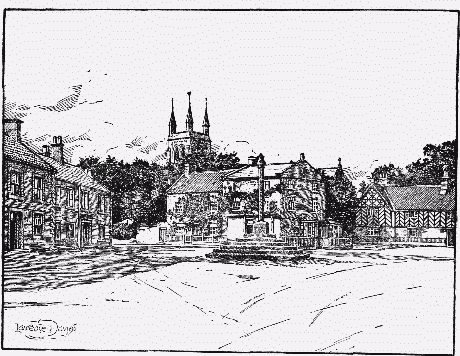
Market Square, Helmsley
On the west side of the market-place is an 18thcentury house built of stone and having a tiled roof. It is three stories high and has an attached porch of Ionic columns carrying a triangular pediment over. On the same side, opposite the road to the castle, is a two-story house of the same date and character, while a little further down is another 18th-century three-story house having dressed quoins and slate roof and a Doric porch with a triangular pediment.
Duncombe Park, the seat of the Earl of Feversham, stands a short distance to the west of the town of Helmsley. (fn. 8) The original structure was built for Thomas Duncombe in 1713 by William Wakefield, but the design is ascribed to Vanbrugh. A plan and elevation of the house as then erected is given in Vitruvius Britannicus, and shows a large central block, roughly rectangular in form, with two side wings containing the stables and bake-houses, &c., connected with the main building by short corridors. The house was, however, considerably altered in 1845 under the superintendence of Barry, when projecting side bays were added to the main front and the detached side wings completely rebuilt. It was almost entirely burnt down in 1879, and was subsequently rebuilt after the original design. The existing building is an ashlar-faced structure two stories high with a basement. In the centre of the main or east front is a handsome tetrastyle portico of the Doric order with a carved tympanum to the pediment. The main cornice is carried round the building, and the parapet or attic is surmounted by vases. The original windows on this side are round-headed to the ground floor and rectangular to the floor above. The western front is more simply treated with Doric pilasters, the centre bay being carried up with an attic and pediment. The windows on this side are mostly rectangular, those to the ground floor being surmounted by small pediments. The modern porch opens into the great hall, a fine apartment originally some 60 ft. by 40 ft. The house contains a fine collection of pictures and stands in an extensive park, which includes the wellknown terrace at Rievaulx. At either end of the latter stand small stone temples, one circular and of the Tuscan order, the other rectangular with a tetrastyle Ionic portico. The Ionic temple has a coved and painted plaster ceiling, with a copy of Guido's Aurora in the centre and Hero and Leander, Andromeda, Diana, Hercules and Omphale, &c., in the coves, the whole being the work of Burnice. (fn. 9)
About a mile and a half to the west of Helmsley, at the junction of the roads from Stokesley and Thirsk, is the base of a cross. The woods in this district date back to Domesday, and a complaint was made in 1276–7 that they had all been afforested by Robert de Roos. (fn. 10) Coppices comprising 441 acres were in the possession of Rievaulx Abbey at its dissolution. (fn. 11)
The village of Carlton lies about 2 miles north of Helmsley. It is built on the high road on the top of a hill, and consists mostly of stone cottages roofed with pantiles. The church of St. Aidan is at the north end of the village.
South of Rievaulx Abbey is Griff Farm. Griff and Stilton (Tilstune) were in 1086 land of the king and the Count of Mortain, Grim having held the former and Fredgist and Ughtred the latter before the Conquest. (fn. 12) Walter Espec granted the 4 carucates of Griff and the 5 of Stilton to Rievaulx Abbey. (fn. 13) The grange of Griff was granted to the Earl of Rutland in 1538–9 (fn. 14); it has since descended with the manor, and is now a model farm. The site of Harome Hall with its moat lies by the Rye, south-west of Harome village. A water-mill for grain and a fulling-mill here were mentioned in 1430. (fn. 15) At Laskill Pastures (Laueschales, xiii cent.; Lascales, xiv cent.) Edward II stayed in 1323. (fn. 16) Remains of monastic buildings at Laskill Bridge are said to have been discovered in 1855.
There was a school at Helmsley in the 13th century. (fn. 17)
The Wesleyan chapel here was built in 1800 and enlarged in 1852. There is a Wesleyan chapel at Pockley, another at Rievaulx, and there are Particular Baptist and Primitive Methodist chapels at Helmsley. A National school was erected in 1881, partly by the Earl of Feversham, and another was built in 1888. There are also National schools at Harome and Bilsdale-Midcable. In Helmsley is a Roman Catholic church of St. Mary, built in 1895 and served from Ampleforth.
Castle
Rising behind the town and surrounded by elms are the ruins of the castle built by Robert de Roos, lord of Helmsley from 1190 to 1227. (fn. 18) This castle was visited by Edward III in 1334. (fn. 19) It was besieged by Lord Fairfax in 1644 with 700 foot and 300 horse, and though he reported that he found it very strong and well stored (fn. 20) it was finally surrendered. (fn. 21) It was dismantled by the Parliament, and although after the Restoration the second Duke of Buckingham partly restored it and lived there, it again fell into decay after his death in 1687. The castle has followed the descent of the manor of Helmsley (q.v.), and the ruins now belong to William Ernest Earl of Feversham. The site includes a rectangular inner ward, about 350 ft. by 220 ft., surrounded by an inner rampart on which stood the curtain wall, and an inner ditch some 60 ft. to 80 ft. wide. The inner main gateway, of which little now stands, is on the south-east side, and this is strengthened by a large outwork or main barbican, about 198 ft. by 124 ft., with powerful curtain walls and a gate-house which was approached by drawbridges. From this outwork a second rampart or ridge of earth is carried round the site and is cut through at the south corner; on its north-west side was a smaller barbican protecting an entrance there. The outer rampart is surrounded by a second ditch inclosing both the barbicans, and beyond this is another bank, with further outworks before the barbicans. The remains of the keep, about 100 ft. high, stand in the middle of the northeast side of the ward, and on the opposite side is a long range of domestic buildings in two blocks, all more or less ruined. Close to and west of the keep are traces of another long building, perhaps a chapel or hall, about 74 ft. by 28 ft., and a fragment of its south angle still stands. Very little is left of the main curtain wall except to the north of the south-west range of buildings. The wall here terminates in the remains of a round tower at the west corner of the ward.
The original part of the building, erected about 1190–1200, appears to have included the lower part of the keep and the main block of the south-west range. The outwork on the south-east side was built at the same time or soon afterwards. The keep was altered in the 13th century, probably by Robert de Roos (d. 1285), and in the 14th century an additional story was built with the square angle turrets, while the floors were rearranged. The outer gateway was also strengthened, and the building next to the keep was erected in the latter half of the same century. In the 15th century the main block of the south-west range was altered, the remainder being built by Edward Manners, third Earl of Rutland, who died in 1587. At the same time he appears to have altered all the floor levels of the older portion.
The curtain wall of the main barbican is of 12th13th-century masonry; its two halves converge in an obtuse angle of about 150 degrees on to the middle gateway, which is flanked by the remains of circular towers of the same period; each of the towers was pierced by rectangular loops, but those of the east tower are now mere gaps. There is also a semicircular tower at each end, also with the gaps of former windows; from these the walls extend inwards to the inner moat. In the side wall at the west end is a large semicircular archway, now blocked, and there are traces of a similar opening at the other end. The space between the two middle towers is filled in with the narrower 14th-century gateway of sandstone rubble and ashlar. The jambs of the outer gateway are square. The lofty segmental outermost arch is filled in with an ashlar tympanum above the springing line, and has a moulded label turned up in the middle to mitre with a horizontal string-course above. The tympanum rests on carved corbels, now defaced. The rear vault of the arch is also segmental; in it are two small vertical piercings, through which bars could be dropped from above to hold back the drawbridge. The jambs are corbelled out just below the springing line, and near the inner face of this projection or impost on either side is cut a short horizontal groove, also probably to receive the drawbridge. Behind the rear arch is a second and lower archway with a pointed head filled in with a small tympanum at the apex; the arch springs from moulded capitals with small crowned head corbels. On the face of the arch above the north-east corbel is cut a curious little head with long ears. Within this second archway the sides of the gateway are recessed to form a small chamber or lobby, on each side of which is a row of corbel tabling with trefoiled arches and a cornice of two moulded orders; it is covered by a segmental barrel vault, with three chamfered ribs, at the feet of which, on the south-west side only, are carved human faces. On the inner side of the chamber is the groove for the portcullis, with wave-moulded jambs forming a return with the lower member of the cornice. The archway behind the portcullis is narrower and has rough square jambs of modern repair and a chamfered segmental head. The floor level here was probably higher than that outside, as the portcullis grooves do not reach to the ground level, but the steps have disappeared. The north-east jamb, although mainly a modern repair, retains what appears to be the half of a narrow trefoiled ogee arch of a single heavy half-round section springing from an ogee-moulded corbel capital. The floor of the upper chamber of the gate-house is now cemented, but the masonry above the crown of the vault below breaks through. Over the outer archway are the remains of a squareheaded window with moulded jambs, mullion and transom; the jambs are rebated below the transom and grooved for glass above it. The inner wall is demolished down to the floor level, but at the west corner at the end of the side wall is the moulded jamb of a doorway, and at the east corner a splayed ashlar face, probably the side of a skew passage. Of the flanking towers the inner halves are demolished and the soil within them is level with the upper floor of the gateway. Within the northeast tower is a small rectangular garderobe of 14th-century date; it is entered by a square-headed doorway and is lighted by a rectangular loop overlooking the moat; stone risers form the seat and there is a recess on one side. The flat ceiling is of stone with a cornice of two wave - moulded orders.
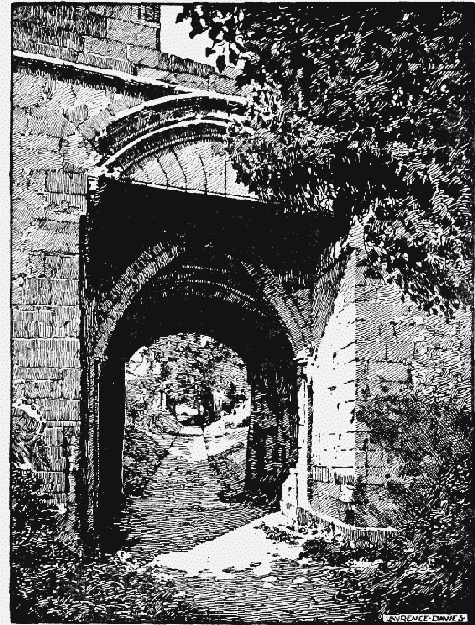
Outer Gateway, Helmsley Castle
Of the 12th-13th-century inner gateway on the inner rampart only part of the south-west side remains. The outer edge has a deep rebate, probably for the drawbridge to close against, and set back about 5 ft. are the jamb and two voussoirs of an archway of two chamfered orders. In the middle of the jamb is a vertical groove for a portcullis. Behind this archway was a small chamber, on the north-west side of which is the jamb of an inner archway of two square orders with a chamfered base. The northeastern side of the gate-house is represented by a rough pile of stones, and almost all the stonework on the south-eastern side of the ward has disappeared or is buried beneath the bank.
The keep, which is about 100 ft. high, retains its south-west face complete, with about two-thirds of each of its north-west and south-east faces, the remainder having fallen into the moat, where fragments of masonry still remain. The south-east wall and part of the south-west are overgrown with ivy, thus obscuring much of the detail above the ground stage, and the floors and roof have disappeared. The keep as it stands appears to have been of four stories, but the 12th-century work was only of two, with a high curtain wall rising above the roof of the second story, in all about 70 ft. high. The ground story was vaulted, and the upper appears to have had a gabled roof, which gave place to a vaulted roof in the 13th century, when lancet windows were inserted and probably other work done. In the 14th century the space within the curtain walls was utilized for a third story, the floor levels were rearranged and the fourth story, about 30 ft., was added, with the angle turrets and embattled parapet. The earlier masonry is of roughly-squared rubble of grey stone with wide joints into which thin slips of stone have been inserted, and yellow sandstone quoins, while the upper and later walling is of yellow roughly-coursed ashlar. In the west corner is a vice reaching to the first floor only, into which it opens with a doorway; the steps are gone. It is entered through a rough gap, probably the original doorway robbed of its dressings, in the south-west wall. The ground-floor chamber is partly filled in with an accumulation of earth. On the south-east side is the arched gap of the original doorway, and in the south-west wall are two small rectangular lights. On the north-west side is a blocked pointed doorway set higher in the wall and probably of later insertion; this is not visible inside the tower. The first floor or second story had a round-headed doorway into it at the north end of the north-west wall; of this one jamb and part of the arch remain, and inside are traces of a stair from the ground floor leading up to it. In the south-west wall are three 13th-century lancet windows, the middle one taller than the others, with splayed jambs and heads inside. The heads of the middle and southernmost lights have been considerably lowered inside by the insertion of later rear arches made to slope upward in the thickness of the wall from the internal face to the heads of the outer stonework. The northernmost lancet has had its lower half filled in and its north jamb cut away to form a curved passage up to the later second-floor level. The stumps of two of the vaulting ribs over this passage still remain, and below it is a springer of a 14th-century diagonal vaulting rib by the side of the doorway from the west vice already mentioned. The narrow passage from the lancet ran along the northwest wall a few feet and had a heavy hollow-chamfered cornice resting on four moulded corbels of 14th-century detail. From the same wall at about the same level as this cornice sprang the chamfered ribs of the 13th-century vault to the great hall; of these the lower stones of three are in situ. In the face of the lowest stone of each is cut a small notch, probably to receive the end of a joist. At the same level on the south-west wall above the northernmost lancet are the lower stones of another rib slightly skewed towards the south; it is chamfered on its south face, but square on its north side, so that it probably was set against the side of the small 14th-century passageway and is therefore contemporary with it. Close to and south of it in the same wall is another springingstone of a diagonal rib towards the south; it is probably of earlier date than the other. The (later) third story has a round-headed window of two deep orders slightly chamfered and with splayed inner jambs in the middle of the south-west wall; it appears to be of 12th-century date. The crown of the original rear arch of the middle lancet ran up into this window, but it is now broken away. The wall inside, south of this window, is covered with ivy, but north of it is the weather course of a gabled roof rising at a pitch of about 45 degrees from the level of the short corbel table on the north-west wall; the pitch appears to be too low to cover the 13th-century vault of the great chamber, and was therefore probably that of a roof earlier than the vault. A few feet above its haunch (inside) is a length of horizontal stringcourse or cornice appearing on the south-west wall only. About 70 ft. from the ground is the level of the change from the 12th to the 14th-century masonry, marking the top of the original curtain walls, which is also shown inside by a 12th-century corbel table to the former parapet; a chase below the corbel table marks the level of the 14th-century fourth floor. In the middle of the south-west wall, immediately above the change in masonry outside, is a 14th-century single-light window. There was a similar window in the north-west wall, but it has been walled up on the outside at a later date and converted internally into a fireplace. Both these windows cut through the earlier corbel table. The south and west square angle turrets are corbelled out and rise well above the embattled parapets of the main walls. They have shallow pilasters at each end of the outer faces resting on moulded corbels; each side has a deep embrasure in the parapet and there are doorways on to the main walls. The broken north end of the north-west wall reveals the interior of a circular vice from the third-floor level to the roof; a part of the jamb of the lowest doorway and two of the steps are still in position about half-way up. The curtain wall along the north-east side of the ward has entirely disappeared. Close to and south-west of the keep is a fragment of standing masonry forming the south corner of a former rectangular building, the outline of which is indicated by mounds. It is about 20 ft. high; on the south-east side of it is the splayed and moulded jamb of a large window in the end wall of the building. On the inner face the jamb shaft has a moulded capital. In the south-west wall is the splayed jamb of a window with a higher sill than the other. There were square angle buttresses with gabled heads, but only the outline remains of the south-west buttress and little more of the other.
The domestic buildings on the south-west side of the ward consist of a square tower about 31 ft. by 26 ft. 5 in., four stories in height, with a basement, and a longer and narrower building, 75 ft. by 18 ft. 8 in., of two stories extending to the north-west of the tower and ending in a three-story building of equal width, with gabled walls. Only the two-story range retains its floors and roof, the others being open from the ground to the sky, while that at the north-west end is inaccessible except from above. The outer wall of the narrower range is built on the 12th-century curtain wall. The north-west end building appears to be of a slightly later date than the rest of the range, a straight joint on the north-east face indicating the junction of the two, and it appears to have been built over the end of a curtain wall which ran in an easterly direction across the ward, dividing it into northern and southern courts; the broken section of the wall remains to show its thickness and construction, but the remainder of it has disappeared. The ground story or cellar of this end building is lighted by two narrow slits on the south-west face overlooking the moat, the second story has square-headed windows on the north-eastern and north-western sides, and the third story has a three-light window with a moulded entablature, probably of the 17th century, in the gable on the south-west side. The rest of the narrower range is of late 16th-century date. The ground stage has four large windows, each of four lights with transoms and moulded labels on the south-west side and three (two of three and one of four lights) in the north-east wall. All are partly or wholly blocked up; the southernmost on the south-west side has moulded inner jambs, the others are plain. At the two ends of the northeast wall (towards the ward) are blocked square-headed doorways, the southern being almost entirely hidden by the steps up to the doorway of the upper story over it. To the north of it is a blocked roundheaded doorway, probably inserted during the 17thcentury repairs. Access is now obtained by a woodframed doorway inserted in one of the windows. There are two fireplaces in this wall, the northern possibly part of the later repair, while the southern fireplace is larger and has moulded jambs and a threecentred arch; it is now partly filled in by a modern strengthening buttress. In the middle of the outer wall is a circular vice in the thickness of the wall; it is now closed up. The upper story is divided by wood partitions into four chambers and has four windows in either side wall similar to those below, except the second from the south end of the southwest wall, which is a semi-octagonal oriel window of five lights. The southernmost window in the southwest wall is blocked and filled with a modern roundarched recess. At the south end of the north-east wall is the entrance doorway with moulded jambs and four-centred flat arch in a square head with sunk spandrels. Of the two fireplaces in the north-east wall the northern has moulded jambs and four-centred arch in a square head with sunk spandrels; the other has moulded jambs and an arch hidden by the wood overmantel. In the end or north-west wall is a plain four-centred fireplace. The story was originally divided into two chambers only, and the middle partition retains on its south-east side some of the 16th-century oak wall lining; it is of two bays vertically by five laterally; each of the bays has a flattened three-centred head with a dentil inner edge and fluted face. The spandrels are carved with a wheel and two leaves; two of the pilasters are fluted, the others are moulded; the transom and frieze are also fluted, and the moulded cornice is enriched with dentils; in the southernmost bay is a door. On the south-west wall (south of the oriel window) are two similar bays of framing without the wood panels, and opposite, on the north-east side, are the rather dilapidated and partially charred remains of a fireplace and overmantel of three panelled bays. Some scraps of similar panelling are made up in the northernmost partition. Some parts remain of an elaborate plaster frieze on the end (north-west) wall and on both sides of the middle partition, the best being on the south-east side of the latter. Here it is almost perfect and contains three quartered shields with the arms of Edward third Earl of Rutland impaling those of his wife Isabel daughter of Sir Thomas Holcroft, kt., of Vale Royal, Cheshire; the decoration between the shields includes figures of dolphins and mermaids and fleurs de lis. Part of the ceiling south of this partition retains its original plaster ornament, the moulded ribs of which form a kind of interlacing octagon pattern, the spaces being filled with strapwork designs and Tudor roses. The roof is gabled and covered with stone slabs and has a low parapet.
Of the south-east tower only the four walls remain. The north-west and north-east walls incorporate part of the 12th-century building, but the south-east and south-west sides are apparently those of a 15thcentury enlargement. The floor levels seem to have been altered in the 16th century to suit those of the adjoining building. The south-west wall rises sheer from the moat and is strengthened by three buttresses with moulded offsets and plinths. There is a basement or dungeon below the ground level of the castle with a long, narrow slit overlooking the moat, but to this there is no existing means of access. A vice in the west corner led to the upper floors, but only the lower steps are now left; it was entered by doorways, now blocked, from the ground floor and first floor of the 16th-century range, and from the first, second and third floors of the tower, and is lighted by a rectangular window with chamfered jambs in the south-west wall overlooking the moat. The ground story of the tower has a round-headed 12th-century doorway of two chamfered orders from the ward through the north end of the north-east wall. To the south is a large fireplace with a flat lintel, probably of the 16th century. In the centre of the south-east wall is a window of four lights, two of which are now filled in, with a blocked two-light window to the east of it. Both seem to be contemporary with the fireplace. In the south-west wall is a 15th-century window of two lights and a small doorway with a shouldered head leading to the garderobe at this angle. In the north-west wall is a doorway leading to the ground floor of the 16thcentury range; a passage to the vice in the west corner of the tower opens out of its western jamb. The garderobes in the south corners were altered to the new levels, and being in the same positions as regards plan the older and later doorways are in two cases merged one into the other in one long vertical opening. The fireplace in the north-east wall of the (later) first floor has jambs of two hollowchamfered orders and a straight-sided Tudor arch with shields in the spandrels, one apparently with a bend and the other with a bend sinister. That in the south-west wall opposite is similar except that it has plain spandrels. The two windows in the northeast wall are blocked; over that north of the middle is the head of a small late 12th or 13th-century lancet window. In the middle of the north-west wall is a gap, probably a modern break-through from the upper story of the 16th-century range, and further north is a square-headed doorway, probably the older entrance. The second floor has windows and central fireplace in the north-east and south-west walls like those below except that the latter has roses in the spandrels. The third floor has a fireplace with traceried spandrels on the south-west side and a square one with chamfered edges in the north-east wall. The tops of these two walls have moulded string-courses and low-pitched gables, probably of the 17th century, and the others low parapets; they are overgrown with shrubs and creepers.
The curtain wall of the ward butts against the east corner of the tower with a straight joint; at the junction in the curtain wall was a space covered with a half-arch, but this was filled in later apparently to take a garderobe, which is lighted by a small loop towards the north-east. A curious length of plain string-course is continued from the curtain wall at about the first floor level a short distance along the north-east face of the tower, with which, however, it does not line, the two forming an angle of some 8°; it probably belonged to a low building of later date which was built against the tower without being bonded in and has since disappeared; the string-course cuts across a blocked doorway. A doorway opened on to the top of the curtain wall south of the tower. This only continues for a few feet on this side of the tower, the remainder having been demolished; but on the north side of the range of buildings the curtain wall remains up to the inner ground level as far as the west corner of the ward, where part of a circular tower still stands. There are no traces of the curtain walls or gate-houses on the north-west side of the ward, but a wall across the inner moat, 12 ft. 6 in. thick, with an ashlar face, evidently formed the outer pier of a drawbridge on that side.
The castle has apparently in former years served as a quarry, but is evidently being better preserved now. Many loose stones lie in the moats and much of the masonry is covered with earth. A great deal of ivy grows on the keep and other buildings, which accounts, no doubt, for some of the later destruction. A part of the space between the keep and the southwest range has now been levelled to serve as a lawn tennis ground, but the levels of the rest are all more or less unequal, and excavation might reveal the former existence of other buildings of which no traces remain at present.
The 'Old Park' to the west of Helmsley and the park called 'la Haye' are mentioned in 1250–1. (fn. 22) Both the Old and New Park occur in 1302, while the Rapark appears to have been an orchard. (fn. 23)
Manors
Before the Conquest three thegns held 3½ carucates of land in HELMSLEY as two 'manors,' which by 1086 had come into the hands of the king. Another 'manor' of 8 carucates was held in the time of the Confessor by Ughtred, and this afterwards passed to the Count of Mortain, (fn. 24) who also had a 'manor' of 5 carucates in Harome and a 'manor' of 1 carucate in Pockley. On the attainder of William second Count of Mortain in 1106 (fn. 25) all this land came into the hands of the Crown, but before 1122 (the date of the founding of Kirkham Priory) it was in the possession of Walter Espec, and may have previously belonged to William Espec; for Warden in Bedfordshire, where Walter founded a Cistercian abbey in 1136, belonged in 1086 to William 'Spech,' and Bilsdale Church (fn. 26) was founded early in the 12th century by William 'the noble.' (fn. 27) Walter Espec was the foremost noble of his time in the northern counties. He was justice of the forests and justice itinerant of the northern counties under Henry I and commanded at the battle of the Standard on the English side in 1138. He died in about 1153, (fn. 28) but having no issue had alienated a great part of his estates in founding the monasteries of Kirkham and Rievaulx in Yorkshire and the house at Warden. (fn. 29) Aelred, the contemporary Abbot of Rievaulx, describes Walter Espec as an old man, keen, wise and loyal, of gigantic stature and build, with black hair, a long beard, a broad, open brow, large piercing eyes and sonorous voice. (fn. 30) A later ballad describes him at the battle of the Standard as 'large as the mountaine oake.' (fn. 31) His heirs were the sons of his three sisters Hawise, Aubrey and Odelina, married respectively into the families of Bussy, Trailly and Roos (Ros). Odelina by her husband Peter de Roos had sons Everard and Robert. (fn. 32) In 1157–8 Robert rendered account of 1,000 marks for the land of Walter Espec, (fn. 33) and confirmed the grants of Walter to Rievaulx Abbey for the souls of his father and his brother Everard. (fn. 34) Robert had a son Everard, (fn. 35) who was in 1166 a minor in the custody of the sheriff, (fn. 36) and in 1174–5 paid fine for his lands. (fn. 37) Everard left a son Robert called Furfan, (fn. 38) who had livery in 1190–1, (fn. 39) and built the castle of Helmsley. He was one of the twenty-five barons elected to ensure the observance of the Great Charter and withstood King John to the last. (fn. 40) He founded and endowed religious houses, and, assuming before his death the habit of the Templars, was buried in 1227 in the Temple Church, London, where his effigy may be seen. By his wife Isabel, illegitimate daughter of William the Lion of Scotland, he had a son and heir William, who died in 1258, leaving a son Robert. Robert obtained Belvoir Castle in Leicestershire by his marriage with the heiress of William Daubeny and became the first Lord Roos (fn. 41) of Hamlake.
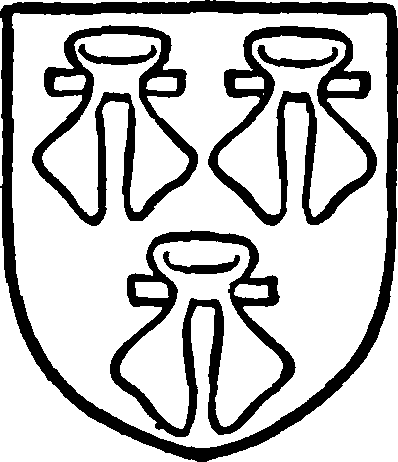
Roos of Hamlake. Gules three water bougets argent.
Robert died in 1285 and was succeeded by his son William, (fn. 42) whose son and heir William succeeded him in 1316, (fn. 43) and died February 1342–3, leaving a son and heir William. (fn. 44) In 1352 William died in the Holy Land and was succeeded by his brother Thomas, (fn. 45) who died on his way to Palestine in 1383, leaving a son and heir John. (fn. 46) This John, too, set out on crusade, and after his death in Cyprus in 1393 his remains were brought home to Rievaulx for burial. (fn. 47) He left no children and was succeeded by his brother William, (fn. 48) Lord Treasurer and one of the King's Council. (fn. 49) William died in 1414 and was succeeded first by his eldest son John, (fn. 50) and afterwards in 1421 by his second son Thomas, (fn. 51) who served in the French wars and died in 1430, leaving a son and heir Thomas. (fn. 52) Thomas took the Lancastrian side in the Wars of the Roses, was attainted in 1461 and beheaded in 1464 after the battle of Hexham. (fn. 53) His mother Eleanor, daughter of the Earl of Warwick, and now in her second widowhood, having married Edmund Duke of Somerset on the death of Lord Roos, (fn. 54) continued to hold the manor of Harome in dower, and Marjory, (fn. 55) widow of his uncle John, retained Helmsley Castle and manor in dower; but the reversion of these estates was in 1465 granted by the king to his brother George Duke of Clarence in fee. (fn. 56) Edmund son and heir of the attainted baron was restored in 1485, (fn. 57) and Sir Thomas Lovell, who had the governance of him and his estates, as he 'was not of sufficient disscrecion to guyde himself and his lyvelode,' (fn. 58) held the castle and manor of Helmsley. (fn. 59) Edmund died unmarried in 1508 and was succeeded by Sir George Manners, son of his sister Eleanor. (fn. 60) This nephew fell sick and died at the siege of Tournay in 1513, leaving a son and heir Thomas, created Earl of Rutland in 1525. Thomas died in 1543 and was succeeded by his son Henry, (fn. 61) who as a supporter of the Duke of Northumberland was imprisoned at Queen Mary's accession, but was soon restored to her favour. (fn. 62) He died in 1563 and was succeeded by his son Edward, (fn. 63) the third earl, who after holding many other offices was in 1587 designated Lord Chancellor, but only survived the preceding Chancellor two days. (fn. 64) At his death his only child Elizabeth was aged eleven. (fn. 65) His brother John, the fourth earl, (fn. 66) succeeded him at Helmsley and died in 1587–8, leaving a son and heir Roger, (fn. 67) who married the daughter of Sir Philip Sidney. In 1600–1 he was implicated in the plot of the Earl of Essex and imprisoned in the Tower. (fn. 68) Roger entertained James I at Belvoir Castle in his progress to London in 1603 (fn. 69); he died childless in 1612 and was succeeded by his brother Francis. (fn. 70) In 1616 the claim of Francis to the ancient barony of Roos was disallowed in favour of his cousin William Cecil, the heir general, but he was in compensation declared to be 'Lord Roos of Hamlake whose son and heir should be called Lord Roos of Hamlake, Trusbutt and Belvoir.' On the death of his cousin two years later, however, Francis became the heir general to the old barony. (fn. 71) He died in 1632, leaving an only daughter Katharine Duchess of Buckingham and Lady Roos, his brother George the seventh Earl of Rutland being his heir male. (fn. 72) George made a conveyance of the Helmsley estates in 1634, (fn. 73) but Helmsley descended with the Roos barony (fn. 74) to Katharine's son, George Villiers Duke of Buckingham, whose younger brother, 'the beautiful Francis Villiers,' (fn. 75) made a conveyance of this estate in 1648. (fn. 76) Francis was slain on the Royalist side in a skirmish near Kingston, Surrey, in this year, (fn. 77) and George lost his estates through fighting on the king's side. (fn. 78) The castle, manor, borough of Helmsley and advowson of the church, the manors of Rievaulx, Wombleton, Harome, Pockley, Beadlam, Sproxton, Carlton, Cowhouse, and the three Bilsdales, all described as the possessions of Francis Villiers, esq., were in 1650 granted to the Commonwealth commander-in-chief, Sir Thomas Fairfax, and his heirs, (fn. 79) but George Duke of Buckingham recovered these estates by his marriage with Mary, only child of Sir Thomas Fairfax, seven years later. (fn. 80) He was the fifth and last duke, famous for his extravagance and profligacy, and died without legitimate issue in 1687. (fn. 81) Dryden satirized him in the well-known passage in Absalom and Achitophel, where Buckingham appears as 'Zimri':
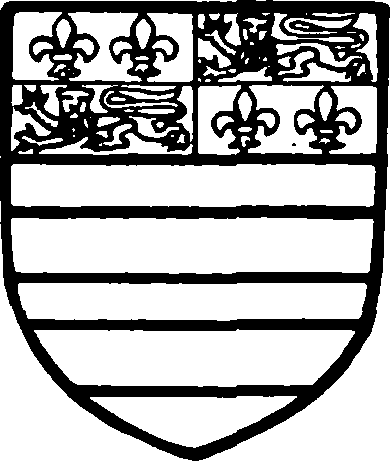
Manners, Earl of Rutland. Or two bars azure and a quartered chief of azure with two fleurs de lis or and gules with a leopard or.
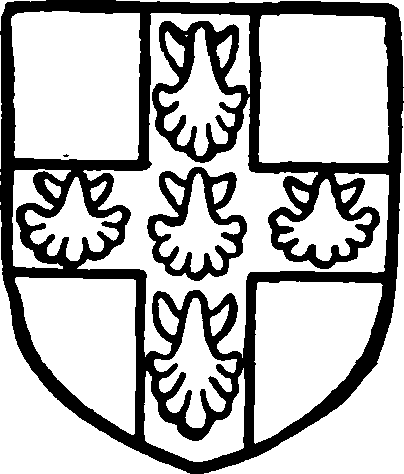
Villiers, Duke of Buckingham. Argent a cross gules with five scallops or thereon.
'A man so various that he seem'd to be Not one, but all mankind's epitome; Stiff in opinions, always in the wrong, Was everything by starts, and nothing long; But, in the course of one revolving moon, Was chemist, fiddler, statesman, and buffoon.' (fn. 82)
An Act of Parliament was passed in 1689 for enabling his trustees to sell the Helmsley and other estates to pay his debts, (fn. 83) and in 1695 these trustees conveyed all the manors in this parish with the castle and borough to Charles Duncombe and others. (fn. 84)
'And Helmsley, once proud Buckingham's delight, Slides to a scrivener or a city-knight,' (fn. 85)
for Sir Charles Duncombe was a London banker.
Sir Charles died childless in 1711, (fn. 86) and these estates passed to his sister Mary, wife of Thomas Browne, who with her husband assumed the name of Duncombe. Thomas son of Mary 'of Duncombe Park formerly Helmsley' died in 1745–6, leaving two sons, Thomas, who died in 1779 leaving only daughters, and Charles Slingsby Duncombe, who succeeded his brother and died in 1803. Charles his son was created Lord Feversham in 1826 and died in 1841, leaving a son and heir William, who died in 1867, and was succeeded by his son William Ernest Duncombe, the present owner, created Viscount Helmsley and Earl of Feversham in 1868. (fn. 87)
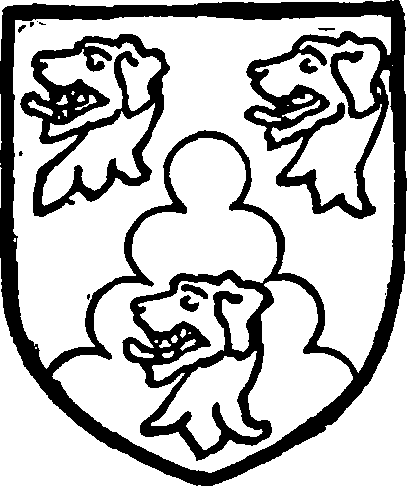
Duncombe, Earl of Feversham. Party cheveronwise and engrailed gules and argent with three talbots' heads razed and counter-coloured.
Robert Roos, who was lord of Helmsley from 1258 to 1285, claimed jura regalia in Helmsley, and the Constable of Helmsley Castle was accused of preventing the king's bailiff holding his wapentake court. (fn. 88) Robert claimed gallows at Helmsley and other places from the Conquest and produced the charter of Henry II to Everard Roos granting him the lands of Robert his father with infangentheof in all his lands. He also claimed the fines under the assize of bread and ale at Helmsley because he had a market there, and stated that his predecessors had had free warren there from the Conquest. (fn. 89) His free court of Helmsley is mentioned in 1285, when the yearly toll of the market was worth £11. (fn. 90) This market must have fallen into desuetude, for in 1670 Charles II granted a weekly market and three fairs to George Duke of Buckingham. (fn. 91) The market is still held, but since the opening of the railway the day has been altered from Saturday to Friday. Fairs are now held on 19 May, 16 July, 1 and 2 October and 5 and 6 November for cattle, sheep and horses.
No mention of BILSDALE (Bildesdale, xiii-xiv cent.; Billesdale, xiii-xvi cent.) occurs in Domesday Book, where it was probably surveyed under Helmsley. (fn. 92) A church was founded here by William 'the noble,' probably William Espec, (fn. 93) and Bilsdale was in 1145 given by Walter Espec to Rievaulx Abbey. (fn. 94) A manor here, which was evidently not included in this grant, belonged in the middle of the 13th century to Simon de Ver; his son Simon sold it in about 1274 to the neighbouring house of Kirkham, which held it of Robert de Roos in 1284–5. (fn. 95) Both Bilsdale Rievaulx and Bilsdale Kirkham were granted after the Dissolution to the Earl of Rutland, (fn. 96) and have followed the descent of Helmsley.
Before the Conquest HAROME (Harun, Harem, xi cent.; Hairun, xii cent.; Haron, xiii-xvi cent.; Harome, Haroun, xv cent.; Haram, xvi cent.) was a berewick of Kirkby Moorside (q.v.), and Sortcol held 1½ carucates here, Torbrand 2 oxgangs and Ughtred a 'manor' of 5 carucates. In 1086 these were held respectively by the king, Berengar de Toni and the Count of Mortain. (fn. 97) On the attainder of the Count of Mortain his fee here was evidently granted to the Especs, (fn. 98) for Drew de Harome was described as a 'man' of Walter Espec, and Harome belonged in 1166 to the barony of Everard de Roos. (fn. 99) His descendants held the overlordship (fn. 100) until it merged in the under-tenancy.
In 1166 Drew de Harome held one knight's fee of the barony of Everard de Roos. (fn. 101) He had a son William, probably his heir. (fn. 102) In the latter part of the 13th century Sir William de Harome, kt., son of Drew de Harome son of William de Harome, (fn. 103) held Harome, (fn. 104) and a William was lord in 1284–5 (fn. 105) and 1316. (fn. 106) Margaret daughter and heir of William de Harome married Nicholas le Mareschal of Dalton next Topcliffe. In 1323–4 Nicholas de Topcliffe and Emma his wife by right of Emma conveyed tenements here to William de Roos, (fn. 107) and in 1326 the manor was included in the entail of William's estate. (fn. 108) Harome has since followed the descent of the manor of Helmsley (q.v.).
The court baron of Thomas de Roos is mentioned in 1430. (fn. 109)
Before the Conquest POCKLEY (Pochelac, xi cent.; Pocele, Pockele, Pokkele, xiii-xv cent.; Speskelegh, 1316) belonged to Ulf and Ughtred, who each held 1 carucate as a 'manor.' In 1086 the Archbishop of York held the land of Ulf, the Count of Mortain that of Ughtred. (fn. 110) The Count of Mortain's lands came to the Crown in 1106, (fn. 111) and before 1284–5 the archbishops had ceased to hold lands in Pockley. (fn. 112) In 1278–81 Peter de Roos held Pockley of his brother Robert and claimed warren by grant of Henry III. (fn. 113) Robert de Roos was tenant in 1284–5 (fn. 114) and from this time the manor descended with that of Helmsley (fn. 115); it is now in the possession of Lord Feversham.
In the time of the Confessor SPROXTON (Sprostune, xi-xii cent.) belonged to Turloga, Norman, and Sortcolf, who held three 'manors'; in 1086 it was in the hands of the king, who had 5 carucates here. (fn. 116) Robert de Sproxton appears among the 'men' of Walter Espec, and an unsuccessful claim to the overlordship was made during the 13th century by the Roos family. (fn. 117) In 1299 the mill and 11 oxgangs in Sproxton were held in chief by the under-tenant, and the capital messuage and 8 oxgangs were held of the Abbot of St. Mary's, York, (fn. 118) to whom Richard I had confirmed the grant of Walding of 1 carucate of land. (fn. 119) Henceforth the tenants are said to hold in chief. (fn. 120)
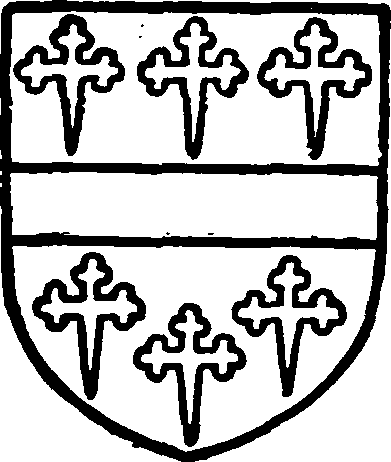
Layton. Argent a fesse between six crosslets fitchy sable.
Henry I granted to one Robert 6 carucates of land, 4 in Sproxton and 2 in Newton, to hold by serjeanty of the forest, with soc and sac and other customs. This grant was confirmed by Henry II to his son Robert, (fn. 121) whose heir was his son Simon. Grants made by Robert and Simon to Rievaulx were confirmed by Henry II. (fn. 122) Before 1166, when Richard de Sproxton, brother and heir of Simon, held Sproxton, (fn. 123) Ryedale had been disafforested and the tenure changed. (fn. 124) King John in 1204 confirmed Sproxton to Richard, who was to hold it by the service of a fourth part of a knight's fee and 1 mark annually. (fn. 125) In 1219 Richard de Sproxton owed the king half a mark scutage for his lands here, (fn. 126) and he was lord in 1226–7. (fn. 127) In 1233 his son Robert, described as the heir of his uncle Simon de Sproxton, (fn. 128) had succeeded. (fn. 129) He had a son William and a grandson Robert. (fn. 130) The latter died seised about 1299, leaving a son and heir William, (fn. 131) who in 1321 had licence to settle the manor on himself for life with remainder to his son Robert and Christine daughter of Nicholas de Meynell and their heirs. (fn. 132) William died in 1348–9; Robert, his son and heir, (fn. 133) died in 1382, (fn. 134) leaving a son and heir William, who died in 1416. William's heir was his daughter Joan wife of Nicholas Clay, (fn. 135) who died in 1448–9, leaving a son and heir John Layton, (fn. 136) lord of East Layton, founder of the family of Layton of Sproxton. John died seised in 1461 and was succeeded by his son John, a clerk, (fn. 137) who died in 1473 and was succeeded by his brother William. (fn. 138) William died in 1500–1, leaving a son and heir Robert, (fn. 139) whose son and heir John was twenty-one years old in 1522. (fn. 140) In 1526 John was convicted as a clerk of the murder of his wife Margaret (fn. 141); but in 1528 (fn. 142) he sold this manor to William Thorpe and John Marchant. In 1535 Robert Layton was concerned with a third part of the manor (fn. 143); in 1557 it was in the hands of the Earl of Rutland, (fn. 144) and afterwards descended with Helmsley (q.v.) to Lord Feversham. Robert de Roos had free warren in 1276, as guardian of the heir of Sproxton, by what warrant was not known. (fn. 145)
Borough
Very little is known of the mesne borough of Helmsley, the overlordship of which followed the descent of the manor (q.v.). It is not specifically mentioned in 1285 among the possessions of Robert de Roos, (fn. 146) though certainly then in existence (fn. 147); the £11 said to be due from the market and its tolls were afterwards accounted for as the farm of the borough, (fn. 148) and the burgesses had the toll at this time, for in 1276 complaint was made that they had augmented it at pleasure. (fn. 149) The burgesses further held the toll of the fair and their own courts, (fn. 150) these being probably presided over by the bailiff, who would be sworn in at the lord's court in the manner usual in boroughs of this type. (fn. 151) The borough probably survived until the 17th century, (fn. 152) but it never received a charter of incorporation or sent representatives to Parliament. The town is now governed by a rural district council.
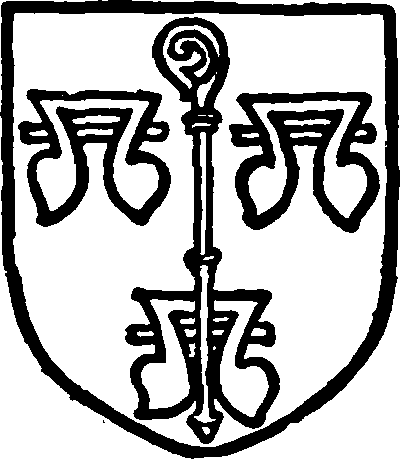
Rievaulx Abbey. Gules a crozier or erect between three water bougets argent.
Rievaulx Abbey
The monastery of Rievaulx, the earliest Cistercian house in the county, was founded by Walter Espec in 1131. (fn. 153) The abbey is situated at the head of a deep valley formed by a bend of the River Rye below Old Byland. It stands on a plateau, partly of natural and partly of artificial origin, through being cut into the bank behind which slopes gently down from the famous terrace above. Opposite to the abbey rise the wooded sides of Ashberry Hill, and the valley is narrowed in at its lower end by another wooded bank.
The most striking views of this, the most picturesquely situated of all the English religious houses, may be had on the road to Old Byland, a little above the abbey, looking directly down the church and showing the full length of the frater. The site is much encumbered with trees, which, amidst so much woodland, might be removed with advantage.
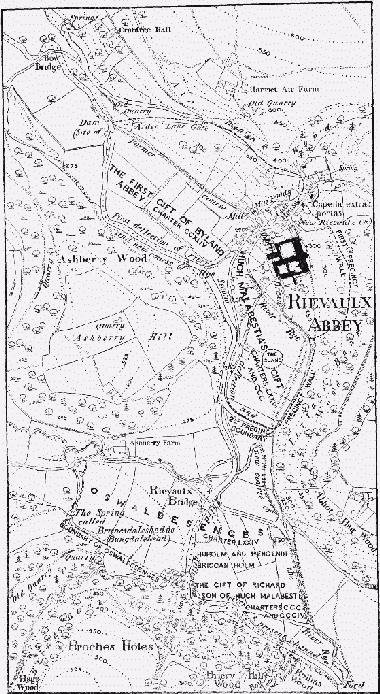
Site Plan of Rievaulx Abbey (Based upon the Ordnance Survey Map, with the sanction of the Controller of H. M. Stationery Office)
The main approaches are by the upper road from Helmsley and the road from Old Byland, which unite just outside the site of the gate-house. Close to the junction of the two roads is the ruined conduit-house, from which drinking water was distributed to the abbey buildings. The ground about and above is still full of ever-flowing springs, which also help to fill the fish-stews below. The conduit-house is a narrow stone building, now roofless, without any architectural features. At one time it was converted into a cottage, but has in one end the remains of a carefully built stone settling-tank, now choked with the ruins of the cottage.
On the side of the hill to the left, just before the gate-house is reached, stands the capella extra portas. (fn. 154) Until lately it was a roofless and much-ruined oblong building, with a Tudor east window of three uncusped lights and late diagonal buttresses at the west end, with a 13th-century doorway between. In the north wall was also a 13th-century lancet window. The chapel, which seems to have had a western gallery, was restored for the use of the inhabitants of the hamlet in 1906, when a chancel, tower and spire and a small vestry were added to it in a quiet and unpretentious fashion. The chapel was thus doubled in length and covered with a simple open roof. The old east window was preserved by being inserted in the new north wall.
Just below the chapel the road runs through the site of the inner or great gate-house, a side wall of which, with the base of one arch, can be seen on the right. Two rounded arches remain on the left, on the bank behind the hedge. Northward of the gate are the buried remains of a large rectangular building, and beyond that the fish-stews. The gate-house was apparently of late 12th-century date.
To the south-east of the gate-house, behind a picturesque group of thatched and tile-roofed stone cottages with dry-walled gardens, stand the remains of the abbey, on a series of terraces cut out of the hillside, the church being on one and the cloister with the buildings east and west of it on another. Owing to the slope of the ground the dorter and the frater are run out upon sub-vaults. In consequence of the restricted site the church stands nearly south and north, instead of east and west, but for greater clearness it will be convenient to describe the buildings in the more conventional manner.
Of the church only the presbytery and quire, with the transepts and the east arch of the crossing, are standing, the nave being a hopeless ruin, which is buried up to its window sills.
The church was begun about 1145, and consisted at first of a short aisleless presbytery, a crossing surmounted by a low belfry, with north and south transepts, each with three eastern chapels, and a nave and aisles of nine bays with a broad and shallow western porch. The design of the nave can to some extent be recovered from the remains of the transepts, but the floor is encumbered with some 8 ft. in depth of fallen ruin. Part of the west wall rises above this, and shows that the nave, like that at Fountains, had a tall and deep recess on each side of the western doorway. Pieces of the south aisle wall with pilaster buttresses show towards the cloister. At the east end of the nave are the outer halves of the two roundheaded arches opening from the transepts into the aisles, of one square order, rising from a string-course. The aisles had no parapets, but, as the lead-line against the north transept shows, projecting eaves with apparently a corbel table under resting on a stringcourse. This string-course was evidently carried over the aisle windows, which stood upon a similar one, but it is clear from the eaves level that it could not have run horizontally, and on the south side are plain traces that the aisles were vaulted transversely, as at Fountains, and the windows set in a series of gables like those to the Fountains transept chapels.
The original transepts remain nearly to their full height on the west, and show a ground story of plain walling up to a semi-hexagonal string-course, on which stand plain round-headed windows. Another stringcourse runs at the springing line of these and is carried over them as a label. Above the windows is a second belt of walling up to a third string-course, on which stand the clearstory windows. These were like those below but not quite so tall. Between the windows outside are pilaster strips, but the corbel table, &c., which they carried has been replaced by later work. The north gable was divided vertically into three strips by pilasters and horizontally by string-courses at the springing line of the western windows. In the eastern division is a blocked original doorway with segmental head; west of this an added gabled building, probably of half-timbered construction, has abutted. (fn. 155) Only a fragment is left of the chapel wall eastwards. The south gable was largely covered from the first by buildings against it, but contains the mutilated remnant of a vice to the roofs (as at Fountains) and a segmental-headed doorway in the south-west corner which communicated with the dorter. A smaller doorway further east led into the vestry.
During the second quarter of the 13th century a reconstruction and enlargement of the eastern arm of the church took place. It was begun in the north transept by the building of the piers and two northern arches (fn. 156) of an arcade of three bays, with a triforium stage of pairs of arches divided by clustered shafts with a sunk quatrefoil over, and a clearstory of three plain pointed windows with elaborately moulded rear arches. The clearstory has a wall passage with squareheaded openings. Between the triforium openings are triplets of shafts resting on moulded corbels just under the string-course. These shafts did not, however, carry a vault, but were continued up through the clearstory to support a flat wooden ceiling. The ornamental string-course on which this rested may be seen against the steeple, which also shows the pitches of the original high and a later lower roof. The capitals of the pillars, the labels of the arches, the outer jambs of the triforium openings, the upper string-course, the edge of the inner orders and the labels of the clearstory windows, together with the capitals and label of the north arch of the crossing and the string-course under the ceiling, are all decorated with nail-heads of different sizes, according to their position. The north gable has, in place of the Norman window, three tall lancets of a height (on account of the flat ceiling), and the original windows on the west side have received pointed heads and been superimposed by a new clearstory with lancet windows. Above these is a fragment of a nailheaded cornice. Outside the added clearstory windows are contained within a tall pointed arch flanked by smaller arches with trefoiled heads. The shafts that flanked the windows were detached and are lost. In the added work the Norman pilasters are carried up, but narrower, and end in a moulded corbel table and cornice. At the north-west corner of the transept is a plain pyramidal pinnacle, but at the north-east corner the pilasters are capped by lofty gable heads.
The south transept was begun to be altered at the same time as the north by building the two pillars and two southernmost arches of a new arcade, but all the work above is of later date, in imitation of that of the north transept. The southernmost arch springs from an elaborately moulded corbel over the Norman vestry doorway.
Before continuing the rebuilding of the south transept the monks began to build a new presbytery of seven bays, with a vestry on the south. The east end, which was built first, as usual, has two tiers of lancet windows, three in each tier. Those of the lower row are of one height and simply moulded, and are flanked by pairs of shafts, which also carry the heads of two pointed panels between the lights. The windows of the upper tier are much wider than those below, and the middle one is taller than the others. They are also so close together as practically to form a three-light window, with clusters of shafts instead of mullions. The arches are decorated with the dog-tooth ornament. In the spandrels above are a pair of sunk trefoils. Externally the same features are repeated, but in a simpler manner, and at the top of the wall are the bases of a third triplet that filled the lost gable. The ends of the aisles each contained a single lancet like those of the lower tier, but that in the south aisle is curiously distorted and set to one side to make room for a vice within, which is carried up externally as a miniature spire. Above the aisle window was a second lancet set in a wall arcade.
The sides of the new presbytery consist of a main arcade of moulded arches springing from clustered pillars with moulded capitals, together with a triforium and clearstory. The triforium has suffered much from mutilation, but had in each bay a pair of tall pointed openings with elaborate mouldings enriched with the dog-tooth ornament and flanked by clusters of shafts. Each opening was also subdivided by twin shafts and decorated with a sunk quatrefoil in the spandrel. A similar but larger quatrefoil also occurs in the spandrel between the two main arches. (fn. 157) The clearstory openings consist of a tall pointed arch flanked by two narrow pointed panels with attached jamb shafts. Behind these is a wall passage, having at the back pairs of wide pointed windows, plain within, but moulded without and flanked by jamb shafts. The presbytery bays are divided by triple vaulting shafts, which carried a simple quadripartite vault. In the easternmost bays the shafts rise from carved corbels under the triforium string-course, but the three westernmost start at a lower level on moulded corbels between the arches. (fn. 158) There is also a noteworthy difference in the plans of the piers. The eastern responds have their bases covered by an altar platform, but the first, third, fifth and sixth piers and those of the steeple and transept arcades have ten-sided bases, and are all of the same section. The second and fourth piers, however, have round bases, with a different section. The capitals are all alike. The arch mouldings are likewise identical throughout the north side, and include those of the eastern face of the southern half of the transept arch (fn. 159) next the steeple. The south arcade of the presbytery and the northernmost of the transept arches have also the same mouldings as the north side, but those of the fourth and fifth arches differ and are peculiar to themselves. There are also some interesting variations in the sections of the ribs of the aisle vaults. Those of the north aisle and of the first, sixth and seventh (fn. 160) bays of the south aisle are of one pattern. The second, third, fourth and fifth south bays are of a second pattern, and the two outer bays of each transept of a third pattern. The vaults are, nevertheless, all one work, as is shown by the different sections occurring on the same springing blocks.
For the support of the presbytery vaults a series of butting arches was fixed on each side. They sprang from the upper parts of the aisle buttresses to the clearstory wall, where they rested some feet above the aisle roofs, which they spanned. To counteract the thrust further a row of rectangular piers was built beyond the buttresses to carry a second series of arches butting against them. Two of the upper butting arches and traces of the lower are still visible on the north side, where the bases of the five piers also remain, and the lower part of another on the south side is incorporated in the remains of the vestry.
The manner in which the 13th-century work replaced the older work piecemeal, instead of the latter being taken down first to make way for it, is exemplified in an interesting manner in the new building.
Portions of the brown sandstone walling which is characteristic of the early Norman church still remain in place at the back of the new westernmost bays, also behind the east wall of both transepts (in one case over the triforium). There is likewise a section of the south wall of the Norman steeple actually in its original position right over the south arch of the new crossing, which must, of course, have been inserted beneath it in the usual mediaeval manner.
The crossing seems to have been entirely reconstructed at the same time as the presbytery and was covered like it with a stone vault. From the vault over this a pair of arches opened eastward into the space above the presbytery vault, and there were similar entrances into the space above the transept ceilings. There is not enough left to show how the western side was treated. The north and south arches of the crossing rest on piers starting from the ground, but the eastern piers rise from moulded corbels at some height from the floor.
Before leaving the church something must be said about the light thrown upon its arrangements by a survey of the buildings made at the Suppression, probably for the grantee, Thomas Earl of Rutland, and now preserved at Belvoir Castle. (fn. 161)
The first or easternmost bay of the presbytery contained three chapels in a row. All three had painted wooden tables before the altar and two tables of alabaster on the altar. As they severally likewise contained gilded images of our Lady, St. John the Baptist and St. John the Evangelist, the chapels were probably dedicated in honour of those saints. The east end of the north aisle also formed a chapel, having a table on the altar 'lyghtly paynted,' and the corresponding chapel on the south contained 'a tabernacle of wood, ij tables of wood for alters gylt, a great tabernacle of wood, a seal of wood, and a forme.' The Survey states that 'a faire parclose at the est end of the church extendyng from one syde of the church to the other p[arty]sheneth the fyve alters above rehersid.' This stood upon the top of the two steps of the broad altar platform which still crosses the church on the east side of the first pair of piers. Each altar stood on a higher step, with a floor drain just below and was separated from its neighbour by a stone wall 9 ft. long and 1 ft. thick. These were joined up to the parclose by wooden screens, and the pin-holes for fixing the tables, &c., are still to be seen over the place of each altar. The second bay of the presbytery was left clear for processions. The high altar stood in the third bay against an arcaded stone wall or screen which was continued down the sides of the presbytery and quire to the crossing. There was 'a loft of tymber on the bakside of the high altar with a sele under hit all of wood,' also 'tables of wood before the alter and above the alter gyldyd, x imagys gyldyd, an image of our lady gyldyd,' and 'a little shrine over the alter gyldyd.' Our Lady's image seems to have stood against the pillar to the north, where there are marks of its fixing. The presbytery extended to the middle of the fifth bay, which was there crossed by the gradus presbyterii; to the west of these were the upper entrances from the aisles into the quire. 'The stallys' of the quire occupied the two westernmost bays, which were closed in westwards by the pulpitum, called in the Survey 'the rode loft.' This stood under the eastern arch of the crossing, and above its line are the holes for the beam that carried the rood and St. Mary and St. John.
The south aisle of the presbytery contained 'a presse for copys' and 'close romys of tymber for books.' Outside the fourth bay was the vestry, which, from being built over a vaulted bonehole, is called 'the charnell chapel.'
The two chapels in 'the north crosse ile' had each a painted table below and a table of alabaster on the altar, and one contained images of St. John the Baptist and St. John the Evangelist, also of alabaster. The steeple is described as 'tomylled down,' and 'the tymber all to brokyn.' The altars in the two chapels of the south 'crosseile' had each a 'payntyd table of wood before hit,' and on one was a 'payntyd table' and on the other a table of alabaster. There was likewise 'an ymage of Saynt Cristofer in a tabernacle sett betwene both this ij chapells.' In the transept itself was also 'an old oreloge of tymbre steple fashon,' and 'a clokehouse and a clok therin complete,' but the wooden roof was 'all to brokyn (fn. 162) with falling of the steple.'
The 'body of the church' had a painted wooden ceiling, and a clearstory 'of xviij lights of square stone,' which suggests that the nave was nine bays long. It was separated from the crossing by a 'parclose overthwart the body.'
The north aisle of the nave contained four chapels, each with a parclose, apparently to the west, between it and the next, and the easternmost a second parclose, probably in the arch to the transept. The south side of each would be closed by the screen wall along the fronts of the nave piers which normally inclosed the quire of the lay brothers in the nave. The altar of the first chapel had 'a table above hit payntyd'; the second 'a table of wood carvyd without imagys' and 'a table above hit payntyd and gylded'; the third chapel 'one alter with imagery of stone'; and the fourth 'a table of alabaster' and images of our Lady and of 'Mary Magdalyn gyldyd.'
The south aisle contained a 'holy water stok of merbyll' beside the cloister doorway, and 'a place of iij howr of tymber of dyvers romys to put bokes in without a vyse.' It likewise contained two chapels. The one had three parcloses, a table carved without images, and 'a sele of waynscot.' The other had but one parclose and 'a tymber table carved with the imagys of the Trinite, ower Lady (and) Saynt Margaret.' The nave seems to have had a large west window, and under it outside a lead-roofed 'house or portche at the west end of the church,' like Fountains and Byland.
The cloister square was south of the nave, which was entered from it by a doorway in the north-east corner, now buried beneath a heap of ruins. There must have been a flight of steps up to it, as the cloister floor was 7 ft. below that of the transept. There are no remains above ground of the cloister alleys, the wooden roofs of which were partly 'appoynted to the smeltyng of the kyngs lede.' In the north alley, that against the church, would be 'the deskes ther called carolls.' From the number of fragments that are lying about, including a nice twin capital now in the dorter sub-vault with grooves cut in it, it is probable that, as at Jervaulx, the arcades of the Norman cloister continued standing, at any rate in part, until the end.
The west side of the cloister was partly overlapped by the south transept, (fn. 163) which has in it the wide and deep round-headed recess of the armarium commune or common book-case. Next to the transept was the library, with the old vestry east of it. The vestry had a barrel vault and was entered from the transept. There was no room over it, but above the remains of its vault is the round outer opening of a quatrefoil window in the transept aisle, and higher up another but square-headed opening that lighted the space over the aisle vault. West of the vestry is a curious deep chase in the wall, and beyond it the mutilated Norman stair to the roofs. This was rendered useless by the 13th-century changes in the gable and then done away with. It was entered apparently from the library, above the barrel vault of which was also the way into the transept from the dorter. The library had a doorway and a window in its west wall. The chapter-house came next, and is known to have been divided into alleys by rows of slender pillars and to have had an apsidal east end. Both it, however, and the parlour south of it are at present buried under a mound of fallen stuff. Next to the parlour was apparently the stair from the cloister up to the dorter, and beside it the way into the dorter sub-vault. The subvault was one of the earliest buildings and quite a lofty room, with a vaulted roof carried by two rows of pillars. Its southern end was lighted by large roundheaded windows. The end bay, through which the main drain ran, was walled off from the rest and barrel vaulted. Beyond it was a continuation, destroyed apparently not long before the Suppression. The east side of the dorter sub-vault is all down to half its height and buried in its own ruin, but the last bay is standing, with its pilaster buttresses and a perfect double splayed window. Over this is an inserted double window at the dorter level with another in the opposite wall. Most of the west wall of the dorter is left, though much ruined, with traces of a window in each bay. The dorter was at least 200 ft. long, and extended right up to the transept, upon the gable of which traces of its earlier and a later roof can be traced. The 'particions' of its cubicles and other divisions, and its leaded roof, are mentioned in the Survey.
Not long before the Suppression the dorter was shortened by a bay and a wall of white stone built across it, in which is a transomed lancet with fourcentred rear arch, with a row of joist holes over, and the jamb of a larger window in the blocking of another opening. North of the new wall are two doorways, one going east, the other from without. Both doorways communicated with the rere-dorter, which was a large chamber extending eastwards over a barrelvaulted substructure that must have had windows and doorways in its north side. All is now ruined and buried except the portions described. Along the south side ran the drain of the rere-dorter, the outer wall of which is standing to its full height. There are no openings in it, but it has a set-off for the rere-dorter floor at the dorter level. The 'particions,' roof and lead of 'the second dorter,' as the rere-dorter is called, are mentioned in the Survey.
In later times the rere-dorter was shortened by the building of a three-storied camera in its east end. Of this all that is now visible are a trefoiled loop that lighted its basement, two square-headed openings on the first floor, and remains of two or three openings on the second floor.
The dorter and the 'second dorter' formed two sides of a large square court, with (apparently) a row of chambers on the north (perhaps the library as at Fountains) above a gallery which led from the cloister to the infirmary hall on the east.
The remains of the infirmary hall show that it was one of the early Norman buildings and placed north and south. Along its west face ran a pentice, and at about the middle of the same side is the original wide round-headed doorway. The hall was divided externally into bays by ashlar pilasters. Round these the string-course under which the pentice was fixed is carried, and upon it stood the windows. These were tall and round-headed, widely splayed within, as may be seen from the five or six that are left. The south end of the building is nearly all gone, as is all the east side, save a fragment of the north-east angle which fixes the length and breadth of the hall. Beyond the north end were sundry chambers, all ruined and buried, extending as far as the church, with apparently a passage to a chapel on the east, now a cottage, which still retains a floor of shaped early 13th-century tiles and the casement of the brass of an abbot.
Early in the Tudor period, and probably at the same time as the other changes above mentioned, the hall was subdivided by a cross wall or partition, and its southern half made into two stories. The new upper floor was entered by a curiously designed doorway with cinquefoiled head in the west wall, having over it a sculptured table of the Annunciation, (fn. 164) and perhaps other subjects in a carved frame. The doorway was reached by a flight of stone steps, and apparently covered by a wooden porch. At the same time the Norman windows of the hall were subdivided by transomed uncusped lights. One of the Tudor windows of the new upper chamber remains in the south end. The extension of the rere-dorter beyond this, which served the infirmary, was also done away with and its south end finished off as a buttress. In the wall between the two former sections of the rere-dorter is the remnant of a passage with a ribbed vault. Outside the north-east fragment of the hall are a richly moulded (blocked) Tudor window and the jamb of a doorway, belonging to the same changes, probably in connexion with the chapel; and this work doubtless included a building that extended up to the church, with an oriel window on the first floor which was inserted in the first window of the south aisle. These extensive alterations are paralleled by similar changes at Fountains, when they were connected with the rearrangement of the abbot's lodging.
The survey mentions as to the above: 'the long house between the hall and the dorter' and its partitions; the hall, with its leaded roof, 'the portall, the scirenys, the tables with fastenyd trestylles, the formys' and the pavement; 'the chambers at the south end of the hall,' its leaded roof, 'the flowers, the particions, the imagys and tables gyldyd that cam out of the church, the portall karvyd.' At the north end of the hall was apparently the 'great chamber,' the portal, floor and leaded roof of which are mentioned; also 'the iij romys north therof seelyd round with waynscot.' 'In the parlour under' were a portall and a partition, and there was a lead-roofed 'entry into the church chamber.' This was also covered with lead and contained a portal and 'a case of boxis for evidens.' Mention is likewise made of 'the abbottes dyning chamber' and 'the abbottes chapell,' both of which had lead roofs. The 'Abbottes kytchyn' is mentioned incidentally as one of the places to which the pipes of the conduit led, but the only contents specified are 'a boylyng pott of brasse bordered with lede' (fn. 165) and a 'swildyng pott' likewise of brass.
The first of the buildings south of the cloister was the warming-house. It belonged to the first date and had a doorway from the cloister and two (probably three) windows above. Against its west wall was the great chimney, and outside it, against the frater wall, may be traced the sloping roof of the wood-shed. Above this is the line of the gabled or eaves roof of the warming-house, which apparently had not an upper chamber.
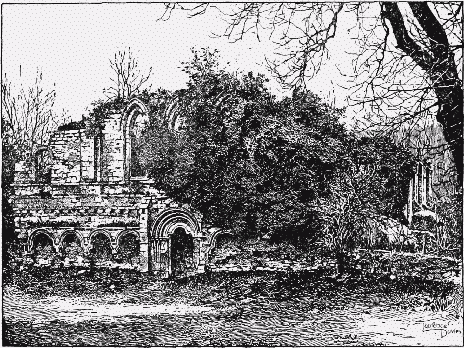
Rievaulx Abbey: Cloister Front of the Frater
The frater, which comes next, was largely remodelled towards the close of the 12th century, but retains traces of the earlier work. The cloister front is fairly perfect. It has in the middle a late 12thcentury doorway with curious trefoiled head, within a round-headed archway of three orders with detached shafts, flanked by plain ashlar buttresses. Beyond the doorway on each side was the lavatory. This consisted of two series of four round-headed arches, springing in an odd way from carved and moulded square brackets. The ashlar work at the back has been torn out, but enough is left to show that under the arches stood a row of large semicircular basins, having behind them a long, narrow tank or 'lavour of lede overcast with pewter' with a row of taps. The supply and waste pipes cannot now be traced, but at the back of the first arch of the western series is a hole for a branch supply pipe into the frater for washing up cups and platters. The eastern series of arches is fairly perfect, but of the western parts of only three arches are left. Over the lavatory is a single course of contemporary ashlar, and above that a belt of the original early Norman masonry, with the joist holes for the cloister roof and a deep chase for its wall-plate. This lay under the existing stringcourse, which again has over it, especially eastwards, much of the early masonry. Higher up, and flanked by two contemporary corbelled-out pilasters in line with the frater walls, are three pointed windows of equal height. Inside the frater the lower part of the early rubble wall remains for a few feet up, but above this is a facing of beautifully coursed ashlar of the later date. The doorway has a segmental-moulded rear arch with side shafts, and within the head are remains of the old white plastering, with red masonry lines and rows of superimposed semicircles. The windows above are set within an arcade of alternate wide and narrow arches, carried by shafts with carved or voluted capitals with square abacus, and bases set in a sloping sill.
Unlike the generality of Cistercian fraters, this at Rievaulx, owing to the rapid fall of the ground, stands over a lofty and important sub-vault. The walls are of the same rudely-coursed rubble as the earliest work, to which they apparently belong. It was not vaulted originally, but all four walls have been cut back to carry the wall ribs and springers of a vault of the second date (fn. 166); larger windows have also been inserted in place of the original ones. The new vault was ten bays long, and when first planned was to have three alleys, with a south window to each, but the middle window was afterwards built up and a springer inserted in the blocking for a vault of two alleys, (fn. 167) which was duly built. The north end shows the two-alley springers only. The sub-vault was lighted, besides the two south windows, by east windows in the second, fourth, sixth and seventh bays from the south and by west windows in the first and fourth bays. In the sixth west bay is a doorway with trefoiled head, and in the fifth east bay is the relieving arch over the great drain from the kitchen to the rere-dorter. Owing to the bank against which it is built there are no openings in the northern part of the sub-vault.
The north end of the frater has already been described. The east wall has an ashlar facing of the first date for some 4 ft. up, and is then faced with the later ashlar up to the top so far as it is overlapped by the warming-house. Beyond this the later ashlar extends downwards to the top of the old sub-vault wall and upwards to a moulded string-course below the frater windows. The lowest course of ashlar is left rough because it was covered by the stone seat that extended along the foot of the wall. Above the string-course is a row of seven wide lancets, set within a wall arcade of alternate wide and narrow arches once carried by banded shafts. The bases are mostly round and set in a sloping sill, but the capitals are square with leafy volutes. The windows have also a moulded outer order, but the capitals of the banded jamb shafts are round and carved with leafwork. The south end of the frater has a like arcade with three windows in it, and there are three windows similarly treated in the south end of the west wall. Beyond them the arcade was continued, but in a different way, right up to the north end. The change is due to the arrangement of the wall pulpit, which had towards the frater an open arcade of four of the wider arches, now all fallen out except the two ends, apparently carried by triplets of shafts. Beyond the pulpit no effort was made to revert to the alternating arcade, and the wider arches, after passing the blind panel over the pulpit door and a window next it, were continued all along. The last arch is, however, a narrow one. The pulpit was entered from the frater at its north end by a square-headed doorway a few steps above the floor. The door opened into a lobby, with a small pointed loop at the back and a recess on the right hand, at the foot of a flight of stone steps ascending southwards. These have been torn out, but their rake is shown by the rise in the sills of the four broad lancet windows at the back. At the top of the steps is a tall and wide recess with shouldered head, probably to hold books, &c. In the middle of the stair is a vice descending to the sub-vault below, but the doorway into this is at present covered up by fallen rubbish. The object of this unusual arrangement is uncertain. Nothing is left of the pulpit itself, but its pieces will perhaps be recovered some day from the sub-vault below when that is cleared of the mass of fallen stuff which now encumbers it. The frater has lost the top of its walls, except at the south end, where there is a string-course over the wall arcade and in a lowered gable above three short and plain windows. This gable belongs to a late roof of ten bays, the principals of which rested on carved corbels of differing patterns. The older roof was one of eleven bays, with the principal timbers rising from triple shafts with simple corbels under. Both sets of corbels remain. In the north end of the west wall was a serving hatch from the kitchen on the other side, and apparently an arrangement of lockers or recesses, but the stonework about them has been torn away Owing to the removal of the floor through the destruction of the vaulting below nothing is left to indicate the arrangement of the frater, and the survey only mentions the leaded roof, the ironwork and 'old smale glasse' of its twentyfour windows and 'the deskes.'
On the east side of the frater all but a section on the north of the original rubble wall has been cut back and faced with later ashlar. The four end bays have buttresses, and there was a fifth, sub-vault high. The windows have simple chamfered openings with a sloping set-off below at the floor level, and another above them projecting forward to carry the corbels under the cornice. The south end is buttressed up to the springing of the main windows, but all the work here is very plain. On the west side the projection for the pulpit is brought forward to the front of the buttresses and carried upon round arches extending between them; it shows also a three-sided projection for the descending vice. Under a larger arch at the north end is a round-headed window to the trefoiled doorway visible within.
Of the kitchen very little is left. The east wall, that next the frater, has traces of three bays of 13thcentury vaulting. The north and south ends have both gone, and of the west there is a fragment of the earlier date in line with the west wall of the cloister.
Of the cellarer's range, or 'garnere on the west of the Cloyster,' as the survey calls it, only two fragments remain. These show that it was two-storied, with its west wall in line with the front of the church, but it was so narrow, being only half the usual width, that it could hardly have been built as was customary for the accommodation of the lay brothers. In what part of the abbey they were lodged it is impossible to say under the existing conditions, but the fine subvault of the frater was probably the hall in which they had their meals.
The sites of the brew-house, bake-house and garner, which were all under one roof, of the lay brothers' infirmary, and of the several guest-houses have all to be sought for by excavation before they can be located.
It is evident from a study of the natural surroundings that the site of the abbey was at first bounded westwards by the River Rye. This did not then follow its present course clear of the abbey site, but ran from Bow Bridge, half a mile up stream, in a direct line towards the abbey, about which it made a bend. It then continued southward close under the steeply-rising bank below the terrace and onwards across the flat south of it to the foot of Hollins Wood.
The sloping plateau within the bend was evidently the only available place for the abbey, but after cutting away to some extent the steep bank behind and levelling terraces for them the monks were still compelled to set out their buildings with regard to the trend of the rise, and so their church stands nearly north and south.
The low-lying land on the western side of the river belonged to Byland Abbey, which seems then to have stood in the valley above Bow Bridge, but some time before 1146 permission was given to William the abbot and the brethren of Rievaulx 'to make a dyke (fossatum) through our land at the foot of Ashberry Hill, as they might deem advantageous to them, and to have to their own use the land which on their side they inclose with the same dyke.' (fn. 168) The course of the Rye was accordingly deflected from a point just below Bow Bridge, near the old quarries called Penny Piece that furnished the stone used in the first buildings of the abbey. After hugging Ashberry Hill for a short distance the dyke seems to have been brought back to the main stream through a new guteria or channel opposite the end of the frater. The old section of the stream was then converted into a race to work the abbey mill and flush the main drain, and by an ingenious system of dams and channels, which may still be traced, it was also apparently used as a canal to bring down the stone from Penny Piece to the abbey.
At some time between 1154 and 1163, and not improbably soon after the agreement between Byland and Rievaulx, a further section of the valley was given to the abbey by Hugh Malebiche. It included 'all the land that lies between the hill which is called Brockesholes and the water of Rye from Oswaldeshenges as far as the guteria, and all the nearest island below the guteria towards Helmsley, so that the monks may make a dyke (fossatum) through that land as near the hill as they can and lead the river Rye through it, and the land which may happen to be on their side afterwards shall remain to them for ever.' (fn. 169) 'Oswaldeshenges' was given to the abbey at the same time by a separate charter, (fn. 170) and appears to have been the low-lying ground at the lower end of the valley east and west of the present Clogger's Bridge. These grants enabled the monks to divert a further section of the Rye under Ashberry Hill to a point south of the land still called the Island, where it was again brought across to the original course opposite. This line is marked by a bank which formed an extension of the original boundary of the abbey precinct.
The grants of Hugh Malebiche were subsequently confirmed by his son Richard, (fn. 171) who further gave to the monks 'all the land at the foot of the hill called Brockesholes and from Aldenetoftes (fn. 172) to Oswaldenges, as far as that place where Huholm ends on the south under Aldenetoftes, so that they may make a dyke (fossatum) and lead the Rye as near the hill as they wish, and have all the land which happens to be towards their land of Griff on the east side of the same water.' The bridge of their guteria he likewise freely gave them to have and repair as they willed. He also gave them 'the holm at Hemgerdebrig in the territory of Scawton between Aldenetoftes and the water of Rye as their dyke goes round, to hold and inclose and use as they will and to lead through it the water of Rye as near the hill as they will.'
This gift, which was made between 1193 and 1203, (fn. 173) evidently includes the southernmost extremity of the valley, and accounts for the third deflection of the Rye under and along Hollins Wood below 'Brockeholes,' whence the stream resumes its original course. The old bed of the Rye seems to have been utilized as a canal to convey the stone of which the new quire and presbytery were built from the quarry at Hollins Wood to the abbey. (fn. 174) The abbey precinct originally extended from Penny Piece along the road from Old Byland to a point below the conduit-house, and thence down to the great gate-house. It thence continued some way along the bank above the abbey, and then turned down to join the river at a point about 700 ft. east of the infirmary hall, where the bend of the stream ceased. The stream itself of course formed the western boundary. After the gift of the Island the boundary was extended from its junction at the river bend along the eastern bank of the original stream and round the end of the Island along the new course of the Rye up to Penny Piece.
After the dissolution of the abbey in 1538–9 the house and site with the appurtenances were granted in fee to Thomas Earl of Rutland. (fn. 175) The manor henceforth followed the descent of Helmsley (fn. 176) (q.v.).
Churches
The church of ALL SAINTS consists of a chancel 31 ft. 9 in. by 19 ft. 4½ in., north transept 23 ft. by 20 ft. 7 in., south transept 27 ft. 8 in. by 19 ft. 5 in., nave 81 ft. by 22 ft. 6 in., north aisle 12 ft. wide, modern south porch and west tower 14 ft. 2 in. by 14 ft. These measurements are all internal.
The nave appears to date from the middle of the 12th century, the earliest details remaining being the chancel arch and south doorway. The north aisle was built late in the 12th century or early in the 13th and the west tower was added a little later. Of this 13th-century tower the walls still survive to the height of the bell-chamber. The lancet windows of the second stage in the west and north walls are of original date, a fact proved by the same two mason's marks being found on the stones of the tower arch and the jambs of these lancets. What additions or insertions may have been made during subsequent periods of the Middle Ages the drastic restorations to which the fabric has been subjected have rendered it impossible to ascertain. In the year 1849 the north aisle was rebuilt, and twenty years later the church was 'Normanized' throughout.
The chancel as at present existing has been entirely refaced inside and out, if not rebuilt. In the east wall are three grouped round-arched windows. In the north wall are two windows of similar type, and between them a doorway to the modern vestry. In the south wall are two similar windows. The chancel arch is of original 12th-century date and consists of two square orders, the outer order carved with the cheveron ornament on the nave side and the inner order with a coarse bead on the same side; on the chancel side both orders are plain. The responds have shafted jambs; the shafts are modern, but the capitals and abaci appear to be original. The capital of the south respond of the inner order is voluted, as also are the capitals of the western responds of the outer order. The capital of the north respond of the inner order is carved with an interlacing ornament. The responds of the outer order have cushion capitals on the east side. The transepts, which have both been completely modernized, open into the nave by two-centred arches of two orders, under the northern of which is placed the organ, and are lighted by modern round-arched windows.
The north arcade of the nave is of four bays with two-centred arches of two plain orders, with labels intersecting over the columns and stopped by foliated bosses. The responds are semicircular and have foliated capitals with semi-octagonal abaci and moulded bases; the piers are composed of four clustered columns with foliated capitals, square abaci and moulded bases. The arches, abaci and capitals of the whole arcade, with the exception of the responds, which are entirely modern, are of original late 12th-century or early 13th-century date; the shafts and bases are modern throughout. Portions of the label appear to be original. In the south wall to the east of the south doorway are two modern windows, each of two coupled round-arched lights. The south doorway, which is of original 12th-century date, is of four round-arched orders with shafted jambs. The capitals are scalloped and their abaci are grooved and chamfered. The arches are cheveron-moulded. The shafts and jambs have been much renewed on both sides. The south porch is modern. To the west of the south doorway is a modern coupled window of two round-arched lights. The north aisle is lighted by three modern windows in the north wall and two windows in the east and west walls respectively.
The tower arch, which is of original early 13thcentury date, is two-centred and of three chamfered orders, the inner order being moulded on the east side with a filleted bowtel between two hollows. The responds are composed of three filleted rolls with hollows between. The capitals are plain bells with chamfered neckings, the fillets being continued on the face of the capitals. The bases are moulded with two plain rolls. The tower is in three stages with shallow buttresses at the angles and dwarf buttresses in the middle of the north, south and west faces. These have been much restored, but they are in the main original. The coupled round-arched west window of the ground stage is modern. The ringing stage is lighted by coupled lancets on the north, west and south. Those in the north and south walls are of original 13th-century date. Externally the heads are of two chamfered orders supported by a central circular shaft with foliated capital. Above this stage the tower has been completely rebuilt in the pseudoNorman style of the restorers. The belfry is lighted on all four sides by coupled round-arched windows and is finished by a corbel table surmounted by a plain parapet with octagonal pinnacles at the angles. The roofs are high-pitched and covered externally with green slates.
There is a ring of eight bells, the tenor by Mears & Stainbank of London, 1868, the rest by Pack & Chapman of London, 1770.
The plate is silver and consists of two cups with cover patens, two flagons and an alms basin. The older of the two cups bears the York mark for 1636 with the maker's mark S.C., for Sem Casson of York, and the cover, which probably belonged to another vessel now lost, has the York mark of 1638. It bears the maker's mark I.T., for John Thompson of York. The other cup, with cover, the flagons and alms basin form a service by themselves and are inscribed 'Given to Helmsly Church in the year 1724.' Three other chalices and patens have been recently made for use in some hamlet chapels in the parish.
The registers begin in 1575.
The church of ST. CHAD, Sproxton, consists of a chancel measuring 15 ft. 10 in. by 16 ft. 9 in., and a nave 21 ft. 2 in. by 16 ft. 9 in., with a timber and lead bellcote over the west gable of the nave. The building, the details of which are re-used early 17thcentury work, was formerly at West Newton Grange, where it had latterly been used as a barn. It was presented by the Earl of Feversham to the late vicar of Helmsley, who took it down and rebuilt it at Sproxton in 1879.
In the east wall of the chancel is a three-light window, the centre light round-arched beneath a square head, the side lights square-headed. The centre light rises above the side lights and the external label follows the line of their heads. There are no windows in the north wall of the chancel. At the south-east are a black marble piscina and credence table. In the south wall is a three-light window of similar character to the window in the east wall. A modern oak screen with a wide central opening and baluster columns, with capitals of Ionic character, divides the chancel from the nave. In the north wall of the nave is a square-headed single-light window, containing some fragments of late mediaeval stained glass, representing the Crucifixion. (fn. 177) Over the figure of our Lord is a pinnacled and crocketed canopy. Below the waist of the figure the fragments of glass are pieced together without relation to the design. At the west end is a modern screen with a small gallery over. In the west wall is an elliptical light, the major axis of which is placed horizontally. The stairs to the gallery are placed at the north-west, and the spaces on either side of the entrance beneath the gallery are utilized as vestries. The west doorway has a chamfered semicircular head and a chamfered label stopped on moulded imposts, and chamfered jambs. In the south wall is a three-light window of similar design to that in the south wall of the chancel.
The roof is high-pitched and covered externally with stone slates. The bellcote has a stone base, raised upon which is the timber bellcote with leaded cupola. The chancel and nave are ceiled internally with a segmental panelled ceiling, the ribs of which are picked out in colour.
The bell and communion plate are modern.
The church of ST. JOHN BAPTIST, Pockley, is a modern building built of stone with stone slate roofs, and consists of a chancel with north vestry and organ chamber, nave, south porch and western bell gable. It was erected in 1870 from the designs of G. Gilbert Scott.
The font is of 13th-century date and was originally in the church of All Saints, Helmsley. It is hexagonal, the bowl being supported by six attached shafts having moulded capitals and bases.
The church of ST. AIDAN, Carlton, is a small modern building, of old foundation, built of stone with a tiled roof in 1886 from the designs of Mr. Temple Moore, and consists of a continuous chancel and nave under one roof, with a west tower and south projecting doorway.
There are three bells.
The living is held with that of Helmsley.
The church of ST. MARY THE VIRGIN, Rievaulx, built in 1906, incorporates the remains of the small chapel which stood outside the monastery gate, a chancel and tower with spire being added. The living is held with the vicarage of Helmsley.
The church of ST. HILDA, Bilsdale Kirkham, was built in 1851 in place of an earlier building. It is of stone in the Gothic style of the period, consisting of chancel, nave, south porch and west turret containing two bells.
The plate consists of a London-made silver cup and paten of 1851 and an electro-plated flagon.
The registers begin in 1588.
The church of ST. JOHN THE EVANGELIST, Bilsdale Midcable, built in 1896, is of Yorkshire stone in the 14th-century style, consisting of chancel, nave, north aisle and west tower with spire.
The church of ST. SAVIOUR, Harome, built in 1862 to replace an earlier structure, is a plain building of stone in 13th-century style, consisting of chancel, nave, south porch and western bell-turret.
The plate includes a silver cup inscribed 'Donum Dominae Metcalfe, Cappellae Harom,' and bears the York mark for 1681, maker's mark George Gibson. There are also two modern silver patens, a plated flagon and brass almsdish.
Advowson
The church of Helmsley and its priest are mentioned among the possessions of the Count of Mortain in 1086. (fn. 178) The church and 1 carucate of land in Helmsley were granted by Walter Espec, the founder, and Adelina his wife to Kirkham Abbey, (fn. 179) and the church was appropriated to the abbey before the close of the 13th century, (fn. 180) the vicar being mentioned in 1268. (fn. 181) The grant of Walter Espec was confirmed by Simon son of Walter de Ver about 1229. (fn. 182) The abbey retained this church until the Dissolution, (fn. 183) after which, in 1541, the rectory and advowson of the vicarage were granted in fee to Thomas Earl of Rutland (fn. 184); the advowson subsequently descended with the manor, (fn. 185) and now belongs to Lord Feversham. (fn. 186) In 1360 Robert de Flamborough obtained licence to endow a chantry in the parish church (fn. 187); this was evidently that chantry of our Lady which was afterwards said to have been founded in 1370 by Robert de Flamborough and Emma his wife. (fn. 188) The advowson of this chantry was in 1372 settled on Robert and Emma for their lives with remainder to Thomas Roos of Helmsley and his heirs. (fn. 189) The altar of St. Nicholas in this church is mentioned in 1481. (fn. 190) A chapel was constructed by order of the archbishop in Helmsley Castle and was dedicated in 1253, although the Prior and convent of Kirkham protested that this was an infringement of the rights of the parish church. (fn. 191)
Early in the 12th century a church was founded at Bilsdale by William [Espec] (fn. 192) in the name of St. Hilda the Virgin. (fn. 193) This church is again mentioned in 1387, when money had been found under an altar, (fn. 194) and the vicar is mentioned in 1476. (fn. 195) The advowson of the church of St. Hilda was transferred in 1874 from the vicar of Helmsley to the Earl of Feversham, (fn. 196) the present patron. The church of St. John the Evangelist was erected in 1896 for the new parish of Bilsdale Midcable. The living is a vicarage in the gift of Lord Feversham.
There was a chapel in 1471 at Harome (fn. 197) where the present church of St. Saviour was erected in 1862. The living is a vicarage in the same gift.
In 1338 William de Roos had licence to grant lands in Pockley to a chaplain to celebrate divine service daily in the chapel of St. Nicholas of Pockley. (fn. 198) The advowson belonged to the lords of Helmsley. (fn. 199) In 1547 the chantry here, a mile or more from the parish church, was said to have no endowments; until eleven or twelve years previously it had been maintained by a 'stock' of eighty ewes in the charge of the tenants of Pockley. (fn. 200) The modern church of St. John the Baptist at Pockley serves a parish formed from Pockley with East Moors. The living is a vicarage in the gift of and held by the vicar of Helmsley.
The district church of St. Mary Magdalene at East Moors was built in 1882. From 1617 (fn. 201) to 1817 (fn. 202) conveyances of Sproxton rectory were made with the manor. A hermitage at Sproxton is mentioned in 1329. (fn. 203)
Charities
The poor's stock consists of £39 12s. 3d. consols with the official trustees, and comprises the benefactions of a Mr. Smith, Rev. Charles Mason, Ralph Harrison, and John Watson, 1727, and Francis Wheelwright.
Francis Wheelwright by his will left £50 for the distribution of bread. The legacy was laid out in 1676 in the purchase of the tithe-rent of £3 on land in Newby Wiske, which is received from the executors of the late Mr. William Ruston.
In 1858 Margaret Dixon by will left £100 to be invested, and the income applied in support of the organist and choir, represented by £115 9s. 8d. consols with the official trustees, which sum was augmented by £121 7s. 7d. consols purchased with a legacy under the will of Sarah Dixon, 1858, the income being applicable equally between the choir and the poor.
The several charities are administered together. In 1905 the dividends on the several sums of stock amounting to £6 18s. were applied as to one moiety to the choir of the parish church and as to the other moiety in money to the poor, and the tithe rentcharge of £3 is applied in the distribution of fourteen loaves of bread once a month.
Benjamin Kendrew, by will proved in 1891, left £50 for the benefit of Helmsley Wesleyan Circuit, represented by £46 19s. 9d. 2½ per cent. annuities with the official trustees, the dividends of which, amounting to £1 3s. 4d., are applied in support of the ministry.
A sum of £3 6s. derived from a sum of £60 deposited in the York Permanent Building Society in respect of a charity known as the 'Russell and Bentley Legacy' is also applied by the circuit stewards in support of the ministry.
In 1894 John Gore by will left £80 8s. 11d. consols (with the official trustees) for the poor of the congregation of the Wesleyan chapel at Town End, Blackmoor. The dividends, amounting to £2, are applied in accordance with the trusts before Christmas-tide amongst poor widows and orphans.
Township of Harome.—John Stockton by will. 1839, left £10 a year for educational purposes in this township. By reduction of interest on consols the sum of £8 6s. 8d. only is now payable. (See under Kirkby Moorside.)
Township of Pockley —John Stockton made the like bequest for education in this township.
Chapelry of Bilsdale St. Hilda.—Mrs. Frances Fletcher, by will proved 1880, left £200 India 3 per cent. stock for the poor. In 1905 gifts of coal were made to eleven poor persons.