
A History of the County of York North Riding: Volume 1. Originally published by Victoria County History, London, 1914.
This free content was digitised by double rekeying. All rights reserved.
'Parishes: New Malton', in A History of the County of York North Riding: Volume 1, (London, 1914) pp. 529-537. British History Online https://www.british-history.ac.uk/vch/yorks/north/vol1/pp529-537 [accessed 25 April 2024]
In this section
NEW MALTON
New Malton comprises the two ecclesiastical parishes of St. Michael and St. Leonard. It was until 1855 a part of the parish of Old Malton, and the general description of this latter parish includes that of its former member.
South of Old Malton the York road passes through New Malton. The town is built on undulating ground, which falls very rapidly towards the Derwent where it bounds the settlement to the south. There are modern extensions of the town on the west and north, and Norton, on the east bank of the Derwent, practically forms a suburb. The main road from Whitby enters New Malton as Old Malton gate, and further south, as Yorkersgate, forms the principal street of the town. This road is crossed by a street called Wheelgate and its continuation Castlegate. A road from Castlegate leads over the bridge of Derwent to Norton, and the river is again crossed by another road further south from Yorkersgate to the railway station at the junction of the branches to Thirsk, Driffield and Whitby with the York and Scarborough branch of the North Eastern railway. The town was once surrounded by walls, their course being now marked by the parish boundary. (fn. 1) The four gates were in the keeping of the burgesses. (fn. 2) The walls probably determined the shape of the market-place; this lies between Yorkersgate (York house gate, 1784) and Wheelgate, which is connected with Old Malton gate by Greengate. The market-place is divided into two squares, the church of St. Michael (fn. 3) standing in the western and the town hall in the eastern square, the ground rising sharply from south to north. The town hall is a stone building of the 18th century with various modern additions. The Black Swan Inn on the northern side of the market-place is a good specimen of an 18th-century house and possesses a fine wooden cornice. On the same side of the market-place is a fine stone house, now known as St. Michael's House, much repaired but of about the same date. To the north and outside the wall is the modern cattle market. On the north side of Finkle Street, which leads from the market-place to Wheelgate, are some old two-story houses with overhanging first floors. In Wheelgate, as the lower part of the Helmsley road is called, is a 15th-century crypt, now forming portion of the cellars of the Cross Keys Inn, an 18th-century building. It is of three bays, with vaulting shafts, ribbed cross vault, and carved bosses at the intersection of the ribs. It is situated on some land which once belonged to Malton Priory. At the south end of Yorkersgate is York House, a fine stone building of late 17th or early 18th-century date, consisting of a centre and two gabled wings, having large windows with moulded architraves and double-hung sash-frames. In the centre of the garden front, overlooking the River Derwent, which runs at the foot of the sloping terraced garden, is an arched recess, with rusticated quoins and voussoirs, within which is the large staircase window. The plan is symmetrical, consisting of a large square hall with rooms on either side.
St. Leonard's Church stands within a large churchyard adjoining the grounds of the Lodge which border upon the road leading to Pickering and Whitby, at the northern extremity of the town. South of the Lodge is the site of Malton Castle. Malton Castle was erected probably in the early part of the 12th century. It was granted by Henry I to Eustace son of John, (fn. 4) that 'oneeyed, wicked traitor,' who, after having long secretly favoured King David, in 1138 marched with the Scots into Yorkshire, planning to deliver Malton into their hands. (fn. 5) After the Scottish defeat at the battle of the Standard Malton was destroyed and its castle was besieged by the king's men in revenge for the burning of several villages by its garrison during the war. After a truce of eight days, however, the siege was abandoned. (fn. 6) It was probably at this castle that Richard I and the King of Scotland held an interview in 1194, (fn. 7) and Malton was visited by King John in February 1213 (fn. 8) and afterwards by Edward II. (fn. 9) A royal grant of the custody of the castle was made in 1317 to John de Mowbray, but 'certain illdisposed persons' occupied the castle and refused to admit him. (fn. 10) In 1322, after the hasty flight of Edward from Byland Abbey and the defeat of the royal army, Malton fell into the hands of Robert de Brus and formed a centre for Scottish depredations on the surrounding country. (fn. 11) Brus probably stayed at the castle, but wrecked it before his retreat northwards at the end of October. (fn. 12)
Leland spoke of the castle as a ruin, (fn. 13) but it was besieged in the Civil War, (fn. 14) though this time its garrison was for the king. In 1643 the member for Malton refused to attend Parliament, (fn. 15) but in 1644 Newcastle's forces were defeated here by Sir William Constable, one of the regicides. (fn. 16)
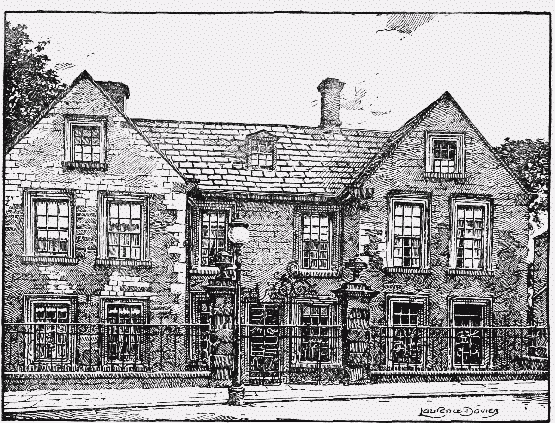
York House, Yorkersgate, New Malton
Of the house built by Ralph Lord Eure in the 17th century only the lodge remains. This has been converted into a modern residence and added to on the east and west, and is now occupied by the Hon. G. N. Dawnay. It is a rectangular Jacobean building two stories in height built of stone, and stands about 50 yards back from, and on the east side of, the Pickering road, on the border of New Malton, the grounds being divided from the roadway by a screen wall of apparently the same date as the building, but so much weathered that all the detail is lost. The principal gateway was placed in the middle of the wall in an axial line with the lodge. It was semicircular, and stood between coupled columns mounted on bases and supporting an entablature; the mouldings and any ornament here and elsewhere have, however, fallen too far into decay to discern the order to which they originally belonged.
The centre parts of the north and south fronts project slightly beyond the general wall face, while at the corners of the building are flat angle buttresses rising above the parapets and surmounted by ogee-shaped finials. The drive to the main buildings was undoubtedly through the middle of the lodge, as shown by semicircular archways, now blocked up, in the centre of the north and south fronts. On either side of the archways are detached and coupled Doric columns, standing on bases and supporting entablatures, which break round them and are carried across the central projection. The architrave and frieze stop on the return, but the cornice is continued round the building. The upper story is treated in a similar manner to the ground stage. The original windows were square-headed and divided by stone transoms and mullions, but only those in the upper part of the central front projection remain intact. The remaining windows have sash-frames and are mostly modern. The building has lately been carefully renovated.
At Spital Hill, Broughton, stood the hospital or almshouse of St. Mary Magdalene. This hospital was dissolved in January 1618–19, when it sheltered two men and three women. (fn. 17)
In 1905 a Cottage Hospital was established for Malton, Norton and the district. It is supported by voluntary contributions.
The Roman Catholic church of St. Mary was erected in 1837, the Wesleyan chapel in Savile Street in 1811, the Ebenezer Congregational church in Savile Street in 1815, the Baptist chapel in 1822; and there are also a Primitive Methodist chapel in Wheelgate, a Unitarian chapel and meeting-houses for the Society of Friends and the Plymouth Brethren. The Quaker John Whitehead first preached at Malton in 1652. (fn. 18)
There has long been an industrial community in Malton. Goldsmiths, masons and mercers are mentioned in the 13th century. (fn. 19) There were weavers in the time of Henry II, (fn. 20) and in 1327 complaint was made that the wool merchants of York, Hull, Malton and other towns confederated by writings and oaths to reduce the price of wool. (fn. 21) The surrounding country has always been, as Leland described it, 'plentiful of corne and pasture,' (fn. 22) while milling, malting and brewing have been its chief industries, and barrels and ears of corn formed the coat of arms of the priory. Besides its two breweries, malting and corn-mills, Malton has bonemills and nursery gardens, and is famous for its horses. John Scott, the trainer, purchased Whitewall House stables in 1825, and lived there until his death in 1871. Before 1862 he trained in all sixteen winners of the St. Leger, and he trained six Derby winners, eight winners of the Oaks and many famous horses. (fn. 23) James Watson, the Radical publisher (born 1799), and Godfrey Sykes, the decorative artist (born 1825), were natives of Malton. (fn. 24) The schoolmaster is mentioned in 1392. (fn. 25)
The navigation rights on the Derwent are vested in the North Eastern railway. There was formerly considerable river traffic, but this has declined.
Borough
The mesne borough of New Malton appears to have grown up about the castle, and its overlordship follows the manor (q.v.) in descent. Henry II refers to it as a demesne borough, (fn. 26) and it may have come into being while the greater part of the land here was in the hands of the Crown. (fn. 27) It paid £49 14s. 4d. as tallage in 1184. (fn. 28) The town was governed by two bailiffs with two under-bailiffs and a borough clerk to hold the court. (fn. 29) No other bailiff might make an attachment or summons in the borough without the sworn bailiff. The burgesses were only to do suit twice a year at the court, except at gaol deliveries; no other court was to be held in the borough, and all complaints in this court were to be judged by the suitors of the court, and all fines taken except those belonging to the lord, such as those touching the common oven or the assize of bread. Every burgess but those dwelling in the knight's fee or belonging to the priory should give to the lord gabellage (gaffelege) for his tenement yearly, the amount depending on his occupation and the number of doors of his tenement. They might sell, give or will their tenements. (fn. 30) The lord of the fee had no rights of wardship. Twelve of the burgesses answered before the justices of the peace in all sessions and before the sheriff when his tourn was held within their liberty. The burgesses had a free prison, a pillory and 'a thew lawful and strong.' They were quit of toll on their merchandise, and in dealings with merchants who lived outside the borough the latter were to pay the toll. Common butchers, however, gave toll daily 'of old custom,' and burgesses selling herrings in Lent gave 1d. on each 1,000 herrings or else 4d. as the 'Skattegild.' They might grind corn at the mill of the lord at a fixed multure, and the commonalty chose two sworn millers and one page, who might not be appointed or removed without their consent. All the inhabitants of the borough might grind their corn or malt where they would except in their own houses. Measures used were to be proved in the court twice a year, the burgesses having the standard, which should agree with the king's; bakers and butchers were to be sworn twice a year; no baker who baked white bread should bake brown bread and vice versa; similarly no fishmonger ('groser of fysche') might cut his own fish by himself, nor the tanner and shoemaker encroach on each other's crafts. The burgesses might sell their malt and ale at pleasure, in their own houses and at their own price; and all inhabitants of the borough might sell bread and ale at what price they would at Michaelmas and from Christmas to the next court. Every common brewer who wished to sell ale outside his house had to make fine once a year with the bailiff, but brewers who held of the knight's fee or of the Prior of Malton paid no fine. The burgesses chose in their court two ale-tasters who with one sub-bailiff tasted the ale of all common brewers weekly.
These privileges were in 1596 claimed by the burgesses as immemorial (fn. 31) In 1624 the townsmen, supported by Lord Eure, petitioned for a charter of incorporation. This petition was referred to the attorney-general, (fn. 32) but nothing was done, and in the early 19th century the borough survived only for Parliamentary purposes. The burgages (the electors) then numbered about 100, and the bailiff was appointed at the court leet of the lord of the manor. (fn. 33) In 1854 New Malton, Old Malton and Norton were constituted a district under the Public Health Act of 1848. (fn. 34) The town is now governed by an urban district council formed under the provisions of the Local Government Act, 1894. (fn. 35) Norton was made a separate parish in 1889.
Malton returned two members to Parliament in 1295 and 1297, but not again until 1640. It had two representatives from 1640 until 1868. It was until 1832 a Whig pocket borough, but by the Reform Act of 1832 its limits were extended to include Old Malton and Norton, and the elective franchise was conferred on the inhabitant householders. (fn. 36) Malton was deprived of one member in 1868, and lost its separate repesentation under the Redistribution of Seats Act of 1885. It now forms part of the Thirsk and Malton division of Yorkshire.
Among its representatives have been Robert Lilburne, the regicide, who was returned to Richard Cromwell's Parliament, but was unseated on a petition, (fn. 37) Burke and Grattan, the lawyers Lord Cottenham and Lord Abinger, (fn. 38) Henry Gally Knight the writer on architecture, (fn. 39) and Viscount Ossington, speaker of the House of Commons. (fn. 40)
The market and fair, prescriptive like the borough, seem to have been always retained by the lords. They were acquired by the Hon. Thomas Wentworth in 1713 (fn. 41) with the manor, and now belong to Lord Fitzwilliam. The first mention found of the market is in 1283, (fn. 42) of the fair 1295. (fn. 43) The market rights extend over the whole town, so that tolls are claimed upon sales in the streets or inn yards, and there is said to be no restriction as to special days for a market, though it is the custom to demand toll only on the Saturday before and on fair days and in the cattle market on Tuesday. The corn market is held every Saturday; the corn exchange is not, however, used, as the farmers prefer doing business in private. There are three fairs, viz. the whole week before Palm Sunday, at Michaelmas (11 and 12 October) and on the Saturday before Martinmas. Each combines a pleasure fair with the sale of cattle, but the two things are now kept distinct. A pleasure fair held on Shrove Tuesday, and known as Crucalty Fair, has almost entirely lapsed. Some complaint is said to be made of the old manorial privilege of taking toll at fair time on all merchandise which comes into or goes out of Malton. (fn. 44) In 1661, in consequence of complaints concerning the uncertainty of the keeping of Malton fair, an order was issued that if any alehousekeeper within 5 miles of Malton entertained any person bringing a horse to the fair before 20 September he should be disabled from keeping a common alehouse for three years; if any person not licensed to keep a common alehouse within this distance entertained such a person and took anything for horse or man he should be proceeded against as an unlicensed alehouse-keeper. (fn. 45)
Manor
At MALTON, before the Conquest, Siward and Torchil held 8 carucates as two 'manors,' Colebrand 3 carucates as one 'manor,' Ulf 1 carucate as one 'manor,' and Oudefride 1½ carucates. In 1086 the Archbishop of York held the land of Ulf and the Count of Mortain that of Oudefride, (fn. 46) the rest being in the king's hands. The Count of Mortain's possessions subsequently escheated to the Crown, (fn. 47) and both Maltons became members of the fee of Mowbray. (fn. 48) The king denied the right of John de Mowbray to the overlordship in 1314–15, granting him at the same time its custody during pleasure, (fn. 49) and in the following year granted the manor to Joan (or Isabel) (fn. 50) widow of Alexander Comyn of Buchan during pleasure. (fn. 51) The Mowbrays, however, continued to assert their right, (fn. 52) and New Malton was in 1539 said to be held of their head manor of Thirsk (fn. 53); though in a return of 1487 it was said to be held of the king in chief as of the honour and manor of Pickering. (fn. 54)
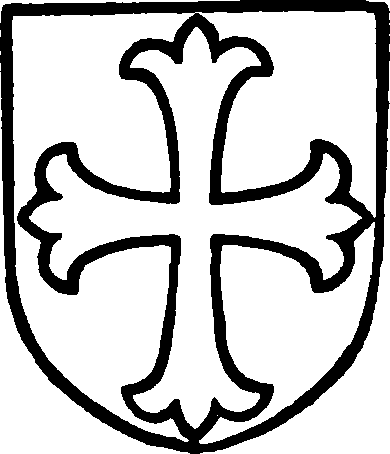
Vescy. Gules a cross paty argent.
Henry I granted the castle with appurtenances to Eustace son of John, who founded Malton Priory. (fn. 55) Besides Malton Eustace held the fortress of Alnwick, and played an important part in the rebellions against King Stephen. By his second wife, Beatrice daughter of Ivo de Vescy, Eustace had a son William, known as Vescy. (fn. 56) Eustace son of William had livery of the manor of Malton in 1189–90, (fn. 57) and was killed at the siege of Barnard Castle in 1215. (fn. 58) He left a son William, who died in 1252, (fn. 59) leaving a widow Agnes, one of the co-heirs of Walter Marshal, fifth Earl of Pembroke. (fn. 60) The manor of Malton was assigned to her in dower. (fn. 61) William's eldest son John ranged himself with the barons in the Civil War. He was summoned to the Parliament of 1265. Wounded and taken prisoner at Evesham, he again rebelled in 1267, but was forced to submit by Prince Edward. (fn. 62) He died without issue in 1287, (fn. 63) and was succeeded by his brother William, (fn. 64) who in 1289 was one of the claimants to the Scottish throne as grandson of Margaret daughter of William the Lion. On the death of his mother Agnes in 1290 (fn. 65) he succeeded to Kildare and other of the Marshals' lands in Ireland. His only legitimate son John having died in 1295 (fn. 66) he in 1296 (fn. 67) settled Malton on his bastard child William, known as 'William de Vescy of Kildare,' who was slain at Bannockburn and left no issue. (fn. 68) In 1315, on the death of the elder William's widow Isabel, who had held Malton in dower, Gilbert de Ayton was declared the rightful heir. (fn. 69) Gilbert claimed through Warin de Vescy, brother of the Eustace who was killed at Barnard Castle. Warin's daughter Margery married Gilbert de Ayton (fn. 70) and had a son William, who had a son Gilbert who died without issue and another son William, father of the above Gilbert de Ayton. (fn. 71) The king took advantage of the disputed succession to allow Joan Comyn to quarter her household at Malton and take £50 yearly (fn. 72) from its issues, but in 1318 it was ordered to be delivered to Gilbert de Ayton. (fn. 73) In 1327–8 Gilbert de Ayton settled the manor on himself for life with remainder to his son William and his heirs by his wife Isabel. (fn. 74) Gilbert was alive in 1332, (fn. 75) but William had succeeded by 1349. (fn. 76) William died in 1387, leaving three daughters and co-heirs—Katharine wife of Sir Ralph Eure, Anastasia wife of Sir Edward St. John, and Elizabeth, who married first William Place and secondly Sir John Conyers of Sockburn. (fn. 77) They divided New Malton between them, though the Eures had the whole of Old Malton (q.v.).
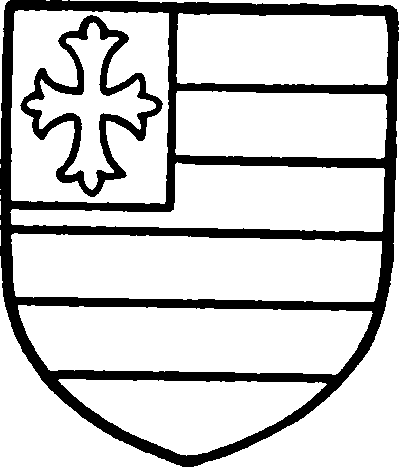
Ayton. Barry or and azure a quarter gules with a cross paty argent thereon.
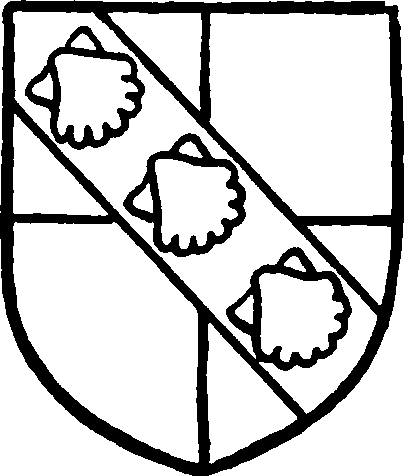
Eure. Quarterly or and gules a bend sable with three scallops argent thereon.
Sir Ralph Eure, husband of Katharine de Ayton, was at various times Sheriff of Northumberland and Yorkshire, was governor of Newcastle-on-Tyne and constable of York Castle, and died in 1422. (fn. 78) His son William, also Sheriff of Yorkshire, fought at Agincourt, and was buried in Malton Abbey, (fn. 79) his wife Maud, daughter of Henry Lord Fitz Hugh, (fn. 80) leaving directions in 1422 to be buried by his side in the quire. (fn. 81) Their son Ralph, who succeeded, was killed at Towton in 1461 and left a son William, Sheriff of Yorkshire in 1497; his eldest son Ralph was Sheriff of Northumberland in 1504 and of Yorkshire in 1506 and 1510. (fn. 82) Sir Ralph Eure, described as 'of Ayton,' (fn. 83) died in 1539 seised of one-third of the castle and borough of New Malton; he left a son and heir William, (fn. 84) Sheriff of Northumberland in 1527, captain of Berwick-on-Tweed, warden of the East Marches towards Scotland, who was created Lord Eure of Witton, co. Durham, in February 1543–4 (fn. 85) and died in 1547–8. William son of his son Ralph was his heir, (fn. 86) Ralph having been slain by the Scots at Ancram Moor in 1545. (fn. 87) William second Lord Eure died in 1593–4, leaving a son and heir Ralph, (fn. 88) who died in 1617. Ralph's heir William (fn. 89) completed the acquirement of the whole of Malton. (fn. 90) He was a recusant, (fn. 91) and after some resistance his house at Malton was seized. In 1625 Lord Clifford reported to the council his proceedings in disarming Lord Eure at Malton, (fn. 92) and seven years later the sheriff again stated that he had met with resistance in attempting to seize the house. (fn. 93) Ultimately, while the house at Malton was in the charge of his second son William, during Lord Eure's absence in London, the sheriff procured ordnance, battered the mansion and made a breach in the wall, whereupon the defenders left secretly and the sheriff took possession. (fn. 94) At the same time the unfortunate owner was overwhelmed with debts. He seems to have been immediately put back in possession of Malton, but in 1635 complained that the trustees to pay his debts had sold most of his estate and leased the rest, and yet many debts remained unpaid. He offered to make any settlement, provided he retained Malton House, the honour of the family, and its park. (fn. 95) On receiving the king's summons when the Civil War broke out he replied that £32,000 had been taken out of his estate, 'whereby my ability is made far unable to show that obedient duty which I owe to his Majesty's service, and as the justness and fitness of this cause requires. Therefore I dare not presume to offer particulars of myself unto my sovereign, considering that all that I am or have is his Majesty's due. Therefore I freely offer my estate, house and life'; and, as he was lame and his elder son Ralph a prisoner, he sent his second son to take his place and attend the king with horse and arms at York. (fn. 96) In 1642 Malton was held by a Royalist garrison, (fn. 97) and Lord Eure's estates were sequestered. He died in 1646, having survived both his sons. In 1650 William, only son of his elder son Ralph, petitioned for his grandfather's estates. He died without issue in 1652, and the sequestration was removed in favour of his heirs, his uncle William Eure's daughters, Margaret and Mary, who had been bred Protestants. (fn. 98) It is said that these sisters could not agree as to the partition of Malton, and in 1675 the family mansion was pulled down and divided stone by stone between them. (fn. 99) Margaret married Thomas Danby of Farnley, first mayor of Leeds, and Mary married William Palmes of Lindley. (fn. 100) In 1713 William, Mary, and others conveyed the manors of Old and New Malton to Thomas WatsonWentworth. (fn. 101) Thomas, who died in 1723, was succeeded by his son Sir Thomas Watson-Wentworth, created Lord Malton in 1728, Earl of Malton in 1733 and Marquess of Rockingham in 1746. He was father of Charles Marquess of Rockingham, who succeeded him in 1750, was twice prime minister, and died childless in 1782. (fn. 102) By the marriage in 1744 of Charles's sister Anne with William Fitzwilliam, third Earl Fitzwilliam, Malton came to their son William, who took the additional surname Wentworth and died in 1833. His son Charles William died in 1857 and was succeeded by his younger son William Thomas Spencer, (fn. 103) who died in 1902 and was succeeded by his grandson William Charles de Meuron Wentworth-Fitzwilliam, the seventh earl, (fn. 104) the present owner.
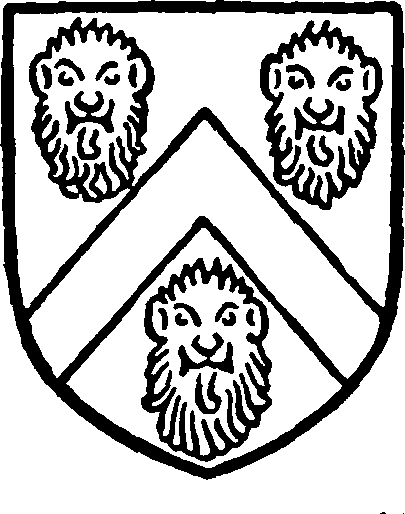
Wentworth. Sable a cheveron between three leopards' heads or.
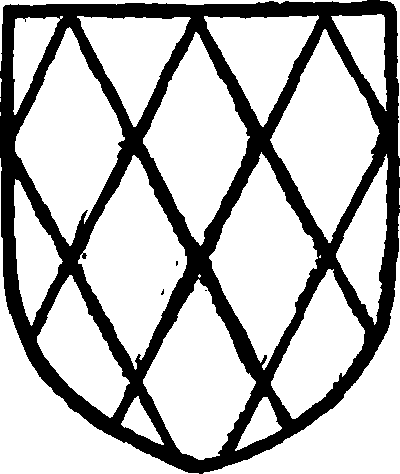
Fitzwilliam. Lozengy argent and gules.
Sir Edward St. John, who married the second of the Ayton co-heirs, died seised of one third of the Malton property in 1388–9, leaving a daughter and heir Margaret married to Thomas de Brounflete. (fn. 105) Their son Henry in 1448–9 was summoned to Parliament as Baron de Vescy, and in 1456 obtained dispensation from further attendance in Parliament because of his services in the wars of Henry V and his advanced age. (fn. 106) He died without male issue in 1468–9. His only daughter Margaret, then wife of Sir Lancelot Threlkeld, (fn. 107) had previously married John Lord de Clifford of Skipton, Yorks. Her first husband's estates being confiscated after the battle of Towton, she concealed the heir Henry in the wilds of Cumberland and is said to have had him brought up as a shepherd. She died in 1493, but on the accession of Henry VII her son's attainder was reversed. Henry Lord de Clifford commanded at Flodden, where he won honour and died in 1523. (fn. 108)
His son and heir Henry was in 1525 created Earl of Cumberland (fn. 109) and died in 1542. He was succeeded by his son Henry, who died seised of a third of the castle and manor of Malton in 1571, leaving a son and heir George, (fn. 110) who in the spring of 1599–1600 conveyed his third part to Ralph Lord Eure. (fn. 111)
Elizabeth daughter and co-heir of Sir William de Ayton married William Place, who died seised of a third of the manor in 1387. (fn. 112) By her second husband John Conyers Elizabeth had an only daughter Isabel; she married Sir Robert Conyers, lord of Sockburn, (fn. 113) whose successors retained (fn. 114) it until George Conyers in 1611 conveyed his third part of New Malton to Sir William Eure, junior. (fn. 115)
The carucate of land held by the Archbishop of York at the time of the Domesday Survey was in the Liberty of St. Peter in 1284–5 (fn. 116); it afterwards became part of the prebend of Knaresborough. (fn. 117)
In 1276 Agnes de Vescy, lady of the manor, had gallows and assize of bread and ale in Malton. (fn. 118) In 1283 the Prior and convent of Malton complained that, though they had done no wrong, Agnes de Vescy and others assaulted some of their canons and lay brothers near St. Leonard's Church, imprisoned them, took their cattle, of which the greater number died of hunger, and by public proclamation in her full market at Malton prohibited any persons from supplying the priory with victuals. (fn. 119) William de Vescy, however, in 1295 granted the canons freedom from distraint for debt and quittance for themselves and their tenants of toll, pontage, stallage, passage, suits of court and mills, and all customs of the market and fair of Malton and elsewhere, with liberty to have their own breweries and amerce their brewers. (fn. 120)
Churches
The church of ST. MICHAEL consists of a chancel 31 ft. by 18 ft. 5 in., north vestry, north transept 18 ft. 3 in. by 17 ft. 7 in., south transept 15 ft. 8 in. by 16 ft. 11 in., nave 56 ft. 4 in. by 23 ft. 2 in., north and south aisles of the same length, the north aisle being 8 ft. 9 in. wide at the west end and 9 ft. wide at the east, and the south aisle 6 ft. 7 in. wide at the west and 7 ft. 7 in. wide at the east, and west tower 11 ft. 8 in. by 10 ft. 11 in. These measurements are all internal.
The nave is the earliest part of the church, and has arcades which date from the middle of the 12th century. The width of the south aisle suggests that it is of the same date as its arcade; the north aisle was probably rebuilt at some subsequent date, but this and most of the later history of the church have been completely obscured by modern restorations. The tower was built in the 15th century, and in its addition the nave was slightly shortened. The chancel was rebuilt in its present form in 1858, and the chancel arch and east wall of the nave, together with the piers of the south arcade, whose original capitals remain, were rebuilt in 1883, when the present north and south transepts were erected.
The chancel is lighted on the east by three grouped round-arched windows of Norman design with a circular window over. In the eastern part of the south wall is a round-arched light ; a similar window in a corresponding position in the north wall now borrows light from the vestry added at the last restoration. The south transept opens into the chancel by a plain round arch, and is lighted from the south by two windows designed in the style of the 12th century with a circular window above, and there are windows of similar type in the east and west walls. The north transept is occupied by the organ chamber and quire vestry.
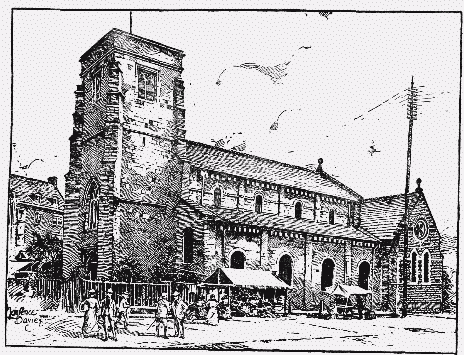
St. Michael's Church, Malton, from the South-west
The north arcade of the nave is of four bays with arches of two square orders carried by circular columns and responds with moulded bases, scalloped capitals and square-chamfered abaci. Above the arcade is a chamfered string-course. The modern clearstory windows, four in number, are of 12thcentury design. The exterior of the clearstory has been entirely refaced. Under the eaves is a corbel table, one or two of the corbels of which may be of the 12th century. The rebuilt south arcade resembles the north, with the exception that it is about 1 ft. lower, and the columns have no bases above the present floor level. The clearstory is similar to that in the north wall. The 15th-century tower arch is of two segmental orders, the outer order plain and the inner chamfered. The tower being placed slightly to the north, this arch is out of centre with the nave. The eastern angles of the abaci of the columns of the nave arcades have been cut off on the aisle sides, probably in the 18th century, for some reason connected with the galleries, which were removed at the last restoration.
The north aisle is lighted on the north by four windows similar in style to the other modern work in the church. The westernmost window is about half the height of the other windows in the same wall and suggests that a north doorway may have occupied this position at one time. In the west wall is a similar round-arched modern window. The sills of these windows are about 5 ft. 6 in. from the floor level. The exterior of the aisle has been entirely refaced, if not rebuilt. The south aisle is lighted by a similar number of modern windows, their sills being only about 1 ft. 6 in. above the floor level. This fact and the absence of visible bases to the columns of the south arcade of the nave suggest that originally this aisle was floored at a lower level than the north aisle, following the slope of the site from north to south.
The 15th-century west tower is in three stages with diagonal buttresses on the west and buttresses running north and south on the east. The parapet is plain. The west door and three-light west window over are modern 'perpendicular' insertions. The belfry is lighted by windows of two cinquefoiled lights under square heads in the north, west and south walls; in the east wall is a single-light square-headed window. The roofs throughout are modern. At the west end of the south aisle is a font of uncommon design, probably of 12th-century date. The outside of the bowl is sculptured with incised patterns in four compartments, and stands on a square chamfered base, beneath which is a modern plinth. Traces of colour are still to be seen on the incised ornament of the bowl.
The bells are four in number. The sanctus bell has no inscription, date, or maker's mark, but a similar bell is known to have been in existence before 1676; the treble bell is modern, cast by Mears & Stainbank of London in 1877; the second bell is inscribed, 'Gloria in excelsis Deo, 1676'; the third bell, 'Beatus est populus qui exaudiunt clangorem, 1676.'
The plate consists of two silver cups and a paten, a base metal cup and flagon and a pewter plate. One cup of 1702 bears the inscription, 'The Gifte of Christopher Percehay of New Malton, Esq., and Susannah his wife to the church of St. Michael's, 1705.' The other cup is modern and the gift of James and Margaret Smith, 1860. The silver paten is of 1702 and is inscribed similarly to the old cup. The base metal cup and flagon and the pewter plate are undated.
The registers date from 1571.
The church of ST. LEONARD consists of a chancel measuring internally 46 ft. by 21 ft. 2 in., north chapel 26 ft. 10 in. by 12 ft., nave 53 ft. 4 in. by 23 ft. 11 in., north aisle 51 ft. 1 in. by 8 ft. 7 in., and west tower 12 ft. by 12 ft. 8 in.
The earliest portion of the building is the 12thcentury north arcade of the nave. The arcade which separates the chancel from the north chapel appears to be slightly later in date. The tower is of the 15th century, and was formerly surmounted by a stone spire, removed some time in the 19th century, and replaced by a spire of timber and slate. In 1907 the church was restored, when the south wall of the chancel was taken down and entirely rebuilt and the south wall of the nave refaced, new windows being inserted in both. A photograph now hanging in the vestry shows the interior before restoration. From this it appears that the new windows follow more or less the design of the former, which seem to have been of late 15th-century date.
The east window of the chancel, which is of five uncusped lights with uncusped tracery under a twocentred head, is a modern copy of a late 16th-century insertion. To the south of the altar in the east wall is a 15th-century piscina with projecting basin. The arcade dividing the north chapel from the chancel is of three bays with semicircular arches of two chamfered orders, supported by circular columns, with circular abaci and moulded capitals and bases, of late 12th-century character. In the south wall of the chancel are three modern two-light windows of late 15th-century design. At the south-east of the chancel is a niche of late 16th-century character, with an elliptical head, projecting key-stone, and square projecting impost mould. The chancel arch is modern and is designed in the style of the 15th century.
The north arcade of the nave is of three bays with semicircular arches of a single chamfered order, carried by circular columns and responds with circular bell capitals and moulded bases, the varying levels of which point to a fall in the nave floor from east to west. On the north wall immediately under the wall-plate of the modern roof are some wedge-shaped 12thcentury corbels, which appear to have been made out of old voussoirs. The south wall of the nave is lighted by three modern three-light windows with uncusped tracery under pointed heads. The north aisle is lighted by three modern three-light windows with square heads. The tower arch is of 15th-century date and is of three hollow-chamfered orders, the inner order being stopped by carved corbels. The tower rises in three stages, and is crowned by an embattled parapet, surmounted by a modern timber and slate spire. The western angle buttresses are modern, as are also the west door and two-light window over and the four bell-chamber windows in the second stage from the ground, each of which is of two cinquefoiled lights with tracery under a twocentred head. The top stage is occupied by modern circular openings containing the clock dials.
At the south-west corner of the nave is a plain tub font, probably of 12th-century date.
There is a ring of eight bells, cast in the year 1768 by Lester & Pack of London, with the following inscriptions: (1) 'I hope to make it understood, That tho' I'm little yet I'm good'; (2) 'If you have a judicious ear, You'll own my voice is sweet and clear'; (3) 'Such wond'rous pow'r to music's given, It elevates the soul to Heaven'; (4) 'Good people all who hear me ring, Be faithful to your God and King'; (5) 'Whilst thus we join in cheerful sound, May love and loyalty abound'; (6) 'My worthy donor's name is Finch, I'll sound his praise and never flinch'; (7) 'Tell it in Country and in Town, My patriot tongue proclaims me "Doune"'; (8) 'Ye sons of liberty revere my name, And glory in the sound of "Rockinghame."'
The plate consists of a silver cup, paten and flagon and a pewter cup. The silver cup bears the inscription, 'Peter Walmsley Minister, Robert Stockell, Jos. Thorp Chappelwardens, Anno Christi 1742.' The paten, flagon and pewter cup are modern. The paten was presented by Mrs. W. Metcalfe on Easter Day, 1873, and the flagon was presented by Edward and Mary Rose in memory of their eldest son Raymond Percy Rose in 1879.
The registers begin in 1600.
Advowson
New Malton was formerly in the parish of Old Malton, (fn. 121) but before 1831 it formed the two ecclesiastical parishes of St. Michael and St. Leonard united in 1855. Both chapelries are mentioned in the 13th century, (fn. 122) and belonged to Malton Priory, the advowson of both following the descent of that of Old Malton (q.v.). St. Michael's now forms a vicarage, with the perpetual curacy of St. Leonard's attached.
In 1520 Robert Hansby, burgess of New Malton, left tenements to the fabric of both these churches or chapels on condition that the wardens should celebrate his exequies yearly. In 1522 John Hanceby bequeathed three burgages and £20 in Malton for the foundation of a chantry at the altar of St. Mary in the chapel of St. Michael. (fn. 123)
Thomas Stokesley of New Malton and others received licence in 1444 to acquire lands to the value of £10 yearly for establishing a corporate gild of St. John the Baptist at New Malton under two wardens elected yearly for the maintenance of the roads, causeways and bridge. (fn. 124) This was perhaps the chantry of St. John the Baptist in the chapel similarly dedicated, said in 1545 to have been founded by John Butterwick in 1478 to pray for the souls of Henry V, Thomas Stokesley and other benefactors of the chantry. The chantry was bound to repair Malton bridge and other highways. (fn. 125) The service in this chapel was said in 1545 to be of no foundation, but it was added that divers of the welldisposed parishioners had given certain lands towards the maintenance of service. (fn. 126) The Crown in 1608 granted to Francis Philipps and Richard Moore lands of the late chantry of St. John the Baptist. (fn. 127)
The service in St. Leonard's chapel was maintained similarly to that of St. Michael. Walter de Hoton gave to the chapel of St. Leonard for the residence of the chaplain a house on the east of the chapel. (fn. 128) Each chapel had its curate. (fn. 129) The Crown made a grant in 1607 of part of the possessions of the late chantry in this chapel. (fn. 130)
The chantry in the chapel of St. James in Malton Castle was founded by Agnes and John de Vescy to pray for the souls of the founders and all Christian souls, and to say mass or divine service in the chapel of St. Mary Magdalene in Malton parish twice yearly. (fn. 131)
Charities
In 1903 Miss Walker, by deed dated 23 February, settled a sum of £205 17s. 3d. 2½ per cent. annuities, held by the official trustees for the benefit of the Sunday school attached to the churches of St. Michael and St. Leonard in New and Old Malton.
Charity of Edward Barton, see under Old Malton.