A History of the County of York North Riding: Volume 1. Originally published by Victoria County History, London, 1914.
This free content was digitised by double rekeying. All rights reserved.
'Parishes: Nunnington', in A History of the County of York North Riding: Volume 1, ed. William Page (London, 1914), British History Online https://www.british-history.ac.uk/vch/yorks/north/vol1/pp544-548 [accessed 30 April 2025].
'Parishes: Nunnington', in A History of the County of York North Riding: Volume 1. Edited by William Page (London, 1914), British History Online, accessed April 30, 2025, https://www.british-history.ac.uk/vch/yorks/north/vol1/pp544-548.
"Parishes: Nunnington". A History of the County of York North Riding: Volume 1. Ed. William Page (London, 1914), British History Online. Web. 30 April 2025. https://www.british-history.ac.uk/vch/yorks/north/vol1/pp544-548.
In this section
NUNNINGTON
Nonninctune, Noningtune (xi cent.); Nuninton (xiii cent.).
Nunnington is a parish covering about 2,000 acres in the valley of the Rye. The Rye itself flows through the centre of the parish from west to east, while its tributary the Riccal, flowing south-east, joins the Rye about 3 miles east of Nunnington village.
The southern bank of the Rye at this point is a long, gentle slope up from the river to a hill called Cauklass Bank, which is crowned with an avenue of firs; this avenue forms the southern boundary of the parish. From the hill there are wide views over the moors to Cleveland, and on a clear day over the valley of Pickering towards the sea. A 17th-century map of Nunnington shows an old race-course marked out along the ridge. (fn. 1)
At its eastern end Cauklass Bank is crossed by the road from York to Kirkby Moorside, which runs directly north down the hill and over the Rye by Nunnington Bridge. It passes through a fine avenue of limes and sycamores which extends the whole way down the slope.
The village of Nunnington lies on the lower slopes of the hill, on the west of the York road, and between the Rye and a second high road which runs from west to east through the parish connecting Oswaldkirk and Salton. On the latter road, and at the highest point of the village, stands the church of All Saints and St. James.
From the church a steep street slopes down to the river parallel to the York road. The village has a Wesleyan chapel dating from 1876.
On the east side of the York road is the hospital and school founded by Ranald Graham before 1678, and lower down on the river bank is Nunnington Hall, (fn. 2) a two-story stone building with attics in the roof lighted by dormer windows. The original hall was erected in the early part of the 17th century, possibly by John Holloway, and appears to have been built round a central court, the east and west wings of which projected a little beyond those on the north and south; but late in the century this building was considerably altered by Richard Graham, first Viscount Preston, who apparently pulled down the north wing, rebuilt the south front and made several additions and internal alterations, while in more recent years many minor alterations have been made to the house.
Through the pulling down of the north wing and the subsequent additions the plan of the house now takes the form of an H fronting the south, with the side wings projecting considerably on the north. The connecting block originally formed the south side of the central court, but in the 18th century offices were added on the north, with the result that the original external wall to the courtyard is now a central division wall dividing it lengthwise into two. The principal entrance is in the centre of this block through a square-headed doorway surrounded by a moulded architrave, over which is a broken triangular pediment containing a shield bearing the interlacing initials 'R. G.' The doorway opens into a large hall occupying the full width of the original front block and extending on the west as far as the west wing, but on the east between the hall and the west wall of the eastern wing is a late 17th-century panelled room. The hall has also panelling of this date, and in the centre of the north wall is a fireplace over which are the arms (fn. 3) of Graham of Esk impaling Howard, while opening from the north-west is a large 17th-century staircase which ascends to the first floor. At the south end of the west wing, entered off the hall and panelled with late 17th-century panelling, is the dining room. On the north of the dining room is the gun room, which has a fireplace on the west with transomed and mullioned windows, each of three lights on either side. Behind the gun room is an original oak staircase in two flights with moulded balusters, handrail, and square newel posts surmounted by finials. A modern porch has been built on the west side of this staircase. The southernmost room in the east wing is similar to the corresponding room in the west wing, though a modern corridor has been taken out of it on the west side. Behind this room is another, lighted from the east by two transomed and mullioned windows with a doorway between them, which probably formed one of the main entrances to the house. To the north is a smaller room and behind it another original twoflight staircase. This marked the extent of the original east wing.
The addition on the north side of the hall is roofed over at the first floor level, but the main staircase is carried up and stops at the landing, although both the smaller staircases are continued up to the attics in the roof. Over the greater part of the hall is a large drawing room with a smaller room opening out of it at the east end, while the side wings accommodate the bedrooms. The south or principal front, which is entirely the work of the first Viscount Preston, is symmetrically designed. It is lighted by square-headed sash windows with moulded architraves and sills and is crowned by a moulded cornice. Although the west front has been a good deal disturbed and added to, a few of the original transomed and mullioned windows still remain. The east elevation, however, has been left comparatively untouched. In the centre is a doorway, the jambs and head of which are composed of large rusticated blocks of masonry of a convex section, while over the head is a small hood mould or cornice. On either side of the doorway is a three-light transomed and mullioned window, and above these, lighting the room on the first floor, are window openings of a similar kind, although their mullions and transoms have been taken out and sashes have been inserted. There is no window to the first floor immediately over the entrance doorway, but the wall is carried up above the cornice to form a central gabled dormer which is surmounted by a ball finial. Lighting the staircase and the rooms beyond the northernmost chimney are some original windows; four original lead rain-water pipes with ornamental heads are also on this side of the house. The back of the building, though by no means beautiful, is interesting as exhibiting records of the destroyed north wing. On the east wall of the principal staircase are two blocked-up original windows at the first floor level, while the roof to the kitchen comes across the middle of another original window in the west wall of the east wing. The hall is approached from the west through wrought-iron gates with rusticated piers surmounted by ball finials and adjoining the south end of the west wing.
A lane runs along the river bank from the hall to the old mill, passing through an avenue of limes and beeches. The mill of Nunnington was worth 3s. at the time of the Domesday Survey (fn. 4) and has since descended with the manor (fn. 5) (q.v.).
From Nunnington Bridge, which is built of stone and has three arches, the York road runs north across the Riccal and Riccal Moor. There was at one time a vill of Riccal with a water-mill appurtenant (fn. 6) held by the lords of the manor of Nunnington of the Lord Roos of Helmsley for 2 lb. of pepper. (fn. 7) Both have now disappeared.
The Gilling and Pickering branch of the North Eastern railway has a station at Nunnington, about a mile west of the village.
In the early 19th century much fruit was sent to Leeds and other markets from this parish, (fn. 8) which is noted for its fertility. The subsoil is Kimmeridge clay and corallian beds. There are quarries in the south, but the chief occupation of the inhabitants is agriculture. 1,317 acres are under cultivation, (fn. 9) and wheat, barley and oats are grown. There are still many orchards.
An inclosure award for Nunnington, Ness and Stonegrave was made in 1776. (fn. 10)
Manor
In 1086 NUNNINGTON was extended at 12½ carucates; of these 6 were in the hands of the Count of Mortain, (fn. 11) half a carucate was a royal 'manor' formerly held by Gamel, (fn. 12) and the remaining 6 carucates formed a waste 'manor,' in the possession of Ralph Paynel, with soke in Stonegrave, Ness, Holme and 'Wichum.' (fn. 13)
This manor formed part of the Paynel (fn. 14) fee, and at the beginning of the 13th century was held by the Stonegrave family, lords of Stonegrave (q.v.), who held Nunnington and its soke for 2¼ knights' fees. (fn. 15) It remained in their hands till the death of John de Stonegrave in 1295, when it passed to his daughter Isabel wife of Simon de Pateshull. (fn. 16) Simon was dead in 1295–6, (fn. 17) leaving a son John by Isabel, who married as her second husband Walter de Teye, (fn. 18) 'king's yeoman.' Together they made a settlement of the manor in 1297 on themselves and the heirs of Isabel. (fn. 19) Walter died in or about 1325 and was succeeded by his step-son John de Pateshull. (fn. 20) John died seised in 1349, (fn. 21) leaving a son and heir William. (fn. 22) In 1358–9 the manors and advowsons of Nunnington and Stonegrave were settled on William de Pateshull for life with remainder to Sir Henry Green, kt., of Green's Norton, Northants. (fn. 23) Henry Green had livery in 1359 (fn. 24) and died seised in 1370, leaving a son and heir Thomas, (fn. 25) who died in 1392–3. (fn. 26) A settlement of the manor was made in 1393 on John son of Thomas, with remainder, should he die without heirs, to his elder brother Thomas. (fn. 27) Sir Thomas Green, kt., died seised in 1418, leaving a son and heir Thomas, (fn. 28) who lived till 1462–3. (fn. 29) A Sir William Green, possibly brother of Thomas, held this fee in 1428. (fn. 30) In 1507 Sir Thomas Green, son of Sir Thomas, died, leaving two daughters and co-heirs— Anne, married to Sir Nicholas Vaux, kt., afterwards Lord Vaux of Harrowden, and Maud, married to Sir Thomas Parr of Kendal. (fn. 31) The elder daughter had the hundred and manor of Green's Norton. In 1512 the heiresses and their husbands settled the manors and advowsons of Nunnington, Stonegrave and Ness on Sir Thomas Parr and Maud. (fn. 32) Maud died in 1532, leaving a son and heir William, (fn. 33) afterwards Marquess of Northampton. (fn. 34) He was attainted for his share in Lady Jane Grey's rebellion (fn. 35) and never recovered the manor of Nunnington. (fn. 36)
Nunnington remained in the possession of the Crown for about seventy years. (fn. 37) The family of Norcliffe had a long lease of the manor-house (fn. 38) and was resident here in the late 16th and early 17th centuries. (fn. 39) A lease of the whole manor was granted in or about 1572 to a Dr. Huicke, who disposed of his interest to John Butler. (fn. 40) The three daughters of John Butler claimed the profits of this lease in 1582 against their stepfather Robert Eland, declaring that their father had left it by will to his wife Agnes in trust for his children. (fn. 41)
In 1603 George Watkins and others obtained a lease of the manor for thirty-one years. (fn. 42) Twenty-five years later, however, it was granted to Edward Ditchfield and the other trustees of the City of London. (fn. 43) It was sold 'by the Londoners' in the same year for £3,687 7s. 6d., (fn. 44) the purchaser being the John Holloway who held the manor in 1630. (fn. 45) Before 1655 the manor had come into the hands of one Humphrey Thayer, (fn. 46) who sold it for £9,500 (fn. 47) to Ranald Graham of Lewisham. (fn. 48)
Ranald Graham was dead before December 1685, when his will was proved. (fn. 49) He was succeeded by his nephew Sir Richard Graham of Netherby, (fn. 50) who was created Viscount Preston in 1681 and married Anne second daughter of Charles Howard Earl of Carlisle. (fn. 51) Viscount Preston was attainted in 1689 for attempting to join James II in France, and his manors were granted four years later to the Earl of Carlisle, Sir George Fletcher and Thomas Bendlowes, junior. (fn. 52) A pardon was afterwards granted to Viscount Preston, (fn. 53) who recovered his lands. He was succeeded by his son and heir Edward, (fn. 54) whose heir was his son Charles last Viscount Preston. (fn. 55) The heirs of the latter, who died in 1739, were his aunts, Mary Graham and Catherine Lady Widdrington. (fn. 56) They had joint possession of the manor of Nunnington in 1748. (fn. 57) Mary died unmarried, (fn. 58) and Lady Widdrington left her estates to trustees, with reversion after various other persons to Sir Bellingham Graham, bart., of Norton Conyers. (fn. 59)

Graham of Netherby. Or a chief sable with three scallops or therein.
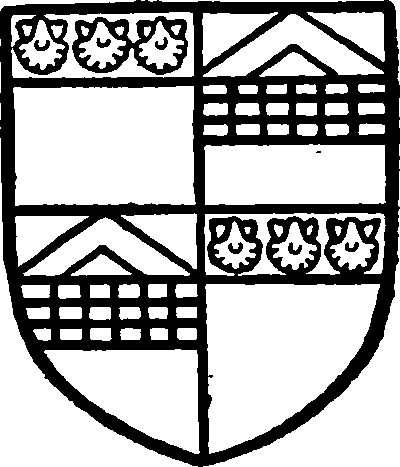
Graham of Norton Conyers. Graham quartered with Or a fesse checky argent and azure with a cheveron gules in the chief, for Stewart of Strathearn.
In 1785 Sir Bellingham Graham held the manor, (fn. 60) which followed the descent of Norton Conyers (fn. 61) till 1839. (fn. 62) It was then purchased from Sir Bellingham Reginald Graham, seventh baronet, by William Rutson of Newby Wiske. (fn. 63) The late Mr. Henry Rutson was the lord of the manor at the time of his death.
Of the 6 carucates held by the Count of Mortain for two 'manors' in 1086, (fn. 64) 3 carucates seem to have come soon afterwards into the hands of Turgis de Radeham; he granted them to the abbey of St. Mary, York, which had an overlordship at WEST NUNNINGTON till the 15th century at least. (fn. 65) Alexander de Nevill held 2 carucates 2 oxgangs under the abbot in 1249. (fn. 66) This had passed to John de Stonegrave before 1284–5, when he held 3 carucates of the liberty of St. Mary (fn. 67); henceforth it followed the descent of the chief manor of Nunnington. (fn. 68) Walter de Teye had a 'capital messuage' there in 1325. (fn. 69)
The Ingram de Folenfaunt who granted yearly rent from his manor of Nunnington to John de Bossevill in 1324 (fn. 70) was probably a tenant of Walter de Teye and the Pateshulls. His daughter Margery quitclaimed her right here to John de Pateshull in 1344. (fn. 71)
The rest of the Count of Mortain's holding appears to have been granted to the Brus family. Adam Torny held 3 carucates of the fee of Brus in 1284–5 (fn. 72) and paid subsidy in 1301. (fn. 73) The 'heirs of William Torny' were still holding in 1428, (fn. 74) but their estate is not again mentioned.
The family of Maltby held from the beginning of the 13th century an estate here of this fee. (fn. 75) Gilbert de Maltby, a contemporary of Simon de Stonegrave, granted land here to Rievaulx Abbey. (fn. 76) John de Maltby held 1 knight's fee in Maltby and Nunnington in 1284–5, (fn. 77) and this descended in his family till the 15th century at least. (fn. 78)
Half a carucate, possibly the half-carucate which had been in the king's hands in 1086, was held from the 13th century onwards of the family of Roos of Helmsley by the lords of the manor. (fn. 79)
The vill of RICCAL, which in 1086 was held like this half-carucate by the king as the successor of Gamel, (fn. 80) also passed to the Roos family. It was held under them by the Stonegraves, (fn. 81) and followed the descent of the manor of Nunnington. (fn. 82)
The priory of St. Mary of Keldholme held 4 oxgangs in Nunnington, 2 of which were granted by Robert de Maltby and Emma his wife. (fn. 83)
Simon de Stonegrave obtained a grant of free warren in his demesne lands in Nunnington in 1257. (fn. 84) Fisheries in the Rye and the Riccal were privileges of the manor in the 17th century. (fn. 85)
Church
The church of ALL SAINTS consists of a chancel measuring internally 21 ft. by 17 ft., modern north vestry and organ chamber, nave 43 ft. 9 in. by 22 ft., west tower 10 ft. 7 in. by 10 ft. 9 in., and a modern south porch.
From the general resemblance to the church at Oswaldkirk it is possible that the nave dates from the latter part of the 12th century, but the earliest details at present existing are of late 13th-century date. The tower appears to have been rebuilt in 1672. The whole church was restored and refitted in 1884, when the present vestry and organ chamber were erected in place of a dilapidated vestry added about 1824.
The east window of the chancel is of late 13thcentury date, and consists of two trefoiled lights, with a quatrefoiled circle within a two-centred head. There are now no windows in the north wall of the chancel, but the small lancet now reset in the north wall of the modern organ chamber originally occupied the position of the organ opening formed at the northwest of the chancel. In the south wall are the remains of an original piscina with a projecting bowl beneath a modern shouldered arch. To the west of this is an original window with tracery similar to that of the east window. To the westward of this, again, is a priest's door with shouldered head, the jambs and lintel of which appear to be original. Next to this is a small lancet with shouldered rear arch, also of original date. The chancel arch, which is also original, is of two chamfered orders. The inner order is stopped upon semi-octagonal corbels, and the chamfer of the outer orders is continued down the responds and stopped about 4 ft. from the floor level.
The north wall of the nave is lighted by three late 13th-century windows of two trefoiled lights with uncusped spandrels within two-centred heads. The north doorway at the western end of this wall is of the same date and has a two-centred head with a label and head stops externally, and a segmental rear arch. Externally a string-course runs beneath the sills of the windows, broken by the label of the north doorway. The string-course is not returned round the angles of the wall, but is cut off flush with the east and west walls. The tower arch is modern and of two chamfered orders. The south wall is lighted by three two-light windows of similar date and character to those of the north wall. The south doorway is also of the same date and has a two-centred head. The present porch was rebuilt in 1884 and replaces a 17th-century porch. A string-course similar to that on the north wall runs beneath the sills of the windows. The tower is in two stages with an embattled parapet and modern crocketed pinnacles. The west window of the ground stage, which was originally square-headed, is of two lights with tracery of 15th-century character and has a modern two-centred head. The bell-chamber is lighted by two-light windows in each face. The roofs are modern and with the exception of that of the tower, which is leaded, are covered with slates.
In the south wall of the nave, within a recess with a multifoiled moulded ogee arch, flanked by gabled pilasters of one offset, is the effigy of a knight of the late 13th or early 14th century wearing a hauberk of mail, with camail, surcoat and knee-cops and holding his heart in his hands. A sword hangs by a belt; most of his shield has been broken away, but from what remains it appears to have borne the arms of Teye, lord of Stonegrave: (or) a fesse between two cheverons (gules) with three molets pierced (or) on the fesse. The feet rest upon a lion; the lion upon which the pillow supporting the head rested has nearly disappeared, one foot alone remaining. Another animal, portions of which remain, perhaps held the bottom of the shield in his teeth. On the north wall of the chancel is an elaborate marble mural tablet to Richard Viscount Preston and Lord Graham of Eske, who died at Nunnington in 1695. On the south wall of the nave is a mural tablet of marble to William Lord Widdrington, son-in-law of the preceding, who died in 1743. This monument was removed from the chancel in 1884. The pulpit is Jacobean.
There are three bells: the first, by Samuel Smith of York, inscribed 'Venite Exultemus Domino 1675'; the second, 'Soli Deo Gloria 1638' (no maker's mark); the tenor, also by Samuel Smith of York, 'Gloria in excelsis Deo 1675.'
The plate consists of a silver cup and cover paten, a paten and a pewter flagon. The cup and cover paten, bearing the same inscription, 'Ex dono Susanna Grahme Paro: de Nunnigton' (sic), and the maker's mark O.S., are of 1661. The other paten is silver-gilt, and is inscribed 'Deo Opt. Max. & Ecclesiae de Nunington Hanc Patinam Humillime D.D. Alexr Dunlop A.M. Rectr ibid. Natali D.N. I.H.S. X.P.S.I. m.dccx.' The flagon is undated.
The registers begin in 1539.
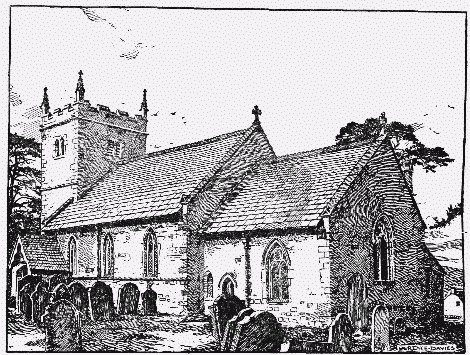
Nunnington Church from the South-east
Advowson
The church of All Saints or All Saints and St. James (fn. 86) at Nunnington seems to have belonged to the fee which Turgis de Radeham granted to the Abbot of St. Mary, York. (fn. 87) The advowson of the rectory was in the hands of the lord of the manor in 1325, and was held of the abbot. It followed the descent of the manor (q.v.) until 1553, since when it has remained in the possession of the Crown. (fn. 88)
Charities
The hospital and school founded by Ranald Graham alias Grahme, 1678, is endowed with a building used as a girls' school, a schoolmaster's residence, let at £4 a year, a schoolmistress's residence at £2 a year and a rent-charge of £20 issuing out of land at Nunnington lately belonging to Mr. Henry Rutson. By a scheme of the Charity Commissioners dated 12 June 1906 the rent-charge of £20 is constituted the endowment of a separate charity to be called the Graham Pension charity, the pensioners to be three in number, to be elected for three years (subject to renewal) and the stipend to be at the discretion of the trustees thereby appointed.
The charity fund consists of £290 invested on the security of a bond of the Mersey Dock and Harbour Board at 4 per cent. arising from gifts of various donors set out in the table of benefactions, including David Bedford's gift of £40 for education, 1730, and Mary Metcalf's gift of £50 for education, 1824. By an order dated 5 August 1904, made under the Board of Education Act, 1899, the sum of £90, part of the said fund, was constituted the Bedford and Metcalf Educational Foundation; the income thereof is paid to the National school erected in 1869.
In 1868 Thomas Agar, by will proved at York 17 April, left £50 to the churchwardens, the income to be applied for the benefit of poor residents. The legacy was invested in £40 Great Western Railway 5 per cent. stock.