Survey of London: Volume 22, Bankside (The Parishes of St. Saviour and Christchurch Southwark). Originally published by London County Council, London, 1950.
This free content was digitised by double rekeying. All rights reserved.
'Union Street', in Survey of London: Volume 22, Bankside (The Parishes of St. Saviour and Christchurch Southwark), ed. Howard Roberts, Walter H Godfrey (London, 1950), British History Online https://www.british-history.ac.uk/survey-london/vol22/pp84-86 [accessed 30 April 2025].
'Union Street', in Survey of London: Volume 22, Bankside (The Parishes of St. Saviour and Christchurch Southwark). Edited by Howard Roberts, Walter H Godfrey (London, 1950), British History Online, accessed April 30, 2025, https://www.british-history.ac.uk/survey-london/vol22/pp84-86.
"Union Street". Survey of London: Volume 22, Bankside (The Parishes of St. Saviour and Christchurch Southwark). Ed. Howard Roberts, Walter H Godfrey (London, 1950), British History Online. Web. 30 April 2025. https://www.british-history.ac.uk/survey-london/vol22/pp84-86.
In this section
CHAPTER 12: UNION STREET
Union Street now extends from Borough High Street to Blackfriars Road. The eastern portion was laid out under an Act passed in 1774 for making a new workhouse for the parish and for "making a carriage way from the . . . High Street, through the Greyhound Inn, into Queen Street, and for improving the passage from thence into Gravel Lane, leading towards the Black Friars Bridge Road, in the parish of Christ Church." (fn. 188) The first intention of the vestry had been to build the workhouse at the western end of the Greyhound Inn, but this proposal fell through and the workhouse was erected in 1779–80 on a piece of ground specially bought for the purpose (on the site of Southwark Bridge Road Fire Station). (fn. 16) The eastern end of Union Street was opened in 1781 and in the following year Union Hall was erected on the south side for meetings of the justices of the county of Surrey. (fn. 72)
In 1813 Queen Street and its continuation, Duke Street, were renamed Union Street (fn. 13) and in 1908 Charlotte Street at the western end was also incorporated into Union Street.
Red Cross Burial Ground
There is a long-established tradition that the burial ground which was formerly at the north-east corner of Union Street and Red Cross Way, and which was known as the Cross Bones Burying Ground, was the burial place of the "single women" of the stews on Bankside. The only proof which has been adduced for the truth of this tradition is the fact that the ground remained unconsecrated, although from the middle of the 17th century (fn. n1) until 1853 it was used as a parish burial ground. The reason appears to be, however, that the ground was held on lease from the Bishop of Winchester and that it was customary only to consecrate freehold ground. (fn. 189) The ground was approximately 133 feet north to south and 153 feet east to west. In 1791 the vestry agreed to use the south-west corner of it for a new schoolhouse for the Boys' Charity School which was then "unhappily Situated in a Dark Alley" near Montague Close. (fn. 16) Seventy boys at this school were supported by the charity known as Collett's Gift and by voluntary subscriptions and twenty by the Newcomen Charity. (fn. 72) St. Saviour's Parochial Schools now occupy the whole site of the burial ground.
No. 18 (formerly No. 8)
Circa 1789 George Gwilt, the elder, surveyor to the Surrey and Kent Commissioners of Sewers, district surveyor of St. George's Parish and surveyor to the Clink Paving Commissioners, built several houses on the north side of Union Street, east of the burial ground. (fn. 17) He and his son occupied No. 18 (formerly No. 8) for a number of years. (fn. 31) Here he formed a museum of local antiquities. (fn. 17) Copies of two of his drawings of Roman pottery are reproduced on p. 1. His house, a drawing of which is reproduced on Plate 62a, was pulled down at the end of the 19th century.
Nos. 59 and 61 (formerly 175 and 174)
These premises have been in the same occupation for a long period and in effect form one building. Most of it dates from early in the 19th century but it incorporates part of an older house which appears to have been built in the later half of the 18th century.
The remains of the earlier building include a room at the rear on the first floor containing plain dado panelling and a stone mantelpiece with moulded jambs and head with a moulded keystone on which is an incised lozenge device. On either side of the mantelpiece are tall wood cupboards similarly panelled to the dado. A dresser extends the full width and height of the east wall of the room.
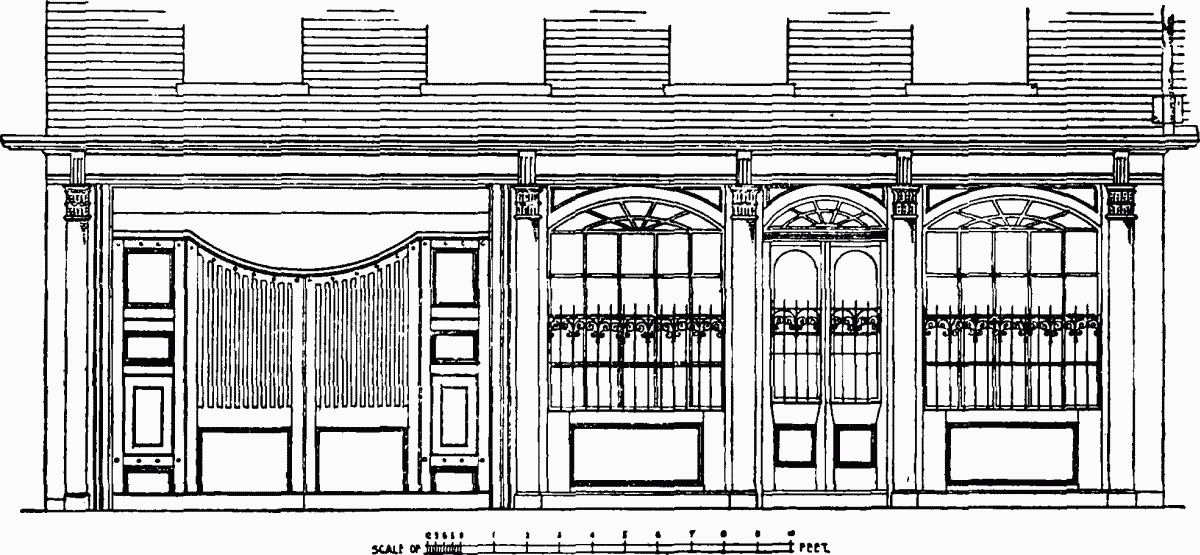
Nos. 59 and 61 Union Street. Shop front. Measured drawings by R. G. Absolon
The early 19th-century brick front has flat gauged arches to the windows and a moulded stone cornice with blocking course. There is a good shop front of this date with a recessed entrance in the centre and a wide entry at the east end. A bracketed wood cornice supported on oval Corinthian pilasters extends the full width of the front. The shop entrance and the windows on each side have arched fanlights with radiating bars and ornamental wrought-iron protective grilles below. The reveals to the shop entrance and the lower part of the double shop doors and stallboards are panelled. There are double doors to the entry which are shaped above to a hollow curve and have plain vertical wood grilles and panelling beneath and at the sides. On the first floor are two office rooms having communicating folding doors with large circular panels and reeded architraves with rosettes in the angles. The other doors and window openings have similar surrounds and with the window shutters are panelled in the manner of the early 19th century.
In the yard at the rear is an old building of four storeys in brick and timber with the top storey mainly of wood, louvred on the side next the yard. The interior is plain with an open timber roof covered with pantiles. The first and second floors are lighted by ranges of small pane mullioned windows, the majority being filled with knob glass. The centre part towards the yard has double-hung delivery doors to each floor. The building was designed for malting barley but is now only used for storage, the ground floor retaining the stalls of former stabling. It is in poor condition.
The site of these premises originally formed part of Southwark Park Estate and of the ground leased in 1820 to Arthur Pott and others by the Bishop of Winchester. (fn. 190)
In 1821 Arthur Pott leased Nos. 59 and 61, Union Street, with the ground behind and the house next door to John Allsop. (fn. 190) The firm of Allsop, turners and brushmakers, were in occupation of the premises from 1787 until 1880. Their factory is marked on a plan of the Clink Liberty prepared for the Clink Paving Commissioners in 1812. The present owners, Joseph Watson & Co., yeast manufacturers, have held Nos. 59 and 61 since 1882. (fn. 31)
Nos. 100–112 (formerly 56–62)
These houses, which vary in height, form a mid to late 18th-century group. They comprise two storeys and attic over shops. Most of them have red brick fronts with hipped dormers in tiled roofs. Some of the windows retain their flush frames. The houses are in a derelict condition through damage from enemy action and subsequent deterioration.
Nos. 100–112 can be traced in the rate books back to 1748, when the existing books start. There is no indication of any rebuilding, though the houses have been much altered and shop fronts have been inserted. In the middle years of the 19th century Union Street was a centre of "the hat trade and furriers connected with this Branch of Manufacture," (fn. 83) and the directories show Samuel Cashshaw "hat manufacturer," at No. 100 in 1817–44; Steele and Foster, "hatters and furriers," at No. 102 in 1864–73 and Lincoln and Bennett, "hat manufacturers," at No. 104 in 1850–61.