
Survey of London: Volume 25, St George's Fields (The Parishes of St. George the Martyr Southwark and St. Mary Newington). Originally published by London County Council, London, 1955.
This free content was digitised by double rekeying. All rights reserved.
'Suffolk Place and the Mint', in Survey of London: Volume 25, St George's Fields (The Parishes of St. George the Martyr Southwark and St. Mary Newington), (London, 1955) pp. 22-25. British History Online https://www.british-history.ac.uk/survey-london/vol25/pp22-25 [accessed 8 May 2024]
CHAPTER 3: SUFFOLK PLACE AND THE MINT (LANT STREET, GREAT SUFFOLK STREET, ETC.)
Wyngaerde's view of London, circa 1550 (Plate 10), shows Suffolk Place on the west side of Borough High Street as "a large and most sumptuous building," (fn. 76) surmounted by towers and cupolas. Its size and importance so much impressed the unknown draughtsman of the plan of Borough High Street of circa 1542 (see Plate 1a), that he made it appear larger than St. Saviour's Church or any other building in the locality. Stow states that the house was built by Charles Brandon, Duke of Suffolk, in the time of Henry VIII and later writers have followed his lead, (fn. n1) but the Brandon family had had a residence on the site for at least half a century previously. Sir John Howard, afterwards Duke of Norfolk, stayed at "Brandennes Place in Sothwerke" in 1465, (fn. 77) and it is probable that both the Sir William Brandon who was killed on Bosworth Field, and his father, also Sir William, who survived him, lived there. Sir Thomas Brandon, son of the elder Sir William, who inherited the house from his mother in 1497, (fn. 78) added to the grounds both by purchasing land and by leasing part of the Bishop of Winchester's Park. He lived in Southwark in lavish style. His will (fn. 79) mentions the plate, hangings, carpets and beds in the house, all of which he left to Lady Jane Guildford for life with reversion to his nephew Charles, and gowns of cloth of gold which were to be broken up and made into "coats for the rood" of St. Saviour's Abbey at Bermondsey, of Barking Abbey, and of "Our Lady Pew" at Westminster. (fn. n2)
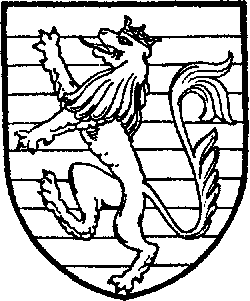
Charles Brandon, Duke of Suffolk
Sir Thomas died in 1510, and in the same year his nephew succeeded to his office of Marshal of the King's Bench. (fn. 81) Seemingly he acquired possession of the family residence at about the same time, granting Lady Jane Guildford in exchange an annuity of £47 6s. 8d. (fn. n3) (fn. 82) Charles Brandon was a flamboyant character and a great favourite with Henry VIII, who created him Duke of Suffolk in 1514. He was present at the Field of the Cloth of Gold in 1520 (fn. 25) and in 1522 he entertained the King and the Emperor Charles V to dinner at Suffolk Place, and afterwards hunted with them in Southwark Park. (fn. 83)
In 1536, Henry VIII, having first arranged alternative accommodation for the Bishop of Norwich in Cannon Row, Westminster, granted the bishop's house near Charing Cross to Charles, Duke of Suffolk, in exchange for Suffolk Place, (fn. 82) which became part of the jointure of the young Queen Jane. (fn. 81) A keeper of Suffolk Place was appointed and for the next 20 years the house was used occasionally as a royal residence or for the reception of distinguished visitors. Entries in the royal accounts for 2 gardeners and 2 women "weeding, and setting of strawberries," and for 3,000 "red rossiers" and 1,000 slips of damask roses and cages to put birds in, suggest that the gardens were well kept up. (fn. 81)
About the year 1545 a Royal Mint was established in a part of the building where, early in his reign, Edward VI commissioned certain "new moneys of gold"—the sovereign, royal, angel and half angel—to be made. (fn. 21) The mint was closed in 1551 owing to the discovery of frauds amounting to £4,000. (fn. 84)
King Philip and Queen Mary spent the night at Suffolk Place in August, 1555, after dining with the Lord Chancellor at Winchester House. (fn. 85) In the following February the Queen granted Suffolk Place to the Archbishop of York by way of compensation for the loss of York Place (Whitehall Palace) which her father had taken from the see. (fn. 86) The grant included barns, stables, dovecotes, orchards, gardens, banqueting houses and conduits totalling 14 acres of ground in all.
From a survey of the property (fn. 87) made in the time of Edward VI it is obvious that parts of the grounds had already been leased out and that small tenements had been built along the street frontage. The house was perhaps too large or too much out of repair for the Archbishop, for he decided to dispose of it almost at once, and in July, 1557, Elles Dyall and John Tull "citizens and tylers" were in possession. (fn. 88) The break up of the mansion began immediately and it was completely demolished by June, 1562, when the site was sold to Anthony Cage. (fn. 89) Stow tells us that "many small cottages of great rents" were built there "to the encreasing of beggers in that Borough." (fn. n4) (fn. 76)
The estate, which continued to be known as Suffolk Place or the Mint, was owned by Sir Edward Bromfield (fn. n5) in 1651, when the Parliamentary Commissioners, under the mistaken impression that it was still royal property, made a survey. (fn. 92) Besides a capital messuage on the south, by Harrow Alley, the Commissioners listed 16 tenements with gardens and grounds amounting to about 13 acres.
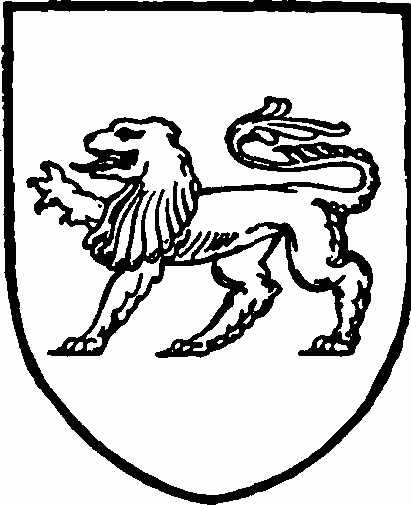
Sir Edward Bromfield
In 1679 Thomas Lant married the daughter of Sir Edward Bromfield, and in due course acquired a life interest in Suffolk Place. (fn. 93) At this time, as shown on Morden and Lea's map (1682), although the northern part of the area in the neighbourhood of Mint Street, and the frontage to Blackman Street, were closely developed, the greater part of the site was still open ground. In 1702 Lant petitioned the House of Lords for leave to bring in a Bill to enable him to make leases at the best improved rent that he could get. He had previously had no power to do so, and the tenements were "unrepaired, Unlet and Ruinous." (fn. 93) The Act was passed and considerable building activity followed, but the present No. 66 Great Suffolk Street, a three-storey building with mansard roof, is the sole survivor of this period. On the 1761 edition of Rocque's map, Great Suffolk Street is shown as Dirty Lane, and there is still a fair-sized piece of garden remaining to the north of it. Lant Street was formed in 1770 but was not fully built up until after 1800. Nos. 31–55 (Plate 19b) date from the late 18th century and Nos. 25–29 from the early 19th century. (fn. n6) Dickens lodged in Lant Street as a boy when his parents were in the Marshalsea, and in The Pickwick Papers he depicts Bob Sawyer in lodgings there and remarks on the gentle melancholy engendered by the street in which "the majority of the inhabitants either direct their energies to the letting of furnished apartments, or devote themselves to the healthful and invigorating pursuit of mangling."
The Suffolk estate lay within the Rules of the King's Bench Prison and, perhaps partly for this reason and partly because it had once been royal property and had remained an undivided estate for several centuries, it acquired some prescriptive rights as a liberty. When it was put up for auction in 1811 the particulars of sale stated that the owner had exercised the privilege of appointing two constables to act there, and that this privilege would be handed on to the purchaser of the largest share. (fn. 91)
The Mint had an evil reputation during the 18th century as a resort of coiners, thieves and the like. It was the haunt of the notorious Jack Sheppard and his companion Jonathan Wild, who is said to have kept his horses at the Duke's Head in Red Cross Street. Some slight improvement was made to the western end of the Mint in 1820–24, when Southwark Bridge Road was cut through, but in 1840 the district was described as "exceedingly filthy and wretched," (fn. 94) and it was still intersected by open sewers. In 1842 Southwark Improvement Commissioners were appointed by Act of Parliament to form a new street through the Mint from Blackman Street to Southwark Bridge Road and to carry out other improvements there. (fn. n7) (fn. 95) A plan was prepared but was not carried out because there was no provision in the Act for the payment of the cost. (fn. 96) Year after year the vestry petitioned the Commissioners for Metropolitan Improvements and the Commissioners of Woods and Forests for some means of raising the necessary funds to clean up the district. In 1848 the Rev. John F. Bullock and other landlords of the Mint themselves put forward a proposal for widening Peter, Queen and King Streets but withdrew it before the vestry had time to discuss it. It was not until 1875, when the vestry, approaching the problem from another angle, suggested that the formation of a new road to link up with Southwark Bridge Road would be a great relief to the congestion of traffic over London Bridge, that any progress was made. Powers to form such a road, approximately on the line proposed by the 1842 Act, were granted to the Metropolitan Board of Works by the Metropolitan Street Improvements Act of 1877, and Marshalsea Road was opened in 1888. (fn. 97)
A small public open space, known as Little Dorrit's Playground, was opened in 1902 north of Marshalsea Road. Much of the area is now derelict as a result of air raid damage and is awaiting redevelopment.
The late 17th century brick building illustrated here, which occupies the approximate position of the capital messuage held by Bromfield in 1651, survived until the early 1930's. It was hidden away among the network of courts—Falcon Court, Bird Cage Alley and Harrow Alley—which were built up round it in the 18th century. After being used at various times as a school and workshop it became a lodging house at some time before 1851 (fn. 98) under the name of the Farmhouse and continued as such until after the 1914–18 war. W. H. Davies, the tramp poet, lodged there in the early 1900's. (fn. 99)
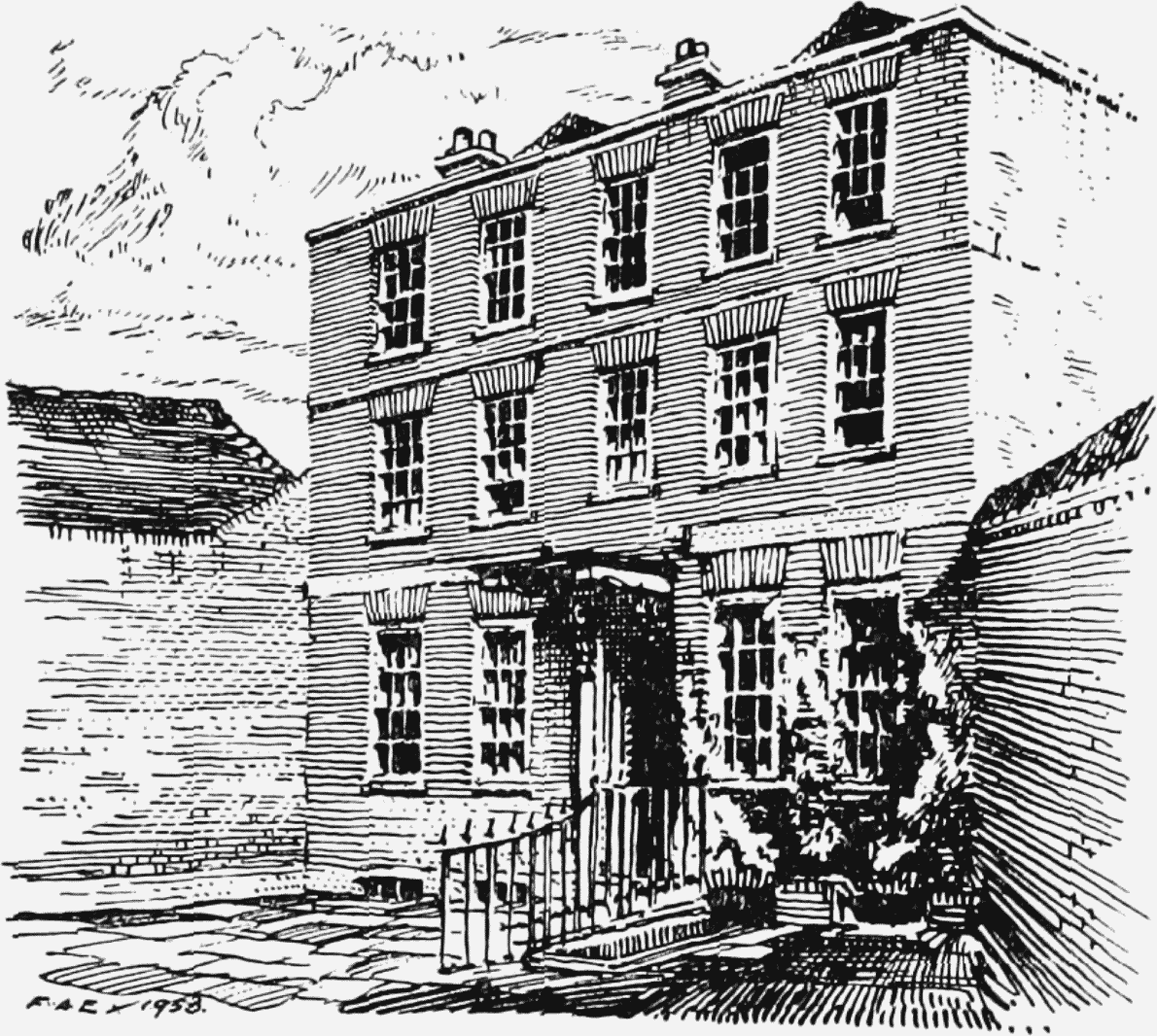
The Farmhouse, Harrow Street