Survey of London: Volume 25, St George's Fields (The Parishes of St. George the Martyr Southwark and St. Mary Newington). Originally published by London County Council, London, 1955.
This free content was digitised by double rekeying. All rights reserved.
'St George's Fields: Formation of the roads', in Survey of London: Volume 25, St George's Fields (The Parishes of St. George the Martyr Southwark and St. Mary Newington), ed. Ida Darlington (London, 1955), British History Online https://www.british-history.ac.uk/survey-london/vol25/pp39-48 [accessed 30 April 2025].
'St George's Fields: Formation of the roads', in Survey of London: Volume 25, St George's Fields (The Parishes of St. George the Martyr Southwark and St. Mary Newington). Edited by Ida Darlington (London, 1955), British History Online, accessed April 30, 2025, https://www.british-history.ac.uk/survey-london/vol25/pp39-48.
"St George's Fields: Formation of the roads". Survey of London: Volume 25, St George's Fields (The Parishes of St. George the Martyr Southwark and St. Mary Newington). Ed. Ida Darlington (London, 1955), British History Online. Web. 30 April 2025. https://www.british-history.ac.uk/survey-london/vol25/pp39-48.
CHAPTER 5: ST. GEORGE'S FIELDS: THE FORMATION OF THE ROADS
St. George's Fields, called Southwark Field until nearly the end of the 15th century, formed the common field of the manor and borough of Southwark. The mediaeval borough of Southwark was granted to the City of London by Edward III, and the three Southwark Manors, the Guildable, the King's Manor and the Great Liberty Manor came into the possession of the City later; the first was merged into the borough by an Act of Parliament passed in 1377, (fn. 122) and the two latter were granted in 1550 by charter of Edward VI. (fn. n1) That charter also granted to the City "Moulter's (Moulton's) Close" and 39 acres and 3 rods of meadow in St. George's Fields. (fn. 11) The cost of the charter was paid for out of the Bridge House account, (fn. n2) and henceforward this land in St. George's Fields, together with the 17 acres there which the Wardens of London Bridge had acquired in the first half of the 13th century, were administered as part of the Bridge House Estate.
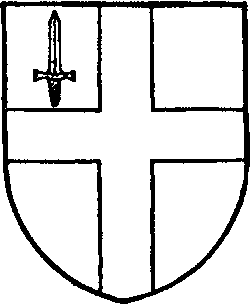
City of Lond
There are frequent references in mediaeval records to the holdings of St. Thomas' Hospital, the Priory of Bermondsey and others dispersed in strips in the fields. Among the Southwark Manor records is a survey made in 1555 of the way in which the field was divided between the various owners. It was said to contain 155 acres in all, of which the City definitely claimed 20, but, probably owing to the confusion which had arisen after the dissolution of the religious houses, only just over 90 acres were accounted for; the survey ends with a note that the residue should go to the lords of the fee, i.e., the City "yf noman canne clayme iustly any more." (fn. 124)
By 1621 the acreage of the fields had shrunk to 144 (fn. 125) and from time to time other small portions were built on or enclosed, but it is astonishing to find the strip system of agriculture with the traditional throwing open for common grazing after Lammastide persisting there on the very doorstep of the metropolis until almost the end of the 18th century, and even after the formation of the roads to London, Westminster and Blackfriars Bridges across the fields had made nonsense of the original field plan.
To the west, Southwark Field merged into Lambeth Marsh, and to the north it was bounded by the Bishop of Winchester's Park, known in the Middle Ages as the Wyllys or Willows. It was low-lying and was intersected by ditches and ponds and it was for the most part used only for pasture, but some crops were being grown there in the 17th and 18th centuries. When Southwark became populous frequent edicts were issued against the casting of offal and other refuse into the river and so polluting the water supply. The only easy alternative was to deposit it in the fields, and the records of the Surrey and Kent Sewer Commissioners contain entries such as: "Yf the said Conygrave doe carry the Offall wch cometh of his Slaughter house… from tyme to tyme in wheele-barrowes into the feilds… Then hee may be tollerated to keepe a slaughter & tripehouse." (fn. 126) There is also evidence that some of the open sewers which carried away foul water from the tenements of the Borough flowed back into the fields and not out into the river. (fn. 126) Yet in the 18th century Londoners came in response to the advertisements to drink the medicinal and health giving waters sold from St. George's Spa at the Dog and Duck!
As has been shown in Chapter 1, the swampy nature of the ground in Southwark was a deterrent to the formation of roads. There were, however, tracks across St. George's Fields from an early date which were used in dry weather. One of these, which ran between the north-east side of the fields and the Bishop of Winchester's Park to the river-side near Paris Garden, was the subject of a lawsuit in 1618 between the innkeepers of Borough High Street (backed by the City authorities) and Edward Alleyn and other inhabitants of Bankside. The former wished to close the path, since visitors to the theatres and bear gardens near the river were using it instead of coming up to London Bridge and then taking boat or going along the road on the river wall, thus depriving the inns near the bridge foot of custom. The details of the dispute and the plan made in connection with it are reproduced in Bankside. (fn. 7) Suffice it here that the path remained in use, became known as Dirty Lane, and, in the early years of the 19th century, was widened to form Great Suffolk Street.
None of the other paths worn across the fields became a recognized right of way except the one which ran from Newington Butts to Church Street, Lambeth, and to the Horseferry there. As is shown in a later chapter (p. 81) this path probably dates back at least to the 13th century when the Archbishop of Canterbury built himself a house in Lambeth. The fact that the path did not cut across any holdings is a confirmation that it was of early date. It is shown on the earliest known plan of the fields, made about 1555, (fn. 124) skirting Moulton's Close (part of which was later occupied by Bethlem Hospital) and the three adjoining plots of land. During the 17th century this path was formed into a road, roughly on the line of the present Lambeth and St. George's Roads. (fn. n3) It thus became the first carriage road across this open and marshy area (see Rocque's map, Plate 53), but during the first part of the 18th century it can have been little more than a track. An Act of 1719, (fn. 127) which ordered that money should be set aside out of the tolls on Surrey roads for its repair, stated that it was in such a bad condition as to be dangerous in the winter season. The traffic along it greatly increased after the opening of Westminster Bridge and Westminster Bridge Road, and in 1751 a further Act (fn. 128) was passed which not only ordered that the existing road from the Stones End at Lambeth to the almshouses at Newington (i.e. St. George's Road), should be opened and widened, but also prescribed the continuation of Westminster Bridge Road and the formation of Borough Road, across the fields to Borough High Street, and of New Kent Road, as a continuation of Lambeth (St. George's) Road from Newington Butts to the Old Kent Road. (fn. n4) The Act specified that the roads were to lie in as straight lines as possible and that the ground purchased for them should be not less than 80 feet wide.
Much of the line of the new road across St. George's Fields lay over City, i.e. Bridge House Estate, property (see p. 50), and in 1753 the necessary strips of land were purchased by the Trustees of the Surrey New Roads from the City and the other owners concerned. By 1760, therefore, when Blackfriars Bridge was projected, St. George's Fields were traversed by two roads running west to east across open ground with a few scattered buildings on the perimeter, the two chief being the Dog and Duck in Lambeth Road and the King's Bench Prison in Borough Road (Plate 53).
The erection of Blackfriars Bridge posed an ideal planner's problem. Approach roads were needed across an open area with no obstacles to circumvent except the marshy nature of the ground and the need for an ultimate link up with the main roads running south-west and south-east towards the coast. The flow of Turnpike Acts was in full spate at this time, and it was the fashion for the landed and coach-owning gentry to take an interest in road planning.
A number of solutions were put forward. The first to be published appeared in the Universal Magazine for May, 1765. It proposed that there should be one main road from the bridge, branching just near Christ Church, one branch running south-west to Lambeth Marsh, and the other running south-east to Newington Butts and crossing Borough Road diagonally. In the following year the supplement to the Gentleman's Magazine contained a plan purporting to be by a person "perfectly acquainted with every spot" on the Surrey side of the bridge. He suggested two main roads, one running in almost a straight line from the bridge foot to join what is now Kennington Park Road near Newington Butts, and the other connecting this road, at a point just north of Christ Church, with the New Inn at the foot of Westminster Bridge. The plan also included several subsidiary roads, one of which linked Newington Butts with Gravel Lane, roughly parallel to the main approach road to Blackfriars Bridge. The scheme had little to recommend it except immediate expediency. It had no symmetry, the projected roads joined the older roads at awkward angles, and the main road junction was placed at Christ Church, too near the bridge for convenient dispersal of traffic.
In July, 1768, the London Magazine published a plan which approximated to that ultimately adopted except that no provision was made for a circus at the road junction in the middle of the fields, though one was provided near Christ Church, the meeting place of two new proposed roads, one running straight to Westminster Bridge Road and the other to Borough High Street. This plan was re-issued in 1769 with the lines of roads, as finally decided, superimposed upon it.
The plan reproduced on Plate 21 was the most elaborate of the various schemes put forward, with a criss-cross of roads in the middle of St. George's Fields and five circuses where they intersected. This plan, of which there are copies in the British Museum, the Bodleian Library and the Guildhall Library, appears to have been issued separately.
In November, 1767, the City Corporation instructed the Blackfriars Bridge Committee to prepare a Bill for the approaches. (fn. n5) The aim of the committee and of their surveyor Robert Mylne was, we learn from a later report, to make "a handsome avenue" through the County of Surrey by which "Strangers from the Continent" might approach the Capital, and to form three subsidiary roads. First, "a direct way to Saint Margarets Hill at the Centre of Southwark to accomodate that quarter and relieve London Bridge, the Second a Line to Newington Butts where all the Roads from the South met as in a Center, and thirdly a direct Line to Westminster Bridge to communicate with all the Villages to the Westward and to accomodate the City with a more short way to the further parts of Westminster, the Courts of Justice, Houses of Parliament, etc. than by the longer and incumbred way of the Strand and Charing Cross." (fn. 9) So many conflicting interests were involved that the committee finally decided to drop the idea of the side roads for the time being and to ask for powers to construct a straight road, 80 feet wide, from the bridge to a circus, not exceeding 250 feet in diameter, at its junction with what are now Borough and Westminster Bridge Roads, and for two new roads, Lambeth and London Roads, from the circus to the Dog and Duck (on the site of the Imperial War Museum) and Newington Butts respectively (Plate 22).
In 1768–69 these proposals were debated in the House of Commons. (fn. 30) Various objections were raised, (fn. n6) but Mylne having, after discussion, come to an agreement with the Trustees of the Surrey New Roads, the main objectors, the Bill received the Royal assent in April, 1769. (fn. 129) The rise in the ground level in the centre of the fields was probably the determining factor in the decision to make the main road junction there.
Mylne wasted no time. By 26th May, 1769, he had got out his specifications for the contractors who were to supply the gravel and to make the roads, including the provision of "stout strong Labourers… accustomed to the Shovel Pick Ax or Wheel-barrow under the Regulation of one or two experienced Foremen," with an estimate of cost (£15,000). (fn. 130) On 7th June, he was ready with plans of the new roads and particulars of the area, owners and tenants of the pieces of ground which would have to be purchased. A week later an advertisement was inserted in the Daily Advertiser inviting scavengers and others to shoot rubbish of any kind at convenient points along the lines of the proposed roads. On 22nd June, the committee gave William Austin the contract for supply of gravel and William Kyberd for labour at the price of 1s. 8d. a day for each man, including tools and beer. Negotiations with owners of property went quickly forward and were practically complete by the end of July. Most of the ground was bought at a flat rate per acre, or exchanged for other City property, but in a few cases some further compensation had to be given for loss of trade or amenities. (fn. n7) On 4th June, 1770, just over a year from the passing of the Act, the roads were completed sufficiently to be opened for general use; a remarkable feat, especially when one considers the marshy nature of the ground and the fact that Mylne was also responsible for work on the northern approaches at the same time. He certainly deserved the formal vote of thanks given him by the committee "for the great Skill Diligence and Integrity" with which he had "executed the several important Works entrusted to his Care." The rails along the sides of the roads were finished early in 1771, and in June Mylne was able to report that the raising of the new roads "with rubbish" was complete. (fn. n8)
Meanwhile, in June, 1770, the Blackfriars Bridge Committee decided that an obelisk should be placed in the middle of the circus at the road junction in the fields, and Mylne was ordered to prepare a drawing. The design was approved and work was begun on the foundations. A protest of the Trustees of the Surrey New Roads that it would be inconvenient to travellers was withdrawn when they were told that lights would be erected there, and the obelisk was apparently in position by July, 1771, when the committee ordered that the City arms should be carved upon it and an addition should be made to the inscription specifying that it was put up during the mayoralty of Brass Crosby. It was railed in, and four unserviceable guns were put up as posts to protect it from damage by traffic. The obelisk remained in the middle of St. George's Circus until 1905, when it was moved to its present position in what is now the Geraldine Mary Harmsworth Park near the junction of Lambeth and St. George's Roads (Plate 42b). The obelisk, which is of Portland stone, bears the inscriptions—
North face—
ERECTED IN
XIth Year
OF THE REIGN
OF KING GEORGE
THE THIRD
MDCCLXXI
THE RIGHT HONOURABLE
BRASS CROSBY ESQUIRE
LORD MAYOR
South Face—
ONE MILE
CCCL FEET
FROM
FLEET STREET
(City coat of arms below)
East face—
ONE MILE
FROM
PALACE YARD
WESTMINSTER
Hall
West face—
ONE MILE
XXXX FEET
FROM
LONDON BRIDGE
For the next few years Mylne was kept busy. There were still some outstanding matters to be settled concerning property acquired for the roads and there were lengthy negotiations over the proposal, initiated by the parish of St. Saviour in 1774, for the formation of a new cross road from Borough High Street to Great Surrey Street (Blackfriars Road) (fn. n9); Union Street, formed on the line of Queen Street, Duke Street and Charlotte Street, was the ultimate outcome of this project. There were, too, difficulties over the accounts. In June, 1775, the toll-keeper at Blackfriars Bridge complained that the greater part of the 2,158 pounds weight of copper taken in tolls during the previous three weeks was bad or counterfeit, and arrangements had to be made for the bad coin to be melted down. The total cost of the roads, as reported by the surveyor in 1780, was £28,607 3s. 1¼d., £1,207 3s.1¼d. 3s.1¼d in excess of the amount borrowed for the purpose. On the other hand, the amount raised by tolls and the sale of surplus materials between Michaelmas, 1775, and Michaelmas, 1779, was £26,367 13s. 6½d. These figures show that the roads were given heavy use as soon as they were completed and that by 1780 their capital cost was in a fair way to being recovered out of income. (fn. n10) During the Gordon Riots in June, 1780, the toll houses on the bridge were burnt and the money chest containing about £268 was stolen. (fn. n11) With his usual promptitude Mylne had the toll houses rebuilt within four months. The week-day tolls were continued until 22nd June, 1785 when the gates and toll houses were removed and sold. In 1782 the committee had ordered that the Sunday toll on foot passengers over the bridge should be reduced from 1d. to a ½d. The Sunday toll was not finally abolished until 1811. It produced a net income of about £500 a year for watering and lighting the bridge.
Although, as will be shown in the next chapter, the responsibility for letting the Bridge House property in St. George's Fields, and their ultimate enclosure and development, devolved on the City Surveyor, George Dance junior, it was Mylne who had to see that "the Fronts of the Houses" were "Conformable to the General Design" of the streets, and to prevent encroachments on the roads and on the ten-foot strip on either side of them which the Act laid down was to be preserved clear of obstructions.
Mylne was a young and untried man when he was first engaged, and the Blackfriars Bridge Committee agreed to pay him a salary of £350 a year, on the tacit understanding that if he completed the work to their satisfaction his ultimate reward would be equivalent to that usually paid to City surveyors (i.e. 5 per cent on all bills less the salary already paid to him and the allowance to his clerks). In December, 1770, he asked the committee to adjust the payments made to him, a request which they passed on to the Court of Common Council with the proposal that he should receive the equivalent of 5 per cent on all works payments and 1 per cent on purchases and sales of materials. This proposal was refused, and it was not until 1775, after a further petition from Mylne, that the Court of Common Council agreed to this allowance being made to him.
After 1773 his salary was fixed at £105 a year (plus the percentage allowances) a meagre enough sum in return for all his work on the bridge and its approaches, the embankment at the northern abutment of the bridge, and the great sewer over the Fleet Ditch, especially as, to quote his own words, "His Plans were copied and resorted to freely: His Advice was always given readily without a Fee; and his House open at all times for these Purposes, as a Public Office." Mylne's reputation as an architect and engineer is well established; the record of his relations with the Blackfriars Bridge Committee shows that he was also a singularly upright, conscientious and efficient public servant. He retained his office as surveyor to the Blackfriars Bridge Committee until his death in 1811.
When the Strand (i.e. Waterloo) Bridge was built under the Act of 1809 (fn. 131) most of the land between its southern abutment and St. George's Circus was still open ground, and there were few vested interests or physical obstacles to hinder the making of a wide, straight approach road to meet Westminster Bridge Road just west of the circus. The purchase of ground from James Quallett, the City Corporation, Temple West and others was duly authorized and a 70 foot wide road was completed by 1820. (fn. n12)
It was unfortunate that by 1811, when the formation of Southwark Bridge and its approaches was authorized, (fn. 133) the ground to the north and east of St. George's Fields was already closely developed and the cutting of a direct road from the bridge to St. George's Circus, which would have been the logical finish to the pattern of the main roads in this area, would have entailed too drastic a clearance of existing buildings to be acceptable either to Parliament or to the promoters of the company. The 1811 Act prescribed a 60 foot wide road between the bridge foot and Union Street and a continuation to Blackman (Borough High) Street approximately on the line of the later Marshalsea Road. The first part of this road was built, though even this was curved instead of having a clean straight line, but apparently the promoters baulked at the difficulty of cutting through the warren of courts and lanes which made up the Mint, and in 1820 (fn. n13) they obtained an amending Act (fn. 134) which enabled them to divert Southwark Bridge Road westward, south of Union Street, to cross Great Suffolk Street and Borough Road, and join Newington Causeway a little to the north of the Elephant and Castle. A minimum of 45 feet in width was prescribed for this part of the road. Expediency had replaced planning in the development of St. George's Fields.
Before leaving the subject of the road structure of St. George's Fields something must be said about the road junction at the Elephant and Castle, which for the last sixty years and more has been one of the worst traffic bottlenecks in south London. The trouble had its origins in 1641, when John Flaxman, a blacksmith, got permission from the Lords of the Manor to build a workshop on a piece of waste ground in the middle of the road on condition that he gave 4s. a year to the poor. (fn. 135) The traffic of the roads, to Kennington, Walworth and Lambeth, which met there, brought plenty., of trade to the smithy, and in 1658 the parish officers thought it worth while to apply to the manor court for a grant of the ground to be held by copy, of court roll for the benefit of the poor. (fn. 136) In 1672 the smithy was known as the White Horse. (fn. 135) It is clearly marked as a detached house on the 1681 plan of Walworth Manor (Plate 49). Fifty years later it was leased to William Benskin, farrier, who covenanted to build a brick house or houses on part of the plot. (fn. 137) At some date between 1731 (fn. 138) and 1767, and probably about 1760, after the formation of London Road and the New Kent Road, the smithy became an inn and was renamed the Elephant and Castle.
In 1796, a survey (fn. 139) was made for the parish of the Elephant and Castle Estate, and it was decided to let it in three lots, one of which was the Elephant and Castle public house and the two brick tenements adjoining it. (fn. n14) The inn was rebuilt just before 1818 when it was leased to Mrs. Jane Fisher for 31 years. (fn. 140) This building is shown in Pollard's coaching print which forms the frontispiece to this volume and in the view of the Newington Turnpike on Plate 50a.
At the end of the 19th century, the volume of traffic using the Elephant and Castle intersection was becoming so great that the island site was seriously impeding its flow. The current leases expired in 1890 and 1892, and in 1891 the Vestry of St. Mary, Newington and the Trustees of the St. Mary Copyhold Estates agreed on joint negotiation with the London County Council, for the widening of the Walworth Road. The site was enfranchised, and negotiations were protracted until 1897, but neither the Trustees nor the Council were prepared to pay the considerable cost involved. (fn. n15) The whole site was let on building lease, and in 1897–98 the Elephant and Castle was again rebuilt.
Two schemes had been proposed at this time: the first, put forward by the Vestry, suggested the moving westward of the Elephant and Castle site from the Walworth Road towards Newington Butts and the curtailing of the projection towards Newington Causeway, without any reduction in the overall area: the second, put forward by the Council, proposed that the west side of the Walworth Road and the north side of Short Street should be set back, to ease the flow of traffic. (fn. 141)
In 1930, the Council and the Ministry of Transport put forward another scheme, not merely for Walworth Road, but for the whole intersection. Parliamentary approval was obtained (fn. 142), but the financial difficulties of the depression intervened, and the powers lapsed. The proposed lay-out was similar to that at the junction of Kingsway with the Strand. The line of Walworth Road and Newington Causeway was to be retained, but the island on which the Elephant and Castle stood was to be removed in order to widen Walworth Road. To the west, a semi-circular roadway, enclosing a central block of buildings, was to be formed by cutting back all the building lines between Newington Causeway, London Road, St. George's Road, Newington Butts and Short Street. The central block was suggested as suitable for artisans' dwellings, as it would have little commercial value. The cost of this scheme, including the rehousing of the displaced population, was estimated at £1,950,000. (fn. 143)
Pre-war fire damage and war damage (some of the most intensive in London), although leaving the public house and some other substantial buildings, have cleared a considerable area round the road intersection and given an opportunity for comprehensive re-development. The County of London Plan (1943) proposed a diversion of Newington Butts across the site of the Metropolitan Tabernacle to join a large six-sided traffic roundabout. (fn. 144) In 1947, it was proposed that the roadway on this roundabout should be raised so that pedestrians could pass underneath it to a block of buildings and the Tube station on the island. The five other main roads were to be widened.
The revised proposals of the L.C.C. Development Plan (1951) (fn. 145) are due to the high cost of the 1947 scheme and the decision to restore the Metropolitan Tabernacle. In this latest scheme which is still (1954) under consideration, Walworth Road is diverted via Draper Street to join Newington Butts at a subsidiary roundabout, while at the main intersection five roads converge on a five-sided roundabout with a central grass-covered open island without buildings. The island on which the Elephant and Castle now stands will disappear, though the public house will probably be rebuilt nearby. (fn. n16)