Survey of London: Volume 24, the Parish of St Pancras Part 4: King's Cross Neighbourhood. Originally published by London County Council, London, 1952.
This free content was digitised by double rekeying. All rights reserved.
'Somers Town', in Survey of London: Volume 24, the Parish of St Pancras Part 4: King's Cross Neighbourhood, ed. Walter H Godfrey, W McB. Marcham (London, 1952), British History Online https://www.british-history.ac.uk/survey-london/vol24/pt4/pp118-123 [accessed 30 April 2025].
'Somers Town', in Survey of London: Volume 24, the Parish of St Pancras Part 4: King's Cross Neighbourhood. Edited by Walter H Godfrey, W McB. Marcham (London, 1952), British History Online, accessed April 30, 2025, https://www.british-history.ac.uk/survey-london/vol24/pt4/pp118-123.
"Somers Town". Survey of London: Volume 24, the Parish of St Pancras Part 4: King's Cross Neighbourhood. Ed. Walter H Godfrey, W McB. Marcham (London, 1952), British History Online. Web. 30 April 2025. https://www.british-history.ac.uk/survey-london/vol24/pt4/pp118-123.
In this section
CHAPTER 12: SOMERS TOWN
Somers Town, the area mainly on the north of Euston and St. Pancras Stations, was built on an estate formerly belonging to the Charterhouse. In 1608 it was sold by Thomas Smith, cordwainer, to Margaret Hawkins. On 13th June, 1621, it was sold by her executors to Anthony Lewes of Burton, Gresford, Denbigh, from whom, in 1628, it was purchased by Charles Cocks of the Middle Temple. Another Charles Cocks, M.P. for Worcester, 1694–5, married Mary, sister of Lord Chancellor Somers, and their grandson, Sir Charles Cocks, Bt., was created Baron Somers of Evesham in 1784— hence the name Somers Town.
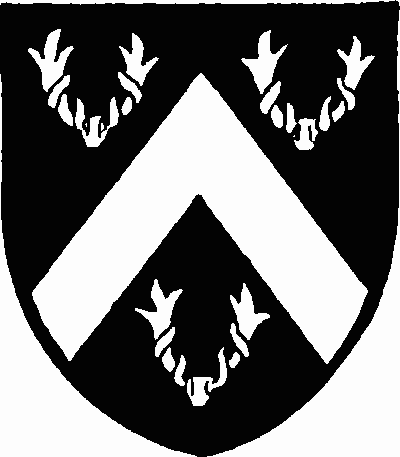
Somers—Cocks
The land lay north of the Skinners' Company's Estate, the western boundary following Duke's Road (Row), east of St. Pancras New Church, across Euston Road along Churchway and bending north of Drummond Crescent. Proceeding north it included the houses on the west side of Eversholt (formerly Upper Seymour) Street, after which it turned east, north of Cranleigh (formerly Johnson) Street, and south, to the east of Chalton Street as far as the houses on the north side of Polygon Road (formerly Hampden Street). From here the boundary went along Brill Row, marching with the Aldenham School or Brewers' Company's Estate, and crossing Euston Road north-west of Flaxman Terrace, joined Duke's Road.
The streets were laid out in rectangular form, the chief feature being Clarendon Square within which was built the Polygon, a fifteen-sided figure comprising thirty-two houses. In Euston Road, Somers Place and South Place have already been mentioned. An interesting description of the neighbourhood in 1813 is to be found in a communication to the Gentleman's Magazine by J. P. Malcolm: "Somers Town was planned: and Mr. Jacob Leroux becoming the principal landholder under Lord Somers, the former built a handsome house for himself, and various streets were named from the titles of that noble Lord, a chapel was opened, a polygon begun in a large square, and every thing seemed to proceed prosperously, when some unforeseen cause occurred, which checked the fervour of building, and many carcases of houses were sold for less than the value of the materials."
CXXXIX—Chalton Street
Chalton Street runs parallel to Ossulston Street the whole length of the estate. The name was formerly given to the southern portion as far as Phœnix Road. North of this it formed the east side of Clarendon Square and beyond this point (Polygon Road) it was known as Union Street and Stibbington Street.
Its older buildings stand at the south end on the west side which has odd numbers running from south to north. The houses are mostly of two storeys in brick over shops on the ground floor. Nos. 3 and 5 have been refronted and Nos. 7 to 35 survive, some with alterations. Nos. 37 to 43 have been rebuilt. Nos. 45 and 57 to 65 are of similar character, the entrance to Churchway Passage, being between Nos. 65 and 67, and the same type of building continues to No. 79, Nos. 75, 77 and 79 being derelict. Nos. 81 to 89 are now demolished and the frontage to Polygon Road is modern. Between Polygon Road and Aldenham Street there are old houses on both sides of the street, Nos. 109 to 113 (west) and 108 to 124 (east). No. 126 at the corner of Aldenham Street has been demolished.
Chalton Street continues into the Bedford Estate (see p. 128). There was at No. 32 a public house, called the Coffee House, an interesting memento of the occupation of the district by French emigres.
Christ Church stood on the east side of Chalton Street a little south ofPhœnix Road. It was destroyed by bombing during the 1939–45 war. The north wall, chancel walls and part of the tower are still standing. It was built in 1868 at the expense of George Moore of the firm of Copestake Moore & Co., together with a parsonage and schools, to supply the want of a church when the former St. Luke's had been removed by the Midland Railway to Kentish Town (see St. Luke's, Oseney Crescent, p. 143). (fn. 119) The church was in the Gothic style with iron columns, the architects being Messrs. Newman & Billing.
Vicars:
CXL—Ossulston Street
Ossulston Street, one of the main thoroughfares passing south to north through Somers Town, leaves Euston Road just west of Somers Town Goods Station. Its west side has been rebuilt as far as Polygon Road, but between this and Aldenham Street are a few early 19th-century buildings. Nos. 159, 161 and 163 are houses of London stock brick with basements and railed areas and three storeys above with cambered arches to the windows. No. 165 has a shop and two upper storeys of brick. The part of the street south of Chapel Street (now removed) was known as Wilsted Street (see Britton's map, Plate 4).
CXLI—Phœnix Road
Phœnix Road (formerly Street) passes from west to east across Somers Town and connects Eversholt Street with Pancras Road. The western part was originally the south side of Clarendon Square; at its Euston end it joined Brill Row by means of a crescent (see Britton's map, Plate 4).
The settlement of Somers Town was greatly hastened through its becoming the home of refugees from the French Revolution, who sought cheap accommodation. A standing memorial to this period is the Roman Catholic Church of St. Aloysius on the south side of Phœnix Road (formerly Clarendon Square). This church was built by the Abbé Carron in 1808, as a successor to a chapel in Chalton Street. At the latter was ordained the Rev. J. Nerinckx, who joined Abbé Carron in January, 1800, and, after the Abbé's return to France in 1815, became pastor of St. Aloysius until his death in 1855. He built schools here and established charitable institutions including "a repository, from which soup is distributed twice a week, and to which the opulent are solicited by the Abbé to contribute pecuniary donations, medicines, old linen, wine, clothes, etc." (fn. 120) The church was altered and repaired in 1850. It has a classical stuccoed front with four pilasters supporting an entablature and pediment. (Plate 86.) It is elaborately decorated and furnished within and has a number of memorials, including one to the Rev. J. Nerinckx, and busts of the Abbé Carron and the Bishop de St. Pol.
Part of Phœnix Road is marked on Horwood's map of 1799 but the first three houses shown in occupation in the rate books occur in 1801. The road has been largely rebuilt. A few of the old houses remain on the south side between Eversholt Street and Chalton Street. They are of plain brick with broad sash windows, which have slender glazing-bars, and arched doorways. Nos. 16 to 24 (even numbers) have each one window alongside the entrance door. No. 26 is wider with two windows and a segmentalarched door; its ground floor is rendered in stucco. East of this is "St. Aloysius Catholic School, 1852." Only the ruins of Nos. 24 and 26 remain. No. 30 is of three storeys and basement, brick throughout; it has a semicircular-headed doorway with a good fanlight between two windows on the ground floor. No. 32 is of similar character but narrower, with one ground floor window. The church occupies the next site and beyond it is the Convent and Nos. 38 and 40.
CXLII—Polygon Road
Polygon Road runs east and west, parallel with Phoenix Road, passing through the northern limit of the former Clarendon Square. It takes its present name from the interesting architectural experiment, the Polygon, that stood in the centre of the square. The roads east and west used to be known as Hampden Street and Gee Street respectively.
Clarendon Square stood on a site formerly occupied by the barracks of the Life Guards, and was built round the space occupied by the Polygon. The agreement for building the latter was made in 1793 (fn. 121) between Jacob Leroux, who held the land on lease from Lord Somers and lived himself in Somers Town, and Job Hoare, carpenter, of St. Pancras. Leroux advanced the money for the land, described as part of Brill Farm. Hoare agreed to build the Polygon within twelve months. It was to consist of thirty-two houses, each "four storeys high and garretts, to be 18 feet by 27 ft. 6 ins." They were to be built together, the frontage of each pair of houses forming one of the external sides of the figure. Further details of the contract included "iron balconies to each house . . ., two marble mantelpieces at least to each and the remainder of Portland Stone . . . wood dados and mouldings and double deal six-panelled doors to the two principal storeys." Hoare was also to build the garden walls, which partitioned the space within the Polygon, and to construct the necessary sewer.
Horwood's map of 1799 and Tompson's map of 1803 show the Polygon built in the fields with a circular road round it. The main block of each pair of houses was rectangular, with connecting recessed wings, slightly wedge-shaped, to conform to the general plan. The whole has been demolished and flats are now built on the site.
The south side of Polygon Road has been rebuilt but a number of original houses remain on the north side, numbered 3 to 69 (odd numbers) Nos. 3 to 15, between Eversholt Street (formerly Upper Seymour Street) and Werrington Street (formerly Clarendon Street) have basements with railed areas and stuccoed ground floors with round-headed doorways. The stucco is channel-jointed except in Nos. 13 and 15. The two upper storeys are of stock brick with balconies to some of the first floor windows.
Nos. 27 to 49 formed the north side of Clarendon Square. Of these No. 29 is a more important house, of four storeys with channel-jointed stucco to the ground floor. No. 31 is larger still, with greater width and with two-storey wings on each side. It is set back from the main frontage and was built by Jacob Leroux for his own occupation. It is of three storeys, the upper ones brick and the ground floor stuccoed, with a moulded cornice above and three tall centre windows to the first floor without balconies.
East of this is the later St. Mary's School; then follow Nos. 41 to 47, of the same character as the houses further west, of four storeys. No. 49, at the corner of Chalton Street, is cement-rendered below and has a shop facing Chalton Street. East of Chalton Street are three houses, Nos. 51, 53 and 59, which have their ground floors occupied by shops. No. 57 has a wide gateway. Nos. 61 to 69 are somewhat later houses of three storeys with segmental-headed doorways and railed areas.
The house in the centre of the north side of Clarendon Square was occupied by the Abbé Carron after Jacob Leroux. William Godwin (1756–1836) author of Political Justice, who lived in Chalton Street, took an apartment in the Polygon on his marriage in 1797 to Mary Wollstonecraft. She died here in the same year, after giving birth to a daughter, Mary, the future wife of the poet Shelley. Godwin later married Mrs. Mary Jane Clairmont, who lived next door to him at the Polygon. In Clarendon Square resided also Edward Scriven (1775–1841) the well-known engraver and Samuel de Wilde (1748–1832), portrait-painter, who painted portraits of actors in character.
Werrington Street (formerly Clarendon Street), which formed the west side of Clarendon Square and continues north and south, has lost most of its houses. It was designed in the same style as the rest of the Somers Estate, the surviving houses being between Nos. 53 to 63 (east side) from Cranleigh Street to Bridgeway (formerly Bridgewater) Street and 77 to 93 (east), excluding 83 and 85, from Aldenham Street to Polygon Road. (For the northern portion beyond Cranleigh Street see the Bedford Estate, p. 130.) Bridgeway Street, which branches from it on the east, contains a row of sixteen small houses of three storeys in height on the north side.
CXLIII—Aldenham Street West part (formerly Grenville Street)
The name of this street is derived from Aldenham School and was formerly attached to the eastern part of the street in the adjoining estate (see Chapter 13, p. 124). The north side of the street has been rebuilt, but on the south Nos. 85 to 111 (odd), except 101 and 103 which have been demolished, survive between Chalton and Werrington Streets. The numbering is from east to west.
The houses are of three storeys with stucco facing to ground floors and basements and round-headed doorways. Nos. 89, 105, and 107 have shopfronts. The upper part of No. 107 is rendered in cement and the windows have architraves. Between Werrington and Eversholt Streets are modern flats and the Church of St. Mary the Virgin (see below).
CXLIV—Eversholt Street (formerly Seymour Street and Upper Seymour Street)
The name Eversholt Street was originally given only to the northern part of this street above Cranleigh Street (formerly Johnson Street) which lies on the Bedford Estate (see p.129). The portion in Somers Town comprises the former Upper Seymour Street and the part of Seymour Street north of Drummond Crescent. The lower part continues south to the Euston Road immediately east of Euston Station.
The remaining old buildings are on the east side of the street between Phœnix Road and Cranleigh Street; they are numbered from 106 to 184 (even). Nos. 106 to 126 have shops with two brick storeys above with rectangular sash windows set in semi-circular-headed recesses. North of Polygon Road are two shops (Nos. 128 and 130) with two stucco-faced upper storeys and windows with architraves. Nos. 132 to 136 resemble Nos. 106–126. North of these and at the corner of Aldenham Street is the Church of St.Mary the Virgin, built in 1824–27, an exercise in the Gothic style by W. and H. W. Inwood. The site and furnishings were paid for out of the local rates, but the building cost was met by a Parliamentary grant. Shortly after its consecration (11th May, 1826) the church attracted a certain notoriety as the scene of conversion of a number of people in the neighbourhood from Roman Catholicism. (fn. 35) Its architecture incurred the satire of A. W. Pugin who contrasted it with Bishop Skirlaw's Chapel at Skirlaugh, Yorkshire. The interior was decorated by J. K. Colling in 1874, (fn. 122) and R. C. Reade in 1890, when the galleries were removed and traceried transomes inserted in the windows. The chancel was added by Ewan Christian in 1878.
The church was known in its early days as "Mr. Judkin's Chapel." Mr. Owen P. Thomas, a schoolfellow of Charles Dickens at the Classical and Commercial Academy in the Hampstead Road, relates how he and Dickens "very piously attended the morning service at Seymour Street Chapel." (fn. 4) At the consecration of the church the Rev. William Stephen Gilly (1789–1855) attended as minister, but apparently only preached here. The list of incumbents include—
Northwards, Nos. 138–184 are similar to Nos. 106–126, except that most of them have channel-jointed ground storeys instead of shops.
CXLV—Cranleigh Street (formerly Johnson Street)
Cranleigh Street runs west to east from Eversholt Street to Chalton Street crossing Werrington Street. On the south side between the last and Chalton Street are houses (Nos. 41 to 57 consec.) of three different designs.
No. 41, next the public house at the corner of Werrington Street, has a stuccoed ground storey with a round-headed doorway and a wide camber-headed window, and two upper storeys of brick with balconies to the first floor. The floor levels are higher than those to the east of it. Nos. 42 to 49 have no stucco; the doorways have flattened curved arches, and the windows are square-headed. In Nos. 42, 46 and 49 the first floor windows are lowered for balconies.
Nos. 50 to 54 have stuccoed ground storeys with elliptical or threecentred arches to the doorways but square-headed windows. The two upper storeys are of yellow brick. The first floor windows are wide and square-headed in round-headed recesses as elsewhere on the estate. There are string-courses and plain copings. Nos. 55, 56 and 57 have stuccoed ground storeys with round-headed doorways, and two upper storeys of plain brickwork.
All the basement areas have been filled in and railings removed.
No. 13 was the home of Charles Dickens and his parents from 1824 to 1827. A plaque erected on the house by the London County Council in 1911 was removed when the building was demolished in 1934. Flats now cover the site.