A History of the County of Huntingdon: Volume 3. Originally published by Victoria County History, London, 1936.
This free content was digitised by double rekeying. All rights reserved.
'Parishes: Grafham with East Perry', in A History of the County of Huntingdon: Volume 3, ed. William Page, Granville Proby, S Inskip Ladds (London, 1936), British History Online https://www.british-history.ac.uk/vch/hunts/vol3/pp60-66 [accessed 30 April 2025].
'Parishes: Grafham with East Perry', in A History of the County of Huntingdon: Volume 3. Edited by William Page, Granville Proby, S Inskip Ladds (London, 1936), British History Online, accessed April 30, 2025, https://www.british-history.ac.uk/vch/hunts/vol3/pp60-66.
"Parishes: Grafham with East Perry". A History of the County of Huntingdon: Volume 3. Ed. William Page, Granville Proby, S Inskip Ladds (London, 1936), British History Online. Web. 30 April 2025. https://www.british-history.ac.uk/vch/hunts/vol3/pp60-66.
In this section
GRAFHAM with EAST PERRY
Grafham, Grafam (xi–xii cent.); Grofham, Graffeham (xiv-xvi cent.); Peri, Pirie (xii cent.); Est Perye, Pirie in Grofam (xiv cent.).
The parish comprises 1,927 acres of land, about half of which is arable and the rest grass land. The soil is Boulder Clay and the subsoil Oxford Clay. The Diddington Brook, sometimes called the Grafham Brook, (fn. 1) which flows into the Ouse, runs from northwest to south-east and forms the parish boundary on the south-west and south sides of the parish. The land rises from the brook, where it is about 90 ft. above the Ordnance datum, to about 189 ft. at the village on the north side of the brook and to 182 ft. at East Perry on the south side.
The somewhat scattered village stands on high land at the meeting of by-roads from Great Staughton by Church Hill, from Easton by Hartham Street, now only a grass track, from Ellington by Breach Road, and from Huntingdon and from Buckden. The church is on the south side of the village, and to the north of it is the Rectory, the kitchen of which dates back to the 16th century and formed part of a two-story brick house with a tiled roof. The Fox Inn in the village is a timber-framed thatched house of the 17th century with modern additions. About a quarter of a mile north-west of the church is the moated site of the manor house (fn. 2) of the Engaines, who in the 14th century are said to have had a park near the highway leading to Sibthorpe in Ellington. (fn. 3) This was also the site of the manor house of the Bigg family in the 17th and 18th centuries. Half a mile to the east of the village is another moated inclosure. (fn. 4)
Although there is now no woodland in the parish, in 1086 there was pannage one league square. (fn. 5) During John's reign Nigel de Lovetot granted his wood here to Robert Russell, (fn. 6) and Ivo le Moyne had a great wood here; (fn. 7) there were also six groves in 1301, (fn. 8) so that before the 14th century there must have been a fair amount of woodland.
The western part of the hamlet of Perry is in the parish of Great Staughton and is known as West Perry; the eastern and less populous part is in Grafham parish. To the east of East Perry is Grafham Farm, an early 17th-century timber-framed house with tiled roof and modern additions.
There is a station on the London Midland and Scottish Railway to the north of the village on the road to Ellington. The village feast was formerly held on the second day after the feast of St. Lawrence (12 August), but in 1373, as it was found to interfere with the harvest, it was changed to the feast of St. Theckla the Virgin (fn. 9) (23 September).
There was an Act for the Inclosure in 1774, (fn. 10) and the resulting award in 1776, (fn. 11) and a further Act for inclosing 2,000 acres in Great Staughton and Grafham in 1807. (fn. 12)
William Hull, the artist (1820–80), was the son of a small farmer at Grafham. (fn. 13)
The lord of Grafham in 1279 had gallows, view of frankpledge and its appurtenances, and his tenants had ceased to attend the sheriff's court. (fn. 14)
The Knights Hospitallers claimed view of frankpledge of their tenants here. (fn. 15)
Manors
In 1086 GRAFHAM, assessed at 5 hides, was held by seven sokemen of the king. It seems, however, that the lands had been seized by Eustace the Sheriff, although on inquiry it was returned that they had been and still were the king's sokeland and no charter had been seen or evidence produced of seisin having been given to Eustace. (fn. 16) It would appear, however, that Eustace retained possession of half of the 5 hides, as 2½ hides passed to his successors, the Lovetots, and became part of the Lovetot Fee, while the other 2½ hides formed part of the Gloucester Fee. (fn. 17)

Clare. Or tbree cheverons gules.
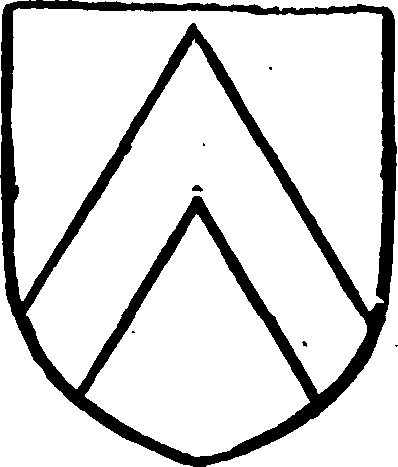
Stafford. Or a cbeveron gules.
From Roger de Lovetot, who was holding the LOVETOT FEE in 1125, the manor went to his nephew Richard, son of his brother Nigel. (fn. 18) Richard was succeeded by his son William, and he, as regards Southoe, the head of the Lovetot Fee in Huntingdon, and Grafham, by his younger son Nigel, who died about 1179. From this date the overlordship of the Lovetot Fee in Grafham was attached to the barony of Southoe and followed the descent of that manor (q.v.). (fn. 19) Richard, son of Nigel Lovetot, was succeeded by his brother Roger, Nigel, son of Roger, a clerk in holy orders, was succeeded in 1219 by his three sisters and co-heirs: Amice, wife of Ralph de Amundeville, Royce, who married firstly Hubert de Bromford and secondly Hugh le Fleming, and Alice, the wife of William Patrick. Nigel de Amundeville, the son of Amice, conveyed his third of the service of a knight's fee in Thurning, Hemingford, Offord and Grafham to Richard de Clare, Earl of Gloucester and Hertford, in 1258. (fn. 20) Royce's son, Richard, took the name of Lovetot and his third of the overlordship of Grafham passed with his purparty of Southoe (q.v.) to his descendant Edward Lovetot, whose widow Joan was holding it in 1401. (fn. 21) Margaret, wife of Sir John Cheyne, was the heir of Edward and Joan, but before 1428 this purparty of the Lovetot Fee had passed to the Earl of Stafford, who represented the Gloucester barony. The remaining third of Alice, wife of William Patrick, went to William their son, and from him to his sister Margery, the wife of John de Littlebury. Margery and John conveyed their interest in Southoe to Richard de Clare, Earl of Gloucester, in 1259. Thus all three purparties came to the barony of Gloucester and passed with the manor or barony of Southoe (q.v.). (fn. 22)

Le Moyne. Argent two bars sable with three molets sable in the chief.
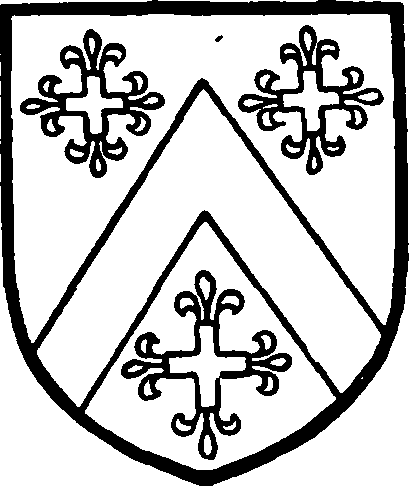
Anderson. Argent a cheveron between three crosses sable flowered at the ends.
The chief of the tenants of the Lovetot Fee was the family of le Moyne. Reginald, father of Berenger le Moyne, was holding lands in Grafham and elsewhere in the time of Henry II, which he exchanged with Philip le Moyne for the vill of Walton. Philip was living in 1207, (fn. 23) and his son Ivo le Moyne of Little Paxton (q.v.) gave 2 carucates, which were probably all his holding in Grafham, to Sawtry Abbey (fn. 24) about 1235. Ivo by his will left to the abbot, with his body to be buried in the abbey, his messuage with a grove and his whole holding in Grafham with certain exceptions. (fn. 25) Probably he died before 1240, when Gilbert, his nephew, confirmed a carucate to the abbey. (fn. 26) Joan, widow of Ivo, who married Richard de Yrecester (Irchester), granted to the abbot her dower lands in Grafham in 1248 (fn. 27) and confirmed them when she married her third husband, John Boleard. (fn. 28) Ivo's gift was also confirmed by Nigel de Amundeville as chief lord so that neither he nor his heirs should distrain for reliefs, wards, suits of court or other services. (fn. 29) After the dissolution of Sawtry Abbey these lands passed to Sir Richard Williams alias Cromwell, whose court here is mentioned in 1543 to 1554, (fn. 30) and passed to Francis, his second son, who died seised of the manor of Grafham in 1598, leaving a son Henry. (fn. 31) In 1600 Henry conveyed the manor to Edmund Anderson, Chief Justice of the Common Pleas, (fn. 32) who was succeeded by his son, Sir Francis. Francis died seised of the manor in 1616, leaving Edmund his son and heir. (fn. 33) Edmund died seised in 1638, leaving a daughter Dorothy, aged 7½ years, (fn. 34) but the manor was settled on the heirs male and passed after the death of Lady Dunsmore, widow of Sir Francis Anderson, in 1652 to Stephen, younger brother of Edmund. His son Stephen was created a baronet and settled the manor in 1659 and 1660. (fn. 35) Before the end of the century the manor had passed to the Bernards and went with the Bernard estates to the Duke of Manchester, the present owner.
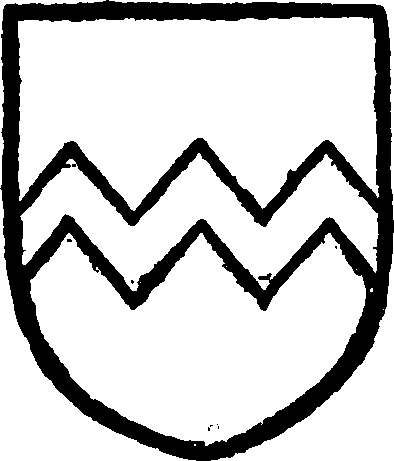
Papworth. Gules a fesse dancetty argent.
Another large freeholder of the Lovetot Fee was William de Papworth of Grafham, who is mentioned among those who were injured by the afforesting of lands in Hunts in 1299. (fn. 36) He died in 1314 seised of lands in Grafham, when he left a wife Ada and a son John, aged 14½ years. (fn. 37) John was dealing with lands in Grafham in 1345 and, described as Sir John de Papworth, knight, he was acquiring land of John Russell and Eleanor, his wife. (fn. 38) In 1348 Sir William, son of Sir John de Papworth, knight, and Elizabeth his wife settled a manor in Grafham, which had belonged to John his father, on themselves and the heirs of their bodies, failing such heirs to Edmund, son of said John and his heirs. (fn. 39) William de Papworth, who was dealing with a manor of Grafham in 1371, (fn. 40) was probably a son or grandson of William, son of John. In 1400 Sir William Papworth, knight, conveyed all his tenements in Grafham, Perry and Buckden to John Hervy. (fn. 41) Joan Lovetot of Southoe, with the assent of her daughter Margaret, wife of Sir John Cheyne, in 1401 granted licence to John Hervy to assign all the lands of William Papworth within her fee in Grafham and Perry to the Abbot and Convent of Sawtry, (fn. 42) and in 1402 licence in mortmain was given by the Crown. (fn. 43) The transaction was confirmed by Sir William Papworth in 1413 and by his widow in the same year. (fn. 44) Thus this holding became merged in the manor of the Abbot of Sawtry and later followed the same descent.
The family of Russell were also large freeholders of the Lovetot Fee in Grafham. Robert Russell, who, as Robert son of Robert Russell, was witness to a charter relating to Grafham before 1244, (fn. 45) in 1248 agreed to permit Adam, Abbot of Sawtry, to have common of pasture in Grafham. (fn. 46) About the same time Nigel de Lovetot, with the consent of William his brother, granted to Robert Russell for his homage and service certain woodland in Grafham, (fn. 47) and again Robert, with the consent of his wife Muriel, granted lands in Grafham to Adam, son of Hamuld. (fn. 48) Robert died in 1254 seised of 2 carucates in Grafham held of many lords, leaving as his heir his brother, John. (fn. 49) Sir John joined Simon de Montfort and his lands were seized as those of a rebel after the battle of Evesham in 1265. (fn. 50) He was reinstated, however, and was holding lands of both the Lovetot and Gloucester Fees in 1279. (fn. 51) It is not clear what became of this holding, but it probably passed to the Abbey of Sawtry with the greater part of the Lovetot Fee.
Another holding of the Lovetot Fee is found in Domesday Survey (1086), when it appears that Eustace the Sheriff held half a hide in Grafham and Oilard the larderer held it of him. (fn. 52) We find this half hide in the hands of Eustace's successors the Lovetots, and it appears that Nigel de Lovetot, probably Nigel the priest (son of Roger), who died in 1219, gave it to the prior of Huntingdon. In 1279, it was held of the prior by Amice le Noble, John Russell and two villeins, who made redemption of flesh and blood for their sons and daughters and paid aid at the will of the prior. (fn. 53) In 1535 the prior held 15s. of rent in Grafham and a part of the tithes. (fn. 54) The half hide seems to have been split up among various owners and was probably merged in the principal manor.
The manor of PERRY, which is partly in Great Staughton (q.v.) and partly in Grafham, was part of the lands of Eustace the Sheriff and was held in 1086 by Alwin Deule. It was assessed at one hide and there was a church there. (fn. 55) Like other lands of Eustace, the overlordship passed to the Lovetots and descended with the Lovetot Fee in Grafham (q.v.). The tenant in demesne early in the 13th century was apparently Thomas, son of William Perry, who sold 170 acres of land in Perry Lovetot to George de Beville. George, it was reported, was killed in the battle of Lewes (1264), and Roger de Lovetot as an adherent to Simon de Montfort and overlord seized his land. George, however, returned and made fine for the redemption of his lands and sold them to Henry Engaine, who died in 1272 and was succeeded by his brother John, who successfully brought an action in 1286 against Thomas, son of Roger de Lovetot, for reinstatement in this holding. (fn. 56) These lands were confirmed to John, brother of Henry Engaine, by Thomas de Lovetot in 1288, (fn. 57) and subsequently the overlordship passed with the Lovetot Fee and the subtenancy with the Engaines manor in Grafham. (fn. 58)
The other moiety of the 5 hides, held by the king in 1086, went to the Earldom of Gloucester at an early date and formed a part of the GLOUCESTER FEE. William FitzRobert, Earl of Gloucester, was holding in 1167, and the fee followed the descent of the earldom until Richard de Clare, Earl of Gloucester, acquired the overlordship of the Lovetot Fee in the middle of the 13th century, and it then followed the descent of the overlordship of that fee.
The family of Grafham held the subtenancy of the half knight's fee under the Earls of Gloucester. This family has been identified with that of Engaine (fn. 59) owing to the similarity of the christian names of some of its members and the fact that some of the members are called 'le noble de Grafham.' If it were a younger branch of the Engaine family it must have split off at an early date, as William de Grafham is mentioned in 1166 (fn. 60) and Robert de Grafham recovered the right to half a knight's fee in Woolley from Simon de Maufe in 1180. (fn. 61) William de Grafham was dealing with land in Grafham in 1199 and was holding half a knight's fee of the Honour of Gloucester in 1211–12 and perhaps rather earlier. (fn. 62) Viel, son of William, witnessed a deed as to a tenement in Grafham. He was dealing with the advowson of the church in 1223 (fn. 63) and at the same time recovered the advowson from Elias de Amundeville and others representing the Lovetot Fee. (fn. 64) In 1243 he was holding half a knight's fee in Grafham of the barony of Gloucester (fn. 65) and in 1244 he presented to the church on the resignation of Walter, his son, late rector. (fn. 66) Viel apparently left a son Robert. During the disturbed condition of the country about the time of the battles of Lewes and Evesham (1264–5) a mesne lordship in the hands of Henry Engaine was interposed between the Earl of Gloucester and Robert de Grafham. In 1264 Robert de Grafham held half a knight's fee in Grafham of Henry Engaine and he of the Earl of Gloucester, (fn. 67) and in 1272–3 Sir John, brother and heir of Henry Engaine, had the wardship of the heir of Robert de Grafham, probably as overlord. (fn. 68) Viel, son of Robert de Grafham, in 1279 held 2½ hides of Sir John Engaine which were of the fee of Gilbert de Clare, Earl of Gloucester. (fn. 69) Viel also held the advowson of the church. In 1281 Viel obtained protection for two years on going abroad, (fn. 70) and in 1287 he received a further protection when going in the retinue of his overlord John Engaine on the king's service into Wales. (fn. 71) Viel seems to have surrendered in 1295 to his overlord, Sir John Engaine, all his lands and tenements in Grafham, including the messuage which Maud, mother of Viel, held in dower, but excepting the advowson of the church, which was let to the parson of Steeple Gidding with an undertaking that no further grant of the advowson would be made to anyone but to Engaine. (fn. 72) There was much litigation between the Grafhams and Engaines as to the manor and tenements in Grafham in the early years of the 14th century, but eventually the manor passed wholly to the Engaines. In 1310 Peter de Croft and Amice his wife, probably tenants of the Engaines, brought an action to recover two parts of the manor of Grafham against Viel, son of Robert de Grafham, Martin de Littlebury and Joan his wife, John, son of Viel son of Robert de Grafham, and Elizabeth his wife, and Robert, son of Robert de Grafham, descendants and representatives of Viel de Grafham who granted his lands to Sir John Engaine in 1295. The defendants said that Andrew le Moyne held half of two parts of the manor, and Viel pleaded that he entered the remainder on the death of his father Robert by hereditary right. The jury, however, said that Andrew did not hold the said lands and Peter and Amice had been disseised of the said two parts except 40 acres of wood and the advowson of the church. (fn. 73) The Grafhams continued to hold lands in Grafham, but the manor, held of the Gloucester Fee, with the advowson, descended from John Engaine with Gaynes manor in Dillington, Great Staughton (q.v.), down to Anne, daughter of Katherine, Lady Howard of Effingham, and wife of William Paulet, Marquess of Winchester, who seems to have sold the property before 1576. In 1667 Mrs. Anna Bigg, widow of Walter Bigg, sheriff of London, was lady of the manor and patron of the church. (fn. 74) The manor passed to her son John and grandson, another John, who died unmarried in 1748 leaving it to his sister Lucy for life and then to his friend Sir John Bernard of Brampton. (fn. 75) Lucy only survived her brother three months, (fn. 76) and Sir John Bernard came in for the property. It has since passed with Brampton Park (q.v.) to the Duke of Manchester.
There was another branch of the Grafham family holding in Grafham. In the time of King John (1199–1216) Nigel de Lovetot granted a tenement and a hermitage in Grafham to Robert Rufus to be held of Simon, son of Stephen de Grafham. (fn. 77) In 1223 Stephen, son of Simon, conveyed the advowson of Grafham to Viel de Grafham after some litigation. (fn. 78) Simon, son of Stephen, had three sons, Thomas, William and Simon. (fn. 79) Thomas had a son Simon who granted lands to his son Thomas. (fn. 80)
Church
The church of ALL SAINTS consists of a chancel (26¼ ft. by 12¾ ft.), nave (46½ ft. by 16 ft.), north aisle (47½ ft. by 10¾ ft.), south chapel (23½ ft. by 9½ ft.), west tower (10 ft. by 10 ft.), and south porch. The walls are of pebble and stone rubble with stone dressings, and the roofs are covered with tiles and lead.
The church is not mentioned in the Domesday Survey (1086), and the north arcade of the nave, c. 1250, appears to be the earliest work which remains; but the fact that the chancel is some half-century later seems to point to an earlier church on the site, although no vestige of it exists. The south chapel was added early in the 14th century, and towards the end of this century the north aisle was rebuilt. The tower and spire were built c. 1400, but the stairturret at its south-east angle was added a little later. The rood-stairs were built in the 15th century. The porch was built, or rebuilt, in 1657; and apparently some work was done to the chancel in 1689. In 1724 the 'steeple and bell-loft' were much out of repair, (fn. 81) and in 1748 the archdeacon recorded 'the whole of the church very bad and nasty.' (fn. 82) A new floor, considerably raised, was put down in 1880, and the steeple was pointed in 1884. The church was restored in 1901–3, when most of the walls were underpinned, a new buttress built on the south side of the chancel, and the porch rebuilt. The spire was pointed in 1906, and the lead on the aisle roofs was recast in 1908.
The late 13th-century chancel has an original threelight east window, but the sill, mullions and tracery are modern, and the lower part of the window has been destroyed. The north wall has an original twolight window completely altered in the 16th century and now having a square head; a square-headed 15th-century window with a 13th-century western inner splay; and an original doorway with a twocentred head and continuous chamfered jambs. The south wall has an original three-light window with intersecting tracery in a two-centred head; an original two-light window with a plain spandrel in a two-centred head, and the lower part of the west light rebated for a shutter; (fn. 83) an original double piscina with two pointed arches on a central shaft and two attached jamb-shafts, all with moulded capitals and bases, and nine-foiled and seven-foiled basins. The chancel arch is modern, two-centred and plastered. The roof is modern, but has two rather older tie-beams.

Plan of Grafham Church
The mid 13th-century nave has a north arcade of four bays of two-centred arches of two chamfered orders resting on low circular columns and semicircular responds, all with moulded capitals but bases hidden by the floor. The south wall has an early 14th-century arcade to the chapel, having two bays of two chamfered orders resting on an octagonal column and semi-octagonal responds, all with moulded capitals and bases; an early 16th-century square-headed twolight window with carved roses in the spandrels; and a late 13th-century doorway with a two-centred head and continuous chamfered jambs. In the southwest corner is the late 15th-century doorway to the tower stairs, having a four-centred head and continuous chamfered jambs. The modern roof is hidden by a plastered ceiling, but two 15th-century tie-beams with jack-legs and braces can be seen, and several 15th-century carved stone corbels remain; on the south side are two 18th-century dormer windows.
The late 14th-century north aisle has an original three-light east window with a four-centred head. The north wall has three original square-headed twolight windows; and a doorway with a two-centred head of two moulded orders on double chamfered jambs. There is no west window, and the upper part of the wall is modern, but at the base of the parapetcoping is a carved demi-angel holding a shield. In the south wall, eastward of the arcade, is a piscina with two-centred head, projecting sill and circular basin. In the south-east corner is the 15th-century lower doorway of the rood-stairs, having a four-centred head and continuous moulded jambs. The early 16thcentury pent-roof has moulded beams, but the western bay is modern.
The early 14th-century south chapel (fn. 84) has an original three-light east window with a segmental-pointed head and having a semi-octagonal projecting pedestal for a statue on the sill inside. The south wall has two square-headed 14th-century two-light windows and an original piscina with trefoiled head and circular basin. The west wall has no windows and was refaced on the western side apparently in the 17th century, and again in 1902. The early 16th-century pent-roof has moulded wall plates.
The west tower, c. 1400, has a two-centred tower arch of two chamfered orders, the inner order resting on semicircular attached shafts with moulded capitals and bases. The west doorway has a four-centred head of two orders and continuous moulded jambs. The west window is of three-lights with tracery in a fourcentred head. The belfry windows are of two-lights with a quatrefoil in a two-centred head. The tower has diagonal buttresses at the north-west and southwest angles, which rise slightly above the west window and are then carried up as clasping buttresses to just above the sills of the belfry windows; at the springing of these windows the tower becomes an octagon with small pinnacles rising from the broaches. Immediately above the heads of the belfry windows the octagonal spire rises from a projecting moulding; it has two tiers of spirelights, the lower of twolights and on the cardinal faces, and the upper singlelights and on the diagonal faces. The height to the top is 88 feet 3 inches.
Adjoining the south-east angle of the tower is a large 15th-century octagonal stair-turret with two small quatrefoiled lights and finished with an irregular sloped stone roof.
The porch, at the west end of the south chapel, is modern and has a two-centred arch of two hollowmoulded orders enriched with carved paterae, and splayed jambs. The gable above is coped with medieval coping-stones, and has two date-stones, inscribed: (a) 'Nov. 9. 1657. R.S.' and (b) 'Rebuilt 1902. H.H. E.B. J.T.H.' In the north-east angle is the octagonal shaft and base of a 15th-century stoup. Previous to 1902 the porch was of badly built red brickwork with a semicircular-headed arch covered with cement, and a thin modern roof; the gable had the earlier coping-stones re-used, and the date-stone of 1657 above the arch.
The font, c. 1300, has a tapering octagonal bowl with panelled sides, resting on a circular stem and one octagonal and one circular step.
There are three bells, inscribed: (1) (no inscription but two founders' marks); (2) Sum Rosa pulsata mundi Katerina vocata; (3) S. Katerina. The first is by Watts of Leicester; the second by William Dawe of London, c. 1381–1418; and the third by Newcombe of Leicester. In 1552 there were three bells and a sanctus bell; (fn. 85) and these, including the sanctus bell, remained as late as 1724. (fn. 86) The bells were quarter-turned in 1900.
A late 17th-century Communion table, now in the tower, has turned legs and moulded rails. The hexagonal oak pulpit, c. 1700, has raised panels and moulded cornice. In the nave is a 16th-century shaped bench-end and a few other fragments incorporated in a modern seat.
Built into the west wall of the south porch are numerous old stones found during the restoration of 1901–3, viz.: The upper part of a boldly carved early 14th-century sepulchral slab bearing the demi-effigy of a priest, found re-used as a step to the north doorway; part of the octagonal shaft of a cross; a stone inscribed '1689. R.A.' found built in at the foot of the south wall of the south chapel, near the porch; (fn. 87) pieces of a moulded arch, etc.
There are the following monuments: in the chancel, to the Rev. Benjamin Puckle, rector, d. 1853, and Elizabeth, his wife, d. 1845; Louisa Hale, his daughter, wife of Lieut. Col. Henry G. Puckle, d. 1860; Georgina Hale, daughter of Frederick Hale Puckle, d. 1882; the Rev. Benjamin Hale Puckle, rector, d. 1892, and Eleanor (Brady), his wife, d. 1891; Thomas Norman Puckle, d. 1914; and Lieut. Col. John Puckle, d. 1917; War Memorial, 1918; and floor slab to the Rev. William Fairclough, rector, d. 1713, and the Rev. William Fairclough, junior, d. 1762. In the south chapel, floor slab to Mrs. Lucy Bigg, d. 1748. In the south porch, to Elizabeth Fortrey, widow, d. 1708/9; and John Bigg, Esq., d. 1748.
The registers are as follows: (i) baptisms from 1581, marriages and burials from 23 April 1586 to 5 November 1718; (ii) baptisms, marriages and burials 2 December 1718 to 8 November 1812, marriages end 8 February 1751; (iii) marriages 1 November 1754 to 13 January 1783; (iv) marriages 10 November 1783 to 29 September 1812.
The church plate (fn. 88) consists of a Britannia silver cup, hall-marked for 1719–20; a Britannia silver cover-paten, hall-marked for 1711–12; a plated plate, inscribed 'Graffham Church, 1854.'
Advowson
The earliest reference we have to the advowson of the rectory of Grafham is in a dispute in which Viel de Grafham recovered it from the co-heirs of the Lovetot Fee, the Prior of Huntingdon, Stephen son of Simon (de Grafham), and Laurence, son of Cuthbert, in 1222. (fn. 89) Viel presented in that year and shortly after he presented his son Walter, who resigned in 1242. (fn. 90) The advowson remained with the Grafham family until John Engaine acquired a mesne lordship of the manor and held it as guardian of the heir of Robert de Grafham. About 1316 he and his wife Eleanor recovered the right of presentation from Viel, son of Robert de Grafham, and from this date the patronage followed the descent of the manor of the Gloucester Fee (see above) held by the Engaines, Broughtons, Cromwells, Biggs, Bernards and so to the present Duke of Manchester.
The church is dedicated to All Saints. (fn. 91) The suggestion sometimes made that the dedication is to St. Alban is wrong.
In the return in the Domesday Survey (1086) for Perry it is stated there was a church there, (fn. 92) but there is no return of a church at Grafham. This church was probably the chapel of St. Katherine in East Perry, which apparently belonged to the Priory of Stonely. In the reign of Edward I Sir Henry Engaine granted to Stonely Priory lands in East Perry for the maintenance of a priest to celebrate divine service daily in this chapel for the souls of George Beville and the parents, predecessors and successors of Sir Henry Engaine. (fn. 93) The chapel seems to have fallen into decay before the dissolution of Stonely Priory. The lands of the priory in Grafham were granted in 1544 to Oliver Leder and Frances his wife. (fn. 94)
Charities
The charity called the Town Farm and Bigg's Charity, otherwise known as the Charity of Elizabeth Fortrey and John Bigg, are now regulated by a scheme of the Charity Commissioners dated 1 May 1923.
Town Farm.—This property originally consisted of land known as Town Farm containing about 40 acres, land known as Town Close containing about 3 acres, two cottages and a blacksmith's shop. The rents in the first instance were applied towards the repair of the church and the surplus distributed to the poor of the parish. The property has since been sold under the authority of the Charity Commissioners.
Elizabeth Fortrey, by will dated 26 Oct. 1708, gave £100 to the parish of Grafham to be laid out by her brother John Bigg in purchasing an estate of inheritance, the rents and profits to be disposed of for the use of the poor.
John Bigg, the nephew of the testatrix, by his will dated 24 March 1747, gave to the poor of the parish of Grafham £150 in lieu of the £100 given by his aunt's will. The sum of £150 was laid out in the purchase of land, which has since been sold under the authority of an Order of the Charity Commissioners.
The endowment of the charities in 1928 consisted of £1,411 8s. 10d. 5 per cent. War Stock, 1929–47, with the Official Trustees, and which under the provisions of the above-mentioned scheme of 1 May 1923 was apportioned in equal moieties between the charities called respectively 'The Town Farm and Bigg's Ecclesiastical Charity' and 'The Town Farm and Bigg's Charity for the Poor.'
The income of the Ecclesiastical Charity is applied by the trustees towards the maintenance and repair of the fabric of the parish church of Grafham and in defraying the expenses incidental to the maintenance of divine service in the said church. The trustees consist of the rector of Grafham (ex officio trustee) and two representative trustees appointed by the Parochial Church Council.
The income of the charity for the poor is applied by the trustees for the benefit of the poor in accordance with the provisions of the said scheme. The trustees consist of the rector (ex officio trustee), two trustees appointed by the parish meeting and two co-optative trustees.