A History of the County of Huntingdon: Volume 3. Originally published by Victoria County History, London, 1936.
This free content was digitised by double rekeying. All rights reserved.
'Parishes: Hamerton', in A History of the County of Huntingdon: Volume 3, ed. William Page, Granville Proby, S Inskip Ladds (London, 1936), British History Online https://www.british-history.ac.uk/vch/hunts/vol3/pp66-69 [accessed 2 May 2025].
'Parishes: Hamerton', in A History of the County of Huntingdon: Volume 3. Edited by William Page, Granville Proby, S Inskip Ladds (London, 1936), British History Online, accessed May 2, 2025, https://www.british-history.ac.uk/vch/hunts/vol3/pp66-69.
"Parishes: Hamerton". A History of the County of Huntingdon: Volume 3. Ed. William Page, Granville Proby, S Inskip Ladds (London, 1936), British History Online. Web. 2 May 2025. https://www.british-history.ac.uk/vch/hunts/vol3/pp66-69.
In this section
HAMERTON
Hambertune (xi cent.); Hamertun (xii cent.).
The parish comprises 2,184 acres, a considerable part of which is arable land. Hamerton Grove, on the west side of the parish, with one or two small copses makes up 55 acres of woodland. The Alconbury Brook flows through the village and the north part of the parish. The land here is about 82 ft. above Ordnance datum and rises at the southern boundary to 227 ft.
The picturesque village, largely composed of 17thcentury timber-framed cottages, lies at the intersection of the roads from Leighton Bromswold to the Giddings and from Upton and Alconbury Weston to Winwick. The church is on the south side of the village and to the south of it is the Rectory House, adjoining the remains of a homestead moat which marks the site of the capital messuage of the Beauchamps mentioned in 1274 (fn. 1) and 1324. (fn. 2) The 'Manor Place' was in lease to John Lawncell in 1542, when he left his interest in it to Silvester Bedell, subject to 'Mastris Sibell' not coming to dwell in it herself. (fn. 3) The following are the particulars for sale of this house by Sir Francis Compton in 1669: 'One large mansion house contayning a greate Hall, two parlours, one Dining Room, one kitchen, with brew-house, wash-house, darye-house and several stables and barns and other convenient outhouses, and 20 lodging chambers, one faire court before it, and several yardes behind it, and ponds of water, with a great garden and other lesser gardens and fair oarchards well planted with good fruit, consisting of about ten acres. A dove house well stocked. The advowson thereto belonging worth £120 per annum.' The Manor Farm, on the west side of the village, is an interesting brick house with tiled roof, of the latter half of the 16th century, to which additions were made in the 17th century. Rookery Farm, at the east end of the village, is a 17thcentury timber-framed house, adjoining which is an ancient brick barn. The footbridge over the Alconbury Brook, beside which is a ford, was repaired in the reign of Edward VI by the churchwardens, who defrayed the cost by the sale of a cope of blue velvet sold for 30s. (fn. 4) Probably the 14th-century re-used material in the stonework of the bridge formed a part of the repairs of this date. About a mile to the south-west is Grange Farm, which was probably the site of the grange of the priory of Royston.
In 1374 an inquiry was ordered as to two felons who took sanctuary in the church of Hamerton, when 'the ministers of the church' hindered the bailiffs from seizing their horses, goods and chattels. (fn. 5)
The nearest railway stations are at Abbots Ripton and Barnwell, both 7 miles distant.
Some 13th-century field-names are Bonefurlong at Caldewell, Millefurlong in Cumbe, Brocfurlong and Blakedole. (fn. 6)
Manor
Ulfeck held HAMERTON, assessed at 15 hides (the 15 has been altered from 12), in 1066 and the Conqueror gave it to Eudo (Eoun) Dapifer or the Sewer, son of Hubert de Rie. Two knights held two hides in 1086. The Domesday Survey contains a passage underlined for deletion that Alick and Lewine held three hides, the soke of which was in Leightonstone Hundred, and further that Eudo held the land and the king had the soke. (fn. 7) Presumably Ulfeck had only 12 hides, and the 15 were made up by the addition of these three. In 1096–7 Eudo founded Colchester Abbey, to which he granted two-thirds of the tithes of Hamerton. He died in 1120, as is considered by Dr. Round, without issue, but according to the Genealogia Fundatoris of Tintern he left a daughter Margaret, who married William de Mandeville to whose son, Geoffrey de Mandeville, the Empress Maud in 1142 granted portions of Eudo's fiefs in England on certain conditions. (fn. 8) The Mandevilles, however, never held Hamerton, which seems to have passed to William de St. Clair, who held lands in Huntingdonshire, including probably this manor, in 1130–1 (fn. 9) and granted the church to St. John's Abbey, Colchester. (fn. 10) It seems likely that he left a daughter who married Aubrey de Dammartin, to whom the king granted the manor about 1152–3, to hold by the service of one knight. (fn. 11) Aubrey and Maud his wife confirmed the church to St. John's, Colchester, Hubert de St. Clair, brother of William, being a witness to their charter. (fn. 12) Hubert also confirmed the church, (fn. 13) before 1156. (fn. 14) Hubert's widow, Clemence, held the manor in dower in 1185, but William de Lanvalei, husband of their daughter and heir Gunnora, (fn. 15) held the manor in 1156, (fn. 16) and settled the reversion of it on his younger son Ralph, to hold of the elder son and heir, William (II), by the service of half a knight's fee. (fn. 17)
In 1205 William de Lanvalei (III) was under age; (fn. 18) in 1210–12 he held a knight's fee here; (fn. 19) in 1215 he had livery of Colchester Castle, but died the same year, leaving a daughter and heir Hawise, wife by 1230 of John, son of Hubert de Burgh, the justiciar. (fn. 20) John succeeded to the honours and estates of his wife, heir to the Lanvalei property, but not to his father's honours. His son, John, died in 1280, leaving three daughters: Hawise, the wife of Thomas de Greilly, Devorgilla, the wife of Robert Fitz Walter, and Margery, a nun at Chicksand. (fn. 21) Robert Fitz Walter was overlord in 1324, (fn. 22) and the overlordship passed from his heiress Hawise to her son William de Morley, hereditary Marshal of Ireland. (fn. 23) The last mention found of this overlordship is in 1613, when the manor was still held of the Lords Morley, (fn. 24) whose barony fell into abeyance about 1686. (fn. 25) The service is variously given as a red sparrowhawk (fn. 26) and a pair of white gloves. (fn. 27)
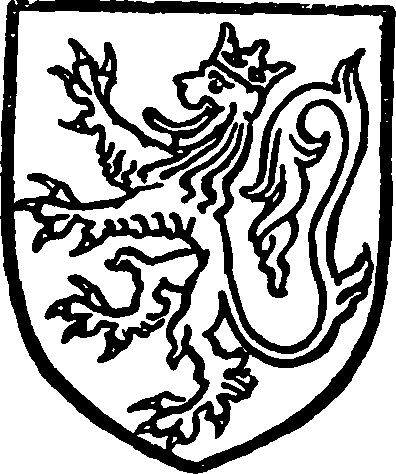
Morley. Argent a lion sable crowned or.
The Ralph de Lanvalei to whom the reversion of the manor was granted in demesne before the death of Lady Clemence (fn. 28) was succeeded by a sister, Gunnora, who married William de Beauchamp, (fn. 29) one of the Beauchamps of Bedford. They had a son John, whose heir was a minor in 1232. (fn. 30) William de Beauchamp had a family by a second wife, his son being Simon de Beauchamp (IV), whose daughter and heir, Joan, died before 1262, her heirs being her three aunts, of whom one was Beatrice, the wife of Thomas Fitz Otes. (fn. 31)
William Fitz Otes was concerned with 2 carucates of land here in 1243, (fn. 32) probably on the occasion of his brother Thomas's marriage with the Beauchamp heiress Beatrice. Thomas died seised in 1274 leaving a young son Otes and three daughters, Joan, Maud and Beatrice. (fn. 33) Beatrice, widow of Thomas Fitz Otes, married William de Munchensey and in 1279 was holding Hamerton in dower. (fn. 34) Her son Otes died before 1282 (fn. 35) and was succeeded, as regards Hamerton, by his sister Maud, the wife of John Botetourt. (fn. 36) Maud was still alive on John's death in 1324, leaving an heir, her grandson John, son of Thomas Botetourt, a minor. (fn. 37) Her daughter Elizabeth, wife of William, Lord Latimer, succeeded her in Bedfordshire. (fn. 38) For some reason Hamerton and Mendlesham (Suff.), another Fitz Otes manor, passed to Otto Botetourt, who dealt with the latter in 1330 and died seised of both manors in 1345, leaving a son John under age and a widow Sibyl. (fn. 39) In 1346 Hamerton was held by Sibyl, probably as dower. (fn. 40) John was holding a knight's fee in Mendlesham in 1361, (fn. 41) and died before 1377, when his widow Katherine sued for dower from John, son of Sir John Knyvet and Joan his wife, daughter and heir of John Botetourt. (fn. 42) Thus Hamerton went to the Knyvets.
In 1418 John Knyvet of Mendlesham died seised of the manor of Hamerton, leaving a son and heir Sir John, (fn. 43) who died seised in 1445, leaving a son and heir John. (fn. 44)
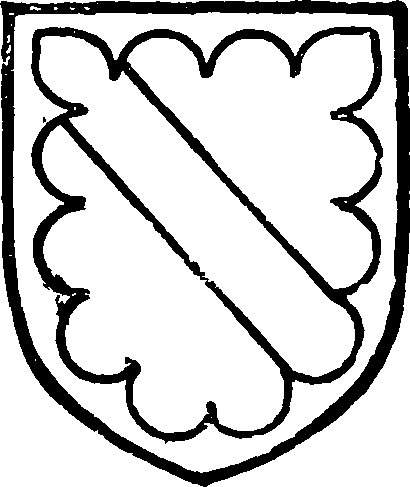
Knyvet. Argent a bend and a border engrailed sable.
John Knyvet died in 1490, leaving a son William aged 50 years and a widow Alice. (fn. 45) Sir William Knyvet settled the manor of Hamerton on his son Charles and Anne his wife for their lives (fn. 46) and died in 1515, leaving as his heir Edmund, son of Thomas, son of his son Edmund Knyvet, aged 7 years, (fn. 47) but Charles was still holding in 1522. (fn. 48) The younger Edmund was succeeded by Sir Thomas Knyvet, who in 1565 conveyed Hamerton to Silvester Bedell. (fn. 49) Silvester was succeeded by Sir John, his son by his first wife Margaret Highfield. Sir John died in 1613, (fn. 50) leaving a son Thomas who married Winifred, daughter of Sir Arthur Capell of Hadham (Herts) and died also in 1613. (fn. 51) Their son Capell was created a baronet in 1622 and died and was buried at Hamerton in 1643. He left two daughters: Elizabeth, who married Sir Francis Compton, and Mary, who in 1655 married Sir Thomas Leventhorpe, bart. (fn. 52)
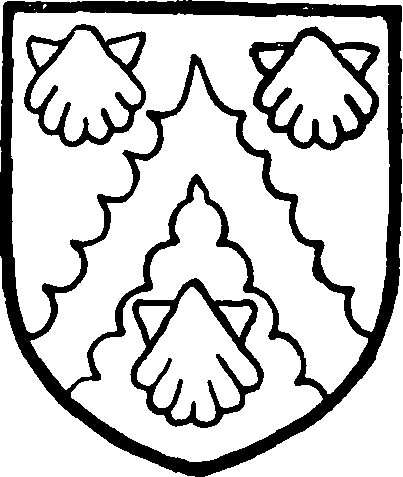
Bedell. Gules a cheveron engrailed between three scallops argent.
Sir Francis purchased the Leventhorpe moiety and thus obtained the whole manor. (fn. 53) In 1683 he sold it to Erasmus Smith (fn. 54) or Herriz of Edmundthorpe (co. Leic.). Erasmus died in 1691 and was buried at Hamerton. His son Hugh Smith left two daughters and co-heirs, Lucy and Dorothy, who each took a moiety of the manor of Hamerton. Lucy married in 1747 James Stanley, eldest son of Edward, eleventh Earl of Derby, who assumed the additional surname of Smith. He died in 1771 in his father's lifetime, leaving a son Edward Smith Stanley, commonly called Lord Stanley, who settled a moiety of the manor in 1774 (fn. 55) and succeeded his grandfather as twelfth Earl of Derby in 1776. Dorothy Smith, the other co-heir, married in 1746 John Barry, youngest son of James, fourth Earl of Barrymore, and their son, James Hugh Smith Barry, settled the other moiety of the manor in 1778. (fn. 56) James Hugh left his estates to his natural son, John Smith Barry, who in 1821 by royal licence took the name and arms of Smith Barry and seems to have acquired the whole manor of Hamerton. He died in 1837, leaving a son James Hugh (d. 1856), whose son Arthur Hugh Smith Barry was created Lord Barrymore in 1902. Lord Barrymore died without male heir in 1925 and was succeeded by his nephew, Mr. Robert Raymond Smith Barry, the present owner. (fn. 57)
The lords of Hamerton in 1276–9 had gallows, view of frankpledge, amends under the assize of bread and ale, and warren from of old. (fn. 58)
Royston Priory held a carucate of land here of the lord. (fn. 59) It seems to have been granted to the Cromwells after the Dissolution, (fn. 60) but afterwards descended with the manor. (fn. 61)
The Knights Hospitallers claimed view of frankpledge of their tenants here. (fn. 62)
Church
The church of ALL SAINTS consists of a chancel (32¾ ft. by 17½ ft.) with vestry on the north (14½ ft. by 9¼ ft.), nave (51¼ ft. by 19 ft.), north aisle (10 ft. wide), south aisle (9¾ ft. wide), west tower (11 ft. by 11 ft.) and south porch. The walls are of stone rubble and pebble rubble, with stone dressings; the tower is of ashlar. The roofs are covered with tiles, slates and lead.
The church is not mentioned in the Domesday Survey (1086), but one probably existed, and there is a reference to it in 1130. (fn. 63) The earliest parts of the present building are the side windows of the porch, which date from the extreme end of the 13th century, but the whole church seems to have been rebuilt with chancel, nave, side aisles and south porch in the early years of the 14th century. The usual reconstruction took place late in the 15th century, when the aisle walls were largely rebuilt with larger windows, a clearstory added to the nave, the roofs of nave and aisles renewed, a rood-screen and rood-stairs added, and west tower built. The chancel, being decayed and ruinous, was partly rebuilt in 1796, when a new steep roof covered with tiles replaced the former flat leaded roof. (fn. 64) The church was restored in 1854, when the chancel walls were refaced; and the chancel was underpinned and repaired in 1896–7.
The early 14th-century chancel has a three-light east window with tracery in a two-centred head, nearly all modern. The north wall has two early 14thcentury two-light windows with plain spandrels in two-centred heads; an early 14th-century singlelight low-side window; a modern doorway to the vestry; and a modern niche for a credence. The south wall has two two-light windows similar to those in the north wall, but both have their inner sills carried down, that of the eastern window to form a seat, and that of the western to allow a low-side window to be formed below a transom in the western light; an early 14th-century doorway with a two-centred head and continuous moulded jambs; and a modern piscina with a quatrefoiled basin. The early 14thcentury chancel arch has a two-centred arch of two chamfered orders, the inner order carried on moulded corbels supported on carved heads. The roof is modern. The side walls have a stone cornice under the eaves carved with ball-flowers.
The modern vestry has a three-light window in the east wall, a plain doorway in the west wall, and a fireplace on the north.
The early 14th-century nave has an arcade of four bays on each side, all having two-centred arches of two chamfered orders resting on octagonal columns with moulded capitals and bases, and similar halfcolumns to the responds. The details on the north side are slightly earlier than those on the south. The labels over the arches turn up at the apex and run into the string-course below the clearstory. The late 15th-century upper doorway of the rood-stairs is in the north-east angle. The late 15th-century clearstory has four three-light windows on each side, having cinquefoiled lights and four-centred heads. The contemporary roof, much restored, has moulded beams, carved figures at the feet of the jack-legs, and carved angels with outstretched wings at the feet of the intermediate principals. The original corbels below the jack-legs are carved with angels.
The early 14th-century north aisle has in the north wall three late 15th-century three-light windows with four-centred heads, and a doorway of similar date with a four-centred head and continuous chamfered jambs. The east and west windows are similar to those in the north wall. On the east wall is a rectangular 15th-century bracket; and at the southern end of this wall is the lower doorway of the late 15th-century rood-stairs, the stairs themselves being partly in the aisle and partly in a semicircular turret in the outside angle between the chancel and aisle. The roof is largely modern, but retains some old beams with carved figures at the feet of the jack-legs—four of them being figures of the Evangelists with animals' heads; and the corbels below are crudely carved grotesques.
The late 14th-century south aisle has a late 15thcentury three-light east window with simple tracery in a depressed four-centred head. The south wall has three somewhat similar three-light windows with vertical tracery; an early 14th-century doorway with a two-centred head and continuous hollowchamfered jambs; and a modern piscina with trefoiled head and 14th-century trefoiled basin. (fn. 65) The roof is similar to that of the north aisle and the jack-legs rest on similar corbels.
The late 15th-century west tower has a two-centred tower arch of three moulded orders, the two outer continuous and the inner order resting on semicircular attached shafts with moulded capitals and bases. The west doorway has a two-centred arch in a square head with traceried spandrels, continuous moulded jambs with moulded bases, and a moulded label formed partly of the string-course above; the west window is a three-light with intersecting tracery in a four-centred head. The second stage is blank. The third stage has a two-light window with simple tracery in a four-centred head. The belfry windows are coupled transomed two-lights with simple tracery in four-centred heads. The tower has square buttresses set in from the angles, which rise to half-way up the belfry windows, and is finished with an embattled parapet, below which is a band of quatrefoils in circles. The stairs are in the south-west angle.
The early 14th-century porch has a two-centred outer arch of two chamfered orders, the lower order resting on attached semicircular shafts with moulded capitals. The east and west walls each have a reset late 13th-century two-light window with a soffit-cusped circle in a two-centred head. In the north wall, east of the door, is a semicircular headed recess for a stoup, but with modern basin. The roof is modern, but retains two late 15th-century beams.
The 15th-century font has an octagonal panelled bowl with moulded coving on an elongated-octagonal panelled stem and moulded base, and stands upon two steps. It is fixed against the western column of the south arcade, and the side against the column has been cut off.
There are four bells, inscribed: (1) C. & G. Mears Founders London 1854; (2) T: Eayre Kettering: [Crown]: 1728: [Crown] Gloria Patri Filio et Spiritui Sancto; (3) Non Verba Sed Voce Resonabo Domine Lavdem [and, on second line] Thomas Norris cast me 1628 W. Bvrnbi S. Fitchiohn Ch: Wa.; (4) Henry Penn made me 1706 William Smith churchwarden. In 1709 there were four bells and a clock. (fn. 66) They were rehung in a new frame in 1933.
In the chancel is a loose piece of 15th-century oak tracery, apparently from the chancel screen, which existed as late as 1851. (fn. 67) A few of the benches in the church incorporate 15th-century moulded rails, etc. The 17th-century Communion table is in the south aisle.
In the churchyard is a late 13th-century base of a column used as the base of a modern churchyard cross; the real base of the churchyard cross was found in a clump of trees north of the church and now lies in the churchyard on that side. A stone fixed to the south clearstory wall, outside, is inscribed 'I. B. 1707.'
On the north wall of the north aisle are some small remains of painting, including parts of a late 15thcentury St. Christopher, and a woman, and 17thcentury inscriptions.
There are the following monuments: in the vestry, to the Rev. Ferrar Collet, rector, d. 1679; and the Rev. John Pyne, rector, d. 1822; in the nave, to Rose Sophia Thomas, d. 1898; Arthur Hugh, Lord Barrymore, d. 1925; in the north aisle, War Memorial, 1914–19; in the south aisle, to Mawde (Lane), wife of John Bedell, d. 1587 (fn. 68); Sir John Bedell, Kt., d. 1613; Ralph Newton, d. 1760, Ann, his wife, d. 1775, and Ann d. 1762, Ralph d. 1763, John d. 1787, their children, Christopher, their son, d. 1798, Martha, his wife, d. 1839, Ann, Christopher's daughter, d. 1854, Elizabeth, wife of Christopher's son, Ralph, d. 1805, and some infants.
The registers are as follows: (i) baptisms, marriages and burials 27 November 1750 to 11 December 1812, marriages end 4 December 1763; (ii) the Official Marriage Book, 5 December 1763 to 3 January 1812.
The church plate consists of a silver cup with a coarse stem, inscribed 'The Town of Hamerton in the County of Huntington' and hall-marked for 1674–5; a silver cover paten, inscribed 'Hammerton Com: Hunt:' and similarly hall-marked; (fn. 69) a silver standing paten, inscribed 'Presented by James Hugh Smith Barry Esqre to the Church of Hamerton, September 1837. The Revd. A. Nash Rector' and hallmarked for 1837–8; a silver flagon, inscribed 'The Church of Hamerton in the County of Huntingdon' and hall-marked for 1851–2.
Advowson
The church seems to have been given to St. John's Abbey, Colchester, by William de St. Clair about 1130, (fn. 70) and his gift was confirmed by Aubrey de Dammartin and Maud his wife. (fn. 71) The abbey continued in possession until the Dissolution. (fn. 72) It was retained by the Crown until 1599, when it was granted to Henry Best, (fn. 73) probably on behalf of Sir John Bedell, the lord of the manor, who included the advowson in a settlement in 1600. (fn. 74) Except for a presentation by Susan Collet, executrix of Ferrar Collet, late rector, in 1679, (fn. 75) probably for one turn only, the patronage has remained in the hands of the lord of the manor to the present day.
The living is a rectory.
There are no charities for this parish.