A History of the County of Huntingdon: Volume 3. Originally published by Victoria County History, London, 1936.
This free content was digitised by double rekeying. All rights reserved.
'Parishes: Keyston', in A History of the County of Huntingdon: Volume 3, ed. William Page, Granville Proby, S Inskip Ladds (London, 1936), British History Online https://www.british-history.ac.uk/vch/hunts/vol3/pp69-75 [accessed 1 May 2025].
'Parishes: Keyston', in A History of the County of Huntingdon: Volume 3. Edited by William Page, Granville Proby, S Inskip Ladds (London, 1936), British History Online, accessed May 1, 2025, https://www.british-history.ac.uk/vch/hunts/vol3/pp69-75.
"Parishes: Keyston". A History of the County of Huntingdon: Volume 3. Ed. William Page, Granville Proby, S Inskip Ladds (London, 1936), British History Online. Web. 1 May 2025. https://www.british-history.ac.uk/vch/hunts/vol3/pp69-75.
In this section
KEYSTON
Chetelestan, Ketelestan (xi cent.); Keston (xiii cent.); Keyston (xvi cent.).
The parish of Keyston, containing about 2,690 acres, lies on the Northamptonshire border, and on its west and parts of its north and south sides the boundaries of the parish and county coincide. The land is undulating, but rises from the brook, a tributary of the Alconbury Brook, which runs through the middle of the parish. Here the land is about 150 ft. above Ordnance datum, and rises to nearly 250 ft. in the north and a little over that height to the south.
Although much of the land is arable, most of it is laid down for grass. There are many small copses scattered over the parish, but on the whole there is little woodland. The road from Huntingdon to Thrapston runs through the north of the parish, and a by-road from Covington to Raunds through the middle. The village stands midway between these roads, about 13½ miles from Huntingdon, and is approached by a road called Toll Bar Lane from the north and by another road from the south. It is arranged round roads forming approximately an oval shape. Within this figure is the church, to the west of which is the Manor Farm. The ancient manor house, which stood in the large field containing earthworks, east of the church, (fn. 1) was described in 1589 as 'newly built,' when, with its outbuildings, it was said to be 'in good and sufficient repair.' (fn. 2) At that time Henry Clifford, who had secured a lease for forty-one years from Robert, Earl of Essex, less than a year before the sale of the manor, was living there. (fn. 3)
During Henry Clifford's tenure of the manor the common fields were 'improved and made into several closes,' the Earl of Essex having given licence for the inclosure; (fn. 4) and it seems probable that some planting of trees was done at the same time, as the survey of 1589 mentions that 'there are neither woods nor underwoods pertaining to the said manor, saving some okes and elmes growing in hedgerowes about the several closes.' (fn. 5) The house was pulled down by Thomas Elderkin about a century ago, and the present Manor House was then built, but has been enlarged in recent years. A 17th-century house built of rubble with a tiled roof has a sundial on the south gable, which bears the initials 'R. W. 1700.' To the east of this house is another late 17th-century house, thatched and timber-framed, which has been partially refaced with brick.
Manchester Lodge is about a mile south of the village.
The village stands about two miles north-east from Raunds station (Northants) on the Kettering and Cambridge branch of the L.M.S. Railway.
The following place-names occur in the survey of 1605: Basinghame's bridge, the Cross, Duckinglane, Froglane, Gotheridge feld, Hilmeadow or Hillymead, Middlebrook, Milfeld, Morden feld, Staples or Stables meadow, Towne meadow, Torpens meadow, Read close, Torpill's end. (fn. 6)
Manors
The manor of KEYSTON, which was assessed in 1086 at 4 hides, belonged to the farm of King Edward the Confessor; and though Aluric the sheriff occupied the township, 'he always paid the King's farm therefrom, and his sons after him until Eustace took the shrievalty.' The hundred, however, bore witness against Eustace's efforts to acquire the manor, and at the time of the Domesday Survey it was in the custody of Ranulf, the brother of Ilger. (fn. 7)
It is not clear at what date it was granted to Saher de Quincy; but it was stated in 1220 that it was given to the Earl of Winchester for his maintenance in the king's service at the royal pleasure. (fn. 8) This was apparently an ineffectual bribe, for both Saher and his son Roger rebelled against King John and continued to support Louis the Dauphin even after the accession of Henry III; the manor of Keyston was accordingly committed to Joslan de Brisay and Peter des Roches on 2 November 1220, after it had been taken into the king's hand on the 25th of the previous July, when the news of Saher's death reached him. Provision was made for Margaret de Quincy, Saher's widow, by the assignment to her of another manor, and his goods were saved to his executors. (fn. 9) Early in the following year Roger, son of Saher, submitted and did homage, and on 26 February 1221 orders were sent out that he should be given seisin of the lands, fees, and rents of Saher, his father, without delay. (fn. 10) In 1255 he was dealing with meadow land in Keyston, (fn. 11) but the manor is not mentioned among his Huntingdonshire possessions in the inquest taken after his death in 1264. It seems, nevertheless, to have passed to his daughters and co-heirs; for Helen, the widow of Alan la Zouche, Elizabeth, the wife of Alexander Comyn, Earl of Buchan, and Margaret, the widow of William Ferrers, Earl of Derby, were parties to a fine concerning it in 1271, when 2 carucates of land here were settled upon Margaret and her heirs. (fn. 12) She died about 1280, (fn. 13) leaving as her heir her grandson, John de Ferrers. He made proof of his age on 8 July 1293, when Robert of Heacham, the rector of Keyston, stated that he had been born at Cardiff on Saturday before St. John's Day (20 June) 1271, which the rector of Kimbolton confirmed, adding that it was just two years after the marriage of his parents, Robert de Ferrers and Eleanor, granddaughter of Sir Humfrey de Bohun of Kimbolton. (fn. 14)
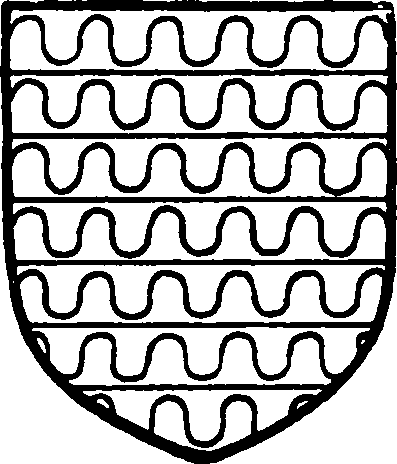
Ferrers of Chartley. Vairy or and gules.
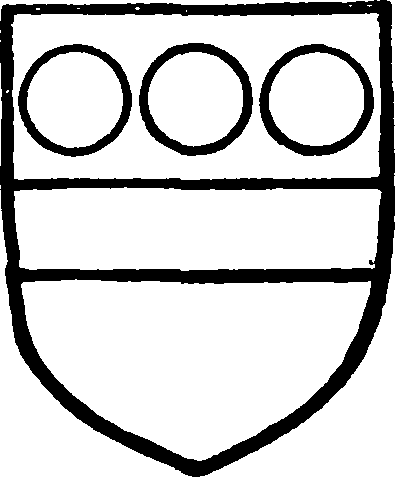
Devereux. Argent a fesse gules with three roundels gules in the chief.
The manor subsequently followed the descent of the barony of Ferrers of Chartley. (fn. 15) Anne, daughter and heir of Sir William de Ferrers of Chartley (d. 1450), married Walter Devereux, and their great-greatgrandson Walter was created Earl of Essex in 1572 and died in 1576. (fn. 16) Robert, Earl of Essex and Lord Ferrers, received a licence to alienate the manor to Thomas Crompton and Robert Wright in 1589. (fn. 17) This was a forced sale, made in order to discharge a debt of £3,000 to the Crown. The manor was regarded as having been sold to the queen, (fn. 18) and seems to have remained in the Crown until 1616, when, being in the tenure of Henry Clifford (to whom it appears to have been first leased by Walter, Earl of Essex, about 1588), it was granted by James I to Thomas Emerson, his heirs and assigns. (fn. 19) Within two years it had passed to Thomas Dudley and Margaret his wife, who sold it in 1618 to Sir James Wingfield. (fn. 20)

Wingfield. Argent a bend gules cotised sable with three pairs of wings argent on the bend.
Almost immediately after this purchase Sir James Wingfield, with the consent of the freeholders on the manor, began to turn arable into pasture, and for this purpose inclosed over 1,700 acres, the freeholders receiving shares in the inclosure and the rector a tithe rent-charge of 20d. an acre yearly in compensation of his glebe. (fn. 21) In 1634 the manor was conveyed to Sir Francis Bodenham and Edward Harbert for the purpose of settlement on Sir James and his heirs. (fn. 22) His son, Edward Maria Wingfield, succeeded him before 21 April 1642, when his estate at Keyston was certified by Mr. Justice Heath to be sufficient security for the payment of a debt which he owed to Wolley Leigh of Thorpe in Surrey. (fn. 23) This debt was collected at the end of the first Civil War by the Parliament, the Committee for Advance of Money giving order 'for the sale by Edward Maria Wingfield of Keston of so much of his estate as should produce £800 due upon a bond to Wolley Lee [Leigh] esq., a Delinquent.' (fn. 24) Wingfield was still living at Keyston in 1655, (fn. 25) but presumably did not care to risk the remainder of his estate by joining in the royalist rising of that year. He seems to have been succeeded before 1680 by his son John, who died about 1687, (fn. 26) leaving four daughters and co-heirs: Mary, Alice, Elizabeth and Dorothy, the eldest of whom was not more than seven years old. In 1703 a settlement of a quarter of the manor was made upon Alice, on her marriage with William Leete, (fn. 27) who died before 1739. Mary married William Bridges, and the youngest sister Dorothy was married at Keyston in 1710 to the rector, Henry Lee. (fn. 28) Elizabeth, who never married, died in 1739, when a fresh settlement of the manor was made. (fn. 29) Mary and Dorothy had no children, but Alice had a son, Wingfield Leete, and several daughters. One of these, Dorothy, was adopted by the Lees as their heir, but she died unmarried in 1729, at the age of seventeen, during the lifetime of her aunt, Dorothy Lee. (fn. 30) In 1751 Wingfield Leete with his wife Mary and his sister Anna Maria and Dorothy Lee were parties to a recovery concerning Keyston Manor; this appears to have been made in connection with the marriage of Anna Maria to James Sykes. (fn. 31) Wingfield Leete died childless, and after his death the manor was divided between his sisters, Anna Maria Sykes and Mary, the wife of Richard Willis. Richard Wingfield Willis, Mary's son, was heir to both sisters. (fn. 32) He sold the whole manor in 1791 to Thomas Elderkin, (fn. 33) whose family remained in possession of it until 1877, in which year another Thomas Elderkin sold it to Messrs. Duncan and Milligan. In 1912 Mr. Milligan sold the manor to Mr. Joseph Henry Horsley, who died in 1917 and was succeeded by his son, Mr. Guy B. Horsley, who sold it in 1933 to Sir Holburt Waring.
An action heard before the justices of assize in 1286 seems to indicate the existence of a sub-manor in Keyston which had been held by Osbert Covenard, who had granted a tenement to Stephen de Scaldewell to be held of him. Osbert then gave the services due from Stephen to Maurice de Monte Martirum, who held them of William de Ferrers. Stephen died and was succeeded by Walter, his son, who did homage to Maurice. After Maurice's death William de Ferrers, as overlord, gave the custody of Saher, son of Maurice, to Simon de Cotes, who unjustly disseised Walter. (fn. 34) The later descent of this holding has not been traced, but a reputed manor known as MONTAGU MANOR appears in the 17th century. In 1609 Edward and Thomas Dudley conveyed lands to Sir Sidney Montagu, (fn. 35) who was presumably a trustee for his brother Henry. At his death in 1642 Henry, Earl of Manchester, bequeathed to his son Walter 500 marks a year rent-charge on Keyston Manor. 'Walter, being then out of England and afterwards in the Tower, demanded this rent of the young Earl his brother,' who said the will was void as the rent-charge was given on lands that would not bear it, and further that during his six years' imprisonment he had furnished him with nearly that sum for his subsistence. On his release Walter 'accepted a small present from the Earl for his journey to France,' and thereafter, having taken religious vows, expected nothing further. But in 1657 he heard that his brother was being 'questioned for two-thirds of his rentcharge and arrears on the score of his recusancy,' and thereupon urged the Cardinal (Mazarin) to represent to the Protector that he had been 'relieved by his brother's kindness only, not of right,' and to request that the Earl might not be pressed on this demand. (fn. 36)
The property followed the descent of the Earldom and afterwards of the Dukedom of Manchester (fn. 37) until 1918, when under the names of Manchester Lodge Farm and Mickle Hill Farm it was put up to auction and later sold. Any manorial rights there may have been have apparently been lost.
As was frequently the case with regard to the property of absentee landlords, Keyston seems to have been developed, probably in the 13th century, by conveying away large freeholds. It appears from an action in 1286 that William Wold or William, son of Maurice de Wold Weston (Old Weston), gave to Ralph Waldeschef of Chesterton and Beatrice, his wife, lands in Keyston which Ralph afterwards leased to Roger de Lylleford and Alice, his wife. Beatrice in her widowhood later, as Roger asserted, quitclaimed to him all her right in the vill and fields of Keyston which included the lands given by William de Wold. Beatrice, however, denied that the quitclaim was sealed by her. (fn. 38) In 1299 Roger and Alice conveyed lands in Keyston to Richard le Faukener of Keyston, clerk, (fn. 39) and in 1384 John de Stukeley obtained from a Thomas Faukener and Elizabeth his wife a quitclaim of 2 messuages, 8 tofts, a carucate of land, 6 acres of meadow, 2 acres of pasture and rent of one penny and a left-hand glove, (fn. 40) and a similar quitclaim from Richard Northfolk and Margaret his wife of whatsoever right they might have in the premises during the lifetime of Margaret. (fn. 41) It seems probable that this, like Stukeley's land in Gidding, was afterwards sold on account of his debts, but no evidence as to its further history has been found.
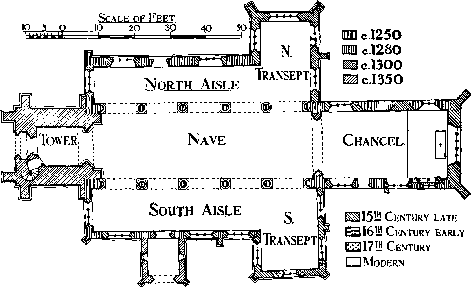
Plan of Keyston Church
Another large holding was that of 400 acres of land, 30 acres meadow, and 20 acres pasture, which appears to have been the inheritance of Anne the wife of Thomas Pulter the elder. She and her husband conveyed it in 1475 to John Nicholls. (fn. 42) Thomas Pulter had other lands in Keyston, for he afterwards complained that he had enfeoffed William Husey, Simon Hareby, John Lytyll and John Dymmok 'to the intent to refeffe him,' which they refused to do. He brought an action against them in Chancery about 1475, (fn. 43) but the result has not been found.
In 1432 John Drewell and Henry Penwortham, clerks, obtained a quitclaim concerning 5 messuages, 2 tofts, a dovecot, 300 acres land, 16 acres meadow and 6d. rent in Keyston from Simon Horne of Daventry and Elizabeth his wife and the heirs of Elizabeth, with a warrant to the heirs of Henry; (fn. 44) and in the year following they received a similar quitclaim of the premises from Thomas Agard and his wife Christiana and the heirs of Christiana. (fn. 45)
Church
The church of ST. JOHN THE BAPTIST consists of a chancel (36¼ ft. by 19 ft.), nave (60¾ ft. by 18½ ft.), north transept (22½ ft. by 13¾ ft.), south transept (22 ft. by 16 ft.), north aisle (46¼ ft. by 10¼ ft.), south aisle (46½ ft. by 11½ ft.), west tower (11¼ ft. by 10¾ ft.), and south porch. The walls are of coursed rubble with stone dressings, and the roofs are covered with zinc and lead.
The church is not mentioned in the Domesday Survey (1086), and the earliest existing parts are the nave and aisles, c. 1250, and the chancel, c. 1280. The tower and porch were built c. 1350. Commencing about 1480 a considerable reconstruction took place: the east wall of the chancel was rebuilt, the walls heightened and a new window inserted in each; the clearstory was added to the nave; the south transept was built and new windows inserted in the south aisle walls; and finally, c. 1500, the north transept was built and new windows formed in the north aisle walls. The roofs of the nave, transepts and aisles were renewed when these parts were respectively reconstructed towards the end of the 15th century, and correspond with the slight differences of date; but those of the south aisle and porch were renewed in the 17th century. The church underwent a general restoration in 1883, when the lead on the nave roof was replaced with zinc; and shortly afterwards the top of the spire was repaired. The roofs of the south aisle and transept were repaired in 1897; the chancel was re-roofed in 1904, and the spire was again repaired in 1908. The roofs of the north transept and north aisle were thoroughly repaired in 1922–3, and in 1928 the top of the spire was again repaired.
The chancel, c. 1280, has a 15th-century five-light east window with a two-centred head, and with modern mullions and geometrical tracery. The north wall has a late 13th-century two-light window with a plain spandrel in a two-centred head; the blocked rear-jambs and arch of a similar window, only visible inside; a 15th-century three-light window with vertical tracery in a four-centred head, partly occupying the position of a 13th-century window of which the eastern splays and the rear-arch remain; a blocked modern doorway. The south wall has a late 13thcentury two-light window similar to that on the north; an early 16th-century three-light window with a four-centred head occupying the position of a 13th-century window of which the eastern jamb and part of the arch remain; a 15th-century three-light window similar to that on the north; a 13th-century doorway with a moulded trefoiled arch and one engaged jamb-shaft each side, with capitals having stiffleaf foliage and moulded bases; a piscina and triple sedilia, c. 1300, having trefoiled heads carried on three circular shafts with moulded capitals and bases, octofoiled basin to the piscina and graduated seats to the sedilia. The north-west and south-west windows contain a little 15th-century glass, that on north with the winged lion of St. Mark and that on south with a figure of a female saint. The side walls have been heightened in the 15th century, when the east wall seems to have been rebuilt; at the foot of the east gable, at the north end, is a carving of a roseen-soleil in a recessed panel, and at the south end is the carved head of a bishop. The roof is modern, 1904. The chancel arch, c. 1300, is two-centred, of three chamfered orders resting on three attached shafts on each side, having moulded capitals and bases.
The nave, c. 1250, has an arcade of five bays on each side, having two centred arches of two chamfered orders, resting on columns and responds which are alternately circular and octagonal, but the circular columns on one side face octagonal columns on the other; the responds, which are half-columns, are semicircular at the north-west and south-east, and semi-octagonal at the north-east and south-west. All have moulded capitals and bases and square plinths. Three of the capitals on the north side have the nail-head ornament. The late 15th-century clearstory has five two-light windows on each side, having vertical tracery in four-centred heads. The early 16th-century roof has moulded beams, jack-legs and braces, with traceried spandrels; there are remains of painted decoration on the eastern beam.
The late 15th-century north transept (fn. 46) has, in the east wall, two original three-light windows with fourcentred heads; and a rectangular locker. The north wall has an original transomed four-light window with tracery in a four-centred head. The west wall has a three-light window similar to those in the east wall. The east and north windows contain a little contemporary glass with fragments of two figures and borders of crowns, letters, the white rose and the rising sun and other ornaments. The contemporary roof is of low pitch and has moulded and carved beams, jacklegs, braces and carved spandrel pieces. The stone corbels at the feet of the jack-legs are moulded and embattled.
The late 15th-century south transept has, in the east wall, two original three-light windows with vertical tracery in four-centred heads; and a 14thcentury piscina with a two-centred head and an octofoiled basin. The south wall has parts of the jambs and splays of a large blocked window, probably of four lights, in which a 17th-century two-light window with a four-centred head has been formed with the old materials. The west wall has a three-light window similar to those in the east wall. The 16th-century roof has moulded beams, jack-legs and braces, with carved bosses to the beams and purlins. Two of the stone corbels under the jack-legs are carved with heads.
The north aisle, c. 1250, has, in the north wall, two late 15th-century three-light windows with fourcentred heads, and there is another in the west wall. The original north doorway has a two-centred head of two chamfered orders, the outer order resting on detached shafts (one of which has gone) with moulded capitals and bases. The late 15th-century pent-roof is generally similar to that of the north transept, and the feet of the jack-legs rest on moulded and carved stone corbels.
The south aisle, c. 1250, has, in the south wall, three late 15th-century three-light windows with vertical tracery in four-centred heads; and a 14thcentury south doorway with a two-centred head and continuous moulded jambs. The west wall has a late 15th-century window with tracery in a fourcentred head, apparently similar to those in the south wall, but reduced in height and some of the tracery omitted. The pent-roof is nearly all modern, but retains a few 17th-century timbers.
The west tower, c. 1350, has a two-centred tower arch of three chamfered orders carried on similar responds with moulded capitals and bases. The west doorway has a two-centred head with continuous moulded jambs; immediately above the apex is a small bracket supported by a carved recumbent figure of a man. The doorway is set in the inner half of the wall, and the outer half forms a shallow porch with ogee head, cusped and sub-cusped, and with carved spandrels (one being the head and forepart of a goat), crocketed label, and a straight-sided embattled label forming a gable above; the jambs each have three filleted bowtels with moulded capitals and chamfered bases; there is a slight thickening of the wall carried up above the straight-sided label, finished with a square top, and flanked by two small buttresses carried up as pinnacles. Above this porch is a lozengeshaped window with tracery and a continuous label all round. In the next stage the north, south and west walls each have a single-light window; and the east wall has a small doorway with a segmental-pointed head, opening on to the roof. The belfry windows are coupled transomed two-lights with tracery in two-centred heads; the jambs are carved with fourleaved flowers and a running stem; and the lights above the transoms are filled in with rough stones forming small triangular openings. Above these windows is a deep band of five panels on each side, with traceried heads. The tower has a boldly moulded plinth and square buttresses set well in from the angles, those on the east being within the nave. The buttresses are carried to the top of the tower, which is finished with a moulded cornice with carved heads and notch-heads and is surmounted by an octagonal broach spire having three tiers of lights, the first and third on the cardinal faces; the windows of the lowest tier are of two lights with a central and two attached jamb-shafts, and have a quatrefoil in the head, those of the second tier are somewhat similar, and those of the top tier are single-lights. The top of the spire is about 137½ ft. above the ground. The lowest stage of the tower was vaulted, but the vault has been replaced by a wooden floor. The tower stairs are in the south-west angle, and are covered by a quadripartite vault with chamfered ribs.
The south porch, c. 1350, has a two-centred outer archway of two wave-moulded orders, the inner order carried on semicircular attached shafts with moulded capitals and bases. The side walls have each a singlelight window. The late 16th-century roof has moulded beams.
The font has a modern octagonal bowl on a 13thcentury circular stem and base and a square plinth. The 13th-century octagonal bowl with tapering sides was found, about forty years ago, in the rectory garden, and now lies loose in the south aisle.
There are five bells, inscribed: (1) Feare the Lorde 1592. (2) William Marks churchwarden: . I: Eayre fecit. 1743 gloria Deo soli: . Francis [?] Clitherow Esquire. (3) Remember the ende 1592. (4) Give God the praise 1592. (5) Thomas Rvssell of Wootton near X Bedford made me in 1733 Thomas Simonts churchwarden. The first, third and fourth are by Watts of Leicester. In 1552 there were four bells and a sanctus bell. (fn. 47) There were five bells by about 1709, (fn. 48) but whether this is counting the sanctus bell is not clear.
There are a few simple old seats in the aisles, and one is dated 1608. A bench-end, made up with a modern seat in the north transept, is inscribed 'D. Lee her seat.' (fn. 49)
The oak lectern, made up from a 17th-century bedstead, has a desk ornamented with arabesque carving, a turned stem with octagonal base, and triangular foot. The reading desk is made up of 17th-century turned and moulded oak.
Lying loose in the south aisle is a coped coffin-lid, c. 1300, with foliated cross at head and foot, and having a transverse bar with crossed ends in the middle. There are three 13th-century stone coffins lying across ditches in the village.
In the walling of the east wall of the porch are two stones with remains of 11th-century interlaced ornament; and another similar stone is built into the south wall of the tower. Lying loose in the church is an oak cadaver, c. 1500. On the west wall of the north transept is a reset early 16th-century matrix of a brass with indents of a man and wife and inscription plate; the top of the stone has been cut to the shape of a two-centred arch, and on either side of the figures an ornamental cross, the letter 'D' and a monogram (probably 'N A') have been deeply cut in.
There are the following monuments: in the chancel, floor slabs now fixed on the wall, to I.W. 1680; the Rev. John Gardner, rector, d. 1698, and Frances, his wife, d. 1740; Francis, Catherine and John, children of John and Frances Gardner (date illegible); John Gardner, son of the same, d. 1707; the Rev. John Cooke, d. 1764; Margaret, his wife, d. 1761; and Frances, their daughter, d. 1753; and glass window to Joseph Henry Horsley, d. 1917, and Wilfrid Palmer Horsley, his son, d. 1917. In the north transept, to the Rev. Henry Lee, rector, d. 1751; and floor slabs to Ann (Wingfield), wife of Robert Hampson, d. 1666; Alice, wife of Robert Gowler, d. 1725; Dorothy Leete, d. 1729; Elizabeth Wingfield, d. 1739; Mary, wife of John Wingfield, d. 1739; Henry Lee [d. 1751]; and Dorothy Lee, wife of the Rev. Henry Lee, d. 1762. In the south transept, to Frederick Henry Binns, d. 1846; and glass window to Elizabeth Binns, d. 1885. In the north aisle, War Memorial, 1914–18; and glass window to T. R. Spencer, d. 1863.
The registers are as follows: (i) baptisms, marriages and burials 11 February 1637/8 to 22 March 172930; (ii) the same 24 May 1728 to 25 December 1770, marriages end 30 December 1753; (iii) baptisms and burials 7 April 1771 to 2 December 1812; (iv) marriages 25 November 1754 to 10 August 1812.
The church plate consists of a silver cup inscribed 'Keystone. H. Lee, D.D. Rector,' hallmarked for 1735–6; (fn. 50) a silver cover paten for same, similarly hall-marked; a shaped silver plate, inscribed 'Keystone W. Elliston, D.D., Rector. 1776,' hall-marked for 1775–6; (fn. 51) a silver flagon, inscribed 'Keystone. Revd. J. P. Goodman M.A. & R.D. Rector,' and on the bottom 'Presented by Mary P. Ray, sister of the Rector. July 1885,' hall-marked for 1885–6.
Advowson
The church at Keyston was valued in 1291 at £18 13s. 4d. (fn. 52) and in 1535 at £30 1s. 6d. (fn. 53) In 1428 it was assessed at twenty-three marks, and paid 37s. 4d. to the subsidy. (fn. 54) The advowson was attached to the manor and followed the same descent. (fn. 55) It was acquired before 1764 by Charles, Marquess of Rockingham; (fn. 56) it descended to Mr. G. C. WentworthFitzwilliam, whose executors are now patrons. The tithes in Keyston seem to have been of considerable value, for about 1620, when Sir James Wingfield proposed the inclosure of over 1,700 acres of land, the rector, John Scott, (fn. 57) 'perceiving the great inconvenience which was to arise to the church,' resisted the proposal and refused to receive tithes in kind out of the inclosure, declaring that the rectory was thereby disinherited almost to the value of one-half yearly. (fn. 58) Upon this complaint, 'to prevent the disherison of the said church and to make the said parsonage of as good, or neere as good, value as it was before,' Sir James and his tenants agreed that arbitrators 'of qualitie and conscience' should be chosen by common consent 'for establishing such a yearly rate upon the new inclosed grounds as they in their consciences and discretions should think to be equall ratably and respectively for the proportion of the said lands.' Sir Robert Payne and Sir Lewis Pemberton, the chosen arbitrators, decided that the inclosure should pay 1s. 8d. an acre yearly to the rector and his successors in lieu of tithes. Notwithstanding their agreement, Edward Bate and Thomas Hilles, 'two substantiall tenants' and owners respectively of 120 and 850 acres of the inclosure, neglected to pay their share. The rector brought an action against them in chancery; whereupon Edward Bate declared that the rate was exorbitant, and begged 'not to be compelled to pay as sett down by the referees'; while Thomas Hilles pleaded that, having consulted Edward Maria Wingfield and learned that 'Dame Mary,' probably the widow of Sir Edward Wingfield, 'was not willing to encumber the inheritance with this perpetual rent charge,' he did not absolutely agree to it, but 'did pay at times to stay suits until there might be some friendly agreement.' (fn. 59)
There are no charities for this parish.