A History of the County of Huntingdon: Volume 3. Originally published by Victoria County History, London, 1936.
This free content was digitised by double rekeying. All rights reserved.
'Parishes: Kimbolton', in A History of the County of Huntingdon: Volume 3, ed. William Page, Granville Proby, S Inskip Ladds (London, 1936), British History Online https://www.british-history.ac.uk/vch/hunts/vol3/pp75-86 [accessed 30 April 2025].
'Parishes: Kimbolton', in A History of the County of Huntingdon: Volume 3. Edited by William Page, Granville Proby, S Inskip Ladds (London, 1936), British History Online, accessed April 30, 2025, https://www.british-history.ac.uk/vch/hunts/vol3/pp75-86.
"Parishes: Kimbolton". A History of the County of Huntingdon: Volume 3. Ed. William Page, Granville Proby, S Inskip Ladds (London, 1936), British History Online. Web. 30 April 2025. https://www.british-history.ac.uk/vch/hunts/vol3/pp75-86.
In this section
KIMBOLTON
Chenebalton (xi cent.); Chenebolton (xii cent.); Kenebalton (xii-xiii cent.); Kenebaulton (xiii cent.); Kembauton (xiv cent.); Kymbalton (xiv-xvii cent.); Kymbolton, Kimoltoun, Guimolton, Quybolton (fn. 1) (xvi cent.). Stanlegh, Staynley (xiii cent.); Stonle (xiii-xvi cent.); Stoneley (xvi-xvii cent.). Wormedik, Wermedych (xiii cent.); Wormedich (xiii-xvi cent.); Worndiche (xvi cent.).
The parish of Kimbolton, of which the area is 5,140 acres, including 17 acres of inland water, comprises the town or village of Kimbolton and the hamlets of Stonely, to the east, and Wornditch, ½ mile to the west. Newtown in the north and Over Stow, adjoining Long Stow, also represent old hamlets; while the site of the 14th-century district of Werkwell (Wertwell, Qwertwell) is now unknown.
Kimbolton stands on the Bedfordshire border and the jurisdiction of its lords has always extended into that county. It gave its name to a hundred in 1086. (fn. 2)
The soil and subsoil are Oxford Clay, but chalk is found and there is gravel in the Kym valley. The land is mostly pasture, and the district was formerly noted for its shorthorns. There is, however, a fair amount of arable land, which in 1279 amounted to 700 acres, (fn. 3) a considerable quantity for that date. Kimbolton has always been a woodland district, and in 1086 there was woodland for pannage a league square. From the grove called 'la haie' Richard Russell, (fn. 4) who had custody of Kimbolton from 1178 to 1185, took 222 oaks for building a court and chamber in Leicestershire. (fn. 5) 'La Haye' or 'Heywode,' containing 200 acres, belonged to the manor in 1275–9. (fn. 6) In the next century there is mention of 'Lythlehay' (now Littless Wood) in Stonely between the park called Brythamwyk (Brihtelmewick, xii-xiii cent.; Brykhamwyke, xvi cent.; Brycknell, Brightholme, xvii cent.) (fn. 7) in the lord's demesne and Lyminge (now Lymage) Wood (fn. 8) in Great Staughton. A keeper of this park and of Hyghwode wood (now represented by Highpark Farm) was appointed in 1544. (fn. 9) The park was parcel of the castle demesnes in 1610, (fn. 10) and in 1615 was conveyed to Sir Henry Montagu. (fn. 11) Dudney (Dudenhey) Wood, on the east side of the parish, is mentioned in the 13th century, (fn. 12) and was perhaps one of the three groves belonging to the Earl of Hereford in 1301. (fn. 13) In 1544 Stonely Priory was recorded to have held four groves of wood in Kimbolton. (fn. 14) There were two foresters among the 'burgenses and cottars' of Kimbolton in 1279. (fn. 15)
The River Kym, which before it enters the western boundary of the parish is known as the River Til, flows south-east through the middle of the parish and town. The land adjoining it is about 100 ft. above the Ordnance datum and rises to just under 250 ft. on the northern boundary and to just over 200 ft. on the southern boundary. The chief hills are Honeyhill (Honyhill, xvi cent.), Hungry Hill, Over Hills and Warren Hill.
The town of Kimbolton is 2¼ miles from Kimbolton station on the London Midland and Scottish Railway. It lies along the road from Higham Ferrers to St. Neots in the valley of the Kym, which skirts its north-east side. As occurs in so many market towns, the main road has been diverted so as to pass through the High Street and Market Place in order to collect the tolls from passengers and merchandise. The street leading south-west from the line of the main road is called George Lane, after the George Hotel, a good 17th-century house, at the end of the lane, which has been converted into an hotel. The High Street, (fn. 16) which carries the main road through the town, is a fine wide road with a footpath on either side marked off by posts, and having the arched gateway of the back entrance to the castle precincts at one end and the church at the other. The Market Place probably adjoined the churchyard and extended as far as might be necessary along the broad High Street. Here probably stood the cross to which there is reference in 1487, (fn. 17) and here was the Market Hall, a wooden building on pillars, the site of which is marked by a flat stone. The houses on both sides of the street are timber-framed buildings of the 17th century or brick buildings of the 18th century, many of them converted from private houses into shops or inns and remodelled to adapt them to their new uses. On the north-east side a good 16th-century house with 17th-century additions has been divided and converted into an inn and a shop, and the White Horse Hotel has a stone at the back bearing the date 1640. The remainder of the houses on this side of the street are of the 17th century and later, as also are those on the opposite side. In the vicarage garden, south-west of the church, are the remains of a moat. At the church the street curves back to the line of the main high road. Parallel to the High Street on the north-east is East Street, which has some 17th-century houses much altered and remodelled in the 18th century and later. A house towards the north-west has a painted sundial.
Although we have reference in 1279 to the burgesses and cottars of Kimbolton and of burgage land, and in the wills of the 15th and 16th centuries we find references to 'burgages,' (fn. 18) there does not seem to be any other evidence of a borough with its court and other appurtenances. The lord had a market, view of frankpledge, gallows, pillory and tumbril. The villeins of the manor held at the will of the lord, paid aid and made redemption of flesh and blood for their sons and daughters. (fn. 19) The market town evidently grew up under the shadow of the castle and continued an important place until the 19th century, when it ceased to be a market town about 1890, (fn. 20) and now has a decreasing population. So far as we know, the first market was held under the charter granted by King John in 1200 to Geoffrey Fitz Piers, Earl of Essex, whereby a market was to be held on Friday and a yearly fair for three days on the eve of St. Andrew's Day and the two following days. (fn. 21) In 1441 the Earl of Buckingham was granted two fairs—namely, on Tuesday and Wednesday in Easter week and on 2 and 3 July. (fn. 22) When Kimbolton was bestowed on Sir Richard Wingfield in 1522 he received a grant of the market on Friday and a yearly fair on old St. Andrew's Day (11 Dec.); (fn. 23) the following year he was granted a yearly fair on St. Mary Magdalen's Day (fn. 24) (22 July). The market was discontinued about 1890. (fn. 25) Four fairs are now held yearly, three for toys on Friday in Easter week, Friday in Whitsun week and the Friday after old Michaelmas Day respectively, the fourth on 11 December, called Tandry Fair (St. Andrew's Fair, held on old St. Andrew's Day), while a statute fair for hiring servants is held on 21 September or the nearest Wednesday. Lacemaking was carried on early in the 19th century. (fn. 26)
About a mile westward along the high road leading from the village is the hamlet of Wornditch, with Wornditch Farm, a 16th-century brick and stone house with a part of timber framing, remodelled in the 17th century, and Wornditch Hall, which from early in the 18th century was the residence of the Day family. Thomas Day, who died in 1775, left his property here and at Spaldwick to his eldest son Thomas, with reversion under certain conditions to a younger son John. Thomas married late in life, leaving a son Thomas, whose paternity was disputed by his uncle John. Two lawsuits followed in 1784 and 1797, at both of which the paternity of the younger Thomas was confirmed. In 1801, however, to save further litigation, Thomas conveyed Wornditch to his cousin John, son of John Day, but retained his property at Spaldwick. (fn. 27) From John Day Wornditch passed to his descendants, who sold it to Charles Robert Wade-Gery about 1900. His widow lived there until her death about 20 years later, when it was sold to Mr. Reuben Llewellyn Farley, the present owner.
Ilfield, apparently in Wornditch, is mentioned in the 14th and 15th centuries. (fn. 28)
Warren House, about half a mile south-east of the village, is a square building with a porch on the southwest front, over which is a gable. It was built in the 17th century from 16th-century material brought from the old castle.
The hamlet of Stonely is about three-quarters of a mile south-east of the town of Kimbolton and to the east of Kimbolton Park. Along Hatchet Lane here are some 17th-century timber-framed cottages. The site of the Augustinian priory dedicated to the Blessed Virgin is now marked by portions of the moat which surrounded it and the remains of some masonry in a little building on the site. In 1582 it was stated that a chapel called 'Our Ladie Chapple' sometime stood near the late priory, which would probably be the church of the priory. A way called 'Saynte Marye Waye' led from the chapel to Perry; it lay along a highway until it came to Lady Grove, then entered the Prior's Pasture, and through this pasture to Perry Green and Perry; the way through the Prior's Pasture was first 'dyched' in Sir Oliver Leder's time. (fn. 29) An investigation of 1591 as to the lands of the priory in Overstow, Wornditch and Newtown mentions a Great Pasture in Overstow on the north side of Fylmans (Fillman, Feldman) Waye, Longbreach Furlong north of the way by the Upper Pasture called Beggerums, Ridds Way, Overshortlands, Nethershortlands, Yardes Endes, Goodwinsellhill, Badwinsellhill, Fernellhill and other field-names. (fn. 30)
There were meeting-houses at Kimbolton and Wornditch in 1672. (fn. 31) The vicar, Philip Nye, who died in that year, organised an Independent church here before 1643, when he was summoned to the Westminster Assembly of Divines. (fn. 32)
John Martin (1741–1820) was Baptist minister here towards the end of the 18th century. (fn. 33) A Moravian chapel was built in 1823, a dissenting chapel was registered for marriages in 1839, (fn. 34) and a Baptist and Independent chapel in 1854. (fn. 35)
The endowed Grammar School was founded in 1600 by Henry Bayle, a fuller, and William Dawson, a baker, of Kimbolton. Being dilapidated, it was demolished in 1874, and a larger school was constructed in 1877 on the Tilbrook road. The Council School dates from 1838. There was an almshouse before 1500, apparently in the High Street near the church, (fn. 36) and buildings were erected for the poor in 1701 adjoining the south-west corner of the churchyard, but were pulled down in 1877, when houses were built in the Grass Yard at the opposite corner of the churchyard for four women. (fn. 37) Mandeville Hall (1914), on the Thrapston road, was raised in memory of Louise, Duchess of Devonshire, previously Duchess of Manchester.
In 1279 there was a windmill at Newtown, (fn. 38) perhaps the windmill, etc., described as in Kimbolton, Great Staughton, Overstowe and Netherstowe sold to Sir John Popham in 1607 by Sir Anthony Mildmay, Sir Richard Wingfield, Sir Francis Popham, Sir Robert Wingfield, Sir Thomas Wingfield, Robert Throckmorton and John Pickering. (fn. 39)
There was an inclosure of 1,038 acres in Kimbolton, the award for which is dated 1769, (fn. 40) and also an inclosure of 748 acres at Wornditch, the award for which is dated 1795.
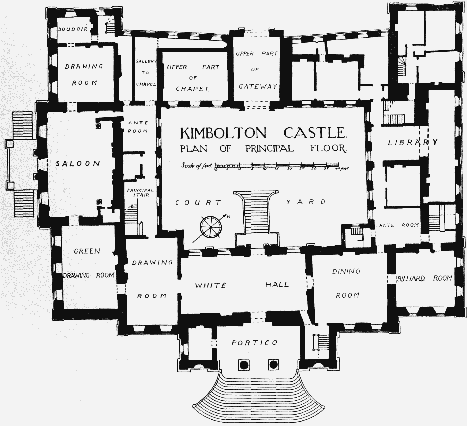
Reproduced by permission of the Controller of H.M. Stationery Office from the Report of the Royal Commission on Historical Monuments, Hunts.
Castle
It is probable that Geoffrey Fitz Piers, who married the elder daughter and coheiress of William de Say in 1185 (fn. 41) and was created Earl of Essex in 1199, was the original builder of the castle. There may have been a small castle here at Castle Hill thrown up during the anarchy of Stephen's reign (fn. 42) before this date, but the existing site, there can be little doubt, dates from the time of Geoffrey Fitz Piers. The castle was certainly built before 1201, when the Earl received King John in his manor here. (fn. 43) John was evidently so much enchanted with the place that in 1205 he granted lands in Brampton and Alconbury to be held by the service of providing fish, wine and hay once yearly when the king should wish to visit Kimbolton, (fn. 44) and visited it again in 1213. (fn. 45) William, brother and heir of Geoffrey son of Geoffrey Fitz Piers, forfeited Kimbolton, and on its restoration in 1217 we have the earliest direct mention of a castle. (fn. 46) It was attacked in 1221 by the Earl of Albemarle, who was ignominiously repulsed. (fn. 47) Although it had its constable in 1236 (fn. 48) and its seneschal in 1243 (fn. 49) and is called a castle, it is described in 1279 as a fortalace (forcelet'), (fn. 50) which implies something less than a fully developed castle. While held by Humphrey de Bohun, who fell at the battle of Boroughbridge in 1322, and whose wife was Elizabeth, daughter of Edward I, the castle was garrisoned and provisioned by the king. (fn. 51) Edward II visited his nephew John, Earl of Hereford, in 1326 (fn. 52) at Kimbolton, and Edward III was there in 1334. (fn. 53)
It is said that Anne, Duchess of Buckingham (d. 1480), rebuilt the greater part of the inner court of the castle (fn. 54) and in 1463 considerable expense was incurred for lead for roofing brought from Derbyshire. (fn. 55) The castle is described in 1521 as 'a right goodly lodging contained in little room, within a moat well and compendiously trussed together in due and convenient proportion, one thing with another, with an inner court, for the most part builded within sixty years by Duchess Anne, wife of Duke Humphrey, slain at Northampton field. There are lodgings and offices for keeping a duke's house in stately manner'; but, 'by occasion of the old maintill wall, the hall there well builded is likely to perish; and through the said castle is and will be great decay, by occasion there is no reparations done.' Outside the moat was 'a convenient room for a base court, now used like a gresse close'; in it were 'a fair barn and goodly houses fit for stables.' (fn. 56)
In 1522 the king gave the castle to Sir Richard Wingfield, and the next year he granted him leave to take stone and lead from the ruined castle of Higham Ferrers for the rebuilding of this castle. (fn. 57) A few years later Leland tells us: 'The Castelle is double diked and the building of it is metely strong. . . . Syr Richard Wingfield builded new fair lodgyns and galeries upon the olde foundations of the Castelle.' (fn. 58) The double dykes were probably something like the double moat at Cretingsbury, (fn. 59) because the date of building was rather too late for a motte-castle.
The story of Queen Katharine's unhappy sojourn here in 1534 has already been told. It does not seem to have entailed any structural alterations, and probably Sir Richard's building stood unaltered when, in 1615, the castle came into the possession of Sir Henry Montagu. Inventories of furniture taken in 1642 and 1687 tell us that it had a great hall with screens, a long gallery, a chapel, dining room, drawing room, upper round chamber, lower round chamber, Queen's Chamber, and many other rooms, a gatehouse, stables, 'the Castle Court,' 'the Dyall Court,' 'the Great Garden,' 'the Little fountain Garden.' (fn. 60) Unfortunately the inventories give no indication of the position of any of these rooms, but it is possible, from various sources, to locate a few of them. The great hall was the present White Hall, but included the site of the present drawing room (once the billiard room); the sixth Duke found the feet of the ancient rafters still remaining in the walls of the latter room. A bow window of this room, of which mention is made, was probably the great bow window of the dais of the hall. The screens would be at the other end; and the withdrawing room occupied part of the position of the present green drawing room. The long gallery occupied the site of the saloon, but was probably longer at each end, and it did not project beyond the general line of the front wall as the saloon does. Next to it were Queen Katharine's bedchamber and closet, which are said to have survived unaltered, but it is obvious that they had new windows and doors inserted in 1707, and apparently other alterations have been made. The chapel and the archway adjoining it doubtless still occupy their original positions, and the gatehouse, we may assume, stood away from the castle proper, on the western side of the outer moat.
Apparently Charles, 4th Earl, erected a range of rooms with a staircase and passages, chiefly to improve the communications, in the courtyard, against the old south wing. In 1694–5 he rebuilt the inner wall of the north wing to correspond, although he probably did not add any new rooms or passages on this side. (fn. 61) About the same time the inner walls of the east and west ranges were rebuilt. In 1707 the old south wing fell down, with the exception of Queen Katharine's bedchamber and closet, and Sir John Vanbrugh was called in to rebuild it. He replaced the long gallery with a large saloon, (fn. 62) which projects in front of the main wall and has an outer door in the centre with a flight of steps down to the garden, and he faced Queen Katharine's rooms to match his new work. This rebuilding was finished early in 1709; and within the next few years the remaining fronts of the castle were rebuilt, a large portico being erected on the east side in front of the White Hall.
The castle as it stands to-day has on the east front, which now constitutes the state approach, a large portico with Doric columns and a large flight of steps; the rest of the front, flanking the portico, has plain windows with segmental heads. The south or garden front has a large doorway in the centre, with flights of stairs to the garden, and the remainder, which is very plain, has large windows like those on the east front. The west front, which was the original approach, has a large carriage archway in the centre, and similar windows to those of the other sides; the north and south ranges project beyond the main line of this front, and they also rise slightly above it, giving it a more interesting character than the other fronts. The north front has similar windows to the rest; the middle portion stands on an arcade of five elliptical arches with rusticated piers, and has an added story which brings its parapet up to the level of those of the angle buildings. The whole of the fronts are faced with stone; they have rusticated angle pilasters and coarse embattled parapets. The walls facing the central courtyard are faced with red bricks and the windows and doors have stone architraves. The great hall, on the east, has three large windows and a doorway, the latter with a segmental pediment and surmounted with the Montagu arms and supporters; the wall is divided into bays by four Corinthian pilasters, and a stone staircase with iron balustrades leads up to the door. The other three sides have three tiers of windows, and that on the west has a round-headed carriage archway.
Inside, the principal rooms are all on the first floor. The White Hall has Ionic pilasters flanking the doors, a deep cornice and a coved ceiling. The saloon has Corinthian columns and pilasters, frieze and cornice, and a panelled ceiling. Queen Katharine's bedchamber is panelled with panelling of 1709. The walls of the chapel are panelled, and at the gallery level are three semicircular arches. The great staircase, much modernised, has some richly carved screenwork and arches. Many of the other rooms have 17th-century panelling and beams. One of the thick walls on the ground floor of the south range has a 16th-century doorway with four-centred arch and moulded jambs, and also a blocked window. Another similar doorway on the ground floor is at the southern end of the old east wall of the courtyard. Many other old walls and features must remain, but are covered by later plaster and panelling.
The moats have been entirely filled up, and their position cannot be identified. The grounds round the castle were laid out with terraces on at least three sides, and on the south was a great garden having a lawn flanked by two rows of lime trees, beyond which was a large elliptical pond with shrubberies on each side, and beyond this was another piece of ornamental water; (fn. 63) all this was enclosed on the two sides by brick walls ornamented with sixty-six stone flowerpots. Judging by Vanbrugh's letters, (fn. 64) it is probable that the gardens had been made not long before 1707; but there is now little left of them. An avenue of trees on the east side led to a gate and drive connecting with the high-road.
The gatehouse opening on to the south end of the town street was built by Robert Adam about 1766. It consists of a central archway between two rusticated windows, the wall flanked and divided by Doric pilasters supporting a frieze and cornice. On each side are wings, each divided into bays by shallow pilasters between which are semicircular arches each containing a plain window. At the end of the wings are buildings of one bay each, somewhat similar to the central part. It is very doubtful if this building stands on the site of the old gatehouse. The stone gateway with iron gates at the north end of the gardens was built by Adam at about the same time.
Manors
KIMBOLTON with the lands of its soke formed the only estate of Harold in Huntingdonshire in 1066. By 1086 it had passed to William de Warenne, when the sokeland attached to it extended into Swineshead, Great and Little Catworth in Huntingdonshire and Keysoe and 'Hanefeld' in Bedfordshire. (fn. 65) Before the middle of the 13th century Kimbolton had become an honour (fn. 66) and comprised lands in Tilbrook, Dean, Pertenhall and Little Staughton. Harold had 10 hides in Kimbolton assessed to the geld in 1066, then worth £7, and in 1086 William de Warenne held them and they had increased in value to £16 4s. There were a priest and a church and a mill. Two knights held a hide of land there. (fn. 67)
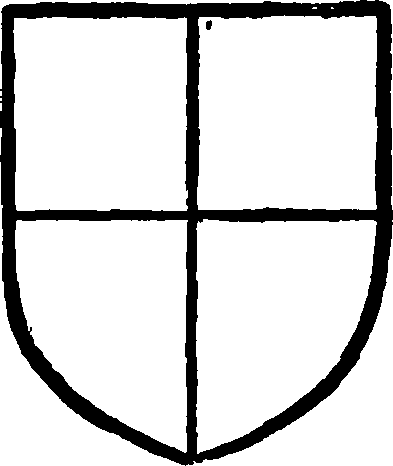
Mandeville. Quarterly or and gules.
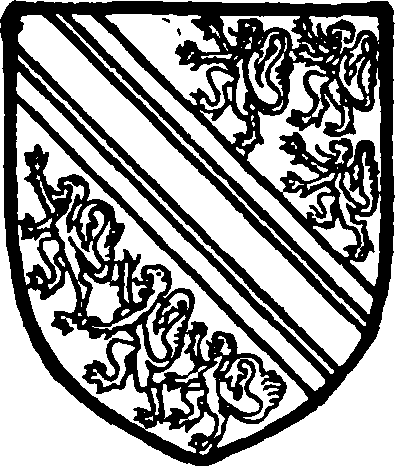
Bohun of Hereford. Azure a bend argent cotised or between six lions or.
William de Warenne died in 1088, shortly after being created Earl of Surrey. His eldest son, William, joined Duke Robert of Normandy against Henry I and forfeited his estates. (fn. 68) Kimbolton seems to have been forfeited again later and was in the hands of William Fitz Ranulph in 1130–1. (fn. 69) The Earl, however, was restored and died 1138, leaving three sons: William, 3rd Earl of Surrey, Reginald, ancestor of the baronial house of Mortimer, and Ralph. William was killed in 1148 while on the Crusade, leaving an only daughter Isabel, married first in 1153 to William, Count of Mortain, second son of King Stephen. (fn. 70) By agreement made in the same year between Stephen and Henry, later King Henry II, most of the Warenne lands were given to William, Count of Mortain, who became Earl of Warenne and Surrey in right of his wife. (fn. 71) William died childless in 1159 (fn. 72) and Kimbolton and its soke were granted to William de Say, who was in possession in 1160–1. (fn. 73) The new owner was the son of William de Say and Beatrice, sister of Geoffrey de Mandeville, first Earl of Essex. He died in 1177; his two daughters and co-heirs, Beatrice and Maud, being under age, (fn. 74) the custody of Kimbolton and its co-heirs was given to Richard Russell. (fn. 75) In 1185 Geoffrey Fitz Piers married Beatrice, (fn. 76) and William de Bokeland of Buckland (Berks) married Maud. Beatrice received Kimbolton, and in 1191 and 1198 Richard I confirmed the division of the inheritance made in the time of his father. (fn. 77) Beatrice died in 1197, two years before her husband was created Earl of Essex in her right. He was succeeded in 1213 by their son Geoffrey, Earl of Essex and Gloucester, who assumed the surname of Mandeville and died childless in 1216. His brother, William de Mandeville, succeeded, but had forfeited his own lands by joining the baronial party in 1215. He was restored in 1217, and had livery of his brother Geoffrey's lands, including Kimbolton. On his death childless in 1227, his wife Christine received it in dower with reversion to Maud, his sister. Maud's first husband was Henry de Bohun, Earl of Hereford, ancestor of the new line of lords of Kimbolton; on his death in 1220 she married Roger de Dauntsey of Dauntsey, Wiltshire, from whom she was granted a divorce, which was revoked by the Pope. Roger had livery of Kimbolton Castle in July and the Countess died in August 1236. (fn. 78) In 1237 Ralph de Mortimer claimed 4 carucates of land here against her son Humphrey, Earl of Hereford, (fn. 79) probably as descendant of William de Warenne. (fn. 80) Humphrey became Earl of Essex after his mother's death. (fn. 81) He forfeited Kimbolton by supporting Simon de Montfort, but recovered it in 1265, (fn. 82) and settled it on the marriage of his son, Humphrey, to Joan, daughter of Robert de Quincy, youngest son of the Earl of Winchester. (fn. 83) Humphrey died in his father's lifetime, leaving a son Humphrey, who succeeded his grandfather in 1275. (fn. 84) His mother held the castle, manor and advowson of the church until her death in 1283. (fn. 85) He was lord in 1285, (fn. 86) but died in 1298, apparently still without having recovered Kimbolton, (fn. 87) which had been seized owing to his defiance of the king at Salisbury two years previously. (fn. 88) His son and heir Humphrey married Elizabeth, Countess of Holland, daughter of Edward I, in 1302, when Kimbolton and other manors and the constableship of England were settled on them and their heirs, with reversion to the Crown. (fn. 89) This Earl was slain at Boroughbridge in 1322. (fn. 90) His elder son John died childless in 1336 and his younger son Humphrey succeeded, (fn. 91) dying unmarried in 1361. His heir was Humphrey, son of his brother William, (fn. 92) Earl of Northampton, who united the three earldoms of Northampton, Hereford and Essex. He died seised in 1373, leaving two daughters, Eleanor and Mary, aged 7 and 3 respectively, (fn. 93) and a widow, Joan (d. 1419), to whom Kimbolton was assigned in dower. In 1377 Joan claimed that Kimbolton belonged to the constableship of England and so was quit of all custom and particularly from assessment for the repair of Huntingdon Bridge. (fn. 94) The claim was probably not allowed, as we hear no more of it. Eleanor, the elder daughter of Humphrey, Earl of Northampton, married the king's youngest son, Thomas de Woodstock, who was made Constable of England, Earl of Buckingham, and in 1385 Duke of Gloucester. He was murdered at Calais in 1397, and his lands were a few days afterwards forfeited to the Crown. His son Humphrey died in 1399, before the reversal of the forfeiture, (fn. 95) leaving his sister Anne, wife of Edmund, Earl of Stafford, as heir to his mother's moiety of the Bohun estates, his aunt Mary, wife of Henry IV, being heir to the other moiety. Under an agreement for a partition of the lands of Humphrey de Bohun between Anne and Henry V, son of Mary, made in 1421, Kimbolton fell to Anne. (fn. 96) She died in 1438, her husband having predeceased her in 1403. (fn. 97) Her son Humphrey, Earl of Buckingham, Hereford, Stafford, and Northampton, was created Duke of Buckingham in 1444, and in 1447 he had a grant of special precedence. (fn. 98) He settled the castle and manor on himself and his wife Anne in 1442. (fn. 99) He died in 1460, when his heir was Henry, aged 4, son of his deceased son Humphrey. (fn. 100) Henry was acknowledged as Lord High Constable in 1483, but on joining the plot of the Earl of Richmond was beheaded and attainted in the same year. (fn. 101) For their good services to the king, Kimbolton formed part of the grant to the Stanleys in 1484, (fn. 102) but was apparently resumed, as in 1485 the castle, manor, lordship and soke were granted in dower to Katharine, formerly wife of the attainted duke (fn. 103) and then Duchess of Bedford. (fn. 104) In the same year their son Edward, the most famous Duke of Buckingham, was restored to all his honours, afterwards becoming the greatest personage at the court of Henry VIII. He was accused of high treason and executed in 1521, when all his honours were forfeited. (fn. 105) In 1522 the manor, castle, market and fair of Kimbolton were granted in tail male and at a rent of £40 (fn. 106) to Sir Richard Wingfield, who had married, as her third husband, Katharine Wydville, widow of Henry, Duke of Buckingham. In 1523 the rent was released, the whole to be held as a knight's fee. (fn. 107) Wingfield was a man of considerable power. 'Who has more influence with the king than Wingfield?' Latimer asked. (fn. 108) He died at Toledo in 1525, leaving a son and heir, Charles, aged 12 years, (fn. 109) by his second wife Bridget, daughter and heir of Sir John Wilshire. (fn. 110) Charles married Jane, daughter of Robert and sister of the famous Sir Francis Knollys, and died seised in 1540 leaving a son Thomas, aged one year, (fn. 111) whose wardship and marriage the king granted to Sir Richard Cromwell. (fn. 112) Thomas seems to have led rather a wild life, and in 1580 his uncle Sir Francis asked for letters from the Council to repress his nephew's unruly doings. His 'simplicitie' is spoken of, and the custody of the lands and woods despoiled by himself and his prodigal son, Edward, was given to his uncle and Sir Walter Mildmay. (fn. 113) He died seised in 1592 and was succeeded by his son Edward, (fn. 114) called 'the great warriour,' (fn. 115) who had been knighted by 1588. (fn. 116) He died in 1603, leaving a son and heir Sir James, (fn. 117) who, with his mother Mary and his wife Elizabeth, conveyed the manor in 1606 to Sir Charles Montagu, kt., and others, apparently as a marriage settlement for Elizabeth. (fn. 118) The property was heavily encumbered and in 1610 the king granted it for assurance of title to Sir James in tail male. (fn. 119) In 1615 Sir James sold the reversion to Sir Henry Montagu, serjeant-at-law, (fn. 120) and in the same year conveyed the estate to the king, (fn. 121) who regranted it to Sir Henry Montagu, (fn. 122) younger brother of Edward, first Baron Montagu of Boughton. Sir Henry was created in 1620 Baron Montagu of Kimbolton and Viscount Mandeville. In 1626 he was created Earl of Manchester and died in 1642. His son Edward, the well-known Parliamentary general, died in 1671. From this date the manor has passed with the Earldom and Dukedom of Manchester, and William Angus Drogo, the ninth Duke, is the present owner. (fn. 123)
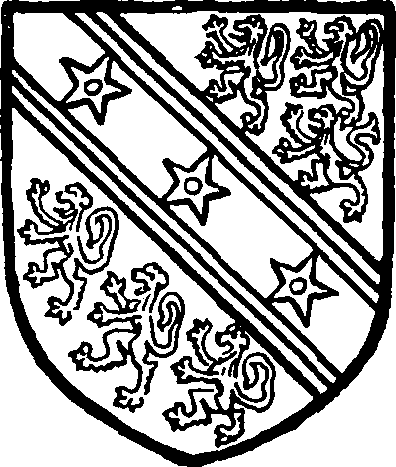
Bohun of Northampton. Azure a bend argent cotised or between six lions or with the difference of three molets gules on the bend.
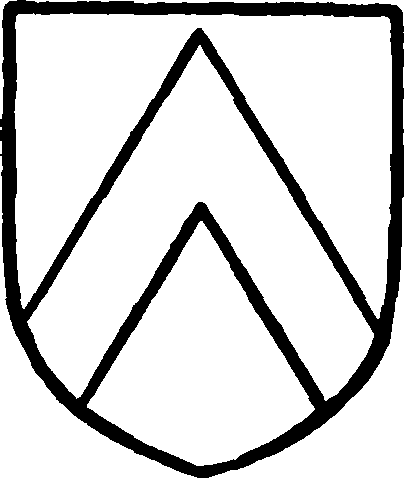
Stafford. Or a cheveron gules.
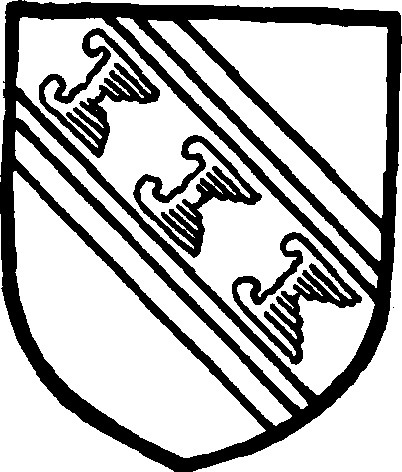
Wingfield. Argent a bend gules cotised sable with three pairs of wings argent on the bend.
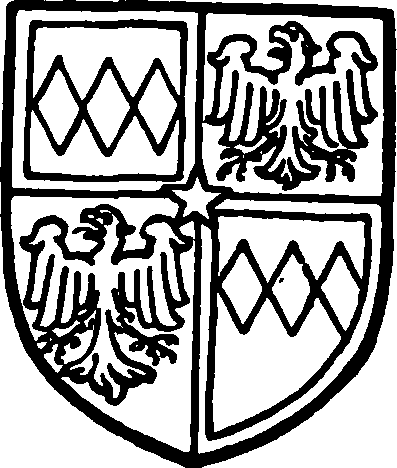
Montagu. Quarterly: 1 and 4, Argent a fesse indented of three fusils gules in a border sable; 2 and 3, Or an eagle vert.
A long list of villeins and free tenants of Kimbolton and its soke exists for 1279. At that time the lord had gallows, view of frankpledge, pillory, tumbril, and assize of bread and ale. (fn. 124) In 1285–6 the Earl of Hereford's claim to view of frankpledge without the king's officer being present was rejected. (fn. 125) The view of frankpledge was held twice a year in 1523. (fn. 126) The annual court leet is still held. (fn. 127) The lord's free chace in the forest of Swineshead is mentioned in 1279, his warren in 1373, (fn. 128) and a mill and several fisheries descended with the manor.
STONELY PRIORY, to the east of Kimbolton Park, it is stated by Leland, was founded by William de Mandeville, Earl of Essex, in 1180, (fn. 129) and again, that it was founded by the Bigrames. (fn. 130) Leland was probably mistaken in the identification of the founder, as the William de Mandeville, Earl of Essex, who was living in 1180 did not hold Kimbolton. It is more likely the founder was William, Earl of Essex, who succeeded his brother Geoffrey in 1216 and died in 1227. The earliest reference to the priory is in 1279, when the prior was a free tenant in Kimbolton, holding 3 virgates with the appurtenances by gift of Master Gilbert de Helpested, for celebrating mass for his soul for ever; and Gilbert held of Peter de Hardwick (chaplain (fn. 131) ) and he of Sir Humphrey de Bohun, lord of Kimbolton. The prior was also a burgess (burgensis) of Kimbolton holding a cottage and 3 acres by burgage tenure. (fn. 132) The additional fact that the advowson of the priory belonged to the lords of Kimbolton (fn. 133) makes it likely that their ancestor, the later William, Earl of Essex, was the founder. Of the Bigrames we know nothing. The name survives in Bigrams Farm and Bigrams Lane. About 1272 Thomas de Bekering died seised, in right of his wife, of 4 virgates of land in Werkwell in Kimbolton, (fn. 134) and in 1279 Peter and Alice de Bekering, brother and sister, each held 100 acres in Werkwell of Sir Thomas de Bekering by their mother's grant and Sir Thomas held of the lord of Kimbolton by the service of half a knight's fee. (fn. 135) From this it would seem that Werkwell was a sub-manor of Kimbolton held by the Bekerings. Thomas, son of Thomas de Bekering, died seised of the field of Wornditch and of 2 carucates of land at Werkwell about 1285. (fn. 136) In 1361 the Earl of Hereford granted to the priory all the lands of Sir Thomas de Bekering, knt., at Werkwell in the parish of Kimbolton. (fn. 137) After the dissolution of Stonely Priory, its lands were at first leased to Oliver Leder, of Great Staughton (q.v.) in 1538, (fn. 138) and the site and appurtenances were granted to him and his wife Frances, in fee, in 1544. (fn. 139) They sold the estate in 1552 to Thomas Mary Wingfield, a younger son of Sir Richard Wingfield and Margaret his wife. (fn. 140) Thomas Mary Wingfield died seised of the house and site in 1557, leaving a son and heir, Edward Mary Wingfield, aged 7, (fn. 141) who was born at Stonely. He was one of the patentees of Virginia in 1606 and 1607 and accompanied the first colonists to Jamestown, but returned in 1608. His diary has been amplified and published as A Discourse of Virginia. (fn. 142) He was in possession of Stonely in 1612, (fn. 143) and died unmarried about 1614. (fn. 144) He had a brother Thomas Mary Wingfield, (fn. 145) but Stonely was about this time acquired by the Montagus, and by 1655 the site of the priory had been united to the Kimbolton estate, (fn. 146) with which it has since descended. (fn. 147)
Church
The church of ST. ANDREW consists of a chancel (41½ ft. by 16 ft.), north chapel (23¾ ft. by 16 ft.), south chapel (21 ft. by 18¼ ft.), north vestry (14 ft. by 11½ ft.), nave (57 ft. by 23 ft.), north aisle (12¾ ft. wide), south aisle (14¼ ft. wide), west tower (13 ft. by 13 ft.), and south porch. The walls are of rubble and pebble rubble with stone dressings except the south wall of the chancel, which is of red bricks; and the roofs are covered with lead.
The church is mentioned in the Domesday Survey, 1086, but the oldest existing portion is the north arcade of the nave, which dates from the middle of the 13th century and indicates a nave of the same size as the present. In the last quarter of the 13th century a south aisle and arcade were added. About 1300 the chancel and the chancel arch were rebuilt, and a few years later the north aisle was probably rebuilt, for the foundations of a 14th-century diagonal buttress were found when the north-west corner was underpinned in 1921. Quite early in the 14th century the tower was built, and the clearstory was added to the nave about 1370. At the end of the 15th century the south aisle was rebuilt and the porch and south chapel added; the north aisle was rebuilt and the north chapel added about 1500, the chancel being largely rebuilt at about the same time. The south wall of the chancel was rebuilt in the 18th century. In 1748 the roofs of the chancel, the two chapels and the nave were out of repair; (fn. 148) in 1787 a new beam was inserted in the nave roof, and another in 1841. (fn. 149) The vestry was built in 1847, and the chancel was re-roofed in 1853; (fn. 150) and about the same time the Montagu vault was formed in the north chapel, a small porch for access to it being added some forty years later. The whole church was restored in 1881–2; the spire in 1903, and the roofs of the nave, aisles and chapels in 1930–1.
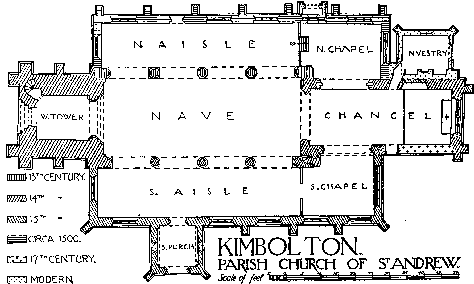
Reproduced by permission of the Controller of H.M. Stationery Office from the Report of the Royal Commission on Historical Monuments, Hunts.
The chancel, chiefly of the 15th century, has a modern four-light east window with vertical tracery in a four-centred head; previous to 1881 this window was a mean four-light window with a nearly flat head. (fn. 151) The north wall has a blocked three-light window of c. 1300, formerly with intersecting tracery in a twocentred head, but mullions and tracery have gone; an archway to the north chapel c. 1500, having a twocentred arch of two moulded orders, the lower order carried on semicircular attached shafts with moulded capitals; and a modern doorway to the vestry. The south wall, partly rebuilt in red brickwork in the 18th century, has a late 15th-century archway to the south chapel, having a two-centred arch of two chamfered orders, and an extra outer order on the south, the lower order carried on semicircular attached shafts with moulded capitals and bases, the latter much damaged; and a plain 18th-century doorway with a semicircular head and plain jambs. The chancel arch, c. 1300, has a two-centred arch of three moulded orders, the lower order resting on filleted shafts with moulded capitals.
Above the chancel roof, visible on the outside only, are two blocked openings, one with a square head and the other lozenge-shaped. The roof is modern.
The vestry, dated 1847, has a four-centred doorway under a square label, in the east wall; a two-light window with tracery in a two-centred head, in the north wall; and a fireplace in the south wall.
The north chapel, c. 1500, (fn. 152) has a four-light east window with vertical tracery in a four-centred head. The north wall has two similar three-light windows. There is no arch between the chapel and the aisle, but the chapel has been filled with a modern vault for the Montagu family, and its present floor is about three feet above the floor of the church. A shallow porch gives access to this vault, and has a doorway with a four-centred head and flanked by two buttresses surmounted by pinnacles supporting heraldic beasts; a shaped gable incloses a coat of arms (Montagu and Monthermer quarterly), and is finished with an heraldic finial.
The late 15th-century south chapel (fn. 153) has a fivelight east window with vertical tracery in a depressed four-centred head. The south wall has two similar two-light windows and a double piscina with fourcentred arches under a square head and having two circular basins. In the north-west angle are the rood-stairs, with a square-headed doorway. The contemporary door has cinquefoiled headed panels. There is no arch between the chapel and the aisle.
The mid 13th-century nave has an arcade of four bays on each side, having two-centred arches of two chamfered orders. That on the north is of mid 13thcentury date, and has one octagonal and two circular columns and semi-octagonal responds, all having moulded capitals with nail-head ornament and moulded bases, except the west respond, which is without the nail-heads, but has bold fleur-de-lis carved on the capital. The labels of the arcade have the nail-head ornament. That on the south is of the late 13th century, and has circular columns and semicircular responds with moulded capitals and bases. On the north side of the chancel arch is a niche, c. 1500, with cinquefoiled head, under a crocketed label between two pinnacles. The upper doorway of the rood-stairs is in the south-east angle, and the stairs are carried up in a small turret to the roof.
The clearstory, c. 1370, has four two-light windows on each side, each with tracery in a two-centred head.
The 15th-century roof, much restored in 1930–1, is of flat pitch and has moulded beams with jack-legs and carved braces; and the feet of the jack-legs rest on 14th-century corbels carved with grotesque heads and with shields including a bend sinister, three chevrons and a saltire. Marks of two earlier roofs remain on the west wall, but covered by the plaster— one the steep-pitched roof preceding the clearstory and the other the low-pitched first roof of the clearstory. In 1855 the western bay was occupied by a large organ gallery carried on four wooden classical columns. (fn. 154)
The north aisle, c. 1500, has, in the north wall, three three-light windows similar to those of the north chapel; a doorway with four-centred head and continuous moulded jambs; and a mutilated stoup. The west wall has a window similar to the others. The 15th-century roof, much restored in 1930, continues over the north chapel, and has moulded beams, jack-legs and braces, and carved figures of apostles and angels.
The late 15th-century south aisle has in the south wall three three-light windows similar to those in the south chapel; and a doorway with two-centred head and continuous moulded jambs, and the label (supported upon small circular attached shafts with moulded capitals and bases) conjoined with a square head inclosing traceried spandrels. The door itself still retains a few portions of tracery. The west wall has a three-light window with original jambs and mullions but a modern segmental head of debased type, the upper part of the wall having been reset in the 18th century; a lead rainwater pipe head close to is dated 1733. The late 15th-century roof, much restored in 1931, and continuing over the south chapel, has moulded beams, jack-legs and braces; the carved bosses at the intersection of the timbers include a shield bearing a chevron impaling a saltire, another with a chevron, a badge of a swan, sacred monograms, and foliage; at the feet of the jack-legs and intermediate principals are figures of apostles and angels.
The early 14th-century tower has a two-centred tower arch of three chamfered orders resting on similar responds with a simple impost moulding. The west doorway has a two-centred arch of four moulded orders—three of them having the ball-flower ornament—and resting on moulded jambs, each with four attached shafts having moulded capitals and bases, much restored; the moulded label is finished with large carved animals as stops. The west window is of two-lights with a plain spandrel in a two-centred head. Above it is a blocked and altered single-light window with a two-centred head; at the same level, in the north wall, is a narrow loop, and apparently another is in the south wall, covered by the clock-face; and in the east wall is a blocked doorway with a twocentred head. The belfry windows are two-lights with plain spandrels in two-centred heads. The tower, which is divided into three stages by stringcourses, has buttresses square at the angles and scarcely reaching the second string-course; and in the middle of the north and south faces are intermediate buttresses rising a little above the first string-course. At the level of the second stringcourse the face of the wall is set back, leaving shallow clasping buttresses at the angles. The tower is finished with a cornice ornamented with carved heads, animals and birds, and from which rises an octagonal broach spire, having three tiers of spire lights, all on the cardinal faces, the lowest being transomed two-lights with plain spandrels in twocentred heads, and with blind tracery in the gable above; the middle tier being transomed two-lights with a quatrefoil in a gabled head; and the top tier being single-lights. Just above the lowest spire lights are two moulded string-courses round the spire. The tower stairs are in the north-west corner.
The late 15th-century south porch has a wavemoulded two-centred arch resting on semicircular attached shafts with moulded capitals and bases, a square-headed outer order with continuous moulded jambs, pierced tracery spandrels, and a moulded label. Above it is a very small niche with canopy cut off and a projecting pedestal. The side walls have plain four-centred wall arches with continuous chamfered jambs, and each inclosing a blocked two-light window with mutilated four-centred head, and the mullion and tracery missing. In the north-east corner is a mutilated stoup with four-centred head, chamfered jambs and a broken basin on a semi-octagonal attached shaft. The roof is modern, but retains one late 15th-century moulded tie-beam.
All the parapets are embattled except that of the north aisle and chapel, which is plain; those of the chancel have been partly rebuilt with brickwork, and those of the north aisle and chapel and south chapel entirely so. The parapets of the south aisle and chapel have the lower parts of pinnacles at the angles and over the buttresses.
The early 13th-century font has a square bowl brought to an octagon by large chamfers having bold hollowed stops at the bottom. The bowl came from Little Stukeley, where it was used as a cattle trough at the Manor Farm; it was brought to Kimbolton in 1913, and set up in the church in 1918. It now stands on a modern central and four smaller shafts. The original font—cylindrical, with rude diagonal lines and foliage—is said to lie in the garden of Ashfield House, Kimbolton, (fn. 155) but was supplanted by a modern font of poor design before 1851.
There are five bells, inscribed: (1) Henricvs Bagley me fecit 1702. (2) His tribus hanc formam Grenus dedit arte Joanes 1571. (3) Henry Penn fvsore 1713. (4) William Eldridge made mee 1660. (5) Ihs nasarenus rex Judeorum fili Dei miserere Dei 1634. The tenor is by Hugh Watts of Leicester. A sanctus bell was sold in 1549–52; (fn. 156) and in 1552 there were five bells in the steeple. (fn. 157) The oak bell-frame is inscribed 1619—Allen, Thomas Young, C.W. In 1709 there were five bells; (fn. 158) in 1854 they were all quarter-turned, (fn. 159) and in 1895–6 they were all rehung by John Taylor and Co. of Loughborough.
At the entrance to the north chapel is a late 15thcentury oak screen of five and a half bays with cusped and sub-cusped ogee heads, crocketed and finialed, and with vertical tracery above. The posts have attached buttresses and pinnacles; the central mullion is omitted to form an entrance, and the top beam is finished with carved brattishing. The lower part is missing, and what remains has been somewhat restored and stands upon a modern wall.
At the entrance to the south chapel is a late 15thcentury oak screen of four bays and a central opening. The bays are generally similar to that on the north, but the mullions have no attached buttresses. The central opening has a cusped and sub-cusped twocentred arch with crocketed and finialed ogee label, and the upper part is filled in with similar tracery to the side bays. The cornice has flowered pateræ, but no brattishing. The close lower part of the screen has cusped and sub-cusped tracery, two panels to each bay, and four of them are painted with figures of the Virgin with St. Anne, St. Michael, St. Edmund and St. Edward the Confessor.
In the vestry is a 17th-century chest with carved front and top rail.
In the chancel are various pieces of funeral armour— two helms with crests, two coronets, a tabard, two swords, three gauntlets, two spurs, six standards and banners, and seven hatchments. In the south chapel are a helmet, two coronets, a tabard and one hatchment.
In the head of the south-west window of the south chapel are some remains of 15th-century painted glass, including the figure of a man in ermine robes, and below him the name 'Symon'; and there are some other fragments in the east window of this chapel, and in the east window of the north chapel.
About the middle of the last century some wall paintings were discovered, including representations of the seven deadly sins, but they were much decayed, so were covered up again. (fn. 160)
In the south chapel there is a monument to Henry, first Earl of Manchester, d. 1641, consisting of a black marble slab supported on white marble columns and arches, with coat of arms; against the wall behind is an elliptical inscription tablet surmounted by an achievement of arms, above which is a Corinthian column carrying a helm and crest; two other columns flank the monument and carry carved skulls. There is also a monument to Lady Isabella (Rich), wife of Sir John Smyth, d. 1632, having an inscription tablet between two Doric columns supporting an entablature and shields of arms; also a monument to Lady Anne (Rich), wife of the third Earl of Manchester, d. 1641, with an inscription tablet in a cartouche standing on a pedestal; and a similar monument to Lady Essex (Cheeke), another wife of the same Earl, d. 1658.
There are also other monuments: in the chancel, to Consuelo, Duchess of Manchester [d. 1909]; and floor slabs to R[ebecca] Bingham, d. 180[o]; the Rev. David Lewis, d. 1819, and Mary, his widow, d. 1830; and Deborah Bunting, d. 1820. In the north chapel, to George Montagu, eldest son of Brig. Genl. Montagu and great-grandson of the 1st Earl of Manchester (n.d.). In the south chapel, to John Pusser, d. 1732; glass window to the 7th Duke of Manchester, d. 1890; and floor slabs to Lady Essex (Rich), wife of Sir Tho. Cheeke, and her daughter Essex, wife of the 2nd Earl of Manchester, d. 1658. In the north aisle, to Thomas Day, d. 1818, and Sarah, his widow, d. 1843; Thomas Day, d. 1857; Mary (Ainsworth), wife of C. Paget Blake, d. 1860; John Chapman, d. 1868; Leslie L. M. Thonger, d. 1889, and Frederick C. F. Thonger, d. 1898; glass windows to Henry Carter, d. 1890, Mary Ann, his wife, d. 1895, Lieut. Henry Gordon Carter, d. 1915, and Firman Gordon Carter, d. 1916. In the south aisle, to William Ashton, d. 1722; the Rev. Harry Welstead, d. 1819; Mary Agnes Welstead, d. 1857; Benjamin Welstead, d. 1858, and Mary, his widow, d. 1873; George Richard Welstead, d. 1887; Sarah Hannah, wife of Major Hayes, d. 1894, and Major James Hayes, d. 1896; Lieut. Col. Harry Merrion Welstead, d. 1915; glass window to the Rev. Thomas Ainsworth, vicar, d. 1868; and Joseph Hughes Hemming, d. 1899.
The registers are as follows: (i) baptisms, marriages and burials 26 December 1653 to 5 June 1709, much out of order; (ii) the same 4 September 1709 to 7 June 1748, somewhat damaged and the dates much out of order—there are a few pages containing entries from 21 March 1646 to 20 Feb. 165¾; (fn. 161) (iii) the same—1748 to—1799, marriages end 17 June 1753, badly burnt at the top of all the pages; (iv) baptisms and burials 2 January 1800 to 3 March 1811, and a loose sheet to 31 March 1812; (v) the Official Marriage Book 19 April 1754 to 24 December 1798; (vi) the same 31 December 1798 to 9 November 1812.
The church plate (fn. 162) consists of a large late 16thcentury silver cup, partly gilt, with three shaped brackets on stem, engraved with scenes of Bel and the Dragon, Daniel in the lions' den, and Habakkuk carried through the air by an angel, and inscribed 'Daniel XIII,' no date-letter; a silver cup, inscribed 'The Gift of Henry Ashton to the Parrish of Kimbalton. 1665,' and with his arms, Argent, a mullet pierced Gules, and crest, A boar's head couped, hall-marked for 1665–6; a silver cup, apparently a copy of the last, inscribed 'The Gift of the Rev. Thos. Ainsworth, Vicar, to the Parish Church of Kimbolton, 1859,' hall-marked for 1859–60; a 17th-century silver standing paten, with no dateletter; a silver alms-dish with floral decoration in repoussé work, c. 1600, no date-letter; a silvergilt flagon, inscribed 'The Gift of Thos. Day Esqr.,' '45.16. 0,' hall-marked for 1750–1.
Advowson
There were a church and a priest at Kimbolton in 1086, (fn. 163) and the patronage passed with the manor until Humphrey de Bohun granted it to Stonely Priory in 1366. (fn. 164) In 1219 G. de Bocland, the rector, appointed William perpetual vicar, with the consent of William de Mandeville, the patron, saving to Bermondsey Priory two parts of the small tithes of the demesnes of the castle. (fn. 165) The two parts of the small tithes are said to have been given to Bermondsey by Odo Dammartin and confirmed by William de Say (fn. 166) (1161–77), and were acquired from Bermondsey Priory by Stonely Priory in 1386 for a perpetual rent of 6s. 8d. (fn. 167) In 1378 Stonely Priory appropriated the rectory, and a vicarage was ordained by John Bukingham, Bishop of Lincoln (1363–98), by authority of Pope Gregory XI (1370–8). Pope Urban VI (1378–89) having revoked all appropriations, Pope Boniface IX (1389–1404) confirmed the appropriation of Kimbolton church in 1397. From 1378 the church had been served by canons of Stonely Priory, a practice which the Pope confirmed. (fn. 168) The advowson remained with the Priory of Stonely until the Dissolution (fn. 169) in 1535.
In 1545 the rectory and advowson were granted to Robert Springe and Thomas, his son. (fn. 170) In 1559 William Smyth and others had licence to alienate the rectory, (fn. 171) and in 1580 he and Humphrey Michell sold the rectory and advowson of the vicarage to William (second son of Sylvester Bedell of Hamerton), (fn. 172) lord of Molesworth (q.v.). William Bedell and the vicar, Edward Robinson, had a dispute as to the payment of small tithes, which the parishioners claimed had been commuted by the gift of a close of pasture containing about 10 acres, given to the vicars by two sisters called Passells in lieu of all such tithes. (fn. 173) William Bedell sold the rectory and advowson in 1612 to Benjamin Browne and Francis Bedell (one of his younger sons). (fn. 174) Sir James Wingfield and Francis Bodenham conveyed half the rectory and advowson of the vicarage in 1615 to Sir Henry Montagu. (fn. 175) In 1637 Henry, Earl of Manchester, presented, and from 1655 the rectory and advowson of the vicarage were in the possession of the Earls and Dukes of Manchester, (fn. 176) who have ever since been patrons. (fn. 177)
In 1240 Richard de Bercham, chaplain, was presented by the Earl of Hereford to the chapel of Kimbolton and instituted as rector without cure of souls. This chapel paid the mother church of Kimbolton 6 lbs. of wax annually and had no land in the parish, but 61 acres in neighbouring parishes. (fn. 178) John de Byllyng, chaplain, is mentioned in 1344. (fn. 179)
A chapel of St. Mary at Stonely is mentioned in 1582, (fn. 180) and there was apparently a chapel at Wornditch. There was a fraternity of Jesus in the parish to which bequests were made in the 15th and 16th century wills. (fn. 181)
Charities
Miss Anne Maria Harriett Welstead, by will proved in the Principal Registry 31 May 1881, gave £100 to the vicar and churchwardens, the income to be distributed in coal to poor widows residing in the parish. This is now represented by a sum of £99 17s. 6d. 2½ per cent. Consolidated Stock with the Official Trustees, and the income is distributed in coal to poor widows of the parish.
John Day, by will proved 29 Oct. 1836, gave to the vicar and churchwardens a sum of money for the benefit of poor communicants which is now represented by a sum of £99 0s. 2d. 2½ per cent. Consolidated Stock with the Official Trustees. The income is distributed in money to poor communicants.
John Cannon, by will proved 19 Jan. 1782, gave £50 to the vicar, churchwardens and overseers, the income to be expended in paying a sum of 10s. to the vicar for preaching a sermon every year and the remainder to be distributed in bread to the poor. The endowment now consists of £17 16s. 3d. 2½ per cent. Consolidated Stockwith the Official Trustees, and the income is paid to the vicar for preaching a sermon. The trustees are the vicar, churchwardens and two persons appointed by the parish council in place of the overseers.
Thomas Spackman, by will dated 8 March 1782, gave a yearly rent-charge of 20s. issuing out of a close in Stonely called Glovers Close, to be applied for the benefit of the poor of the parish. This charge is regularly paid and distributed by the vicar and two others to the poor in money.
William Coleman, by will dated in 1717, gave out of his dwelling house in Back Street, Kimbolton, 10s. a year to be distributed among poor widows of the parish and 10s. a year for a sermon to be preached on St. Thomas's Day. The charge of 20s. a year is regularly paid and applied in accordance with the will of the donor.
William Desbrowe, by will in 1716, gave a close of land containing 1 acre 2 roods in the Butts in Kimbolton, the rents to be distributed amongst the poor of the parish by the minister and churchwardens. The land is now let and the rent, after deduction of land tax, is distributed to the poor of the parish.
Parish Clerk's Fund.—The endowment of this charity consisted of a piece of land known as Parish Clerk Land in the parish of Kimbolton containing 1 acre 1 rood 18 poles, allotted under the Wornditch Inclosure Award, dated 8 Nov. 1799, for the benefit of the parish clerk. The land was sold in 1921 under the authority of an order of the Charity Commissioners and the proceeds invested in the purchase of £30 4s. 1d. War Stock in the name of the Official Trustees. The income is paid to the parish clerk.
Charities of Anne Countess Dowager of Manchester and others.—By indentures of lease and release, dated Feb. 1699, Henry Bull (in consideration of £91, being the charitable gifts given to the poor of Kimbolton by the persons after named: By Anne, Countess Dowager of Manchester in 1698, £40; by the Hon. Eleanor Montagu, daughter of the said Anne, in 1695, £50; and by Jeremiah Burton, £1) granted a close called Bull's Close containing 3 acres, in trust for the use, relief and maintenance or support of the poor. The endowment now consists of £284 12s. 1d. Consols, the dividends on which are distributed in bread to the poor.
Charities of Lady Elizabeth and Lady Doddington Montagu.—Lady Elizabeth Montagu in 1735 left £12 10s. the interest to be given in bread to the poor, and Lady Doddington Montagu in 1774 left 30 guineas for the poor. These two sums are now represented by £17 16s. 3d. Consols with the Official Trustees and the income is distributed with the charities of Anne, Countess Dowager of Manchester, and others in bread to the poor.
William Ashton in 1722 bequeathed £50 for the purchase of lands, the rents to be applied to the benefit of 12 poor people of the parish in bread. This sum was laid out in the purchase of land at Stonely containing 1 acre 2 roods. The land is now let, and the rent is distributed with the charities of Anne Countess Dowager of Manchester and others in bread to the poor.
Loving's Dole.—Thomas Loving in 1557 gave out of his close at Newtown to the poor of the parish 6s. 8d. a year to be distributed among them by the churchwardens yearly on St. Thomas's Day. This annual sum is regularly paid and laid out in the purchase of 40 twopenny loaves which are distributed among as many poor persons on St. Thomas's Day.
Allen's Gift.—William Allen in 1630 gave out of a house in Kimbolton called the Sun Inn 30s. per annum to be distributed among 20 of the poorest people of the parish. This annuity is now paid by Mrs. E. L. Welstead in respect of her house in Kimbolton, formerly the Sun Inn, and distributed in money to the poor.
Nicholas Bull gave in 1608, out of his close at Stonely, to the poor people inhabiting the Almshouse in Kimbolton, a yearly sum of 6s. 8d. to be distributed amongst them. He also gave, out of his lands at Offord D'Arcy, 26s. 8d. yearly to the poor of Stonely, 10s. yearly to the poor of Kimbolton and 3s. 4d. yearly to the chief inhabitants of Stonely for distributing the money. The annual payments, amounting to £2, are paid by the owners of the lands charged, and distributed to the poor in money, and the charge of 6s. 8d. is now paid by the Duke of Manchester and distributed among the inmates of the almshouses.
Peacock's Gift.—William Peacock by his will bequeathed a sum of £50 for the benefit of the inmates of the almshouse. The sum is now represented by £17 16s. 3d. Consols with the Official Trustees and the income is distributed to the inmates of the almshouses.
Love's Charity.—William Love in 1699 gave £10 to the poor of the parish which is reputed to have been laid out in the purchase of a piece of copyhold land, about ½ acre in the parish of Long Stow. This land was surrendered in 1816 and another parcel purchased in the parish of Kimbolton. The land has since been sold and the proceeds invested in the purchase of £67 8s. 4d. Consols in the name of the Official Trustees. The income is distributed to the poor inmates of the almshouses.
Thomas Day in 1857 left £100 for investment, the interest to be divided amongst 15 poor old men over 60 years of age on St. Thomas's Day. This sum is now represented by £100 Consols, the dividends on which are distributed in accordance with the will of the donor.
The Dowager Duchess of Manchester, about the year 1837, left a close at Stonely, the rent of which was to be applied to benefit the poor in the matter of clothing. The land is now let for about £6 per annum which is paid into the Kimbolton Clothing Club.