
A History of the County of Huntingdon: Volume 3. Originally published by Victoria County History, London, 1936.
This free content was digitised by double rekeying. All rights reserved.
'Parishes: Conington', in A History of the County of Huntingdon: Volume 3, (London, 1936) pp. 144-151. British History Online https://www.british-history.ac.uk/vch/hunts/vol3/pp144-151 [accessed 25 April 2024]
In this section
CONINGTON
Cunictune (x cent.); Cunintone, Coninctune (xi cent.); Cunyngton, Conington (xiii, xiv cent.).
The parish of Conington lies on the west side of the Fen and the greater part adjoins the Fen district, where the land is flat, and from which it rises gradually from about 2 ft. above the Ordnance datum in the east to 40 ft. at the Ermine Street. Westward of the Ermine Street the land rises more abruptly and reaches 169 ft. at Conington Round Hill. The parish covers 3,175 acres, which, although mostly pasture, has some good arable land and about 105 acres of woodland. The population in 1921 was 259.
Conington Fen, which occupies a large part of the eastern side of the parish, is now mostly drained and cultivated. Before the 17th century the Fen was used mainly for feeding cattle and sheep and the supply of peat turves, the cutting of which was regulated by the Fen reeves, who also looked after the maintenance and cleaning of the dykes and ditches. On St. Luke's Day, on the tolling of the church bell, the tenants met at the church and went to the Fen to view the ditches belonging to their tenements. The systematic drainage was begun by Sir Thomas Cotton in 1639, and in the following year the first pump was erected. The cultivation of the Fen was then gradually taken in hand, but it was not until the 19th century that the greater part was ploughed. Inclosures began at the end of the 16th century. The farms during the 17th century were mostly pasture, but after the purchase of the manor by Sir John Heathcote the arable land was increased. In 1751 a good deal of land was planted with woad. In 1800 there were 270 acres of arable land, which by 1838 had fallen to 250 acres, but by 1888 it had risen to 290 acres and by 1921 had increased to about 600 acres, which tended to increase the size of farms. Two of the earliest farms on the Fen are Cobalders, which occurs as early as 1757, and Eternity Hall, which takes its name from Edward Smith, a tenant farmer, who lived there to a great age and was called Eternity Smith. Bog oak, frequently found in the Fen, is indicative of former forest land. (fn. 1)
Sir Robert Cotton is said to have found the 'skeleton of a large sea-fish near xx feet long as was then conjectured.' The place of its deposit must have been on the edge of the Fen, somewhere to the east of Conington Church or Bruce's Castle. (fn. 2)
The somewhat scattered village is on the east side of the Ermine Street and lies along the lane called Conington Lane, which leads to the church and Conington Castle or Manor House. A little way along the lane are the Rectory; the Old Rectory, which is a 17th-century half-timber house now converted into two cottages; and some cottages called the Village Row. Farther along the lane are the School and some more cottages, and a 17th-century half-timber thatched house, now two cottages. Beyond Church Lane, leading to the church and Conington Castle, is the Home Farm with one or two more cottages.
The ancient manor house of the Bruses stood within the moated inclosure now called 'Bruce's Castle Moat,' and was probably built by Bernard de Brus soon after 1242. It is described in 1279 as the court of the manor with a garden and spinney containing 6½ acres. (fn. 3) Here this branch of the Brus family lived, and here about 1317 John, son of Bernard de Brus and Agnes, (fn. 4) and in 1336 Agnes, daughter of John de Brus, were born. (fn. 5) From the partition of the property between the co-heirs of John de Brus in 1360 (fn. 6) the house appears to have consisted of a hall with wings on each side; that on the west contained a chapel at the southern end and a chamber called the 'Great Sklat Chamber' at the north, while that on the east doubtless contained the kitchens and servants' rooms. Northward of the house were the great gatehouse and drawbridge, with stables, etc., on either side and a large room called 'le Garite' above them all, and eastward of these were other buildings, probably barns. Surrounding the house, and within the moat, were gardens and yards; at the south-west corner was the vineyard, somewhat northward was the garden, and between the house and the gatehouse was a herbary; at the south-east corner was the 'bake-house yard' with a pond in it. Outside the moat a road ran northward (the approach being from the north), and on the west side of this road was the Barn Yard Close, containing a great barn, a hay-house and a dove-house; and on the south and west was the park. (fn. 7) It is difficult now to realise that the approach was from the north, as the present road is on the west, but it is definitely stated so.
The house was perhaps of timber, and seems to have lasted until 1576, by which time it was probably ruinous and quite out of date, and was abandoned later in the same century.
The house was leased with the manor after the death of Hugh de Wesenham at the end of the 14th century. The Cottons resided here for a time, but Thomas Cotton, who died in 1592, lived at Denton and probably allowed the Bruses' house to fall into decay. Camden in 1586 says that there were traces of an ancient castle within a square ditch, referring to the old manor house, and in a map of the property of Sir Robert Cotton, made about 1600, the position of Bruce's Castle is marked as 'ye ancient scite,' by which time probably the house no longer existed. A farmhouse has been built outside the west side of the moat, which is called Bruce's Castle Farm.
The new house built on another site was erected in the latter part of the 16th century by Sir Robert Cotton. We know from the estate map already referred to that it was built before 1600. (fn. 8) It seems to have consisted originally of a large hall running east and west, with a porch at the south-west corner; and to have had a kitchen and offices at the south end and in a south-west wing, and probably private chambers for the lord and his family towards the east and south-east. Of this building, parts of the hall possibly remain incorporated in the walls of the present staircase and study; while the east wall of the kitchen, with its late 16th-century square-headed windows of two, three and four lights, still stands and perhaps some small parts of the west wall.
In the second decade of the 17th century a northern range, consisting of a long gallery with a central bay window and raised upon open arches, was added to the house, the open arches being formed of late 15th-century stones brought either from Fotheringhay Castle or Maxey Castle. (fn. 9) The long gallery was scarcely completed when Sir Robert Cotton died (1631), and it was finished and a grand staircase added by his son, Sir Thomas, about 1634. The staircase probably adjoined the north-west corner of the other building and the west wall of the long gallery.
Sir John Cotton (1662–1702) did not occupy the house and let it go to ruin, and his grandson, Sir John (1702–1731), pulled down part of it and converted the remainder into a farmhouse. Dr. Stukeley, writing in 1722, states: 'I was concerned to see a stately old house of hewn stone, large and handsome, lie in dismal ruin.' (fn. 10)
Judging by a print of 1792, and from plans for the restoration of the house, the parts pulled down were the grand staircase, the private chambers and some of the kitchen buildings, while the eastern end, at least, of the northern range was allowed to go to ruin and was roofless by 1800. The west end of the northern range, when the staircase was removed, was apparently screened by a plain wall with a flat parapet and some modern windows.
In 1800 Mr. John Heathcote restored the house. He re-roofed the northern range, added embattled parapets to its walls with three stepped gables at the west end, built up the open arches and put windows under them, thus forming rooms in the lower floor of this range, and moved one of the open arches from the east end and put it in the west wall to light his new entrance hall. He also moved the late 16th-century porch of the old hall to the west side of the new entrance hall. He reconstructed the south-western range, and a little later added a third story to it and built the turret in the centre of the west side.
In 1840 Mr. John Moyer Heathcote made considerable internal alterations, including the formation of the present main staircase.
Opposite the northern front of the house is a long raised terrace at either end of which stood the octagonal stone summer-houses in which Sir Robert Cotton placed the antique stones which were given to Trinity College, Cambridge, by the last Sir John Cotton, in 1750.
Conington Round Hill, formerly known as Conington Down, is a spur of the range of hills to the west of the Fens. On it is an earthwork of unknown date and use, consisting of a five-sided moat with a tongue-shaped projection to the south-west. (fn. 11) Perhaps the earthwork may have been thrown up in connexion with a house which Sir Robert Cotton may have proposed to build and afterwards abandoned.
The Crown and Woolpack, formerly the Woolpack Inn, on the Ermine Street, is said to have been frequented by Dick Turpin (d. 1739). The well-known episode of his putting on the shoes of his horse the wrong way in order to mislead his pursuers is said to have taken place here. (fn. 12)
There is reference to a guildhall (le Gyldawle) at Conington in 1523 (fn. 13) and we have frequent bequests to the guild of Holy Trinity in the wills of persons living in the parish during the 16th century. (fn. 14) There was also a guild of Our Lady mentioned in 1503. (fn. 15)
Manor
In 957, King Eadwig granted to his faithful minister Wulfstan 9 hides (mansas or hida) in CONINGTON (Cunictune) to hold freely for his life and with power to bequeath to whom he pleased. The land granted seems, from the boundaries given, to have been east of the Ermine Street (Earninga Straete). (fn. 16) According to Sir Robert Cotton, Conington was granted to Turchil the Dane, (fn. 17) who was banished in 1021 and died, apparently in England, in 1039. It was this Turchil who, at the command of King Cnut, divided the fen among the adjoining townships. (fn. 18) Sir Robert Cotton says that the property was then granted by King Edward the Confessor to Waltheof. There is much confusion, however, and it would seem that Waltheof's predecessor (at least in part of the property) was Turchil of Harringworth, whose wife, Thurgunt or Hurugonda, left land at Sawtry to Ramsey Abbey, that her body might be buried there. (fn. 19) All the lands of Turchil of Harringworth were given by King William to Earl Waltheof and his wife Judith, daughter of Lambert, Count of Lens, and niece of the Conqueror. The monks of Thorney claimed that 6 hides of the 9 hides at which Conington was assessed had been leased by them to Turchil, and on representing the matter to Waltheof he, being a holy and just man, returned the lands to the Abbey. The monks, however, fearing that Fulcard their abbot, with whom they had differences, might waste these lands and give them to his kinsfolk, offered them to Waltheof on the same terms as Turchil held them. Waltheof accepted the offer and held the 6 hides at Conington at farm at the rent of a mark. (fn. 20) After his execution for alleged participation in the rebellion of 1075, Conington was held by his widow Judith, who was holding in 1086. (fn. 21) She, however, ceased to pay the yearly farm of one mark to Thorney Abbey, and no one has since paid it. Maud, daughter of Judith, married Simon de St. Liz, who thus became Earl of Huntingdon and succeeded to the possessions of his wife's mother.
After the death of Simon, Maud married about 1109, as her second husband, David son of Malcolm III, King of Scotland, who ascended the throne of Scotland in 1124 on the death of his brother Alexander I. David resigned his earldom of Huntingdon with the lands attached to the honour, about 1136, in favour of his son Henry, who died in 1152. The earldom and honour of Huntingdon were thereupon given by King Stephen to Simon, son of Simon de St. Liz and Maud, daughter of Waltheof, who died in the following year. In 1157, Henry II acknowledged Malcolm, King of Scotland, as Earl of Huntingdon and endowed him with the lands of the honour. He was succeeded in 1165 by his brother William the Lion, of Scotland. William forfeited on his invasion of England in 1174, when Simon de St. Liz, son of the second Simon above mentioned, was acknowledged Earl of Huntingdon. He died in 1184, when the earldom was regranted to William the Lion, who resigned it to David, his younger brother. David died in 1219, and was succeeded by his son John le Scot, Earl of Huntingdon, Cambridge and Chester. John died in 1237, when his widow Helen, who had married Robert de Quincy, held Conington with other lands until dower should be provided for her. (fn. 22) Conington was, however, for a time in the hands of Simon de St. Liz, the illegitimate brother of Earl Simon III, who died in 1184. (fn. 23) He was seneschal of David, Earl of Huntingdon, in 1194, (fn. 24) from whom another Simon de St. Liz, probably his son, claimed the manor in 1214. (fn. 25) A third Simon, said to have been the seneschal's grandson, claimed it in 1235 from John le Scot, Earl of Huntingdon and Chester. (fn. 26)
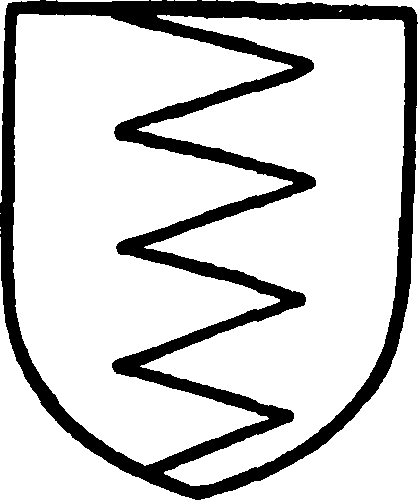
St. Liz. Party indented argent and gules.
On the partition of the great estates of John le Scot, Conington fell to the share of his sister Isabel, wife of Robert de Brus of Annandale, who was holding Conington in 1242. (fn. 27) The overlordship continued with the elder branch of the Brus family and passed from Robert and Isabel to Robert, their elder son, called the 'Competitor' for the Scottish crown. In 1279 the overlordship was held by Robert de Brus of the King of Scotland. (fn. 28) From the Competitor, who died in 1295, it passed to Robert de Brus, his son, who, in right of his wife, became Earl of Carrick. He died in 1304, and the overlordship of Conington, which formed a part of the dower of Eleanor, his second wife, then the wife of Richard le Waleys, was held by her in 1318. (fn. 29) Robert, son of the last Robert de Brus, was crowned King of Scotland in 1306, when his English possessions were forfeited. Eleanor died in 1330, (fn. 30) after which date the overlordship merged in the English crown, and the manor was held in chief as parcel of the honour of Huntingdon for a third of a knight's fee. (fn. 31)
Shortly after 1242 Robert de Brus and Isabel his wife, sister and co-heir of John le Scot, gave the manor of Conington to Bernard, their younger son, to be held of the honour of Huntingdon. Here Bernard apparently built a house. (fn. 32) He joined the Barons against Henry III and his lands were forfeited after the Battle of Evesham in 1265. (fn. 33) He died before August 1266. (fn. 34) Conington, however, had been settled on his widow Constance de Morteyn, who was holding it in 1276–1286. (fn. 35) Their son Bernard probably redeemed it from Robert de Brus, his overlord and uncle, as he redeemed Exton in Rutland in 1280. He was holding Conington in 1295, (fn. 36) and died in 1301. A little while before his death he granted the manor of Conington to his son Bernard (III), (fn. 37) and in 1303 Agatha, his widow, was holding dower there. (fn. 38) Bernard (III) was holding in 1316 (fn. 39) and settled the manor in 1325 on himself and Agnes his wife, with remainder to their son Bernard (IV), (fn. 40) who was then apparently about to marry Maud, daughter of Ralph de Crophull. The manor had fallen in value about this time owing to the meadows and fens having been drowned by the great inundation of waters. An earlier settlement had granted further remainders to John and Edmund, younger sons of Bernard and Agnes. (fn. 41) Bernard de Brus (III) died in 1330 seised with Agnes his wife of the manor and advowson of Conington, leaving Bernard (IV) his son and heir. (fn. 42) Bernard (IV) did not long survive his father, and left as his heir his brother John. His widow Maud, who afterwards married Bennet de Fulsham, appears to have had some interest in Conington, under a settlement, until her death in 1350. (fn. 43) John de Brus settled the manor in 1342 on himself and his wife Margaret and his heirs, (fn. 44) and in the same year, as Lord of Conington, was called upon to answer the Abbot of Ramsey for disseising the abbey of lands in Walton. (fn. 45) He died in 1346 (fn. 46) and left Bernard, a posthumous child who died within a year of his birth, and four daughters. The custody of the heir and afterwards of the co-heirs was granted to John de Grey of Ruthyn in 1347. (fn. 47) The wardship and marriage of the four sisters were sold by John de Grey to John de Verdon and by him to Master Simon de Islip, afterwards Archbishop of Canterbury. Islip sold them to John de Wesenham, (fn. 48) a wealthy merchant, who married Agnes, the eldest daughter, to Hugh de Wesenham his son, (fn. 49) and in order that he might take the whole inheritance, the other three daughters Joan, Elizabeth and Helen were, in 1347, placed in monasteries. Joan went to Nuneaton at the age of about nine, and Elizabeth and Helen, aged respectively about seven and five, were sent to the Priory of Bullington in Lincolnshire, and were professed there within a year. (fn. 50) Agnes was married to Hugh de Wesenham about 1353. In 1358 she was declared the sole heir of her brother, the whereabouts of Joan, it was said, being unknown, and the two other sisters being professed nuns. Hugh and Agnes entered into possession of the whole estate, but their right was almost immediately challenged by Nicholas Grene, (fn. 51) husband of Joan, who apparently had left Nuneaton Priory and married. A good deal of litigation followed. Hugh pleaded that Joan took the habit of religion when she was eleven, and continued to wear it until she was over sixteen. According to the rule of Fontevrault, of which Nuneaton was a cell, if any woman over twelve wore the habit of the order for a year, she was deemed to be professed. Upon this point an inquiry was made by the Bishop of Coventry and Lichfield, by whom it was found that Joan was not professed up to 24th June 1358. It was eventually adjudged that the inheritance should be divided equally between the two sisters, and a partition was made in 1359. (fn. 52)
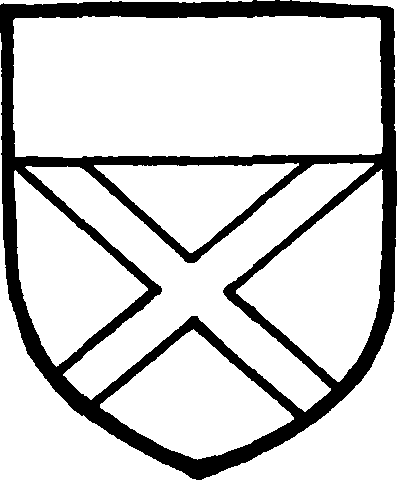
Brus. Azure a saltire and a chief or.
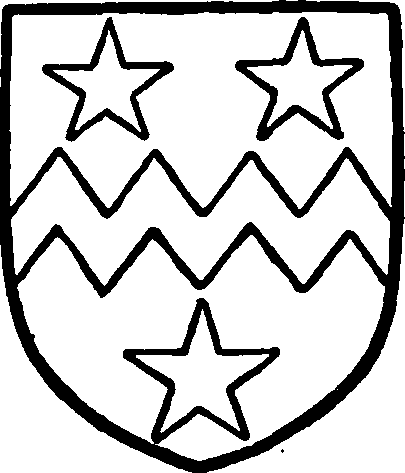
Wesenham. Sable a fesse dancetty between three molets argent.
By the partition the houses at Conington and Exton in Rutland were to be divided for the accommodation of each sister and her husband, and at Conington a new doorway was made for Agnes's use, and Joan and her husband were to have access to the chapel. (fn. 53) In 1361 Nicholas Grene and Joan settled their half-share on themselves in fee tail. (fn. 54) In 1368 both sisters and their husbands received quitclaims as to their holdings from Athelina or Alana, daughter of Bernard de Brus of Thrapston. (fn. 55) After this date the whole manor seems to have passed to the Wesenhams, although the Grenes retained a moiety of the advowson. Agnes, after the death of Hugh de Wesenham, granted the manor to Thomas Kirkeby (d. 1407) for life. (fn. 56) She afterwards married Robert Lovetot, who died in 1393, when Robert de Wesenham, son of Agnes and Hugh, then aged 30, succeeded to the manor of Conington and half the advowson. (fn. 57) Robert de Wesenham enjoyed his inheritance only a few years and died in 1399, leaving a son Thomas his heir, aged 13 years, (fn. 58) whose wardship was granted in 1400 to John de Elvet, one of the King's clerks. (fn. 59) Thomas de Wesenham lived till 1460, when he was succeeded by his brother Robert, aged 60 years, (fn. 60) who died childless in 1477. His heirs were the descendants of his sisters Joan Folville and Cecily Rydyll. Joan's daughter Mary, then aged 54, married firstly William Cotton, secondly Thomas Lacey and thirdly Sir Thomas Billing, chief justice of the King's Bench. Ann Kebell, another daughter of Joan, had a son John, then aged 40 years, who was a serjeant-at-law, and father of George and Thomas Kebell. Cecily Rydyll had a son Thomas who was then aged 36. The manor of Conington, however, had been settled under the will of Thomas de Wesenham, dated 4 Nov. 1460, on Thomas Cotton, son and heir of William Cotton, and his heirs male with remainder to Richard his brother, and ultimate remainders to the other heirs mentioned. (fn. 61)
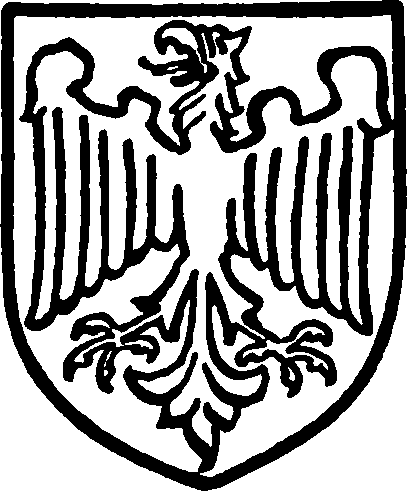
Cotton. Azure an eagle argent with beak and legs or.
Thomas Cotton (I) married Alianora Knightly (who afterwards married John Mulshoe) and died in 1505, leaving Thomas (II) his son and heir, aged 25 years. (fn. 62) Thomas (II) married Joan, daughter of John Parys, in 1512 and died in 1517, leaving a son and heir Thomas (III), aged 2 years. (fn. 63) This Thomas Cotton married Lucy, daughter and co-heir of Thomas Harvey. He made his will in 1574, in which he left Conington to his wife for life and other property to his grandson Robert, son of his son and heir Thomas (IV), and charged his estate in favour of his sons Robert, Philip, Lawrence, John and Kenelm. He died in the same year, leaving Thomas (IV) his son and heir, aged 30 years. (fn. 64) Thomas married firstly, about 1565, Elizabeth, daughter of Francis Shirley of Stanton Harold, by whom he had two sons, Robert and Thomas. By his second wife Dorothy, daughter of John Tamworth, whom he married before 1579, (fn. 65) he had four sons, Henry, Thomas, Ferdinand and John. He died at Conington in 1592, when his eldest son Robert was 21 years of age. At the time of his death his six sons and two brothers, Philip and John, were all living at Conington. (fn. 66)
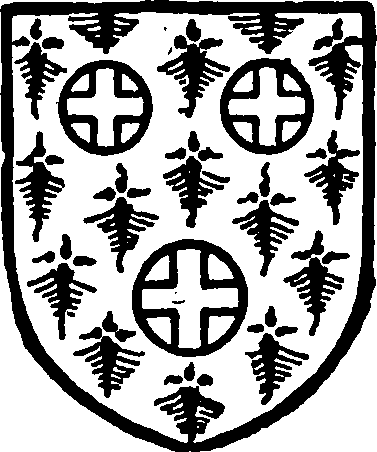
Heathcote. Ermine three roundels vert with a cross or upon each.
Robert, the eldest son, was the celebrated antiquary whose manuscripts form one of the most treasured collections in the British Museum Library. He was knighted in 1603. He, it is said, suggested the creation of baronets as a means of raising money for the Crown, and obtained the title for himself in 1611. He was member of Parliament for Huntingdon in 1604–11, and for various places at other times. He fell into disgrace, being accused of writing a seditious pamphlet. He died at his house at Westminster in 1631, his widow Elizabeth, daughter of William Brocas, surviving him. His heir Thomas (V), who was then 36 years of age, (fn. 67) was sheriff of Huntingdonshire in 1636–7 and member of Parliament for the county in 1640 and for other constituencies. He married firstly Margaret, daughter of Lord William Howard, and secondly Alice, widow of Edmund Anderson. He died in 1662 and was succeeded by Sir John Cotton, his son. Sir John married firstly Dorothy, daughter of Edmund Anderson, and secondly Elizabeth, daughter of Sir Thomas Honywood, and died in 1702. He was succeeded by his grandson John, son of his son John Cotton, who married Elizabeth, daughter of James Herbert. The last-named John died in 1731, and was succeeded by his uncle Sir Robert Cotton, on whose death in 1749 the manor of Conington went to his son Sir John Cotton, who died without male issue in 1752. (fn. 68) The manor of Conington was sold in that year to Sir John Heathcote of Normanton, son of Sir Gilbert Heathcote, a wealthy merchant of London. Sir John conveyed Conington to his second son John, who married in 1764 Lydia, daughter of Benjamin Moyer, and died in 1795. He was succeeded by his son John, who married Mary Ann, daughter of George Thornhill. He died in 1838, leaving his son and heir, John Moyer Heathcote, J.P., D.L., and High Sheriff in 1854, who married the Hon. Emily F. R. Colborne, daughter of Nicholas, first Baron Colborne, and died in 1892. His son, John Moyer Heathcote, J.P., D.L., who succeeded, married Louisa Cecilia, daughter of Norman Macleod of Macleod, and died in 1912. His son, Mr. John Norman Heathcote, is the present owner.
Bernard de Brus had view of frankpledge and royal rights in Conington as part of the honour of Huntingdon. (fn. 69) A free fishery called a 'botesgate' in Whittlesea Mere was purchased by Thomas Cotton (d. 1576) from Sir Richard Williams alias Cromwell. (fn. 70)
The Bevilles of Wood Walton (q.v.) held a large freehold in Conington. In 1261 Richard de Beville was called upon to answer for disseising Reginald de Bocking and Eufemia his wife of common of pasture over 1,000 acres of fen in Conington, Sawtry and Glatton, and liberty of cutting rushes pertaining to their free tenement in Conington. It was agreed that they should have their common of pasture and should cut rushes as might be necessary for their own use. (fn. 71) Reginald de Bocking was still holding land in the manor in 1279. (fn. 72) In 1332 Robert de Beville and William Attehalle were amerced for impounding the beasts of Sir John de Den in a place called 'Seggemor' in Conington. (fn. 73) We have reference to a Thomas Beville at Conington in 1336–52, (fn. 74) and William Beville was a tenant in 1461. (fn. 75) Later we find the Bevilles of Chesterton (q.v.) as freeholders of the manor. William, son of William Beville, died in 1503 seised of a freehold in Conington held by the rent of a pair of gloves, and was succeeded by his brother Robert. (fn. 76)
The monastery of Chicksand in Bedfordshire held lands in Conington in 1279, (fn. 77) which after the Dissolution were granted in 1540 to Philip Parys and Margaret his wife. (fn. 78) Two years later Philip Parys conveyed them to Thomas Cotton, (fn. 79) when they became absorbed into the chief manor.
The Priory of St. Mary of Huntingdon also held lands in Conington, which were confirmed to it, as a virgate of land, by bull of Pope Eugenius in 1147. (fn. 80) These lands after the Dissolution passed to Thomas Cotton under the same deeds as those above mentioned referring to the monastery of Chicksand.
The leper hospital of St. Margaret near Huntingdon was endowed with lands in Conington by King David I (1124–53) and King Malcolm IV (1153–65) of Scotland, which were confirmed to it by Isabel de Brus and Robert her son. (fn. 81) In 1294 the king claimed the year and day of the lands in Conington of Geoffrey, son of William son of Henry de Conyngton, an outlaw, which he held of the warden and brethren of the hospital of St. Margaret. (fn. 82) It was found on inquiry in 1307 that the hospital did not owe suit at the view of frankpledge for the Brus manor. (fn. 83) After the decline of the hospital these lands were granted in 1461 to the master and fellows of Trinity Hall, Cambridge, who by deed dated 10 March 1564 sold them to Thomas Cotton, (fn. 84) from whom they passed with the chief manor.
Malcolm IV, King of Scotland, granted lands in Conington to the Abbot of Sawtry, (fn. 85) and David, Earl of Huntingdon, in 1219 gave with his body, to the Abbot of Sawtry, 8 virgates of land in Conington. This gift was confirmed by Isabel de Brus, daughter of Earl David, but the grant was contested by Earl John in 1228. (fn. 86) Robert de Brus confirmed these gifts in 1254, and in 1279 the abbot was said to hold a hide with seven tenants. (fn. 87) After the Dissolution these lands were granted in 1537 to Richard Williams alias Cromwell, (fn. 88) who in 1540 sold them to Thomas Cotton, from which time they passed with the principal manor.
Church
The church of ALL SAINTS (fn. 89) consists of a chancel (27 ft. by 14¼ ft.), north chapel (12½ ft. by 13¼ ft.), south chapel (12½ ft. by 13½ ft.), nave (55¾ ft. by 16 ft.), north aisle (10½ ft. wide), south aisle (10½ ft. wide), west tower (14¼ ft. by 14¼ ft.), and small north and south porches. The walls are of stone rubble with stone dressings, and the tower is faced entirely with ashlar; the roofs are covered with lead and stone-slates.
The church is mentioned in the Domesday Survey (1086), but we have no indication as to the form of this early building or as to its later evolution, for the whole church underwent a complete rebuilding at the latter end of the 15th century. Possibly the lower parts of the chancel walls may be of c. 1400, but the upper parts are of approximately the same date as the rest of the church, although slightly earlier. The tower is slightly later than the nave; this, however, was not the first tower, as in 1336 the belfry of the church of St. Mary was rebuilt by the parishioners. (fn. 90)
In 1638 the embattled parapets were restored by Sir Thomas Cotton. (fn. 91) The church was restored and repewed in 1841; a new east window was inserted in 1852; (fn. 92) the tower strengthened with iron girders in 1862; and other repairs done in 1897–99.
In the following description all the features are of the extreme end of the 15th century unless otherwise stated.
The chancel has a five-light window nearly all modern except the inner splays and arch. In the north wall is a three-light window and a two-centred arch to the chapel of two moulded orders on moulded responds having attached shafts with moulded capitals and bases. The south wall has a similar window and arch to those in the north; a piscina and sedilia, the former with a cinquefoiled arch under a square embattled head, septfoiled basin boldly projected and carried on a carved head, and a plain shelf, —the latter with three cinquefoiled arches under a square embattled head, the soffits vaulted, and the riser of seat below ornamented with reticulated panelling. The chancel arch is similar to those opening into the chapels, but bears the marks where the screen went. (fn. 93)
The north chapel (fn. 94) has a five-light east window and a four-light window in the north wall. The arch opening into the aisle is similar to that opening into the chancel, and under it is a simple oak screen. In the north-west corner is a circular staircase leading to the rood-loft and to the aisle roof; externally it becomes an octagon above the roof, and is surmounted by a low spirelet with a rather large finial. In the south wall, east of the arch, is a small piscina with a square basin in a projecting sill, and with a stone shelf. There is in the north-east corner a moulded shelf bracket.
The south chapel has windows, arches, screen and staircase similar to the north chapel. The south window is blocked. In the south wall is a piscina very similar to that in the north chapel. The doorway of the staircase has been blocked up, but a plain external doorway has been formed.
The nave has an arcade of four bays on each side, the western arches being much wider than the others, and having a four-centred arch, whereas the others are two-centred. The arches are of two moulded orders carried on narrow piers formed by the continuation downwards of the outer orders between two groups of three attached shafts having moulded capitals and bases. On the north and south sides of each pier is a small attached shaft running up to support the jacklegs of the roof. The blocked upper doorways to the rood-loft remain on both sides. The clearstory has three three-light windows and one five-light on each side, and is surmounted by embattled parapets. Above the chancel arch are three small 15th-century brackets. The flat roof has moulded tie-beams, jacklegs and braces.
The north aisle has three four-light windows in the north wall and a doorway with a four-centred arch on moulded jambs. There are attached shafts on the face of the wall running up to support the jack-legs of the roof. The west wall has a four-light window similar to the others. The walls are surmounted by plain parapets. The roof has moulded tie-beams, jack-legs and braces, but is largely modern.
The south aisle is similar to the north, except that the parapets are embattled; on one of the merlons is cut '1703 Christopher Bray laid me.' The roof is similar to that of the north aisle, but retains more of its old timbers. Over the south door are some remains of a wall painting, possibly St. George and the Dragon, but almost obliterated. (fn. 95)
The tower is unusually fine; in plan it is a square with shallow semi-octagonal panelled turrets at the angles; as the stages of the tower diminish, these turrets become more pronounced until, at last, they rise above the embattled parapets as large octagonal turrets finished with bold, pierced crocketed pinnacles each surmounted with a vane. The tower is of four stages.
The lofty tower arch has a two-centred arch of one chamfered order with two chamfered ribs below it which spring from semi-octagonal shafts with moulded capitals; between these shafts, on the ground level, are doorways leading to the staircases in the northeast and south-east turrets. The ground floor of the tower is cut off from the nave by a solid wall built between the eastern corners of the responds of the tower-arch, probably modern, and having a doorway with a four-centred head. The west doorway of the tower has a two-centred arch of two continuous moulded orders. In the north and south walls are two-light windows. This ground-floor stage of the tower is vaulted with modern stone vaulting. The second stage has a five-light window in the west wall, and is vaulted with a modern plaster vault. The architectural third stage consists of two stories, the lower of which has a doorway in the east wall opening on to the nave roof, and a square-headed two-light window in the other three walls. The upper story has a circular window in the north and south walls. The belfry windows are four-lights with transoms. The north porch has a four-centred outer arch of two continuous moulded orders, and has a stone roof. The south porch is generally similar to that on the north.
The mid 13th-century font has an octagonal bowl ornamented with an arcade of intersecting pointed arches on shafts with moulded capitals and bases; it stands on a modern stem and base.
There are six bells, inscribed: (1) Thomas Mears of London, Founder, 1834; (2) T. Mears of London fecit; (3), (4) and (5) T. Mears of London fecit, 1827; (6) T. Mears of London fecit, 1827 (and on second line) Replaced by John Heathcote, Esq., and the treble bell added, anno domini 1827. In 1709 there were only four bells. (fn. 96) In 1802 three bells were sold and a church clock bought with the proceeds; five bells were paid for in 1828, and one in 1835; (fn. 97) so the undated second bell is perhaps the ancient bell retained in 1802 and recast in 1827.
In the chancel is an early 16th-century oak chair having in the back a traceried panel with spandrels carved with the Annunciation, an embattled top rail, traceried elbow sides carved with figures of angels, and with headless figures surmounting the back posts; it has been patched at times and the front and seat are modern. It is locally said to have come from Fotheringhay and to have been the last chair upon which Queen Mary sat before her execution. Dr. Stukeley, however, calls it the Abbot of Peterborough's chair. (fn. 98) The 17th-century Communion table has turned legs and plain rails and brackets; and there is a plain 17th-century chest. The altar frontal has parts of two 17th-century Italian maniples and two stoles repaired in modern times. Dr. Stukeley (1722) says there was some fine painted glass in the windows, but nothing now remains. (fn. 99)
In the south chapel is a Purbeck marble effigy, c. 1300, of a man in chain mail covered by a monk's habit and cowl and with a knotted cord round his waist. (fn. 100) On the tower floor is the matrix of a 15thcentury brass, having a central cross, kneeling figures on either side with narrow scrolls issuing from their mouths, shield at top and marginal inscription plate. In the chancel is a brass inscription plate to Henry Williamson, Rector, d. 1613–4. (fn. 101) There are two cenotaphs in the north aisle, erected 1600 (1) to Prince Henry of Scotland: a panel flanked by two Corinthian columns and surmounted by a shield, Scotland impaling Warenne; (2) to David, Prince of Scotland and Earl of Huntingdon: (fn. 102) two panels divided and flanked by Corinthian columns supporting a cornice, above which is a round-arched niche flanked with Corinthian columns, and surmounted by a shield quarterly 1 Scotland, 2 the Anglo-Saxon kings, 3 Waltheof, 4 Aeldred. On the base are shields for Henry the Fowler, Emperor of Germany; France; the Anglo-Saxon kings; William the Conqueror; and Scotland. These are evidently intended to show the descent of Earl David from five kings. On three brackets are shields for David King of Scotland impaling Maud daughter of Earl Waltheof; Malcolm King of Scotland impaling Margaret daughter of Edward Aetheling; and Siward (or Waltheof) impaling Aeldred. (fn. 103) In the south aisle two monuments (1) to Thomas Cotton, d. 1519, and Joan (Paris) his wife: a tablet flanked by two Corinthian columns supporting a cornice surmounted by a shield of Cotton impaling Paris; (2) to Thomas Cotton, d. 1547, and Lucy (Harvey) his wife, and to Thomas Cotton, d. 1592, and Elizabeth (Shirley) his wife: a double monument with two arched recesses between three Corinthian columns with cornice, surmounted by a shield of twelve quarterings, and with other shields dispersed about the monument.
There are other monuments: in the chancel, to the Rev. George Heathcote, Rector, d. 1895; and floor slabs to John Cotton, d. 1635; and Henry Harris, Rector, d. 1698/9; in the north chapel, to Sir John Cotton, bart., d. 1702; and floor slabs to D. C. [Dorothy (Anderson) wife of Sir John Cotton, bart.], d. 1662/3 and [Sir] John Cotton, d. 1702; in the south chapel, to Sir Robert Cotton, bart., d. 1631; Sir Thomas Cotton, bart., d. 1662; and floor slabs to M. C. [Margaret (Howard) wife of Sir Thomas Cotton, bart.], d. 162½ Sir R. C. [Robert Cotton], d. 1631; Sir T. C. [Thomas Cotton], d. 1662; and Catherine dau. of Sir John Cotton, bart., d. 1714; John Heathcote, d. 1838; Catherine Sophia, wife of the Rev. George Heathcote, d. 1840; the Hon. Emily Frances (Colborne), wife of John Moyer Heathcote, d. 1849; Mary Anne, relict of John Heathcote, d. 1854; Henry Francis Heathcote, d. 1854; William George Heathcote, d. 1857; John Moyer Heathcote, d. 1892; Louisa Cecilia (Macleod) wife of John Moyer Heathcote, d. 1910; and John Moyer Heathcote, d. 1912; in the nave, floor slabs to Thomas Sibley, d. [1756]; William (?) Hanbury, d. 1731; in the north aisle, to Elizabeth (Honywood) second wife of Sir John Cotton, bart., d. 1702; and floor slabs to . . . Johnson, curate of Holme, d. 1670/1 Kenelm Collins, d. 1681; . . . wife of Thomas Sibley, d. 1704; Mary Chubnall, d. 1714; Ann Bonner, d. 1718; William Sibley, d. 1727, and Ann his widow, d. 1778; William Sibley, d. 1729; in the south aisle, to Frances Catherine (Heathcote) wife of the Rev. William Rooper, d. 1882; and floor slabs to Ishmael Sibley, d. 1708; John son of Thomas Cotton, d. 1717; William, d. 1734, and Rebecca, d. 1737, infant children of Joseph and Anne Sibley; and B. Bonner, d. 1767; and in the tower to H.H., d. 1674; and Mary Bray, d. c. 1700.
In the Rectory garden are several old stones some of which look remarkably like the stones from Sawtry Abbey. One is a cusped quatrefoiled panel inclosing a shield: checky, on a bend three water-bougets.
The registers are as follows: (i) baptisms, marriages and burials 5 April 1583 to 23 February 1698/9 the register has lost its cover, and the entries for 1619–27 are missing; (ii) the same, 18 Sep. 1660 to 24 Dec. 1811, marriages end 25 Oct. 1753; (iii) marriages from 18 June 1756 to 25 Dec. 1812; the usual modern books.
The church plate consists of (fn. 104) a large Britannia silver cup, hall-marked for 1711–12; a Britannia silver standing paten richly ornamented but perhaps altered from its original form, hall-marked for 1702–3; a large silver plate with a foreign mark; a large silver flagon hall-marked for 1837–8, during the last weeks of the reign of King William IV. (fn. 105)
Advowson
The advowson followed the descent of the chief manor of Conington down to the partition in 1346 between the daughters and heirs of John Brus, namely, Agnes, wife of Hugh de Wesenham, and Joan, wife of Nicholas Grene, when each heir had half the advowson or alternate presentation. Agnes's rights passed with the manor. The share of Nicholas Grene and Joan went, on the death of Joan in 1421, to her grandson John Colpepper, son of their daughter Eleanor. (fn. 106) John had a daughter and heir Katherine, who married John Harington and had a son Robertwhose great-greatgrandson John, Lord Harington of Exton (Rutland, q.v.) sold his half of the advowson on 20 April 1608 to Sir Robert Cotton for £150. (fn. 107) Thus Sir Robert obtained the whole of the advowson, which has since continued with the lordship of the principal manor.
In 1413 the feast of the dedication of the church of St. Mary of Conington next Sawtry was changed to Sunday in the octave of the Assumption. (fn. 108)
Charity
A part of the Flitwick Charity left by Sir John Cotton goes to the Rector of Conington.