A History of the County of Huntingdon: Volume 3. Originally published by Victoria County History, London, 1936.
This free content was digitised by double rekeying. All rights reserved.
'Parishes: Stilton', in A History of the County of Huntingdon: Volume 3, ed. William Page, Granville Proby, S Inskip Ladds (London, 1936), British History Online https://www.british-history.ac.uk/vch/hunts/vol3/pp222-227 [accessed 30 April 2025].
'Parishes: Stilton', in A History of the County of Huntingdon: Volume 3. Edited by William Page, Granville Proby, S Inskip Ladds (London, 1936), British History Online, accessed April 30, 2025, https://www.british-history.ac.uk/vch/hunts/vol3/pp222-227.
"Parishes: Stilton". A History of the County of Huntingdon: Volume 3. Ed. William Page, Granville Proby, S Inskip Ladds (London, 1936), British History Online. Web. 30 April 2025. https://www.british-history.ac.uk/vch/hunts/vol3/pp222-227.
In this section
STILTON
Sticiltone (xi cent.).
The parish of Stilton contains 1,637½ acres of land, the subsoil being mainly Oxford Clay, with a small area of Cornbrash. It was inclosed in 1805 by private Act of Parliament. (fn. 1) A few surface implements of the Neolithic age or later have been found, (fn. 2) but of the Roman occupation the only trace recorded at Stilton is a heavy silver seal ring, perhaps dropped by some traveller along the Ermine Street. (fn. 3) From the position of the village on the Ermine Street, now part of the Great North Road, it obtained a certain importance as a posting station, (fn. 4) with inns of a considerable size. The office of post-master was much sought after in the 17th century by the rival innkeepers, one of whom offered to take the post not only without salary, but would pay down £20 to £40 to obtain it. (fn. 5) Of the present-day inns, although both have been rebuilt, the Bell, an interesting stone house rebuilt in 1642, with mullioned windows and a very fine wrought-iron sign, was in existence before 1515. (fn. 6) In 1613 the Herald sat at the Angel Inn to hold his visitation for this part of the county, (fn. 7) and in 1620 it belonged to the Apreece family. (fn. 8) Until recent years it was a fine 18th-century red brick house, but has ceased to be an inn, and is now divided into several tenements. It was partly burnt down in 1923. Both inns claim to have been the first place to sell Stilton cheese, (fn. 9) and in 1725 young Lord Harley, passing through Stilton, tasted and disapproved the cheese sold at the Bell. (fn. 10) The cheese is said to have been made at Stilton before 1720, but was popularised by Cooper Thornhill, landlord of the Bell, about 1730, who, selling more than he could obtain locally, had it made by his relatives in Leicestershire. (fn. 11) The village suffered from very serious fires in 1729, (fn. 12) 1798 and 1895, while the Manor House, which stands north-west of the church, was the scene of a fire in 1907. (fn. 13) There are a Wesleyan and a United Methodist chapel in the parish.
Manors
In the time of Edward the Confessor, Tovi held about half of Stilton as 2 hides, (fn. 14) and the other half was apparently in the hands of the king's sokemen of Norman Cross. (fn. 15) Tovi's lands had been given to Uluuin, Bishop of Dorchester, before the Conquest, (fn. 16) and by 1086 Eustace the Sheriff had apparently acquired the overlordship of the sokemen's land and held it as 2 hides and 1 virgate. (fn. 17) His man John was his subtenant and had 6 oxen ploughing; and 2 sokemen and 2 villeins had one plough. (fn. 18) It would seem, however, that 3 virgates were still held by the sokemen directly from the king. (fn. 19)
Eustace the Sheriff's holding is not called a manor in Domesday Book, but it seems, soon afterwards, to have been recognised as such. It was held by Eustace's successors, the Lovetots, whose barony, on the death of Nigel de Lovetot, in 1219, was divided between his three sisters or their heirs. (fn. 20) These latter, about 1256, (fn. 21) granted the overlordship of their Huntingdonshire lands and fees to Richard de Clare, Earl of Gloucester, (fn. 22) whose descendants held it until the execution and attainder of the Duke of Buckingham in 1521. (fn. 23) At the death of Earl Richard in 1262, Stilton was said still to belong to the Barony of Lovetot, and an annual payment of 2s. a year was made to the Hundred Court of Norman Cross. (fn. 24) In 1285, the amount due was said to have been 4s. 6d., but it had been withdrawn for twenty-four years. (fn. 25) The Earls of Gloucester had set up instead a view of frankpledge or leet for their tenants in Sawtry, Winwick, Folksworth, Wood Walton and Stilton, (fn. 26) which lands were later known as belonging to the Honour of Gloucester fee in Huntingdonshire. (fn. 27) In 1409, the leet was let at farm to John Herlyngton and William Wakefeld for a rent of 50s. a year. (fn. 28)
There were holdings belonging to the Barony of Lovetot and the Honour of Gloucester which were not attached to the subinfeudated manor of Stilton. In the inquisitions held on the deaths of the Earls of Gloucester and their successors, these holdings, held directly of the honour and apparently only owing suit to the leet and not to any manorial court, are not mentioned. In 1379, however, the Prior of Bushmead bought 2 messuages and 19 acres of land, etc., which were held immediately by military service of the Earl of Stafford, (fn. 29) and in 1506 other tenements held directly of the Duke of Buckingham were acquired by St. Michael's College, Cambridge. (fn. 30) In 1558, when the fee and leet were in the hands of the queen, rents amounting to 2s. a year were payable to the fee from holdings in Stilton. (fn. 31) In 1611 James I granted the leet and rents in Stilton to George and Thomas Whitmore, (fn. 32) who in turn in 1612 sold them to Sir Robert Cotton, bt., and his son Thomas. (fn. 33) They were afterwards called the manor of Stilton and passed with Hemington's Manor (q.v.). (fn. 34)
The manor of STILTON may be traced back to the holding assessed at 2 hides and 1 virgate of land held in 1086 by John, a man of Eustace the Sheriff. (fn. 35) Whether he held it in fee or not is uncertain, but it appears to have been subinfeudated before 1100, as it does not seem to have formed part of the two fees which the Lovetots held in demesne. (fn. 36) In 1166, (fn. 37) in the charter of Nigel de Lovetot returning his knights' fees, it does not seem possible to identify Stilton. In 1219, the year of the death of the younger Nigel de Lovetot, Alice de Amundeville held half a knight's fee, less a twentieth part, of the barony of Lovetot. (fn. 38) What relation she was to Elias de Amundeville, Nigel's nephew and co-heir, does not appear. (fn. 39) Before 1236, she seems to have subinfeudated the manor to the Priory of Bushmead in Bedfordshire, with the consent of Elias de Amundeville. (fn. 40) On her death, after 1242, (fn. 41) the manor apparently escheated to the barony, but Nigel de Amundeville, Elias's brother and heir, and Roger de Lovetot, the grandson of Rose, the second sister of Nigel de Lovetot, granted their third shares of the manor to the priory to hold in fee by military service. (fn. 42) By about 1279 the priory had increased its holding by purchasing land from other tenants of the manor, (fn. 43) and a hundred years later it acquired more land in Stilton, some of it belonging to Hemington's Manor (q.v.) and some to the Bishop of Lincoln's fee (q.v.). (fn. 44) In 1535 the yearly value had increased to £20 17s. 8d. (fn. 45) In the 13th century there were free tenants and cottars amongst the priory tenants, (fn. 46) but in 1535 the cottars had disappeared and the lands of the manor were held by a few free tenants and leaseholders, and no manorial court appears to have been held by the priory. (fn. 47) This fact probably led to the breaking up of the estate by grants by the Crown to various feoffees. (fn. 48)
Two of the chief tenements can be traced for many years. The George, with meadow and pasture, was leased for 31 years in 1531 by the priory to Humphrey Bucke at an annual rent of £4 6s. 8d. (fn. 49) In 1545, it was granted in fee to Sir Robert Tyrwhit and his wife Elizabeth, (fn. 50) but he sold it the same year to Miles Forrest of Morborne; (fn. 51) in 1549 Edward VI granted the rent of 8s. due to the Crown from the George to Sir Edward Warner, Silvester Leigh and Leonard Bate. (fn. 52) The George was sold in 1571, by Robert Forrest to Robert Apreece of Washingley, (fn. 53) who died seised of it in 1621 and had settled it on his grandson Robert Apreece. (fn. 54) The latter died seised of it in 1644, (fn. 55) and in 1664 the family owned lands and tenements in Stilton, but the George itself is not specified. (fn. 56)
Another tenement called the Tabard was held of the Priory of Bushmead at the time of the Dissolution by Robert Catlyn, paying £10 a year. (fn. 57) In 1545, Henry VIII granted it to Roger and Robert Taverner. (fn. 58) Before 1590, it had passed to John and Robert White, who sold it in that year to James Boulton. (fn. 59) He settled it in 1597 on himself for life with remainder to William Walter and his wife Clemency. (fn. 60) Walter granted the reversion in 1599 to Richard Symons, (fn. 61) who died seised of it in 1606 and was succeeded by his son Richard. (fn. 62) The latter sold it to William Downhall, who died seised in 1627 and was succeeded by his son William. (fn. 63)
The Bell Inn was the property of Edward Tebald and Alice his wife, whose daughter, Margaret, with her husband, William Redehede, was suing her parents' feoffee for possession in 1500–15. (fn. 64)
The Angel was owned by Robert Apreece, of Washingley, in 1620, when he settled it upon his grandson Robert, and he died seised of it in the next year. (fn. 65) His grandson died similarly seised in 1644. (fn. 66)
The remaining third part of Stilton manor was known as HEMINGTON'S MANOR. (fn. 67) John de Littlebury and his wife Margery, who represented the third sister of Nigel de Lovetot, granted it in 1256 to Richard de Hemington and his wife Amice and Richard's heirs to hold by knight's service. (fn. 68) In 1279 John son of John de Hemington, a minor in the wardship of the Earl of Gloucester, was heir to the manor (fn. 69) and was holding it in 1303. (fn. 70) In 1314, Richard de Hemington had succeeded him, (fn. 71) and in 1330 granted the manor to Robert le Chamberleyn of Stilton and his wife Mary for their lives. (fn. 72) He died before 1373, (fn. 73) and another Richard de Hemington held it in 1378. (fn. 74) In 1394, Katherine Drayton held the manor for life, and a settlement of the reversion was then made by a Richard de Hemington on himself and his son Thomas. (fn. 75) He was living in 1403, (fn. 76) but in 1414 had been succeeded by his son Richard, Thomas presumably having died childless. (fn. 77) In that year Hemington's Manor was sold to feoffees and passed to John Belle, (fn. 78) who died before 1428 (fn. 79) and was succeeded by his daughter and heir Agnes, the wife of John Sankey. (fn. 80) Sankey died before 1437, (fn. 81) and his widow granted the manor to feoffees in 1443, (fn. 82) presumably in trust for her heir Henry Sankey, who obtained seisin in 1458. (fn. 83) In 1522, Marion Grim, the widow of Thomas Sankey, died seised of lands and tenements in Stilton, which passed to her son Thomas Sankey. (fn. 84) He died seised of Hemington's Manor in 1548 and it passed by settlement to his son Edward and his wife Mary. (fn. 85) In 1622, it was in the hands of Thomas Sankey, who with his wife and other parties sold it to William Curtys, a member of a family of yeomen of Stilton. (fn. 86) His son, John Curtys, with the consent apparently of his mother Alice and her second husband, Alan Manestye, sold it to Sir Robert Cotton, the antiquary, (fn. 87) in 1640. On the death of Sir John Cotton in 1731, Hemington's Manor passed to his sister Frances, the wife of William Hanbury, and then to their daughter Mary, the wife of the Rev. Martin Annesley. (fn. 88) The Annesleys held it till the middle of the 19th century, (fn. 89) but in 1854 (fn. 90) the Rev. William Strong was lord of the manor. His son, Major Charles Isham Strong, was holding it in 1885 and still owned it in 1894. (fn. 91) It had passed to Mr. John Ashton Fielden, of Holme, the present owner, by 1903.
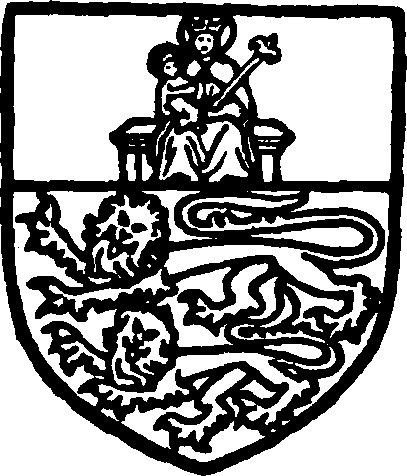
Bishopric of Lincoln. Gules two leopards or and a chief azure with the Virgin and Child or therein.
The manor in Stilton assessed at 2 hides, which had belonged to Tovi and was afterwards given to Uluuin, Bishop of Dorchester, (fn. 92) was held in 1086 by the BISHOP OF LINCOLN, and John held it of the bishop. (fn. 93) In the 13th century the bishop held it as a knight's fee (fn. 94) and in 1279 it was held of him by various sub-tenants by military service. (fn. 95) The bishop then had a view of frankpledge at Stilton; he claimed waif there and to be quit of murdrum and suit to the county and hundred courts. (fn. 96)
The Bishop of Lincoln had a fishery, worth 4s. per annum. (fn. 97) Another fishery of the same value was attached to the manor of Stilton (q.v.), held by the Prior of Bushmead. (fn. 98) The prior's mill was worth 20s. a year. (fn. 99) In 1555, Robert Apreece died seised of a windmill in Stilton, (fn. 100) and in 1621 another Robert Apreece died seised of it, together with a second and new windmill. (fn. 101) In 1570 Robert and Henry Forrest held a mill in Stilton. (fn. 102) A horsemill was acquired in 1590 by James Boulton, together with the Tabard (fn. 103) (q.v.).
In 1792 a market was held at Stilton every Wednesday. (fn. 104) A fair was held on the Monday before Easter in the second half of the 17th century, (fn. 105) but in 1792 the only fair appears to have been held on 16 February. (fn. 106) No grant of either market or fair seems to exist and both had disappeared before 1885. (fn. 107)
Church
The church of ST. MARY consists of a chancel (27½ ft. by 13¼ ft.), with vestry and organ chamber (14½ ft. by 11 ft.) on north, nave (43½ ft. by 14½ ft.), north aisle (6¼ ft. wide), south aisle (6¼ ft. wide), west tower (10½ ft. by 8¼ ft.), and south porch. The walls are of rubble with stone dressings, and the roofs are covered with stone-slates and lead.
The church is not mentioned in the Domesday Survey (1086), and the earliest parts of the present church are the 13th-century nave arcades, of which that on the north is slightly the earlier. Practically all the rest of the church was rebuilt in the 15th century, but the south porch and the vestry are probably a little later, c. 1500. The chancel and vestry are said to have been rebuilt in 1808, when the vestry, originally a chapel, was reduced in length. The church was much restored in 1857, when the gallery was removed from the west end, and the chancel and south porch were restored; the clearstory and the nave roof probably belong to this restoration. Some repairs were done in 1887–88, when the chancel arch and the east wall of the south aisle were rebuilt. In 1908–9 the south aisle was partly rebuilt.
The 15th-century chancel (fn. 108) has a modern threelight east window under a two-centred arch (fn. 109) —the whole of the east wall having been rebuilt. The north wall has a modern segmental-pointed arch to the organ chamber. In the south wall are two modern two-light windows. The modern chancel arch is of two chamfered orders dying into plain chamfered responds without capitals.
The rebuilt north organ chamber and vestry, on the site of a chapel, has a reset late 15th-century square-headed three-light east window. In the west wall are a modern fireplace and a blocked 15th-century four-centred arch to the north aisle.
The 13th-century nave has a north arcade of three bays, the two eastern arches being semicircular, of two plain orders on a circular column and similar half respond-column on the east having moulded capitals and bases. The western arch, probably 15th century, is two centred and of two chamfered orders, and rests on an octagonal column and a similar half respond-column at the west having moulded capitals and bases. The upper doorway to the rood is at the east end of this wall. The south arcade is also of three bays, the two eastern having semicircular arches of two chamfered orders and the western bay a clumsily built two-centred arch, probably 15th century; the columns are circular with mould capitals and bases, and the responds have simil attached half-columns. There are three modern tr foiled clearstory windows on the south side. The ro is modern and of very steep pitch, and in the east gable above the chancel roof is a modern trefoiled window.
The 15th-century north aisle has three two-light windows with four-centred heads; and a doorway with chamfered jambs. In the east wall is a blocked four-centred arch to the organ chamber; and high up in the south-east corner is the jamb of a blocked door way of the rood-stairs.
The largely rebuilt south aisle has a three-light window partly of 15th-century date in the east wall. The south wall has a similar three-light window; a 14th-century three-light window much restored; a 15th-century doorway with continuous moulded jambs; a 15th-century piscina with two-centred head and a round basin; and a semicircular-headed stoup.
The 15th-century west tower has a two-centred tower arch of one continuous chamfered order having two soffit ribs carried on semi-octagonal attached shafts with moulded capitals and bases. The west doorway has continuous moulded jambs and a four-centred head, and above it is a two-light window with a four centred head but with the mullion and tracery destroyed. In the next stage is a square-headed two-light window. The belfry windows are two- lights with four-centred heads. The tower has diagonal buttresses at the north-west and south-west angles, and is finished with an embattled parapet. Formerly it was surmounted by a low pyramidal roof covered with lead rising from within the parapets; (fn. 110) this spire is not shown in Suckling's sketch of c. 1825. (fn. 111)
The south porch, c. 1500, much restored, has a stilted four-centred outer arch of two moulded orders, the inner order carried on semicircular attached shafts with moulded capitals and bases. In the east wall is a 15th-century moulded and carved bracket.
All the roofs of the church are modern.
The 15th-century font has an octagonal bowl, and an octagonal stem and base having a square rectangular buttress-like projection on their west sides.
There are two bells: (1) inscribed Thomas Norris made me 1639; (2) has no inscription, but the stamps of the Oldfields' foundry at Nottingham, together with the figure of the Virgin and Child. In 1709 there were three bells; (fn. 112) one of these was recorded as newly split in 1799, (fn. 113) and was still said to be broken in 1853, (fn. 114) and to have been sold some time between 1859 and 1892. (fn. 115)
There is a 17th-century oak chest with panelled front and carved rails in the vestry.
In the south aisle is a tapered coffin-lid with crudely formed cross at each end of a central rib, probably of 12th-century date, and found in the foundations of the south wall; and in the churchyard are three fragments of coffin-lids, one with carved cross and a calvary. Also in the churchyard is part of the octagonal stem of a 15th-century churchyard cross on a moulded octagonal base.
On the nave floor are two brasses on one slab: (1) civilian in furred gown and woman in high-crowned hat, and inscription plate, to Richard Curthoyse, d. 157¾, and Anne his wife, d. 1606; and (2) two civilians, one in furred gown and the other in doublet and cloak, to Thomas, d. 1590, and John, d. 1618, sons of Richard and Anne Curthoyse.
There are the following monuments: in the chancel, to Jane (Wing), wife of the Rev. Daniel Twining, d. 1820, the Rev. Daniel Twining, Rector, d. 1853, and their children—Daniel, d. 1843, Mary and Hugh, infants, Francis, d. 1864, and Jane, d. 1869; War Memorial, 1914–18; the Rev. George Archer, Rector 1892–1927; floor slabs to Allison Butcher, clerk, d. 1775; Joshua Devereux, d. 1716, Margery his wife, d. 1755, Price their son, d. 1756, and several children; and glass window to William Worthington, d. 1866. In the north aisle, to Elizabeth wife of Thomas Henderson, d. 1833; and Joseph Vise, d. 1841, and Charlotte his wife, d. 1847. In the south aisle, to John Apreece brother of Sir Thomas Hussey Apreece, bart., of Washingley, d. 1821; and Henry Oliver, d. 1842.
The registers are as follows: (i) baptisms, marriages and burials, 25 April 1660 to 10 March 1750/1 (ii) the same, 24 June 1750 to 28 September 1783, marriages end 5 July 1761; (iii) marriages, 30 April 1754 to 14 October 1783: this is not the usual officially printed book; (iv) baptisms, marriages and burials, 4 October 1783 to 28 December 1812: this is a printed book, very similar to the ordinary official marriage book, and has burials in the front, marriages in the middle and baptisms at the end.
The church plate consists of a silver cup inscribed 'This . cupe . made . in . the . yeare . of . our . Lord . God . Anno . domini. 1626 . for the Towne of Stillton George Gresswell and John Scotson (fn. 116) churchwardens. Anime salutem Memento,' hall-marked for 1626–7; a silver cup inscribed 'Stilton – 1822. Josoph Vise, Esqr. Mr. William Smith, Churchwardens,' hall-marked for 1810–11; a silver standing paten inscribed 'Jno Broughton & William Day, Churchwardens, 1630,' hall-marked for 1630–1; a silver standing paten inscribed 'Stilton – 1822. Joseph Vise, Esqr. Mr. William Smith, Churchwardens,' hall-marked for 1822–3; a silver flagon inscribed 'To the Glory of God In commemoration of the Peace & of the Coronation of King Edward VII. 1902. G. A. Rector. T. T. – W. N. Churchwardens,' (fn. 117) hall-marked for 1903–4; a pewter plate inscribed ' I*M 1748 Church Warden Stilton.' (fn. 118)
Advowson
No church is mentioned at Stilton in Domesday Book. (fn. 119) In the early 13th century it appears to have been attached to the fee of the Bishop of Lincoln, and Bishop Hugh de Welles between 1215 and 1218 collated to the rectory by authority of the Lateran Council. (fn. 120) The advowson belonged to the Bishop of Lincoln until it was transferred in 1852 to the Bishop of Peterborough, (fn. 121) who presented in the next year. (fn. 122) The advowson was transferred to the Crown in 1874, (fn. 123) the Lord Chancellor now being patron. In 1222, on the collation of Alan de Keilestorp to the rectory, a pension of 100s. a year was reserved for the maintenance of the clerks of the choir of Lincoln cathedral, (fn. 124) but this pension is not mentioned in 1291. (fn. 125) A portion, valued at 10s. a year, was then payable to the Priory of Huntingdon. (fn. 126) After the Dissolution, (fn. 127) the portion came to the Crown, and was granted in 1600 by Queen Elizabeth to Bishop Heton of Ely. (fn. 128)
The church was taxed at £6 13s. 4d. in 1291 and 1428, and the value in 1535 was £12 6s. 8d. (fn. 129)
In 1338 John de Poynton of Stilton and his wife Emma, formerly wife of John de Stilton, who had newly built the chapel of St. Mary in the church of Stilton, obtained the royal licence to endow it with a messuage and 24 acres of land, held of the Bishop of Lincoln. (fn. 130) No return was apparently made of this endowment at the Dissolution of the Chantries, (fn. 131) when an acre of land at Stilton, valued at 4d. a year, had been given for the provision of lamps. (fn. 132) There was a guild of St. John in the church in 1527. (fn. 133)
Charities
Church Land.—This land originally consisted of arable land known as Dammas' abutting upon Fen Drove, Stilton, containing 5 a. 1 r. 34 p. Under an order of the Charity Commissioners dated 17 January 1908, this land was exchanged for 8 a. 1 r. 22 p. of land in Stilton. The land is let for about £20 per annum, which is carried to the churchwardens' account and applied to the repairs of the church.
William Worthington, by will proved 17 August 1866, bequeathed to the rector and churchwardens £500, the interest to be distributed in bread and coals to the deserving poor residing in the parish. This sum is now represented by £467 14s. 6d. Consols with the Official Trustees, and the dividends are distributed in accordance with the directions contained in the will of the donor.
Mrs. Worthington's Charity.—This charity is comprised in indentures dated respectively 25 February 1867 and 15 March 1869, the will of Frances Worthington, proved 20 October 1876, and is also regulated by a scheme of the Charity Commissioners dated 19 June 1914. The endowment now consists of six small almshouses occupied by three poor men and three poor women, together with sums of £1,468 17s. 7d. Annuities and £1,491 19s. 11d. Consols with the Official Trustees. The income is applied in maintaining the almshouses and inmates in accordance with the directions contained in the above-mentioned indentures.
John Apreece, who died 6 July 1821, bequeathed a sum of stock, the dividends thereon to be distributed among seven poor women of the parish of not less than 60 years of age. The endowment is now represented by £154 7s. Consols with the Official Trustees, the dividends of which are distributed to seven poor women according to the will of the donor.
Under the charity of James Charles Dymock Robertson, founded by will proved 17 June 1895, this parish receives a yearly sum of £10, which is distributed to the poor in coal.