A History of the County of Rutland: Volume 2. Originally published by Victoria County History, London, 1935.
This free content was digitised by double rekeying. All rights reserved.
'Parishes: Hambleton', in A History of the County of Rutland: Volume 2, ed. William Page (London, 1935), British History Online https://www.british-history.ac.uk/vch/rutland/vol2/pp66-72 [accessed 30 April 2025].
'Parishes: Hambleton', in A History of the County of Rutland: Volume 2. Edited by William Page (London, 1935), British History Online, accessed April 30, 2025, https://www.british-history.ac.uk/vch/rutland/vol2/pp66-72.
"Parishes: Hambleton". A History of the County of Rutland: Volume 2. Ed. William Page (London, 1935), British History Online. Web. 30 April 2025. https://www.british-history.ac.uk/vch/rutland/vol2/pp66-72.
In this section
HAMBLETON
Hameldune (xi-xii cent.); Hamildon (xi-xv cent.); Hameldon (xii-xviii cent.); Halmeden (xii cent.); Hamuldon (xiv, xv cent.); Hambledon (xv-xviii cent.); Hambleton (xvii cent.).
The area of the parish of Hambleton is 2,862 acres. The subsoil is Upper Lias and Inferior Oolite; the soil varies. The land is chiefly under pasture, but the usual cereal crops are grown.
The village of Upper Hambleton stands on the top of a hill some 417 ft. above the Ordnance datum, and fine views over the Vale of Catmos can be had from it. The land falls away from the village about 200 ft. to the River Gwash on the south and east and to a stream, a tributary of the Gwash, on the north. The village street is built along a by-road leading from Edith Weston to the main road from Stamford to Oakham, which latter town is about three miles distant. The church is at the west end of the street, and near it are some old thatched and stone roofed cottages. On the south side of the church is a long, low, two-storied building with thatched roof, known as the "Priest's House." It is apparently of late 16th century date. The south front is faced with ashlar and has a mullioned bay-window with corbelled gable above. Along the village street eastward of the church the houses extend along the north side, while on the south is Hambleton Hall, built in 1881, standing in a park of 250 acres, and now the residence of Mrs. Clement Astley Paston Cooper. Near it, a little to the west, is a 17th-century house known as the Manor, now occupied by Major J. Orr-Ewing. It stands probably on the site of the manor house in which the Umfravilles and Badlesmeres lived in the 13th and 14th centuries. The present house is built of stone. It is gabled and of simple but attractive design, with mullioned windows, good chimneys and stone-slated roofs. The house has been modernised and extensive additions have been made to it.
Southward of Upper Hambleton is Middle Hambleton, comprising a few scattered cottages on the west side of the by-road to Manton.
Farther south again is Nether Hambleton, where is the Old Hall, a charming Jacobean house of moderate size. It was not apparently a manor house, but was built about 1610, as recorded in a deed dated 6 April 1611, (fn. 1) wherein Roger Quarles, (fn. 2) who then purchased the estate from Christopher Loveday, mentions it as 'his capitall new erected messuage.' The descendants of Roger Quarles parted with their interest in the property, in December 1634, to Abel Barker of Hambleton, and the sale included 'all dores, waynscott, lockes, keyes, glasse, tables, formes, bedsteads, shelfes, thralls, utensills, etc.' Abel Barker's son, who bore his father's christian name, was created a baronet in 1665. He had purchased the neighbouring manor of Lyndon in 1662 in conjunction with his brother. Shortly before his death Sir Abel Barker (d. 1679) went to reside at the house at Lyndon (q.v.) which he had lately built. The Old Hall at Hambleton was thereupon let as a farm-house, and such it has since remained. (fn. 3) The Barker family continued in possession until they died out in 1845. The estate was then purchased by the Rev. Edward Brown, whose wife was Sarah Barker, an aunt of the last direct descendant, and on his death it passed to his nephew, Edward Nathaniel Conant, grandfather of the present owner. The fact that the Old Hall answered its purpose as a farm-house no doubt accounts for its having been left unaltered and unmodernised, and that it remains so interesting an example of its period. The Palmer family were its tenants for some century and a half. The house is built of stone and the general treatment is simple, with mullioned windows and straight gables. The windows have mostly a single row of two or three lights, but on the south front are some of four lights and some of two lights in height. What gives its particular character to the house is the introduction of loggias on the north and south fronts; that on the north or entrance front is arched, and is ingeniously divided in order to get a porch and a bay window to the hall, while that on the south front is a small open colonnade. There are short lengths of arcaded parapet similar in detail to that at Exton Old Hall, and it would appear that the builder, who presumably was Christopher Loveday, acquired the services of a very competent mason who (it is likely) designed the house after the type prevalent at the time, with the hall in the middle, the family rooms at one end and the kitchens at the other. There is little of ancient interest inside, and practically nothing remains of the various articles enumerated in the sale to Abel Barker.
The tenants of Hambleton and the inhabitants of adjacent towns joined in petitions to the Council of State during the Commonwealth against the oppression of Col. Wayte, member of the Rump Parliament. As lord of the manor, then 2,244 acres in extent, he had broken a promise made when purchasing the property by lessening the tenants' farms, taking their best lands, forcing them to enclose their pastures, doubling their rents, enclosing the springs and turning the brooks, so that they could get no water without trespassing on enclosures, and would not let them reap corn sown with his consent unless they paid 10s. an acre. 'The tenants being 80 families will thus be undone, 30 families of labourers thrown out of work, the parish depopulated, as he says he will pull down houses as they become his by the death of the tenants.' (fn. 4)
There was an estate Act passed in 1693. (fn. 5)
Rider Haggard has described the system of cottage holdings introduced here and in three other Rutland parishes. In 1901 there were 43 small holders in these parishes with holdings varying from 5 to 40 acres, the holdings being all grass. Originally there were many more, the Hambleton cow pasture, which is 102 acres, being divided into 80 cow commons. Some of the holders occupied two or more fields, but usually fields were grazed in common and separate small fields reserved for mowing, five roods being allowed to a cow in the common fields. (fn. 6)
The Black Death was felt very severely, bringing a yearly loss of £11 in rent to the lord. (fn. 7)
Some 14th-century field-names are: Landwar, Sundermedow, Dwpwelleholmes, Elerformedows, Holdmedow, Lampolmedow. (fn. 8) The names Oatemeale Meadow, West Well Spring, Wall Greesons occur in the rectory lands in 1650; (fn. 9) 'le Blynde Lane' in the 'Nethertowne' in 1549. (fn. 10)
The nearest railway stations are Manton, 3 miles south-west, and Oakham, 3 miles north-west.
Manors
The manor of HAMBLETON, with the rest of Martinsley wapentake, first appears as part of the dower of Aelfthryth, mother of Ethelred the Unready, and afterwards as dower of Ethelred's queen Emma. The Confessor granted the two mother churches of Oakham and Hambleton, with the church of St. Peter, Stamford, belonging to Hambleton, and all appurtenances, to St. Peter's, Westminster, while the manors of Oakham and Hambleton belonged to his queen Edith at the time of the Norman Conquest under his grant to her of Rutland for life with reversion to the Abbey. In 1066 Edith had 4 carucates of land in Hambleton with its seven berewicks, 'church sokeland.' Possibly she retained this land until her death in 1075, when William I took it into his own hands. In 1086 he had 5 ploughs here in demesne and 140 villeins and 13 bordars having 40 ploughs. There were three priests and three churches, to which one bovate 8 acres of land belonged. The whole manor with its berewicks was 3 leagues 8 furlongs by 2 leagues 8 furlongs. Albert the clerk held 7 bovates belonging to the churches in Hambleton and the neighbouring lands. (fn. 11) In the Lincolnshire survey, Albert (fn. 12) appears as holding the church of St. Peter, Stamford, with two dwellings and ½ carucate land in Hambleton. (fn. 13) The whole wapentake was in 1086 in the king's hands, with its vills all grouped round the three manors of Oakham, Hambleton and Ridlington. The seven berewicks of Hambleton may have been Braunston, Normanton, Lyndon, Martinsthorpe, Edith Weston, Manton, (fn. 14) and Market Overton (q.v.). Ayston and Wing, which seem to have been attached to Ridlington (q.v.) church, were with Manton members of Hambleton manor in 1622. (fn. 15) Market Overton remained for some time a member of Hambleton manor, but the first five manors developed separately.
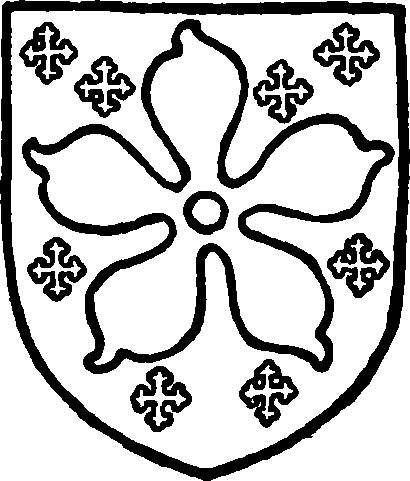
Umfraville. Gules crusily and a cinqfoil or.
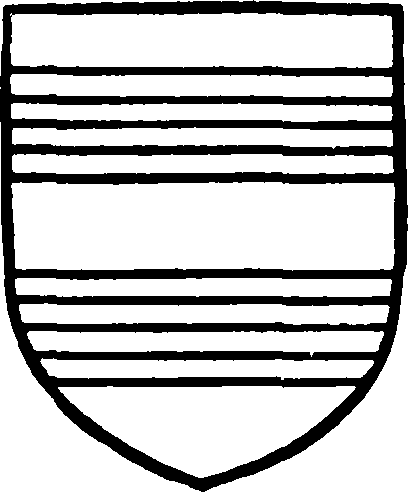
Badlesmere. Argent a fesse double cotised gules.
The manor known by the 14th century as GREAT HAMBLETON was granted by the Conqueror or William Rufus after 1086 to the ancestor of the Umfravilles, apparently Robert 'with the beard,' (fn. 16) 'who came to the Conquest of England.' Robert was apparently succeeded by another Robert (d. about 1145) who was pardoned for some default in 1130, (fn. 17) and he by Odinel, who built Prudhoe Castle. Odinel's son, Odinel d'Umfraville, one of the barons who captured William the Lion at Alnwick, (fn. 18) died seised of land in Normanton and elsewhere in the county in 1182 and was succeeded by his son Robin or Robert (ob.s.p. about 1195). (fn. 19) Hambleton was taken into the king's hands in 1199 as security for a debt owed by Robin's brother and heir Richard to Maud daughter of Ralph Vinitor. (fn. 20) Richard joined the barons against King John and his lands were forfeited and granted to Hugh de Balliol. He, however, returned to his allegiance to Henry III and his lands were restored in 1217. (fn. 21) He was succeeded in 1226 here and in Redesdale by his son Gilbert (I), the 'Flower of the North,' who did homage in Jan. 1226–7 and in 1238 he presented to the church of Market Overton where he held a knight's fee in 1241. He married Maud, Countess of Angus, and became Earl of Angus in her right in 1243. At his death in March 1244–5 the king's brother sought the guardianship of the son and heir Gilbert but was outbid by Simon de Montfort who paid 10,000 marks for it. (fn. 22) His widow Maud (d. 1261) received the manor in dower in 1245 until the king assigned her full dower. (fn. 23) Simon de Montfort, Earl of Leicester, was still guardian in 1258. (fn. 24) The heir Gilbert (II), second Earl of Angus, joined the baronial party against Henry III, (fn. 25) but was in possession of Market Overton in 1267 and of Hambleton in 1275. He settled the two manors in 1289 on his eldest son Gilbert (III) and his wife Margaret daughter of Thomas de Clare, and their issue. (fn. 26) Gilbert (III) died in 1303 in his father's lifetime and the Earl then settled the reversion of the manor of Hambleton, after Margaret's death, on himself and Elizabeth his wife, daughter of Alexander Comin, Earl of Buchan. (fn. 27) Margaret widow of Gilbert (III) had the three Rutland manors in dower. She married as her second husband Bartholomew de Badlesmere, (fn. 28) and they acquired the manors of Hambleton, Normanton and Market Overton before 1305, when they are returned as holding one knight's fee there. (fn. 29) In 1315 Richard de Middleton and Agnes his wife granted to them and the heirs of Bartholomew 150 acres of land in Hambleton and yearly rents of 6s. and ½ lb. cummin. (fn. 30) Bartholomew was returned as lord in 1316. (fn. 31) Gilbert (II) de Umfraville died in 1307 and was succeeded by his eldest surviving son Robert (d. 1325). His son Gilbert (IV) with his son Robert in March 1336–7 released to Giles son of Bartholomew all his right in these manors, apparently for the payment of 1,100 marks. (fn. 32) Bartholomew joined the Earl of Lancaster against Edward II; and after his death in 1322 (fn. 33) his manors of Hambleton and Market Overton were granted for life in that year to Ralph Basset of Drayton. (fn. 34) It is evident there was considerable ill feeling about Basset's tenure of the manor, for we find that his lands were entered in 1326 and 1334, his servants assaulted and his horses, oxen and sheep driven away. (fn. 35) This is probably to be accounted for by the fact that Hambleton had been the residence of the Badlesmeres. Margaret de Umfraville, Lady of Badlesmere, widow of Bartholomew, dated a petition from Hambleton in 1325 (fn. 36) and her son Giles was born here in 1314. (fn. 37) On the accession of Edward III, Giles, although he did not come of age until 1335, obtained a reversal of his father's attainder in 1327. (fn. 38) Ralph Basset did not die till 1343, but Giles seems to have entered into possession of his Rutland manors in 1337 (fn. 39) and died seised of them without issue in 1338. His four sisters and coheirs and their husbands divided his estates. William de Bohun, Earl of Northampton, and his wife Elizabeth, sister of Giles, received the manor of Hambleton. (fn. 40) On the death of the Earl (d. 1360), who outlived Elizabeth, this manor reverted to Edmund son of Roger Mortimer, Earl of March, who was the son of Elizabeth by her first husband Edmund Lord Mortimer of Wigmore. (fn. 41) Edmund was a minor, and the king granted the wardship of Hambleton manor to his daughter Isabel in 1361. (fn. 42) Edmund married Philippa, daughter of Lionel, Duke of Clarence, and dying in 1381 was succeeded by his son Roger, acknowledged heirpresumptive to the throne in 1387. He was killed in an Irish raid in 1398 and was succeeded by his son Edmund aged 7 years. (fn. 43) 'Sir John Lovell kt.' (Lord Lovel of Titchmarsh), who died in 1408, held Hambleton manor for life with reversion to Edmund Earl of March, and instead of being held in chief the manor was said to be held of Edward Duke of York by virtue of a grant by Richard II to the Duke of York and his heirs male. (fn. 44) Edmund Earl of March, the last of the Mortimers in the male line, like his father and grandfather, was lieutenant of Ireland, and died there in 1425. Richard Duke of York, son of his sister Anne, succeeded as Earl of March, (fn. 45) and was in possession of this manor in 1449, (fn. 46) though William Porter kt. was holding the Badlesmere fee in Hambleton and Normanton in 1428. (fn. 47) The Duke of York made a settlement in 1449 (fn. 48) and probably in 1454. (fn. 49) Richard Duke of York died in 1460 when the manor, after various subsidiary dealings, passed to his son Edward, who ascended the throne as Edward IV in the same year. In 1467–8 Edward granted the manor to Sir Henry Ferrers, (fn. 50) grandson of the fifth Lord Ferrers of Groby, when it was stated that he had obtained it by exchange with Richard Quatermaynes and others who held it in fee. (fn. 51) Sir Henry Ferrers kt. died seised in 1500, leaving a son and heir Edward, (fn. 52) who made a settlement in 1548. (fn. 53) Edward's widow Constance held the manor as dower and died in 1551, when it reverted to her grandson Edward, son of her son Henry Ferrers. (fn. 54) Edward in 1553 settled the manor on himself and Bridget his wife with remainders to Henry, Ferdinando and Edward their sons. (fn. 55) Their son Henry in 1601 sold the manor to Sir John Harington. (fn. 56) From that time, except for an interval during the Commonwealth, the manor has descended with the manor of Burley (q.v.) (fn. 57) and is now the property of Mr. Wilfred H. M. Finch, J.P., the chief land owner. In 1650 Col. Thomas Wayte, M.P. for Market Overton, obtained a lease of the manor from the trustees of delinquents' lands, in this case the delinquent being the Duke of Buckingham, (fn. 58) and shortly afterwards purchased it. (fn. 59)
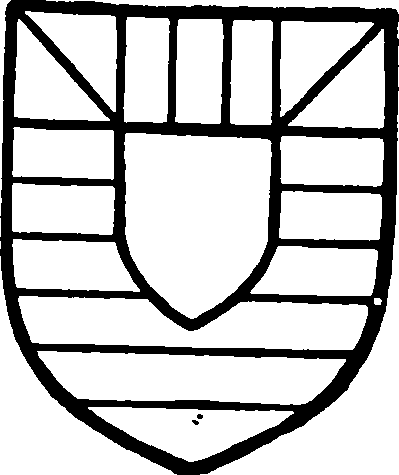
Mortimer. Barry or and azure a chief or with two pales between two gyrons azure therein and a scutcheon argent over all.
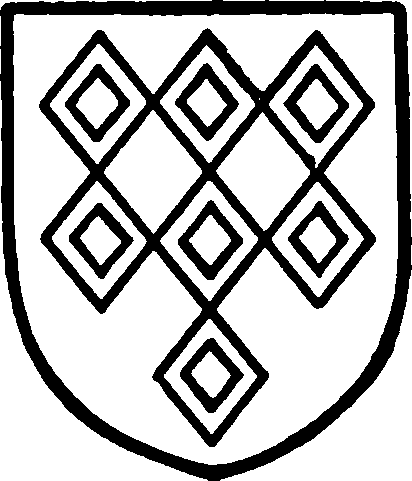
Ferrers. Gules seven voided lozenges or.
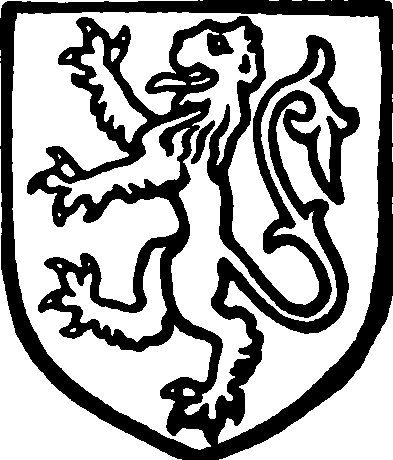
Cromwell. Sable a lion argent.
In 1275 it was stated that the Umfravilles had always had gallows. (fn. 60) Bartholomew, Lord Badlesmere, and his heirs had a grant of free warren in 1315, (fn. 61) confirmed in 1337, (fn. 62) which Ralph Basset exercised in 1326. (fn. 63) A mill belonged to the manor in 1086, (fn. 64) and a windmill is recorded from 1338 to 1674, the capital messuage and dovecote also being mentioned in 1338. (fn. 65)
The manor of LITTLE HAMBLETON (Parva Hambleton) was a member of the Honour of Huntingdon. Earl David (fn. 66) about 1200 confirmed a rent of 30d. here to the priory of St. James near Huntingdon (Hinchingbrooke) as William de Camera had granted it. (fn. 67) In 1442 William de Camera was stated to have granted the priory a rent of 13s. 4d. here, (fn. 68) which the priory received until the Dissolution. (fn. 69) It was then granted in 1538 with all the other priory lands to Richard Williams alias Cromwell in fee. (fn. 70) Richard was succeeded here in 1544 by his son Henry, a minor, (fn. 71) but in 1533 and 1612 the manor was said to be held of the manor of Great Hambleton. (fn. 72)
The first undertenant found is Geoffrey de Ketton, who in 1241 conveyed a carucate of land and the mill to John Talbot (fn. 73) (Taleboth). The latter had a manor-house and chapel, (fn. 74) but is called of Fincham, and was son of Geoffrey Talbot. (fn. 75) John was concerned with lands here in 1247 (fn. 76) and 1249. (fn. 77) John de Causton some time before 1314 leased half the manor to Margaret Gailleway, and in 1314 granted the rever- sion to Bernard de Brus of Exton (q.v.) and Agnes his wife and the heirs of Bernard, (fn. 78) who in 1317 conveyed the half-manor to John son of Henry Byron of Whitwell. (fn. 79) John Byron of Whitwell received further grants from the Gailleway family in 1333. (fn. 80) Sir William de Burton, kt., and Joan widow of John Byron were tenants of the priory here in 1348. (fn. 81) Sir William died 1375–6 and his son Sir Thomas died seised of this manor in 1382, leaving a son Thomas aged 14, and a widow Margery who had a life interest. (fn. 82) She and Thomas Burton, kt., alienated the manor to Roger Flore (Flower) in 1412. (fn. 83) From this date the descent of the manor followed that of Whitwell (q.v.) until 1631, when John Flore and William Sheldon and their wives conveyed the manor to William Smyth and John Tibbs and the heirs of William; (fn. 84) and about 1635 John Flore of Whitwell died seised of tenements here. (fn. 85) In 1674 George Legge and Barbara his wife conveyed half the manor and windmill to Edward Seymour and others; (fn. 86) and in 1711–12 Edward Greathead and others made a settlement of one-third of an annual rent of £60 arising from the manor, (fn. 87) while in 1720 Thomas Dodds and Deborah his wife and Thomas Moore and Eleanor his wife, by right of the wives, made a settlement of the remaining two-thirds. (fn. 88) No further mention of the manor has been found.
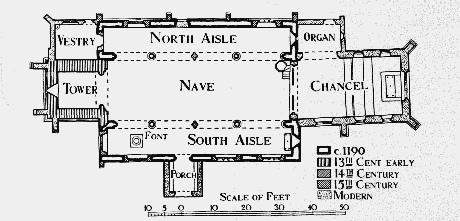
Plan of Hambleton Church
Church
The church of ST. ANDREW stands on the summit of the hill and consists of chancel 32 ft. by 18 ft., with organ chamber on the north side, clearstoried nave of four bays 55 ft. 9 in. by 18ft., north and south aisles respectively 7 ft. 6 in. and 8 ft. wide, south porch, and west tower 11 ft. square, all these measurements being internal. The width across nave and aisles is 38 ft. 6 in.
The church is built throughout of rubble and has low-pitched leaded roofs to chancel and nave, the aisles being covered with modern slates. The nave has a battlemented parapet, which is continued along the east gable, but the parapets of the chancel and aisles are plain. The porch has a stone-slated eaved roof. With the exception of the tower, all the walls are plastered internally.
In the main the building is of late 12th-century date (c. 1180–90), to which period the existing nave arcades and aisles belong, the tower being not very much later, added probably early in the 13th century. In the 14th century new windows were inserted in the north aisle and the chancel seems to have been remodelled, or perhaps wholly rebuilt on its present plan, but most of its mediæval details were obliterated in a restoration about a century ago, (fn. 89) and in 1892 it was pulled down and the present chancel built. In the 15th century new windows were inserted in the south aisle and the clearstory added, the erection of which appears to have necessitated the renewal of the middle pillar of the nave arcades, the new pillars being in the style of the period. (fn. 90) The old seating was removed in 1847 and in 1861 the tower was restored and strengthened by the addition of buttresses. The porch has been rebuilt and a vestry added on the north side of the tower, entered from the aisle.
The chancel is divided externally into two unequal bays and has diagonal angle buttresses and a re-used 15th-century east window of three lights, (fn. 91) the tracery of which, however, is modern. No other ancient features remain, the trefoil-headed 14th-century piscina with fluted bowl supported by a female head being now in the vestry. The eastern bay, or sanctuary, is lighted on each side by two single-light windows, and the shorter western bay by a two-light window on the south. The chancel arch is modern and of two orders, the inner order chamfered on half-round responds with moulded capitals and bases, and the outer with continuous wave moulding. (fn. 92) The chancel is elaborately furnished and has modern sedilia, piscina and credence, and good wrought-iron dwarf screen and gates.
The nave arcades are alike and consist of four pointed arches of two chamfered orders with unstopped hood-moulds on cylindrical pillars and halfround responds, the capitals of which are carved with early incurved stiff-leaf foliage, and have octagonal abaci; the circular moulded bases stand on octagonal plinths. The 15th-century middle pillar on each side is on plan an oblong set north and south, down the angles of which the outer chamfer of the arch is carried, the longer sides having attached columns with moulded capitals and bases. (fn. 93)
The late 12th-century south doorway has a semicircular arch of two orders, the inner with a continuous edge roll, and the outer with very large and roughly wrought tooth ornament, small sunk roundels, and rounded label moulding, springing from two capitals on each side, the shafts of which are gone. On the west side the capitals are scalloped, but those on the east differ in design and have a small fourleaved flower in the common abacus. The north doorway, now blocked, is probably contemporary, but is of very plain character, with rectangular chamfered opening, the head of which is formed by a large plain stone shaped like a tympanum and enclosed by a chamfered hood-mould.
There is an early string chamfered on both edges at sill level round the south aisle outside, and both aisles at the east end retain their original widely splayed single-light windows, (fn. 94) that in the south aisle being round-headed, the other (now opening to the organ chamber) a lancet. No ancient ritual arrangements remain in the aisles, but since 1895 the east end of the south aisle has been used as a chapel. (fn. 95) Of the 15th-century windows in this aisle that at the west end is pointed and of two cinquefoiled lights; the others are of three lights, those on each side of the porch square-headed and with vertical tracery, the easternmost pointed. The north aisle is divided externally into three bays by later buttresses and is lighted by two square-headed 14th-century windows, the easternmost of three lights, and that in the western bay of two, but the latter is not in its original position and its tracery is restored.
The four-centred clearstory windows, four on each side, are of two cinquefoiled lights with hood-moulds and the nave gable has a crocketed pinnacle at the apex.
The tower is of three stages marked by strings, with thrice chamfered plinth, widely splayed west lancet in the lower stage, and a rather larger one in the middle stage on the north and south sides. There is no vice. The bell-chamber windows consist of two lancet lights divided by a mid-shaft with moulded capital and base, set within a chamfered pointed arch with shafted jambs, and hood-mould with notch stops; the spandrels are pierced. (fn. 96) The tower terminates with a plain parapet, behind which rises a very short broach spire with plain angles and two-light gabled openings near the base. The modern four-stage buttresses are well set back from the angles. Internally the tower opens into the nave by a pointed arch of three chamfered orders with hood-mould on the nave side only, the outer order continuous and the two inner springing from clustered responds with mutilated bases and moulded capitals enriched with nail-head.
The font is ancient and may be of 12th-century date; it has a square bowl with bevelled angles, (fn. 97) and stands on a short stem and chamfered plinth.
Some Jacobean arched panels have been worked up in the modern pulpit. There is an old iron-bound oak chest with one lock in the south aisle.
Two coped stone coffin lids, perhaps of 14th-century date, formerly in the churchyard, are now inside the building. They are similar in type, showing the exposed head and feet of an effigy, but of the larger only the upper part remains. (fn. 98) At the east end of the north aisle is a floor slab with an incised cross of somewhat unusual character. There are no monuments earlier than the end of the 18th century. (fn. 99) In the churchyard is a War Memorial Cross.
There are five bells, a new treble by Taylor, of Loughborough, having been added in 1887 to a former ring of four, and the tenor recast. The second and third, dated respectively 1610 and 1621, are by Tobie Norris (I) of Stamford, and the fourth is by Taylor, 1861. (fn. 100)
The plate consists of a cup and cover paten of 1569–70, and a cup, two patens, flagon, and almsdish of 1749–50, the latter pieces inscribed 'Given to the church of Hambleton in Rutland in memory of the Revd. Willm. Gardiner, LL.B., 40 years vicar of the said parish 1750.' (fn. 101)
The registers before 1812 are as follows: (i) all entries 1558–1653; (ii) 1654–1715; (iii) 1716–49; (iv) baptisms and burials 1750–1800, marriages 1750–54; (v) baptisms and burials 1801–12; (vi) marriages 1754–1812. In the second volume is a register of briefs 1707–16, and in the third a similar register 1716–48. The fifth volume contains 'A valuation of the Lordship of Hambleton made in 1792.' There are churchwardens' accounts 1759–1879, and overseers' accounts 1781–1836.
Advowson
In 1585 the church walls were said to be in decay. (fn. 102) The church of Hambleton and its dependent churches were, like the manor, dower of the Saxon queens before the Conquest, and were granted by the Con- fessor to Westminster Abbey, a grant confirmed by William I in 1067. (fn. 103) However, in 1086, when Hambleton had three churches and three priests, Albert the Lotharingian clerk held of the king the churches of Oakham, Hambleton and St. Peter, Stamford. (fn. 104) Before his death William I restored these churches to the Abbey 'as Albert of Lorraine held them'; and a further charter of Rufus ordered the sheriff to do right to the Abbey concerning the churches of Rutland that Osbern the clerk held, and to cause it to have all its lawful churches as in the days of the king's father. (fn. 105) The jury of 1275 stated that the advowson belonged to Westminster Abbey, by what right they did not know, (fn. 106) a curious return, for already in the early part of the century the church advowson belonged to the Bishop of Lincoln and was appropriated to the dean and chapter of Lincoln in 1292. (fn. 107) In 1232 the bishop decreed that at every vacancy his successors might appoint a pension of 20s. of the church of St. Peter, Stamford, (fn. 108) and in 1296 the church was returned as appropriated to the dean and chapter of Lincoln, and the vicar mentioned. (fn. 109) The advowson has remained in the possession of Lincoln Cathedral. (fn. 110) The living is a vicarage separated from Braunston in 1885, and now united to Egleton.
The rectory, except for a few interludes, has also been retained by the dean and chapter. (fn. 111)
'Lampol meadow' was mentioned in 1338. (fn. 112) William Gybbyns, farmer, bequeathed in 1535 certain sums to the high altar and rood light, and to the Lady light in the chancel if anybody else would contribute to endow it and so relieve the church box. He left 4d. to every endowed light, 12d. to 'all soulen' light, and something to the chantry priest. (fn. 113)
At Little Hambleton in 1242 John Talbot received licence for a private chapel in his manor-house, without font or bell, to be served by his own chaplain at his own expense; but he, his wife and their heirs were to attend the church at Great Hambleton on Sundays and similar feast days, unless prevented by sickness, and no Sacrament was to be administered without special licence. Further, John Talbot and his wife agreed to give the Church of St. Andrew, Great Hambleton, on St. Andrew's day, ½ stone of wax or 2s. yearly. (fn. 114)
Charities
Lady Ann Harington's Charity.— A sum of £10 per annum is received for poor people being tenants of the manor. The annual income is distributed by the vicar and churchwardens among 16 recipients on Lordshold (Oakham).
Thomas Watkins, by his will proved 7 March 1905, gave the sum of £10 to be invested and the income to be devoted to the fund for the poor at Christmas, 'In memoriam—Thomas and Mary Watkins.' The endowment now consists of a sum of £11 3s. 10d. 2½ per cent. Consols producing in dividends 5s. 4d. per annum. The income is applied by the vicar and churchwardens in accordance with the trusts.
Mrs. Mary Clara Dixon, by a declaration of trust dated 25 January 1916, gave a sum of £50 to be invested for the benefit of the poor and expressed a desire that the charity should be called The Rev. Henry Daniel and Louisa James Trust. The endowment consists of a sum of £52 12s. 8d. 5 per cent. War Stock producing in dividends £2 12s. 8d. per annum. The charity is administered by the vicar.
The Hambleton War Memorial Repairs Fund was founded by a declaration of trust dated 28 December 1922. The endowment consists of a sum of £10 19s. 10d. 4½ per cent. Treasury Bonds 1932–34, producing in dividends 9s. 10d. per annum. The income is applicable by the vicar and two trustees, appointed by the parish meeting, in the repair of the war memorial erected in Hambleton Churchyard in 1920.
Fryers' Almshouses.—The parish participates in this charity, particulars of which are set out under Manton.
Bell's Charity.—A sum of £10 was left by William Bell for the use of the poor, as appears from an inscription on a tablet in the church and from an entry in an old parish book dated 10 April 1787, in which it is stated that 8s. should be given away in bread to the poor on 1 January in each year and that the money should be deemed the parish stock. This charity is now lost.
John Mitchell's Gift.—John Mitchell, a native of Hambleton and a mariner, about the year 1800 sent the sum of £10 to Mr. Nicholas Needham to be applied for the benefit of John Mitchell's mother. His mother having died before the whole of the money had been expended, the balance of £3 13s. 6d. was paid over to the churchwardens and overseers for the use of the poor. The income was distributed in bread to the poor in the same manner as Bell's Charity. This charity is now lost.
The several sums of stock are with the Official Trustees.