
A History of the County of Rutland: Volume 2. Originally published by Victoria County History, London, 1935.
This free content was digitised by double rekeying. All rights reserved.
'Parishes: Market Overton', in A History of the County of Rutland: Volume 2, (London, 1935) pp. 141-145. British History Online https://www.british-history.ac.uk/vch/rutland/vol2/pp141-145 [accessed 11 April 2024]
In this section
MARKET OVERTON
Overtune (xi cent.); Markedesoverton (xiii cent.); Marcat Overton, Marketishoverton, Marcateshoverton (xiv cent.); Market Orton (xvi–xix cent.); Margat, Margret, Horton (xvi–xvii cent.).
The parish of Market Overton occupies high ground to the north-west of the county between Edmondthorpe and Thistleton. Its area comprises 1,806 acres. The subsoil is Upper Lias and Inferior Oolite. It was stated in 1671 that in 1636 half the lordship of Market Overton was converted from tillage into pasture and inclosed by consent of the parson and inhabitants. (fn. 1) At the present day more than half the area is pasture, the arable land yielding cereals, peas and root crops. Iron is worked to a small extent by the Stanton Ironworks Co. and gives employment to a certain number of men, but the district is mainly agricultural and the population, which was 319 in 1921, is decreasing.
Old field-names are 'the Wong,' Black Holmes, Kirk Hole (a stone pit), and Barrowflats. (fn. 2)
Sir Isaac Newton was connected with the parish, and William Kitchen Parker (1823–90), the comparative anatomist, as druggist's assistant, was articled to a surgeon at Market Overton in 1842. (fn. 3) Thomas Waite, the regicide, governor of Oakham and Uppingham Schools (living 1634–68), is said to have been the son of an alehouse keeper here. (fn. 4) He was a member of the Rump Parliament and lived here in 1653. (fn. 5) His forfeited estate at Market Overton was rented at £140 a year in 1660. (fn. 6)
An old custom, dying out in 1895, was to give 'Plum Shuttles' or 'Valentine buns' to all the children of the parish on 14th February. (fn. 7)
Edward I was here 1 March 1276, (fn. 8) and Edward II 23 August 1315. (fn. 9)
The village stands on the highest point in the parish about 475 ft. above the Ordnance datum, and has wide views over the surrounding country. It is built mainly along a street leading southward from the road from Teigh to Thistleton and Stretton, and in the 14th century served as the market town for a rich agricultural area. It evidently had a market as early as 1200, (fn. 10) and 'Markedes Ouerton' appears in 1238, (fn. 11) but the earliest grant of a market that has been found was on 22 June 1267, when the lord of the manor was empowered to hold a weekly market on Thursdays and a yearly fair on 28, 29 and 30 June. The market day was apparently changed from Thursday to Wednesday by grant of 2 September in the same year. (fn. 12) The Wednesday market and yearly fairs on 5, 6 and 7 June and 17, 18 and 19 October were granted to Bartholomew de Badlesmere in 1315. (fn. 13) The market was still held in 1338, (fn. 14) but no further mention of either market or fair has been found. The market was probably held in the open space at the east end of the churchyard.
The church with a well-timbered churchyard is at the west end of the village within the earthworks of a Roman camp, and to the west of it is the Rectory, which has recently undergone alterations. The cottages are almost entirely of stone with thatched, stone or slate roofs, except a group of modern brick cottages at the east end of the village. The stocks and whipping post, in a good state of preservation, stand under some trees on the Green in the middle of the village. The stocks have four holes with cross pieces of iron between wooden posts, the taller of which forms the whipping post.
There was a manor house here as early as 1337, when Giles de Badlesmere dated his will from it, (fn. 15) and the manorial garden and dovecote are mentioned in the following year. (fn. 16) The present Manor House was rebuilt in 1866; it has an old wall and a small square summer house with a stone roof. The Old Hall with Lavender Farm makes a pleasing group of buildings at the south-west corner of the village. About 2½ miles west of the village is the Oakham Canal, now disused; the Wharf here is modern but marks the place where barges were loaded with barley and malt.
The nearest railway stations are at Ashwell, 3 miles to the south-west of the village, and at South Wytham, 3 miles north.
The manor was entered in both Lincolnshire and Rutland in 1086, and once in the 15th century was assigned to Leicestershire. (fn. 17)
Manors
Before the Conquest MARKET OVERTON and its berewick Stretton belonged to Waltheof, Earl of Huntingdon, who had 3½ carucates of land at geld in the two places. After his death in 1076 they were retained by his widow Judith, who had 3 ploughs in demesne in 1086. (fn. 18) From Judith the overlordship descended with the Honour of Huntingdon. (fn. 19) On the death of John le Scot the overlordship was attached to the purparty which passed to the Hastings, Earls of Pembroke, (fn. 20) at least until the death in 1401 of Philippa widow of John Hastings, who held a third of a knight's fee here as dower. (fn. 21) Later the manor was said to be held of Edmund Earl of Kent, (fn. 22) as representative of the Wake share of Judith's lands. (fn. 23)
The Umfravilles were probably undertenants from the 12th century. Odinell de Umfraville held Normanton and other lands in Rutland, and was succeeded by his son Robin or Robert in 1182. (fn. 24) Robin's nephew Gilbert, son of Richard de Umfraville, presented to the church in 1238 and held a knight's fee here in 1241. (fn. 25) From this date the manor followed the descent of Hambleton (q.v.) (fn. 26) until the death of Giles de Badlesmere in 1338. (fn. 27) His lands were divided among his four sisters and their husbands. Maud, wife of John de Vere, Earl of Oxford, the second sister, had the manor and advowson of Market Overton, (fn. 28) and Margaret, wife of John Tiptoft, the fourth sister, had tenements here; while Hambleton, falling to the third sister, henceforth descended separately. John Earl of Oxford died in 1360 seised of the Market Overton estate (fn. 29) by right of his wife, who survived him, (fn. 30) leaving a son and heir Thomas, (fn. 31) who in 1369 mortgaged the manor to Sir John de Sutton (fn. 32) and later granted it for life to William de Wingfield, kt. and Joan his wife. Thomas died seised of the reversion in 1371, and his son and heir Robert, (fn. 33) the favourite of Richard II, was created Duke of Ireland in 1386 and attainted by the Merciless Parliament in 1388. The reversion of this property fell to his mother, Maud, widow of Earl Thomas. (fn. 34) On the deaths of William de Wingfield and Joan, Maud entered into possession, (fn. 35) but in 1406 Philippa, widow of the attainted duke, obtained a grant of the reversion. (fn. 36) Philippa and Maud (fn. 37) both surrendered their rights to Richard. The manor, however, was still in the king's hands in 1409–10, (fn. 38) but Richard made a settlement in 1412. (fn. 39) He died seised of it in February 1417, leaving a son and heir John, (fn. 40) a Lancastrian, whose lands were in the king's hands in 1462, when he and his eldest son were beheaded. (fn. 41) The same year Market Overton was granted by Edward IV to his brother Richard, Duke of Gloucester; (fn. 42) but John, younger son of the last earl, was restored in blood. (fn. 43) In 1469 John, thirteenth Earl of Oxford, joined in a conveyance of the manor and advowson to Sir John Say, kt. (fn. 44) who died seised in 1478, leaving a son and heir William, (fn. 45) by whom it was settled in 1506. (fn. 46) His daughters and co-heirs were Mary wife of Henry, Earl of Essex, and Elizabeth, married to William, Lord Mountjoy. After some litigation the property was allotted to Mary, but later passed to her sister Elizabeth, (fn. 47) whose daughter Gertrude married Henry Courtenay, Marquess of Exeter, who was holding it in 1535. (fn. 48) He was tried for complicity in the rising in Devon and Cornwall, and was beheaded for treason Jan. 1538–9. (fn. 49) His widow Gertrude was at the same time attainted. A bailiff was appointed in 1540; (fn. 50) and in 1544 the site was leased to Richard, the king's footman, as belonging to Gertrude late Marchioness of Exeter, attainted. (fn. 51) It was sold to John Harington in 1553 (fn. 52) and the Haringtons of Exton (q.v.) held the manor and advowson until 1623, when they were conveyed to John Huggeford of Henwood (co. Warwick). In 1629 they were sold to John Wingfield of Tickencote (q.v.), (fn. 53) descendant of Sir Anthony Wingfield of Tickencote, (fn. 54) by Elizabeth sister and co-heir of John Earl of Oxford, who died in 1526. (fn. 55) They have since descended with Tickencote Manor (fn. 56) (q.v.). They are now held by Mr. John Llewellyn Parry, who took the name of Wingfield.

Hastings. Or a sleeve gules.
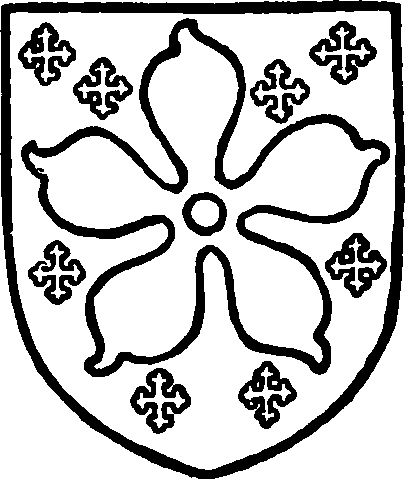
Umfraville. Gules crusilly and a cinqfoil or.
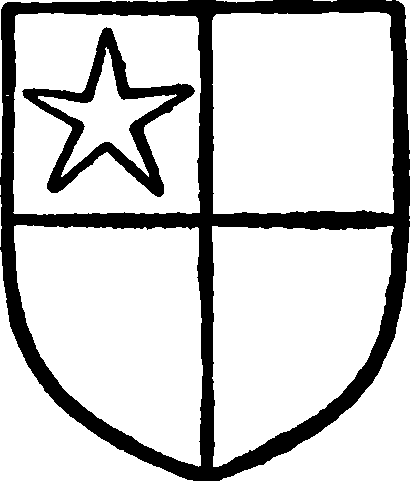
Vere. Quarterly gules and or with a molet argent in the quarter.

Wingfield. Argent a bend gules cotised sable with three pairs of wings argent on the bend.
Woodland one league by half a league belonged to the manor in 1086. (fn. 57) Free warren was granted to Bartholomew de Badlesmere in 1315, (fn. 58) and his son Giles received confirmation in 1337. It is mentioned as appurtenant to the manor until 1811. (fn. 59) In 1276 the lord claimed waif and view of frankpledge twice a year, without the king's officer, by prescription. (fn. 60)
An estate here held of the manor of MARKET OVERTON was, in 1341, assigned to John de Tiptoft and Margaret, one of the sisters and co-heirs of Giles de Badlesmere, after the death of Giles's widow. (fn. 61) In 1369 Robert Tiptoft mortgaged his right to Roger Beler, kt., (fn. 62) who enfeoffed William Slotheby, parson, (fn. 63) and died seised leaving three daughters and co-heirs, whose wardship was granted to Richard Le Scrope in 1372. (fn. 64) The Scropes of Bolton (co. York) held lands here in 1444, (fn. 65) and John Scrope of Bolton died seised of two messuages and 4 bovates of land in 1499, held of St. Agatha's Abbey, Richmond. (fn. 66) The earliest owner in fee of this property was Simon de Bereford, a rebel whose lands here were leased in 1332 at a rent of 16s. 4d. to Robert de Sussex, who seems to have held of the Crown other lands here. (fn. 67) This rent was granted with the Manor of Wendover (co. Bucks) to John de Molyns in fee, (fn. 68) who released his right to Robert de Sussex. (fn. 69) In 1367 Maud, widow of Robert, had the custody of Robert his grandson and heir for lands held in chief here; (fn. 70) and the king made a grant of Robert's marriage in 1370. (fn. 71) Maud died about 1382. (fn. 72) Robert, son of Thomas son of Robert de Sussex her grandson, came of age in 1383 and died in 1421, leaving a son Robert, (fn. 73) who was one of the collectors of the subsidy in 1428. (fn. 74) He died seised of tenements here held respectively of the king and the Countess of Oxford in 1443, when his brother Thomas was his heir. (fn. 75) These tenements were settled on the Warren family in 1505, (fn. 76) and Francis Warren died seised in 1510. (fn. 77) They then passed to John Stubbs or Snokstubbs, yeoman, (fn. 78) from whose family they passed in 1610 to Henry Waite, (fn. 79) possibly progenitor of the regicide. A windmill is mentioned in this fee in 1591 and 1610.
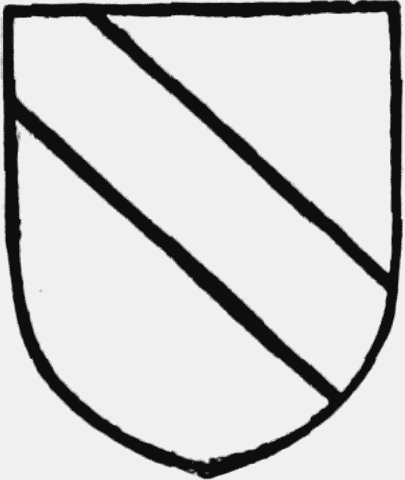
Scrope. Azure abend or.
Church
The church of ST. PETER AND ST. PAUL consists of chancel 24 ft. 9 in. by 14 ft. 9 in. with north organ-chamber and vestry, clearstoried nave 37 ft. 9 in. by 14 ft. 9 in., north and south aisles respectively 12 ft. 6 in. and 9 ft. wide, south transeptal chapel 23 ft. by 19 ft., south porch and west tower 10 ft. 6 in. by 12 ft., all these measurements being internal. The width across nave and aisles is 40 ft. 6 in.
The whole of the building is faced with coursed dressed stones, and has plain parapets to the chancel, transept and nave. The roofs of the chancel and porch are covered with modern blue slates, but elsewhere the roofs, which are of low pitch, are leaded.
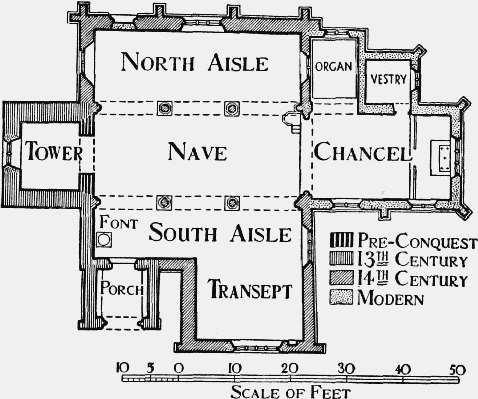
Plan of Market Overton Church
The church stands on the site of a Roman camp, in the south-west portion of the rectangle, (fn. 80) and at the west end there survives a fine Saxon arch, which was preserved when the pre-Conquest church of which it formed part was rebuilt. (fn. 81) The first rebuilding appears to have taken place in the 13th century, when a south aisle at least was added, a porch erected, and the chancel rebuilt with a chapel on its north side. The evidence of a north aisle to the nave at this time is wanting, but in the 14th century the church again underwent a somewhat extensive rebuilding, the north aisle being then added, or a former one widened, a large transeptal chapel added at the east end of the south aisle, the arcade of which was rebuilt, a clearstory erected, and the chancel remodelled. The existing tower was probably erected in the 13th century on the foundations of an earlier structure the proportions of which suggest a forebuilding or porch. (fn. 82) Two pre-Conquest sculptured stones (fn. 83) are incorporated in the walling near the base. The tower, however, appears to have been remodelled in the 14th century, when the top stage was either wholly rebuilt or new windows inserted. No further material changes were made in the fabric until 1861, when the chancel was rebuilt, the vestry and organchamber added and the transept restored. There was a further restoration in 1889. (fn. 84)
The pre-Conquest tower arch, which probably dates from the latter part of the 10th or first half of the 11th century, is in a wall 2 ft. 8 in. thick, and is 6 ft. 8 in. wide. The jambs are constructed of upright and flat stones, or stone slabs set up on edge and laid flat alternately, with three flat stones at the top, and the lower upright stones standing on boldly projecting square plinths. The semicircular arch springs from sloping impost blocks, the height to the underside of which is 9 ft. 6 in., and, like the jambs, is built with stones running through the whole thickness of the wall. For about 3 ft. on either side of the opening the walling is apparently contemporary with the arch, but no other work of pre-Conquest date remains.
The chancel is built more or less on the old lines, of two bays, with diagonal angle buttresses and a pointed (fn. 85) east window of three lights and Decorated tracery. There are two windows of similar character, but of two lights, in the south wall. The north side is covered for about two-thirds of its length by the vestry and organ-chamber, to the latter of which it is open by an arch supported on corbels. Internally the walls are faced with ashlar. The 14th-century chancel arch is of two orders, the outer plainly chamfered and the inner with a wide hollow chamfer, on half-octagonal responds with moulded capitals and plain bases. (fn. 86) Just within the arch on the north side, about 6 ft. 6 in. above the chancel floor, is a plain chamfered corbel, apparently of 13th-century date, from which the arch to the former chapel sprang. (fn. 87) There is no chancel screen, and no ancient ritual arrangements have been preserved. (fn. 88)
The 14th-century nave arcades are of three bays, with pointed arches of two chamfered orders and hoods with head-stops, springing (fn. 89) from octagonal piers and responds with moulded capitals and bases. The width of the transept is nearly equal to half the length of the nave, and it projects 14 ft. 8 in. beyond the aisle, from which internally it is not structurally separated, though the roof runs through to the clearstory wall. The transept has a pointed window of four trefoiled lights and Decorated tracery in the south wall, but the hood-mould alone appears to be original, and at the north end of the east wall there is a 14th-century three-light window with uncusped reticulated tracery, but without hood-mould. (fn. 90) At the east end of the south wall is a 14th-century trefoilheaded piscina with fluted bowl and hood with notch-stops.
There are no windows in the short south aisle, and the doorway (fn. 91) is little if any earlier than the arcades, but the 13th-century walling probably remains unaltered at the west end and the porch is of that period, the arch of the outer doorway resting on filleted keelshaped responds with moulded capitals and bases; the capital of the east respond is enriched with nail-head.
The three bays of the 14th-century north aisle are marked externally by buttresses, and in the west bay is a pointed north doorway, now blocked, of two continuous chamfered orders. The middle bay has an original square-headed traceried window of three lights, and in the end walls are pointed two-light windows, that at the east (from which the cusping has been removed) now opening to the organ-chamber.
The clearstory has four windows on each side, those on the north square-headed and of two trefoiled lights with Decorated tracery, and on the south three pointed two-light windows with 14th-century tracery varying in design, and the fourth, or easternmost, a later square-headed window of three uncusped lights, apparently of 16th-century date. A sanctus bell-cote stands on the east gable.
Externally the hollow moulding below the parapets of the transept and south side of the clearstory, and along the north and south walls of the aisles, is enriched with ball-flowers, heads, four-leaved flowers and other devices. (fn. 92)
The tower is of three stages marked by strings, but is without buttresses or vice, and terminates in a battlemented parapet and pyramidal roof with vane. The pointed two-light west window is much restored, the mullion and tracery being new. Above it, in the middle stage, is a lozenge-shaped uncusped moulded opening, and the pointed bell-chamber windows are of two trefoiled lights with quatrefoil in the head. In the middle stage on the south side is a small rectangular opening, and near the south-west angle a sundial (fn. 93) said to have been given by Sir Isaac Newton, whose grandmother lived in the village. (fn. 94)
West of the chancel all the walls are plastered internally.
The font is of composite character, being made up of three portions, the uppermost square at the top, with moulded edge, and shaped to circular form with chamfered angles and a device of diagonal lines; it may be the upper part of a 12th-century capital. The plain circular middle portion rests on a later moulded circular base enriched with a well-carved inverted strawberry-leaf pattern. (fn. 95)
The pulpit, seating, and other fittings are modern. (fn. 96) There are a number of mural monuments (fn. 97) ranging in date from 1700 to 1917, and a lych-gate has been erected in memory of the men of the parish killed in the war of 1914–19. In the south aisle is a small stone coffin.
There are five bells, a treble and tenor by J. Taylor and Co. of Loughborough having been added in 1888 to a former ring of three. The second and fourth are by Thomas Eayre of Kettering, 1737, and the third is a recasting by Taylor in 1885 of a bell dated 1658. (fn. 98)
The plate consists of a cup and cover paten of 1569–70, a paten with the maker's initials R.I., a flagon of 1651, and a flagon of 1740–41. (fn. 99)
The registers before 1812 are as follows: (i) baptisms and burials 1573–1812, marriages 1573–1754; (ii) marriages 1755–1804; (iii) baptisms 1783–88; (iv) marriages 1804–12.
Advowson
The advowson is first mentioned in 1238, when Gilbert de Umfraville was the patron, (fn. 100) and it has ever since descended with the manor. William Wingfield, kt., as lessee seems to have presented in 1391. (fn. 101) The living is a rectory, united to Thistleton in 1926, and in the alternate gift of Mr. John Llewellyn Parry Wingfield and the bishop of Peterborough.
Earl Simon de St. Liz I gave to St. Andrew's Priory, Northampton, a third part of the tithes of his demesne at Market Overton, and their portion in the church existed in the time of Henry I and was confirmed by Henry II and in 1329. (fn. 102)
A grant was made by Edward VI of tenements and 2 acres of arable land called le Lampe and Serge (i.e., cièrge) land in the west field, given to the lamp and lights by William Walker. (fn. 103)
Charities
A quarter of the net income of Thomas Birch's or Byrch's Charity (see under Cottesmore with Barrow) is distributed in cash payments to about 20 poor of this parish.
Lady Ann Harington's Charity.—A sum of £5 per annum is received by this parish. The income is applied, together with the income from Green's and Pick's Charities, in the distribution of coal among about 24 recipients.
John Green, by his will dated 7 October 1679, charged his lands with a rentcharge of £4 per annum to the minister and overseers of Market Overton for the use of the poor there.
Thomas Edward Pick, by his will proved at the principal registry on the 29 November 1907, gave the sum of £400 to the parish council for the time being of Market Overton to be invested and the interest to be applied in distribution of coal among the poor of the parish. The endowment of the charity now consists of a sum of £407 13s. 7d. 4½ per cent. London County Consolidated stock held by the Official Trustees, producing £18 6s. 10d. annually in dividends.