A History of the County of Rutland: Volume 2. Originally published by Victoria County History, London, 1935.
This free content was digitised by double rekeying. All rights reserved.
'Parishes: North Luffenham', in A History of the County of Rutland: Volume 2, ed. William Page (London, 1935), British History Online https://www.british-history.ac.uk/vch/rutland/vol2/pp195-203 [accessed 2 May 2025].
'Parishes: North Luffenham', in A History of the County of Rutland: Volume 2. Edited by William Page (London, 1935), British History Online, accessed May 2, 2025, https://www.british-history.ac.uk/vch/rutland/vol2/pp195-203.
"Parishes: North Luffenham". A History of the County of Rutland: Volume 2. Ed. William Page (London, 1935), British History Online. Web. 2 May 2025. https://www.british-history.ac.uk/vch/rutland/vol2/pp195-203.
In this section
NORTH LUFFENHAM
Luffenham (xi cent.); Norlufeham, Lufham (xii cent.); North Luffenham (xiii cent.); North Lefenham (xiv cent.).
North Luffenham covers 2,034 acres, mostly of limestone brash with a clay subsoil in places. It is mainly arable, but about a third is grass and only a few small spinneys of woodland. The parish is divided from South Luffenham by the River Chater, from which the land rises to 300 ft. above Ordnance datum. A magnificent view across the valley is obtained from the road leading from the station before entering the village, the land here rising gradually and forming a ridge towards the horizon. The geological formation indicates that water once covered the valley to a considerable extent, and in a deed of 1237 reference is made to 'magna aqua.' (fn. 1) The parish is described in 1813 as consisting mostly of open fields except a few old inclosures.
Sculthorpe, a hamlet of North Luffenham referred to in the Domesday Book (1086) and later documents, has now completely disappeared, the only survival of its name being Sculthorpe Spinney to the south of the railway line near Settings Farm. (fn. 2) In 1635 a close in a place called Sculthorpe belonged to James Digby, (fn. 3) and Sculthorpe Close is again mentioned among his possessions in 1656. (fn. 4) The hamlet is said to have been destroyed by the Parliamentary army in 1642 during the siege of Mr. Noel's house at North Luffenham, as it constituted a threat to the western flank of Lord Grey's army. (fn. 5) At the brickyard between the Luffenhams and Pilton, belonging to Lord Ancaster, a well was discovered in 1881 containing six jugs and fragments of other mediæval pottery (now preserved in the Normanton Estate works). A considerable amount of potsherds was discovered in clay pits here and it has been considered that these relics indicate the site of the lost hamlet of Sculthorpe. (fn. 6)
The extensive village is situated on the slope leading down to the River Chater. It spreads out on both sides of the road from Stamford to Lyndon. The church is on the south side of the village, and to the north-west of it formerly stood Luffenham Hall, the seat of the Noel family, which, having fallen into decay, was pulled down in 1806. (fn. 7) After its demolition the Digby manor house, which stands on the east side of the church, was the most important house in the village and became known as North Luffenham Hall, the name it now bears. (fn. 8) In its present form the house dates from several periods, the oldest portion being probably the work of John Harington, who acquired the estate in 1538 and died in 1553. His son James built the large barn, and in all probability the range of buildings adjacent, which now go to form the outer of the two forecourts on the north side. The barn, which stands to the north-east of the house, has been newly roofed, but its walls, with their long narrow openings and the gabled transept on which is the date 1555, remain unaltered. The adjacent building, which stands at right angles to the barn on the north-west, preserves its original roof timbers, and its upper story is of timber and plaster, a style of building rare in Rutland. (fn. 9) Originally a road ran between these buildings and the house, but some time in the 17th century the road was diverted and this portion of it became a private approach to the house, entered through a round-arched gateway, still standing.
There is no architectural detail in the earlier part of the house to enable its date to be fixed with certainty, and it may be earlier than 1555, but the great chimney which served the kitchen fireplace, the cambered beam of which is visible, is approximately of this period and the rest of the work is of the same general character. Early in the next century the house was altered, probably by James Digby, who purchased the property in 1599 and died in 1619, part of the north or entrance front being rebuilt in wrought stone, with the Digby arms over the doorway, and a wide curved gable added. Considerable extensions were also made at the back, a good oak staircase with turned balusters and flat-topped newels built to give access to the principal rooms, and minor staircases to those of less importance. Some of the rooms were newly panelled, but in others the older panelling was retained. All these changes and additions were probably made about 1616, which date occurs on some of the oak panelling. In the 18th century the south front was rebuilt in the style of the day, with sash windows, dentilled cornice and hipped wooden dormers; this was probably done either by Simon Digby, who died in 1729, or by his son Kenelm (d. 1743), and some of the rooms affected by the alterations were newly panelled. It was apparently at this time, judging by the gate-piers in front of the house on the north side, that the lay-out of the forecourts was undertaken, but after the change of ownership in 1771 no further alterations were made to the building until 1901, when a new room was added on the west side, and ten years later extensive additions were made to the house at both ends by the present owner, Mr. E. Guy Fenwick, the interior being at the same time rearranged and modernised. (fn. 10) The building, therefore, as it now stands comprises work of several periods extending from the 16th to the 20th centuries, the contrast of which, both in style and materials, enhances its general attractiveness. An old kitchen garden, which lies between the house and the road on the north side, is surrounded by a high wall, at one corner of which is a small octagonal tower, or gazebo, placed so as to command the main street of the village.
On the Lyndon Road, at the west end of the village, is the Manor Farm, which bears the date 1640 and has a two-storied gabled porch and low mullioned windows. A gabled stone house at the east end of the village is dated 1628 and another house is dated 1647, much restored in 1894.
There were two mills in the manor in 1086 and one mill in 1503 (fn. 11) and 1635, (fn. 12) and there are references to a prison at Luffenham in 1220 and 1238. (fn. 13)
John Stokesley, who succeeded his brother Richard as rector in 1527, (fn. 14) was sent in 1529 on an embassy to the Pope about the King's divorce from Queen Katherine, and in 1530 he was promoted to the bishopric of London. (fn. 15)
Robert Johnson, founder of the schools and hospitals of Christ in Oakham and Uppingham (1584) and archdeacon of Leicester (1591), was rector of North Luffenham from 1574 until his death in 1625. At North Luffenham, so his son relates (fn. 16) 'he was observant, and preached painfully and kept good hospitality.' Shortly after he had entered upon his cure the refusal of one of his parishioners to pay tithes led to a suit in the Court of Arches, when Johnson's claim was upheld. Disputes about tithes were not uncommon: the courts were not unfrequently occupied in settling such cases. Robert Johnson led an active and useful life. At first the founding, and afterwards the care, of his schools and hospitals occupied much of his time; he also re-founded the Hospital of St. John and St. Anne in Oakham, founded by William Dalby in 1399. Three visitation articles (fn. 17) testify to his work as archdeacon. He died on 23 July 1625, and was buried at North Luffenham.
Vincent Wing, whose grandfather lived in North Luffenham in the time of Henry VIII, was the son of Vincent Wing, and was baptised at North Luffenham in 1587. Although he did not go to either university, he mastered Latin, Greek and astronomy. Wing was the author of several works; his Harmonicon Coeleste, or 'the Coelestial Harmony of th Visible World,' was published in 1651: Astronomia Britannica, his chief and most useful work, appeared in 1652. His Astronomical Almanac, which was in the press at the time of his death, contains a mass of information on astrology, astronomy, and mathematics, and his Almanacs continued to be published at intervals till 1805. Wing was a land surveyor by occupation, and he made a most minute survey of the parish in 1660. He died in 1668 and was buried at North Luffenham. Tycho Wing, the philosopher and astronomer, whose portrait is in the Hall of the Stationers' Company, was descended from Moses Wing, the younger brother of Vincent. (fn. 18) The Rev. E. A. Irons (d. 1923), the noted antiquary, wa rector here.
Place-names found in the records are Budewelle-heved, Wrongedich, Hunisforlong, Wyleweholm, (fn. 19) Fostersbriggeclose, Clapmilleclose, Dovecote Close, Moorbridge Close, Mygrey Helmes, Boygrene, Upfeld (fn. 20) (xiii cent.), Gosholm, Portgate, Ketenemer (xiv cent.), Wrangdykmere (xv cent.).
The parish of North Luffenham possesses some interesting records, covering the period 1307 to 1690. There are documents, chiefly leases, relating to the Guild of St. Mary, and some to the Town Estate, a file of the papers in the tithe suit of 1588, written on paper, and a 15th-century terrier. The Constables' Book begins with the year 1788.
Manors
NORTH LUFFENHAM and SCULTHORPE were held before the Conquest by Edith, Queen of Edward the Confessor, who died in 1075. They were owned by William the Conqueror in 1086 and he had let them at farm to Hugh de Port, a great Hampshire land owner. (fn. 21) Hugh became a monk at Winchester before the end of the century, when they reverted to the Crown. North Luffenham was granted by Henry II to his brother, William Longspee, who subinfeudated it, or a part of it, to Solomon, his despenser (dispensator) or usher (ostiarius). William Longspee died in 1164, (fn. 22) and his estate here and his household apparently passed to his nephew Henry, the young king, son of Henry II, who confirmed William's grant to Solomon, then described as his serjeant (serviens). (fn. 23) Solomon probably forfeited, and it is interesting to note that his land was at this time considered part of Nottinghamshire, for the sheriff of Nottingham and Derby charged himself in 1169 with 66s. for 36 carucates of land in Rutland pertaining to the county of Nottingham of which Simon Bassett ought to render account. This seems to refer to the lands of Solomon, later farmed by Simon Bassett. (fn. 24) Henry, who had been crowned King of England in 1170, during his father's lifetime rebelled against his father and probably lost his lands, for although he was reconciled in 1174 we find the lands of Solomon, the usher, in North Luffenham (then under Rutland) were in farm from the Crown to Simon Bassett in 1177, and an item of 60s. 6d. for the land of Solomon, the usher, in North Luffenham, occurs frequently in the Pipe Rolls until 1190. (fn. 25) In this year Almeric the despenser paid 35s. 6d. of the old farm of North Luffenham of the land of Simon the usher. In the same year also William Mauduit, the king's chamberlain, paid for having 71 solidates of land in North Luffenham which the King had. (fn. 26) By this, apparently, he obtained the overlordship previously held by William Longspee and Henry the young king. Probably there were other lands in North Luffenham than those held by Solomon, which on Henry the young king's forfeiture were granted by Henry II to William Mauduit, as in 1206 Robert Mauduit, who had succeeded his father William, pleaded that William, his grandfather, was seised of certain lands in the time of Henry II. (fn. 27) Solomon the usher apparently died about 1194, and it would seem his property went to co-heirs. Walter de Cauz in 1195 paid 40s. for having 60 solidates in North Luffenham of his inheritance. In the previous year Pietencia (Pientia) widow of Walter de Cauz, possibly father of the above Walter, had sued Alonoth de Sifrewast for her dower in Oxfordshire and Berkshire. (fn. 28) In 1196 Walter Mauduit claimed against Walter de Cauz and Richard Papillon 60 acres in North Luffenham. Walter essoined himself on account of illness and Richard conveyed to Robert a third of his lands. (fn. 29) In the same year Walter de Cauz conveyed 60 solidates and 11 solidates of land to Robert Mauduit covenanting to deliver all charters relating to them. (fn. 30) It is clear that Robert Mauduit was acquiring all the large freeholds in order to hold the manor in demesne. (fn. 31) Robert's grandson William Mauduit became Earl of Warwick, and from this date the overlordship passed with Barrowden (q.v.).
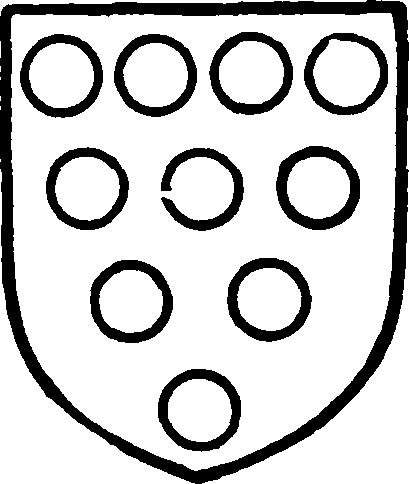
Zouche. Azure bezanty.
Before 1273 the manor had been subinfeudated to George de Cantilupe, who died in that year. Half a fee in North Luffenham was assigned in 1276 to George's sister and co-heiress Milicent, wife of Eudo la Zouche of Haringworth, formerly married to John de Montalt. (fn. 32) Milicent, then widow of Eudo, in 1280 recovered the service of half a knight's fee in North Luffenham against Isabel, widow of James de Paunton, Roger Skerehare and eighteen others and sued them for their services. (fn. 33) Milicent was still alive in 1287. (fn. 34) In 1345 her grandson Thomas, younger son of William la Zouche of Haringworth, settled land here upon himself and his wife Christine and their issue, with remainder in default to Edmund brother of Thomas, and William la Zouche of Haringworth. (fn. 35) The rents from Luffenham had reverted before 1382 to the elder line of the Zouches, for in April of that year Sir William la Zouche died holding them of the Earl of Warwick. (fn. 36) His son and successor William died in May 1396, (fn. 37) holding rents from North Luffenham, and in November of that year his son William conveyed the manor of Luffenham to trustees to fulfil his will. (fn. 38) Two years later John la Zouche, brother of William, conveyed the manor to the same trustees, (fn. 39) evidently for a similar purpose, for in 1415 William la Zouche died seised of land and tenements in North Luffenham held of the Earl of Warwick as of the manor of Barrowden. (fn. 40) This estate was assigned to his widow Elizabeth, who died in 1425, when it passed to her son Sir William la Zouche. (fn. 41) John la Zouche, grandson of this William, was with Richard III at Bosworth and was attainted and forfeited his honours. He was restored, however, in 1495 and died in 1526. (fn. 42) His heirs were still, in 1536, receiving a rent of 3½d. from land in North Luffenham recently held by the Hospital of All Saints in Stamford (co. Linc.), (fn. 43) but the manor of North Luffenham was conveyed in 1538 by Anthony Cope and Joan his wife to John Harington. (fn. 44) Harington was knighted in 1536 and died in 1553, when it passed to James, his son. (fn. 45) James was succeeded in 1592 by his son Sir John, (fn. 46) who with his wife Anne sold North Luffenham manor in 1599 to James Digby, son of Roger Digby. (fn. 47) James Digby, whose name is on the tenor bell (1619) at North Luffenham, (fn. 48) married Katherine, daughter of Kenelm Digby, of Stoke Dry, by whom he had a son John. (fn. 49) James Digby and his son John were recusants. As they did not attend any church or usual place of common prayer and failed to pay the fine of £20 a month for their recusancy, two-thirds of all their lands were seized. It was found by an inquisition taken in 1627 that they had a capital messuage and 87 acres in North Luffenham in the occupation of James. In 1634 two-thirds were leased for 41 years to Sir Lewis Watson, bart. (fn. 50) An extent of John Digby's land was again made in 1640, (fn. 51) no doubt on account of his continued recusancy. James Digby, son of John, who also was a recusant, settled North Luffenham manor in the early part of 1652, (fn. 52) and died shortly afterwards. He had, before his death, arranged for portions from his estates to be paid to his daughter and to his sisters Katherine and Dorothy, and their claims were allowed by the Committee for Compounding. (fn. 53) James Digby, his son, begged to contract on the Recusants Act for the sequestered two-thirds of his estates. (fn. 54) James died unmarried, and his brother John settled the manor in 1686. (fn. 55) John, who was buried at North Luffenham in 1705, was succeeded by Simon Digby (d. 1729). In 1726 Kenelm Digby his son was in possession of the manor. (fn. 56) He died in August 1743, when his son John, who had been baptised at North Luffenham, succeeded to this manor and married Deborah, daughter of John Fardell. John Digby died 19 May 1758, at the age of 31, and his widow in October 1771.
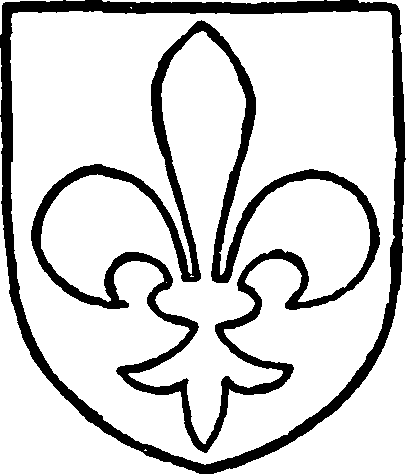
Digby. Azure a fleur de lis argent.
Before 1802 this manor had been acquired by Sir Gilbert Heathcote, (fn. 57) and it has since descended with Bassetts manor in this parish.
There was another manor in Luffenham known as BASSETTS MANOR, part, apparently, of the Lovet Fee, (fn. 58) the head of which was at Elmley Lovett (co. Worc.) and was held of the Earls of Warwick. (fn. 59) A third of a knight's fee was held in 1235–6 by Robert Lovet (Luvet), (fn. 60) who with his son Simon Lovet conveyed land here to Alan Bassett. Simon, for some legal technicality, perhaps, granted his interest to William Mauduit, the chamberlain, his chief lord. (fn. 61) Half a knight's fee was still held in 1276 by the heirs of Philip Lovet, possibly son of Simon Lovet, and Simon le Clerk. (fn. 62) These heirs may have been Sybil Lovet and her sister Joan, who in 1287–8 released to Milicent de Montalt their claims to land in Luffenham which had been held by Simon Lovet. (fn. 63)
There were so many branches of the Bassett family at this time whose members bore the same Christian names that it is difficult to get a connected descent of Bassetts Manor. Alan Bassett seems to have married twice and the Luffenham property went to the sons of one wife while the Bisbrooke (q.v.) estates went to his daughters by Amis de Foxton, another wife.
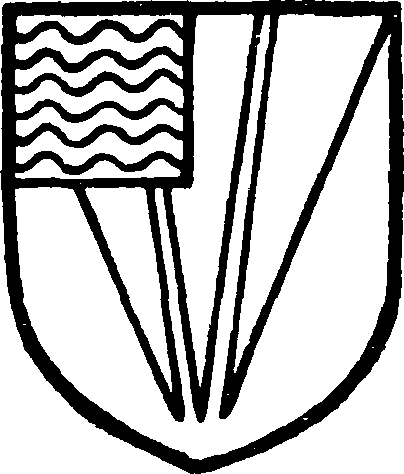
Bassett of North Luffenham. Or three piles gules and a quarter argent with three bars wavy azure therein.
Alan Bassett was keeper of the king's escheats in 1232 (fn. 64) and escheator for Rutland in 1246. (fn. 65) He was succeeded by a son Richard, (fn. 66) who was dead before 1263, when Alan's sons, John and Gilbert Bassett, released to William, son of Richard Bassett, two parts of a messuage and two carucates of land in North Luffenham of the inheritance of Alan their father. (fn. 67) In 1305 and 1315 John Bassett held a fortieth part of a knight's fee in North Luffenham. (fn. 68) It was probably this same John who testified to the coming of age of Giles son of Bartholomew de Badlesmere in 1335. He was then 50 years of age, and had a son of the same age as Giles. (fn. 69) He was appointed in 1307 and 1313 to collect a twentieth and a fifteenth in Rutland, and served on various commissions and offices mostly relating to Rutland. (fn. 70) In 1313 John and Peter Bassett were accused of assaulting Robert de Glaston at North Luffenham. (fn. 71) These may be the John and Peter Bassett who were tenants of Thomas la Zouche at North Luffenham in 1345 and perhaps sons of John. (fn. 72) The fee was returned in 1402 and 1406 as held by the heir of John Bassett, (fn. 73) and in 1428 it is returned as late in the possession of Peter Bassett. (fn. 74) The name of John Bassett of North Luffenham occurs in the list of the gentry of Rutland in 1434, who swore not to maintain peace breakers. (fn. 75) John Bassett was lord of this manor in 1498. (fn. 76) He left a son Nicholas, who married Katherine daughter of Lawrence Awnell. (fn. 77) By an undated complaint before the Star Chamber in the time of Henry VIII Anthony Bassett of North Luffenham accused Simon Digby and others of assaulting him in the house of William Islip of North Luffenham. (fn. 78) Thomas, son of Nicholas Bassett, died in 1532 holding the manor of North Luffenham which had been settled on him and his wife Elizabeth, daughter of William Bewfo, (fn. 79) in 1525. He also held land and a water mill in South Luffenham, and a horse mill in North Luffenham. His son Edward, then aged 24, who succeeded him, (fn. 80) died childless in 1534, and John his brother succeeded to the manor. (fn. 81) John married Anne, daughter of Thomas Rouse of Rowslinch (co. Worc.), (fn. 82) and in 1545 he and his wife conveyed a water mill and land in North and South Luffenham to John Wymark. (fn. 83) In 1569 the manor was settled on John and Anne in tail male. (fn. 84) John died in 1575, (fn. 85) and in 1585 Anne and her son John conveyed the manor for the purpose of settlement to Edmund Rouse. (fn. 86) John Bassett had a large family of children by his wife Elizabeth Lyon. (fn. 87) He was succeeded in 1626 by his eldest son John, (fn. 88) who with his wife Anne sold the manor in 1628 to John Exton, (fn. 89) and in 1636 John Exton, Thomasina his wife and Bridget Exton, widow, sold it to Edward Viscount Campden. (fn. 90)
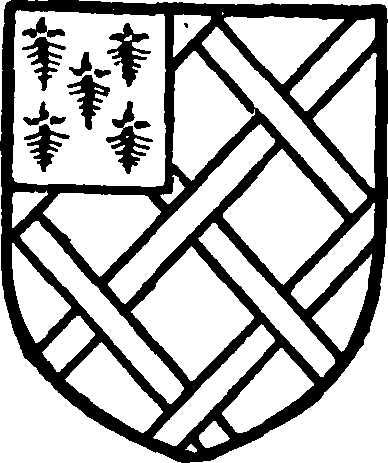
Noel. Or fretty gules with a quarter ermine.
Viscount Campden gave North Luffenham to his younger son Henry Noel, who made North Luffenham Manor his residence. In February 1643 the house was besieged by Parliamentary forces under the command of Thomas Lord Grey, son of Henry Earl of Stamford. Before commencing hostilities Lord Grey twice appealed to Henry Noel to surrender, but the terms were such that he could not accept and he refused. With only 200 men, friends and neighbours, illarmed, Noel had no chance against the 1,300 besiegers, and after holding out some twenty-four hours he surrendered. Terms were agreed upon which were not kept. Lord Grey's followers entered and pillaged the house and some ten dwelling houses of Noel's tenants and neighbours were burnt down and the inhabitants of North Luffenham village plundered of their goods and all their horses. The marauders next turned their attention to the church, where they defaced the monument to Noel's first wife and did considerable damage to the old stained-glass windows. The brass plate with the memorial inscription to Robert Johnson did not escape their notice: to-day it bears marks of their violence. Lord Grey appears to have had little control over his followers: it was only with great difficulty that he saved the lives of Henry Noel and his kinsman, Mr. Henry Skipwith, whom he took with him to Northampton. They were afterwards sent to London. In a petition (fn. 91) to the House of Lords Noel set forth the circumstances of the attack upon his house and complained of the damages which he had suffered. He died in July of the same year, apparently in London. By an order of the House of Lords of 19 July a pass was granted for the carrying down of his body to Campden (fn. 92) (co. Glouc.), where he was buried.
His widow Mary married Sir William Farmer of Easton Neston (co. Northants), and continued to live at Luffenham Hall. (fn. 93)
Luffenham manor passed to a nephew and namesake of Henry Noel, son of his brother Baptist, third Viscount Campden. He was M.P. for Stamford and resided at Luffenham Hall. He left an only child, Juliana, and Luffenham manor passed to his halfbrother Baptist Noel. Baptist was in residence at North Luffenham in 1688 when a letter from the Earl of Peterborough, Lord Lieutenant of the county, sounding him as to his political views, was addressed to him there. (fn. 94) Baptist, son of Baptist, succeeded as third Earl of Gainsborough in 1690. He settled the manor in 1706 and 1711, (fn. 95) and died in 1714. (fn. 96) His son Baptist the fourth earl sold North Luffenham manor in 1729 to William Burton. (fn. 97) In 1764 William Burton, Bartholomew Burton and others conveyed it to Sir Gilbert Heathcote, bart., as the manor of North Luffenham called Bassetts Manor. (fn. 98) It has since descended with the manors of Normanton and Empingham (q.v.) (fn. 99) to the Earl of Ancaster, who is the present lord.
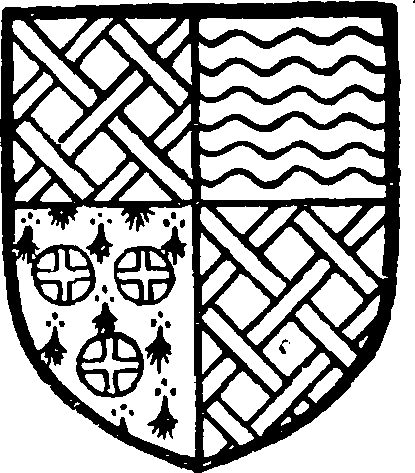
Heathcote-Drummond - Willoughby, Earl of Ancaster. Or fretty azure, for Willoughby, quartering or three bars wavy gules, for Drummond, and ermine three roundels vert each charged with a cross or, for Heathcote.
Before 1223 the prior and convent of Fineshade (co. Northants) had acquired an estate in North Luffenham, which the Pope confirmed at that date. (fn. 100) In a 15th-century terrier the land of Fineshade priory is described as lying in Lee Estfeld and Lee Upfeld. (fn. 101) Shortly before the Dissolution William Pyckwell was the tenant. The prior leased the property in 1536 to John Wymarke, and the Crown granted a similar lease probably in reversion to John Moreton or Monton. (fn. 102) According to a survey of the time of Edward VI, these lands were in lease by John Wymarke, who wished to buy the estate. (fn. 103) John Monton was lessee until 1563, when Richard Hodgson had a lease which terminated four years later and George Tyrrell appears as lessee in 1569. The Fineshade property then became annexed to the advowson and was granted with it in 1588 to Richard Braithwaite of London and Roger Bromley of Bagworth Park (co. Leic.), who conveyed them two days later to William Romney, citizen and haberdasher of London. (fn. 104) Romney was knighted in 1603 and was Governor of the East India Company in 1606–7. (fn. 105) His wife Rebecca, daughter of Robert Taylor and Elizabeth daughter of Hugh Hutton, was half-sister of Robert Johnson's first wife, Susanna Davers. In 1591 Romney conveyed the Fineshade lands to Robert Johnson, (fn. 106) rector of North Luffenham. Robert's eldest grandson, Isaac Johnson, who, there is good reason to think, was brought up by his grandfather at North Luffenham, was one of the founders of Boston, Massachusetts. He and his wife, the Lady Arabella Fynes, accompanied Winthrop in the expedition to Massachusetts in April 1630. The Lady Arabella died within a few weeks of their arrival in America, and Isaac Johnson died in the following October. His name appears as one of the donors on the tenor bell (1619) at North Luffenham. The Fineshade property was sold by Abraham, son of Robert Johnson, to Samuel Barker of South Luffenham. It passed to Jonathan, John, Bridget and Dorothy Barker, four of the children of Samuel Barker of South Luffenham, who died in 1658. The brothers and sisters lived at North Luffenham Manor House, built in 1640. (fn. 107) Jonathan and John Barker died in 1668 and 1675 respectively and Bridget in 1687. Dorothy Barker married Wellesbourne Sill in 1688 and died in 1711. She left a rent from 'Fincet Lands,' to trustees for the foundation of a charity at North Luffenham after the death of her husband, which occurred in 1725. (fn. 108) The charity was established by deed dated 1710. (fn. 109)
The priors of Brooke (co. Rutl.) held land and had a manorial court at North Luffenham as early as 1246. (fn. 110) Their property here was granted to Anthony Cope in 1536 and afterwards to the Noel family, when it became merged in Bassetts manor.
Church
The church of ST. JOHN THE BAPTIST consists of chancel 47 ft. 6 in. by 18 ft., clearstoried nave of four bays 51 ft. 4 in. by 19 ft., north and south aisles 7 ft. wide, north and south porches, and engaged west tower 11 ft. square, all these measurements being internal. The tower is surmounted by a broach spire. The width across nave and aisles is 37 ft. 9 in., and the total internal length of the church about 116 ft.
The building is of rubble throughout, with lowpitched leaded roofs to nave and aisles behind battlemented parapets. The chancel has a modern highpitched stone-slated roof with tabled gutters, and the south porch is also covered with stone slates. The north porch is leaded and has a straight parapet. The aisles extend to the west face of the tower, and are under continuous lean-to roofs.
There were frequent complaints of the decayed and uncared-for state of the fabric between the years 1581 and 1624 during the incumbency of Archdeacon Johnson, and the furniture was apparently in no better condition. (fn. 111) In 1817 the church was reseated with box pews, which remained, together with a west gallery, until the restoration of the building more than fifty years later, under the direction of George Edmund Street. The chancel was restored and newly roofed in 1870–1, (fn. 112) the nave in 1874–5. (fn. 113) In the course of these restorations the plaster was stripped from the walls throughout. (fn. 114)
The building dates in the main from the 13th and 14th centuries, but has developed from a 12thcentury fabric with an aisleless nave, the north-west angle of which remains, now within the western part of the north aisle immediately adjoining the east side of the north tower arch: this portion of walling slopes back at a considerable height above the floor and has a hatched and billet-moulded string.
The 12th-century church was enlarged about 1200–20 by the addition of a north aisle, the arcade of which, consisting of four pointed arches on cylindrical pillars and half-round responds, still remains. The arches are of two chamfered orders, with hood-moulds on each side, and the pillars and responds have circular water-holding bases of two types, on octagonal plinths, except that of the middle pillar, which is square. This pillar has a circular moulded capital, but all the other capitals have early conventional stiff-leaf foliage and octagonal abaci. The hood-moulds have head and notch stops.
In the latter half of the 13th century a south aisle was added, and the existing arcade of four pointed arches is of this period. The arches are of two orders, with hood-mould on the nave side only, the outer order chamfered and the inner order with a large half-round filleted soffit moulding. (fn. 115) The cylindrical pillars have moulded bases on circular plinths, and the capital of the middle pier is also moulded; the other pillars have beautiful foliated capitals in which the leaves alternately rise up and fall over. The responds are composed of clustered shafts with moulded capitals and bases.
The tower was probably erected at the same time as the south aisle or shortly after, both aisles extended westward and the north aisle apparently rebuilt its whole length, the same keel-shaped string running round the whole building west of the chancel. The buttresses have plain triangular heads with fleur-delys terminations. All this work, including the porches, is of late 13th-century date, but may have extended over a number of years. The most western window in the south aisle is of two lights with forked mullion and the corresponding one on the north side is like it, but modern. The north porch has been rebuilt and the doorway very much restored. The other windows of the aisles are later insertions.
The north doorway has a pointed arch of two orders, the inner continuous with two hollows, the outer with a keel-shaped edge-roll on jambshafts with moulded capitals and bases. In the south doorway the moulded outer order springs from clustered jambshafts with circular moulded capitals and bases, while the inner order is chamfered with modern trefoil head. The outer doorway of the south porch has a pointed arch of two chamfered orders, the inner on half-round responds with moulded capitals and bases. In the rebuilt north porch the outer order is moulded on jambshafts with moulded capitals and bases.
The tower is of three (fn. 116) stages, with a projecting vice in the north-west angle, and a tall lancet window in the west wall. At the upper part of the middle stage, on three sides, are tall loops and the bellchamber windows are of two plain pointed lights with cusped circle (fn. 117) in the head. The octagonal broach spire rises from a corbel table of masks and notch heads and has three tiers of gabled openings, (fn. 118) the lower being of two lancet-lights with lozenge in the head and mid-shaft with moulded capitals. The angles of the spire are plain. Internally the tower opens into the nave by a sharply pointed arch of three (fn. 119) chamfered orders with hood-mould, the inner order on half-octagonal responds with moulded capitals and bases and into the aisles by similar but less lofty arches. On the east face of the tower is the tabling of the original high-pitched roof. (fn. 120)
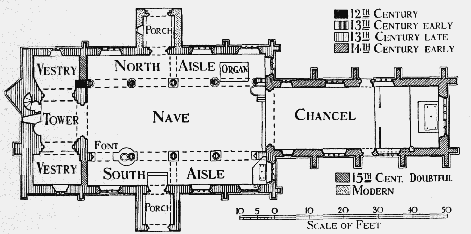
Plan of North Luffenham Church
Early in the 14th century (fn. 121) the chancel was rebuilt on its present plan and new windows were inserted in the aisles. Of these the two east windows are pointed, that in the north aisle being of three trefoiled lights with reticulated tracery, the other of three cinquefoiled lights with curvilinear tracery. (fn. 122) The lateral windows are square-headed and of three trefoiled lights, the hood-moulds having head-stops. At the east end of the south aisle, where the chapel of Our Lady was situate, is a 14th-century trefoil-headed piscina, the bowl of which has been restored, (fn. 123) and high in the east wall an image bracket supported by a head. In the north aisle there is a modern floor drain and a bracket on each side of the east window.
The chancel is of four bays marked externally by large two-stage buttresses and with pairs of buttresses at its eastern angles. It has a moulded base and string at sill level, about 8 ft. above the ground. The hollow eaves moulding is enriched with ball-flower. The large five-light (fn. 124) east window has a flat two centred head and elongated quatrefoil tracery, but is almost wholly restored. The easternmost bay is blank on both sides, but the others are pierced by windows of three and four lights, varying in size and character, and in the westernmost bay on each side, near the bottom of the wall, is a small low-side window, that on the south side pointed and of a single light, the other square headed and of two plain lights. (fn. 125) There are also north and south doorways in the second bay from the east, both of which are wholly restored or modern. On the south wall the windows are all pointed, the two easternmost of four trefoiled lights with geometrical tracery, the smaller window in the west bay being of three cinquefoiled lights, with depressed two-centred arch and tracery of more curvilinear character. On the north wall the tall easternmost window has a segmental head and is of three lights, the outer cinquefoiled and the middle one uncusped with a quatrefoiled circle above. Next to it is a tall traceried window of three trefoiled lights and in the westernmost bay a taller and more sharply pointed window of four lights, the tracery of which consists of a large trefoil within a triangle. All these windows have hood-moulds with head-stops.
Internally the chancel has a keel-shaped string at sill level all round, and with one exception all the windows have chamfered rear arches; the south-west window has a moulded head and hood with small head-stops. (fn. 126) The piscina has a square inner recess under a pointed cinquefoiled head with blind tracery and hood-mould, but the bowl is modern. West of this are two sedilia, with wide trefoiled arches within a square frame, and big enclosing hood-mould with head-stops; the hollow mouldings of the arches, frame and hood are enriched with ball-flower and the whole is set in front of a shallow arched recess below the easternmost window. The lofty 14th-century arch between the chancel and nave is of two chamfered orders with hood-mould on each side, the inner order on half-round responds with octagonal moulded capitals and circular moulded bases. (fn. 127)
In the 15th century the present nave clearstory (fn. 128) was erected and a roodscreen probably first introduced. The screen was removed in 1874, (fn. 129) but a blocked opening at the east end of the north arcade apparently led to the rood-loft stair, and there was also access to the loft from the aisle on the south side of the chancel arch. The four-centred clearstory windows, four on each side, are of two trefoiled lights with lozenge-shaped opening in the head and returned hood-mould. The 15th-century nave roof, though much restored, retains a good deal of original work, and is of four bays with moulded principals and wall pieces resting on corbels. Each bay has an intermediate piece supported by a carved oak angel, at the intersections of which with the ridge and purlins there are carved bosses. The aisle roofs are also much restored, but the bosses appear to be old.
It was perhaps at this time that the west bay of each aisle was screened off by a stone wall, flush with the east face of the tower. High up in each of these walls is a quatrefoil opening, now blocked, widely splayed on the west side. At a later period the south arch of the tower was blocked with masonry to form a vestry, (fn. 130) but the blocking has been removed and a wooden screen erected. The choir vestry north of the tower is also screened off.
The font has a plain octagonal bowl, moulded on the lower edge; it is probably of 14th-century date, but is mounted on a modern stem.
The 17th-century oak pulpit was altered at the time of the restoration and now stands on a modern stone base; it forms six sides of an octagon and has two tiers of arched panels. A Jacobean altar table is now in use at the east end of the south aisle.
Before the restoration the east window contained a considerable amount of early 14th-century glass, placed there by John de Mollesworth, rector (1284– 1329), (fn. 131) but this is now in the middle window on the north side of the chancel and in the middle light of the easternmost window. The middle window contains nine shields placed in three tiers, and beneath the upper tier are canopied figures of St. Mary Magdalene, St. Barbara and St. Edward the Confessor. (fn. 132) The other window contains heraldic glass only. (fn. 133)
There are considerable remains of decorative painting on the arches of the south arcade, the inner and outer orders having respectively radiating bands and six-petal flowers and the soffits red scroll-work. The plastered spandrels are painted with double masonry lines.
In the chancel is a brass chandelier of twelve branches, the gift of John Digby (d. 1758), and in the nave is a dug-out chest with three locks. A barrelorgan case converted into a cupboard, now in the vestry, is inscribed 'O sing praises, sing praises unto our God.'
The inscription on the brass plate in memory of Archdeacon Johnson (d. 1625), founder of Oakham and Uppingham Schools, which is now fixed at the back of one of the sedilia, has already been given. (fn. 134) There are also memorials in the chancel to Mrs. Susanna Noel (fn. 135) (d. 1640) with bust, Samuel Winter, D.D. (d. 1666); Colonel Henry Markham (d. 1672), John Digby (1758), and William Hardyman, rector (d. 1837), and in the aisles to Simon Digby (d. 1582), Jonathan and John Barker, 'two loving brothers' (d. 1668 and 1675), and to fourteen men of the parish who fell in the war of 1914–19.
There is a ring of five bells, the first by Thomas Norris, of Stamford, 1630, the second a medieval bell with imperfect inscription, the third by Tobie Norris I, of Stamford, 1618, the fourth by Thomas Eayre of Kettering, 1742, and the tenor by Henry Oldfield, of Nottingham, 1619. There is also a small clock bell without date or inscription. (fn. 136)
The plate consists of a cup of 1703, a small paten of 1637, a large paten given by Bridget Barker in 1687, and a flagon of 1679, with the arms of Richard Clerk, rector 1641–76. (fn. 137)
The registers before 1812 are as follows: (i) baptisms 1572–1747, marriages and burials 1565–1749; (ii) baptisms 1748–1812, marriages 1749–1832, burials 1748–1812; (iii) marriages 1754–1800; (iv) marriages Nov. 1800–1812. (fn. 138)
The CHAPEL OF OUR LADY, which with its burial ground formerly belonged to the Gild of Our Lady of North Luffenham and in which the village school was kept, stood a short distance to the southeast of the chancel of the church. In 1335 John de Wyke, parson of North Luffenham, obtained licence in mortmain to acquire land and rent worth 5 marks a year, to find a chaplain to celebrate divine service daily in the chapel of St. Mary the Virgin in North Luffenham. (fn. 139) The property of the chantry was in 1567 granted to Robert Holmes and Thomas Boughton. (fn. 140) The chapel was later purchased by the Digby family, who used it as a burial place, but it was demolished by the Heathcotes, part of the material being used to build a small garden house, now in the grounds of North Luffenham Hall, (fn. 141) and part going to the building of a school in the village, afterwards used as a reading room. (fn. 142)
Advowson
The advowson of the church of North Luffenham was held with Oakham Castle, (fn. 143) and passed into the hands of the king on the attainder of the Duke of Buckingham in 1521. (fn. 144) The advowson was granted in 1588 to Richard Braithwaite and Roger Bromley and by them sold two days later to William Romney of London, together with the land belonging to Fineshade Priory. (fn. 145) In July 1591 Romney conveyed the advowson to Emmanuel College, Cambridge, having, as appears above, sold the priory land shortly before to Robert Johnson, the incumbent of North Luffenham. Johnson was under the impression that the advowson had passed to him with the land. (fn. 146) On the day of Johnson's death in 1625 Henry Mackworth and Isaac Johnson presented Jonathan Tooky to the church. The college took no action at this date, but on the next vacancy in 1640 they presented, and their right was not then or thereafter challenged. (fn. 147)
In 1566 an inquiry was held as to concealed lands in North and South Luffenham for maintaining a chantry and a lamp in the parish church of Luffenham. (fn. 148)
In 1821 a dwelling-house in the occupation of Robert Barfield was licensed for dissenting meetings. This is said to be the beginning of organised dissent in North Luffenham. (fn. 149)
Charities
Town Lands. This charity is comprised in the following indentures of feoffment dated 3 September 30 Henry VIII, 12 August 13 Elizabeth, 26 January 1656, 13 October 1688, and indentures of lease and release, the release dated 4 July 1789. The indenture of feoffment dated 13 October 1688 is the first deed to set out the trusts of this charity, and it directs that the several properties shall be used to and for the use of the church and poor of North Luffenham and the schoolhouse for the benefit of the town. The charity is regulated by a scheme of the Charity Commissioners dated 15 July 1890. The endowment now consists of several pieces of land, farm house, shop and tenements containing in all approximately 101 acres all of which are let at an annual rent of £140, and £143 18s. 7d. 3½ per cent. Conversion Stock and £264 9s. 6d. 5 per cent. Conversion Stock with the Official Trustees producing in dividends £36 10s. per annum. The net income is applied as to one-fourth to the churchwardens for repairs of church, one-fourth in school prizes, and one-half is paid into coal and clothing clubs.
Wellesbourn Sill and Dorothy his wife by indenture dated 9 April 1710 conveyed certain lands in Luffenham to the intent that after their decease the lands should be charged with a sum of £5 per annum to be disposed of as follows:—30s. to the rector of North Luffenham for preaching three sermons on Mondays after Christmas Day, Easter Day and Whit Sunday, 30s. to be distributed among the poor widows and maids upon those days, and 40s. to be laid out in flannel for poor widows and maids. The charge issues out of the Fincett Lands and is applied by the rector in the manner directed, about four recipients participating in the gift of money and flannel.