
A History of the County of Rutland: Volume 2. Originally published by Victoria County History, London, 1935.
This free content was digitised by double rekeying. All rights reserved.
'Parishes: South Luffenham', in A History of the County of Rutland: Volume 2, (London, 1935) pp. 203-207. British History Online https://www.british-history.ac.uk/vch/rutland/vol2/pp203-207 [accessed 26 April 2024]
In this section
SOUTH LUFFENHAM
Luffeham (xii cent.); Southluffenham, Lufham (xiii cent.); South Lufnam, South Lefenham (xiv cent.).
South Luffenham covers an area of 1,442 acres of clay soil with stone and sand in places. About half of the land is arable and half pasture with about 38 acres of woodland. The River Chater forms the boundary between North and South Luffenham and a tributary of it flows in a north-easterly direction through the village. The London Midland and Scottish Railway passes through the parish with a station at the junction of the Peterborough and Leicester lines.
The village lies on the north side of the road from Uppingham to Stamford. It is divided into two parts by a tributary of the River Chater where a pleasant belt of meadow and trees adds to the picturesqueness of the site. The part of the village on the south-east side of the stream has the church and rectory, to the south-west of which is a good round dovecot of stone. South Luffenham Hall stands a short distance to the south-east of the church. It is a rectangular building of two principal stories above a high basement floor, with square-headed transomed windows of two lights, and stone-slated hipped roofs with widely projecting coved eaves and small wooden dormers. The longer sides face north and south, the latter being faced with ashlar, but elsewhere the walling is of coursed dressed stone, the angles are emphasised by quoins and the windows have moulded architraves. Externally, the building has much in common with Lyndon Hall (built 1665) and, like it, is a good example of the Jacobean-Classic overlap, dating probably from the latter part of the 17th century.
On the north-west side of the stream are cottages and the Boot and Shoe Inn, near to which there is a good view across the valley towards North Luffenham.
The old windmill south of the railway station has now only a stump remaining; a cornmill stands on the north side of the station. The mill of South Luffenham was claimed by the co-heirs of Alice de Bidun, (fn. 1) and was recovered from them by Robert Mauduit. (fn. 2) In 1544 John Tooky and his wife Cecily settled land, a watermill and a horsemill in South Luffenham, with remainder to Clement Tooky, Henry Tooky and Boniface Tooky in tail. (fn. 3) This mill still belonged to the Tooky family in 1709 when Noah Tooky and his wife Sarah conveyed it to Robert Meres. (fn. 4)
There are two old quarries in the south-western extremity of the parish, where it borders on Morcott village. The eastern side of the parish, where the land rises to 300 ft., is occupied by South Luffenham Heath, rough pasture land with a small wood on its western edge. There is now a golf course on the heath.
Robert Scott, the lexicographer who, with Dr. Liddell, compiled the great Greek-English Lexicon, was rector of South Luffenham 1850–54. In the latter year he was elected Master of Balliol.
Place-names occurring in the records are Ashclose, Todley Close, Folleys Close, Penn Close, Dovesetts Close, (fn. 5) and certain commons called 'Millhomes' and lands called Church Hedland are mentioned in 1633. (fn. 6)
Manor
In 1086 South Luffenham formed part of the king's manor of Barrowden. (fn. 7) It was granted with that manor to Michael de Hanslope, (fn. 8) and passed, in the same way as Barrowden, to the Earls of Warwick. There are a number of undated grants of land in South Luffenham made by various tenants there to Robert Mauduit, the Chamberlain. (fn. 9)
In 1283 William de Beauchamp, Earl of Warwick, obtained a grant of free warren in South Luffenham, (fn. 10) and at the time of his death he was receiving rents from various free tenants, most of them holding one bovate of land. (fn. 11)
An estate in South Luffenham, which afterwards became the manor, was held of the hundred of Wrandike, (fn. 12) by the Greenham family of Ketton.
In 1254 Richard de Pilton, at the request of Roger de Suwicke and Beatrice his wife, granted to Ralph de Greenham and Mabel his wife and their issue a messuage, 2 bovates of land and a mill in Ketton and South Luffenham. (fn. 13) This probably comprised the manor which from this date followed the descent of Ketton (q.v.) until in 1496 Thomas Greenham, son of William Greenham (fn. 14) of Ketton, who was born at South Luffenham, conveyed a mill and land there and elsewhere to Sir John Digby, of Eye Kettleby (co. Leic.) and Henry Tooky. (fn. 15) Sir John had been knighted by Henry VII for his services at Bosworth and in 1513 he attended King Henry VIII to Calais. He served as Sheriff of Rutland, Warwick and Leicester. (fn. 16) In 1531 he settled the manor of South Luffenham on himself and his wife Sanchia with remainder to his second son Simon Digby and his wife Katherine Clapham. (fn. 17) Sir John died in May 1533 at Eye Kettleby, Sanchia having died earlier in the same month, (fn. 18) and Simon succeeded his parents in the manor. He died at North Luffenham in 1560 and Katherine at South Luffenham in 1558. (fn. 19) Their son Roger succeeded and settled the manor in 1561 on his wife Mary Cheney and his own heirs male. Roger was buried at North Luffenham in 1568, his son James being then a child of five. (fn. 20) South Luffenham was from that time held with North Luffenham by the Digbys. In 1627 a capital messuage here was in the tenure of James Digby, and the land was let to tenants. (fn. 21) This capital messuage, which was called the Hall, was in 1640 delivered by the sheriff to John Turner, in satisfaction of a debt due to him by John Digby. (fn. 22) From this time the records of South Luffenham, as a separate manor, cease, and the manor probably became attached to that of North Luffenham, and came into the possession of the Earls of Ancaster, the present Earl being lord of the manor and principal landowner.
Church
The church of ST. MARY consists of chancel 29 ft. 6 in. by 17 ft. 6 in. with south chapel 21 ft. 3 in. by 13 ft. 6 in., nave 37 ft. 8 in. by 18 ft., north and south aisles respectively 8 ft. 3 in. and 12 ft. wide, south porch, and west tower 9 ft. square, all these measurements being internal. The tower is surmounted by a spire. The width across nave and aisles is 43 ft. There are clearstories both to chancel and nave.
The tower is faced with ashlar, but elsewhere the building is of rubble. The chancel has a modern gabled stone-slated roof, but the low-pitched roofs of the nave and aisles are leaded. The porch is covered with stone slates. All the roofs are eaved. The chancel was restored about 1850, and in 1861 there was an extensive restoration of the whole of the fabric, under the direction of G. E. Street, when the plaster was stripped from the walls, the tower arch opened out, the chancel floor raised, and the fittings renewed. A narrow arch (fn. 23) was at this time cut through the wall at the east end of the south arcade, in which previously there had been a rood-loft staircase.
The original church was probably an aisleless building with small chancel, and was enlarged c. 1190–1200 by the addition of a north aisle of two bays, the arcade of which remains. The semicircular arches are of two orders with edge-rolls and flat soffits, and the hoods, which occur only on the side towards the nave, are enriched with billet moulding. The arches spring from half-round responds and a cylindrical dividing pillar, all with moulded bases on square plinths and carved capitals with divided square abaci. In the responds, the abaci are quirked and are without ornament, but that of the pillar is enriched with two lines of nail-head and the capital itself has a human head in each angle and facing east and west, (fn. 24) with large angle volutes terminating in incurved cones. The capital of the east respond has incurved volutes, but those of the west respond curve outwards: there is a head on one angle of the west capital only. The volutes in every case are enriched with nail-head, the use of which in the arcade marks its transitional character.
In the first half of the 13th century a south aisle was added, the existing arcade of two pointed arches being of that period. The arcade is set out approximately to correspond with that opposite, leaving about 8 ft. length of wall at the east end, which may mark an extension eastward of the nave at this time, when in all probability the chancel was rebuilt, though subsequently altered and enlarged. (fn. 25) The arches of the arcade are of two chamfered orders, with hood-mould on the nave side only, and spring from half-round responds and a cylindrical dividing pillar, all with circular water-holding bases and moulded capitals enriched with nail-head.
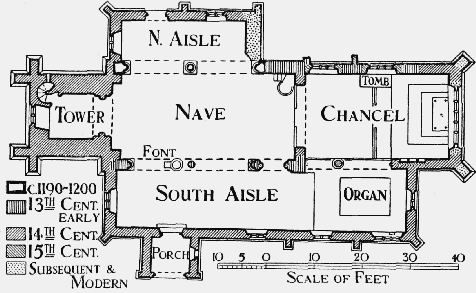
Plan of South Luffenham Church
In the 14th century the whole of the fabric was remodelled, and assumed in a great degree the character it has since retained. Both aisles were rebuilt, the south aisle widened and extended eastward to form a chapel covering the chancel, (fn. 26) the porch and tower were added, and the nave clearstory erected. The existing chancel arch of this period probably indicates a remodelling and lengthening of the chancel at the same time, but in the 15th century new windows were inserted and the walls heightened to provide a clearstory.
The north aisle, as rebuilt in the 14th century, appears to have extended eastward the full length of the nave, but at some subsequent time was shortened; (fn. 27) its east wall has been thickened on the inside and now stands in front of the arcade respond. (fn. 28)
The chancel has a modern east window of five lights with geometrical tracery, and in the north wall are two four-centred three-light windows, the mullions of which run up to the head. The east wall has been much restored and the diagonal buttresses rebuilt. The muchrestored triple sedilia are at one level, and have cinquefoiled ogee arches and hollow chamfered jambs and divisions; the piscina has not survived. On the south side the chancel is open in its western half to the chapel by a 14th-century arcade of two double chamfered pointed arches, respectively 9 ft. and 5 ft. in width, springing from an octagonal dividing pillar with moulded capital and base, and at the east end from a small half-round respond shaft with octagonal moulded capital and circular bases. On the west side the smaller arch springs from a moulded corbel supported by a grotesque head. The arches have hood-moulds on each side. The lofty chancel arch is of two orders, the outer with a continuous hollow chamfer, the inner with a large filleted round moulding dying into square jambs. Below the arch is the lower portion of a 15th-century screen, with moulded rail and four trefoiled panels on each side of the opening. The chancel clearstory has three four-centred windows on each side, without hood-moulds; a tall four-stage buttress in the north side is contemporary with the clearstory. Internally the south wall bears evidence of considerable structural alterations in the chancel. (fn. 29)
The aisles have chamfered plinths and keel-shaped strings at side level; the west window of the north aisle is pointed and of two trefoiled lights with a plain lozenge in the head, but the window in the north wall and all those in the south aisle and chapel are squareheaded and of one type: the easternmost window in the south wall, which lights the chapel, is of three trefoiled lights, the others of two, all having hoodmoulds with head-stops. The south doorway is of two continuous moulded orders with hood-mould; the north doorway has an outer wave-moulding and an inner hollow chamfered order, and above it is a small trefoil-headed niche with hood and finial. On the north side the hollow eaves table is enriched with small grotesque heads widely spaced. All this work is of the 14th century. There is no structural division between the chapel and the south aisle. In the usual position in the chapel is a plain squareheaded chamfered piscina, the fluted bowl of which has been cut away in front.
The porch has a pointed doorway of two continuous chamfered orders with hood-mould, and small trefoiled niche on either side of the arch: its south wall and gable are plastered, and a window in the east wall is blocked. The nave clearstory has three squareheaded windows of two trefoiled lights on each side, of similar character to those in the aisles. The roof is of a very plain description and of four bays, but the rounded corbels of the older roof, five on each side, remain at the level of the sills of the clearstory windows. The roofs of the aisles are much restored.
The tower is of three stages, with moulded plinth, pairs of buttresses at the angles and battlemented parapet. There is a vice in the north-west angle. The pointed west window is of two cinquefoiled lights with curvilinear tracery and hood-mould with good head-stops. In the middle stage on three sides is a tall pointed single-light transomed window, (fn. 30) above which, on the north and south, is a shield charged with a cross, and on the west a small cinquefoiled niche. In the upper stages the face of the tower is slightly recessed, with banded shafts in the angles, but the many-staged buttresses are taken up the full height. The pointed bell-chamber windows are transomed and of two trefoiled lights with quatrefoil in the head. Above the windows is a band of blind tracery and the parapet is carried on head corbels. The spire has crocketed angles and three tiers of gabled openings, the lower and topmost in the cardinal faces, the other alternating. The bottom openings are of two trefoiled lights, the others single, and the spire terminates in a large crocketed finial and cock vanes. Internally the tower opens into the nave by an arch of two chamfered orders, the inner on half-octagonal responds with moulded capitals and bases, and hood-mould with head-stops. The fourcentred doorway to the vice has a continuous wave moulding.
The 14th-century font has an octagonal bowl with quatrefoil panels on seven sides, on an octagonal stem and chamfered base. The stone pulpit dates from 1861.
On the north side of the chancel (fn. 31) is a 14th-century table tomb with panelled sides and effigy of a man in civil costume, the head resting on cushions below a canopy. The western panel contains a shield of the arms of Culpepper with a label of three points.
At the west end of the chapel is a floor slab to Rose Boswell, daughter of Edward Boswell, 'king of the gypsies,' who died in February 1794 near Fosters Bridge. (fn. 32) In the south aisle (fn. 33) are a number of mural tablets of the 18th and 19th century, and a memorial to five men of the parish who fell in the war of 1914–19. In the north aisle is an iron-bound dug-out chest with three locks.
There is a scratch dial on the south-east angle of the porch, above the buttress.
There are four bells in the tower, the first by Hugh Watts of Leicester, 1593, the second and third by Taylor of Loughborough, 1886, and the tenor a medieval bell with recurrent letter s (twice) alternately with a cross. (fn. 34)
The plate consists of a paten of 1637–8 with the maker's mark R.M., a cup and cover paten with the maker's mark only, R.L. twice, but apparently 17th century, and a flagon of 1683–4 inscribed 'The gift of Samuel Barker, Esqre of South Luffenham 1682' with maker's mark P.S. (fn. 35)
The registers before 1812 are as follows: (i) burials 1678–1734; (ii) baptisms and marriages (fn. 36) 1682–1734; (iii) baptisms 1735–71, marriages 1735–54, burials 1735–75; (iv) baptisms 1772–1812, burials 1776–1812; (v) marriages 1754–1812.
Advowson
The advowson of the church of South Luffenham was an appurtenance of the manor of Barrowden (fn. 37) and passed with that manor into the hands of Richard II on the forfeiture of Thomas, Earl of Warwick. (fn. 38) Subsequently the advowson followed the same descent as Barrowden (fn. 39) until the death of the Duke of Clarence in 1478. It then remained in the hands of the Crown until granted to Sir William Cecil, who presented in 1552. The Cecils, Lords Burghley and Earls of Exeter held the advowson until 1706, when a presentation to the church was made by Robert Meres (fn. 40) and by William Barker in 1721 and 1725. In 1726 William Barker and Charles Titley, clerk, and Eleanor his wife conveyed the advowson to Philip Dormer, Earl of Chesterfield. (fn. 41) In 1731 Joshua Cox presented (fn. 42) and in 1734 Joshua and his wife conveyed the advowson to Carteret Leathes, who presented in that year. (fn. 43) William Fancourt, clerk, and Arabella his wife conveyed the advowson in 1761 to Thomas Frewen, clerk. (fn. 44) John Bush presented in 1797 (fn. 45) and in 1802 William Baker and Mary his wife conveyed the advowson to James Bush, (fn. 46) who presented in 1828 and 1849, while John Bush presented in 1850. (fn. 47) William Baker was rector of South Luffenham (1797–1828). He inherited the property and papers of his grandfather Henry Baker, F.R.S. (1698–1774), founder of the Bakerian oration at the Royal Society. William's grandmother was Sarah, daughter of Daniel Defoe, and his father, Henry Baker, was an author. The advowson had been acquired by the Masters and Scholars of Balliol College, Oxford, by 1854 and they are still the owners of it. (fn. 48)
Charities
Barker's Dole is comprised in an indenture dated 1 October 1688, whereby a rent charge of 12s. issuing out of a cottage and lands in South Luffenham was granted to be distributed in doles among the poor. The rent charge issuing out of a field near the Half Way House is paid by the Rutland Brewery Company and is distributed among the poor by the rector and churchwardens.
Sapcote's Charity, founded by an indenture dated 6 June 1857, originally consisted of three almshouses and is now regulated by schemes of the Charity Commissioners dated 21 January 1898 and 26 April 1901. The almshouses are no longer used as such, but are let at an annual rent of about £15. The net income is distributed by two trustees appointed by the parish council in gifts of money to about twelve old people.
The Church Estate.—The origin of this charity is not known, but for many years the endowment consisted of land containing approximately 6 acres situated in South Luffenham and Barrowden. The land has been sold and the endowment is now represented by a sum of £158 14s. 1d. 5 per cent. War stock, with the Official Trustees, producing (1932) £7 18s. 8d. per annum in dividends. The income is paid over by the churchwardens to the church expenses fund.
The Bell Ringers Field Charity, which is referred to in a terrier dated 1749, is regulated by a scheme of the Charity Commissioners dated 18 October 1921. The endowment consists of a piece of land containing 1 acre and 6 poles let at an annual rent of £4. The net income is paid to the bellringer by the rector and two trustees appointed by the Parochial Church Council. There are two stories as to this charity, the one that a lady having lost her way on South Luffen ham Heath was guided home by the sound of the church bells. In gratitude she left an acre of land on the Morcott Road opposite Half Way House to provide a fee to the sexton to ring the bells at 5 a.m. and 8 p.m. daily from 19 October to 25 March. The custom, it was said, continued for a long time. (fn. 49) The other story is that in 1577 the rector and churchwardens were accused of selling the church bells. Their excuse was that they had the full number of bells, but that the great bell which had been cast anew had become the least, hence there was a saving of 40s. This sum was eventually applied to the purchase of a close and a house which it is thought is the origin of Bellringers Close in South Luffenham. (fn. 50) The latter story is borne out by the Archdeacon's visitation of 1577 and was testified by seven parishioners and the rector.