A History of the County of Northampton: Volume 3. Originally published by Victoria County History, London, 1930.
This free content was digitised by double rekeying. All rights reserved.
'The borough of Northampton: Introduction', in A History of the County of Northampton: Volume 3, ed. William Page (London, 1930), British History Online https://www.british-history.ac.uk/vch/northants/vol3/pp1-26 [accessed 30 April 2025].
'The borough of Northampton: Introduction', in A History of the County of Northampton: Volume 3. Edited by William Page (London, 1930), British History Online, accessed April 30, 2025, https://www.british-history.ac.uk/vch/northants/vol3/pp1-26.
"The borough of Northampton: Introduction". A History of the County of Northampton: Volume 3. Ed. William Page (London, 1930), British History Online. Web. 30 April 2025. https://www.british-history.ac.uk/vch/northants/vol3/pp1-26.
In this section
TOPOGRAPHY
THE BOROUGH OF NORTHAMPTON
Ham tune (x cent.); Nordhamtune, Northantone (xi cent.); Norhthamtune, Norhanthon, Norhantuna, Norhantona (xii cent.); Norhamptone (town seal) (xiii cent.).
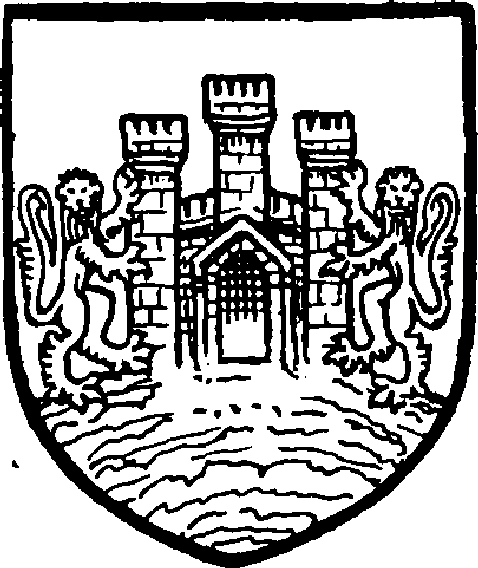
Borough of Northampton. Gules on a mount vert a castle with three towers supported by two leopards rampant or.
Northampton, the county town, lies mainly to the north and east of the River Nene, the oldest part of the town being on a hill which rises from 194 ft. above sea level at the west bridge near Castle station to 294 ft. at the prison near the site of the old north gate. The road from London and Old Stratford, joined south of the river by the road from Oxford and Towcester, runs due north through the town towards Market Harborough and Leicester, and is intersected at right angles in the middle of the town, at All Saints' Church, by the road from Daventry to Little Billing. From here also, roads run to Kettering and to Wellingborough, and it is in this direction that the chief expansion in the 19th and 20th centuries has taken place. West of the river lie the suburbs of Duston and Dallington, extending from the medieval suburb of St. James' End; to the south of the river, and west and east of the London Road lie the rapidly expanding suburbs of Far Cotton and Hardingstone, beyond the medieval suburb of St. Leonard's End. To the north, along the Market Harborough road, the municipality now includes Kingsthorpe, an independent royal manor in the Middle Ages, and outside the parliamentary boundary until 1918. The remains of the town fields are seen in the Race Course, once Northampton Heath, between the Kettering and Market Harborough roads, where the freemen had grazing rights down to 1882, and in Cow Meadow, Calvesholme and Midsummer Meadow, lying along the river to the south of the town.
The first plans for a railway, deposited in 1830, show the line passing through Ashton, Roade and Blisworth, avoiding Northampton. In 1831 the Corporation of Northampton, who owned an estate at Bugbrooke, took up the same attitude as other local landowners in opposing the project for a railway. Later, however, they were acting with a committee of inhabitants of the town in pressing for the line to be brought as near to Northampton as possible. Stephenson reported against the route through the town. The bill for the railway was thrown out in 1832, it was thought by the opposition of the landowners, but a subsequent bill received the Royal assent on 6 May 1833. The London Midland and Scottish Railway now runs from London through Northampton to Rugby and the north; lines run also to Leicester, Kettering, Peterborough, Market Harborough and Bedford. The station in Cotton End, known as Bridge Street, was opened in 1845, the Castle Station in 1859, the latter being enlarged in 1881 so as to become the chief station. The station in St. John's Street was opened in 1872. The Grand Junction Canal joins the Nene at Northampton, this branch having been completed in 1815. Tram lines were first laid down in the town in 1881 and were electrified in 1903. An early omnibus service was run to Wellingborough, and since 1919 motor omnibus services have run to the villages round the town and bring in thousands of both buyers and sellers to the market.
The earliest reference to Northampton in writing occurs in 914, and though the archæological evidence clearly indicates occupation of the castle site in the Romano-British and Anglo-Saxon periods, (fn. 1) no settlement of any importance seems to have existed at Northampton before the time of the Danish conquest. The Danes appear to have made it a centre for military and administrative purposes during the thirty years of their undisturbed occupation (877–912); by 918 (fn. 2) it had a jarl and an army dependent upon it, whose territory extended to the Welland. (fn. 3) Thus, after its reconquest by Edward in 918 it naturally became the centre of one of the new shires organised in the district recovered from the Danes, and in 940 it successfully resisted the invading forces of Anlaf Guthfrithson, the Danish ruler of Northumbria. (fn. 4) As in the case of other Danish towns, however, the military centre seems to have rapidly become a trading centre, for in 1010 it is described as a 'port,' and in spite of the burning in that year by Thorkil's Danes (fn. 5) and the ravages of Edwin's and Morcar's forces in 1065, (fn. 6) it possessed about 316 houses in 1086, and ranked between Warwick and Leicester in size. (fn. 7) It may have possessed three churches, for Anglo-Saxon sculptured stones have been found both at St. Sepulchre's and St. Peter's churches, (fn. 8) and the early reference to All Saints' fair (fn. 9) suggests that this church also may be pre-Norman.
In Domesday (fn. 10) Northampton has the marks of an old county borough. It is extra-hundredal, being rated in the Northants Geld Roll (fn. 11) at a quarter of a hundred. It is characterised by heterogeneity of tenure, containing 87 royal burgesses holding their burgages of the King, whilst some 219 other houses belong to 34 different lords. Of these lords, 24 hold other lands of the King in the county, and the 21 houses of Swain the son of Azur are explicitly said to pertain to his rural manor of Stoke Bruerne. To the old borough, which held 60 royal burgesses under Edward the Confessor, a new borough containing 40 royal burgesses had been added. Unlike the majority of county boroughs, Northampton appears to have no mint; (fn. 12) on the other hand, it is unique among Domesday boroughs in having its farm assessed at a fixed sum (£30 10s. 0d.), payable by the burgesses to the sheriff. There is mention of a 'Durandus prepositus,' (fn. 13) who may well have been the town reeve and have acted in this matter as the sheriff's subordinate. The 'portland' mentioned on folio 219b seems on a balance of evidence to belong rather to the carucated Stamford than to the hidated Northampton. (fn. 14) There is no mention of a castle; its creation was to be the work of the first Norman earl, and the Countess Judith, lady of 16 houses, had not yet given place to her daughter's husband. The other chief tenants were the Bishop of Coutances (23 houses), the Count of Mortain (37 houses), and William Peverel (32 houses). The 'waste' condition of 35½ houses is probably attributable to the raid of 1065.
With the Norman Conquest Northampton became a town of national importance. Its geographical situation, 'in the middle of the kingdom,' as Geoffrey le Scrope said in his opening speech at the Eyre of Northampton in 1329, (fn. 15) made it a valuable strategical point for a government which was determined to control the north and west as well as the south and east, and even before the line of Senlis earls had died out, the castle built by the first of them had been taken over as a royal residence and fortress. (fn. 16) The neighbourhood of the royal hunting lodges of Silverstone and Kings Cliffe and the royal palace of Geddington accounts, no doubt, for a large number of brief royal visits, (fn. 17) but its general convenience as a meeting place is attested by the number of political, social, ecclesiastical and military events that occurred here. Among the long series of councils and parliaments held at Northampton, from the time of Henry I to that of Richard II, may be mentioned the council of 1131, at which the barons of Henry I swore fealty to Maud; (fn. 18) that of 1164 at which Becket was condemned by the King's court and appealed to the Pope; (fn. 19) that of 1176, at which the assize of Northampton was published; (fn. 20) that of 1211, in which John and the Legate Pandulf had their famous debate; (fn. 21) that of 1232, in which the lands of the Earl of Chester were partitioned; (fn. 22) that of 1318, at which Edward II and Thomas of Lancaster came to terms for the time being; (fn. 23) the parliament of 1328, at which peace was made with Scotland and the statute of Northampton was passed; (fn. 24) and the parliament of 1380, at which the imposition of the Poll Tax was decided on. (fn. 25) The importance of the fairs of Northampton is noticed below, and the town was also a favourite centre for tournaments from the time of Henry III to Edward III. (fn. 26) Many church councils and chapters were held here, (fn. 27) and at least three crusades launched. In February 1214, according to the chronicle of St. Andrew's priory, 300 persons of both sexes took the cross here; (fn. 28) in November 1239, Richard of Cornwall and nobles too many to enumerate, swore on the altar of All Saints' that they would lead their troops that year to the Holy Land; (fn. 29) in June 1268 the two sons of Henry III, with 120 other knights and many others, took the cross at Northampton. (fn. 30)
To its geographical position is due the part played by Northampton in the various civil wars. It commanded one of the main roads from London to the North, and was a good base for movements against the west or south-west. In 1173 it was one of the strongholds that held out for Henry II, and next year William of Scotland made his submission there. (fn. 31) In 1215 the first move of the insurgent barons was to besiege Northampton, (fn. 32) and the castle was one of four which were to be given into their hands as a pledge for keeping Magna Carta. (fn. 33) It served as a base in the siege of Bedford in 1224. (fn. 34) Its pivotal position comes out most strikingly in the campaigns of 1264–6. The Royalist forces mustered by Henry at Oxford, at the end of March 1264, marched against Northampton, which was held by the younger Simon de Montfort and 'a great multitude' (fn. 35) of knights and squires. In the Cow Meadow adjoining the town William Marshall, keeper of the peace, and Walter Hyldeburn, assembled the community of the county and addressed them, on behalf of the Earl of Leicester, on the iniquities of the King's party. (fn. 36) The Prior of St. Andrew's, a Frenchman, whose priory occupied the north-west angle of the town fortifications, facilitated the entry of the King's troops through a breach in the garden wall, (fn. 37) and the town was taken and sacked ruthlessly by the Royalists, who, according to Wykes, reduced a most flourishing town to a most wretched state. (fn. 38) Fifty-five knights, including Sir Hugh Gobion and Sir Baldwin Wake, were taken prisoners (fn. 39) and sent to various castles for safe keeping, and at a later date to have been against the King at Northampton was the measure of a man's disloyalty. (fn. 40) The story of the King's threat to hang the students of the ephemeral university of Northampton (fn. 41) for their resistance to him occurs only in a 14th century chronicle. (fn. 42) The town was, however, deprived of its mayor and committed to the keeping of a royal custos, (fn. 43) Ralph de Hotot, who was to keep in touch with the constable of the castle. In the autumn that followed Lewes, when the King's government was controlled by Leicester, the levies were assembled at Northampton, (fn. 44) and a tournament was planned here by the younger de Montforts for Easter 1265, which was cancelled because of Gilbert de Clare's refusal to come. (fn. 45) Later, when the younger Simon was marching from the south to join his father in the west, he went out of his way to go through Northampton, counting, it would seem, on the warm support of the town. (fn. 46) Again, after Evesham, Henry and his son made Northampton the rendezvous for the troops going against the isle of Axholm, (fn. 47) and held a council here at Christmas, at which the younger Simon surrendered himself. (fn. 48) Northampton was also the King's headquarters from April to June 1266. (fn. 49) With the town held in turn by the rival parties, it is not surprising that the Jews took refuge in a body in the castle, (fn. 50) and that the priory suffered both from want and from failure to maintain order. (fn. 51)
Edward I made little use of Northampton as compared with his father, though four parliaments were held there by Edward II, and both parliaments and assemblies of merchants (fn. 52) by Edward III. The parliament of 1380, however, some of whose sessions were held in St. Andrew's Priory, (fn. 53) was the last to meet here, and in the 15th century Northampton ceases to be a centre of national importance. Its strategic significance was illustrated again in 1460. In June of that year Warwick had landed from France and been welcomed enthusiastically by London. The forces of Henry VI moved from Coventry and took up a position at Northampton to cut off London from the north. On July 10 they were routed by the forces of Warwick and March, marching from London through Towcester, in the meadows south-east of the town, between the river and Delapré Abbey. Henry VI was taken prisoner, and his queen fled to Scotland. We are told that the flight was watched by the Archbishop of Canterbury from the hill of the Headless Cross, which indicates that the Eleanor Cross on the London Road outside the abbey grounds had already had its top broken off. (fn. 54) Not till 1642 was Northampton to be as prominent again in national politics.
Between the record of Domesday Book and the first royal grant to the borough, almost exactly a hundred years elapsed. In 1185 the burgesses of Northampton made a fine of 200 marks to hold their town in chief, (fn. 55) and it is probably to this grant by Henry II that John's charter refers. (fn. 56) The constitutional history of the intervening period is largely conjectural, but for some of the time, at least, it must have been bound up with that of the earls of Northampton. (fn. 57) No earl is mentioned in Domesday; it is supposed that Simon de Senlis became earl after his marriage with Waltheof's daughter Maud about 1089, and died on his return from the Holy Land some time between 1111 and 1113. (fn. 58) He was the founder of the Cluniac priory of St. Andrew's, the builder of the first castle, the Norman churches of the Holy Sepulchre and All Saints, and, according to tradition, of the town wall. In 1113 his widow married David of Scotland, (fn. 59) who probably acted as guardian to his stepson, the second Simon, the founder of Delapré Abbey. By August 1138 Simon II had been rewarded with the earldom for his loyalty to Stephen, whom David was opposing. (fn. 60) In 1153, when Simon II died, his son, Simon III, the builder of St. Peter's Church, was under age, and he only held the earldom from 1159 to 1183 or 1184, when he died without heirs. (fn. 61) Various charters of the Senlis earls are preserved in the cartulary of St. Andrew's priory. One of the charters of Simon I is addressed to 'his reeve of Northampton,' and those of Simon II are addressed to 'his reeves and burgesses of Northampton and to all his ministers of Northampton.' (fn. 62) These formulae are lacking from the charters of Simon III. They indicate, as Dr. Tait has shown, (fn. 63) that for part of the 11th and 12th centuries Northampton was a mesne borough, dependent, like Leicester, upon its earl, and not directly upon the King. Granted by Rufus to Simon I with the earldom, the town was retained by Henry I on his death, and was being farmed by the Crown in 1130. (fn. 64) Stephen restored it to Simon II with the earldom, but Henry II resumed it in 1154, (fn. 65) and it was farmed by a royal official— from 1170 onwards, by the sheriff (fn. 66) —up to 1185. The death of Simon III may have made the King the readier to grant the burgesses' request in that year to farm the borough themselves, though the concession was terminable. This farm had risen from the £30 10s. 0d. of Domesday to £100 in 1130, and from 1185 onwards it was £120 down to the 15th century. (fn. 67) The right to pay the farm directly at the Exchequer logically involved the right to elect reeves or prepositos, and this right is expressly granted in the first charter extant, that of 18 November 1189, which is preserved in the town archives at Northampton. (fn. 68) From 1185 to 1197 the names of the two town reeves are to be found on the Pipe Roll; (fn. 69) after that year the formula runs 'the burgesses of Northampton,' giving no names.
Besides the grant of the firma burgi in fee-farm, which made the concession of Henry II a permanency, and the licence to choose their own reeve freely every year, the privileges granted to the burgesses of Northampton in 1189 included the ratification of established customs, the tenurial privileges of warranty of lands, freedom from scotale and such exactions, freedom from billeting; the jurisdictional privileges of freedom from external pleas, freedom from the duel, and preservation of established judicial customs, a weekly court of husting to be held in the town, and exemption from miskenning; also freedom from the murder fine and from arbitrary amercements; the commercial privileges of freedom from toll throughout England, and the right of retaliation on any borough which infringed this custom. The privileges granted to Northampton were explicitly modelled on those of London. It falls into that group of boroughs, others of which were Norwich, Lincoln and Oxford, which looked to London for forms and precedents, (fn. 70) and on several occasions it definitely and consciously copied London customs, (fn. 71) if in some other respects, as will be shown, it had affinities with its neighbour, the mesne borough of Leicester. The clause confirming ancient custom, grants to the burgesses 'all other liberties and free customs which our citizens of London have had or have . . . according to the liberties of the city of London and the laws of the borough of Northampton.' (fn. 72) This last phrase is almost certainly to be associated with the oldest town custumal, which, as Miss Bateson has shown, (fn. 73) belongs to much the same date as the charter of Richard I. The town custumals throw so much light on the constitutional history of the borough that it will be well to describe them here. The Liber Custumarum preserved at Northampton, and printed in the 'Records of the Borough,' is the last of four versions of the town customs. The two oldest are in Latin and are preserved in a 14th century manuscript in the Bodleian Library. (fn. 74) The first, containing 24 clauses, is headed by a list of the forty burgesses who authorised the custumal and swore to preserve it. (fn. 75) Nine of these appear on the Pipe Rolls as accounting for the farm of the borough between 1184 and 1196, and it seems certain that the custumal was drawn up in connection with the grant of the firma burgi, between 1185 and 1190. The second custumal, containing 42 clauses, is headed by a list of 24 burgesses, most of whom can be identified as having flourished 1228–1264. Two of the clauses of this custumal are dated and belong to 1251 and 1260; it may thus be assigned to round about 1260. The next version is French, and is in a manuscript now at the British Museum, (fn. 76) but belonging to the town of Northampton as late as 1769, and uniform in binding with the Liber Custumarum, still in the possession of the corporation. It contains 58 articles, the first 56 adapted from those of the two earlier custumals, the two last new. The latest is dated 7 October 1341. From this French version was made an English translation, seemingly about 1461, (fn. 77) supplemented by further regulations and ordinances, enrolled from time to time, as they were carried in the town assembly or council, the whole forming the Liber Custumarum, now preserved at Northampton, the latest entry in which is dated 11 October 1549. (fn. 78)
The first custumal (c. 1190) refers to bailiffs who take distresses on behalf of the King, (fn. 79) to reeves or prepositi who intervene with an apparently higher authority and can give a man entry, together with the bailiff, (fn. 80) and to the probi homines de placitis—the suitors of a court at which transfers of land take place for which the witness of these suitors is sufficient warrant. (fn. 81) There is no reference to a mayor; the reeves seem to be the highest officials. Nor is there any reference to a mayor in John's charter. Of this charter, granted to the town in April 1200, there are two versions differing from each other at the precise point where both differ from Richard's charter. This is with regard to the election of officials. The version on the charter roll (fn. 82) provides that two burgesses were to be elected by the common counsel of the vill and presented to the sheriff, who should select one of them and present him to the chief justice at Westminster at the time of rendering his account, to be prepositus of the town. The version of the Cartae Antiquae (fn. 83) provides that the two burgesses elected should be presented to the chief justice at Westminster and should serve as prepositi. Both versions say that the officials so elected should only be removable by the common counsel of the town, and provide also for the election of four coroners (fn. 84) to keep the pleas of the Crown and to see that the reeves treat rich and poor alike justly. There is some difficulty in deciding between the merits of the two charters. (fn. 85) On the whole, the version of the Cartae Antiquae seems the more likely to be correct. (fn. 86) Its form was followed by Henry the third's charter of 1227, (fn. 87) which merely adds that the two prepositi shall be presented to the chief justice by the letters patent of the vill, and this procedure was presumably followed down to the charter of 1299, though the early Exchequer rolls do not record the presentations.
The prepositi of 1227 are certainly the bailiffs of a later date; indeed, as early as 1222 the Exchequer addresses a writ to 'the mayor and bailiffs' of Northampton. (fn. 88) Two prepositi, as we have seen, appear on the Pipe Roll accounting for the farm as early in 1185. This is an additional reason for preferring the version of the Cartae Antiquae. Dr. Cox assigns the first mayor to the reign of Richard I, but there appears to be no evidence for the existence of a mayor, so-called, save the handwriting of certain undated deeds. (fn. 89) As late as 1212 John addressed to the reeve and good men of Northampton a command to lead the armed forces of the town, which is directed in the cases of London and Lincoln to the mayors of those cities. (fn. 90) But three years later an unequivocally dated document mentions what may well be the election of the first mayor of Northampton. On 17 February 1215 John, then at Silverstone, addressed a writ to his good men (probi homines) of Northampton: 'Know that we have received William Thilly to be your mayor. We therefore command you to be intendent to him as your mayor, and to cause to be elected twelve of the better and more discreet of your town to expedite with him your affairs in your town.' (fn. 91) From this date onwards commands directed to the mayor, coupled sometimes with the reeves or bailiffs and sometimes with the good men of the town, occur upon the Close and Patent Rolls, (fn. 92) though the reeves are addressed by themselves on matters connected with the Exchequer, (fn. 93) and under Henry III the title of bailiff soon displaces that of reeve altogether in the royal commands whether on judicial or on financial matters. (fn. 94)
William Tilly, the first mayor of Northampton, is also mentioned in a letter of Faukes de Bréauté to Hubert de Burgh, which must fall between 1215 and 1224. (fn. 95) He held land in Flore: (fn. 96) he, or a relation of the same name, is mentioned in the 1260 custumal as one of the burgesses appointed for levying a duty on the sale of cloths to foreign merchants, (fn. 97) and his name occurs in several early town deeds. (fn. 98) He probably held office for many years, as was usual among his successors in the 13th century. (fn. 99) The next mayors mentioned by name are Robert de Leycester, who occurs in a lawsuit in 1229, (fn. 100) and Robert le Especer, who accounts at the Exchequer in 1231. (fn. 101) Six other mayors are named, from 1249 to 1272, (fn. 102) and six from 1273 to 1299. (fn. 103) Under the charter of 1299, now preserved at Northampton, (fn. 104) the burgesses were to present the mayor-elect at the Exchequer every year within the octave of Michaelmas, that he might there take the oath pertaining to his office. From 1299 onwards the name of the mayor is enrolled on the Michaelmas Presentationes of the Memoranda Roll in the Exchequer, often accompanied by the names of the burgesses who signed the letters patent presenting him. (fn. 105) The same names recur from year to year, and are clearly those of the leading burgesses— the mayor's colleagues and councillors. In 1478 Edward IV granted by letters patent that the mayor might henceforth be sworn in before the town recorder at Northampton, without coming up to Westminster. (fn. 106) The re-election of the mayor, usual in the 14th century, was restricted in the 15th. In 1437, during the fourth mayoralty of John Sprygy, it was ordained that henceforth no mayor who had held office for a whole year should be re-elected till seven years had passed. (fn. 107) In 1558 the assembly confirmed this, adding that none should be chosen mayor oftener than thrice, (fn. 108) whilst in 1570 this was reduced to twice. (fn. 109) The election of the mayors, to be held before Michaelmas under the charter of 1299, took place about St. Matthew's Day (21 September) in the 14th century, (fn. 110) about St. Giles' Day (1 September) in the 16th, (fn. 111) and was directed in 1618 to be held within ten days of the first of August. (fn. 112) The mayor-elect was known as 'the mayor's joint' till Michaelmas, when he assumed office. (fn. 113)
The charters of 1200 and of 1227 had stated that the bailiffs, if well conducted, were only to be removable by the common council of the town. All the evidence indicates that they were elected annually and served for a year only, rarely being re-elected. They were the chief administrative officials, sharing the judicial duties of the mayor, (fn. 114) and acted within the borough as the sheriff did outside, with additional duties, as the custumals show, in connection with the industrial regulations. As the officials who executed the king's writs, before 1257 by custom and after 1257 by charter, they were the king's bailiffs and are sometimes so described. (fn. 115) They were personally responsible for the payment of the fee farm of the town at the Exchequer, and the office, like the sheriff's, thus entailed financial risks. 'Every year the men of the town who are bailiffs are impoverished and made beggars by reason of the aforesaid farm,' says the petition of 1334. (fn. 116)
The 13th century custumal refers to the mayor's clerk as issuing the mayor's summons, (fn. 117) but the earliest mention of a clerk by name is in connection with the records. Ralph Barun witnesses deeds as clerk under the first and third mayors, (fn. 118) and John, son of Eustace, who had the customs of Northampton recorded for the information of those who should come after, is described in this second custumal as clerk of Northampton, (fn. 119) and witnessed a deed as such in the mayoralty of John le Especer. (fn. 120) The town farm is occasionally paid in at the Exchequer by a clerk. (fn. 121) In the 14th century the town clerk is called the clericus memorandorum, (fn. 122) which indicates his duty of keeping the records of pleas and enrolments, and in 1419 John Lauendon is called the common clerk. (fn. 123)
The letters close of 17 February 1215 had commanded the 'good men' to elect twelve of their number to assist the mayor in the government of the town. This was not then a general custom in English boroughs, in spite of the statement in the Little Domesday of Ipswich regarding the election of 12 portmen there in 1200. But if the number of the mayor's advisers was twelve in the first half of the 13th century, by the second half we already seem to trace the Twenty Four who were sharing the work of government with him in the later middle ages. Leicester, which offers both parallels and contrasts to Northampton, had by 1225 set up its body of 24 sworn men or jurats who were bound to come at the summons of the alderman to give him help and counsel in the affairs of the town. (fn. 124) The second Northampton custumal (c. 1260) is headed with the names of 24 jurati who passed the regulations, (fn. 125) and whose consent is later mentioned as necessary if a stranger wishes to set up his stall in the market. (fn. 126) In spite of the gaps in the records, ten out of the twenty-four can be identified as having held office as bailiff or mayor before 1255. Moreover, the first regulation that follows provides for a 2s. amercement of those who fail to come at the mayor's summons. It would seem that these are the Twenty Four who in the 14th century act as the mayor's colleagues in official transactions. (fn. 127) In 1401 they are described as the Twenty Four sworn of the Mayor's council (fn. 128) and in 1415 as the Twenty Four comburgenses; (fn. 129) in 1473 they are called his Twenty Four. (fn. 130) The form of the oath taken by the Twenty Four suggests that it was readministered each year. (fn. 131) In 1442, at a husting held in the council house at the Guildhall, it was agreed by the Mayor and several of the Twenty Four that heavy penalties should be imposed on those sworn 'as well to the mayor's counsel as to the secret counsel (secretum consilium) of the town of Northampton' who divulged discussions held therein. (fn. 132) There is no other reference to any privy council, and the resolution probably refers to emergencies when there was a special need of secrecy. It was re-enacted in 1557 with altered penalties. (fn. 133) In 1531 two mercers of the town were said to be 'for ever put out of the Court and Councell of the seid toun of Norhampton, and never to be sommoned ne takyn for any of the Company of the xxiiijti Comburgesses of the same toun . . . and never have place ne seit within the Court of the same toun whereas other the xxiiijti Comburgesses do alweise sitt, that is to sey within the barris comynly called the Chequer of the seid Court.' (fn. 134) This, like another expulsion in 1544, is authorised by the mayor and ex-mayors, who bind themselves not to recall the expelled but by the consent of all the mayors and exmayors. By this time, then, an inner ring existed in the town government, and though the act of 1489, hereafter to be mentioned, had sanctioned the privileges of the ex-mayors, it seems unlikely that it created them. The 'twenty four co-burgesses' of the 16th century town assembly books become from 1595 onwards 'the bailiffs and ex-bailiffs,' of varying numbers, who wore distinctive gowns, and still occasionally acted with the mayor and aldermen apart from the rest of the assembly up to 1835, (fn. 135) but had resigned the control of town policy to 'the mayor's brethren'—soon to be called the aldermen. In the 15th century, however, the mayor's council seems to have had considerable powers as the effective town executive. A number of ordinances for the crafts were issued by its authority, after consultation with the craft concerned. (fn. 136) The wardens and searchers of the crafts reported before the mayor and his council; (fn. 137) they had some standing in the Court of Husting, which is said on one occasion to have been regularly summoned by the mayor, the coroner and the Twenty Four. (fn. 138) They acted with the mayor in exercising patronage and in assigning guardians to minors in the mayor's custody. (fn. 139) The council met like the husting on Mondays, at the Guildhall. (fn. 140) In fact, in the 15th century, the mayor's council, like the king's, was a body exercising legislative, administrative and judicial functions, and effectively directing the supposedly popular assembly which met from time to time at St. Giles'.
In addition to the officials already mentioned the 13th century custumal mentions a mayor's serjeant, or executive official, to whom the 15th century records add four bailiffs' serjeants, (fn. 141) later to be known as serjeants-at-mace. In the 15th century also appear the two chamberlains who have custody with the mayor of the common chest and of the town property (fn. 142) and pay the mayor his allowance of twenty marks.
As at Exeter and Norwich, whose constitutions were likewise modelled on that of London, there is no trace of the existence of a merchant gild; the prepositura or provostry regulate all industrial matters. Freemen were, however, sharply distinguished from other residents. The second custumal (c. 1260) provided that every native merchant who wished to enter the freedom must pay 5s. 4d., whoever he was, (fn. 143) and this rate held good till 1341, when it was reduced to 6d. for sons of townsmen at lot and scot of the town. (fn. 144) It is probable that freemen and probi homines were the same; sons of probi homines had to pay only a halfpenny to be enrolled in a tithing, where strangers had to pay 5d. (fn. 145) In view of the high payment for the freedom, one clause of the 13th century custumal is of special interest: 'That no commune be made henceforth by which the government (prepositura) may lose its rights. If anyone be convicted of this he shall incur the amercement of the town of 40s. without remission.' (fn. 146) There is other evidence of the existence of an aristocracy envied by their less well-todo fellow-townsmen. The only original return extant to the inquest of 1274–5 (fn. 147) is described as being made by the lesser folk of the town, (fn. 148) and it complains bitterly that the wealthier burgesses escape the burdens of citizenship. 'Divers burgesses holding many and great rents in the town refuse to make common cause with the community in tallages and other things, with the result that a large number of craftsmen (menestralli) have left the town because they are too grievously tallaged.' (fn. 149) Some of the exemptions from tallage to which the jurors refer are enrolled upon the Patent Roll. (fn. 150) They complain further that when poor townsmen are put on assizes and have to go to London and elsewhere on the business of the town, it is at their own charges, whilst the rich men, if they have to do business abroad on behalf of the town, have all their expenses allowed them and the poor have to pay for it. (fn. 151) This kind of complaint was arising from many towns in the 13th century, (fn. 152) notably from Oxford, (fn. 153) and it has recently been suggested that it forms part of the wave of anti-aristocratic feeling expressed in 1259 by the communitas bachelerie Angliae. (fn. 154) There is no record in Northampton of the proclaiming of a commune as at London in 1262–3 (fn. 155) or at Bury St. Edmunds in 1264, (fn. 156) but we are told that the bad example of the bachelarii of those towns infected others, (fn. 157) and it would seem that such a demonstration was apprehended by the drafters of the second custumal. The ruthless sacking of the town by the royalists in 1264 suggests that if the priory was for the King, the townsfolk, like the scholars, were for the barons, and the attribute of Northampton in the medieval list of towns preserved in the same manuscript with the custumal echoes the term associated with turbulent democracy—'Bachelerie de Norhampton.' (fn. 158) Already in the 13th century it looks as if the town government was in the hands of an oligarchy, closed by custom, if not by ordinance.
Freedom in Northampton was probably the equivalent of membership of the gild merchant in towns where such existed; its essence lay in the right to 'marchaundizen' in the town itself, and to claim the town's chartered privileges of exemption from toll and custom elsewhere. (fn. 159) In 1396 it was ordered that no freeman need pay stallage, unless he had more than one stall in the market. (fn. 160) A petition of 1433 shows that non-residents held the freedom as well as residents. (fn. 161) Certain judicial privileges of freemen are mentioned; the right to wage a single-handed law, (fn. 162) and exemption for the first year from service on juries. (fn. 163) Further regulations are found on the assembly books when these begin. All members of crafts could be made free of the borough by paying 20s. (fn. 164) From 1606 there are lists of freemen from year to year, as they were enrolled, down to 1833, (fn. 165) and from these it would appear that the fee for a freeman's son was 3s. 4d., for an apprentice who had fulfilled his term 10s., and for an outsider £5, in 1606. The fee for outsiders was raised later. The freedom was granted free to various deserving persons, and outsiders marrying freemen's widows were admitted at a reduced fee. In 1835 (fn. 166) the commissioners found that freedom could be acquired in five ways: by birth— fee £1 2s.; by marriage—fee £8 4s.; by apprenticeship—fee £1 15s. 6d.; by purchase—fee £15 4s.; and by gift. The freeman's oath, of loyalty to the King, obedience to the mayor, contribution to town charges, and keeping of the peace, is given in a 16th century form in the Liber Custumarum. (fn. 167) The assembly books of 1568 give examples of the enforcement of these duties on persons who had failed to keep their oaths 'taken at the time of their admission to the freedom of the town.' (fn. 168) A 17th century version of the oath in the British Museum custumal adds the words 'You shall take no apprentice for any less term than seven years, by indenture, which indenture you shall cause to be made by the town clerk . . . and enrolled at the next court of hustings after his binding.' (fn. 169) This clause was cut out of the freeman's oath by a resolution of the assembly on 2 May 1778. From 1660 to 1733 freemen, whether resident or not, had the parliamentary vote; after 1733 only residents could vote. Up to 1796 the freemen still had the monopoly of trade, but the privilege was dropped in the new charter of that year. In 1835 the town clerk estimated the number of freemen at about 400. (fn. 170)
The town assembly, consisting presumably of the whole body of freemen or probi homines, was held from very early times, according to Henry Lee, (fn. 171) in the churchyard of St. Giles for the election of the town officials, and in St. Giles' church, according to the Liber Custumarum, for the passing of municipal legislation. (fn. 172) It was apparently summoned by the mayor, and met on any day of the week except Saturday, the market day, and only rarely on Monday, the meeting day. As at Leicester and Chester, (fn. 173) the meeting about St. Denys' day seems to have been especially important for craft business. (fn. 174) In the 14th century the assembly is described as a congregation, consisting of the mayor, the Twenty Four, and the whole commonalty of the town. (fn. 175) In the 15th century it is also called a colloquium generale and a comyn semble. (fn. 176) In one case it is said that the mayor and the Twenty-Four made certain provisions and ordinances at the special petition of the commonalty, (fn. 177) and it seems probable that the 'commonalty' did not retain much initiative. On another occasion the commonalty confirms in December an ordinance made by the mayor in September. (fn. 178) Important craft ordinances were passed by the mayor and his council without reference to the assembly. (fn. 179)
The assembly was to lose its popular character on the pretext of its disorderly conduct, but there is evidence of disputes within the town government itself at an earlier date. In the eyre of 1329 complaint was made that William de Tekne (mayor 1309–10 and 1314–15) (fn. 180) and William de Burgo, the town clerk, had by colour of their office levied sums of money from certain ex-bailiffs, broken into the common chest, taken the common seal and sealed with it the quittances which they gave to the bailiffs, thus defrauding the whole community. The jury, however, acquitted the accused, saying that they had opened the chest by the consent of the whole town because of important affairs touching the welfare of the whole community, and had not converted any of the town funds to their own use. (fn. 181) Again in 1326 or 1327 a number of burgesses, some of whom were later mayors of the town, making a confederacy with a convicted clerk and a man in process of being outlawed, attacked the mayor, Walter de Pateshull, who was also a coroner, dragged him by the hair of his head out of his house, and made him, in full court of Northampton, forswear the office of coroner henceforth. (fn. 182) Public opinion seems to have been on the side of the rioters, for though the deed was not denied, their substantial fellow burgess John de Longueville (fn. 183) stood pledge for five of the offenders and a royal pardon was forthcoming for another. (fn. 184)
The medieval phase in the borough's constitutional history ends not so much with the incorporation of the town by the charter of 14 March 1459, by the name of the mayor, bailiffs and burgesses of Northampton, (fn. 185) as with the passing of the act of 1489. This act was almost certainly the result of the concerted action of Leicester and Northampton. There is much to make such joint action natural. There are several later instances of the one borough seeking the other's advice. (fn. 186) Commercial intercourse was close; payments for entering the Leicester gild merchant were made in Northampton fair, and Northampton merchants traded at Leicester. (fn. 187) Leicester, like Northampton, had 24 jurati originally elective; (fn. 188) it had a weekly portman moot with competence similar to the Northampton husting; its common hall corresponded to the Northampton assembly. (fn. 189) By the 14th century its twenty-four jurati had become a close body, the last election having occurred in 1273, (fn. 190) and in the 15th century they also were called the comburgesses. In 1466 and 1467 orders were carried excluding the common folk of Leicester who were not gildsmen from meetings of the common hall, especially at the time of the election of the mayor. (fn. 191) As in the county courts, it would seem that the unenfranchised were crowding in and claiming an equal share in elections with those worthy and substantial burgesses who had for the last two hundred years been effectively controlling the town government. The corporations of Northampton and Leicester fell back on Parliament to support their vested interests, and in response to their petition or petitions two acts were passed in the Parliament of Jan.-Feb. 1489, which created in each town a body of 48 burgesses who were henceforth to exercise the powers possessed till then by the assembly at Northampton and the common hall at Leicester. The wording of the two acts was not identical, but their interpretation was very similar. The act for Northampton opens 'Forasmoche as of late greate divisions, dissentions and discordes have growen and been had as well in the Townes and Boroughes of Northampton and Leycester as in other dyvers Townes . . . amongst the Inhabitauntes of the same, for the election and choyse of Mayres, Bailles and other Officers within the same, by reason that such multytude of the said Inhabitauntes, beyng of lytil substaunce and haveour, and of no sadnes, discretion, wisdome ne reason, whiche oft in nombre exced in their Assembles other that been approved, discrete, sadde and well disposed persones, have by . . . their Bandys, Confederacys, Exclamacions and Hedynesse, used in the seid Assembles, caused great trobles, divisions and discordes among theym selfe, as well in the seid Ellections, as in Assessyng of other lawfull Charges and Imposicions amongst theym, to the subversion of the gode Rule, Governaunce, and old Politik demenyng of the seid Burghes, and oft tymes to the greate breach of the Kyngs Peace within the same, to the fere, drede and manyfold perills that thereby may ensue' (fn. 192) . . . and provides that henceforth the Mayor and his brethren the ex-Mayors shall nominate 48 persons who have not hitherto been mayors or bailiffs who shall, in conjunction with the mayor, the ex-mayors and the ex-bailiffs, henceforth yearly elect the mayors and bailiffs for the town. The Mayor and ex-mayors shall have power to change the personnel of the 48 at will, and shall also appoint all other town officials, the mayor having a casting vote if the votes are equal. (fn. 193) The council of the borough followed up this act by an order as to the procedure to be followed in holding the elections of mayors and bailiffs. 'Fyrst the day of the seide eleccion acustomed all tho that have voyces in the same eleccions to mete at all halowe Chirche att a convenient houre bi fore none and ther to here a masse of the holy goste. And at the ende of the same to departe and goo to the Gylde halde And ther to take every man ther setes be the Assigment of the Meire and of his brethern As schall Accorde with theire discrecions And then the Joyntes to be made Accordyng to the olde Custome. And the parsones named in the Joyntes severyally to be sette in sondry papyrs. And then the same papers to be borne abowte bi the town Clerke and the Comen serieant for the tyme beyng to every of the parsones thatt shall geve voyces. As stylly as maybe. And every voyce to be entred bi the seide Clerk to the names of the seide parsones to Whom they geve their voyces. And whan the hole voyces be geven and passed then the seide clerke and serieant to bryng the papers to the Meire for the tyme beyng. And to his brethern that have ben meyres. And ther bi the sight of the more parte of the seide voyces to puplisshe and make opyn the persones uppon whom the eleccions rest. And thys ordur to be folowed and thus done withoute noyse or crye.' (fn. 194) The council also issued an order early in 1490 inflicting penalties on those who should use seditious or slanderous words against the mayor, his brethren, or the Twenty Four, (fn. 195) clinching it by an ordinance in 1495–6 which declared disobedience to the mayor to be perjury or breach of the freeman's oath, and gave the mayor, 'the King's chancellor' for his year in Northampton, power to determine such perjury and disobedience. (fn. 196) The act had probably provoked opposition here at Leicester, where the commonalty elected a rival mayor in opposition to that chosen by the Forty Eight. (fn. 197)
From this time onwards the government of the town was in the hands of a closed body; the mayor and ex-mayors (called aldermen from 1618), (fn. 198) the Twenty Four (called ex-bailiffs from 1595), (fn. 199) and the company of Forty Eight, who made up with the others what was called from 1599 the common council of the town. (fn. 200) An oath, pre-reformation in form, to be administered to the aldermen, indicates that they were at first supposed roughly to represent the five wards of the town. (fn. 201) The charter of 1599 further declared that the Eight and Forty should hold office for life, unless removed according to the custom of the town, and that the bailiffs could only be elected from among the number of the Forty Eight. (fn. 202) This finally closed the ring.
Throughout the middle ages only one town court is named: the court of husting which the charter of 1189 provided should be held once only in the week. Whether the various jurisdictions acquired by the town were all exercised at this weekly court, or whether other sessions were held with other names it does not seem possible to say. The charter of 1189 provided that no burgess should plead outside the walls save in pleas of foreign tenures; that right should be done concerning lands and tenures within the city according to its own customs; and that pleas of debt within the town should be held there. The first custumal (c. 1190) is mainly concerned with matters of land tenure; 16 out of its 24 chapters deal with customs of inheritance, alienation and the rights of the feudal lord. The witness of the 'men of the pleas' is frequently mentioned (fn. 203) as necessary for transfers of land in the town court (undoubtedly the husting), while the bailiffs and coroners seem to be needed to authorise seisin. (fn. 204) No records of the court survive, but a large number of deeds, at Northampton and elsewhere, register transfers of land that took place in it, and illustrate the special customs of the town. If a kinsman wished to assert his right of first purchase, he had to make his offer before three court days had passed, after the feoffment of the stranger. (fn. 205) In one early 13th century deed the court in which the plea of land had been held is called the porthimoth' de Norhant'. (fn. 206) No other instance of the use of this term at Northampton has been found; at Leicester and Ipswich the court at which transfers of land took place was called the portmannmot. (fn. 207) Both bailiffs and prepositi are mentioned in connection with the court, (fn. 208) and John's charter appoints coroners to see that the prepositi do justice. At the end of the 12th century, then, the weekly court was a court of record for land cases and a court for the collection of debts and probably enforcement of contracts, (fn. 209) at which the prepositi presided, royal writs were pleaded, (fn. 210) and the 'good men of the pleas' made the judgments.
The charter of 18 Jan. 1257 authorised a number of jurisdictional privileges, some of which had certainly been exercised before without express sanction. (fn. 211) In consequence, probably, of the general enquiry into royal rights in 1255, Thomas Kin, mayor of Northampton, appeared at the Exchequer and declared that the burgesses of Northampton had always had the return of writs, and the sheriff of Northants said that he had found the town in possession of that right. (fn. 212) It was this, probably, that led to the burgesses purchasing their new Charter, in which, in common with some seventeen other boroughs in the years 1255 to 1257, (fn. 213) they obtained the right to exclude the sheriff from executing summons or distresses in the town and to serve writs and summons of the Exchequer by their own officials. Henceforth the bailiffs took the sheriff's place in the borough, and he could only intervene if they neglected their duties. The charter also granted that burgesses should not be convicted by strangers in any trespass, appeal or criminal charge brought against them, but only by their fellow-burgesses, unless concerning matters touching the borough community. Infangthef was also granted. Thus the town courts now had jurisdiction over criminal matters, excepting only those pleas of the crown which the coroners kept against the coming of the justices in eyre. The eyre roll of 1247 shows that even before this grant thieves who admitted their crime had been hanged by the judgment of the town court. (fn. 214) The eyre roll of 1285 mentions a case of appeal for defamation in the court of Northampton. (fn. 215) In 1274 the jurors said that the sheriff had never held his tourn in Northampton, and that the town had a free court with gallows, pillory, tumbril, assize of bread and ale and all other liberties belonging the crown by royal grant. (fn. 216) Both the custumal and the eyre rolls of 1253 and 1285 show that the frankpledge system was operative in the borough. The mayor and bailiff must have held what was later called a court leet, (fn. 217) whilst the rights of infangthef, etc., would constitute the town court a court baron. Both these names survived into the 19th century and are mentioned in 1835. The ordinary business of the town court is well illustrated by a cancelled account of its pleas and perquisites for one whole year, (fn. 218) which shows that payments were taken for trespass, for hamsoken, for hue unjustly raised, for contempt done to the bailiffs and their serjeants, for default, for false claims and for claims not prosecuted, for licence to agree, for unjust detention of chattels, for entering a tithing, for having a place to sell bread in, and for selling unsealed or badly baked bread. Judging by the names of the townsmen, the date of this estreat is between 1285 and 1300. It would seem to be the accounts of the court during a period when the liberty was in the king's hands, possibly after the eyre of 1285, when the borough was convicted of having exceeded its rights of infangthef by hanging a Dunstable man. (fn. 219) In 1329 a custos of Northampton was appointed for similar reasons. The second custumal, with its frequent references to the bailiffs' power of amercement, (fn. 220) and its numerous mercantile regulations, (fn. 221) which must have been enforced in the town courts, belongs to the same stage. A plea of 1307 shows that the bailiffs of Northampton had no jurisdiction in pleas of debt over 40s. (fn. 222) The court was described in 1315 as 'the King's court of Northampton.' (fn. 223) In the eyre of 1329 the mayor and commonalty claimed jurisdiction in a case of dower before the justices, asserting that by their charter no plea of tenements within Northampton ought to be held except before the mayor and bailiffs within the walls. This led to a long discussion as to the jurisdiction of the mayor, who soon shifted his ground, asking only that the justices should sit within the walls (as they had done in 1285) and not at the Castle. Justice Scrope and the King's Counsel, however, pointed out that the charter under which jurisdiction was claimed made no mention of a mayor, and asserted that the town had no mayor in the reign of Henry III. From the coroners' roll, also, it was clear that the king's lieges had been arraigned and put to death for felonies committed outside the town, the franchise of infangthef having thus been executed. The justice also condemned the irregularity of the coroners keeping a joint record, when each of the four ought to have had his own roll. For these various reasons the liberties of the town were seized into the king's hands, and the officials removed from their offices. The bailiffs and two of the coroners were reappointed and sworn in as the king's delegates, but a custos was appointed in place of the mayor. (fn. 224) From the deeds of the 13th and 14th centuries it appears that mayor, bailiffs and coroners were present at the court, (fn. 225) and in the 15th century the Twenty Four sometimes at least took part. (fn. 226) The pleas at which the freemen were sworn in must have been the husting. (fn. 227) In 1557 the assembly ordered that the mayor should be assisted by four ex-mayors and six exbailiffs every Monday at the court of husting, and that members of the Common Council might also be called upon to attend there. (fn. 228) The proceedings were enrolled by the town clerk on the Rotulus Memorandorum, (fn. 229) destroyed presumably in the fire of 1675, for no medieval court rolls are extant. Some legal formulæ are entered in the Liber Custumarum. (fn. 230)
The charter of Richard II of 14 June 1385 granted to the mayor and bailiffs cognizance of all pleas whatever arising within the town, to be holden before them in the guild hall of the town and to the mayor the right to keep the assize of bread, wine and ale, of measures and of weights, to inquire concerning forestallers and regraters, and to inflict the penalties and take the profits arising from this jurisdiction. (fn. 231) This charter again must have sanctioned existing practices; the mayor had the assize of bread and ale in 1274. The procedure and scope of his duties as clerk of the market are indicated by the formulæ in the Liber Custumarum and the charge administered to the jurors. (fn. 232) In 1621 the mayor was said to fine victuallers sitting as clerk of the market, at court-leet, as well as at quarter-sessions. (fn. 233) The charter of Henry VI of 11 June 1445, constituted the mayor for the time being the King's escheator in the town, its suburbs and fields, with the jurisdiction belonging to the office, (fn. 234) and his charter of 14 March 1459, which incorporated the town, appointed the mayor Justice of the Peace for the town. (fn. 235) In addition to these jurisdictions the mayor had the duty of registering recognizances of debt under the Statute Merchant, probably from 1283 and certainly from 1311. (fn. 236) This also was done in the court of husting. (fn. 237)
As elsewhere, the sessions of the Justices of the Peace absorbed the work of the older courts of Northampton. Under the charter of 1495 a recorder learned in the law and two other more honest and learned coburgesses were to be elected annually to sit with the mayor as justices of the peace. (fn. 238) The charter of 1599 provided that the late mayor should be one of the two burgesses. (fn. 239) By the charter of 1796 the bench was enlarged to consist of mayor, recorder, deputyrecorder, ex-mayor and three other aldermen, as the business was too heavy for the existing number. (fn. 240)
Thus down to 1835 all the magistrates were elective, and the majority were members of the corporation. The magistrates' sessions had absorbed all the criminal business, short of capital offences, and the court-leet and court-baron had purely formal duties. (fn. 241) The Northampton justices' abuse of their judicial powers, in combination with the town bailiffs' bias in empanelling juries, was singled out for condemnation in the general report of the Municipal Commissioners of 1835. (fn. 242)
The court of husting, still of importance in the 16th and 17th centuries, (fn. 243) had dwindled almost to vanishing point by the 19th century. It sat as a 'court of record' once in three weeks, and was held before the mayor and two bailiffs and the town steward, but had little business—in 1830 fifteen actions, in 1831 four, and in 1832 six. (fn. 244) An attempt to have a court of Requests established in 1818–19 was defeated in the House of Lords. (fn. 245) Enrolments of recognizances are extant for 1783–1803. (fn. 246) There was also, in the 16th and 17th centuries, an orphans' court, reorganised, if not originated by the charter of 1599, (fn. 247) which was held the first Thursday of Lent, at which the mayor and chamberlains inquired into the conduct of guardians and sureties. (fn. 248)
A special inquest was held at Northampton for inquiring into boundaries or party walls. A similar inquest was used in London from the 12th century onwards, (fn. 249) and in some other boroughs later, but the name by which it was known in Northampton— Vernall's inquest—appears to be unique. Its origin can be traced to clause 11 of the earliest custumal (fn. 250) (c. 1190), which provides for the holding of a jury to decide disputes over walls, gutters, or other boundaries. Records of the holding of such inquests are found in the assembly books as late as 1724, and the inquest was annually appointed down to 1768, (fn. 251) so that the institution has a history of some 570 years. The special local name has never been satisfactorily explained, in the absence of mediaeval forms of the word. It is possibly to be associated with the form veiours, vayowres or aviewers, as used for the jury that surveyed the boundaries in Bristol where, as in Northampton, it was the mayor's duty to adjudicate as to boundaries and gutters from the 13th century on. (fn. 252) The corruption would be no stranger than that of frith-borh to third borough, the Northampton term for the tithing man.
The closing of the corporation at Northampton, as at Leicester, (fn. 253) may not have involved any real injustice or caused any serious discontent in the 15th and 16th centuries. In the course of the 17th and 18th centuries, however, the situation was completely transformed, and this was due as much to political as to social developments. Northampton has been called the Mecca of English Nonconformists, and, less kindly, 'a nest of Puritans—malignant, refractory spirits who disturb the peace of the church.' (fn. 254) From the time when the students and 'bachelery' of Northampton supported Simon de Montfort against the King and the prior to the time when the borough persisted in re-electing Charles Bradlaugh, in the face of a House of Commons zealous for the conventions of religion, there is a recurring tradition of defiance of authority. The Lollardry of the 14th, and the prophesyings of the 16th century, the dissemination of Penry's Marprelate Tracts, stitched, if not printed, in Northampton; the obstinate resistance to Laudian reform in the 17th century, (fn. 255) are followed by the militant puritanism of the civil wars and the last stand of the Leveller Thompson; (fn. 256) the pioneer activities of Independent, Baptist, Quaker, Moravian and Wesleyan congregations, with their meeting houses at Castle Hill and College Lane, Doddridge's Academy and Ryland's School; (fn. 257) the iconoclastic free-thought of Thomas Woolston and Charles Bradlaugh; and the radicalism of Chartists like Gammage. The conservative influences come from the county; it was not a Northampton parson who preached the doctrine of 'Apostolic obedience' to the justices of Assize at All Saints' in 1632 so comprehensively that the Archbishop refused to license the publication of the sermon. In view of the proverbial relationship of cobbling and politics, it is interesting to notice that during these same centuries Northampton comes to take the first place in the shoemaking industry of England.
The irresolution of mayor and corporation as to their attitude on Elizabeth's death is vividly thrown up in Sir Thomas Tresham's account of his ride to Northampton in March 1603, and his threefold proclamation of James I (regarded as a potential patron of Papists) outside the south gate, on the steps of the mayor's house, and in the mayor's own chamber. (fn. 258) After these initial hesitations the town maintained the forms of loyalty in frequent welcomes to the first two Stuarts on their journeys through Northampton to or from Holdenby House, (fn. 259) but from 1632 overt acts of the corporation betray a growing opposition to royal policy. Troops were refused in that year, (fn. 260) shipmoney in 1636, (fn. 261) and the fees of the king's messengers were reduced in 1640. (fn. 262) In March 1641 the Assembly resolved to complain to Parliament of the renewed attempts to exact coat and conduct money from the town, and to take the trained bands out of the liberties. (fn. 263) In January 1642 a petition, signed at the Swan Inn, Northampton, against Papists and Bishops went up to the Commons. (fn. 264) From the outbreak of hostilities Northampton became one of the more important Parliamentary garrison towns, and the town government used every effort to strengthen it. Nicholas Wharton, one of the London volunteers in Essex' army, who entered the town in August 1642, describes the walls as 'miserably ruined, though the country abounds in mines of stones'; (fn. 265) the town, with the assistance at first of the Earl of Manchester and later of the Parliamentary committee for the town and county set to work to organise the defences. (fn. 266) The assembly voted £100 in 1642 and another £160 in 1643, for improving the fortifications; a scheme for the provision of labour by the five wards in rotation on the first five days of the week was worked out. (fn. 267) Stores were laid up against a possible siege; the south and west bridges were turned into drawbridges, (fn. 268) and outlying houses in St. Edmund's end pulled down to make the east gate safer. (fn. 269) Besides occupying the castle, the troops were billeted on the townsmen, who further helped the forces by supplying 2,000 pairs of shoes to Cromwell's army. (fn. 270) From Northampton Fairfax marched out to Naseby in 1645, and after the battle the Northampton churches received the living as prisoners, and their churchyards the dead. (fn. 271) The Commonwealth reduced the parliamentary representation of the borough to one member, and it is possible that the town shared the dislike of the county for the government of Major-General Boteler, (fn. 272) though it does not seem to have joined in the county's Humble Address to General Monk on his arrival at Northampton on 24 January 1660. (fn. 273) Be that as it may, on 10 May 1660 Charles II was proclaimed 'by our Mayor and Aldermen in their scarlett, and the bayliffs and Forty-Eight burgesses in all their formalities, with a troop of Horse and three Companies of Foot, and Drums, Trumpets and the Town waitse.' (fn. 274) In spite of this show of loyalty, the corporation was drastically purged by the commissioners appointed under the Corporation Act of 1662. In September of that year, whilst the town-walls were being demolished under the supervision of the Lord Lieutenant, the mayor-elect, the bailiffs-elect, 8 aldermen, 14 ex-bailiffs and 32 of the Forty Eight were turned out, (fn. 275) and the town had to pay £200 for the renewal of its charter, (fn. 276) which was accompanied by the proviso that the appointments of recorder and town clerk were to be confirmed by the king, and that all the officials must take the oaths of allegiance and supremacy. (fn. 277) In 1672 there was some talk of a quo warranto against the town for the refusal to re-elect Peterborough as recorder, (fn. 278) and though the king did not then insist, in 1681 the corporation were forced to accept him in place of the father of their sitting member, a prominent Exclusionist Whig, whom they had just elected to the office. (fn. 279) In 1683, following the example of a number of other boroughs who had been cowed by the fate of London, Northampton surrendered its charter and received a new one which nominated the town officials and entire corporation and 'according to the new mode of charters,' (fn. 280) reserved to the king the right to remove any official who should subsequently be elected. (fn. 281) This right was freely exercised by James II, who, between February and September 1688, removed a mayor, 8 aldermen, the town attorney, 16 ex-bailiffs, the acting-bailiffs, 23 common council men, and, in September, the mayor-elect. (fn. 282) The Earl of Peterborough, the recorder, also made a speech to the assembly, desiring them not to promise their votes at the coming parliamentary election till they had heard from him; 'but the Prince of Orange coming in a short time after, there was an end put to that request,' (fn. 283) and the mob broke into the earl's house and spoiled his chapel. (fn. 284) From 1688 the town supported the Crown loyally. In 1745, when the Duke of Cumberland was preparing to make a stand outside Northampton (fn. 285) against the advancing forces of Charles Edward, the recruiting efforts of Halifax were warmly backed up by Doddridge, and one of the pupils of his academy was standard-bearer to the regiment of 814 volunteers raised in Northampton. (fn. 286) This temporary rapprochement of church and chapel was not, however, lasting; the corporation grew steadily more exclusive in its Anglicanism and Toryism; and as the Liberal and Nonconformist element in the town became more wealthy and influential, the town government grewless and less representative. Of the 67 subscribers to the loan for the French war in 1757, more than half were members of the Castle Hill Church. (fn. 287) 'We term it a Tory Corporation,' said a leading Northampton dissenter, giving evidence before the Select Committee on Municipal Corporations in 1833, (fn. 288) and in 1835 'it was admitted by the mayor that he had never known an instance in which a person opposed to the politics of the corporation had been elected to the body. . . . Scarcely any of the master-manufacturers engaged in the staple trade of the town are members of the established church. . . . Since the repeal of the Test and Corporation Acts no dissenter has been admitted into the common council.' (fn. 289) The reform of the borough was long overdue in 1835.
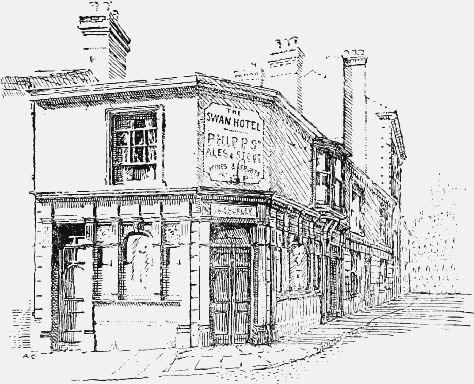
Northampton: The Swan Hotel
The constitution of the corporation remained unchanged in substance from 1489 to 1835. As to its working we have evidence lacking for the medieval period. The records of the town assembly (latterly small enough to meet in the Guildhall) (fn. 290) are extant from 1553 to 1835; (fn. 291) the minutes of the Mayor and Aldermen's Court from 1694 to 1797; (fn. 292) the mayor's and chamberlain's accounts from 1675 to 1835; (fn. 293) the minute-books of the Committee of Accounts from 1800 to 1822, (fn. 294) and the Enrolments of Apprenticeship and admission of freemen, some in the first assembly book, and the rest separately enrolled from 1562 to 1835. (fn. 295) There is also a good deal of material on the parliamentary representation of the borough from 1732 to 1835. (fn. 296) There is also the chronicle of Henry Lee, town clerk from 1662 to 1715; (fn. 297) and the two custumal books, at Northampton and at the British Museum, contain oaths of office, corrected and brought up to date from time to time, (fn. 298) which enable us to differentiate the functions and names of the town officials.
The mayor was generally chosen from among the ex-bailiffs, but sometimes (e.g., in 1702, 1762, 1817, 1819) from the members of the Forty Eight. In spite of a resolution of 1570 that no man should be mayor more than twice, (fn. 299) there are numerous instances of mayors serving thrice, and T. Cresswell served four times (1579, 1588, 1596, 1604). The mayor's allowance, 20 marks in the 16th, as in the 14th century, varied according to the thrifty or festive tendencies of the times, but rose steadily in the 18th century from £30 in 1745 to £105 in 1801, £220 in 1814, and £350 in 1829, when the tide turned. (fn. 300) In 1835 it was £150. No doubt the increase was partly due to the difficulty of inducing members of the corporation to accept an office which entailed so much expenditure on 'treats' and 'feasts.' (fn. 301) The mayor and ex-mayors or aldermen had much the same functions as the mayor and his council had had before 1489. (fn. 302) Under the charter of 1489 they nominated the Forty Eight, and thus completely controlled the personnel of the corporation. (fn. 303) They appointed all the corporation officials that were not elected by the assembly, such as coroners, chamberlains, constables, serjeants and beadles, searchers and tasters for the trades, collectors of rents, the town clerk and the steward. They administered a variety of charities, and their preferential treatment of candidates of their own political colour was noted severely in 1835. (fn. 304) Finally they decided when the assembly should be summoned. In the 17th century the court of the mayor and aldermen met fortnightly; in the 18th century less frequently, and the business was almost entirely confined to the filling of offices, the dealing with charity property, and the calling of assemblies.
The two bailiffs, elected annually from the company of the Forty Eight by the whole assembly, became members for life of the body of ex-bailiffs, from whom as a rule the mayor was chosen. They received as their allowance the rent of a river meadow known as the Bailiffs' Hook, which amounted in 1835 to £31 a year, and had then been recently supplemented by a grant of 50 guineas. (fn. 305) Their functions had come to be almost purely administrative and fiscal, as the Court of Record where they sat became less and less important. They were still responsible for the payment of the fee farm, for the arrangement of fairs and markets, and for the collection of tolls. They also supervised the keeping of watch and ward and the upkeep of the walls till 1662. (fn. 306) They impanelled juries and executed the writs of central and local justices, the corporation successfully upholding its right to exclude the sheriff's action in this matter. (fn. 307)
The Forty Eight, nominated for life by the mayor and aldermen from the body of freemen, served as a pool from which the bailiffs could be chosen. (fn. 308) They could be displaced by a vote of the assembly. (fn. 309) With the mayor and aldermen, the bailiffs and ex-bailiffs, they made up the common council or assembly, which elected the mayor, the recorder, and the bailiffs, and other corporation officials, (fn. 310) admitted freemen, leased corporation property, and passed ordinances or bye laws, though this form of activity practically ceased in the 18th century, when they had come to take very little thought for the general wellbeing of the town. (fn. 311) The contrast between the earlier and later Assembly Books well reflects the narrowing of interests.
Of the other town officials the Recorder was first in dignity. He is first mentioned in 1478 as the person before whom, with the coroners, the mayor was to be sworn in at Northampton, instead of going up to the Exchequer. (fn. 312) The charter of 1495 provided that the assembly should every year elect a discreet man learned in the law as Recorder, to serve as a justice of the peace for the borough, and be one of the quorum of three, with power to hear and determine all felonies and trespasses committed within the town. (fn. 313) The office was as a rule held for life, and the first recorded election (in 1568), was made by the mayor and aldermen. (fn. 314) As the influence of the county over the town increased, it became customary to appoint some neighbouring gentleman, who often served as knight of the shire or member for the borough. The first honorary appointment seems to have been the election in 1642 of the Earl of Manchester, a member of the family of Montagu of Boughton, 'for various favours shown by him to the town, and especially for having provided for its defence,' (fn. 315) and thenceforward the work of the office seems to have been done by a deputy-recorder. In 1671, the assembly elected the Earl of Peterborough as Recorder, but the next year the new mayor, a county gentleman, induced them to replace him by the Earl of Northampton. (fn. 316) For this discourtesy to a royal favourite the mayor was summoned before the Privy Council, and rebuked by the King, who, however, allowed the election to stand. (fn. 317) The Earl of Northampton was formally re-elected every year until his death, and was a most valuable friend to Northampton in forwarding the Bill for the rebuilding of the town after the fire of 1675. When the earl begged the King to delay the prorogation of parliament for half an hour or so that the Bill might pass, Charles observed: 'My lord, I do much wonder you should be so kind to the town of Northampton which in the time of the wars were so unkind to my lord of Northampton, your father.' (fn. 318) The earl replied: 'If it may please your Majesty, I forgive them,' and the King said: 'My lord, if you forgive them, I shall do the same.' (fn. 319) On Northampton's death, however, the town was forced to accept Peterborough until 1688, when the recordership became, in practice, hereditary in the Compton family, till the death of the last Earl of Northampton in 1828. The position then ceased to be honorary, and a working lawyer was appointed. (fn. 320) The most distinguished of the deputy-recorders of Northampton had been Spencer Perceval, who held the office from 1787–1807, gave legal opinion and advice to the town on several important occasions, helped to secure the new charter in 1796, and represented the borough in Parliament from 1796 till his assassination in 1812. (fn. 321) His statue by Chantrey, erected by public subscription (fn. 322) and placed in All Saints' in 1817, was transferred to the council chamber of the town hall, where it now stands, in 1866.
The town clerk, common clerk or mayor's clerk acted also as clerk of the recognizances. (fn. 323) He was appointed as a rule by the mayor and aldermen and in practice held the office for life. He had a small stipend, but his income was mainly derived from fees. In 1652 it was put on record that he should have no voice in matters discussed in the assembly; (fn. 324) his importance as a permanent official is well illustrated by the story told by Henry Lee, town clerk from 1662–1688 and from 1690–1715, of the election of the mayor in 1694. Eight members of the corporation in turn had been elected and refused to serve. 'It being night, And the Mayor and Aldermen tired, the Mayor proposed to the Aldermen to adjourn the Court to the next day, And then I informed them That it was against the Express words of the Charter.' (If the mayor was not elected at one sitting, the existing mayor had to serve another year.) 'I told the present Mayor that . . . without speedy care taken they would all be gon, and thereupon he starts up from his Seat in the Councell Chamber and made hast to the Hall dore and lockt it and brought in the Keys and laid them before him upon the Table, and said: "Now I will stay here till to-morrow this time, but I will choose a Mayor." . . . It happened to be a wett night, and after nine of the clock.' (fn. 325)
The town steward, first mentioned in the 15th century, (fn. 326) acted as clerk to the bailiffs at the court of record, and mayor's clerk at the court leet. (fn. 327) He was appointed by the mayor and alderman and paid by fees only.
The coroners, according to the charter, should have been chosen by the assembly; in practice the mayor and aldermen often appointed. The election was annual, and it was usual to choose aldermen for the office. (fn. 328)
The chamberlains, elected annually, at first by the assembly and later by the mayor and aldermen, acted as the town treasurers. They kept the town accounts and had one of the keys of the common chest. (fn. 329) During the 17th century there were two, a senior and a junior chamberlain, each holding office for two years. Their accounts (fn. 330) are preserved in the corporation archives from 1554 onwards, with gaps, and are of great value, including as they do the rental of the town lands, receipts by fines and grazing fees, payments to town officials and beneficiaries, and all kinds of occasional expenditure. The increase in the amounts spent on feasting is well marked. From 1785 to 1835 the town chamberlain wore a distinctive badge of 'a respectable silver key in the gothic taste, double gilt.' (fn. 331) By 1835 the chamberlain's functions had become largely honorary, and the real work of accounting was done by a treasurer, also elected by the mayor and aldermen. (fn. 332)
The serjeants of the mayor and bailiffs, known, from the rods of office they carried, as mace-bearers from the 14th century (fn. 333) were five in number, one for each ward of the town. Four were reckoned as bailiffs' serjeants and called in the 17th and 18th centuries serjeants at mace; the fifth was known as mayor's serjeant or mace-bearer. According to the form of their oaths in the town custumal (fn. 334) they executed attachments and distresses and had custody of prisoners, whilst the mayor's serjeant also assized measures and weights and levied estreats. They were appointed by the mayor and aldermen. Besides the fees and perquisites of their office the bailiffs' serjeants received in 1833 a salary of 6 guineas each, and the mace-bearer £27. (fn. 335) Four small maces, one going back to the reign of James I, are preserved at Northampton, together with the great mace still in use, made probably, like that of Leicester, by Thomas Maundy of London under the Commonwealth. (fn. 336)
The duties of the serjeants had become largely formal by 1835; their police duties were being performed by the constables. The 15th century custumal gives the constable's oath which defines his duties, and also that of the tithing man or dozener, (fn. 337) whose office, at that period, is still mainly one of presenting at the leet. In the 17th century custumal a later form of the sacramentum decenariorum includes the duty of apprehension of wandering and idle persons of different kinds, (fn. 338) and can be taken as defining the duties of the third borough or head borough who in the 16th and 17th centuries assisted the constable. Each ward had one constable and two third boroughs, appointed from 1581 to 1690 by the assembly, and after that date by the mayor and aldermen. (fn. 339) In 1833 there were in all 23 constables and head boroughs, paid according to the work done, by piece rates, out of the town rates by authority of the magistrates. (fn. 340) Among other minor officials of the corporation were the town crier, the hallkeeper, and, from 1584 to 1698 at least, the town waits or musicians. (fn. 341)
The government of the close corporation appears to have been on the whole satisfactory down to the Restoration. From that date the town records give evidence of steady deterioration. Alongside of the growth of political exclusiveness went the tendency within the corporation of the mayor and aldermen to arrogate to themselves more power, and the diminution in the corporation as a whole of the sense of responsibility for the well-being of all the town. The borough revenues were regarded as a fund entirely at their disposal, and any fresh needs of the growing town were met out of the town rates, fixed by the magistrates at quarter sessions and kept distinct from the corporation accounts. (fn. 342) As early as 1692 a mayor is commended because 'he did not sell the town land for claret as others did.' (fn. 343) The corporation became, in fact, little more than a dining club with considerable powers of patronage.
One by-product of this stagnation was the difficulty found in filling municipal office and even in recruiting the corporation itself. A substantial sum was annually derived from the fines of those who refused office. We have seen that in 1694 eight mayorsdesignate refused to serve. This brought in £80. Similar difficulties occurred in 1711, 1713, 1723, and 1730. (fn. 344) The same reluctance to serve was shown by bailiffs-elect. (fn. 345) The records of the mayor and aldermen's court show the difficulty of filling up the vacancies in the Forty Eight created annually by the election of the two bailiffs. The first instance of refusal to act is recorded in 1696, and from that time complaints were constant. (fn. 346) On 7 August 1775, for instance, 13 persons who were elected to the Forty Eight were displaced because of their refusal to take the oath; ten of them, however, were immediately re-elected with six others. On 5 August 1776 twelve were similarly displaced and re-elected. (fn. 347) The assembly in its turn was endeavouring to compel persons to become freemen: on 23 May 1776, for instance, it was resolved that nine persons should be admitted freemen at £10 each, and prosecuted if they refused. (fn. 348) As a result, by 1791 the corporation consisted of a mayor, 18 aldermen, 22 bailiffs and 19 Forty Eight men, whilst 29 persons elected to the Forty Eight were refusing to act. Under the charter of 1663 the mayor and aldermen had power to fine, and if necessary imprison and distrain freemen who refused to serve. (fn. 349) Having taken legal opinion, in 1794 they had a mandamus served on several of the defaulters, and the case was brought before the court of King's Bench, with unforeseen consequences. It appeared that by the Act of 1489 the mayor must be elected by a majority of the Forty Eight, not being ex-bailiffs, and that for several years past the mayors had been elected by a minority, as no majority existed. (fn. 350) The corporation had thus no legal warrant for its existence, and the only remedy was to surrender the charter of 1663 (fn. 351) and petition for a new one. The townsmen seized on the chance of asserting their rights and held a meeting on 1 June 1795 at the County Hall (not being allowed the use of the Town Hall) and a counterpetition organised by Edward Bouverie, the Whig member for the borough, was signed by five hundred persons, praying the King not to grant a charter without reference to the petitioners. (fn. 352) The attitude of the corporation is reflected in the resolution passed in the assembly of 8 June. (fn. 353)
'That it is the opinion of this Assembly that the peace and good government of this town and the interest of all its inhabitants whether free or not free of the corporation have been well secured under the Ancient Powers and Franchises heretofore and hitherto exercised by the Corporation.
'That it would not be wise to depart from a System which has been found upon such long experience to answer. And therefore it is the opinion of this Assembly that they should endeavour to procure such a Charter only as shall confirm and restore the ancient Rights and Franchises of the Corporation and leave the Government and the Election of its officers under the same regulations which have hitherto prevailed.'
Thanks were also voted to Mr. Charles Smith for his 'manly and steady conduct in resisting the unjust imputations aimed at the Corporation' at the late town meeting.
As was to be expected, the view of the assembly rather than that of the town meeting was accepted by the central government, and the charter of 2 April 1796 (fn. 354) differed only in trifling respects from that of 1663. The right to fine freemen for refusal of office and to fine members of the corporation for nonattendance at assemblies was made definite, and the clause forbidding any but freemen to trade within the town was dropped. The fresh lease of life given to the old corporation led to no improvement either in zeal or in public spirit. Quorums were difficult to obtain, (fn. 355) and the worst instances of the expenditure of public funds on entertainment, of the exploitation of charity endowments for party purposes, and of political bias in judicial action belong to the period 1796–1835. A proposal from one of its own members in 1831 to reform the financial procedure of the corporation was quashed as 'unusual, improper and prejudicial,' (fn. 356) and the appointment of a special committee to audit the accounts in 1833, though it produced a valuable report, was in the nature of a deathbed repentance. The epitaph of the old régime was spoken by Cockburn in 1835: 'It seems impossible to justify a system which alienates from the municipal government the affections and respect of one half of the community and gives rise to complaints of so serious a character.' (fn. 357) In November 1835 the close corporation of the last three and a half centuries was replaced by an elective body of one mayor, 6 aldermen, and 18 councillors, representing the three wards into which the town was newly divided.
Under the Local Government Act of 1888 (51 and 52 Vict. c. 41) Northampton became a county borough in that year, but the form of its government was unchanged till 1898, when, owing to the victories of the Progressive party in the municipal elections of 1897, (fn. 358) a Boundaries Committee was appointed and a Provisional Order obtained from the Local Government Board, redividing the town into six wards. After further enquiry, the area of the town was enlarged by the act of 30 July 1900 (fn. 359) so as to include nine wards, each of which returned three councillors, who with nine aldermen, made up a council of 36 members. In 1911 the Northampton Corporation Act (fn. 360) was passed, under which the borough was divided into twelve wards, and from 1912 on the council has consisted of the time-honoured number of 48.
The first recorded representation of the borough in a parliament is in 11 Edward I, (fn. 361) and, except under the Commonwealth, there were two members up to 1918. The earliest writs are directed to the mayor and good men, (fn. 362) whilst the returns for Edward II's reign state that the members were elected by the bailiffs, by the mayor and bailiffs, or per considerationem ville. (fn. 363) From 1381 at least, the elections appear to have been made in the assembly at St. Giles'. (fn. 364) A comparison of the list of mayors and bailiffs with that of the members shows that the same group of burgesses performed both services. (fn. 365) In 1381 the assembly resolved that the borough should always be represented in Parliament by the ex-mayor, unless he had discharged the office of burgess before his mayoralty. (fn. 366) From 1489 onwards it appears that, as the parliamentary elections were still made in the assembly, (fn. 367) voting was restricted to members of the corporation. The act of 1489 did not mention elections to parliament, but the King's letter to Leicester in the same year definitely laid it down that only members of the common council should have votes for parliamentary elections, (fn. 368) and it is possible that the two acts, so nearly identical in form, were interpreted similarly. The members were chosen from among the corporation until the reign of Elizabeth, when the practice begins of choosing county gentlemen to represent the town. From 1553, the recorder was generally chosen as one member, and the Yelvertons of Easton Maudit established a strong family interest, whilst the Knightleys of Fawsley were another county family with influence in the borough. The notorious Peter Wentworth of Lillingston had sat for a Cornish borough before he represented Northampton in 1586, 1589 and 1592. (fn. 369) In 1601 the assembly books record that Mr. Henry Hickman, LL.D., and Francis Tate, Esq., made request to be chosen burgesses for the town and were accepted as being the first a resident and the second the son of a freeman, provided they paid their own expenses. (fn. 370) They were both made honorary freemen. Aldermen are still chosen as members after this date, but economy on the side of the corporation and solicitation from outside soon established the parliamentary representation of the borough as a prize to be competed for among the county gentry. (fn. 371) Henry Lee finds it noteworthy that in 1640 Zouch Tate of Delapré was elected burgess 'without his making any interest and without his knowledge till after the election.' (fn. 372)
Under the Commonwealth the representation of the borough was reduced to one. At the Restoration Northampton, like several other boroughs, (fn. 373) underwent a peaceful revolution; the parliamentary vote ceased to be the monopoly of the corporation. There must have been warning signs, for both at Leicester and Northampton the corporations prepared to resist an attack. The assembly at Northampton ordered on 19 June 1660 'That this town do unite with any other corporation of the neighbourhood for the maintenance and continuance of their constancy in the choice of Burgesses to serve in Parliament by the mayor, Bailiffs and Burgesses.' (fn. 374) In the elections for the convention two returns were made; the one of Francis Harvey and Richard Rainsford, the other of Sir John Norwich and Richard Rainsford. The Committee for Privileges reported that 'the commonalty as well as the bailiffs, aldermen and 48 common councilmen have the right to elect,' and that therefore Rainsford and Norwich were elected. (fn. 375) Harvey, the deputy-recorder, was the corporation candidate. In the elections of 1661 there was again a double return for Northampton: the sheriff brought an indenture with the names of Sir John Norwich and Sir James Langham; the mayor returned Langham and Harvey. The return of the mayor, the lawful returning officer, was filed, and Langham and Harvey were temporarily allowed to sit, (fn. 376) but after investigation the Committee for Privileges reported that the mayor had used menaces to such as would not give their votes to Mr. Harvey, had made infants free on the morning of the election that they might vote as he pleased, had caused persons to be put by who would not vote as he desired, had released Quakers from prison and put halberts in their hands to keep back such as would have voted contrary to his intentions, had adjourned the taking of the poll into the Church of All Saints and there behaved himself in a profane and indecent manner, and had declared beforehand that Mr. Rainsford should not be elected because he had given a charge for the Book of Common Prayer. On account of these irregularities the election was declared void by the Commons, by a vote of 185 to 127. (fn. 377) The mayor was brought into the House in the custody of the Serjeant at Arms, and making a humble submission on his knees, received a grave reprehension. Henry Lee, who appears to have confounded the elections of 1660 and 1661, (fn. 378) says that there were five candidates, and that the poll was held in the chancel of All Saints, by reason of the great rain that fell that day so that it could not be taken at the Market Cross. 'The election of burgesses,' he adds, 'was then ordered to be made in the town by the freemen and inhabitants of the town, and has continued a popular election ever since.' (fn. 379) Nevertheless more disputed returns followed, leading to a more precise definition of the franchise. The bye-election ordered on 13 June 1661 led to the return of Sir Charles Compton and Rainsford; but Compton died soon after and a fresh writ was issued on 5 Dec. 1661. (fn. 380) This time Sir J. Langham was elected, and the rival candidate, Sir W. Dudley, protested. The Committee for Privileges reported on 26 April 1662 that lawful voters had been prevented from voting, but the matter was too intricate for them to determine; the House accepted their report and declared the election void. (fn. 381) The new bye-election was postponed for nearly a year by the rising of Parliament, but in February 1663 a fresh writ was issued (fn. 382) and the election took place on 7 March. (fn. 383) The mayor attempted to hold it in the assembly, but two of the members of the corporation protested and left the guildhall with many others, joining the 'popularity' (fn. 384) in the market square which was shouting 'A Hatton! a Hatton!' The rest of the corporation elected Sir W. Dudley; Mr. Hatton's party polled at the Market Cross, and the sheriff received two indentures. As in duty bound he returned the one sealed by the town clerk (Henry Lee himself), but Hatton appealed to the House of Commons, and the Committee for Privileges, after hearing much evidence, reaffirmed that 'the voices in election do not belong to the Mayor, Aldermen and Forty-Eight only, and that . . . Mr. Hatton was duly elected.' The name of Dudley was erased from the indenture by the Clerk of the House and that of Hatton inserted. (fn. 385) In 1664 there was a fresh byeelection, necessitated by Rainsford's becoming a Baron of the Exchequer. (fn. 386) Again the return was disputed. On 26 April (fn. 387) the Committee of Elections reported that counsel on both sides agreed that whoever had the majority of voices of inhabitants being householders and not receiving alms ought to be elected; and that the Committee upheld this and were of opinion that the sharing of the charitable gift at Christmas was a taking of alms. On this interpretation, Sir Henry Yelverton was declared duly elected, and Sir John Bernard unseated. It would appear that the process of corrupting the popular electors had already begun.
From this time Northampton enjoyed what Tennant in 1782 (fn. 388) calls the cruel privilege of a very popular franchise. It is not unlikely that the townsmen owed their enfranchisement to the fact that their political sympathies were more royalist than those of the corporation, even after the purging of 1662, (fn. 389) for in 1665 the mayor-elect was arrested by royal command. (fn. 390) Very soon, however, the corporation became more Tory than the town. In 1678 the Montagu interest, strong in the borough since the reign of James I, (fn. 391) was exerted on the Exclusionist side. 'There are four that stand,' young Perceval reports; 'Mr. Montagu is the only man who treateth . . . the townsmen themselves say, both he and his father spend £100 per week, but to no purpose, for whomsoever the King will recommend they are resolved to choose, and there coming a letter in favour of Sir W. Temple, he, it is thought, will be the man.' (fn. 392) Owing to the Tory leanings of the returning officers, Temple was returned, but unseated by a vote of the House 'with so united a cry as made it very legible what inclination they bear to the patron of the first.' (fn. 393) From this time on the Montagu interest dominates the borough representation, and as the recordership had become a hereditary perquisite of the earls of Northampton, the Compton interest was equally strong and for a long series of parliaments the borough was represented by a Compton and a Montagu. In 1733 the assembly declared 'We think we have in some measure a right to be represented by a brother of the earl of Northampton.' (fn. 394) But on this occasion the corporation overreached itself. The parliamentary franchise was held to belong ' to every freeman, whether resident or not, and every householder, whether free or not,' (fn. 395) and the mayor, for the purposes of the election, admitted 396 gentlemen of the county to be freemen of the town, on payment of 3 guineas a man: (fn. 396) but the defeated candidate successfully petitioned against the return of Colonel Montagu, elected by these new votes. In 1740 legal opinion taken by the corporation upheld the ruling that only resident freemen had the parliamentary vote. (fn. 397) In 1768 a third great county interest entered the field. Earl Spencer put forward the Hon. Thomas Howe against the Montagu candidate, Sir G. Osborn, and the Compton candidate, Sir G. B. Rodney. It was popularly believed that £400,000 was spent on this election by the three patrons. (fn. 398) The campaign began at Michaelmas 1767 and lasted till April 1768, after fourteen days' polling. The mayor and corporation used all their influence against the Spencer candidate, (fn. 399) and by common agreement the oath as to bribery was not administered to any voter. A supporter of Halifax, rebutting the charge of bribery, wrote: 'I have never heard of any other expense on his part but that of eating and drinking. (fn. 400) . . . How can it be avoided when an old family interest is to be defended against a sudden and unexpected invasion? In such a case one cannot blame what is done for self-defence.' (fn. 401) Another contemporary says: 'Each voter that would had twelve, fourteen or fifty guineas, some £100 to £500. The single article of ribbands cost £6,000.' (fn. 402) Osborn and Rodney were returned; but a scrutiny in the House of Commons in 1769 resulted in Howe's being declared elected, and Osborn and Rodney tossed for the other seat, which was retained by Rodney. (fn. 403) The expenses of the scrutiny, which took six weeks, during which Lord Spencer kept open house for members of Parliament, led to the Earl of Northampton's leaving the kingdom after cutting down the trees and selling the furniture at Compton Winyates, whilst Halifax and Spencer were also seriously crippled. The Compton and Spencer interests held the field after this for some years. From 1796–1812 Spencer Perceval, deputy recorder since 1787, represented the borough (at first as 'Lord Northampton's Man') (fn. 404) and there were a series of uncontested elections. In 1818 the understanding that each party returned one candidate was terminated (fn. 405) and another fierce contest took place. The corporation supported the Tory interest energetically, and in 1826 went so far as to vote £1,000 out of the borough funds towards the expenses of a candidate in the ministerial interest: an action condemned by the commissioners of 1835, but falling far short of the party excesses of the Leicester corporation. (fn. 406) In 1768 the number of townsmen claiming votes was 1170, and some 900 were allowed to poll. In 1784 908 voted, in 1790 893, (fn. 407) and in 1818 1,287. (fn. 408) The number of electors under the Reform Act of 1832 was 2,497. (fn. 409) The last notable episode in the parliamentary history of Northampton was connected with Charles Bradlaugh. After two unsuccessful candidatures, he was elected M.P. for Northampton in 1880. He was unseated on his refusal to take the oath administered to members, and was re-elected by the borough four times—in 1881, 1882, 1884 and 1885. Finally, in 1886, he was allowed to sit, and he remained one of the burgesses until his death in 1891. (fn. 410) By the Representation of the People Act in 1918, the borough representation was reduced from two to one. The borough was represented by Miss Margaret Bondfield in the parliament of 1923–24.
In 1086 the sum payable to the sheriff by the burgesses was £30 10s.; in 1130 the sheriff accounted for £100 at the Exchequer; and in 1185 the firma burgi was fixed at £120. The burgesses had difficulty in paying this and they appear to have been badly in arrears at the beginning of the reign of Henry III, so that in 1227 the town was taken into the king's hand (fn. 411) and a custos appointed. (fn. 412) In 1334 the town applied in vain for a reduction of the farm, (fn. 413) but in 1462 Edward IV remitted £20 of it for the next twenty years, a period extended later. (fn. 414) In 1484 Richard III increased the relief to 50 marks, (fn. 415) but Henry VII reduced it again to £22. (fn. 416) Under a grant of 1514 the farm was permanently fixed at £98, (fn. 417) as it is to-day. It has been assigned from time to time to different persons, such as Robert de Crevequer in 1301, (fn. 418) and Roger de Beauchamp in 1338. (fn. 419) From 1351 £66 13s. 4d. of it has been payable to the Dean and Chapter of Windsor, (fn. 420) and the remaining £31 6s. 8d. is paid to Mr. George Finch, the representative of the earl of Winchilsea and Nottingham. (fn. 421)
By acquiring the firma burgi, the burgesses acquired the right of collecting the burgage-rents hitherto payable to the king. Early deeds frequently describe tenements held de prepositura ville. It is not always clear whether the rents are included in the farm, or whether in some cases the bailiffs are collecting them on the king's behalf and accounting for them separately at the Exchequer. Thus Hugh Gobion is said to hold his land in chief of the king by the service of 2s. payable yearly at the Exchequer by the hands of the prepositura of Northampton, (fn. 422) whilst Richard Gobion 'holds his land of the King in chief by burgage, paying 15s. 4d. to the prepositura of Northampton towards the farm of the said town.' (fn. 423) In a survey of 1291 of nine houses lately held by Jews in Northampton, three are said to be held de prepositura (fn. 424) —one in the Corn Row, one in the Market Place, and one not specified. The rents are 8d., 2s. and 8d., and in two of the three instances payments are due to other persons as well. In 1361 Hawise le Botiller (née Gobion) is said to have held 8 shops in Northampton, as burgage of the town, rendering to the king 12d. yearly towards the farm of the town. (fn. 425) The petition of 1334 refers to rents that go to make up the fee farm of the town, (fn. 426) and another petition in which Northampton joined with four other towns in 1376 shows that several burgesses who held burgages of the king had so wasted their land that the rents were not forthcoming for the payment of the borough farm. (fn. 427) In 1467 the rents due for the stalls in the market are described as the king's, and also as the property of the suitors to the town court, and they were collected by the bailiffs, 'fee farmers to the King within this town.' (fn. 428) When purprestures were presented, it was not uncommon for the encroacher to be allowed to keep the land usurped, paying for it a rent to the prepositura in aid of the firma burgi. (fn. 429) In 1391 the mayor and chamberlains are expressly given power to let to farm all waste places, for rents to be paid to them for the town. (fn. 430) Sixteen such holdings were let out by them in 1439. (fn. 431) Much property had come into the hands of the town by the close of the Middle Ages, and by the name of 'The Chamber lands' was confirmed to the town by the charter of 1599. (fn. 432)
The condition of the town of Northampton in 1504 is shown by a rental (fn. 433) in which the town is divided into streets with the lanes running off on either side, into market rows and districts. Probably the most important area was 'Swinwel-strete,' now Derngate, which was apparently the residential quarter, and included the manor of Gobions and the Grange. The latter, which formerly belonged to Thomas Latimer, was late of Thomas Tresham, and then held by John Chauncy. It included land next the postern called Derngate and other adjoining land. Property here belonged to the chapel of Blessed Mary the Virgin in All Saints Church, and to the fraternity of Holy Trinity. There were inns called 'le Crown,' 'le Bell,' 'le Tabard,' and 'le Bulle,' and a house called 'le Blakhall.' St. Giles Street, which extended to the town wall, was mostly inhabited by tradesmen, bakers and fullers and Adam 'le Garlikemonger.' In Abingdon (Habyngdon) Street, leading to the East Gate, was a quarry. In St. Sepulchre's Lane, now probably Church Lane, was a house formerly of Thomas Tresham, then in the hands of the King. There were five tenements around the cross of Alnoth (ad crucem Alnoth ?). In the Masters' Street (in vico Magistrorum) were various houses which had been acquired by the College of All Saints, and in the tenure of the College; near by were Fullers' Street and Weavers' Street. In the South Quarter (the south part of Bridge Street) and the parish of St. Gregory was 'Stokkwell Hall' and lands of the fraternities of Corpus Christi and St. Nicholas in the Wall, probably connected with the famous rood in the wall in St. Gregory's Church. Laundry Street was probably near the river. The district of Bridge Street (in vico Pontis) included the holme or island called Barmerholme (Baums holem) belonging to Sir John Longville, several tenements belonging to the chapel of the Blessed Mary and the fraternity of the Holy Trinity, and land at the South Gate belonging to the Hospital of St. Thomas the Martyr. Under Kingswell Street we have mention of a lane called 'Lewnyslane,' an inn in Bridge Street called 'the Angel,' 'Wolmongerstrete' and an ancient rent from a tenement in 'le Cowmede' where there was formerly a mill. We next come to the Market Place, where in the Glovers' Row there were 17 shops, in Mercers' Row 9 shops and 2 tenements, the Retailers' Row (Rengum Regratorum Socorum (sic)) 14 shops. In Butchers' Row there were on the north side 12 stalls and one shop and on the south side 14 stalls, many of which belonged to religious houses. In Fishers' Row there were shops and stalls. In Barbers' Row in the Old Drapery there were 22 shops. In Gold Street, the lands were largely in the hands of religious houses. In the parish of the Blessed Mary next the Castle there was a mill near the church and a tenement belonging to the fraternity of the Blessed Katherine in the church of St. Mary, and land outside the West Gate belonging to the fraternity of Corpus Christi. In the parish of St. Peter there was waste land about the town wall and there were tenements around the castle and the Friars Preachers. In the North Quarter into which 'Berwardstrete' ran was a house held by Peytmyn the Jew. St. Sepulchre's Street, now probably Sheep Street, extended to the North Gate. Newland in the parish of St. Michael seems to have extended to Bearward Street. There was a tenement called 'le Grenetree' near the Friars Minor. 'Le Fawkon' and an inn called 'le Hart' in the tenure of William Crawme, notary, were in Cornmongers' Row. There were also the Row where barley, oats and drage were sold, a Row opposite Bakers' Row, then called Potters' Hill, Shoemakers' Row, and the Tailory, where there was an inn called 'le Swan.'
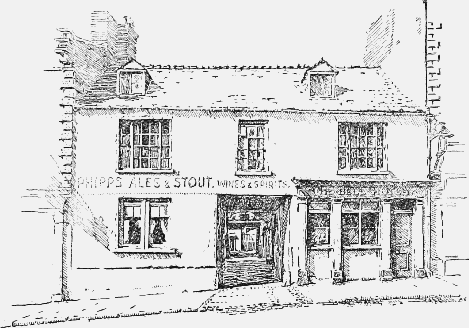
Northampton: The Bell Inn
A terrier of the town property in the year 1586 (fn. 434) shows that the borough then held houses and lands in all the five wards of the town, including a good number of stables, gardens and orchards, a house called St. George's Hall, (fn. 435) eight shops under the Town Hall, as well as arable and meadow lands in Milton, Heyford, Pitsford, and Cotton, and a house in Pitsford. A good many of these plots were sold by the town in 1621–2, probably in order to get together the purchase-money for Gobion's manor, which was acquired in 1622 at the cost of £1,520. (fn. 436)
The first mention of Gobions at Northampton seems to be in 1130, when Hugh Gobion paid 10 marks for a duel. (fn. 437) The Gobion family held a considerable amount of property throughout the Midland counties. Hugh Gobion witnessed a charter of Earl Simon II to St. Andrews, (fn. 438) and a Hugh Gobion was sheriff of Northants in 1161. (fn. 439) On the death of Hugh Gobion about 1166 the sheriff seized his land, (fn. 440) and accounted henceforth for 100s. a year from the land which was Hugh Gobion's (fn. 441) until it was recovered by his grandson in 1200. (fn. 442) Hugh's son Richard granted by deed to St. Andrew's Priory a shop, paying 5s. a year, 'which is set up at All Saints Fair before the house of Hugh my father, next the market place towards Northampton,' (fn. 443) This Richard had seven sons and six daughters and died before 1185. (fn. 444) Among the corporation records are deeds by which William de Vipont granted to Richard Gobion, second son of the last, lands in Cotes and beyond the South Bridge of Northampton. (fn. 445) This is the 'Earl Gobion' of Northampton tradition who gave goodly commons and liberties to the town. (fn. 446) His lands, including the recovered 'Grange,' were again seized into the king's hands later, as he joined the baronial faction against John, but in 1217 he was restored to favour. (fn. 447) He acted as royal Justice, and was the patron of the Franciscans on their first coming to Northampton, giving them shelter on his land outside the East Gate. (fn. 448) His son Hugh owed 16s. 4d. for relief, 'according to the custom of the town of Northampton,' in 1230. (fn. 449) This Hugh joined the barons against Henry III, was taken prisoner in the siege of Northampton in 1264, and was disinherited after Evesham. (fn. 450) He recovered his lands from Robert de Turbervil, lord of Crickhowel, for a payment of 95 marks, (fn. 451) in 1267–70. A deed of his at Northampton locates Gobion's grange as being near St. Giles' churchyard. (fn. 452) In 1275 his son Richard succeeded, (fn. 453) and the inquisitio post mortem of the latter in 1301 gives a list of 49 houses and shops held of him in Northampton, with the names of the tenants. (fn. 454) Richard left two daughters, of whom the younger, Elizabeth, wife of Sir Thomas Paynell, inherited Gobion's manor in Northampton, together with Knaptoft. Her son took the name of Gobion, (fn. 455) but his successors were known as Paynells. The manor descended to Margaret Paynell, wife of Thomas Kennisman, whose daughter Elizabeth married John Turpin, who died in 1493, when 13s. 4d. was still payable as burgage rent to the mayor and corporation of Northampton. (fn. 456) From her the manor descended to George Turpin, who in 1558 sold the manor to Robert Harrison for £420, (fn. 457) who in turn sold it to the mayor and corporation of Northampton on 20 April 1622.
Among the town muniments, besides the title-deeds of Gobion's manor, are deeds recording the acquisition of Marvell's Mill, Millholme and Foot meadow in 1656, (fn. 458) and records of various sales of town property, notably of lands near the castle to Sir R. Haselrige in 1680. (fn. 459) In the 17th and 18th centuries a great deal of the town property was let at a low rent on long leases, the lessee having, however, to pay a heavy fine for renewal. (fn. 460) In the 16th century the borough held on lease lands to the west of the town formerly held by St. James' Abbey, known as Duston lordship, where the burgesses exercised common rights as in the town fields. The borough failed, however, to obtain the freehold of the lordship by purchase. (fn. 461)
In 1835 the property of the borough, including property whose origin was unknown, Gobion's manor, the bailiff lands, land acquired more recently, the profits of the butchers' stalls and the fees on the old commons brought in £1,448 12s. 3d. per annum. (fn. 462) In addition to this the tolls were let at £200 a year, and the trust estates and charity endowments brought in £3,304 odd. (fn. 463) With the administration of these charities went certain rights of patronage: the corporation appointed the warden of St. Thomas' Hospital, (fn. 464) the headmaster of the Free Grammar School (fn. 465) and the corporation schools and the Vicar of All Saints'. The Assembly Books record various resolutions with regard to the management of St. Thomas' Hospital, (fn. 466) which appears to have been well administered. It was moved in 1834 from the old building at the bottom of Bridge Street (destroyed in 1874) (fn. 467) and the charity, in a house in St. Giles' Street, still supports both inmates and out pensioners. (fn. 468) The advowson of All Saints was sold to the mayor and corporation by Sir Thomas Littleton and his wife in 1619 for £200, (fn. 469) and remained in their hands till 1835 when, under the Municipal Corporations Act, they had to sell it. Appointments to the living were made by trustees, being such of the corporation as lived in All Saints' parish. (fn. 470)
In 1275 it was alleged that the appointment of the master of the hospital of St. John belonged to the borough, (fn. 471) and an attempt was made by the mayor and corporation to get control of the nomination in the 17th century in vain. (fn. 472) The bishop of Lincoln was and is patron of the hospital, (fn. 473) which was intended for the poor of the county, as that of St. Thomas was for the townspeople. (fn. 474) The mayor and burgesses also had the right, probably from its foundation, of presentation to the chapel of St. Leonard attached to the Hospital of St. Leonard without Northampton. (fn. 475) In 1282 they asserted that the wardenship belonged to them of the right and in the name of the lord king. Down to 1294 the prior of St. Andrew's and the Vicar of Hardingstone had to sanction the chaplain's appointment; after that the mayor and burgesses were the sole patrons and the mayor was ex officio master of the hospital. In 1473 he and the Twenty Four calmly reduced the number of beneficiaries to one, and leased the hospital with all its lands and appurtenances to John Peck of Kingsthorpe for life, on the condition that he should provide the chaplain's board and lodging, keep the buildings in repair, and maintain one man or woman leper in place of the brothers and sisters of former times. (fn. 476) When the lessee died in 1505 the assembly resolved to keep the management of the hospital in their own hands, and each mayor had to take an oath to govern the hospital truly. (fn. 477) Two of the aldermen were to act as wardens, with a bailiff under them to levy the rents, and they were to render accounts annually. In 1546 St. Leonard's Hospital was said to have lands worth £10 15s. 9d. a year, and to be held by the mayor and Twenty Four in free alms, for the keeping of one leper; (fn. 478) and in 1547 it was taken into the king's hands, and granted out again to F. Samwell, together with the chapel of St. Katharine, in 1549. (fn. 479) The mayor and corporation protested vigorously, asserting in a petition to the Chancellor of the Court of Augmentations (fn. 480) that for four hundred years and more they had been lawfully seised of the hospital and chapel of St. Leonard's. In response to this an inquiry was held which vindicated the claims of the corporation, (fn. 481) and they were allowed, on payment of £41 to Samwell, to keep the hospital as well as the chapel of St. Katharine, to serve as a chapel of ease for the sick. After this the rights of the corporation were unchallenged. As leprosy died out, one poor man or woman was maintained up to 1840, when the last beneficiary died, and the considerable endowments of the hospital were applied to the reduction of the rates. An investigation by the Charity Commissioners was hampered by a refusal of the corporation to produce the records, and in 1857 the Attorney-General filed an information in Chancery and the facts were made public. After long discussion, the property of St. Leonard's was assigned to the support of the grammar school in July 1864. The lands of the charity are described in detail in the town terrier of 1586. (fn. 482)
The town property was administered by the mayor and chamberlains, who had power from the 14th century to let out lands under their common seal. (fn. 483) The existence of a common seal seems to be implied in the reference to the letters patent of the town in the charter of 1227—an addition to the charter of 1200 which it mostly repeats. In 1282 it is definitely stated that the common seal has been attached to certain letters patent, (fn. 484) and there is at the Record Office one such letter patent to which a seal was formerly attached. (fn. 485) The oldest known common seal of Northampton appears to have belonged to the early 13th century. It was circular, 15/8 in. in diameter and bore an embattled tower with closed portal, the walls and battlements charged with fourteen irregular quatrefoils. Over the battlements appears the head of a knight, to the left, holding a crossbow and a bannerflag; in the field a sprig and leaves of foliage. The inscription was Sigillum: Commune: Norhamptone. (fn. 486) The mayor's official seal, of less rude design, appears to have been made early in the 14th century, (fn. 487) and is perhaps to be associated with the charter of 1299. It was used for sealing letters accrediting freemen in other towns and returns of writs by the bailiffs, (fn. 488) authenticating exemplifications of deeds enrolled on the Town Memoranda Rolls (fn. 489) and adding authority to private deeds when the seals of the parties were not well known. (fn. 490) It was circular, 15/8 in. in diameter, and bore a triple-towered castle, walls masoned and embattled, doors open, supported by two lions passant guardant of England; in the field above, a reticulated pattern. The inscription ran: *s' maioritatis ville norhamtonie. (fn. 491) These two seals were in use down to the last quarter of the 17th century (fn. 492) and were probably destroyed when superseded. The common seals of 1667 and 1796 are in the keeping of the corporation. That of 1667 is oval, and 15/16 in. long, and bears a circular triple-towered castle, flanked by two lions, with the inscription northamptoniæ 19 caroli 2 r. angliæ. The common seal of 1796 is also oval and is 1¼ in. long, bearing on a shield the town arms of a castle and two lions. The inscription runs: northampton charter renewed xxxvi geo. iii. The common seal now in use, made in 1879, is circular, 2¼ in. in diameter, and bears on a shield the borough arms, with the inscription, castello fortior concordia.
Impressions are extant of three other town seals.
There were two seals for use under the Statute of
Merchants for sealing recognizances; the mayor's seal
and the clerk's counterseal. A letter from the burgesses
in 1319 to the Chancellor reports that they have elected
their mayor to keep the great seal and a clerk, their comburgess, to keep the small one. (fn. 493) In 1351 Edward III
appointed one of his yeomen to keep the smaller seal,
but as he could not execute the office in person, it fell
back into the hands of the Northampton clerk. (fn. 494) In
1408 the clerk lost the smaller seal, and the mayor
sent him up to the Exchequer to get it renewed. (fn. 495) The
inscription on the mayor's seal (circular, 15/8 in.) is
s' regis edwardi ad recogn' debitorum. The design
is like that for London. The inscription on the clerk's
counterseal is
S: cl'ici: de: stat: m'cat: norhton,
and it bears a representation of St. Andrew on his cross. (fn. 496)
The cloth seal, of which a cast is preserved at Northampton, (fn. 497) was used for stamping Northampton cloth
which had paid the subsidy. Only three other instances
of a cloth seal are mentioned in the British Museum
Catalogue of Seals, whilst there are seventeen distinct
examples of town seals under the Statute Merchant. (fn. 498)
The Northampton cloth seal is an inch in diameter,
and bears a king's head in the centre and round it the
inscription, s': panorum: norhamton: (fn. 499)
The open fields lay to the north and east of the town, the meadows to the south being used for pasture after haytime. There is a good map of the lands formerly belonging to St. Andrew's Priory in the year 1632; it shows a North Field, a Middle Field, and a South Field, as well as Monkspark, Rushmill Meadows and the Priory Leaze, and the town lands, including the recently acquired Gobion's manor, are indicated scattered among the other holdings. (fn. 500) Among the borough records is a deed of 1373 which mentions lands lying in the North Field (Whetehul, Nether Whetehul, and Bartholomew furlong), in the East Field (Monkespark furlong) and the South Field (Brerewong and Mede furlong) as well as the Portmede. (fn. 501) There are constant references to the town meadows and pastures. In 1391 it was ordered that no freeman should graze more than two beasts in the common pastures without payment. (fn. 502) In 1553 the assembly ordered 'That no man shall keep moor for his franchis than iij bestes upon the commons in alle, and that they be his owne . . . upon payne of xld . . . Item that the Cowe medowe, the horse medowe next ytt and Rawlines holme shal be kept severall from the purification of Saynt Mary the Virgin untyll the invention of the holy crosse in May and likewise from the assumption of our lady unto saynt luke day the evangeliste upon payne of xld. every beast.' (fn. 503) In 1556 the right of common was restricted to freemen 'downlying and uprising and dwelling within the liberties' and further regulations enforcing this restriction were passed in 1599. Rules were laid down in 1582 for the times for throwing open The Cow Meadow, St. George's Leys, Balms Holme and the Foot Meadow, and there were regulations from time to time as to the branding of the cattle, the turning out of diseased beasts and the nuisances caused by curriers or fullers, whilst from time to time the rates payable for depasturing beasts and the numbers allowed gratis to each freeman were altered. The freemen enjoyed rights of common during 'the open tide' not only in the lands owned by the corporation but in those of other proprietors, and Henry Lee describes a dispute between the freemen and Mr. Bryan, the owner of Marvells Mills and Millholm, in 1648, about the date on which Millholm and Footmeadow were thrown open. The freemen declared it should be Midsummer day; Bryan claimed as right the nine days' grace which custom had sanctioned. (fn. 504) The Chamberlain's accounts frequently mention the town bull. (fn. 505) They show that 280 horses and 103 cows were depastured by freemen on the town commons in 1692 and 233 horses and 221 cows in 1698. The annual branding of the freemen's cattle by the town chamberlain became the occasion of a public holiday and a town feast. (fn. 506)
In 1778, in spite of the opposition of the corporation, (fn. 507) an act was passed for enclosing the open fields. (fn. 508) That the scheme was in contemplation as far back as 1752 appears from a lease in that year of a farm in Northampton Fields for fifteen years 'if the open fields remain so long unenclosed.' (fn. 509) The fields of Hardingstone, Kingsthorpe, Moulton and Duston had been enclosed between 1765 and 1776. The commissioners' award under the act of 1778, dated 24 June 1779, is at the County Hall. It assigns to the corporation 133 acres of land in five allotments, and to the freemen, at the special request of the corporation, (fn. 510) 87 a. 1 r. 29 p. on the raceground, to be subject to a horserace to be held between 20 July and 20 October every year. Trustees were appointed for the management of the new commons created by the award. (fn. 511) In 1870 the town held 189 a. o r. 39 p. of commons, including the Freemen's common on the racecourse (formerly part of Northampton Heath), where every freeman could pasture 6 head of cattle at fixed rates; the Old Commons, vested in the corporation, comprising Midsummer Meadow, Cow Meadow, Calves Holme, Baulms Holm and Foot Meadow; and the New Commons, also vested in the corporation. (fn. 512) Under the Northampton Corporation Markets and Fairs Act of 1870, (fn. 513) the freemen were given certain rights in the New Commons in return for giving up their rights in a portion of the Cow Meadow for the building of the present Cattle Market (1870–73). In 1882, under the Northampton Corporation Act of that year, (fn. 514) the freemen's rights of common of pasture and all other rights in the freemen's commons were sold to the corporation for a perpetual annuity of £800, to be paid yearly to the Freemen's trustees. (fn. 515) This marks the end of the common pastures of the town as such; the racecourse is now preserved as an open recreation ground for the growing population of the northern part of the town, whilst Cow Meadow, Calvesholme and Midsummer Meadow serve that purpose in the south. The laying out of pleasure walks in Cow Meadow began as far back as 1703, when the assembly authorised the expenditure of £30 in planting trees, making walks and 'other occasions and conveniences to be ornamentall and useful.' The discovery of a chalybeate spring, called Vigo Well from the victory of 1702, had roused the hope of making Northampton a fashionable watering place. (fn. 516) In 1784 a new walk was laid out from St. Thomas of Canterbury's well to Vigo well, planted with trees 'to form an agreeable shelter' and fenced to preserve them from the cattle. (fn. 517) Since 1884 further park lands and pleasure grounds have been acquired by the town, which owned, by 1921, 409 a. 3 r. 26 p. for these purposes. Of these Abington Park was acquired in 1895 and 1903, 20 acres being presented to the corporation, with Abington Hall by Baroness Wantage in 1893, and the rest being purchased by the town; Victoria Park in St. James' End was acquired partly by purchase, partly by the gift of Earl Spencer in 1898 and 1910; Far Cotton Recreation Ground and Kingsthorpe Recreation Ground by purchase in 1912 and 1920, and Dallington Park (22 a. 3 r. 28 p.) by the gift of Messrs. C. E. and T. D. Lewis, in 1921. (fn. 518)
The first reference to a fair at Northampton is found in the charter of Simon II granting to the monks of St. Andrew's priory a tenth of the profits of the fair held on All Saints' Day in the church and churchyard of All Saints (fn. 519) which is described (1180–1183) as ecclesia de foro in Northampton. (fn. 520) The fair may have grown out of the church wake, and be older than the Conquest. On 9 November 1235 Henry III by letters close forbade the holding of either market or fair in the church or churchyard of All Saints, and ordered them to be held henceforth in a waste and empty place to the north of the church—the present market square. (fn. 521) The inspiration of the reforms undoubtedly came from Robert Grosseteste, Archdeacon of Northampton from 1221. (fn. 522) The date of this and many other letters of Henry III which concern the fair makes it clear that it went on well into the second half of November in the 13th century, and the parliamentary petition of 1334 (fn. 523) states that at that time it lasted from All Saints' Day (November 1) to St. Andrew's (November 30). It came to be associated especially with the feast of St. Hugh (November 17), that Bishop of Lincoln who, in 1190, had braved the fury of the burgesses of Northampton by suppressing the cult of a pseudo victim of the Jews in All Saints' Church, (fn. 524) and had been canonised in 1220.
The fair of Northampton was one of the four or five great fairs from which purchases were systematically made for the royal household in the reigns of John and Henry III. (fn. 525) In 1208, 1212, 1213 and 1214, for instance, John ordered purchases of robes and horses to be made there. (fn. 526) In 1218 two royal bailiffs were appointed to 'keep the fair,' and look out for the royal interests there. (fn. 527) Whatever other duties these terms may cover, the two men were empowered to make prises of wool, cloth and hides for the king's use, payment being promised later. A subsequent order directed that the wool seized at the fair should be sold at rates fixed by the mayor and reeves of Northampton. (fn. 528) In 1231 William de Haverhill and William the king's tailor were ordered to buy at Northampton fair 150 robes for the knights of the king's household, 100 robes for his clerks and serjeants, five robes for grooms (garciones), and 300 tunics for alms. (fn. 529) Other orders for the purchase of cloth at the fair of Northampton occur later. (fn. 530) In 1240 the King and Council arranged that all the King's prises from merchants should be paid for at four terms; the Northampton purchases being paid for at the fair of St. Ives, the St. Ives purchases at Boston, the Boston purchases at Winchester, and the Winchester purchases at Northampton. (fn. 531) In spite of the provision, the jurors of 1274–5 complained that Henry III owed the commonalty of Northampton £4,000 and £100 for cloth bought at the fairs of Northampton and other places. (fn. 532) Both the king and burgesses of Northampton were also in debt to Douai merchants for cloth sold at Northampton, (fn. 533) and there is an account of an uproar raised by merchants of Ypres and Douai at Northampton Fair in 1254 when the King's officials enforced the Assize of cloth. (fn. 534) The charter of 1257 provided that no foreign merchants should lodge in Northampton during the fairs without the licence of the bailiffs. (fn. 535) A deed of 1280 records the grant by Robert of Pitsford of a house in Abington Street to a burgess of Northampton on condition that during the fairs he should provide a kitchen and stabling for nine horses for the Burellers of London. (fn. 536)
In 1268 the king granted a yearly fair on St. James' day (July 25) to the abbot and monks of St. James' without Northampton, (fn. 537) and this fair, held outside the town at St. James' End beyond the west bridge, was a frequent source of dispute between the town and the abbey till the dissolution of the monasteries, when the expenses and the profits of it cancelled out. (fn. 538) After that date it became a town fair, but it continued to be held in 'le fayre yard,' (fn. 539) or elsewhere in the Abbey ground (fn. 540) till about 1700. Dr. Cox found references to a fair on St. George's day as early as the reign of Edward I. (fn. 541) In 1334, the town petitioned for a fair to last from Whitsuntide to the Gules of August, and the council recommended the grant of an eight days' fair. (fn. 542) The charter of 1337, however, granted a fair to last for four weeks from the second Monday after Trinity. (fn. 543) This fair is not mentioned in the charter of 1495, which clearly reflects the decline in Northampton trade by limiting the duration of the spring and autumn fairs to eight days each. (fn. 544) In 1566 there were still only two fairs—St. George's and St. Hugh's. (fn. 545) The charter of 1599 sanctions the holding of seven fairs, each to last three days, on St. George's Day (23 April), St. Hugh's (17 November), the Nativity of Our Lady (8 September), the Annunciation (25 March), the Conception of the Virgin (8 December), the Assumption (15 August), and St. James' (25 July). (fn. 546) When Bridges wrote (before 1724), an eighth fair had been added on 9 February. (fn. 547) The charter of 1796 retained these eight fairs, but as the old calendar was followed, the date of each was put forward eleven days. A new fair was sanctioned for 19 June (new style.) (fn. 548) By 1815 a tenth fair had been added, on the first Thursday in November, which was toll-free. (fn. 549) In 1849 there were thirteen fairs. In addition to those just mentioned there were fairs on the second Tuesday in January and the third Monday in March, whilst a new fair called the Wool Fair, on 1 July, had been recently established. (fn. 550) The fair on 19 September was known as the Cheese Fair, an innovation of Mr. Slowick Carr, Mayor of Northampton 1750–51. (fn. 551) An Act of 1870 empowered the corporation of Northampton to establish markets and fairs, (fn. 552) and at present there are twelve fairs, the wool fair having been dropped. (fn. 553)
The charter of 1599 sanctioned the holding of a free market every Wednesday, Friday and Saturday by the burgesses 'as heretofore accustomed.' (fn. 554) In 1683 they were also granted a cattle market for the first Thursday in every month. (fn. 555) In 1740 the market day was Saturday; (fn. 556) in 1849, as now Wednesday and Saturday were the market days. (fn. 557) Wednesday is the day for fat stock, Saturday for store cattle. The cattle market, opened in 1873, is on part of the Cow Meadow, and extends over six acres, with accommodation for 5,000 sheep, 5,000 beasts, and 500 pigs. The regulation of the markets was in the hands of the mayor as clerk of the markets from 1385 by charter, and probably before that date by custom. The standard weights and measures belonging to the corporation, including a bushel and gallon dated 1601, are preserved in the Town Museum. (fn. 558)
The street names of Northampton are a fairly clear indication of the marketing centres of the medieval town. Sheep Street, The Horse Market, and the Hog Market lie in the north-western quarter; Corn Hill, (fn. 559) Malt Hill and Wood Hill north and east of the Market Square; Mercers Row to the south and the Drapery to the west of it, whilst Woolmonger Street runs to the south west, and Gold Street (once Goldsmiths' Street) runs west from the centre of the town. Henry Lee believed that the original market square was in the open space known as the Mayorhold or Marehold where the first Town Hall stood; (fn. 560) but the early description of All Saints' as de foro (fn. 561) suggests that in the 12th century the market was already held where it is to-day. The market square itself, known as the Chequer from the 14th century, has long been held one of the chief distinctions of Northampton. Morton in 1712 says 'The Market Hill is lookt upon as the finest in Europe; a fair, spacious, open place.' (fn. 562) Pennant calls it 'an ornament to the town; few can boast the like,' (fn. 563) and the Chartist Gammage calls it 'one of the prettiest in England.' (fn. 564) The butchers' stalls or shambles to which a number of early deeds refer (fn. 565) were probably placed here, and it is supposed that the rows mentioned in early deeds, such as wimplers' row, mercers' row, cobblers' row, cooks' row and malt row (fn. 566) ran along the west side of the square, where to-day a line of shops separates the Drapery from the market place. A market cross is mentioned in 14th and 15th century deeds, and the new one, erected in 1535, a fine piece of Renaissance work, as described by Henry Lee, (fn. 567) was destroyed in the fire of 1675. The market place also contained the great conduit, erected about 1481, a building of two or three stories, with a hall above the conduit which was used for meetings of companies that had constitutions for regulating trade, (fn. 568) and with arches below containing shops in the 17th and a bridewell in the 18th century. These, with all the buildings round the market square, except the Town Hall and Dr. Danvers' House in its north-east corner, were destroyed in the fire of 1675. (fn. 569) From an early date the market square has been the centre of the civic no less than the mercantile life of the borough, and has witnessed a series of notable public meetings such as the holding of the forest eyre of 1637, (fn. 570) the disputed election 'by the popularity' in 1663, (fn. 571) the great debate between Fergus O'Connor and Richard Cobden in 1844, (fn. 572) down to the public reception of the present King and Queen on 23 September 1913. (fn. 573)
The fair and market days were the only occasions on which foreigners were allowed to sell their wares in Northampton, and the fair and market tolls made an important part of the borough revenues. They were levied by the town bailiffs or their deputies at a fixed scale of rates, revised from time to time in the assembly. (fn. 574) Besides the market tolls, smaller tolls on the sale of corn and wood in the town were leviable, and the corn toll was collected in kind down to 1775. (fn. 575) The position of Northampton as the county market town is well illustrated by the corn riots of 1693–4. In November 1693 the 'mobile' cut sacks of corn and threw the wagons into the river on several market days in succession, whilst many came to the market with knives in their girdles to force the sale of corn at their own prices. (fn. 576) In June 1694 again loads of corn were seized and the mayor and his brethren defied and knocked about; and a free fight took place in which two were killed and some sixty wounded. (fn. 577) The occasion of the riots was the dearth noted by Lee, together with the sight of corn being sold in large quantities out of the town—presumably for the troops over sea. (fn. 578) The market for beasts and sheep, of little or no importance in the 18th century, was revived in 1802 by the mayor of that time and developed steadily thenceforward. (fn. 579)
Besides the tolls on sales, traverse tolls were collected, from the 12th century if not earlier, from beasts and burdens passing through the town. In the oldest borough custumal (c. 1190) it is said that these tolls are collected at certain fixed places. (fn. 580) According to the presentment of the jurors in the eyre of 1329, (fn. 581) they had been collected since 1264, when the town was in the king's hand, at points along the roads leading to Northampton, distant, in some cases, as much as fifteen miles from the town, so as to prevent strangers evading the toll by going round the town instead of through it. At this date the toll places were at Slipton on the Kettering road, at Billing Bridge on the Wellingborough road, and at Syresham Cross on the Brackley Road. (fn. 582) In the reign of Elizabeth the tolls were collected at the entrance to the town, and it had become customary for the bailiffs to lease the right of collecting them to private persons. (fn. 583) In 1765 the market tolls and traverse tolls together were let at a rent of £87 a year. The system was continued to 1829, the rents falling to 70 guineas in 1801 and rising to £219 in 1829, owing probably to stricter exaction. This increased stringency led to resistance, and finally to the great Toll Cause of Lancum v. Lovell in 1831, when the corporation incurred expenses of over £2,000 in defending its rights to levy the tolls. (fn. 584) The test case was fought on a claim for 11d. toll upon oxen bought in Northampton market, and 10d. traverse toll upon laden waggons going through the town, and a great body of legal precedents was cited—and misinterpreted—by counsel for and against the corporation. (fn. 585) Judgment was given for Lancum, the lessee of the corporation, in February 1832, but an application for a new trial was granted, on the ground of the rejection of legal evidence, in January 1833. (fn. 586) However, the defendant, an old countryman, died in July 1833 before the fresh trial could be held. (fn. 587) The case revealed a good deal of ill feeling between the corporation and the agriculturists of the surrounding district, though a declaration signed by 244 farmers and graziers of the neighbourhood expressed their appreciation of the value of the Northampton fairs. (fn. 588) One of the first acts of the reformed corporation was to discontinue the traverse tolls, as contrary to the spirit of the time and the freedom of trade, in 1836. (fn. 589)