
A History of the County of Northampton: Volume 3. Originally published by Victoria County History, London, 1930.
This free content was digitised by double rekeying. All rights reserved.
'Parishes: Oundle', in A History of the County of Northampton: Volume 3, (London, 1930) pp. 85-101. British History Online https://www.british-history.ac.uk/vch/northants/vol3/pp85-101 [accessed 26 April 2024]
In this section
OUNDLE
Undala, Undela (x cent.); Oundel (xiv cent.).
The parish of Oundle is situated on the Nene, which almost surrounds the level ground called St. Sythe's meadow. This ancient market town is situated on the higher ground to the north-west, on the neck of this little peninsula. The hamlets of Ashton and Elmington lie to the north-east, across the river; Biggin and Churchfield to the west. The land near the river is liable to floods, but the main part of the town stands from 25 ft. to 35 ft. above the level of the river, and the ground rises on the east and west boundaries to about 250 ft.
The area of the parish is 4,992 acres, of which 3,144 acres are in Oundle and 1,848 in Ashton. In 1895 Biggin and Churchfield, with the rural portion of the township, were added to Benefield, (fn. 1) the area of Oundle being thus reduced to 2,228 acres. The land is mainly permanent pasture. A private Act, unprinted, (fn. 2) was passed in 1807 for the inclosure and the tithes of Oundle; under it the vicarage was augmented by 66 acres. (fn. 3)
There are several mineral springs in the neighbourhood, (fn. 4) and a century ago the making of bobbin lace was a local industry.
A road from Thrapston on the south crosses the river Nene by the South or Crowthorp Bridge, which has six round keystoned arches and a plain sloped coping, but is of no architectural interest. There were formerly two crosses on the old bridge 12 ft. apart, the bridge extending '20 ft. from one cross to the north and 40 ft. from the other to the south.' (fn. 5) The road continues north and again crosses the Nene by the North Bridge on its way to Elton and Peterborough. The North Bridge was rebuilt and widened in 1912–14. It consists of eleven arches, six over the river proper and five more widely spaced in the approach from the town. A tablet recording a former rebuilding, found during the course of repair in 1835, has been inserted in the parapet; the inscription reads: 'In the yere of oure Lord 1570 thes arches wer borne doune by the waters extremytie. In the yere of oure Lord 1571 they wer bulded agayn with lyme and stonne. Thanks be to God.' On the east side of the bridge is the railway station (opened 1845) on a branch of the London Midland and Scottish Railway. Near by on the river is a wharf or dock. Other roads from Stoke Doyle, Benefield, Glapthorn and Fotheringhay converge on the town. At the junction of the roads from Benefield and Stoke Doyle, the district was formerly called Chapel End, from the mediæval chapel of St. Thomas of Canterbury. Leland, referring to this chapel about 1540, describes it as 'the church or chapel of St. Thomas now of our Lady.' The site of the chapel is at present approximately occupied by Jesus Church.
The town has many picturesque stone-built houses, chiefly of 17th and 18th century date, and some retaining earlier work, but the growing needs of Oundle School have necessitated the removal of several interesting blocks of buildings, notably in New Street. The new buildings, however, are everywhere designed to harmonise with their surroundings, and add not a little to the pleasant aspect of the town, being mostly in a late Gothic style adapted to modern needs. The grammar school and almshouse on the south side of the churchyard, which was a reconstruction by Sir William Laxton of the then existing guildhall, (fn. 6) was pulled down in 1852 to make room for the new Laxton School building, and new almshouses were built on a near site. The new school building has an open ground story, with wide four-centered arches, square-headed mullioned windows above, and a gable to the Market Place. The bronze tablet formerly over the entrance of the old school has been built into the end wall; it bears the escutcheon of Sir William Laxton between the arms of the city of London and of the Grocers Company and an inscription in Latin, Greek, and Hebrew, the Latin version of which reads, 'Vndellæ natus Londini parta labore Laxtonus posuit senibus puerisque levamē.' New school buildings adjoining were erected in 1885.
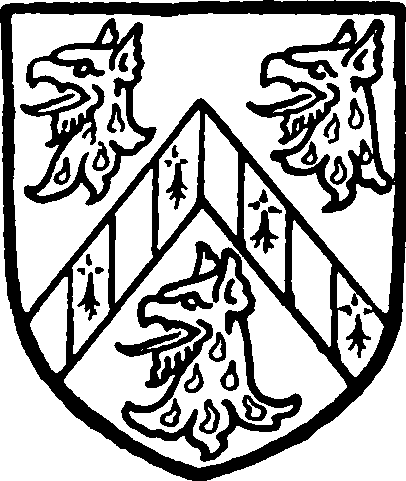
Laxton. Argent a cheveron gobony ermine and sable between three griffons' heads gules sprinkled with drops of gold.
The Town Hall and Market House, which stands in the middle of the Market Place, is a plain but not unpleasing gabled building of two stories erected in 1826, in which year the market cross, which stood to the east of it, at the top of St. Osyth Lane, was destroyed. The cross, which was dated 1591, consisted of a tall shaft on two octagonal stone steps, and was surrounded by a pent house of timber, also octagonal, with highpitched roof covered with stone slates. (fn. 7) The war memorial stands in the Market Place.
At the corner of West Street (formerly the High Street) and New Street is a house now turned into a shop on the ground floor, with a panel in the gable inscribed '1626 W.W.,' the initials being those of William Whitwell, who built the block of property on that site, which extended to, and apparently included, the Talbot Hotel in New Street. Part of this property was pulled down for the Post Office, erected in 1903, but the Talbot Hotel, originally the Tabret, (fn. 8) remains unaltered, and is a picturesque gabled building of three stories, with mullioned bay windows and wide central archway. The staircase is a good example of the period, with moulded rails, turned balusters and square newels with tall shaped finials. (fn. 9) The White Lion Hotel in North Street, another gabled three-story house with mullioned windows, has a panel with the initials 'E.H., I.H.,' but another inscribed 'A.H., B.H. mdcxli' appears to be modern, though probably marking the position of one of that date. The Anchor Inn, a low twostory building, at the corner of St. Osyth Lane and East Road, with a panel inscribed '1637 I.M.,' forms the end of a row of small houses in St. Osyth Lane, which were apparently built at the same time. (fn. 10)
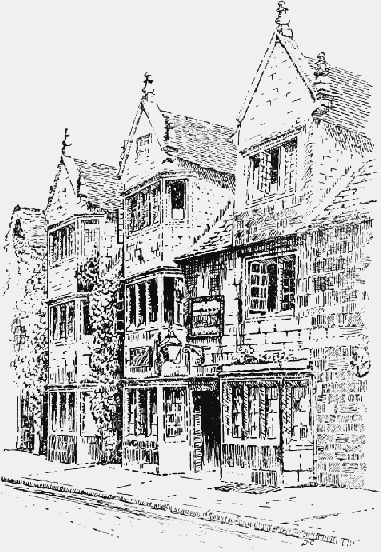
Oundle: The White Lion Hotel
A gabled house on the north side of West Street, near Chapel End, is dated 'W.H. 1650,' and in the same street are two stone gabled 17th-century houses forming a single property known since 1801 as Paine's Almshouses, (fn. 11) built on either side of a small courtyard and connected by a high wall with moulded coping, in which is a small but charming gateway with four-centered arch in a square frame, circular pediment, and tall obelisk finials. (fn. 12)
Latham's Hospital and School (fn. 13) in North Street, built in 1611, though much restored and wholly modernised internally, preserves generally its original appearance, and is of two stories with mullioned windows, and three gabled wings towards the street inclosing two small courtyards entered by stone gateways. There was a restoration in 1837 and a more extensive one in 1912, when railings took the place of the high stone wall to one of the courtyards. The inscriptions over the gateways were obliterated in Bridges' time, but over the school door was 'a rude picture of a schoolmaster in a chair, with a cap on his head and his scholars around him, but much defaced.' (fn. 14) The 'hall' of the hospital, formerly on the ground floor, is now in the upper story: it contains some good 17th-century furniture and the prayer which Nicholas Latham 'penned by himself' painted on a board above the fireplace. (fn. 15)
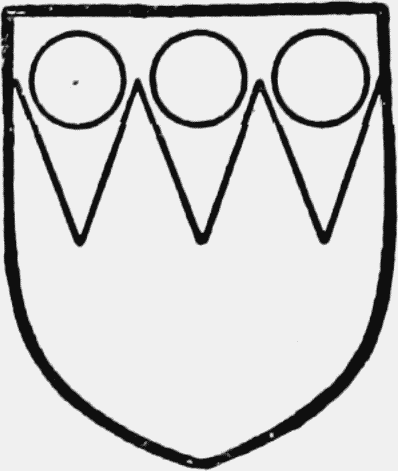
Latham. Or a chief indented azure charged with three roundels argent.
The house known as The Berrystead, (fn. 16) now the property of Oundle School, is a large building of two stories with lofty basement and dormered attics, originally of 17th century date, but apparently rebuilt from the ground floor in the century following. The basement has mullioned windows, and a stone dated 1670 has been reused in a later wing, but the main elevations have tall sash windows, central doorway with pedimented head, dressed quoins, and bold cornice. The house is under parallel roofs with two gables at each end. The garden extends down to East Road, where there is a small square 17th century pavilion, or garden-house, with pyramidal stone slated roof. The wrought-iron gates adjoining the lower road have been erected at the entrance to East Haddon Hall. Another house, known as Cobthorne, (fn. 17) in West Street, is of the same type, with mullioned windows in the basement, central doorway, and barred sash windows on the ground floor, and a range of five similar windows above. It was built by William Butler, commander of the Parliamentary forces, who used the timber from Lyveden House in its construction. (fn. 18) A 17th-century oak staircase with turned balusters with ball tops runs from basement to attic, and is a good specimen of the period, built round a central well-hole. (fn. 19)
Bramston House, at the corner of the Market Place and St. Osyth Lane (formerly St. Sithe's Lane or Lark Lane) is an early 18th-century building of three stories, the front elevation of which is of ashlar with tall flanking pilasters, plain central doorway, sash windows, cornice and balustraded parapet. York's House, on the south side of West Street, has a lead head dated 1715, and attached to a large 18th century house on the opposite side of the street is a gardenhouse of the same period facing Milton Road, which has round-headed sash windows and low domed stone slated roof.
Ashton chapel and schoolhouse, erected in 1706, is a rectangular building measuring externally about 57 ft. by 18 ft., with diagonal angle buttresses, and a bell-cote, (fn. 20) containing one bell, over the west gable. The schoolhouse, of two stories, occupies the east end of the building, which is faced with coursed, undressed stone, and has a slated roof. The entrance to the chapel is at the west end by a well-designed classic doorway, above which is a round-headed window of three lights, forming with it a single architectural composition. There is an altar-piece of canvas painted by Mrs. Creed, and two wooden tablets with long inscriptions relating the foundation of the chapel and school. (fn. 21) Two doors at the east end, one on each side of the altar, lead to the schoolhouse, to which there is also external access. The side windows of the chapel are of two rounded lights. There is an addition to the building at the east end or the north side.
Oundle is governed by an Urban District Council of 15 members formed in 1895, and is also the head of a Rural District Council extending from Yarwell to Thorpe Achurch and from Bulwick to Warmington, the town itself being excepted. The Urban District Council succeeded a body of Commissioners appointed under an Act of 1825, (fn. 22) consisting of the lord of the manor, the vicar and the master of the school as ex-officio commissioners, and 92 others named in the Act. The number was not to fall below 40 and the qualification was £500. The streets were to be improved by the removal of the Butter Cross, Shambles, etc.; the market day was changed from Saturday to Thursday and a stock market added; provision was made for lighting the town with gas or oil. The old Ascensiontide fair was later represented by a pleasure fair on Whit Monday; St. Valentine's fair for horses is kept on 25 February, St. Lawrence's fair is discontinued, but a new fair is held on 12 October. The Urban Council controls the water supply, but gas is supplied by a company.
The history of Oundle begins with St. Wilfrid, who established a monastery here, where he died in 709; his body was taken to Ripon. (fn. 23) A later archbishop of York (Wulfstan) was buried at Oundle in 957. (fn. 24) The town and the surrounding district were at a very early time given to the abbey of Peterborough, being restored or confirmed to the abbey in 972; the charter shows that it then was the local government centre for 'eight hundreds' and that it had a market. (fn. 25) It was probably about this time that St. Ethelwold visited the place in his endeavours to restore the abbeys destroyed by the Danes. (fn. 26) Leofsi son of Bixi afterwards despoiled the abbey of Oundle and other lands, and they lay waste for two years; afterwards, however, he was compelled to restore them. (fn. 27)
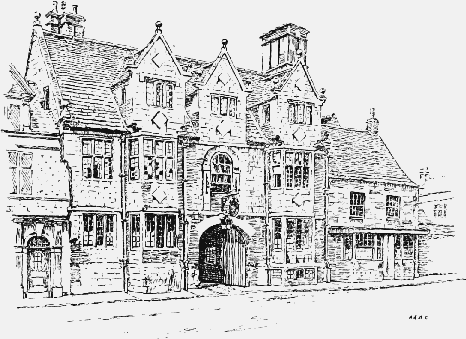
Oundle: The Talbot Hotel
As in the case of most monastic manors, the history of the place was peaceful and uneventful. With the district generally it suffered from the ravages of earl Morcar in 1065, (fn. 28) and again from King John's vengeance on the monks of Peterborough in 1216; the church escaped, but the granges were destroyed. (fn. 29) In 1230 Henry III passed through on his way south from Stamford to Hertford. (fn. 30) Occasional outrages are reported, as when the bishop of Durham's men were assaulted in 1297, and despoiled of the goods they had purchased for the bishop in the market; (fn. 31) or when in 1351 some knights and their men broke into the abbot's park and carried away his goods and deer. (fn. 32) A series of grants of pontage for the repair of Ashton bridge began in 1352 with renewals every few years till 1401. (fn. 33)
Sabine Johnson, a Polebrook woman, wrote in 1545: 'Ripen hath buried one of plague and at Oundle they die still very sore. I fear this town' [Glapthorn], (fn. 34); and a month later: 'At Oundle they die sore.' (fn. 35)
In the next century Oundle seems to have been a meeting place for county business, especially in connection with the musters of men liable to serve. (fn. 36)
John Leland (fn. 37) gives a good description of the town as he saw it about 1540, approaching from the south. The river name should be noticed: 'The town standeth on the further ripe as I came to it. The bridge over Avon is of five great arches and two small. There is a little gutter or brook coming upon the causey as I entered, on the left hand, into Avon river, among the arches of the bridge. The town hath a very good market and is all builded of stone. The parish church is very fair. One Robert Wiat, a merchant, and Joan his wife made a goodly south porch . . . They also made on the south side of the churchyard a pretty almshouse of squared stone, and a goodly large hall over it for the brotherhood of that church. And at the west end of the churchyard they made lodgings for two chantry priests founded there by them. The scripture in brass on the almshouse door beareth the date of the year of our Lord 1485 as I remember. At the west-northwest end of Oundle churchyard is the farm or parsonage house (fn. 38) impropriated to Peterborough. It is a £50 by year. Peterborough was lord also of the town, and now the king hath allotted it to the queen's dowry. . . . The river of Avon so windeth about Oundle town that it almost insulateth it, saving a little by west-northwest. Going out at the town end of Oundle towards Fotheringhay I rode over a stone bridge through which the Avon passeth. It is called the North bridge, being of a great length because men may pass when the river overfloweth, the meadows lying on every side on a great level thereabout. I guessed there were about a thirty arches of small and great that bare up this causey. From Oundle to Fotheringhay a two miles by marvellous fair corn ground and pasture, but little wood.'
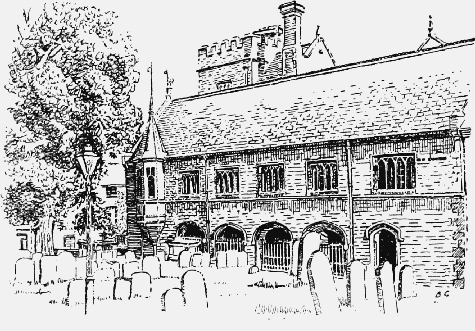
Oundle: Laxton's School
An elaborate extent was made in 1565. (fn. 39) The whole main street now called West Street and North Street was then High Street, and New Street was Bury Street; St. Sithe's (or Osith's) Lane, leading down to her meadow, was then Lark Lane. Leland's description of the Guildhall is borne out: 'A very fair hall, builded with freestone.' The lord's 'stockhouse and cage for punishment' stood at the turn from the Market Place to Bury Street. (fn. 40) The Burystede is thus described: 'A general hall with cook-house adjoining and several little garrets under one roof, a tiled stable and the malthouse thatched with straw.' (fn. 41) Near by was the Drumming Well which was one of the curiosities of the town. In; letter of Feb. 1667–8 occurs this account of it:
'There is much discourse of a strange well at Oundle, wherein a kind of drumming, in the manner of a march, has been heard. It is said to be very ominous, having been heard heretofore, and always precedes some great accident. I wrote to the town for an account of it and was informed . . that it bear for a fortnight the latter end of last month and the beginning of this, and was heard in the very same manner before the [late] King's death, the death of Cromwell, the King's coming in, and the fire of London.' (fn. 42)
William Butler commanded the Parliamentary forces here; he destroyed the house of the Ferrars at Little Gidding and also Lyveden. (fn. 43) The district seems to have been on the Parliamentary side, but a letter writer in 1655 speaks of 'this disaffected corner,' and states that there were persons enlisting horses and men at Oundle and promising fourteen days' pay. (fn. 44)
In 1666 there was again an outbreak of the plague brought from London; there were over 200 deaths. (fn. 45) Several tradesmen's token were issued about that time, sixteen being recorded by Williamson between 1657 and 1669. (fn. 46) A project for making the Nene navigable from Peterborough to Oundle occurs in 1692, but does not seem to have been carried through. (fn. 47) Sir Matthew Dudley about 1700 tried to establish the manufacture of serges, etc., bringing weavers over from Flanders; but the effort did not succeed. (fn. 48) A view of the town was engraved in 1710. (fn. 49) In 1722 there was a complaint that the postmistress of Oundle was notorious for opening letters. (fn. 50) Soldiers were stationed in the town in the 18th century. (fn. 51)
A curious scheme for the relief of the unemployed was tried here a century age At a Vestry meeting on 9 Feb. 1820 it was resolved that a levy of 8d. in the pound should be paid by every occupier of land and other property in the parish who was assessed above certain amount and considered competent to employ his quota of men and boys, or pay the amount assessed to the Overseers according to a plan outline in a pamphlet printed at Oundle by T. and E. Bel The plan was that if a farmer spent an amount equal to the levy in employing men and boys (men a 18d. a day and boys at 6d.) he would be relieved altogether; if not, he would be relieved of so much a he had so spent.
Sir William Laxton, founder of the school an almshouses, was a native of Oundle, who acquire wealth in London, becoming an alderman and mayor (1544). He died in 1556 and was buried in St. Mary Aldermary. (fn. 52)
Less attractive were two other natives—the fanatic William Hacket (d. 1591) and his associate or disciple Giles Wigginton (d. c. 1597). The former was expected to inaugurate a new religious era, but as his disciples talked of dethroning the queen, he came under the suspicions of the Government and was ultimately executed at the Cross in Cheapside, London. Wigginton's extreme Puritanism brought him into conflict with Whitgift and he was deprived of his vicarage of Sedbergh; ultimately, however, he was restored. He wrote some theological works.
Peter Hansted (d. 1645) was born at Oundle and educated at Cambridge, but had the D.D. degree given him at Oxford in 1642. He published various comedies and a poem in praise of tobacco; also several sermons. He died at Banbury during the siege.
John Newton (d. 1678), brought up at Oundle but springing from a Devonshire family, was educated at Oxford, and distinguished himself as a mathematician and author of school books. He was also a firm royalist and after 1660 received promotion, becoming a canon of Hereford in 1672.
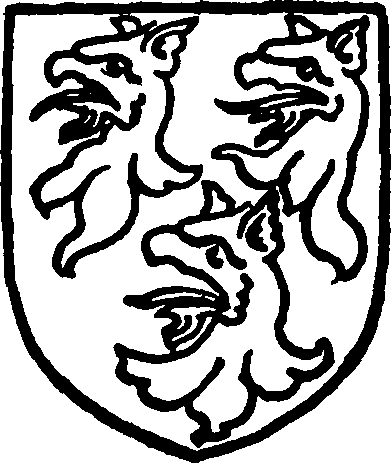
Whitwell of Berrystead. Azure three griffons' heads razed or.
Richard Resbury was vicar of Oundle during the Commonwealth period, (fn. 53) but resigned before 1662 and practised physic, preaching, however, in his own house at Oundle. His son Nathaniel was baptised at Oundle in 1643, educated at Cambridge, and being a conformist obtained various benefices, becoming chaplain to William and Mary in 1691. He died at Reading in 1711.
The Whitwells were another local family. William Whitwell settled in the house now known as Berrystead about 1680. John Whitwell, who took the name of Griffin, was born at Oundle in 1719 and had a distinguished military career, finally becoming field marshal (1796). In 1784 he was allowed the title of Lord Howard of Walden (4th baron) in right of his mother, and was created Lord Braybrooke in 1788. He died in 1797.
Stephen Bramston, a lawyer, resided at Bramston House about 1700. James Yorke Bramston, son of John Bramston, born at Oundle 1763, while studying law with Charles Butler, became a Catholic and ultimately a bishop, being Vicar-apostolic of the London district in 1827. He died 11 July 1836.
Wynne Ellis, born at Oundle in 1790, made a fortune in business in London and became famous as a picture collector; 44 of his pictures are in the National Gallery. He also gave large sums to charities, including £50,000 to Simeon's Trustees. He died in 1875.
Thomas Dix, usher of the school, wrote on land surveying (1799); one of his illustrations is a plan of the fields in N.E. Oundle.
Miles Joseph Berkeley, F.R.S., born at Biggin in 1803, was a distinguished botanist; he became vicar of Sibbertoft, 1868, and died in 1889. (fn. 54)
Other men of note were connected with Oundle by residence. Robert Wild, a puritan divine, ejected from his benefice in 1662, at last settled in Oundle, where he died in 1679. Dr. Anthony Tuckney, ejected from the mastership of St. John's College, Cambridge, after the Restoration, and William Dillingham, similarly ejected from the mastership of Emmanuel, passed some of their later years in Oundle. Dillingham's brother was the conforming vicar. John Noorthouck, author of a History of London, etc., passed the end of his life at Oundle, dying in 1816. (fn. 55) Thomas Haynes, of Oundle, wrote several books on gardening, 1811–2.
Manors
King Edgar in 972 confirmed to the monks of Peterborough the 'tun' called OUNDLE, with all that lies thereto, called the Eight Hundreds, and market and toll, so freely that neither king, bishop, earl nor sheriff may interfere, but only the abbot. (fn. 56) This was confirmed by later kings. (fn. 57) In 1086 the abbot had 6 hides in Oundle. The mill was let for 20s. and 250 eels. There were 50 acres of meadow, and woodland of 3 leagues by 2 leagues; when stocked, worth 20s. The market yielded 25s. The whole was worth 5s. in 1066, but in 1086 £11. (fn. 58) Land in Thurning, Winwick, Luddington and Hemington belonged to this lordship. Some forty years later the abbot held 6 hides in demesne in Oundle. (fn. 59) Yet another document of the same date states that there were 4 hides geldable, out of which 25 men held 20 yardlands, and rendered 20s., 40 hens, and 200 eggs. The men of the town had 9 ploughs, and ploughed once a week in autumn for the lord; and other works were done. There were 15 burgesses, who rendered 30s. The market rendered £4 3s., and the mill 40s. and 200 eels. The abbot kept the wood in his own hand. The men of the town and 6 ox-herds rendered 5s. chevage. The church pertained to the altar of the abbey. (fn. 60)
Richard I gave 40 acres in the manor of Oundle to be free of all exactions. (fn. 61) Henry III in 1268 granted a yearly fair on the morrow of the Ascension and for fourteen days following at the manor of Oundle; (fn. 62) and in 1304 Edward I granted the monks free warren in their demesne lands of Oundle and Biggin. (fn. 63) In 1316 the tenants of Oundle and its members were the abbot of Peterborough, the abbot of Crowland (for Elmington), and Hugh de Gorham (for Churchfield, etc.). (fn. 64)
Burgesses have been mentioned above. An "R., abbot of Burg," Robert of Lindsey (1214–22), confirmed various liberties to the men of Oundle: they were quit of all tallage, and might marry their daughters as they pleased; they were, however, to reap three days in the autumn, the abbot providing food for them on one day, and to pay pannage. The abbot reserved all pleas of the portman-mote and all customs belonging to the market. For these liberties the annual rent of £5 19s. 7d. due to the abbey was increased to £12 17s. 6d. (fn. 65) The value of the manor of Oundle and the grange of Biggin was assessed at £44 14s. a year in 1291. (fn. 66) In addition to the burgesses there were franklins and virgaters (or semi-virgaters). (fn. 67)
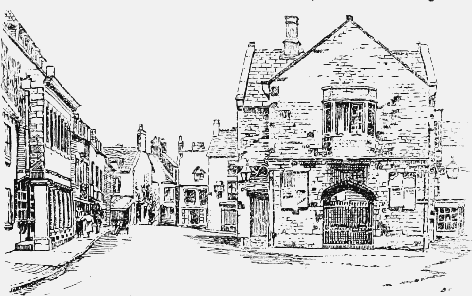
Oundle: The Market Place
A long account of the abbey's rights in OUNDLE and BIGGIN was compiled in 1321 after the death of Abbot Godfrey. In the town was a capital messuage, with dovecote and two water mills; also 170 acres arable land, with meadow and pasture. At Biggin were 200 acres arable land in demesne, and other 260 acres newly brought under the plough and therefore worth only 1d. an acre; also a park; two free tenants rendered 7s. and a pound of cummin. There were 37 free tenants in Oundle, holding 24 burgages, and rendering £10 4s. 3½d.; ten natives with 8 virgates of land, rendering £4; twelve natives with 7 virgates, rendering £8 13s. 4d.; with various boon works. The portman-mote and market tolls yielded 53s. 4d.; and there was another court worth 3s. 4d. a year. The total was £43 11s. (fn. 68) At an enquiry de quo warranto in 1329 the abbot claimed, among other things, 'through toll' at Oundle, as held by his predecessors, viz., for each sack of wool 2d., each horse load 1½d., bundle on a man's back ¼d., cartload of merchandise 2d., and other dues for animals and wine. He alleged that in former times there was no common way through Oundle, on account of the inundation of the waters, and this toll was granted for licence to pass through the abbot's land and make two bridges (at the cost of the county) on this soil. (fn. 69) A rental of April 1400 shows that the burgages were then held at varying rents, but 4s. was a usual sum; suit to the oven and portman-mote, and other customs were in force. Sometimes there were several tenants for one burgage. The burgesses' charter is mentioned, but not recited. The list of the free tenants is headed by John Wakirlee, who held one carucate of land, paying 12s. rent and providing reapers at harvest time; if he brewed, there was 1d. for ale toll; pannage, 1d. for each pig. His tenants also rendered 4d. rent, ale toll and pannage, and did reaping. (fn. 70) About the same time the fields were measured; Inhamfield, Howefield, and Holmfield are names. (fn. 71) In 1565 a freehold tenement in Hillfield was recorded thus: 'This was a manor in Wakerlees' days and kept a court baron upon the same, which is now dismembered because the land is sold to divers persons. (fn. 72)
Of the tenants there is little to be told. Vivien de Churchfield held 1/6 hide in Oundle in the time of Henry I, (fn. 73) having received it from Abbot Thorold (1070–98), together with ¼ hide in Warmington, to be held by serjeanty of serving as the abbot's knight with two horses and arms. (fn. 74) This probably descended like Churchfield. In 1400 Lord Fitz Walter held in right of his wife, daughter of Sir John Devereux, a free tenement formerly belonging to Hugh de Gorham. (fn. 75) There are a few fines concerning tenements in Oundle, among which may be mentioned those by which John de Grey obtained (1259–61) a messuage and land from John de Suleny and a similar tenement from William de Musca and Joan his wife. (fn. 76) In 1345 Thomas de Pabenham held 50s. rent of Roger de Grey from a carucate of land in Oundle occupied by Basilia, widow of John de Croyland. (fn. 77)
William Cook of Oundle, who died in 1503, held messuages and land there of the abbot; his heir was his son Richard, aged seven. (fn. 78) Richard Chamberlain died in 1624, holding messuages etc. in Oundle of the king as of his manor of East Greenwich, lately belonging to the Minoresses of Aldgate. (fn. 79) From depositions taken a few years before, it appears he had land by the North Bridge, Howehill fields, Pexley, Windmill fields, St. Stithes fields, Further Marsh, Higher Marsh, Hey furlong, the Long Leaze beneath the Fleet, and Twidalls Crowder meadow. (fn. 80) Other religious houses having lands here were the priory of Fineshade, (fn. 81) the college of Fotheringhay, (fn. 82) and the Hospitallers. (fn. 83)
The abbot's grange or manor of Biggin has been mentioned above. Fulk de Lisures, forester to Henry II, made a purpresture upon the demesnes of Oundle which William his son quitclaimed to Abbot Benedict (1177–93). The abbot then built there New Place, or Biggin Grange. (fn. 84) Geoffrey Cras later released to the abbey his land in the Biggin, the 'new place of the monks.' (fn. 85) In 1285–91, Gilbert de Clare, earl of Gloucester, laid claim to the manor, alleging that it was not appurtenant to Oundle, as the abbot claimed, but was a member of the honour of Clare. (fn. 86) The plea is said to have been ended by the sudden death of Earl Gilbert (Dec. 1295), and the abbot retained the manor. (fn. 87)
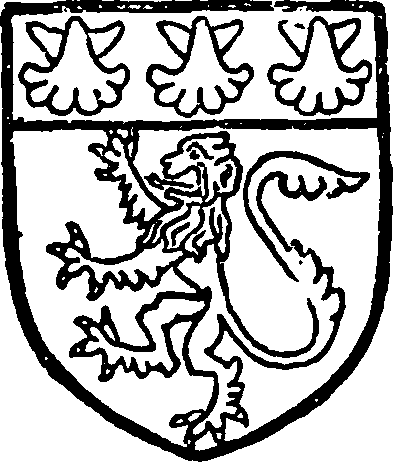
Russell, Earl of Bedford. Argent a lion gules and a chief sable charged with three scallops argent.
After the dissolution of the abbey the king's ministers in 1546 returned as profits of the manor of Oundle the mill, the manor of Biggin, and various minor profits, as the oven, fishery (at farm), the custom called Tolchester ale, tolls of fair and market, and pannage. (fn. 88) The steward was Sir Robert Tyrwhitt, and the bailiff Gilbert Pickering, both appointed in 1543. (fn. 89) This lordship was among those assigned as jointure to Queen Katherine Howard in 1542, (fn. 90) and then in 1543 to her successor, Queen Katherine Parr; (fn. 91) the latter held until her death in 1548. Then on 26 January 1549–50 Edward VI granted to John earl of Bedford the manors of Oundle and Biggin, with fairs, markets, and sheriff's tourn in Oundle, with other lands, to be held by the fortieth part of a knight's fee, and rendering for Oundle £39 13s. 1d. (fn. 92) He died in 1555, and was succeeded by his son Francis. Two new fairs on the feasts of St. Valentine (14 Feb.) and St. Lawrence (10 Aug.) were granted, and the survey already cited was made for this earl in 1565. He died on 28 July, 1585, having in 1580 settled the manors of Oundle and Biggin on his wife Bridget, with remainder to his eldest son Francis. This son having died the day before his father, the succession passed to his son Edward, then aged 13. (fn. 93) Edward died on 1 May 1627, without issue, and was succeeded in the title and entailed estates by his cousin Francis (son of William), but the heir general was Anne, daughter of John, son of Francis, the 2nd earl, and wife of Henry Somerset Lord Herbert, (fn. 94) who in 1628 succeeded his father as earl of Worcester.
A dispute as to a court leet at Oundle, between Francis earl of Bedford, as lord of the manor, and Sir Edward Montagu, as lord of the hundred, about 1630, shows what were the customs. The former argued that the grant of the manor to the first earl, as it included the sheriff's tourn, proved his claim, while the latter insisted on the grant of the hundred to his predecessor, Sir Edward Montagu. The abbots of Peterborough had kept a leet of the hundred, and the residents and inhabitants of Oundle had done suit and service at it. Two eminent lawyers, to whom the matter was referred, agreed that the old leet was of the hundred, not of the manor, and that the earl's tenants in Oundle were not discharged of suit to it. No new court had been created. The sum of 6s. 10d. for 20½ yardlands, in respect of the sheriff's tourn, belonged to the manor; also 8s. for the view of frankpledge. There might be suits for anything under 40s. in the manor court, although the manor was within the hundred. Goods of felons and fugitives also pertained to the manor. As to fines and amercements there was a doubt; they probably belonged to the hundred. (fn. 95)
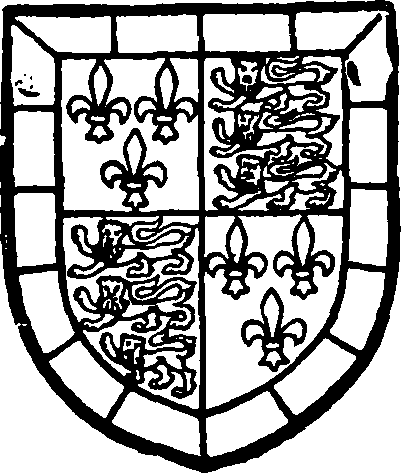
Somerset, Earl of Worcester. France quartered with England in a border gobony argent and azure.
The story about this time is not clear. Edward earl of Bedford and Lucy his wife in 1614 gave the grange of Biggin, with its appurtenances in Oundle, Barnwell and Southwick, to trustees, (fn. 96) and later in the same year they demised the manor house of Oundle (i.e., the Berrystead), with its dovecote, lands etc. to John Okes for 99 years, (fn. 97) and this term or a fresh one became vested in Sir James Evington in 1632–33. (fn. 98) The manor itself, with the rectory and the advowson of the vicarage, are stated in a fine of 1629 to be in the hands of Henry earl of Worcester and Anne his wife and John Somerset, son and heir apparent of the earl; (fn. 99) this was probably Anne's inheritance. Mention of the rectory and advowson seems to be a mistake. The rectory, which had a manor of its own, had been sold by James I in 1607 to Sir Thomas Monson and William Darwyn, but the advowson of the vicarage was retained by the Crown. (fn. 100) On this point, therefore, the fine of 1629 is misleading. John Somerset died soon afterwards, and in 1636 the manor of Oundle, with the rectory and advowson, ten messuages, three water mills, dovecote, lands, etc., in Oundle, Barnwell, and Southwick was held by his brother Edward, then son and heir apparent of the earl of Worcester. (fn. 101) It is probable that he wished to sell it, for the earl of Manchester, writing to his brother, Lord Montagu, says: 'The last time I spoke to my lord of Worcester he told me he thought his son would sell Oundle. I accepted of his offer. . . . The place is so fit for you as I imagine you will strain your purse or sell some other land to have this.' (fn. 102) The Montagus did not get it, and in 1650 Henry earl of Worcester was a vouchee in a recovery of the manor. (fn. 103) The manor and part at least of the lands were held by Sir Gilbert Pickering and Elizabeth his wife in 1662, (fn. 104) but in 1676 William earl of Powis, Elizabeth his wife, Henry earl of Norfolk and Henry his son and heir apparent held the manor of Oundle with the rectory and advowson of the vicarage. Warranty was to be given by the heirs of Elizabeth, (fn. 105) who was the younger daughter of the above-named Edward (Somerset), marquis of Worcester; her elder sister Anne had married the earl (later, duke) of Norfolk, and this accounts for her husband and son being named in the fine.
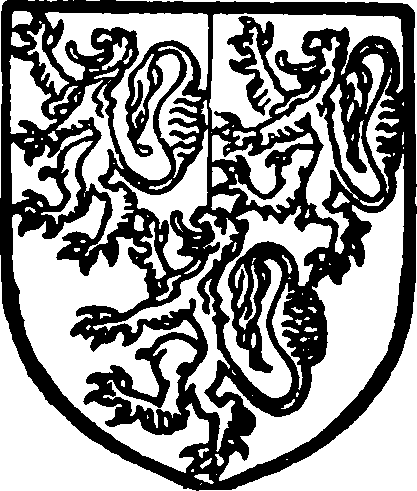
Herbert, Earl of Powis. Party azure and gules three lions argent.
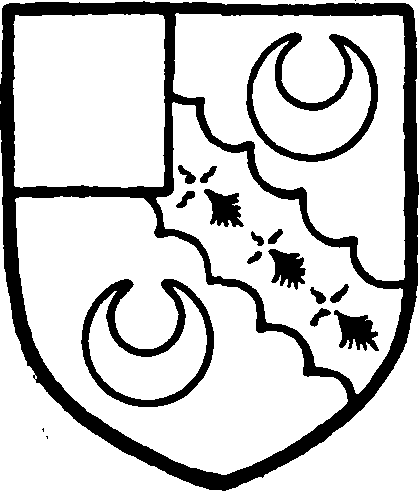
Watts. Azure a bend engrailed erminois between two crescents or with a quarter gules.
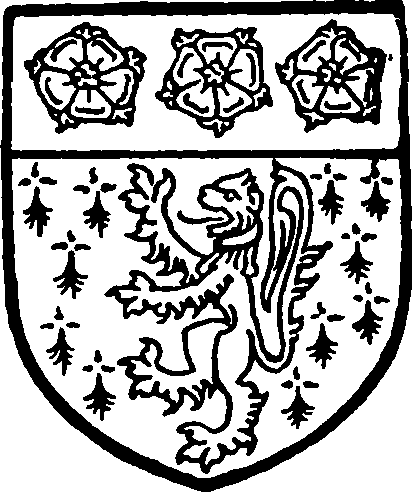
Russell. Ermine a lion gules with a collar argent and a chief azure with three roses argent thereon.
The earl (later, marquis) of Powis refused to accept the Revolution of 1688 and went into exile with James II, dying at St. Germains in 1696. Being outlawed, his estates were confiscated, and in 1691 it was found on inquiry that he had held the manor of Oundle, with court baron, market, three fairs, water mill, lime kiln, Park Wood, Hills Wood, Pexley Wood, Hall Wood, Parson's Wood, the capital messuage called the Berrystead and site of the manor (late in the possession of Bridget Page and then of Thomas Manning), also the manor of Biggin, with appurtenances in several adjacent parishes. (fn. 106) The estates were in 1696 granted to William Earl of Rochford (fn. 107) but were eventually restored to the Marquis of Powis's son William (d. 1745), (fn. 108) who sold Oundle and Biggin together with Benefield in 1724 to James Joye. He died in 1741 and was succeeded by his son Charles who died unmarried in 1776. Charles was followed by his brother Peter Joye of the Inner Temple, who by his will proved in 1782 (fn. 109) left his property to his wife Anne for life with remainder to his sisters Elizabeth and Jane. Anne married as her second husband Sir Isaac Pocock and died in 1818, (fn. 110) being predeceased by her sisters-in-law. The trustees under the will of the survivor Jane Joye (fn. 111) sold the property in 1822 to Jesse Watts Russell, who had taken the additional name of Watts on his marriage with Mary daughter of David Pike Watts of Portland Place. He was succeeded in 1875 by his son Jesse David Watts Russell, M.P. for North Staffordshire (1879) whose eldest daughter Josephine married Sir Arthur Birch, K.C.M.G. Their son Capt. Arthur Egerton Watts Russell (who took the name of Watts Russell in 1898) died in 1923 leaving a son David. Mrs. Watts Russell of Biggin Hall, is now lady of the manor.
The Court Rolls begin in October 1678. The market dues are still paid to the lord of the manor. (fn. 112)
The RECTORY MANOR has been mentioned in the preceding account. Nothing is known of the conditions while it was in the possession of the rectors of the parish; the rector about 1400 paid 2s. a year for free entry to the fields. (fn. 113) When the vicarage was constituted the rectory was appropriated to the monks of Peterborough and shared the fate of their other estates. In 1546 John Nox farmed the rectory for £55 13s. 4d. a year, (fn. 114) and in 1590 the Crown granted the rectory, with the advowson of the vicarage, to Sir Anthony Mildmay, Grace his wife, and Mary their daughter, for life. (fn. 115) Mary became Countess of Westmorland and died in 1640, when this grant would expire. As already stated it was sold by James I to Sir Thomas Mounson and William Darwyn with all rights, court, view of frank pledge, etc., except the advowsons of churches, vicarages, etc., to be held in socage of the manor of East Greenwich at a perpetual rent of £39 6s. 8d.; ecclesiastical dues were to be paid also, including 6s. 8d. a year to the poor and £13 6s. 8d. to the vicar of Oundle. (fn. 116)
In 1674 the rectory manor was acquired by Bernard Walcott from William Page and Bridget his wife, as the manor of the rectory of Oundle and the rectory with its tithes, etc., two messuages, 30 acres of land, dovecote, etc.; (fn. 117) and Bernard Walcott and Elizabeth (Page) his wife were in possession in 1680. (fn. 118) Out of the Crown's reserved rent £32 13s. 4d. a year was granted by James I to his queen Anne (fn. 119) and by Charles I to Queen Henrietta Maria. (fn. 120) Later it was sold and shared by various persons, (fn. 121) whose rights were purchased in 1750 by William Walcott, (fn. 122) who thus held the rectory clear of the rent to the Crown. Dr. William Walcott, who died in 1806, left (by his wife Mary Creed) a son William, after whose death in 1827, aged 74, the property went to the Simcoe family, who disposed of it. (fn. 123) The rectory manor was purchased by John Smith, who was succeeded by his son John William Smith, of a local family of brewers and bankers. The dues included mortuaries and Easter dues, called 'Apron money' in Oundle, because the tradesmen were the chief contributors; these were originally fixed at 2d. per head, but ultimately stood at 1s. 2½d. per house. (fn. 124) About 1870 the court of the rectory manor was held every two or three years.
CHURCHFIELD occurs as Ciricfeld in an ancient account of the boundaries of a piece of land at Oundle. (fn. 125) Abbot Thorold gave Vivian ½ hide in Circafeld (fn. 126) as well as the 1/6 hide in Oundle already mentioned, and he held it c. 1125. (fn. 127) He was succeeded by Henry Angevin, who was living in 1133 and 1163, and he by William Angevin before 1169, who left a widow Ismania. (fn. 128) Baldric the Angevin, his son, held a knight's fee in Churchfield, Warmington and Oundle in 1189, (fn. 129) and acquired 32 acres in Churchfield from Matefrei the dispenser in 1202, (fn. 130) and was witness to a charter of Abbot Robert de Lindsey (1214–22). (fn. 131) Later (?1242) William Angevin held ½ a knight's fee in the three places named, (fn. 132) but he or a son William incurred forfeiture in the Barons' war, his lands being given to Philip Marmion, who afterwards released the same to the abbot of Peterborough. (fn. 133) Hugh de Gorham married Margery, daughter of William Angevin, (fn. 134) and in 1289 did homage to the abbot for lands in Churchfield, Oundle, Stokes, and Warmington. (fn. 135) Hugh died in 1325, but in 1312 he and Margery his wife gave the reversion of this estate to William de Gorham (their son) and Isabel his wife. (fn. 136) William and Isabel sold the manor of Churchfield to Robert de Wyvill, bishop of Salisbury, in 1332. (fn. 137) Four years later it was settled on Henry Wyvill and Katherine his wife and their issue, (fn. 138) and in 1346 Henry Wyvill held ¼ knight's fee in Churchfield, formerly the estate of Geoffrey Angevin. (fn. 139) Katherine, as widow of Henry, held it in 1352, when it was settled on Geoffrey Blount and Margaret his wife, probably the daughter of Henry. (fn. 140) Twenty years later (1372) Walter de Frampton of Melcombe Regis and Margaret his wife had the manors of Churchfield and Lyveden. (fn. 141) From this date Churchfield followed the descent of Lyveden in Aldwinkle St. Peter (q.v.).
In 1338 the abbot of Peterborough received licence to acquire in mortmain inter alia 33s. rent from tenements in Oundle called CLARYVAUS FEE, the vendor being the rector Robert de Croyland. (fn. 142) It does not appear that this 'fee' was a manor. The surname occurs in 1347, when Richard Aloom of Oundle was pardoned for the death of Nicholas Clerivaux. (fn. 143)
ASHTON (Ascetone, 1086, Ayston, Hen. I and common, Ashton, xvi cent.) is now a separate township, formed in 1885 when the adjacent hamlet of Elmington was added to it. (fn. 144) In 1086 the abbot of Peterborough held it as 4½ hides. Two mills rendered 40s. and 325 eels. It was worth only 8s. in 1066, but in 1086 £7. There was a free tenant, Ivo, who held ½ hide, worth 4s. (fn. 145) About 1125 the abbot held 4 hides in demesne, and there were now two free tenants, Ralph Papilian and Levenoth, holding ½ hide each. (fn. 146) The descent of these free tenements cannot be traced; they are mentioned in 1321 as paying 5s. each, (fn. 147) in 1408 the fees formerly held by John Papilliun and William son of Ralph contributed 12d. each to the sheriff's aid (fn. 148). Simon de Stokes in 1242 did the service of ½ knight for the 2 hides and one virgate he held of the abbot in Stoke, Ashton and Warmington. (fn. 149) Some 13th century deeds (fn. 150) show that there was a family using the local name, Robert son of Adam de Ayston making some small gifts. (fn. 151) Roger Malherbe of Polebrook gave to the Hospital of St. John Baptist at Armston the rent of a pound of cummin due from David de Ayston and Constance his wife for land at Ashton. (fn. 152) The abbey of Peterborough's estate in Ashton, lands, rents, mills, and bakehouse, was valued at £10 17s. 4d. a year in 1291. (fn. 153)
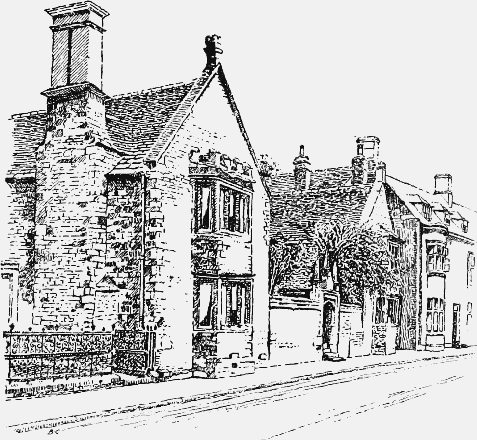
Oundle: Paine's Almshouses
In 1309 Godfrey abbot of Peterborough and the convent demised to John de Croyland and Robert his son for life a messuage and 3 virgates of land in Ashton, with the water mills, millpool, moor, Yakholme and meadow; they were to render £7 16s. 8d. a year and do ploughing and other services. (fn. 154) A survey made in 1321 shows that in Ashton there were a messuage and two water mills; in demesne were 102 acres of arable and 10 acres of meadow. Fourteen natives each held a messuage with 1 virgate of land (which would account for 3½ hides, unless the 'small virgate' was used), paying 8s. rent and doing two ploughings at the winter and Lent sowings, and reaping two days. Two other natives, holding 2½ virgates, rendered 25s., and two customary tenants held 1 virgate and rendered 11s.; but these four did no works. A cottar paid 6d. rent, but worked for the lord every Monday from midsummer to Michaelmas. (fn. 155)
John Norwych of Gayton died in 1504 holding a messuage in Ashton of the abbot of Peterborough by fealty and 8d. rent. His wife Katherine is named, and his son Simon, aged 13, was heir. (fn. 156)
In 1535 the revenues of the abbey from Ashton are given. (fn. 157) In 1553 the manor of Ashton, with manor house and three mills, and the rectory, etc, of Wilboston, were sold by the Crown to Hugh Lawe and Thomas Lawe, who were to hold them by the service of 1/40 knight's fee. (fn. 158)
A dispute arose in 1602 between Sir Anthony Mildmay and others and Thomas Lawe concerning the tithes of Ashton and its four mills. Three of the mills were corn mills under one roof; the other was a fulling mill. Defendant and his father Hugh Lawe were alleged to have had the tithes by lease 50 years ago. Robert Selbie, a tanner, aged 78, deposed that in his youth the fulling mill was known as the New Mill; 13s. 4d. used to be paid as tithe for the corn mills. Hugh Lawe had transferred his lease of the tithes to Mr. Price (who married Hugh's daughter), and Sir Anthony Mildmay then had it. He remembered the chapel of ease at Ashton; a priest called Sir John said service there in the time of Henry VIII, and witness had acted as his clerk. Another witness said that the minor tithes were paid to Sir John as 'chapel tithes,' but the tithes of corn, wool, lamb, and the mills, with 30s. 2½d. and a few pence for the ancient meadows belonged to the rectory. There was mention of Sandells meadow in Ashton, said to belong to Oundle. (fn. 159)
Thomas Lawe died at Ashton in 1628, holding the manor of Ashton, and a capital messuage occupied by Peter Dayrew. By a settlement made in 1627 the estate was to remain to John Lawe of Wigston (Leics) and then to his brother Thomas Lawe of Mount Sorrell (Leics); but the heirs were Bridget Aprice, widow, his sister; Thomas Aprice, son of Robert Aprice by Elizabeth his wife, another sister; John Wildbore, gent., son and heir of Matthew Wildbore and Elizabeth his wife, one of the daughters of John Flamsteed and Catherine his wife, another sister of Thomas Lawe; and this Catherine's four other daughters—Meriell wife of William Gifford, Mary wife of Francis Muscott, Joan wife of Roland Tampian, clerk, and Catherine Fowler, widow. (fn. 160) The brothers were probably half-brothers and therefore passed over by the jury.
The estate was probably disposed of in parcels and the 'manor' does not occur again, though J. W. Smith of the Rectory, Oundle, was styled lord of it in 1874. (fn. 161) A manor house and a green are marked on the map to the south of the chapel.
Peter Dayrew or Darrell, mentioned above, was succeeded by Newdigate Paynes, who died at Ashton in 1643, leaving a son and heir Thomas, aged 14½ The tenure was unknown. (fn. 162)
Bridges states that about 1710 there were 25 families in Ashton. (fn. 163) About 1870 'a few scattered farm houses' was the description. The Hon. Mrs. N. C. Rothschild is now the owner, with a residence called Ashton Wold.
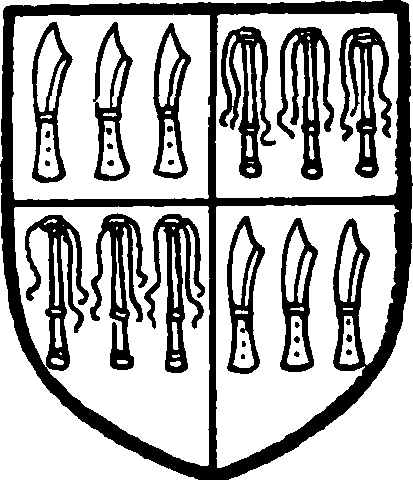
Croyland Abbey. Gules three knives argent quartering azure three scourges or.
In ELMINCTON, according to a spurious charter in Ingulph, the abbey of Croyland held 3 hides of land at an early date, possession being confirmed by Edred (946–955). (fn. 164) Ingulph says that Abbot Turketul gave this manor when he became a monk. (fn. 165) In 1086 the abbey had two estates there; one hide was held in demesne, with land for one plough, and was worth 8s. in 1066 and 16s. in 1086; two hides, with land for three ploughs, were worth 12s. and 20s. respectively at those dates. (fn. 166) In the survey made c. 1125 only one hide is recorded. (fn. 167) A fine in 1218–9 between the abbot of Croyland and Ascelin de Waleis concerning land in Elmington is recorded. (fn. 168) It was found in 1276 that the abbot's tenants in Elmington had withdrawn suit to the hundred court for the last 24 years; they had been accustomed to do this suit and pay 12d. at the sheriff's tourn. (fn. 169) In 1316 the abbot of Croyland was lord. (fn. 170)
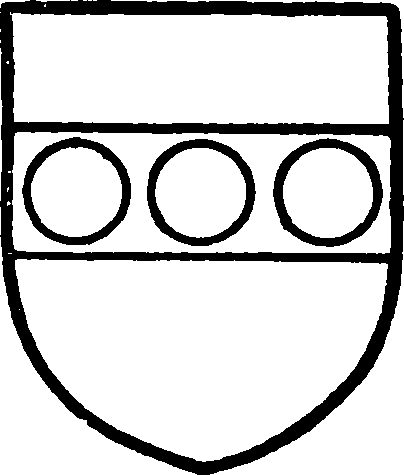
Kirkham of Fineshade. Argent of fesse gules with three bezants thereon.
At the dissolution it was found that the abbey had received £7 10s. from Elmington, by a demise made in 1534 to Thomas Clark and Margaret his wife; the money was used by the pittancer and almoner. (fn. 171) The reversion of the 'manor and hamlet' was sold to Sir Robert Kirkham in 1542, it being stated that Richard Clark, father of Thomas, had held it beforetime; Kirkham was to hold by knight's service. (fn. 172) The manor had been included in the jointure of Queen Katherine Howard in 1541, (fn. 173) but she was executed a year later. Sir Robert Kirkham, who also acquired Fineshade, which became the seat of his family, died in 1558, while the lease was still in force. (fn. 174) The manor of Elmington was included in a settlement made by his son William Kirkham the elder in 1586. (fn. 175) This settlement is recited in the inquisition taken after his death in 1599, when he was succeeded by a son William, who had a brother Thomas. (fn. 176) Walter Kirkham son of William died in 1636 holding the manor of Elmington of the king by knight's service; the heir was his cousin Robert (aged 40), son of the above-named Thomas. (fn. 177) In 1647 Robert Kirkham, Anne his wife and Walter (his son) joined in selling this manor to Henry Pickering; warranty was promised against the heirs of Sir Robert Kirkham, the great grandfather, William the uncle, and Walter his son. (fn. 178) Kirkham was deeply in debt. (fn. 179)
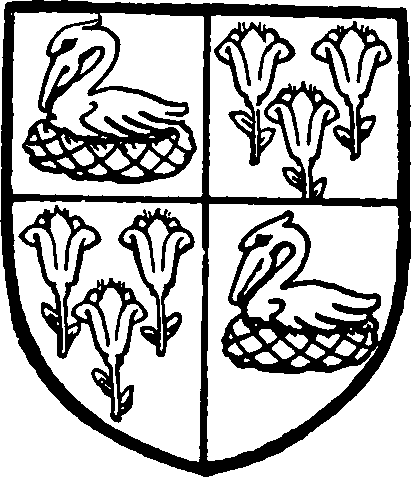
Corpus Christi College. Gules a pelican in her piety argent quartering azure three lilies argent with stalks and leaves vert.
Henry Pickering and Elizabeth his wife were in possession in 1660. (fn. 180) He was created a baronet soon afterwards, and seated at Whaddon in Cambridgeshire. His father was rector of Aldwinkle in the Commonwealth time (1647–1657), and he himself had been a colonel in the Parliamentary army. His wife was Elizabeth daughter of Sir Thomas Viner. He died in 1668. (fn. 181) The manor of Elmington, with a messuage, 150 acres of land, etc., was in 1681 secured to Sir Henry Pickering, bart., (fn. 182) but was sold in 1687 to Dr. John Spencer, master of Corpus Christi College, Cambridge, and dean of Ely. The price paid was £3,600 and the estate was said to be worth £200 a year. Dr. Spencer gave it to his college, for the augmentation of the mastership and other endowments. He expressed a wish that the master should visit the estate twice in three years. (fn. 183) There is now no manor claimed, but the estate remains in the possession of the college. There were two farmhouses in Elmington about 1870.
Church
The church of ST. PETER consists of chancel 47 ft. by 21 ft., with north and south chapels, each 22 ft. by 17 ft., clearstoried nave 80 ft. by 20 ft., north and south aisles, each 18 ft. wide, north and south transepts, each 36 ft. by 20 ft., south porch, and west tower 17 ft. square, surmounted by a lofty spire. All these measurements are internal. There is also a twostoried vestry on the north side of the chancel at its east end. The total internal length of the church is 153 ft., and the width across nave and aisles 62 ft.; across the transepts the width is 98 ft.
No portion of the building is older than the 12th century, but part of a pre-Conquest grave-slab, or coffin-lid, with plait-work in two panels, (fn. 184) found below the south transept about 1904, is probably a relic of the burial ground attached to the first church on the site.
The plan of the existing building seems to have developed from a cruciform 12th-century church with central tower, the nave of which was the same width as at present, and about 51 ft. long. The tower occupied the position of the existing eastern bay, with transepts about 18 ft. long, extending north and south, and the chancel was about half its present length. There is no reliable evidence of any change of plan before the end of the 12th century, though a plain chamfered string at the west end of the north aisle has suggested that an aisle may have been added on that side. It is more likely, however, that the string is not in its original position, and that the plan of the building remained unchanged until the first half of the 13th century, when very extensive alterations and additions were made, amounting almost to a rebuilding. The chancel was lengthened, chapels added on both sides at its west end, that on the south being the Lady Chapel, (fn. 185) and aisles thrown out from the nave in line with the ends of the already existing chapels. All this work appears to have been completed by about 1260, but the south aisle and chancel chapels seem to have been built first and finished before the north aisle was taken in hand, and probably before the chancel was completed. The reconstruction and lengthening of the transepts followed during the last quarter of the 13th century at a time when geometrical window tracery was fully developed, but the central tower appears to have remained standing till about 1340–50. It was then taken down, the western arch of the crossing being entirely removed, and the tower space added to the nave, new arches made into the chancel and transepts, and a clearstory carried through from the west wall of the chancel to the west end of the church. The three new arches closely correspond in moulding to the chancel arch at Cotterstock church, which was rebuilt soon after the foundation of the chantry college there in 1338; it is therefore reasonable to suppose that this work at Oundle dates from the decade immediately preceding the Black Death, the outbreak of which may have postponed the building of the west tower. The five-light east window of the south chapel, and possibly one of the south windows, was inserted about this time, or perhaps a little later. The tower and spire were not begun until the end of the 14th or the beginning of the 15th century. Their scale suggests that a rebuilding of the nave, such as took place later at Kettering, was contemplated, though never carried out. The tower was built a little to the west of the existing wall of the church, with complete buttresses on all sides, the old wall being afterwards taken down and the nave joined to the tower by hastily executed masonry.
The chancel walls were heightened and the pitch of the roof lowered in the 15th century, when the present east window was inserted. The roof of the north chapel was also lowered in the same way, the head of its east window being raised and a large new window inserted in the north wall. Other windows were inserted during this period in the aisles. The porch is said to have been built about 1485 by a merchant named Robert Wyatt and Joan his wife, who founded the almshouse to the south of the churchyard. The vestry is an addition of the 16th century. (fn. 186)
The spire was rebuilt in 1634, and restored in 1837, and again in 1899. The church underwent an extensive restoration in 1864, when galleries and pews erected earlier in the century were removed.
The whole of the building is faced with rubble and has low-pitched leaded roofs behind plain and battlemented parapets. Internally, except in the chancel and chapels, where the plaster remains, the walls have been stripped.
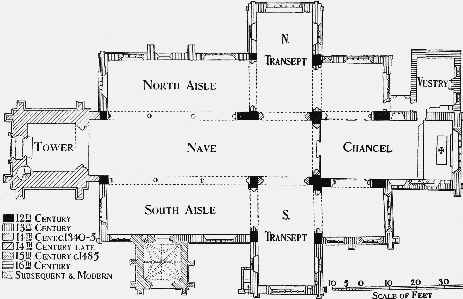
Plan of Oundle Church
Of the 12th century fabric a fair amount of walling remains at the east end of the nave and west part of the chancel, the arches to the chapels and transepts having been cut through the earlier walls. Architectural features, however, are scanty. The top of a round-headed window remains over the arch between the chancel and north chapel, and the inner arch of the blocked north doorway of the chapel appears to be of this date, but if so it is not in its original place, the position of the window indicating that there was no chapel here in Norman times. (fn. 187) The south-west quoining of the original south transept at its junction with the aisle is still visible, and portions of early masonry in all probability remain at the angles of both transepts, and possibly at the west end of the nave. (fn. 188) The position of the west arch of the central tower seems to be indicated by corbels which remain in the walls, and the 12th century plinths of the chancel arch and of the responds of the north and south arches of the crossing remain below the present bases. The longer masonry pier at the east end of the 13th century nave arcade on the north side probably indicates that there was a projecting vice or staircase turret at the north-west corner of the tower, (fn. 189) which would stand within the aisle until the tower was demolished, and thus account for the different spacing of the arcade on that side.
The chancel has a five-light east window with perpendicular tracery and a roof of four bays. In the south wall are two 13th century windows, each of two trefoiled lights and quatrefoil plate tracery, lengthened in the 15th century by their heads being raised, and there is a similar window in the north wall. The plain trefoiled piscina recess is original, but the three sedilia west of it, arranged in ascending order, were made in the 14th century, and have ogee cinquefoiled arches with crocketed hoods and finials on detached shafts with moulded capitals and bases. The responds of the arches between the older western part of the chancel and the chapels have rounded capitals with good early 13th century mouldings and bases with deep water moulds. The arch on the north side is segmental in form and cuts into the sill of the Norman window; that on the south side is pointed, with two chamfered orders, and retains traces of colour. The west arches of both chapels opening into the transepts are of two chamfered orders and the capitals of the half round responds have nail-head ornament much renewed. The arch from the south aisle into the transept corresponds to these in detail, and the south arcade of the nave, of three bays, has arches of two chamfered orders, and cylindrical columns with deep water-moulds in the bases and elaborately moulded capitals with nail-head ornament in the groove above the lowest projecting member. The west window of the south aisle is composed of five graduated lancets. All the work from the west part of the chancel represents the alterations of the beginning of the 13th century. In the north arcade of the nave, also of three bays, the bases of the cylindrical columns have hollow mouldings of a more cramped design than those on the south, and there are no bands of nail-head in the capitals, while the abaci, instead of consisting of a roll, fillet, and soffit hollow, are formed of a scroll, quirk and small under-roll. The arch (fn. 190) into the north transept from the aisle has a continuous outer chamfer and the responds supporting the inner chamfer are filleted, as are also the responds of the arcade on this side. The west window of the north aisle, wholly renewed on the outside, consists of four lancets of equal height, the head being filled with plate tracery—two quatrefoiled circles below a sexfoiled circle. The westernmost of the two south windows of the south chapel has three quatrefoiled circles in the head. The north doorway has a moulded arch of three orders on jamb shafts with moulded capitals and bases. All this work, with the possible exception of the doorway which appears earlier, is of about the same date as the east part of the chancel, c. 1250–60.
The transepts project 18 ft. beyond the aisles and beneath the south transept is a small vaulted crypt, or bone-hole, approached by steps from the outside. The five-light north window and the two-light west window of the north transept have tracery formed by the curving and intersection of the mullions, and the three-light east window has geometrical tracery in the head, with very acute-angled trefoil cusping, and a row of ball-flower round the upper portion. The south window of the south transept is also of five lights with excellent geometrical tracery, and the east and west windows are each of two rounded trefoil lights with a large quatrefoiled circle in the head. The five-light east window of the north chapel is of this later period and has geometrical tracery, but it appears to have been lengthened in the 15th century when the plain four-light north window was inserted. The window in the south aisle east of the porch is of five trefoiled lights with geometrical tracery, but that west of the porch and the corresponding window in the north aisle are four-centered 15th century openings of three cinquefoiled lights. The window in the north aisle east of the doorway is of five cinquefoiled lights like the east window of the chapel. In the south chapel is a piscina beneath a cusped ogee arch, and there is another piscina of the late 14th or early 15th century in the south transept, together with an aumbry. (fn. 191)
The three arches of the former crossing are of two moulded orders, the outer continuous, the inner on responds with moulded capitals and bases. The northern entrance of the rood-loft remains high up in the north wall above the arch to the transept, and near the chancel arch. Close to it is a corbel for the rood beam and above is a small window inserted to throw light upon the rood. There are four three-light clearstory windows on each side of the nave, but owing to the masonry left between the new arches and the nave arcades the eastern window of the clearstory on either side is not above the eastern arches.
The tower is of two main stages and has a moulded plinth, double angle buttresses, battlemented parapets, and octagonal angle turrets. The first stage is again sub-divided into two, the lower of which has traceried panels. The shallow west porch, with cinquefoiled ogee arch and crocketed gable, is a late example of a local peculiarity of design, the earliest instances of which are the west porches of Higham Ferrers and Raunds. (fn. 192) On either side of the gable is a canopied niche, and the west doorway has continuous mouldings. Above the porch is a two-light pointed window, with a similar 'blind window' on either side. The upper stage of the tower has three tall traceried belfry openings forming the middle panels of a row of five on each face, and below the windows is a less lofty range of panels the middle one alone of which is open. The tall lower stage is vaulted, with a large central well hole and the arch to the nave is of three chamfered orders. The spire has crocketed angles and three sets of lights on the cardinal faces. The date 1634 is cut in bold numerals under the lowest light on the south side. The general design of the tower and spire is of much grace and beauty, the predominant vertical lines giving it an apparent lightness which its bulk, in proportion to the building to which it is attached, might seem to preclude.
The south porch is vaulted and has a chamber above approached by a circular stair from the aisle. The outer opening has a four-centered arch with square label and quatrefoiled circles in the spandrels. Above are three empty niches, with windows between, and the gable has a battlemented parapet. The inner doorway is of the same date as the porch, with panelled jambs. In the porch is a stone coffin.
The lower portion of a 15th century rood screen remains, with three traceried panels on each side of the opening, and the screens separating the chancel from the chapels, which appear to be rather earlier in the same period, are entire. The fine painted pulpit is apparently of 15th century date, though it used to be known as the 'Reformation pulpit.' It has traceried panels ornamented with gilded leaden stars on a black background, and is picked out in red. The fine brass lectern with eagle book-rest is of mid-15th century date; the 'tradition' that it came from Fotheringhay seems to be unsupported.
The font now in use dates only from 1909 and is of late gothic pattern, but there is an early 18th century block font with panelled sides under the tower.
At the end of the gangway in the north transept is a heavy oak chair used by the master of Sir William Laxton's School, on the head of which is the inscription 'svmptv [AROMATOPOLON] londinensivm a.d. 1576'; and in the vestry a small wooden box inscribed 'This belongs to the vestry in Oundle 1676,' a 17th century table, and a chest with two locks of about the same period. Below the tower is a brass chandelier inscribed 'Ex dono Edvardi Bedell generosi anno Dni 1687.'
The oldest monument is the grave slab of John de Oundle, rector (d. 1278), in the floor of the chancel. It has a floriated cross and imperfect border inscription in Lombardic characters, which Bridges recorded as 'Johan: de: Undele: ke: ci: Lid.: Re: de: Scoteye.' (fn. 193) In the chancel floor are also three large blue slabs with indents of brasses, two of which were of priests, and stones marking the burial places of John Lewis, apothecary, and William Filbrigge, (fn. 194) gent., both of whom died in 1687. On the north wall of the chancel is an elaborate Renaissance monument with Ionic columns, strapwork patterns, and shields of arms, to Martha Kirkham of Fineshade (d. 1616), the pedestal of which bears inscriptions to Susanna, widow of William Walcot (d. 1737) and her daughter Elizabeth (d. 1735), and on the opposite wall tablets to William Walcot, M.D. of Oundle (d. 1806), and his son of the same name (d. 1827). There is also a tablet in the chancel to William Raper, gent. (d. 1746), who 'studied physick all his life, not to profit but for the pleasure of doing good.' In the floor of the north aisle is a stone with indents of two figures and a brass inscription recording the burial of Katharine, wife of Peter Dayrell, second son of Sir Thomas Dayrell of Lillingstone Dayrell, Bucks, and eldest daughter of Edward Cuthbert of Oundle, who died in 1615, (fn. 195) and at the west end of the same aisle is a small mural monument to William Loringe of Haymes, Gloucestershire (d. 1628). (fn. 196) In the south aisle is an inscription to James Risley (d. 1605) and Joan his wife (d. 1612). There is an elaborate monument between the windows of the south chapel to Mary Gaymes (d. 1760) and Mrs. Mary Kirkham, formerly wife of W. Langhorn Games (d. 1754), and at the west end of the south aisle one commemorating the Rev. John Shillibeer, head master of Oundle School and rector of Stoke Doyle (d. 1841).
There is a ring of eight bells in the tower, four of which (the treble, second, third and tenor) were recast by Mears and Stainbank in 1869, after damage by a fire in the belfry on 16 August, 1868. The fourth is by Thomas Eayre, of Kettering, 1735, the fifth by the same founder 1742, the sixth by Joseph Eayre, of St. Neots, 1763, and the seventh by Thomas Osborn, of Downham, Norfolk, 1801. (fn. 197) The chimes date from the renewal of the clock in 1868.
The plate consists of a silver cup, paten, flagon and breadholder of 1697, given by William Whitwell, each piece engraved with his crest, a talbot passant; (fn. 198) two silver basins of 1729; two silver plates of 1731, inscribed 'The gift of Mrs. Alice Hunt, widow, to the church of Oundle, Com. North'ton,' with the arms of the donor; two silver cups of 1847, and two plated cups given in 1855. (fn. 199)
The registers before 1812 are as follows: (i) all entries 1625–1732, (ii) all entries 1733–1748, (iii) baptisms and burials 1749–1812, marriages 1749–55, (iv) marriages 1755–80, (v) marriages 1780–1806, (vi) marriages 1808–12.
Advowson
The advowson of the rectory belonged to the abbey of Peterborough. The earliest of the rectors known is one Ralph, who occurs in 1159. (fn. 200) He may be the rector, Ralph, who renounced his right to certain tithes. (fn. 201) The earliest recorded presentation is that of John de Burgo, subdeacon, in 1234. (fn. 202) John de Thoresby, one of the king's clerks, held the rectory of Oundle for a time (1346) as one of his many preferments; he became chancellor (1349–56) and archbishop of York (1352–73). (fn. 203) Richard de Treton, rector, made an agreement with the abbot in 1395 concerning his claim to take wood and brushwood in the abbot's woods at Oundle for his fires in the rectory. (fn. 204)
To Treton in 1393 succeeded Thomas Brake, presented by the abbot; two years later the king presented John Boor, and a long dispute ensued, in the courts in England and at Rome, with various changes of fortune, (fn. 205) but at last, in 1402, Brake's right was fully acknowledged, and he retained the rectory for about thirty years in peace. (fn. 206) Another dispute occurred about 1447, when Dr. Henry Sharp, rector of Potterspury, obtained a papal grant of the rectory, vacant by the promotion of John Delabere to the see of St. David's; (fn. 207) the king pardoned this breach of the statute of provisors on account of Sharp's services at Rome in the establishment of Eton college, (fn. 208) but one John Middlehame appealed to the pope against it, alleging a presentation by the abbot. (fn. 209)
In 1477 the king, after inquiry, allowed the abbot to appropriate the rectory in mortmain, a sufficient endowment for a vicarage being provided, and a distribution to the poor yearly. For this permission the convent gave the king certain lands at Cottenham. (fn. 210) This was carried out, and the vicars were nominated by the abbots till the Dissolution, and by the Crown (except possibly during the lease to Mildmay mentioned above) until 1869, when this advowson was exchanged with the bishop of Peterborough for that of Harpenden, Herts.
The Rectory manor has been noticed above. In 1535 the vicar had £13 6s. 8d. a year; and there were two chantry priests, each receiving 106s. 8d. (8 marks). (fn. 211) Lights in the church had an endowment of 18d. (fn. 212)
In 1636 Walter Kirkham of Fineshade left £10 a year, charged on his estate at Elmington, to maintain daily service at Oundle at 7 in the morning and 5 in the evening; but the service was not rendered and the money ceased to be paid. (fn. 213)
Henry Bedell, vicar of Southwick, in 1692, was son of 'Captain Bedell of Oundle, who died in 1693 and left an estate in reversion to the value of £140 a year (after the death of his son) to remain in perpetual augmentation of the vicarage of Oundle, on condition of paying £15 a year to his sister for her life and £300 to other relatives.' (fn. 214)
In 1710 the vicar had the 20 marks from Mr. Walcott, the impropriator; also £10 for reading prayers on Wednesdays and Fridays, and £30 under the will of the late Sir E. Nichols. (fn. 215)
Jesus Church was built in 1879 at the west end of the town by the late Mr. Watts Russell on or near the site of the chapel of St. Thomas of Canterbury. It was designed by Sir A. W. Blomfield, and is in plan a Greek cross with central octagonal tower or lantern with pointed roof. It possesses a silver cup, paten and flagon of 1878.
There were chapels at Ashton, Elmington and Churchfield in 1189, (fn. 216) but the two latter have disappeared without leaving any history. In later times, as already stated, there was a chapel at the west end known as St. Thomas's; its origin is unknown, but it is mentioned in the rental of 1400, (fn. 217) and Leland records its new title of St. Mary, after Henry VIII's prohibition of the 'traitor Thomas.' What remained of it about 1700 is described by Bridges. (fn. 218)
'John parson of Aston' attested a local charter next after John parson of Oundle, in 1248, (fn. 219) but may have been rector of some other church. The chapel of St. Mary Magdalen (?) was still in use in the time of Henry VIII, as appears by a suit quoted above, in which the small tithes of the township were shown to have been given to the priest who served it. It was desecrated shortly afterwards, and in 1548 the cemetery and chapel of Ashton in Oundle, and the cemetery and chapel of Oundle (probably St. Thomas's) were sold by the crown to Francis Samwell, to be held in socage as of the manor of Green's Norton. (fn. 220) The site is said to be that of the Manor House. A new chapel and schoolhouse was built in 1708, under the will of Jemima Creed, daughter of John Creed of Oundle.
Joan Wyot, widow of Robert Wyot, obtained the king's licence in 1499 to found a gild of St. Mary in the parish church of Oundle, and endow it with lands to the value of £10 a year for the maintenance of one or more chaplains to celebrate for the soul of Robert Wyot and for Joan herself and the members of the gild, who might be both men and women. (fn. 221) Joan died in or before 1507, when her executors obtained a further licence to alienate 32 messuages, 16 acres of land and 10 acres of meadow in Oundle for the endowment. (fn. 222) The gildhouse stood in the churchyard of Oundle, and was admired by Leland; it was later used as the home of the grammar school and almshouse. In the time of Philip and Mary a rent of 10s. came from the Gildhall, which abutted on a bakehouse called the Cornhill on the east, the churchyard of St. Mary on the north, and lands of Lord Bedford and — Rudston on the south and west. Before the suppression of the gild certain poor folk had lodging and allowances, and afterwards they were maintained by the charity of the people. The executors of Sir William Laxton desired to make a perpetual foundation there, and in 1557 Lady Laxton agreed to pay £20 for the building. (fn. 223) The rest of the lands had been sold in 1550. (fn. 224)
Of the religious history of the place there is little to be told. Among the presentments to the bishop in 1613 was one against Henry Wortley, who had maintained that 'women had no souls but their shoesoles,' but recanted; and another against William Wortley for allowing a wizard to come into his house to tell fortunes. (fn. 225) The vicars seem to have been Puritans, Eusebius Paget being deprived for that reason in 1573. (fn. 226) His successor 'found the people in a state of the most deplorable ignorance and profaneness, living in the constant profanation of the Lord's day by Whitsun ales, morris dances and other ungodly sports.' (fn. 227) At the archbishop's visitation in 1635 the church and churchyard were found to be very much out of order. The schoolmaster (Mr. Cobbes) was admonished for using a wrong catechism and for expounding the Ten Commandments out of the writings of a silenced minister; he refused to bow at the name of Jesus. The ministers of the deanery appearing, were, in general, canonical in their habits, except those of the peculiars, of whom there was but one in a priest's cloak. (fn. 228) The Quakers were no more welcome here than elsewhere to the established Presbyterians; a document of 1655 names William Butler of Oundle among 'those now in commission who have all along given the power unto the Beast and have fought with the Lamb, and to this day think they do God service in imprisoning His servants.' (fn. 229) It does not appear that there was ever a Quaker meeting-house here.
At the Restoration the vicar, Richard Resbury, retired, but ministered in his house. He was licensed in 1672 as a Congregationalist, and Robert Wild and Thomas Fownes as Presbyterians; the house of Mary Breton at Oundle was licensed for meetings. (fn. 230)
The existing Independent congregation appears to have originated from these efforts, and in 1690 or 1691, soon after the Toleration Act, a meeting house was built, which in 1724 became the property of the congregation. (fn. 231) It continued in use until the present Congregational Chapel in West Street was built in 1864. John Paine (1801) left £300 to it.
The Baptist Chapel, now part of New House, Stoke Road, is stated to have been founded in 1800. The present building in West Street dates from 1852.
The Wesleyan Methodists had two ministers in 1827. (fn. 232) The old chapel was in New Street; the present one, in West Street, was built in 1842.
The Jinks family, carriers, set apart a room in their house in West Street, where Mass was said occasionally from 1807 to about 1880 by priests from Peterborough. Fr. Ignatius Spencer, the Passionist, preached his first sermon there. (fn. 233)
Charities
The Feoffee or Town Estates comprised in Indenture of Lease and Release dated 9 and 10 July, 1828, include the following property, viz.: allotments in Stoke Road; a field called 'Bouners Home' containing 3 roods; Wakerley and Dovehouse Close and Cottage containing 22a. 2r. 32 poles; a field on Herne Road containing 1a. 3r. 9p.; a field on Stoke Road containing 4a. 2r. 29p., and a field at Elton, Hunts, containing 7a., and wharf and land at North Bridge, Oundle; £25 0s. 9d. India 3 per cent. Stock with the Official Trustees of Charitable Funds; a sum of £210 10s. 6d. 5 per cent. War Stock in the names of John Miller Siddons and others, the whole producing in 1924, with the income from Franklyn's Charity mentioned below, £96 1s. 4d. The estates are chargeable with annual payments in respect of the following benefactions which were paid to and became merged in the general property of the Feoffees, viz.: £20 given by William Thirlby to the poor; £10 given by Ralph Robinson, half the income to be applied towards the repair of the church and half towards repairing the highway in Oundle; £10 given by Thomas Orton, the interest to be employed in such good charitable uses as the Feoffees should think fit; £12 given by Hester Lucas, the interest to be applied in the purchase and distribution of copies of the New Whole Duty of Man; and £10 bequeathed by Thomas Webb in 1753, the interest to be applied in the distribution of penny loaves on St. Thomas' Day by the vicar and churchwardens.
Francis Hodge by his Will dated 11 November, 1695, gave £20, the interest to be applied in the purchase of Bibles for poor children and like purposes.
In 1924 £2 was distributed in doles to 8 persons; £3 was expended in gifts; £3 10s. 6d. in Bibles; 8s. in bread on St. Thomas Day; £20 to the Oundle Nursing Association; £5 5s. 4d. to the Beneficiaries of Clifton's Charity, and £8 17s. 11d. was expended in material and labour on Ashton Road.
By his Will dated 12 May, 1544, Thomas Franklyn gave about 13 acres of land for the relief of the poor. The land was sold and the endowment of this Charity is now represented by a sum of £336 18s. 0d., Consols with the Official Trustees of Charitable Funds producing £8 8s. 4d. in dividends, which sum is applied by the Feoffees of the Town Estates.
The Almshouses of Sir William Laxton were founded by a Codicil to his Will dated 27 July, 1556, and are under the management of the Grocers' Company of the City of London. The almshouses are for the accommodation of 7 poor men, who receive a weekly stipend, and a nurse. The Official Trustees of Charitable Funds hold a sum of £1,664 Consols producing £41 12s. 0d. yearly in dividends. This sum of Stock represents the redemption of a yearly payment of £41 12s. 0d. issuing out of property in the City of London in the possession of the Grocers' Company.
Parson Latham's Hospital, founded and incorporated pursuant to the Statute 39 Eliz. c. 5, by Deed Poll dated 15 May, 1611, is regulated by schemes of the Charity Commissioners dated 1 July, 1910, 16 January, 1914, and 1 March, 1921. It is administered by a body of 10 Trustees. The full number of almspeople shall be not less than 8 and not more than 12. They shall be poor widows or spinsters of not less than 50 years of age. The endowment consists of land situate in various parts of the Counties of Northampton and Huntingdon aggregating about 397 acres, and the following sums of stock with the Official Trustees of Charitable Funds: £900 13s. 3d. 5 per cent. War Stock; £293 16s. 2d. 3½ per cent. Conversion Stock, and £307 13s. 1d. 4½ per cent. Conversion Stock; the whole producing nearly £650 in 1924. Out of the income a sum of £50 is payable to the Trustees of Parson Latham's Educational Foundation. In 1924 stipends amounting to £149 10s. 0d. were paid to 9 inmates, £15 15s. 0d. was expended on medical attendance and nursing, £3 was distributed to 6 poor of Oundle, £2 to 4 poor of Polebrook, and £2 to 8 poor people in Kirton in Holland in County of Lincoln.
The Parish of Oundle participates in the Charity of Clement Bellamy founded by Will dated 12 October, 1658. It is administered by a body of Trustees appointed by a scheme of the Charity Commissioners dated 3 June, 1910. The property consists of £243 17s. 10d. Consols with the Official Trustees of Charitable Funds producing £6 1s. 8d. yearly in dividends and a rent charge of £20 issuing out of land in Cotterstock called Bartons Holme. The income is subject to a payment of £8 to the Bellamy Educational Foundation, and the residue is applicable in putting out apprentices to some useful trade or occupation deserving and necessitous boys and girls whose parents have been bona fide resident in one of the parishes of Cotterstock, Glapthorne, Oundle and Tansor.
Jemima Creed's Charity, founded by will dated 11 February, 1705, is administered by a body of trustees in accordance with a scheme of the Charity Commissioners dated 22 January, 1909. The property consists of a building used as a chapel, about 20 acres of pasture land known as Law's Holme near Ashton Bridge let for £25 yearly, and a sum of £224 11s. 6d. Consols with the Official Trustees of Charitable Funds producing £5 12s. 4d. yearly in dividends. The stock arose partly from accumulations of income and partly from the sale of 31 poles of land. Out of the net yearly income £20 is applic- able to the Creed Educational Foundation, and the residue is paid to the Vicar in consideration of his conducting religious services and giving religious instruction in the Hamlet of Ashton.
By his will dated 29 January, 1723, John Clifton gave £300 to the feoffees of the Town Estates, the interest to be applied for the benefit of two poor blind people, or failing this to be distributed among deserving old men. In respect of this charity a sum of £5 5s. 4d. was distributed in 1924.
Paine's Almshouses. By an Indenture dated 21 May, 1801, John Paine conveyed to trustees 4 tenements situate at Chapel End in Oundle upon trust to place therein poor persons or families of or attending the congregation of Protestant dissenters in Oundle. The almshouses have no endowment.
By an Order of the Northamptonshire County Court holden at Oundle 17 April, 1860, the Vicar and Churchwardens of Oundle were appointed Trustees of the Charity of Miss Charlotte Simcoe, the endowment of which consists of £500 Consols with the Official Trustees of Charitable Funds producing £12 10s. 0d. yearly in dividends, which is distributed in flannel to about 100 recipients.
The Unknown Donors Charity consists of a yearly payment of 6s. 8d. paid by the Hon. Mrs. C. Rothschild out of the Tring Estate. This payment is distributed in flannel by the Vicar and Churchwardens with Miss Simcoe's Charity.
The Charity of John William Smith, founded by will proved in P.R. 1 June, 1897, is regulated by a scheme of the Charity Commissioners dated 2 April, 1912. The property consists of £135 4 per cent. 1st Pref. Stock of the L. and N.E. Rly. with the Official Trustees of Charitable Funds producing yearly £5 8s. 0d. in dividends, which is distributed in doles by the Trustees of Parson Latham's Hospital.