A History of the County of Northampton: Volume 3. Originally published by Victoria County History, London, 1930.
This free content was digitised by double rekeying. All rights reserved.
'Parishes: Cranford St. John', in A History of the County of Northampton: Volume 3, ed. William Page (London, 1930), British History Online https://www.british-history.ac.uk/vch/northants/vol3/pp189-192 [accessed 9 May 2025].
'Parishes: Cranford St. John', in A History of the County of Northampton: Volume 3. Edited by William Page (London, 1930), British History Online, accessed May 9, 2025, https://www.british-history.ac.uk/vch/northants/vol3/pp189-192.
"Parishes: Cranford St. John". A History of the County of Northampton: Volume 3. Ed. William Page (London, 1930), British History Online. Web. 9 May 2025. https://www.british-history.ac.uk/vch/northants/vol3/pp189-192.
In this section
CRANFORD ST. JOHN
Craneford (xi, xii cent.); Craunford (xvi cent.).
The parish of Cranford St. John lies between 100 ft. and 300 ft. above the ordnance datum. The subsoil is Great Oolite and Upper Lias. A stream flows on the north of the parish. There are various quarries, and ironstone was worked to a considerable extent during the 19th century. (fn. 1) The village lies along the main road from Kettering to Thrapston and Huntingdon; the station, on the Kettering and Huntingdon branch of the London Midland and Scottish Railway, is on the south side of the road, but the church and the greater part of the village are on the north side.
The manor house is a plain early 17th-century gabled stone building of two main stories and attics, with low mullioned windows and wind-break chimneys. The roofs were entirely renewed about forty years ago and are covered with red tiles, but externally the house has few ornamental features. The principal, or south elevation, has three wide gables, on the middle one of which is a sundial. Internally the building has been a good deal modernised, but it retains (1928) a good oak staircase of c. 1620, consisting of four flights returned on themselves, with flat pierced balusters and square newels with shaped tops and pendants.
The parish was inclosed by Private Act of Parliament in 1805. (fn. 2)
Manors
The manor of CRANFORD ST. JOHN, alias FITZRANES MANOR, alias DRAYTON MANOR, alias LOVETT'S MANOR, cannot be identified in Domesday Book, but it may probably be part of the 5 hides held in the early 12th century by Simon fitz Peter. (fn. 3) No overlord is mentioned, but the land was probably held of the fee of Curci, since Margery de Riviers, the co-heiress of Alice de Curci, was the overlord in 1235–36. (fn. 4) In 1368 lands in Slipton and Cranford formed part of the Brixworth fee held of the honour of Curci. (fn. 5) As at Brixworth the mesne lordship passed from Simon Fitz Peter to a succession of Simon Fitz Simons, the last of whom died in 1280, when he was succeeded by his grandson or nephew Sir John de Verdun. His son Sir Thomas succeeded in 1295 and died in 1315 leaving a son John. Sir John de Verdun was holding in 1368 of Robert de Lisle. (fn. 6) In 1466, however, this part of Cranford was held of Richard Earl of Warwick, (fn. 7) and in 1479 of Richard Duke of Gloucester. (fn. 8) In the reign of Henry VII the overlordship came to the Crown. (fn. 9)
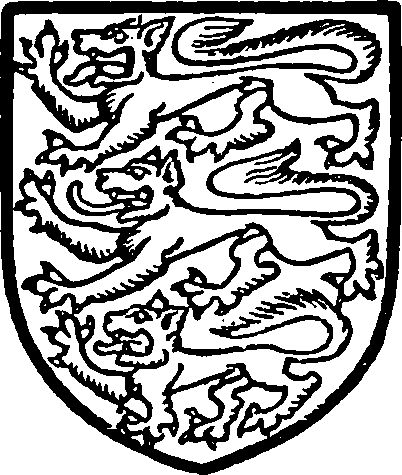
Lovett. Argent three wolves passant palewise sable.
In the 12th century the tenant in demesne of these 5 hides was Ralph fitz Roger. (fn. 10) Part of the land was later held by knight's service by William de Cranford, who died before 1209, when his heir, presumably a minor, had succeeded him. (fn. 11) Ralph de Cranford was the tenant between 1235 (fn. 12) and 1262. (fn. 13) He was succeeded by his son William who was holding in 1284, (fn. 14) but in 1295 Ralph son of William appears. (fn. 15) William son of Ralph de Cranford made a settlement of the manor in 1330. (fn. 16) The next tenants were Baldwin Drayton of Cranford and his wife Alice, and as the manor formed part of her inheritance, she may have been the daughter of the last William de Cranford. (fn. 17) She and her husband sold it in 1394 to John son of Baldwin Drayton, (fn. 18) and in 1426 the latter together with his son John, who had married Anne, daughter of Robert de Cranford, were parties to a lawsuit over lands in Cranford. (fn. 19) In 1466 William Drayton died seised of a capital messuage and land in Cranford. (fn. 20) His son Richard died in 1479. (fn. 21) The property seems to have passed to Richard's sister Anne, the wife of Thomas Lovett. (fn. 22) Henry Lovett, presumably her son, died seised of 'Drayton's manor' in Cranford in 1492. (fn. 23) He was succeeded by his son Thomas, who died seised in 1542, his heir being his grandson, another Thomas Lovett. (fn. 24) The latter sold the manor in 1550 to Thomas Goodfellow. (fn. 25) In 1614 Christopher Goodfellow was the tenant (fn. 26) and it passed about 1652 to his daughters Jane, the wife of William Coo, and Mary and Sarah Goodfellow. (fn. 27) The manor came to the family of Coo and passed on the death of William Coo in 1676 to their son Christopher Coo, D.D., who also was lord of Daundelyn's manor (q.v.) in Cranford St. Andrew. (fn. 28)
In 1805, Elizabeth, Duchess of Buccleuch, owned the manor of Cranford St. John. (fn. 29)
A second holding in Cranford St. John was known in the 16th century as the manor of CRANFORD. It originally formed part of the holding of Bertram of Verdun in the early 12th century (fn. 30) and seems to have been separated by the overlord, John de Verdun, Constable of Ireland, from Curzon's manor in Cranford St. Andrews. (fn. 31) In 1476 this estate was said to be held directly of the Abbey of Peterborough, (fn. 32) and after the Dissolution, of the king in chief. (fn. 33) In the reign of Henry III certain lands were held by William de Esseby of Sir Richard Curzon, but they were forfeited for felony and escheated to the Constable, who granted them to John de Kirkby, Bishop of Ely, to hold as the sixth part of half a knight's fee. (fn. 34) On the bishop's death in 1289 the lands should have escheated to Robert Curzon, (fn. 35) but they passed to William de Kirkby, the bishop's brother, and were held immediately of the Verduns. (fn. 36) William died in 1302 seised of rents and tenements in Cranford and in 1303 his lands were divided between his four sisters and coheirs, Cranford being assigned to Maud, the wife of Gilbert de Houby. (fn. 37) She died seised about 1311 and was succeeded by her son Walter de Houby. (fn. 38) Cranford seems to have passed to his son Anketine, who died seised of 6 messuages, 6 virgates of land and 8 marks rent in Cranford. (fn. 39) These tenements finally passed to John Bellers, the son of Elizabeth, the daughter of Anthony, the son of Alice, the daughter of Anketine de Houby. (fn. 40) Bellers died seised in 1476 and Cranford passed to John Villers, the son of his sister Joan. (fn. 41) In 1506 Villers was succeeded by his son, another John, (fn. 42) who sold the manor of Cranford to Edward Montagu, serjeant-at-law, William Dudley, William Stokes, Thomas Stokes and Henry Freeman, giving a quitclaim to the purchasers and the heirs of Montagu. (fn. 43) Henry Freeman, however, appears to have obtained possession of these lands, (fn. 44) and his son Thomas Freeman died in 1637 seised of the manor and left the land which was parcel of the manor to his executors for provision for the children of his brother Henry. (fn. 45) His heir was Henry's son Thomas, a minor. (fn. 46) A Thomas Freeman died in 1692, and the manor passed to his daughter Elizabeth, the wife of—Weaver. (fn. 47) In 1730, their son, the Rev. William Henry Weaver, was lord of the manor. (fn. 48) A free fishery in Cranford is mentioned in 1753 (fn. 49) and 1786 (fn. 50) as appurtenant to Lovett's manor, and at the latter date 3 water corn mills belonged to the manor. (fn. 51)
Church
The church of ST. JOHN consists of chancel, 28 ft. 3 in. by 12 ft. 10 in., with north chapel and vestry, clearstoried nave of three bays 38 ft. by 13 ft. 10 in., north and south aisles, north and south porches, and west tower 8 ft. 6 in. square, all these measurements being internal. The north aisle is 11 ft. wide, the south aisle 10 ft. 6 in., the width across nave and aisles being 39 ft. 2 in. The chapel is structurally a continuation of the north aisle, with the vestry at its east end, and covers the chancel its full length. The south aisle had been taken down before Bridges' time (d. 1724), but was rebuilt in 1842, (fn. 52) and a south porch added; in 1880 the aisle was extended eastward about half the length of the chapel to form an organ chamber, and the chancel restored. There was a general restoration in 1887. Bridges, at the beginning of the 18th century, records that the stump of a spire was then standing; the spire had 'fallen down some years ago' and broken in upon the roof of the church. It has never been rebuilt.
The building throughout is of rubble, with plain parapets, and the walls are plastered internally. The chancel has a high-pitched tiled roof, but the roofs of the nave and aisles are leaded.
The nave arcades are the oldest part of the building, dating from the end of the 12th century. The north arcade consists of two wide round-headed arches with a narrower and lower one at the west end. The two eastern arches were cut through the wall of an earlier church and are of almost elliptical form, of two orders, the outer square and the inner slightly chamfered, springing from a cylindrical pier and from half-round responds, with separate attached shafts carrying the outer order. The circular moulded capitals of pier and responds are elaborately carved with stiff-leaf foliage in low relief, and the abaci follow the cross plan of the arch orders; the base of the pier is cut away. The work dates from c. 1190, and a few years later the nave appears to have been extended westward by the addition of the smaller (fn. 53) bay, the whole of the south wall taken down, and an entirely new arcade constructed with a narrow and lower west bay to correspond with that on the north. The added bay of the north arcade has a round arch of two square orders on plain corbels, and is of ironstone. The south arcade is all of one build, with round arches of two orders springing from piers and responds with richly carved capitals similar to those opposite. The piers differ in section, the eastern one being a plain cylinder and the other a square with four attached shafts; the responds are similar to those on the north side.
As thus altered in the last years of the 12th century, the church was not very much smaller than the present building, with an aisled nave and a chancel somewhat shorter than the existing one. The chancel was rebuilt and lengthened in the course of the 13th century, and the chapel added c. 1290. The tower belongs to the earlier part of the 13th century, but was heightened a century later (c. 1320), when the clearstory was added and the north aisle reconstructed.
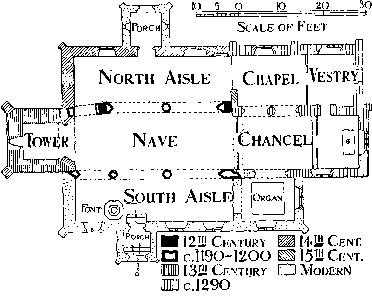
Plan of St. John's Church, Cranford
The chancel is substantially of the 13th century with an east window of three trefoiled lights and beautiful geometrical tracery, c. 1290. In the south wall is an inserted 14th-century square-headed window of two trefoiled lights, and the north wall is pierced at its west end by a late 13th-century arcade of two chamfered arches on an octagonal pier and half-round responds with moulded capitals and bases, opening to the chapel. (fn. 54) On the south side there is a modern arch to the organ chamber. The 13th-century chancel arch is of two chamfered orders with hood, the inner order on moulded corbels. The upper steps of the rood-loft stair and the loft doorway remain on the north side of the arch. The insertion of the rood stair at the back of the north-east respond weakened the chancel arch and a big buttress of two stages was afterwards added within the aisle. Over the south window of the chancel a panel inscribed 'I.L. 1692' probably indicates some repair or reconstruction in that year.
The north aisle has two square-headed 14th-century windows of two trefoiled lights, one on each side of the porch, and there is a similar window in the north wall of the chapel, but another of three lights further east is a late 15th-century insertion. The north doorway is modern. In the north aisle is a restored wall recess with segmental chamfered arch.
There are three clearstory windows on each side, the two outer ones being trefoiled openings within curved triangular labels like those at St. Andrew's church, but the middle window on each side is a tracericd circle. On the south side the windows are modern.
The tower is of two stages with a small west lancet. (fn. 55) and another higher up on the south side in the lofty lower stage. The diagonal buttresses were probably added in the 14th century when the upper story was erected, the windows of which are of two trefoiled lights with transom and quatrefoil in the head. Immediately below the stepped battlemented parapet is a band of panelling, the design of which differs on the four sides, (fn. 56) and there are gargoyles at the angles but no pinnacles. The 14th-century tower arch is of three chamfered orders, the innermost on halfoctagonal responds with moulded capitals and bases. There is no vice.
The font is of the 14th century, with a plain octagonal bowl moulded on the under side; it has a flat 17th century cover.
The pulpit is modern, but worked into it are two Renaissance carved panels of the same type as those in St. Andrew's church, the subjects represented being our Lord before the High Priest, and Pilate washing his hands. There is an early 17th-century low panelled chancel screen, and in the east window is some 14th-century heraldic glass taken from one of the windows of the chapel—(i) the leopards of England, (ii) the arms of Bassingbourne, gyronny of twelve argent and gules, (iii) the same with a label of three points azure. In the window is also some foreign glass with medallions, shields, figures, etc., one piece of which is dated 1547, others being of the 17th century similar in style to that at St. Andrew's church. (fn. 57)
There are no monuments. All the roofs are modern or much restored.
There are six bells, a treble and tenor having been added to a former ring of four in 1907 by Taylor & Co. of Loughborough, who also recast the old third. The second bell is by Hugh Watts II of Leicester 1629, the third by Thomas and John Eayre of Kettering 1717, and the fifth a recasting by Taylor in 1857 of a bell inscribed 'S. Katerina.' (fn. 58)
The plate consists of a cup and paten of 1569, and a paten of c. 1682. (fn. 59)
The registers before 1812 are as follows: (i) baptisms 1627–1753, marriages 1629–1752, burials 1627–1670; (ii) baptisms 1753–1812; (iii) burials 1679–1812; (iv) marriages 1753–1812. There are churchwardens' accounts beginning in 1755.
Advowson
The advowson of the church of St. John (fn. 60) was given before 1218 to the Abbey of St. James, Northampton, (fn. 61) when the pension due to the abbey from the rectory was already considered 'ancient,' but in 1240 it was claimed by Ralph de Cranford, who obtained in return for a quitclaim of all right in the advowson, the homage and service of one of the abbot's tenants at Cranford. (fn. 62) Before 1272 the advowson came into the possession of the Bishop of Lincoln, (fn. 63) whose successors were the patrons of the living until the 19th century, when the rectory of Cranford St. John was consolidated with that of Cranford St. Andrew and the bishop relinquished the advowson. (fn. 64)