A History of the County of Northampton: Volume 3. Originally published by Victoria County History, London, 1930.
This free content was digitised by double rekeying. All rights reserved.
'Parishes: Irthlingborough', in A History of the County of Northampton: Volume 3, ed. William Page (London, 1930), British History Online https://www.british-history.ac.uk/vch/northants/vol3/pp207-214 [accessed 5 May 2025].
'Parishes: Irthlingborough', in A History of the County of Northampton: Volume 3. Edited by William Page (London, 1930), British History Online, accessed May 5, 2025, https://www.british-history.ac.uk/vch/northants/vol3/pp207-214.
"Parishes: Irthlingborough". A History of the County of Northampton: Volume 3. Ed. William Page (London, 1930), British History Online. Web. 5 May 2025. https://www.british-history.ac.uk/vch/northants/vol3/pp207-214.
In this section
IRTHLINGBOROUGH
Erdeburne, Erdinburne (xi cent.), Yrlingbure, Irtlingburg, Irtlibure, Urtlingburch (xii cent.), Yrthingburia, Irelingburg, Irtlingburgh (xiii cent.), Hertillingborogh (xiv cent.), Artleborough (xvi, xvii, xviii cent.), Itchingborowe (xvii cent.).
The parish of Irthlingborough comprises 3,676 acres, of which about half is arable and half under grass. It lies in the bend of the River Nene, which forms its eastern and southern boundaries, while the Ise, a tributary of the Nene, is its western boundary. The land rises northward and westward from the river, reaching 260 ft. at Crow Hill near the confines of Little Addington. The soil is clay, iron- and limestone.
Until the latter part of the 16th century Irthlingborough formed two parishes, the one with its church of St. Peter standing in the village on the south side of the main road, and the other with its church of All Saints about a quarter of a mile east of St. Peter's. The site of this church is in a field overlooking the Nene on the south-west of the road to Higham Ferrers, near the manor house, which was probably the manor house of the Bataille fee to which the church was attached. As early as 1428 (fn. 1) there were only eight parishioners, and in 1562 the church is said to have been 'devasted and in utter ruin.' Sir William Cecil, being in want of lead for the roof of Burleigh House, was informed that the parishioners of All Saints were 'otherwise sufficiently provided of a church,' and that the Dean of Peterborough, who had been approached, declared the lead on the church was worth £10, and no one should have it except Cecil. (fn. 2) In 1570, after an episcopal visitation, the churchwardens were admonished regarding the state of the church. The glass windows were broken 'that 20 nobles will not make them sufficient,' two altars were half standing and 'not pulled down as they ought,' there was 'much superstition which would grieve any man to come to' and the churchyard was 'in confusion.' The churchwardens were ordered to certify that the repairs had been made. (fn. 3) Probably no repairs were carried out, and the church at this time fell into complete ruin, although the fragment of a gravestone, bearing the date 1670, found on the site, may indicate that the churchyard was in use until the close of the 17th century. The church had been pulled down long before Bridges wrote (d. 1724), though considerable remains of it then existed, built into a house. In 1849 only the foundations of the eastern and northern walls could be made out, and from them it was considered that the church was smaller than that of St. Peter's. The foundations are now only discernible for a few feet.
The village clusters round the road from Higham Ferrers to Kettering where it is crossed by the by-road from Wellingborough to the Addingtons and Woodford. The former road crosses the River Nene to the east of the village by Irthlingborough Bridge, which was built probably in the 14th century. It consists of ten ribbed arches of three chamfered orders with five refuge cutwaters on the down-stream side and three further cutwaters at the south end weathering back below the parapet. One of the cutwaters bears the date 1668 denoting, probably, the time of some repair. The bridge was widened on the up-stream side in 1754 by the addition of semicircular brick arches which are advanced nearly to the front of the old cutwaters (fn. 4); on a stone of one of these cutwaters are the arms of Peterborough Monastery. The refuges above on this side have been destroyed. The bridge was repaired in 1922. The expense of the repairs of this bridge, and that at Ditchford at the south of the parish, was formerly borne jointly by Irthlingborough and Higham Ferrers.
The market cross stands at the junction of the two main roads. It is of late 13th century date and consists of a calvary of seven octagonal steps (fn. 5) with a shaft splayed from a square base to form an irregular octagon, on each face of which at unequal distances are carved ballflowers resembling crockets. The capital is carved with trefoil foliage and is surmounted by a square abacus set diagonally to the base. The cross was restored in 1925 by H.M. Office of Works. Bridges states that 'the staff' of the cross, in height 13 ft., was used as a standard for the pole to measure the 'parts or doles on the meadows.' (fn. 6)
A house at the west end of the main street is dated 1624, but very few old buildings remain in the town. On a small two-storied house in Gosham Street is a panel inscribed:
William Trigg built this house for two widows anno dom. 1724
In 1630 there is mention of a meadow called 'Towne Hulme' probably part of the common, the tenants of which and those of the King's meadow in Higham Ferrers had to maintain the ditch between them. An Act for inclosing lands in the parish was passed in 1808. (fn. 7)
Boot and shoemaking has been the principal industry in the parish for a long time. There are also iron works.
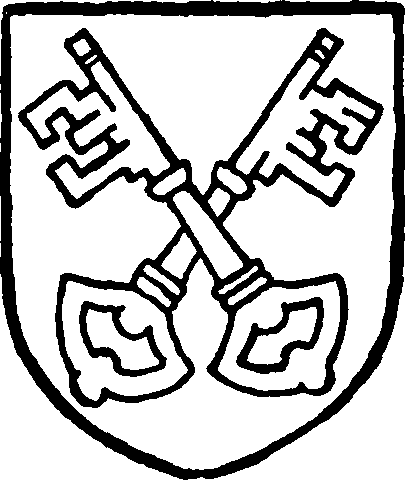
Peterborough Abbey. Gules two crossed keys or.
Manors
IRTHLINGBOROUGH may have been included in Edgar's grant of Kettering (q.v.) to the abbot and convent of Peterborough. In 1086 the abbey held there five hides and one virgate. (fn. 8) The survey of the abbey's land made between 1125 and 1128 states that two hides were in demesne, that three villeins and ten halfvilleins held 1 hide, the priest one virgate and two socmen one bovate and a half, that there were two cottars, and that one hide, less half a virgate, lay vacant. Further, the socmen of Irthlingborough were said to hold one hide, one virgate and one bovate and to owe knights' service.
The Northamptonshire Survey gives the land of the abbey's fee in Irthlingborough as five and a half hides and one small virgate. (fn. 9) A charter of Pope Eugenius III of 1146 (fn. 10) and royal charters of 1189, (fn. 11) 1227 (fn. 12) and 1332 (fn. 13) confirmed their holding in Irthlingborough to the abbot and convent. Abbot Martin de Bec (1135–55) assigned the profits of Irthlingborough to the work of the sacristy; (fn. 14) Abbot Walter, of Bury St. Edmunds (1233–45), built there a new byre and new stables; (fn. 15) and Abbot Godfrey of Crowland (1299–1321) inclosed the right side of the manor with a new stone wall and new gates in front of the hall, the former wall being in ruins. (fn. 16) Officials of the abbey must have stayed in the hall from time to time, and in 1281 it sheltered the Bishop of Lincoln. (fn. 17) In 1321–2, there was a capital messuage, and the demesne included 70 acres of arable land, 21 acres of meadow, and pasture of the annual value of 6s. 8d.; seven free tenants rendered 10s. 6d. a year, twenty-three customary tenants held virgates of land and were bound to do tillage, weeding, reaping and harvesting on 46 acres of the demesne, and to till the remaining 24 acres. Further, for each virgate, they had to supply a man for a day in every week in the year, except at Christmas, Easter, and Whitsuntide, or render ½d. for each day's work of one man. (fn. 18)
The manor continued in the possession of Peterborough Abbey until the Dissolution. (fn. 19)
In 1542 the manor of Irthlingborough was granted to the dean and chapter of Peterborough, (fn. 20) who are still lords.
Hugo Candidus states that when Thorold, Abbot of Peterborough (1069–88), distributed land in knights' fees, because he desired defenders against Hereward the Wake, he made two fees in Irthlingborough. (fn. 21) In 1086, however, four knights held there of the abbot five hides, less one virgate. (fn. 22) In the middle of the next century these knights' fees were apparently represented by 3½ hides held by Reginald de la Bataille, and one hide by Simon Basset of the Avenel fee. (fn. 23) These holdings were included in the confirmatory charters granted to the abbey by Eugenius III, (fn. 24) Richard I, (fn. 25) Henry III, (fn. 26) and Edward III. (fn. 27)
With regard to the BATAILLEFEE, there appears to have been some doubt whether it was held directly of the abbot of Peterborough or of the Bassingbourne fee, which was held of the abbot. (fn. 28) Reginald de la Bataille seems to have been succeeded by William de la Bataille (de Bello), who held land in Irthlingborough in 1179 (fn. 29) and in 1189 he, with Richard del Peak, held 3 knights' fees in Irthlingborough and Addington. William de la Bataille in 1214 claimed the advowson of the church of All Saints, (fn. 30) and in the middle of the 13th century Robert de la Bataille held 1½ knights' fee in Irthlingborough, Addington and Woodford. (fn. 31) In 1316–17 Henry de Drayton conveyed a manor of Irthlingborough to Simon de Drayton probably in settlement. (fn. 32) Simon held it of the fee of Bataille (fn. 33) and in 1327 obtained a grant of free warren over his lands there. (fn. 34) In 1353 he conveyed the manor to John Pyel, citizen and mercer of London, (fn. 35) whose widow Joan, at his desire, founded the college of Irthlingborough in 1388. (fn. 36) The manor passed to Nicholas Pyel, who did homage to the abbot of Peterborough in 1399. (fn. 37) He married Elizabeth Gorge and died in 1402–3. He is said to have had a son John, who was succeeded by Elizabeth, probably his daughter. Elizabeth married Sir William Huddleston and on her death the manor passed to her son, Henry Huddleston, who at his death in 1488 bequeathed it to his daughter Elizabeth, wife of Thomas Cheyney, but failing heirs of her body it was to be devoted to the salvation of his soul and the souls of his parents and ancestors. (fn. 38) Sir Thomas Cheyney and others, in 1511, obtained licence to grant to the dean and chapter of the collegiate church of Irthlingborough lands of the annual value of £21. (fn. 39) These lands probably went towards the endowment of the two additional prebends of the foundation of Lady Cheyney to which reference is found in 1530. (fn. 40) At the dis- solution of the college in 1547, it seems to have been possessed of manorial rights in Irthlingborough. (fn. 41)
A manor in Irthlingborough was settled by Sir Thomas Cheyney, by his will dated 1512, on his wife Anne for life with remainder in fee-tail on Elizabeth, his daughter by his first wife, (fn. 42) Elizabeth Huddleston. Sir Thomas died seised in 1514 and was succeeded by his daughter Elizabeth, then aged 9 years, and affianced to Thomas, son and heir of Sir Nicholas Vaux, (fn. 43) who became second Lord Vaux of Harrowden. Elizabeth died in 1556 and was succeeded by her son William, third Lord Vaux, (fn. 44) who settled the manor in 1564. (fn. 45) He held lands inherited from his mother in Irthlingborough and those of the late College. (fn. 46) In 1574 he mortgaged the glebe lands of the rectory and parsonage. He married Mary, sister of Sir Thomas Tresham, and was imprisoned as a recusant in 1583. (fn. 47) In 1591 his second son Ambrose was accused of having, at his father's instigation, carried off the barley of Robert Gage, farmer of the parsonage. (fn. 48) Lord Vaux died in 1595, having been predeceased by five weeks by his son George, whose heir Edward was a minor. (fn. 49) For assurance of title he obtained a crown grant of the manor in 1612 and 1613, (fn. 50) and in 1616 he had a fresh grant of free warren. (fn. 51) The manor was settled on him in 1628. (fn. 52) In 1632 he married Elizabeth, widow of the first earl of Banbury, and in 1646, (fn. 53) and 1655 (fn. 54) he settled Irthlingborough manor on his reputed son by her, Nicholas, who was born in 1632, and had succeeded to the earldom of Banbury. Nicholas inherited the manor on the death of Lord Vaux in 1661, and died in 1680, (fn. 55) when Irthlingborough manor passed to his eldest daughter Anne, the wife of Sir John Briscoe, knight. By Sir John it was sold before 1724 to John Underwood, attorney-atlaw, of Higham, who was succeeded by his son John, a minor at this date. (fn. 56) John Underwood settled the manor on himself and his wife in 1738, (fn. 57) and was dealing with it in 1768. (fn. 58) It subsequently passed to the dean and chapter of Peterborough, who are the present owners.
The AVENEL FEE in Irthlingborough of one knight was held of the abbot of Peterborough by William Avenel (1125), whose son William was living in 1168. (fn. 59) The second William left two daughters, Amice, the wife of Richard de Vernon, and Elizabeth, the wife of Simon Basset. (fn. 60) The whole fee seems to have passed to Simon Basset. (fn. 61) after William, son of Richard and Amice, had subinfeudated one — Harang of their share. Simon Basset left a son John Basset (1212) and a daughter Mabel, the wife of Guy Wake. Robert son of John Basset was succeeded by his grandson Robert. (fn. 62) The last Robert had a son Robert Basset of Rushton, who did homage to the abbot of Peterborough for his father's lands in Irthlingborough of the fee of Avenel in 1291. (fn. 63) John Basset was holding in 1348, when we find that Hugh Wake, John le Warde and Henry Green held the knight's fee of him. (fn. 64) Hugh Wake was the greatgrandson of Guy and Mabel Wake, referred to above, whose son Thomas had a son Hugh, whose son Hugh was the holder in 1346. (fn. 65) John le Warde and Henry Green represented the interest of — Harang, above referred to, whose share passed to Walkelin de Arderne, and from his son Peter it seems to have been divided between Richard le Warde, whose son John le Warde was holding in 1346, and Hugh Heroun whose share passed to Henry Green. (fn. 66) By 1428 the whole fee of Hugh Wake and John le Warde, possibly including the share of Henry Green, had been acquired by William Braunspath. (fn. 67) The later descent of this holding has not been traced, but it was probably acquired by the chief lords, the abbot and convent of Peterborough, who were purchasing much property about this time.
Apparently the first feoffee of the GARGATE FEE of one knight in Irthlingborough and Warmington was Hugh Gargate, who was enfeoffed probably in the reign of Henry II. (fn. 68) Hugh was followed by Gunfrid Gargate, whose son David granted to Walter, abbot of Peterborough (1233–45) 17 virgates of land with a messuage in Irthlingborough. (fn. 69) About 1228 the fee became divided, two-thirds of it in Warmington going to the St. Liz family and one-third in Irthlingborough to Robert de Meysy and John de Dene. In 1254 Ralph Fitz Henry paid aid on this part of the fee and in 1315 it was held by Roger de Lisle and later by John de Lisle. (fn. 70)
In 1341 John de Seymour (St. Maur) died seised of rents in Irthlingborough, held of Alan de Seymour, leaving a son John, (fn. 71) who in 1347 held of the abbot of Peterborough in Irthlingborough one-third of the knight's fee in Warmington and Irthlingborough which had been in the tenure of Hugh Gargate. (fn. 72) This John de Seymour died in 1349, leaving a son John, a minor, but before his death he had demised his holding in Irthlingborough to William de Seymour of Hardwick. (fn. 73) This conveyance may have been in trust, for in 1357 Thomas de Seymour died seised of messuages and land in Irthlingborough, held of the abbot of Peterborough. The holding had been settled on Thomas, in tail, by the grant of Warine de Seymour, with remainders to his brothers, of whom Nicholas alone survived and inherited, since Thomas died without issue. (fn. 74) In 1428 the tenants of the fee in Irthlingborough once in the tenure of John de Seymour were said to be William Braunspath, Richard Lord and John Lord. (fn. 75) The later descent cannot be traced.
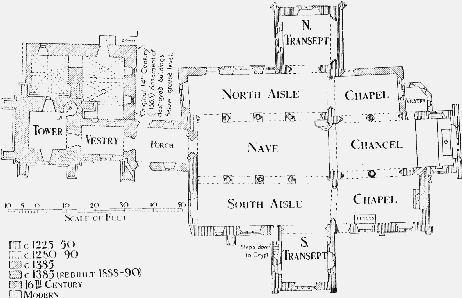
Plan of St. Peter's Church, Irthlingborough
Church
The church of ST. PETER consists of chancel 41 ft. by 16 ft., with north and south chapels, nave of four bays, 44 ft. 6 in. by 18 ft. 6 in., north and south transeptal chapels, 17 ft. by 16 ft., north and south aisles, west porch, 18 ft. by 11 ft. 6 in., and west tower 13 ft. square, all these measurements being internal. The north aisle is 13 ft. 6 in. wide and the south aisle 15 ft., the width across nave and aisles being 51 ft. 6 in. There are clearstories both to chancel and nave, with battlemented parapets, but elsewhere the parapets are plain. All the roofs, except that of the porch, are leaded and of low pitch.
The tower stands west of the porch and is connected with it by a building measuring internally 14 ft. by 10 ft., to which other buildings were attached on the north side covering the tower : the vaulted cellars of these remain. This western structure formed part of the buildings of the college: other collegiate buildings appear to have been on the south side.
The church is built of rubble, and internally the walls have been stripped of plaster, except in the aisles and transepts. The use of mingled ironstone and freestone in the nave and chancel arcades produces a rich note of colour.
The original church was of 12th-century date. It had a nave the same size as at present and a south arcade the moulded pier-bases of which are still in situ, but no other work of this period remains, the church having been entirely rebuilt in the second quarter of the 13th century, approximately on the existing plan. The chancel, chapels, nave, transepts and aisles are substantially of this period, but the chancel was lengthened a bay, c. 1280–90, and windows inserted in other parts of the building. The tower was probably built or begun by John Pyel, but may not have been completed at his death in 1376: he was also responsible for the west doorway, porch, and connecting building, and the establishment of the college led to other alterations in the church, the chancel being heightened by the addition of a clearstory and new windows inserted in other parts. The nave clearstory was added in the latter part of the 15th century.
The tower having long been in a dangerous state (fn. 76) was taken down in 1887 and rebuilt on a new concrete foundation in 1888–93 as far as possible with the old stone. The first portion was completed in the spring of 1889 and the tower finished as far as the battlements in 1892: the octagon was rebuilt in 1893.
The chancel has an east window of five gradated lancets with pierced spandrels, and north and south windows of two lights with forked mullions, all having chamfered rear arches and plain jambs. North of the altar in the east wall is a triangular headed aumbry, and in the south wall below the window a double piscina. (fn. 77) Below the north window is a segmental wall recess with inner moulded arch and trefoiled cusping, containing a 13th-century coped coffin lid with cross in circle. Thus far the work belongs to the late 13th century bay, which extends about 12 ft. beyond the chapel on the south side. Further west in the south wall is a fragment of the earlier 13thcentury piscina and a rectangular aumbry, the lintel of which has a cusped trefoil cut on the face. The western half of the chancel, which formed the collegiate quire, is open to the chapels on both sides by 13thcentury arcades of two arches on piers composed of four clustered shafts and half-round responds, all with moulded capitals and bases: the arches are of two chamfered orders. The wide and lofty chancel arch is of similar character, the outer order continuous, the inner springing from attached shafts with moulded capitals and bases on high plinths. The chancel clearstory has four square-headed three-light windows on each side, the western windows being narrower than the rest.
The chapels differ in size, but that on the north has been rebuilt and its east wall moved slightly west of the respond of the chancel arcade. This was probably done at the beginning of the 16th century by Sir Thomas Cheyney, whose arms occur on two of a row of otherwise blank shields on the parapet. The walling is rather rough and without string-course or buttress, but the old windows were re-used. As rebuilt, the chapel measures internally 21 ft. 6 in. by 13 ft., and it is divided from the north aisle by a 13thcentury arch of two chamfered orders springing from half-round responds at a considerably higher level than those of the nave and chancel arcades. The east window is of two lights with forked mullion and in the north wall is a restored 14th-century window of two trefoiled lights and quatrefoil in the head.
The south chapel is 29 ft. long by 16 ft. wide, and has a moulded outer doorway and two two-light windows with forked mullions in the south wall. The east window is blocked: on its north jamb is an image bracket and another in the north wall adjoining. From the north-east angle of the chapel a 15th-century squint with cinquefoiled and embattled head is directed to the high altar. (fn. 78) The arch to the aisle is similar to that on the north side, but has been restored.
The 13th-century nave arcades consist of four arches (fn. 79) of two chamfered orders springing from piers of four clustered shafts with moulded capitals and bases and from half-round responds. The capitals of the north arcade are more elaborately moulded and of greater projection than those opposite, but on both sides the arches are built of approximately alternate voussoirs of ironstone and freestone, like those of the chancel arcades. (fn. 80) The bases of the piers of the south arcade stand upon square plinths and 12th-century circular moulded bases with foot ornaments: the plinths alone remain on the north side. The lines of the high-pitched 13th-century roof are still visible at the ends of the nave and high in the west wall is a three-light 14th-century window with excellent tracery, probably inserted by Pyel. The lofty clearstory windows have very depressed arches and are of three trefoiled lights. The doorway to the rood loft remains in the south wall west of the chancel arch: towards the aisle several steps of the rood stair remain in the thickness of the wall.
The north aisle has a late 14th-century squareheaded window of four trefoiled lights at the west end and in the north wall a blocked doorway with continous mouldings, a 15th-century window of three lights like those of the nave clearstory, and further east a square-headed 14th-century two-light window. Externally, east of the doorway, is a mutilated stoup and above it a moulded rectangular recess with blank panel.
The south aisle has a restored west window of three gradated lancets, and in the south wall a squareheaded 14th-century three-light window with good reticulated tracery. West of this is a single lancet which, though modernised, appears to be one of the original windows of the 13th-century church: there is another in the west wall of the south transept.
This transept is divided from the aisle by a wide 14th-century arch of two chamfered orders, the inner springing from half-octagonal responds with moulded capitals and bases, and is lighted at the end by a pointed 14th-century window of three lights with reticulated tracery: in the east wall is a late 13th century two-light window with forked mullion. Below the transept is a crypt, or bone-hole, approached from the aisle by a staircase in the thickness of the west wall and covered by a single bay of quadripartite vaulting, the ribs of which spring from low angleshafts. The crypt is lighted by windows on the south and east.
The 13th-century arch to the north transept is similar in character to that between the aisle and the north chapel. Externally the transept has low diagonal buttresses, and is lighted at the end by a window of three gradated lancets and from the west by a two-light window with forked mullion. In the east wall is a wide and deeply recessed moulded arch resting on three short shafts; the arch appears never to have been opened and probably contained the transept altar.
The west porch had originally a chamber over, (fn. 81) but is now open its full height and covered with a modern high-pitched tiled roof hipped at the east end so as not to interfere with the nave window (fn. 82) The porch has four doorways, those north and south being external and placed near the west end of the walls. They have a continuous moulding and labels on the outside, but internally plain segmental rear arches only. The east doorway is, of course, the west doorway of the church and is moulded similarly to the porch, but with some difference in the terminations of the label. On each side of the doorway is a trefoiled niche and above are two transomed, or double stage niches with groined canopies and the arms of Pyel below the sills. The doorway into the forebuilding of the tower corresponds in moulding with the others, and over it is a trefoiled niche with a flue behind, evidently intended for a light. (fn. 83) The porch is now lighted by modern pointed windows of two lights in the north and south walls, but traces of square-headed windows remain on the south side, one of which, high in the wall, retains its label.
The 15th-century font has an octagonal bowl with elaborate traceried panels and embattled top moulding on a panelled stem.
There are four 15th-century stalls on each side of the quire, but the misericords are missing from three: of the others one has a man holding a shield and four are moulded.
The pulpit and seating are modern.
In the floor of the north chapel is a fragment of the brass inscription from the grave of Richard Frysseby, first dean of the college, which reads '. . . pro anima domini Ricardi . . . qui obiit . . .' (fn. 84)
The monument of the founder John Pyel (d. 1376) and Joan his wife in the south chapel has already been described: (fn. 85) the effigies are mutilated and lie on a tomb with panelled sides. A later mutilated female effigy, (fn. 86) supposed to represent Elizabeth, first wife of Sir Thomas Cheyney, lies on the floor of the chapel, and against the east wall is a 16th century canopied table tomb at the back of which are indents of two figure brasses, two shields and two inscriptions. (fn. 87) In the floor of the chapel are three grave slabs containing indents, one a blue stone with figure of priest, inscription, shield and corner roundels, another with figures of knight and lady and shields at bottom, and the third is a fragment only with canopy work and two shields.
In the north chapel are wall monuments to Mary, wife of Anthony Leybourne (d. 1690), Henry Wyckley (d. 1723), Simon Taylor (d. 1786), Simon Oliver Taylor (d. 1819) and Ann his wife (d. 1773).
The tower is of unusual design and stands about 36 ft. west of the nave, having apparently been planned with the college buildings, of which it formed part. It is of four stages, with battlemented parapets and angle turrets and is surmounted by an octagonal lantern of two stages with pointed roof, or short spire of lead. The total height of tower and octagon is 99 ft. The three lower stages of the square tower have rectangular buttresses set back a little from the angles and carried up the bell-chamber stage as flat pilasters. The lower stage has windows on three sides, that on the north being square-headed and on one side set towards the east. The middle stage has openings on the north and west only, while in the third stage there are windows on all four sides with the arms of Pyel in a panel above. The bell-chamber windows consist of two single pointed openings with flowing tracery and hoods, set widely apart and with a trefoiled and gabled niche (fn. 88) between. The two external stages of the lantern are divided by a string and in the lower one wide rectangular openings with trefoiled heads, except on the west side, which is blank. On each face of the upper stage is a square-headed and panelled window of three trefoiled lights with quatrefoils in the head. The tower has a vice in the northeast corner giving access to the bell-chamber: the parapet is carried on a corbel-table and has cross loopholes.
In a description of the tower written by Professor Freeman about 1848, (fn. 89) it is stated that the buttresses on the south side were then new and 'but feeble imitations of the older work.' A vast buttress had been built against the east face as high as the bellchamber windows, concealing any openings on that side, the tower having 'previously been in a somewhat dangerous state, which had been increased by opening a small doorway in the south wall.' (fn. 90) At that time the structure leaned 'very perceptibly' to the southeast.
Internally the lantern was divided by floors into three stories connected by staircases and passages in the thickness of the walls. The lower and uppermost chambers had fireplaces, and all three (fn. 91) floors appear to have formed part of the collegiate buildings. The uppermost chamber was lighted from the large panelled 'windows' of the top stage, the lower parts of which, however, were blocked. The theory that the interior of the lantern had been cased and the fireplaces added some time after its actual building and that the stability of the tower was thus affected, (fn. 92) was not borne out by any structural evidence at the time of demolition. No straight joint in the thickness of the wall was found, the outer and inner stones being tailed into the wall and built with lime mortar, but the filling-in between was found to be of rubble and mud. Upon removing the recessed stone traceried panelling of the upper windows it was found that on seven sides the spaces between the mullions had been filled in with ironstone without bonding into the mullions or jambs, and in the remaining one (facing north) the filling was worked out of the solid stone. The walls of the square tower from the bellchamber downwards were also constructed with a filling of rubble, and it was found that as the walls got thicker the proportion of rubble filling in the centre increased in ratio, causing the walls to split apart vertically and thus largely to crush and destroy the wrought stone. (fn. 93) The failure of the 14th-century structure therefore seems to have been due to an unequal pressure of the lantern on walls of very imperfect construction below, rather than to any additional weight imposed later. As rebuilt, the lantern retains its original internal features, but the floor joists are left open to allow of greater dispersion in the sound of the bells.
The doorway in the middle stage on the north side of the tower no doubt gave access to a building on that side, which was continued eastward as far as the porch, covering and forming part of the existing building between the porch and the tower. The cellars of this structure, as already stated, still remain and consist of two vaulted chambers about 6 ft. high, one opening from the other. The larger is entered from the chamber west of the porch and has two bays of quadripartite vaulting in one of which the boss bears the arms of Pyel: the smaller cellar north of the tower is about 13 ft. square and has a more complicated vault the boss of which is carved with a rose. Both cellars are lighted by splayed windows just above ground level.
The building between the porch and tower is approximately the height of the second stage of the tower, but its south wall has been rebuilt. On the north side it is of two stories with a blocked pointed doorway in each. From the ground floor the tower is entered by a moulded doorway and in the south-east corner is a squint piercing the buttress and commanding the south doorway of the porch.
There are eight bells, two trebles by J. Taylor and Co., of Loughborough, having been added in 1893 to a former ring of six cast by T. Mears of London in 1829. (fn. 94)
The plate consists of a cup, paten, flagon, and two plates with the London date-letter 1832–3, each inscribed 'Irthlingboro' 1833.' (fn. 95)
The registers before 1812 are as follows: (1) baptisms and burials 1562–1739, marriages 1562–1738; (ii) baptisms and burials 1739–1812, marriages 1739–1753; (iii) marriages 1754–1812. The earlier entries in the first volume were copied from an old register book in the year 1603.
Advowson
The church of St. Peter must be that church of Irthlingborough confirmed to Peterborough Abbey in the charters of Eugenius III, (fn. 96) Richard I, (fn. 97) Henry III, (fn. 98) and Edward III. (fn. 99) Pope Eugenius III also confirmed to the abbey two parts of the tithes of the lordship of Irthlingborough. (fn. 100) In 1291 the value of the church was £16 13s. 4d. a year, in addition to a pension of £2 6s. 8d. paid to the abbot of Peterborough. (fn. 101) In 1332 an inquisition having found that no wrong would thus be done, (fn. 102) the abbot and convent of Peterborough received licence to grant to the parson of St. Peter's Church in Irthlingborough, for the enlargement of the rectory house, a messuage there, in exchange for another messuage and an acre of land in the same place. (fn. 103)
In 1388 the rectory became Irthlingborough College (fn. 104) (q.v.) and the patronage was exercised alternately by the heirs of the founder and the abbot of Peterborough. This house, when dissolved, was found to hold lands and other property to the value of £73 4s. 9d. a year, and to have goods and chattels variously returned as worth £6 13s. 4d. (fn. 105) and £7 3s. 2d. (fn. 106) The commissioners stated that 'a vicar of necessitie is to be indowed there forasmuch as the master of the seyd college is both vicar and person there.' The college house, which was annexed to the church, was roofed with lead. (fn. 107) The rectory, the advowson of the vicarage and the church were, in 1581, granted by the queen in fee-farm to Edward Downing and Peter Ashton, the fee simple being vested in John Morley. (fn. 108) At this time the holder of the rectory was bound to pay out £25 10s. 3½d. a year, namely £13 6s. 8d. to the curate for his stipend, 33s. 4d. to the dean and chapter for their pension, and £9 2s. 10½d. to them for their due rent, 13s. 4d. to the bishop for his pension and 3s. 4d. to him for the visitation of Irthlingborough College, and 10s. 9d. to the Archdeacon of Northampton for synodals and procurations. (fn. 109) In 1597 Irthlingborough rectory was conveyed to Edward Vaux, Lord Harrowden, by Sir Thomas Tresham and others. (fn. 110) It is not clear when the advowson passed to this family. Thomas Infield, clerk, in 1639 petitioned Archbishop Laud, who had, he alleged, licensed him in 1633, during a vacancy of the bishopric of Peterborough, to serve the cure of St. Peter's, Irthlingborough. He stated that subsequently William Crane, clerk, had been nominated to the cure by Edward, Lord Vaux, and that the archbishop, by an oversight, had licensed him. George Broughton, Lord Vaux's bailiff, had seized the keys of the church and kept Infield out of it, so that on Sunday, 21 October 1638, there had been no service. Infield declared that the records had been searched and the church found to be a vicarage to which the king presented, institution and induction being by the archbishop. Crane counterpetitioned, stating that he was a poor man with a wife and eight children and no means of subsistence except his curacy, and that Infield had created a disturbance in the church. The Court of High Commission found in favour of Infield, Broughton and Crane being ordered to make submission and the former fined £20 and the latter £10. Crane was also ordered to pay costs. (fn. 111)
It seems to have been established that the advowson was vested in the Crown, for in 1641 the receiver of the king's revenues for Northamptonshire was directed to stay payment to Thomas Infield of the stipend due to him as curate of Irthlingborough, since he was acting as vicar and claiming tithes. (fn. 112) The advowson of St. Peter's vicarage, as well as the rectory, was, however, settled in 1646, (fn. 113) 1651 (fn. 114) and 1655 (fn. 115) on Nicholas, first Earl of Banbury, the holder of the manor. From him both the rectory and the advowson of the vicarage passed to his son Charles, the second earl. (fn. 116) He in 1694 conveyed these rights to Thomas and George Watson, (fn. 117) and in 1696 George Watson conveyed them to Thomas Wentworth, alias Watson, and his wife Alice. (fn. 118) This Thomas, the third son of Lewis Watson, first Earl of Rockingham, had in 1695 inherited the estates of his mother's brother, the second Earl of Strafford, and had then assumed the additional surname of Wentworth. He was created Baron and Earl Malton, and inherited the earldom of Rockingham in 1746. In 1738 he presented to the vicarage William Knowler, who a year later published The Earl of Strafford's Letters and Despatches from the collection inherited by his patron. (fn. 119) Lord Malton was created Marquess of Rockingham in 1746 and died in 1750, leaving a son and heir Charles, who died without issue in 1782, when the rectory and advowson of Irthlingborough passed to his sister's son, William, fourth Earl Fitzwilliam. (fn. 120) They are now in the tenure of George Charles Wentworth-Fitzwilliam, grandson of the fifth earl.
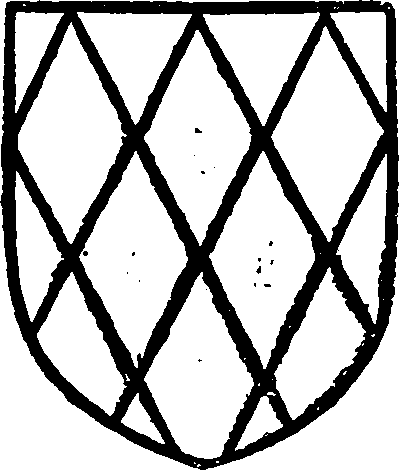
Fitzwilliam. Lozengy argent and gules.
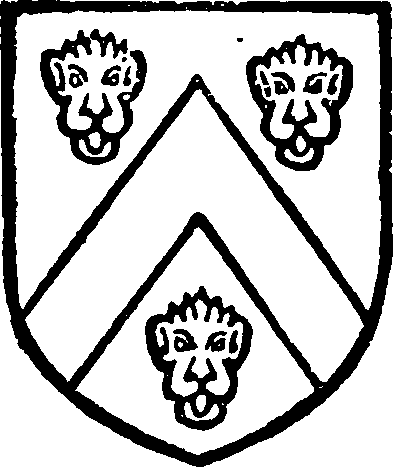
Wentworth. Sable a cheveron between three leopards' beads or.
The church of All Saints followed the descent of the Bataille fee to 1214, when William de la Bataille gave the advowson to the abbot and convent of Peterborough in exchange for lands in the tenure of Nicholas, son of Geoffrey. (fn. 121) In 1313 the pope gave to Robert de Bukyngham, alias de Selford, rector, dispensation to accept another benefice of the value of £40. (fn. 122) John de Thornton was provided to the church in 1328, and on his death in the same year the king successfully claimed the right to present during a vacancy of the abbacy. (fn. 123) After the Dissolution the rectory, namely, the great and small tithes, the house and the glebe, was worth 106s. 8d. (fn. 124) The advowson of the rectory was granted in 1541 to the dean and chapter of Peterborough (fn. 125) who presented in 1661 and 1664. (fn. 126) The bishop collated in 1675, but in 1646, 1651, 1655 and 1683 (fn. 127) the advowson of All Saints together with that of St. Peter was settled as parcel of the estates of the earls of Harrowden. The church, as already stated, had fallen into ruin and the site and parsonage seem to have passed with the manor (q.v.)
Charities
William Trigg built a school and an almshouse in two tenements and by his will, dated 25 Feb. 1728, charged his lands with rentcharges amounting to £27 4s. The charity is regulated by a scheme of the Charity Commissioners dated 18 May 1897, pursuant to which rentcharges of £17 and £1 issuing out of various properties in Finedon and Irthlingborough, including the house at Irthlingborough in which the founder lived, were made the endowments of a separate charity called the Educational and Ecclesiastical Charity of William Trigg. £17 is applied to the National School and £1 to the rector, the trustees being the incumbent, churchwarden and two others.
The remaining rentcharges issuing out of various pieces of land in Irthlingborough, and amounting to £9 4s. yearly, form the endowment of William Trigg's charity for the poor. The trustees are the incumbent and two others appointed by the U.D.C. £2 is paid to each of the two inmates of the almshouse. £1 4s. is distributed to poor widows, and the balance in coal.
Richard Glover, by indenture dated 1 July 1801, settled his land in trustees for the benefit of the poor people of the Society of Friends and charged the same with £10 yearly for the benefit of the poor of the parish. The land known as Glover's Charity Farm, and containing about 177 acres with farmhouse and buildings, was sold in 1916 and the proceeds were invested in £2,387 11s. 1d. Metropolitan Water Board Stock, £916 8s. 2d. 5 per cent. War Stock, £3,793 19s. 10d. 3½ per cent. Conversion Stock, and £2,530 3s. 2d. Liverpool Corporation 5½ per cent. Red. Stock with the Official Trustees of Charitable Funds, producing £389 8s. yearly in dividends.
There are five trustees each of whom is entitled to £1 1s. yearly for his own use; £10 is distributed to the poor at Christmas and the residue is applicable for the benefit of poor Quakers.
The Church Land:—An allotment was awarded on an inclosure to the churchwardens in lieu of lands previously appropriated to the repairs of the Church. The property consists of 19 a. 2 r. 22 p. of land abutting on Marsh Lane and is leased to the U.D.C. at a rent of £70 per annum.
The Irthlingborough Nurses' Home Trust was founded by indenture dated 4 June 1921. The indenture recites that during the late War a fund was raised called the Northamptonshire Regimental Prisoners of War Fund, and as the objects for which had been completely satisfied and a balance of £1,059 left in the hands of the Prisoners of War Committee, it was determined to apply the balance for the purposes of the Irthlingborough Nurses' Home Trust to provide accommodation for a nursing staff for the parish and for the stretchers and other appliances belonging to the St. John Ambulance Association. £615, part of the sum of £1,059, was applied in the purchase of three tenements known as Nos. 27, 29 and 31 Victoria Street, which premises are used for the purposes of the trust. The trustees consist of the rector for the time being and four others.