A History of the County of Northampton: Volume 4. Originally published by Victoria County History, London, 1937.
This free content was digitised by double rekeying. All rights reserved.
'Parishes: Boughton', in A History of the County of Northampton: Volume 4, ed. L F Salzman (London, 1937), British History Online https://www.british-history.ac.uk/vch/northants/vol4/pp76-81 [accessed 2 May 2025].
'Parishes: Boughton', in A History of the County of Northampton: Volume 4. Edited by L F Salzman (London, 1937), British History Online, accessed May 2, 2025, https://www.british-history.ac.uk/vch/northants/vol4/pp76-81.
"Parishes: Boughton". A History of the County of Northampton: Volume 4. Ed. L F Salzman (London, 1937), British History Online. Web. 2 May 2025. https://www.british-history.ac.uk/vch/northants/vol4/pp76-81.
In this section
BOUGHTON
Buchenho, Buchetone, Buchedone, Bochetone (xi cent.); Boketon, Buketone, Buckton (xii–xv cent.).
Boughton is a parish covering an area of 2,060 acres. The soil is marl and clay with a subsoil of stone, while the chief crops are wheat, barley, and beans. The parish, which is heart-shaped, is crossed from north to south by the road running from Northampton to Market Harborough, which skirts Boughton Park, the property of Mr. Frank Panther. Baker, writing about 1820, describes Boughton House (fn. 1) as 'nearly levelled with the ground', (fn. 2) but gives a view made from a sketch of about thirty years before, (fn. 3) which shows a gabled building enclosing three sides of a quadrangle. (fn. 4) The park and adjacent grounds were well wooded and interspersed with temples, triumphal arches, and artificial ruins. (fn. 5) No remains of the old house are left. The present house, called Boughton Park, to distinguish it from the Duke of Buccleuch's seat near Kettering, was built about 1844 by Lt.-Gen. R. W. H. Howard-Vyse. The village of Boughton lies to the east of the park and contains a house, formerly the residence of Captain Whyte-Melville, who wrote many of his novels here. In the village are a number of 17th-century thatched houses, on one of which, south-west of the church, is a tablet inscribed 'Ano. Dom. 1639, t.h., a.h.' A monument was erected in Boughton parish in 1764 in memory of William Cavendish, 4th Duke of Devonshire, in the form of a masonry obelisk. The inscription which it originally bore has been removed. (fn. 6) The old ruined church of St. John the Baptist stands about a mile east of the village on the green where the fair was held since at least the middle of the 14th century. This famous green is most picturesque in appearance, with an undulating surface caused partly by extensive quarrying, the remains of several old pits being found in the neighbourhood. The sandy ground is riddled with rabbit holes. The keeper of Moulton Park used to claim free warren in Boughton fields, a right which was stoutly resisted by the inhabitants. Thos. Aylmer, the bailiff of Boughton in 1531, used to keep greyhounds and ferrets in his house and 'wold never rydde between Northampton and Buckton but that he wold have his cross-bowe hangyng at his sadle bowe with hym, to the intent to kyll conyes by the waye'. Even the chantry priest, Sir John Chene, in the reign of Richard III was accused at his own chantry door of hunting in the warren; and the rabbits invaded the churchyard itself, making the place so dangerous that the inhabitants were afraid to go to mass for fear of breaking their necks. It was said that the bones dug up by the conies would fill a scuttle and 'that a man can go skantly in a corner of yt but he shall fynde it full of dead mennes bones, a thing most pytyous to be seen'. One of the parishioners stated that a 'great number of conyes have so underminded the church yarde of Bouckton that it wold abhorre any Crystiane manys harte in the world to see it'. (fn. 7)
The parish is well watered with springs, one of which, known as St. John the Baptist's Spring, rises in the old churchyard on the green. A branch of the River Nene flows on the north through Boughton Park, while a larger branch of the river forms the western boundary and is crossed several times in its course through the parish by the L.M.S. railway. A road connecting the village with Church and Chapel Brampton descends from 343 ft. to 221 ft., where it crosses the line at Boughton level crossing, the lowest lying ground in the parish being situated here. The mill stands almost a quarter of a mile farther upstream. The highest ground is found to the north and north-east of the parish where an altitude of 418 ft. is reached. There is a Methodist chapel in the village.
The parish has been inclosed under an act passed in 1756. (fn. 8)
Manor
William the Conqueror bestowed most of the land in BOUGHTON upon his niece, the Countess Judith, and the overlordship remained vested in the holders of the honor of Huntingdon of which the descent is traced under Yardley Hastings (q.v.).
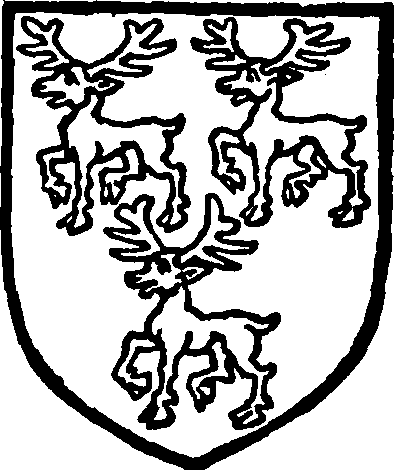
Green. Azure three bucks or.
One of the under-tenants of the countess in 1086 was the Norman abbey of St. Wandrille who held 3 hides less half a virgate, bestowed upon them by the countess; (fn. 9) by the 12th century this estate had increased to 3 hides and 3 small virgates, (fn. 10) probably by the addition of 3 virgates held of the countess at the Domesday Survey by 4 socmen. (fn. 11) It was worth 110s. in 1207, and was appropriated by John for the time being with the lands of other Norman holders, (fn. 12) but was regained by the abbey, whose abbot William de Nutricilla, in the reign of Edward I, conveyed it to John de Boughton, (fn. 13) who already owned land in Boughton by inheritance. (fn. 14) From John it passed to his son, another John; (fn. 15) and to the latter's son Thomas, (fn. 16) against whom and his mother Juliana, William, Abbot of St. Wandrille, brought an action in 1330 claiming that as the estate had belonged to the abbey by virtue of the Prebend of Uphaven, in the diocese of Salisbury, and that as the consent of the dean and chapter had not been obtained, the alienation of the manor by William de Nutricilla was not valid. The abbot, however, failed to prosecute and judgement was given for Thomas, (fn. 17) who in the same year successfully claimed view of frankpledge in his manor of Boughton, on prescription; he was sheriff (fn. 18) for Northants. in 1331, 1334, and 1343. In 1337 the abbey of St. Wandrille was absolved by the Pope from the penalty it had incurred by selling the Boughton estate without licence from the bishop, and the tenure of the Boughton family was thus rendered more secure. (fn. 19) Three years afterwards, however, Sir Thomas de Boughton and Joan his wife sold the reversion of the manor to Henry Green of Isham, junior, (fn. 20) in whose family it remained for many years. (fn. 21) Henry Green was knighted in 1354 and in 1361 was appointed chief justice of the King's Bench, from which he was removed in 1365; (fn. 22) he died in 1369 and was succeeded in his Boughton estates by Thomas, his son by his first wife; Drayton, which he had acquired from Sir John Drayton, brother of his second wife Catherine, being settled on Henry his son by her. (fn. 23) Sir Thomas, who died in 1391, (fn. 24) was succeeded by his son another Sir Thomas, Sheriff of Northants. in 1417, in which year he died. (fn. 25) His widow Mary died in 1433, (fn. 26) when their son, another Sir Thomas, came into possession of the whole manor. (fn. 27) The manor passed from him to his son, grandson, and great-grandson, all of whom were called Thomas, (fn. 28) but the sixth and last Thomas died in 1506, without male heirs, when his property passed to his two daughters Anne and Maud. (fn. 29) During their minority the estate was claimed by the Bishop of Winchester and others, (fn. 30) but this was probably only a question of guardianship, as in 1512 a division of the property was made between Nicholas Vaux and Anne his wife and Thomas Parr and Maud his wife (fn. 31) by which Anne appears to have acquired Boughton Manor. She predeceased her husband, who died in 1523, (fn. 32) shortly after his elevation to the peerage as Lord Vaux of Harrowden, (fn. 33) when their son Thomas inherited the manor. (fn. 34) During his life it appears to have been leased out to Richard Humphrey, after whose death it was the cause of a dispute between his stepson Augustus Crispe and his nephew Thomas Stafford, (fn. 35) but the manor shortly returned to the Vaux family, passing to Thomas's son William, and to the latter's grandson Edward, (fn. 36) who married Elizabeth widow of William Knollys Earl of Banbury. (fn. 37) Edward Vaux died in 1661 without legitimate issue, having settled the manor on his stepson Nicholas Vaux or Knollys, sometimes called Earl of Banbury. (fn. 38) By his first wife, Isabel, Nicholas had one daughter Anne who married Sir John Briscoe and by his second wife, Anne, on whom he settled Boughton on his marriage with her in 1655, (fn. 39) a son Charles who succeeded his father in 1674. (fn. 40) Charles apparently sold Boughton to Sir John Briscoe, the husband of his half-sister Anne, who mortgaged it to Lord Ashburnham, and the latter in 1717 sold it with Pitsford to Thomas Wentworth, Earl of Strafford. (fn. 41) Lord Strafford died in 1739 and his son William died without issue in 1791, when this property was inherited by his sisters and co-heirs or their descendants, Anne wife of the Right Honourable William Conolly, Lucy wife of Sir George Howard, and Henrietta wife of Henry Vernon, as tenants in common, (fn. 42) but as they were anxious to hold their shares in severalty they obtained an Act of Parliament in 1795 by which Boughton and Pitsford were assigned to Richard William Howard-Vyse, a minor, son of Major-General Howard-Vyse and Anne daughter and heir of Lucy Wentworth and Sir George Howard. (fn. 43) The manor has remained in the Howard-Vyse family, (fn. 44) the present owner being Major-Gen. Sir Richard Granville Howard-Vyse.
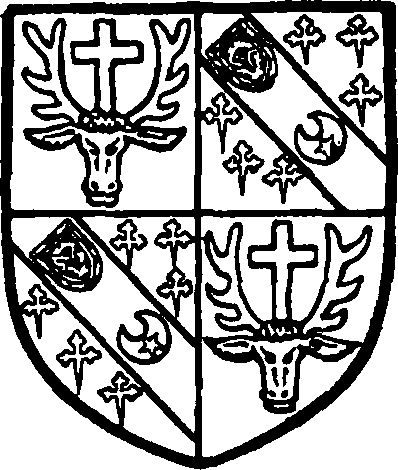
Howard-Vyse. Argent a hart's head cabossed sable with a cross sable between the attires, for Vyse, quartered with Howard.
The Boughton family, who obtained the Manor of Boughton in the reign of Edward I, were already holders of land there, and their estate may have originated in the virgate held in 1086 of Countess Judith by Robert. (fn. 45) The first of this family of whom any record remains was William, who was succeeded by a son Richard, whose son Alexander was a benefactor both to St. Andrew's Priory, Northampton, and to the Hospital of the Holy Trinity, Kingsthorpe. (fn. 46) He died before 1211, leaving a widow Margaret (fn. 47) and two sons, William who died without issue and Walter (fn. 48) who died before 1284. (fn. 49) Walter was succeeded by his son John, (fn. 50) who purchased Boughton manor from St. Wandrille Abbey, when their holding became absorbed in the manor; it is doubtful if it had acquired the legal status of a manor, although Walter is sometimes styled lord of Boughton.
Boughton Green was long associated with a fair, held annually, at least since it was granted to Henry Green in 1350, on the vigil, day, and morrow of St. John the Baptist; (fn. 51) it used to be famed for brooms and wooden-ware, and the last day was given up to wrestling and other forms of sport, but during the last years of its existence it consisted merely of a large horseand cattle-fair and lost its social character. It was abolished during the War (1914–18); the horses formerly sold at Boughton are now sent to the cattle-market at Northampton; and the green has since been enclosed. It was always attached to the manor, and when sold with it in 1717 was estimated at a yearly value of £50. (fn. 52)
In 1086 Gerard held of the Countess Judith half a virgate of land in Boughton (fn. 53) which may have passed to the Prestons, lords of Little Billing Manor, for in 1233 Gilbert de Preston was concerned in a dispute over 2 virgates of land in Boughton. (fn. 54) This holding followed a descent similar to that of Little Billing Manor (q.v.), (fn. 55) but was retained by Laurence de Preston when he alienated Billing, passing from him to his son Laurence whose widow Agnes detained it as dower in 1349 and afterwards to their son Thomas. (fn. 56)
As tenants under the Prestons were the Boughton family, who held 1 virgate of land rendering 17s. 10d. yearly and 2 virgates by foreign service. (fn. 57) In the division of property in 1274 between Laurence de Preston and Alice, the widow of Gilbert, the land in Boughton fell to Alice, (fn. 58) but after this date there is no further mention of the under-tenancy of the Boughtons.
Other lands held of the honor of Huntingdon were those in the possession of the Daubeny family; William Daubeny died seised of land in Boughton c. 1264, (fn. 59) and in 1282 this holding was said to amount to 32 virgates. (fn. 60) It may have been afterwards acquired by the lords of the chief manor for there is no further trace of it.
Robert de Buci held 3 virgates of land less 1 bovate of the king in chief in 1086, (fn. 61) and this estate may have passed to the Bassets of Weldon, who owned land there in 1240. (fn. 62) The under-tenant at the Survey was Robert, and in 1242 Simon le Sauvage (fn. 63) and 'his partners' held a quarter fee in Spratton, Boughton, and Creaton under the Bassets. (fn. 64) In 1284 Ralph Danvers held 7 virgates of Robert de Tateshall who held them of Ralph Basset, (fn. 65) but after this date there is no record of the Basset holding in Boughton.
Another holder in Boughton in 1086 was Godwin the priest, who held 1½ virgates there of the king in chief: (fn. 66) there is no further record of this estate.
A MILL in Boughton which Alexander de Boughton held of the fee of William de Dive was granted by him to the Hospital of the Holy Trinity at Kingsthorpe at the beginning of the 13th century, (fn. 67) and the gift was soon afterwards augmented by the addition of land and the mill-pond (fn. 68) and confirmed in 1211 by Margaret, Alexander's widow. (fn. 69) In 1398 it was leased by the hospital, under the name of a fulling-mill, 'delapidated and ruinous', to Robert Douceamour, parson of Scaldwell, and William Mackus of Kislingbury. (fn. 70) It was apparently reconverted to a corn-mill, as at the view of frankpledge held in 1509 it was stated that John Hopkins, the miller, took excessive toll. (fn. 71) In 1535 the yearly value of the mill was £4 15s. 8d., of which 2s. 8d. was paid to Thomas Vaux Lord Harrowden as rent. (fn. 72) It was granted out by Philip and Mary in 1558 with all the possessions of the dissolved hospital to the Master of the Hospital of the Savoy, (fn. 73) by whom it was afterward leased with other tenements to the Vaux family, lords of the manor, for a lease of 3 lives. (fn. 74) The interest in the lease was conveyed by John Lord Ashburnham to Thomas Wentworth Earl of Strafford with the manor in 1717, (fn. 75) but as by that date the Savoy Hospital had already been dissolved for a few years, (fn. 76) it is probable that Lord Strafford acquired full possession, as the mill has remained attached to the manor. When it changed hands in 1717 it was described as a paper-mill in the tenure of Mr. Allen, who paid for it, the Holms, and the arable ground belonging, an annual rent of £20, but shortly before 1820 it was converted into a corn-mill. (fn. 77) It is situated on the branch of the Nene which divides Boughton from Brampton and which is crossed about a quarter of a mile lower down by a bridge of some antiquity, known as Brampton Bridge or the Long-bridge. At a manor court held in 1509 all the tenants were ordered to repair the bridge called 'le Long Brigge'; (fn. 78) at the present day the burden of keeping the bridge in a good condition falls upon the two parishes alike.
The Hospital of the Holy Trinity and St. David owned a good deal of land in Boughton chiefly by gift from the de Boughton family; Alexander de Boughton gave them, among other gifts, land adjoining a meadow called Thadchesholdon, pasture for 12 score sheep and a messuage held by Ailric the miller. (fn. 79) William his son bestowed upon them rents and a capital messuage. (fn. 80) Other members of this family who were also benefactors were Simon son of Peter, Walter son of Ralph, Simon son of Oger, Reynold son of Niel, and William and Philip sons of Walter. (fn. 81) Richard de Bollessore, the master, claimed common pasture in Boughton in 1367, (fn. 82) and in 1394 granted lands in Boughton, part of which were called Bekemanwell, to Thomas Bollessore and Alice his wife. (fn. 83) The possessions of the Hospital in Boughton were granted to the Savoy Hospital in 1558 (fn. 84) and were held by it until its own dissolution in 1702. (fn. 85)
The de Boughton family were also benefactors to St. Andrew's Priory. Alexander gave them a messuage (fn. 86) and Simon son of Oger, a member of the family, bestowed a virgate and house upon them, (fn. 87) a gift which was confirmed by his son Philip. (fn. 88) Their possessions in Boughton included 1 virgate, 2 houses, half an acre of land in Stonedalesike and half an acre above Bernway pits, (fn. 89) and in 1290 these were valued at 15s. (fn. 90) John a descendant of Philip confirmed these lands, (fn. 91) and in 1319 Thomas son of Thomas of Boughton, his successor, held them on lease under the priory yearly. (fn. 92) They were worth 119s. 6d. in 1443 (fn. 93) after which date there is no trace of them.
Churches
The ruins of the old church of ST. JOHN stand to the north-east of Boughton Green on a site which falls from west to east. The building consisted of chancel, north chapel, nave, and west tower with spire and was of 14th-century date, (fn. 94) but the remains have long been neglected and are undergoing a gradual process of disintegration by the agency of weather and the unchecked growth of ivy. The site is thickly overgrown and at the west end is a confused mass of rubble, broken gravestones, brambles, and nettles. Where the walls stand to any height their architectural features are generally hidden by ivy. Bridges, early in the 18th century, described the building as then 'in ruins, without a roof, the walls in several parts levelled with the ground', (fn. 95) but the tower and spire stood till about 1785. A drawing of the church from the south-east made in 1761 and engraved for Grose's 'Antiquities', (fn. 96) shows a tower of three stages with diagonal angle buttresses, pointed bell-chamber windows, each of two lights, and a spire rising from behind battlemented parapets. The walls of the nave were then standing to a considerable height and the east wall of the chapel retained its gable, but in other respects the state of the ruin seems to have been almost as complete as at the present time. There were three pointed two-light windows in the south wall.
The nave and chancel appear to have been continuous and the chancel had two large three-light east windows with a buttress between, over which was a single vesica-shaped opening. The walls of the chancel still stand almost their full height and both the window openings remain, but the arch of the northern window and all the mullions and tracery are gone: between the windows internally is a canopied niche. The building is 28 ft. wide inside at the east end (fn. 97) and has a moulded plinth and diagonal angle buttresses. The piscina remains in the usual position in the south wall of the chancel, and farther west is a large low-side window, (fn. 98) now blocked, with cinquefoiled square head, hoodmould, and wide segmental rear arch. The south chancel wall stands a considerable height for a length of about 33 ft. and for a further distance of 15 ft. westward is about three or four courses high. All the walling is of rubble.
The chapel opened from the north side of the chancel by an arch about 10 ft. from the east end, and had east and west windows. It measures internally 23 ft. by 16 ft. and has a diagonal north-east angle buttress, but though much of its walling still stands it is completely hidden by ivy. Its east window has a flat wooden lintel.
The tower and west end of the building are level with the ground. The churchyard is still used for burials and is surrounded by a modern fence wall and railing, with gateway on the west. Immediately outside the eastern wall of the chancel is a spring.
The chapel of ST. JOHN THE BAPTIST, now the parish church, stands in the village on the north side of the main street, and consists of a rectangular body, 68 ft. 6 in. by 27 ft. 6 in., small vestry, and west tower, 8 ft. 10 in. square, these measurements being internal. The tower dates from c. 1400, but is the only part of the original building that remains, the body having been rebuilt and enlarged (fn. 99) in 1806, and again in 1846 when the vestry was added. An extensive restoration in 1894 included the re-roofing and re-flooring of the church, the removal of a west gallery and the opening out of the tower arch. The early-19th-century enlargement consisted of a widening on the north side, but the line of the old nave roof remains over the tower arch. The south wall and tower face directly on to the street. A school-house was built at right angles to the tower on the north side in 1841. (fn. 100)
The body of the church is faced with coursed ironstone, and has plain parapets and low-pitched zinccovered roof. All the windows are square-headed, that at the east end and one on the north side being of three uncusped lights, the others of two lights. There is also a two-light window high at the west end of the south wall over the doorway, which formerly served the gallery. The four-centred head of the doorway is old. (fn. 101) Over the east window is the date 1846, and a panel inscribed 'e.m., i.y., 1702' is inserted over the threelight window in the north wall.
The tower is of rubble, of four stages, with diagonal angle buttresses and battlemented parapets. The pointed west doorway has mouldings divided by a casement, and the restored west window and the windows of the bell-chamber are of two cinquefoiled lights with quatrefoil in the head. In the third stage facing west is a panel inscribed 'This was repaired in the year of our Lord 1653'. There is a vice in the south-west angle. The two-centred segmental tower arch is of two chamfered orders, with hood-mould, the outer order continued down the jambs.
The font, pulpit, (fn. 102) and all the fittings are modern.
On the north wall is a tablet to Mary, wife of Col. E. Mandeville Mortimore and eldest daughter of Sir John Briscoe, who died 10 March 1706, (fn. 103) and in the choir are brass plates in memory of (1) Lilly Anne, wife of the Rev. G. S. Howard-Vyse (d. 1869) and Lieut. Harry Granville Lindsay Howard-Vyse, killed in action in Egypt, 1882, and (2) Major Granville William Richard Howard-Vyse, who died in Kashmir, 1892.
Three bells then in the tower were recast in 1907 by James Barwell, of Birmingham, who added two new ones, making the present ring of five. (fn. 104)
The plate consists of a silver cup, paten, and flagon, Birmingham make, of 1854, a plated bread-holder, and two brass alms dishes. (fn. 105)
The registers before 1812 are as follows: (i) baptisms 1549–1767, marriages 1559–1754, burials 1560–1767; (ii) baptisms and burials 1767–1812; (iii) marriages 1754–1812. (fn. 106)
Advowson
The church of Boughton is not mentioned until 1201, when the advowson was in dispute between Alexander de Boughton, Simon de Boughton, Simon son of Oger and Hugh de Anvers. (fn. 107) In 1202 Alexander de Boughton recovered the advowson against Simon de Houghton on the ground that his grandfather William had presented the last person to the church. (fn. 108) The right of presentation belonged to the de Boughton family and descended with the chief manor, Major-Gen. HowardVyse being patron at the present day. The tenure of the de Boughton family and of Sir Henry Green later, however, was contested by the Prestons, who claimed the advowson as appurtenant to their fee in Boughton. In 1273 it was included among the possessions of Gilbert Preston (fn. 109) and it was recovered in 1276 by Alice his widow against Laurence, his nephew and heir, (fn. 110) who in 1294 was sued by John de Boughton, then lord of the manor, for wrongfully exercising that right. (fn. 111) Notwithstanding this, Laurence settled the presentation on himself and his son Laurence, after his death; (fn. 112) and Sir Henry Green, who purchased the reversion of the manor in 1340, (fn. 113) conceiving the advowson to be appendant, brought an action against Sir Thomas de Preston in 1350, after the death of Sir Thomas and Joan de Boughton. Judgement was given for Sir Henry Green and damages were awarded him, being the value of the church for the past two years, during which a nominee of Sir Thomas had held the living. (fn. 114) After this date the lords of the manor continued in undisturbed possession; but Anne, the widow of Richard Humphrey, and Augustus Crispe presented in 1551, 1554, and 1559 when they were holding the manor on lease. (fn. 115) In 1254, (fn. 116) and in 1291 (fn. 117) the church was valued at £6 and in 1535 the rectory was worth £21 per annum. (fn. 118) In 1364 the Pope granted an indulgence of 1 year and 40 days to those who assisted the church of Boughton, in which many miracles of healing were wrought. (fn. 119)
Even before the parish church became quite ruinous in the 18th century its place was taken by a chapel in the village, the present church, for in 1547 the chantry commissioners noted that 'it is to be remembered that there ys one chapell situated within the town of Boughton, wherein comonly the said ii prestes do celebrate for the ease of the parishioners, for the parish churche is distant iii pts. of a myle from ye towne or any house'. (fn. 120)
When, in 1257, Adam Russel and Alice his wife quitclaimed land in Boughton to Peter son of Roger de Boughton for the rent of supplying to the chaplain ministering daily in the chapel of St. John ½d. towards the support of the common light, (fn. 121) it is probable that the reference is to the parish church, but the chapel seems to be referred to in 1329 when licence was given for the continuation for a year of the chapel of St. Thomas the Martyr, built of old times. (fn. 122) This chapel probably originated in a chantry of uncertain foundation. In 1535 Richard Taylor and William Russell were the chantry priests there and the yearly value, which was £10, was divided between them as salary (fn. 123) and when it was dissolved and the priests pensioned in 1547–8, there were no jewels or ornaments belonging to it. (fn. 124) Part of the chantry's possessions, 10s., the rent of one cottage in Northampton, was claimed by the Crown in 1558 against Richard Hanington. These premises were devised to the two chantry priests in 1460 for a term of years which had expired by 1558 and Richard Hanington claimed them as heir to Anne Hanington, widow. (fn. 125)
Charities
The Charity of Richard Humfrey, or Humphrey, founded by will dated 30 November 1547 is regulated by a Scheme of the Charity Commissioners dated 14 April 1924. The property originally consisted of 3 cottages and about 50 acres of land in Pitsford. The cottages and land have been sold and the proceeds invested. The sum of £522 9s. 4d. is held to the account of the Church Extraordinary Repair Fund. The remaining stocks produce about £190 annually in dividends. The trustees are the rector and churchwardens, 2 trustees appointed by the parish meeting and 4 co-optative.
The Earl of Strafford's Charity consists of a yearly sum of £5 paid by Major-Gen. Howard-Vyse out of lands at Boughton and Pitsford which formerly belonged to the Earls of Strafford. The charity is distributed in fuel to poor householders.