A History of the County of Northampton: Volume 4. Originally published by Victoria County History, London, 1937.
This free content was digitised by double rekeying. All rights reserved.
'Parishes: Moulton', in A History of the County of Northampton: Volume 4, ed. L F Salzman (London, 1937), British History Online https://www.british-history.ac.uk/vch/northants/vol4/pp88-94 [accessed 3 May 2025].
'Parishes: Moulton', in A History of the County of Northampton: Volume 4. Edited by L F Salzman (London, 1937), British History Online, accessed May 3, 2025, https://www.british-history.ac.uk/vch/northants/vol4/pp88-94.
"Parishes: Moulton". A History of the County of Northampton: Volume 4. Ed. L F Salzman (London, 1937), British History Online. Web. 3 May 2025. https://www.british-history.ac.uk/vch/northants/vol4/pp88-94.
In this section
MOULTON
Multone, Moltone (xi cent.).
The parish of Moulton covers an area of 3,139 acres; the ground is fairly undulating and of an open nature except for a few plantations. The chief crops are wheat, barley, peas, and beans, and the soil is clay and marl with a subsoil of ironstone and rock. The population, which was 1,638 in 1931, is chiefly engaged in agriculture, but includes many persons engaged in trade and manufacture in Northampton.
The village, which is large and straggling, lies about half a mile west of the high road to Kettering. In the village are a fair number of 17th-century gabled stone houses, generally with thatched roofs, but in most cases the mullioned windows have been modernized. On one is a well-designed panel inscribed 'IME Ao 1658', on another 'GW 1660', whilst the Artichoke Inn, a twostory building retaining its mullioned windows, is dated 1680 and has the initials RMA. There is a Methodist chapel in the main street, and a Baptist chapel at the west end of the village built while the well-known Dr. William Carey, Professor of Sanskrit in Fort William College, India, and founder of the Baptist Missionary Society, was minister here (1785–9). The church stands to the north, rather on the outskirts of the village, while the vicarage is more central, near the schools. To the north-west of the church lies the Manor Farm, built on the site of the old manor-house, with traces of ponds still remaining. Bridges, writing about 1720, speaks of it as 'the new house, now called the Hall'. About half a mile farther north, to the right of the road leading to Holcot, and parallel with New Fox Court and Hog Hole Spinney, is the artificial elevation known as Castle Hill, which may have been the site of the Fitz John's manor, for foundations of buildings have been dug up and the remains of a moat are apparent.
A small stream crosses the parish, and where it passes under the road leading from the village to Moulton Grange the neighbouring ground reaches an elevation of 298 ft. only and is the lowest lying land in the parish, and farther on, where the stream forms the western boundary for a few hundred yards, stands Moulton Mill, with the old windmill, now disused, to the southeast. About three-quarters of a mile west of Moulton is Holly Lodge, built about 1861 and now the seat and property of Mr. J. T. P. Jeyes, while 2 miles north of the village is Moulton Grange, standing in a pleasantly wooded park where the elevation of 412 ft. is reached, the property of Mrs. Manfield. The northern boundary of the parish is formed by a stream which separates it from Brixworth, and in 1276 Simon son of Simon of Brixworth was accused of appropriating the fishing in a certain stretch of water between the fields of Brixworth and Moulton. (fn. 1) Part of the parish was inclosed under an Act passed in 1772. (fn. 2)
Manor
In 1086 the chief manor of MOULTON was held of the Countess Judith (fn. 3) and continued to form part of the honor of Huntingdon, whose descent is traced under Yardley Hastings. It is last mentioned as attached to this honor in 1439, when the Earl of Warwick so held it of Sir Reynold Grey of Ruthin. (fn. 4)
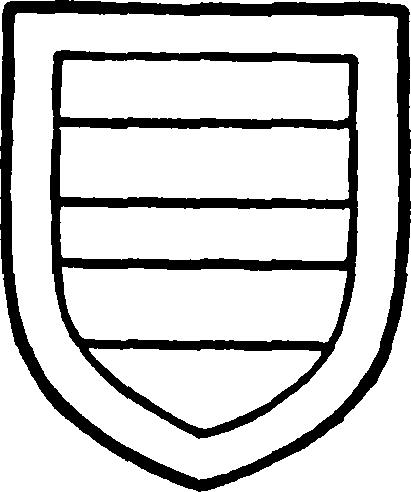
Grimbald. Argent two bars azure and a border gules.
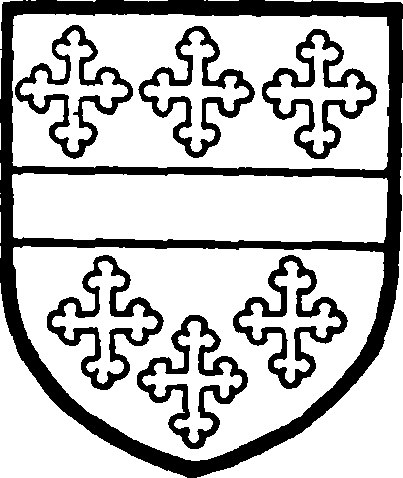
Beauchamp. Gules a fesse between six crosslets or.
As under-tenant at the time of the Domesday Survey stood Grimbald, (fn. 5) whose descendants held Moulton until the middle of the 13th century. His grandson Robert Grimbald married Maud, the daughter and co-heir of Pain de Houghton. (fn. 6) After his death his widow married Richard de la Pek, (fn. 7) who held the manor in her right towards the end of the 12th century. (fn. 8) Robert Grimbaud was returned in 1242 as holding of the honor of Huntingdon in Moulton, (fn. 9) but the actual manor is said to have been acquired from the Grimbalds in the reign of Richard I by Geoffrey Fitz Piers, Earl of Essex, (fn. 10) whose descendant (fn. 11) and heir, John Fitz John, certainly held the manor and in 1276 was holding a view of frankpledge in his court from his tenants, who were geldable at the hundred and had not paid suit of court there for 20 years. (fn. 12) On his death in the same year, the manor, then held mainly as one fee of William Grimbaud, passed to his brother Richard, (fn. 13) who also died without issue in 1297, leaving three sisters or their descendants as his heirs. (fn. 14) Moulton, which was then worth £43 6s. 11d. yearly, was at first assigned to Maud, the eldest sister, wife of William de Beauchamp, Earl of Warwick, (fn. 15) but a subsequent partition awarded the manor to the heirs of Isabel de Vipont, a second sister and co-heir. They were Idonea her daughter, widow of Roger de Leyburn, and Robert de Clifford her grandson. (fn. 16) Idonea, who married John de Cromwell, held half the manor in 1292 (fn. 17) but probably acquired the remaining half from Robert de Clifford soon after, as her husband was lord of Moulton in 1316 (fn. 18) and no further mention is found of the manor in moieties. In 1325 Robert de Wombwell and Robert Tree were fined £300 for damages done by wilful entry of Moulton and Yardley Manors, where they devastated John Cromwell's goods and furniture and expelled him by force and arms, (fn. 19) but in the following year Moulton was given to Roger de Bilney as John remained abroad aiding the queen against the king. (fn. 20) The profits of the manor and all things pertaining to her chamber were, however, granted to Idonea (fn. 21) and Moulton was restored to John by Edward III in 1327. (fn. 22) In 1330 John and Idonea Cromwell claimed view of frankpledge in the manor. (fn. 23) John died shortly afterwards, and on his widow's death in 1334, without issue, Moulton passed, according to the terms of a settlement made in 1320, to Edward the son of Hugh le Despenser the younger, hanged in 1326. (fn. 24) It is likely, however, that this settlement never took effect and that the manor was acquired by the Beauchamps, Earls of Warwick, co-heirs with Isabel de Vipont, as in 1339 Thomas de Beauchamp, nth Earl of Warwick, settled it on his daughter Joan on the occasion of her marriage with Ralph grandson of Ralph Basset of Drayton, the final reversion of the manor being vested in the Earl of Warwick. (fn. 25) The elder Ralph dying in 1343 (fn. 26) and his widow in 1353, (fn. 27) their grandson Ralph succeeded them in the lordship (fn. 28) and received a grant of free warren in 1360. (fn. 29) Ralph died in 1390, when the manor reverted to Thomas Beauchamp, son and heir of the nth Earl. (fn. 30) On the arrest of the Earl for high treason in 1396, Moulton with the other estates was forfeited, (fn. 31) but restored on the accession of Henry IV and passed on Thomas Beauchamp's death in 1401 to his son Richard, (fn. 32) who by his second wife Isabel le Despenser, Countess of Worcester, left a son Henry, aged 15 when he succeeded to Moulton on the death of his father and mother in 1439. (fn. 33) Henry died in 1446, leaving an infant daughter Anne Countess of Warwick, (fn. 34) who died three years later, when the manor devolved on Anne sister of the whole blood to Richard and wife of Sir Richard Neville, created Earl of Warwick and known as 'The KingMaker'. (fn. 35) After his death on the battle-field of Barnet in 1471, his estates were divided between his two daughters and co-heirs, although his widow Anne was still alive. (fn. 36) Having survived both her daughters, however, she obtained the restitution of her estates by Act of Parliament in 1487, (fn. 37) but was obliged to surrender them to the king in the following year. (fn. 38) Henry VII and Henry VIII kept the manor in their own hands, and during the latter's reign the services of several of the king's retainers were rewarded with the office of bailiff of the manor or grants of free warren and land. (fn. 39) In 1550 Edward VI bestowed Moulton on the Princess Elizabeth for life, (fn. 40) and James I in 1613 granted it to Charles Prince of Wales and his heirs. (fn. 41) After Charles's accession to the throne the manor was sold in 1628 to Edward Ditchfield, John Highlord, and others, trustees for the City of London, for a fee-farm rent of £52 17s. 8d., (fn. 42) and some question as to the validity of the letters patent arising, the sale was confirmed in the following year. (fn. 43)
The manor seems to have been sold by the trustees in various small lots, one of which, acquired by the Saunderson family, was sold in 1740, under the name of Moulton Manor, by Mary widow of John Saunderson to Timothy Rogers for £1,500. (fn. 44) By his will dated 15 June 1765, Timothy left his property to his sister Ann Rogers, to whom various yardlands were assigned at the inclosure of the parish in 1772. (fn. 45) The latter, by her will 12 July 1787, bequeathed the manor for life to her faithful servant Elizabeth Lyon with reversion to her cousin Osborn Standest of the Navy Office, London, who by his will in 1814 left the property to his wife Elizabeth with remainder to his children in equal portions, of whom it was purchased in 1850 by Mr. Lewis Loyd. (fn. 46) This property descended to Lady Wantage, the grand-daughter of Mr. Lewis Loyd, but there are no manorial rights exercised at the present day.
Another portion of the estate was purchased by Richard Worley in 1630 (fn. 47) and passed to his descendants, being known as a manor when in the possession of John Worley in 1805. (fn. 48) It was bought with the Saunderson property by Mr. Lewis Loyd in 1850.
The rent of £52 17s. 8d. was sold to William Deacon in 1650 by the trustees for the sale of fee-farm rents, (fn. 49) but was afterwards granted to Queen Katharine in 1665 (fn. 50) and the reversion sold in 1672 to Sir Richard Rainsford, (fn. 51) since which date its descent is similar to that of the fee-farm rent of Kingsthorpe (q.v.), purchased about the same time.
A second holder of land in Moulton at Domesday was Robert de Buci, (fn. 52) whose fief passed to the Bassets of Weldon, of whom Moulton continued to be held. This constituted the ENGAINE FEE.
In the Northampton Geld Roll, dated before 1075, a William Engaine is mentioned where land at Moulton was in default, (fn. 53) and in the Survey of 1086 this William was under-tenant of Robert de Buci, of whom he held 2 hides, 1½ virgates. (fn. 54) His descendants continued to hold this estate, Richard Engaine being in possession in the middle of the 12th century; (fn. 55) he was succeeded by his son Vital, (fn. 56) who died c. 1248, (fn. 57) leaving two sons, Henry who died without issue in 1271 and John. (fn. 58) The Engaines subinfeudated the Fitz Johns, who already held the other manor in Moulton; for in 1296 John Fitz John died holding his manor of Moulton partly, as ⅓ fee, of John Engaine. (fn. 59) This estate thus became amalgamated with Moulton Manor, whose descent has been traced, the last mention of the Engaine overlordship being in 1323, when John Engaine died seised of part of a knight's fee in Moulton, held as of his manor of Blatherwyke (q.v.). (fn. 60)
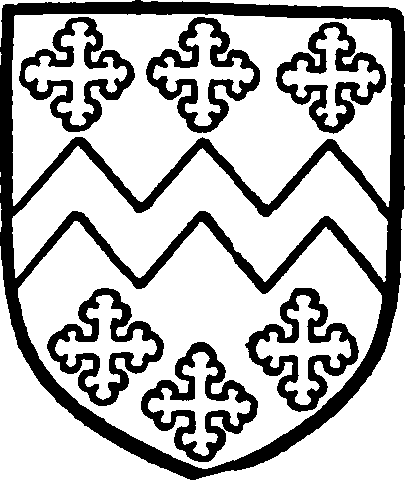
Engaine. Gules crusily and a fesse dancetty or.
Other lands in Moulton were held of the Balliol family, as of the honor of Castle Bernard; these, which in the 12th-century survey were assessed at 1½ hides and I small virgate, were held by Guy de Balliol as of the fee of Faxton, (fn. 61) and were granted with Faxton to the Balliol family, probably by William Rufus. (fn. 62) The Balliols subinfeudated Adam de Periton, (fn. 63) and the estate descended with the manor of Faxton (q.v.).
In the Survey of 1086 and in that of the 12th century, 1½ hides and 1 bovate of land in Moulton are recorded as of the socage of Torp (Kingsthorpe) which was ancient demesne of the Crown, (fn. 64) and part of this holding may be identical with the 5 virgates bestowed by John in 1199 on the church of St. Frideswide, Oxford. (fn. 65) In 1227 the priory was concerned in a dispute with Adam de Periton of Faxton touching the customs which he demanded from them, (fn. 66) and in the reign of Henry III (fn. 67) and in 1291 their land in Moulton was said to be worth 12s. a year, (fn. 68) but there is no further mention of this estate.
The ancient inclosure known as THORPELANDS, which lies on the outskirts of the parish and is bounded by Weston Favell parish, may have developed from the remainder of this Kingsthorpe socage. The name Thorpelands first occurs in 1450, when William Tresham, Speaker of the House of Commons, setting out from Rushton to meet Richard Duke of York, who was crossing from Ireland, was waylaid by some retainers of the Lancastrian, Lord Grey of Ruthin, and there killed by them. (fn. 69) Thorpelands was acquired by the lords of Moulton Manor and passed with it into the possession of the Crown, by whom it was leased in 1516 and again in 1538 to Edmund Haslewood for 21 years. (fn. 70) It was afterwards leased to John Freeman, who was in occupation in 1577, (fn. 71) but it was sold with the manor in 1628 to the trustees of the City of London (fn. 72) and was shortly afterwards acquired in 1631 by Sir William Wilmer of Sywell. (fn. 73) The Wilmers apparently retained it for some years, but it passed through many hands in the 18th century (fn. 74) to William Drage of Stanwick, of whom it was bought in 1816 by Mr. Clarke Hillyard, (fn. 75) afterwards passing to Lord Overstone and then to Lady Wantage.
St. Andrew's Priory acquired a considerable estate in Moulton from the Grimbalds (fn. 76) and other benefactors, among whom were William son of Roger and Master William of Cogenhoe, who granted the priory ½ virgate of land (fn. 77) and Alexander of Moulton who gave it 1 virgate of land which he held from his lord, Simon le Bret, at a rent of 12d. (fn. 78) In 1291 the value of the estate in rents was £2 1s. 4d. and 4s. in lands. (fn. 79) In 1443 the rents of assize came to £2 14s. 5d., (fn. 80) and they were afterwards farmed out to Thomas Chipsey for a term of years of which there were still four remaining in 1535. (fn. 81) In 1538 the priory surrendered to the king, (fn. 82) and part of the lands, in the tenure of Thomas Chipsey, was given in 1543 to Richard Andrews, (fn. 83) after which date there is no further record of this property.
A small estate here was owned by Owston Priory, Leicestershire, founded by Robert Grimbald before 1153 and endowed by him with lands in Moulton (fn. 84) which in the 13th century were assessed at 5s. (fn. 85)
Other lands in Moulton held by Fineshade Priory were granted to it by Richard Engaine the elder who founded the priory at the beginning of John's reign. (fn. 86) His descendants augmented his benefactions, (fn. 87) and the value of the priory's property here in 1291 was £2 2s. a year, (fn. 88) but in 1535 was said to be £1 only. (fn. 89) After the Dissolution in 1540 these lands were confirmed to Thomas Locke who held them on a £50 years' lease from the priory; (fn. 90) but in 1545 they were granted to John Bellery, Edward Bales, and their heirs, (fn. 91) after which date all trace of them is lost.
There is a mill mentioned in the Survey of 1086 on the estate held by William Engaine, which rendered 8d. yearly, (fn. 92) and in 1248 was valued at 20s. (fn. 93) By 1296 2 water-mills are found attached to Moulton Manor, which with the fishing of the ponds were worth 40s. (fn. 94) These mills passed to Idonea de Leyburn, on whose death in 1334 they were in a bad state. (fn. 95) Probably one of them was bestowed by the Bassets or Beauchamps on St. Andrew's Priory, as in 1443 the prior demised to William Cook of Hannington for his life, at an annual rent of 2s., the site of a long mill situated in the fields between Holcot and Moulton, together with Westmylne holm. (fn. 96) In 1551 Elizabeth, afterwards Queen of England, obtained a grant of a water-mill in Moulton for the term of her life, (fn. 97) and James I in 1609 granted to Edward Ferrers and Francis Phelipps a water-mill and horse-mill with the mansion house and meadow in Northmeade adjoining the mills, at a rent of £1 15s. 4d. (fn. 98) This fee-farm rent was sold to William Deaconin 1650 (fn. 99) and follows the descent of the fee-farm rent of the manor (q.v.). In 1706, John Saunderson was in possession of a windmill and a water grist-mill in Moulton; (fn. 100) and there is a mill at the present day situated in the small stream which divides this parish from Boughton.
Church
The church of ST. PETER AND ST. PAUL consists of chancel, 27 ft. 6 in. by 16 ft. 3 in., with north and south chapels; clerestoried nave, 45 ft. 3 in. by 20 ft. 4 in., with north and south aisles continuous with the chancel chapels; south porch, and west tower, 12 ft. 6 in. by 12 ft. 3 in., all these measurements being internal. The north aisle is 15 ft. wide and the south aisle 16 ft. 7 in., the total width across nave and aisles being 56 ft. 6 in. The chapels extend almost the whole length of the chancel, the east end of which projects beyond them about 3 ft.
The building is of rubble throughout, except the upper story of the tower, and internally all the plaster has been removed. The roofs are modern and covered with lead, that of the nave high-pitched, the others low, and all behind plain parapets.
When the church was restored in 1885–6 a portion of a carved pre-Conquest cross-shaft (fn. 101) was found below one of the piers of the south arcade, and is now placed in the chapel south of the chancel arch. Though this implies a burial ground and church of some kind on the site, it is probable that the first stone building was the 12th-century aisleless structure, some portion of which survives in the north wall of the nave, Two pieces of 12th-century ornament are built into the west wall of the south aisle and the south wall west of the porch, and the head (fn. 102) of a semicircular window remains above the second arch from the east of the nave arcade.
About c. 1180–90, a very plain arcade of four rounded arches of two unmoulded orders was cut through the north wall of the nave and an aisle added on that side. The arches are without hood-moulds and spring from piers consisting of four half-rounds against a square centre, with divided plain bell capitals and square abaci, on chamfered bases of cross plan, and from responds of the same character.
The south arcade is probably part of a very extensive rebuilding of the church which took place soon after 1298, in which year the Bishop of Lincoln ordered the inhabitants to rebuild 'the church, tower, and churchyard' which are described as being 'miserably in ruins'. A tower, therefore, must have been added before this time and enough evidence still remains to suggest that the church had been considerably enlarged during the 13 th century. The existing fabric, however, is in the main the reconstructed church of c. 1300, with subsequent alterations. The rebuilding no doubt included the erection of the south aisle, which appears to be contemporary with the arcade, followed by the widening of the north aisle and chapel, beginning at the west end (with a slight break near the north doorway), the building of the tower, and the reconstruction of the chancel and south chapel in their present form. The clerestory and porch appear to be additions later in the century, while early in the 15th-century the tower was heightened by the addition of an upper stage in dressed stone, with short lead-covered wooden spire, and new windows were inserted, or old ones altered, in the aisles and chancel. The spire was pulled down in the time of the Civil War. (fn. 103) A west gallery, erected in 1738, was removed during the restoration of 1885. (fn. 104)
The chancel has a four-centred 15th-century east window of four lights with vertical tracery, and in the south wall a trefoil-headed piscina recess with mutilated bowl, west of which is a blocked 15th-century doorway and over it the remains of a window opening. (fn. 105) Beyond this the chancel is open to the south chapel by an arcade of two arches of two chamfered orders, without hoodmoulds, springing from an octagonal pier with moulded capital and base and from end corbels. On the north side there is a 13-ft. length of blank wall at the east end, (fn. 106) beyond which the chancel is open to the chapel by a single wide arch of two chamfered orders with hoodmould, the inner order springing from mutilated corbels. The arches on both sides are of the 14th century, and were originally filled with screens, the marks of which remain. The early-14th-century chancel arch is also of two chamfered orders, without hood-mould, the inner order on half-octagonal responds with moulded capitals, and bases standing on high plinths. (fn. 107) Lintel doorways to the rood-loft remain north and south of the arch high up at the east end of the nave walls, but there are no stairs. The roof of the chancel, and all its fittings, are modern. There is no chancel-screen.
The north chapel has a 14th-century east window of three trefoiled lights with reticulated tracery and chamfered rear-arch, and on the north side a three-light window with quatrefoil tracery. In the usual position in the south wall is an early-13th-century trefoiled piscina with fluted projecting bowl, and the slots for a wooden shelf above. The south chapel has an east window of four lights, c. 1300, with intersecting tracery and chamfered rear-arch, but the two contemporary four-light windows in the south wall were re-topped in the 15th century with cusped lights and very depressed arches. (fn. 108) There is a trefoil-headed piscina c. 1300 with fluted bowl, and also in the south wall a later pointed doorway, to give headway for which the eastern light of the adjoining window was shortened.
The late-12th-century north arcade has been described, but at some later period the two western piers were encased, built up solid, for some 3 or 4 ft., the westernmost in circular and the other in hexagonal form. The south arcade is also of four bays, with pointed arches of two chamfered orders without hoodmould, on octagonal piers and responds with moulded capitals and bases. There are five square-headed clerestory windows of two trefoiled lights on each side placed very high in the walls: the line of the early-14thcentury high-pitched roof remains over the tower arch.
The west window of the north aisle and one in the north wall west of the doorway are of two lights with forked mullion c. 1300, and those in the corresponding positions on the south side appear to have been contemporary, but the mullion is cut away in the west window and the other is modern. Near the east end of the north aisle is a three-light window with tracery similar to that in the north chapel, and the south aisle has a four-light window east of the porch like those in the south chapel. The 14th-century north doorway is of two continuous orders, the inner wave-moulded and the outer with a hollow chamfer. The south doorway is in part of late-12th-century date with a later pointed arch of two orders, apparently of the 13th century, the outer chamfered, the inner covered by the wooden frame of an inserted panelled door. (fn. 109) The 12th-century jambs were originally shafted, but the shafts are gone, though the capitals and imposts remain. The 14thcentury outer doorway of the porch is of two chamfered orders, the inner springing from moulded corbels: there is a good but much-weathered line of carving on the low-pitched gable of the porch.
The tower is of four stages, the three lower constituting the 14th-century structure, with diagonal buttresses to the top of the second stage, and a vice in the southwest angle corbelled out internally. The west doorway is of two moulded orders, with hood-mould and finial, and an inner order moulded only half-way, the jambs of which differ. Above it in the second stage is a window of two trefoiled lights with quatrefoil in the head, but on the north and south the two lower stages are blank. The original bell-chamber windows are of the same character, but those of the superimposed 15th-century upper stage are tall double transomed openings of two trefoiled lights. The tower finishes with a battlemented parapet and mutilated angle pinnacles. (fn. 110) The arch opening to the nave is of four chamfered orders on the east side, three of which die out, and the innermost springs from half-octagonal responds with moulded capitals and bases. The vice doorway has a lintel on rounded corbels. Below the arch is a portion of the early-18th-century turned oak altar railing.
The font in use was given in 1886, (fn. 111) and the pulpit also is modern.
In the north aisle is a broken 13th-century coffin lid with cross and 'omega' ornament: (fn. 112) an armorial slab to John Sanderson (d. 1689) is now against the north wall. (fn. 113) There are no other monuments older than the middle of the 18th century. In the vestry is a parish chest apparently of 17th-century date.
There is a ring of six bells cast by Edward Arnold or Leicester in 1795, and rehung by Taylor of Loughborough in 1884. (fn. 114) A clock and chimes were erected in 1903. In 1552 there were four bells and a sanctus bell and 'one other great bell hanging in one frame by itself'.
The plate consists of a silver cup of 1607, a paten c. 1685 with maker's mark W.R., and a silver breadholder of 1735 given by Mrs. Sarah Page. (fn. 115)
The registers before 1812 are as follows: (i) baptisms 1565–1635, (fn. 116) 1689–1740, marriages 1566–1652, 1689–1739, burials 1565–1632, 1689–1740; (ii) baptisms and burials 1740–99, marriages 1740–54; (iii) marriages 1755–1812; (iv) baptisms 1800–12; (v) burials 1800–12. The baptisms from 1565 to 1812 have been printed. (fn. 117) The first volume contains a list of briefs 1692–1730, and of unbaptized persons c. 1700. The churchwardens' accounts begin in 1778.
Advowson
The Grimbald family were great benefactors to St. Andrew's Priory and the founder of the family, Grimbald, who witnessed the foundation charter of the priory between 1093–1100, bestowed upon it the church of Moulton with 7 virgates of land and freedom from suit of court: (fn. 118) gifts which were confirmed by his descendants and by William Mandeville Earl of Essex. (fn. 119) Between 1209 and 1235 a vicarage was ordained which consisted in all things belonging to the church except the tithes, which were appropriated by the priory; (fn. 120) but subsequently assignment was made to the vicar of one half of the tithes. (fn. 121) The priory continued to hold the advowson and had a pension in the vicarage of 13s. 4d. which was paid till the Dissolution, (fn. 122) but during the French war of the reign of Edward III, the king is often found presenting to Moulton church, as the priory, being an alien one, was then taken into his hand. (fn. 123) In 1535 the vicarage was worth £15, (fn. 124) and after the dissolution of the priory was granted in 1552 to John Whiting and Thomas Freeman, (fn. 125) who at once conveyed it to Edward Watson. (fn. 126) The latter and his wife Dorothy sold it in 1554 to John Lane of Walgrave, (fn. 127) on whose death three years later, (fn. 128) it passed to his son William, who died while still a minor in 1560, (fn. 129) when he was succeeded by his brother John, of whom the advowson was purchased by John Freeman of Great Billing in 1576. (fn. 130) John Freeman continued in possession until 1615, when on his death it passed with Great Billing Manor (q.v.) to his grandchild and heir Katharine the wife of Sir Edward Gorges, afterwards Baron Dundalk. (fn. 131) By her first husband Edward Haslewood of Maidwell, Katharine had a son, Sir Anthony Haslewood, (fn. 132) to whom she and Sir Edward Gorges conveyed the advowson in 1628, (fn. 133) and it remained vested in the Haslewoods, (fn. 134) passing on the death of Anthony's son William in 1681 to the latter's two daughters and co-heirs, Elizabeth and Penelope, who afterwards married Christopher Lord Hatton of Kirby and Henry Portman respectively. (fn. 135) Penelope gave up her right in the advowson to her sister and Lord Hatton, (fn. 136) to whose sons William and Henry, who both died without issue before 1762, it passed in due course, afterwards descending according to the terms of a settlement to Edward Finch the fifth son of Anne, wife of Daniel Finch, Earl of Winchilsea, and daughter of Christopher Lord Hatton by his first wife Cecily. (fn. 137) Edward Finch assumed the additional name of Hatton in 1764 and on his death in 1771 left the right of presentation to his son George, (fn. 138) by whom it was probably sold some time between 1818 and 1823, the date of his death. (fn. 139) During the rest of the 19th century it passed through many hands, and is at present vested in the Church Association Trust.
In 1301 an indulgence was granted for the chapel of the Blessed Mary in the church, (fn. 140) and in 1495 Thomas Stanner, glazier, bequeathed his possessions and 40s. for the use of Moulton parish church, the parishioners to pray for the souls of himself, his father, mother, and friends. (fn. 141) Moulton rectory was appropriated to St. Andrew's Priory before the Dissolution, and descended with the advowson until the first quarter of the 19th century. It was assessed at £8 in the reign of Henry III (fn. 142) and in 1291, (fn. 143) but by 1535 had risen to twice that value and had been leased to Edward Watson for a term of years, of which four then remained. (fn. 144) It passed with the advowson to the Haslewoods; and in 1649, when Sir Anthony Haslewood compounded for delinquency, the impropriate rectory of Moulton, worth £115 a year, was accepted in part payment of the fine, and £55 a year was to be settled on Moulton church, £35 in augmentation of the minister's salary. (fn. 145) The Lane family laid claim to the rectory as well as to the advowson, (fn. 146) and the dispute was not settled until 1662, when Montague the son of Robert Lane gave up all his claims to William Haslewood. (fn. 147) In 1772, when the parish was inclosed, the great tithes were commuted for 396 acres 17 poles of land, (fn. 148) and the estate was sold in 1818 by Colonel George Finch Hatton, the impropriator, to William Abbot, who was sheriff for Northamptonshire in 1824 and resided in the house built on this road known as Moulton Grange. (fn. 149) Between this date and 1835, this rectorial estate was sold to John Nethercote, (fn. 150) whose ancestors Edward and his wife Susanna held land in Moulton in 1611. (fn. 151)
The Engaines of Blatherwycke apparently settled two-thirds of the great tithes of certain lands in Moulton on the rector of Blatherwycke. These two-thirds were represented in 1291 by a pension of 13s. 4d. in Moulton rectory, (fn. 152) paid in 1600 from land called the 'Wenge' containing 9½ yardlands. (fn. 153) At the inclosure of the parish in 1772, some 32 acres were alloted to the rector of Blatherwycke in lieu of two-thirds of the great tithes arising from Wenglands or Blatherwycke lands, and from Keybery and Fletlands, (fn. 154) and this small estate is still enjoyed by the rectors of Blatherwycke.
Charities
Robert Mills in or about 1611 gave out of land belonging to him 20s. a year to be distributed on St. Stephen's Day in bread to twenty Church widows and 6s. 8d. for a sermon on that day. This charge was redeemed and the endowment now produces £1 2s. in dividends. The charity is administered by the churchwardens.
Martha Spraggott by her will proved in Prerogative Court of Canterbury 4 May 1848 gave a sum of money to the vicar and churchwardens for the poor. The endowment produces £1 7s. yearly in dividends, which are distributed with the Mills charity.
William Barber by his will proved in Northampton 22 April 1882 gave £50 to the vicar and vicar's warden and the owner of Moulton Grange for the benefit of the aged poor. This sum now produces about £1 5s. yearly in dividends.
John Francis by his will proved 26 April 1907 gave £100 to the churchwardens for the benefit of the poor. The money was invested, producing £3 7s. 6d. yearly in dividends.
The income of these four charities is, after the payment of 6s. 8d. to the vicar for a sermon, distributed in doles to about twenty poor widows.
The vicar of Moulton receives annually £30 from the trustees of Sir Edward Nicholls's Charity, which is described under the parish of Kettering.
The several sums of stock are with the Official Trustees of Charitable Funds.