A History of the County of Northampton: Volume 4. Originally published by Victoria County History, London, 1937.
This free content was digitised by double rekeying. All rights reserved.
'Parishes: Wellingborough', in A History of the County of Northampton: Volume 4, ed. L F Salzman (London, 1937), British History Online https://www.british-history.ac.uk/vch/northants/vol4/pp135-146 [accessed 30 April 2025].
'Parishes: Wellingborough', in A History of the County of Northampton: Volume 4. Edited by L F Salzman (London, 1937), British History Online, accessed April 30, 2025, https://www.british-history.ac.uk/vch/northants/vol4/pp135-146.
"Parishes: Wellingborough". A History of the County of Northampton: Volume 4. Ed. L F Salzman (London, 1937), British History Online. Web. 30 April 2025. https://www.british-history.ac.uk/vch/northants/vol4/pp135-146.
In this section
WELLINGBOROUGH
Wendlesberie, Wedlingaberie (xi cent.); Wenlingeburc (xii cent.); Wendlingburgh (xiii-xvi cent.); Wellyngburgh (xiv cent.).
The parish of Wellingborough contains 4,253 acres. The subsoil is Lias and Great Oolite. (fn. 1) The Rivers Nene and Ise form the eastern boundary of the parish, while another stream which joins the Ise forms the northern boundary. The London road from Kettering passes through the town, which is served by two stations on the London, Midland, and Scottish Railway. From the London Road Station, a mile to the south, a fine avenue of trees leads up to the town.
On the west side of the town, behind Sheep Street and overlooking the Swans Pool Brook, is the house called 'Croyland Abbey', which embodies some remains of the manor-house of the abbots of Crowland, including the fragment of a 13th-century doorway. Cole, writing in 1837, said that a considerable part of the house had been taken down 'of late years', and Bridges early in the 18th century records the then recent demolition of an ancient granary near the entrance. The building appears to have been reconstructed in the 17th century, and a good oak staircase of c. 1670, with square newels and shaped flat balusters together with some mullioned windows of the same period remain. The building was modernized about 1860, but part of a fine 15th-century open roof belonging to the great hall of the manor house is still in position above the ceiling of the west wing. It consists of two-and-a-half bays, with a moulded and embattled tie-beam and upper collar, purlins and windbraces—the rafters being modern—and formed the eastern end of the great hall: the rest has gone.
The tithe-barn still stands to the north-west of the house and is six bays long, marked externally by buttresses, built chiefly of local ironstone with limestone courses at intervals, and covered with thatch. Its internal dimensions are 77 ft. by 21 ft. 6 in., and it has two wide doorways on each side, those on the west side being lower than the others, which are 13 ft. 6 in. high. The structure is a very fine example of the stone-built barns of the early 15th century. (fn. 2)
A second tithe-barn in the town, probably that of the manor of Hatton, of the same general character but reduced in length, has recently been demolished. (fn. 3)
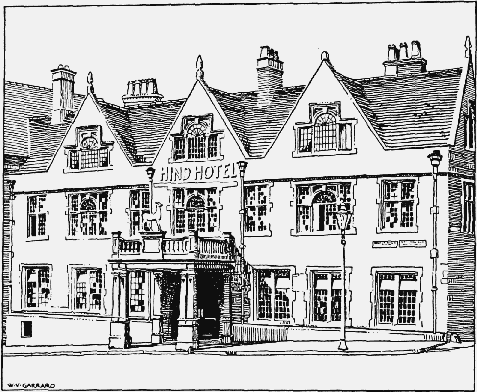
Wellingborough: The Hind Hotel
The old Free School-house stands to the north-west
of the parish church and is a large two-story building of
ironstone with mullioned windows, red-tiled roofs, and
two gables on the principal or south front towards the
churchyard: on the north side it faces directly on to
Church Street. The building was restored in 1904,
since when it has been used as a Church House. A sundial on one of the gables is dated 1621. (fn. 4) Over the doorway on the south front is a panel inscribed: 'Edward
Pickering of Swasey in the county of Cambridge Esqr
one of the sons of Sr John Pickering, late of Tichmarsh
in this county Kt. and Barnt. ano Dni, 1682 gave to this
Free school 130L for the advancemt. of learning—
Aspice, Respice, fac simile.' Adjoining this on the right
is a second panel, (fn. 5) with the inscription: 'Richard Fisher
of Wellingborough gent, gave to the schoolmasters of
this place £15 per an. for the further encouragement of
Learning Ano Dni 1711', and beneath both a third
panel inscribed:
[PHILOMATHESI] multum debeo
Barberis autem nihil.
Immediately adjoining the school-house on the west is a gabled house (fn. 6) with stone slated roof and panel on the north front dated 1608.
The Hind Hotel, (fn. 7) at the west end of the Market Place, is said by local tradition to have been in course of erection at the time of the battle of Naseby. The building, which is of two stories with gabled attics, is faced with local ironstone and its design is attributed to William Batley, of Wellingborough. (fn. 8) As originally built it was quadrangular in plan, with a central courtyard and an entrance gateway 10 ft. wide in the middle of the principal front and one at the opposite end from the stable yard. On three sides of the courtyard was a colonnade supporting an open balustraded passage on the first floor, from which the bedrooms opened. (fn. 9) The building, however, has undergone many alterations and in the early part of the last century had sash windows on the ground floor. These were replaced by the present mullioned windows in 1872, and in 1878 the staircase was altered: the gateway had been closed in 1869 and the space converted into an entrance hall. In 1891 the long north front to Burystead was rebuilt and a wooden portico erected over the entrance. The front to the Market Place is about 69 ft. long and has three regularly spaced roof gables with plain coping and finials, the windows in which have a wide round-headed middle light: on the first floor the windows are transomed and alternately of two and three lights. Two lead spout-heads are dated 1741, and two others 1762. The broad 17th-century oak staircase has turned balusters and square newels with shaped tops and in one of the upper rooms is a good four-centered stone fire-place. The courtyard is now covered in.
A market cross, built in 1719 in front of the Hind Hotel, was taken down in 1798: it is described as consisting of a stepped base 'surmounted by a beehiveshaped rotunda, which served the purpose of a prison', over which was an octagonal fluted shaft with vane. (fn. 10)
The Golden Lion Inn at the bottom of Sheep Street is a small but picturesque stone building, probably of early-17th-century date, with an overhanging timber and plaster gable, recently restored. (fn. 11) The house is said to have been the dwelling of Thomas Roane, who died in 1676. (fn. 12)
In Sheep Street (fn. 13) is an old stone and timber building with overhanging upper story of plaster and thatched roof broken by gables, which since its restoration c. 1917 forms one of the most picturesque groups in the town, the broad surface of the plaster contrasting with the broken lines of the ground story, in which is a bay window and wide entrance gateway. The building is probably of early-17th-century date.
The White Swan Inn (where Queen Henrietta Maria stayed in 1628) was pulled down in 1829.
The new bridge of the River Nene, opened in December 1890, took the place of a 'very long and very picturesque erection', with round arches and two cut-waters, erected c. 1630 (fn. 14) and known as the 'Long Bridge'. (fn. 15)
Wellingborough School was refounded in 1880 (fn. 16) on a new site on the London Road and the buildings, which are of red brick in the style of the Queen Anne period, have been enlarged in 1888, 1895, and 1913. In 1931 a new Grammar School, built on modern lines round a quadrangle, was opened on the Doddington Road.
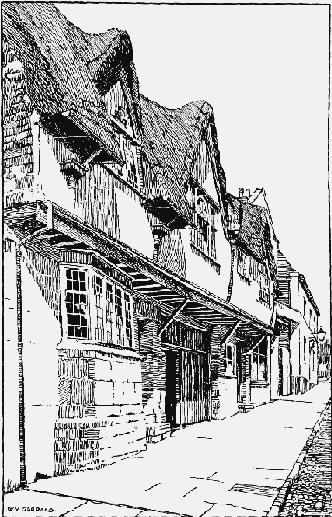
Wellingborough: Sheep Street (before 1917)
The town and manor formed one of the most important possessions of Crowland Abbey from the 10th to the 16th century, with a prosperous market, but the townspeople do not seem to have obtained any measure of selfgovernment, but rather found their right of electing certain officials a burden on the score of expense. (fn. 17) A series of manor accounts of the 13th and 14th centuries were first kept by the reeve only, and the usual officials of a manor appear, but between 1285 and 1289 a collector began to return a separate account for all rents and similar payments. (fn. 18) The collector was elected by the tenants, but in 1385 an agreement was made by which the collector in future was to be appointed by the abbey. This agreement, which contained other clauses, marked the conclusion of a quarrel between the abbot and the townspeople (fn. 19) at the time of the Peasants' Revolt when much damage was done to the abbey demesne. (fn. 20) The collector still accounted for the rents at the time of the Dissolution (fn. 21) and it was probably for rent-collecting purposes that the town was divided into quarters, of which the names Netherend, Upperend, Westend, and Eastend have survived in documents. (fn. 22) The Guild of St. Mary (q.v.) took a leading action in the affairs of the town and applied part of its revenues to the repair of the bridges in the town. As early as 1227 a relaxation of 13 days' penance was granted to those giving alms for the repair of Staplebridge at Wellingborough, (fn. 23) and it was probably for the repair of this bridge, under the mysterious name of 'Sancta Pilbrigge', that Gilbert Champneys in 1375 bequeathed money. (fn. 24) Breke Bridge is mentioned in 1500 and Irewell Bridge in 1539. (fn. 25) The revenues of the Guild after its dissolution were vested in certain feoffees and, under a Decree of Chancery, in 1595 were assigned towards the upkeep of the Grammar School, (fn. 26) but it seems clear that the income of the Feoffees' Charity was used for town purposes. (fn. 27) For many years the school-house served also as the Town Hall, (fn. 28) but in 1821 the feoffees built a new hall out of the revenues of the charity. (fn. 29) Wellingborough Bridge was practically destroyed in a great flood in the 18th century. (fn. 30) In 1669 the town was described as 'a borough containing a great number of houses, all built of stone, and a considerable population', (fn. 31) but in 1738 a great fire destroyed much of the old town. (fn. 32) In 1855 a Board of Health was established, but the government of the town and parish is now controlled by the Urban District Council, established under the Local Government Act of 1894.
In the later 13th century Wellingborough was included in the well-organized system of sheep-farming developed by the abbey of Crowland. (fn. 33) In 1291 the profits of the flocks are specially mentioned amongst the abbey revenues at Wellingborough (fn. 34) and both sheep and wool were sent to Crowland. The special accounts of the sheep-run, however, end abruptly in 1314, (fn. 35) but wool remained an important factor in Wellingborough economy and in 1319 there were 200 sheep on the abbot's demesne. (fn. 36) Probably the demesne lands were usually leased. (fn. 37) In the 16th century there was still a large market for wool and fells in the town. (fn. 38) The making of cheese, which formerly made the cheese fair on St. Luke's Day celebrated, (fn. 39) can be traced back to the 13th century when a large number of cheeses were accounted for to the abbey. (fn. 40) In 1693, and again in 1743, Wellingborough market was the scene of somewhat serious corn riots. (fn. 41) Lace-making was a thriving industry until killed by the introduction of machinemade lace, (fn. 42) but at the present day the main industries of Wellingborough are boot- and shoe-making and ironworks. (fn. 43)
Wellingborough was famous for its waters in the 17th century. Various wells are mentioned in earlier documents, one of them being called Our Lady's Well, (fn. 44) and their medicinal qualities made the town fashionable about 1624, when the Duchess of Buckingham came to drink the waters. (fn. 45) Three years later Charles I and Henrietta Maria received the Mantuan ambassador there, while the Queen seems to have come again in 1628. (fn. 46)
Sir Paul Pindar, the diplomatist, was born at Wellingborough about 1565, and after gaining commercial experience in Venice and Aleppo he was appointed English ambassador to Turkey in 1611. He presented church plate and one of the existing church bells. (fn. 47) Other Wellingborough residents were John Cole (1792–1848), the historian of the town, who was a schoolmaster there in 1835, (fn. 48) and John Askham (1825– 94), the poet and shoemaker who was born there. He was educated for a short time at the Free School and at 10 years old was apprenticed to a shoemaker. He published five volumes of poems and was a member of the earliest School Board in the town in 1871, and was also librarian of the Literary Institute. (fn. 49)
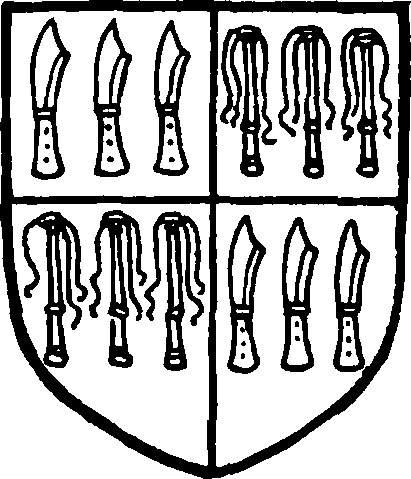
Abbey of Crowland. Gules three knives argent with handles or set fessewise quartered with azure three scourges or erect and fessewise.
Manors
The manor of WELLINGBOROUGH belonged to the abbey of Crowland in Lincolnshire in the reign of Edward the Confessor. (fn. 50) According to the 12th-century tradition at the abbey, it had been given to Crowland in the reign of Edred (946– 55) by Turketyl, the refounder of the abbey, of which he was elected abbot. (fn. 51) In 1086 the abbey held 5½ hides at Wellingborough, of which the value had risen from 50s. in 1066 to 6l. (fn. 52) In 1285 the manor was held in frank-almoin of the king (fn. 53) and in 1329 the abbot claimed to hold sac, soc, toll, team, and infangthief, view of frankpledge, with gallows, tumbril, and pillory. He further claimed that he and his men were free of 'murdrum' and suit to the county and that they were quit of all tolls on their goods. (fn. 54)
In 1319 there were 7 free tenants, 12 full socmen, 35 toft socmen, 36 villeins, 35 molmen, 5 acremen, and 1 cottar. The services due from the tenants are enumerated in much detail and obviously show the manorial custom of a much earlier date, but each in 1319 had a money equivalent. The most interesting group were the socmen, who had retained their special characteristics from the 11th century. Each socman still held a virgate of land, for which a rent of 8d. was due and the service of 'long avering' or carrying had been commuted to 2½d. a year. They paid a fine for entry to their tenements and were admitted in the lord's court, while jointly they paid a fine called 'Francwara' of 2s. 9d., but they were free of the more servile fines &c. paid by the unfree tenants. (fn. 55) At this time, one virgate was divided into four holdings and later all 12 seem to have been subdivided, but their identity was not lost. In the 16th century the holdings were called sokons, one tenant being the head of the sokon and when he died or alienated his holding a fine of 16s. was paid, but the other tenants of his sokon paid no fine, when their tenements changed hands, to the lord of the manor. (fn. 56) The whole manor paid a fine called aid-silver taken at the abbot's will until 1385 when it was fixed at £4 a year. (fn. 57)
The manor was held in demesne by the abbey until its dissolution in 1539 (fn. 58) and was held by the king until 1550–1, (fn. 59) when Edward VI granted it to Princess Elizabeth. (fn. 60) The mansion house and demesne lands had been let by the abbey, the last tenants being William Peke and his son John. (fn. 61) The latter had been succeeded by 1547 by his widow Alice and her second husband Thomas Warner, (fn. 62) and in 1568 Queen Elizabeth gave another lease to Edward Cawton. (fn. 63) The manor itself she seems to have retained till 1590, but in 1574 she granted a considerable part of its lands to Robert Dudley, Earl of Leicester, (fn. 64) and another grant of lands was made in 1576 to Sir Christopher Hatton. (fn. 65) The manor is not mentioned in either grant, but in 1579 Hatton appears to have bought a large estate in Wellingborough including view of frankpledge and stallage rights from Roger Charnock and his wife Elizabeth, (fn. 66) and this possibly represented Leicester's holding. The Charnocks continued to live there, (fn. 67) presumably as tenants of Hatton. In 1590 Elizabeth sold the Crowland manor of Wellingborough, and other property there to Richard Knolles and William Doddington, (fn. 68) presumably mere speculators, as Hatton died seised of the manor of Wellingborough in 1591. (fn. 69) His heir was his nephew Sir William Newport alias Hatton, the son of his sister Dorothy, (fn. 70) but he apparently intended to settle it on his cousin John Hatton. (fn. 71) Whether he did so seems to have been uncertain in 1616, (fn. 72) but the situation was complicated by the fact that Sir Christopher died heavily in debt to the Crown and in 1594 the Queen granted the manor for twentyone years to William and Francis Tate for the settlement of his debts. (fn. 73) Sir William Hatton died in 1596–7, having settled the manor on his elder daughter and heir Frances, (fn. 74) who married Robert Rich, 2nd Earl of Warwick. (fn. 75) Finally, in 1616 a division was made between Robert Rich and his wife on one hand and Christopher son of John Hatton on the other. (fn. 76) From this time the manor was held in two separate portions known as the manor of Wellingborough and the manor of WellingboroughHatton.
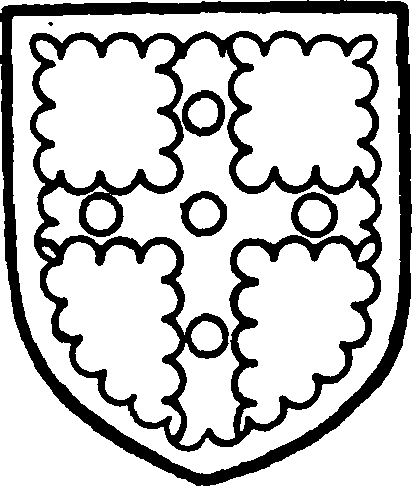
Greville. Sable a cross in a border engrailed or with five roundels sable on the cross.
The manor of WELLINGBOROUGH was sold in 1620 (fn. 77) by the Earl of Warwick and his wife to Fulke Greville, Lord Brooke, who left it in his will dated 1627/8 to his cousin Robert Greville. (fn. 78) His family held it till the 19th century, (fn. 79) but sold it to John Vivian. From him it passed to Quintus Vivian, who was lord of the manor in 1837 (fn. 80) and died in 1877. Major Quintus Vivian left a daughter Flora, who married William Frederick Byng, second son of the Earl of Strafford. Their daughter Violet married Dr. Edmund Distin Maddick, C.B.E., whose son, Major Edmund Cecil Strafford Byng-Maddick, is now lord of the manors of Wellingborough.
WESTHALL FEE was a small manor held by Crowland Abbey at the time of its dissolution; it was let at farm to John Peke, with the demesnes of the chief manor of Wellingborough, (fn. 81) into which it was evidently absorbed. This may possibly represent the virgate held in 1086 by the Bishop of Coutances, appurtenant to Harrowden. (fn. 82) The sub-tenant at that date was Norgot, and in 1199 one Hugh 'son of Norgaut' granted half a virgate in Wellingborough to the Abbot of Crowland. (fn. 83)
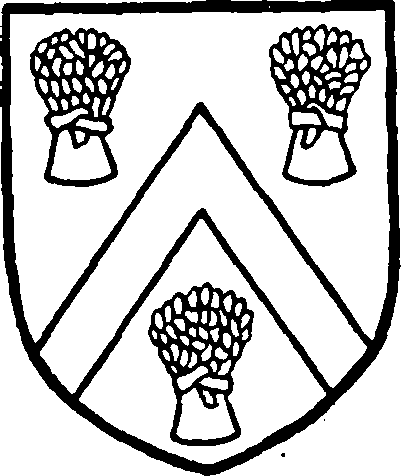
Hatton. Azure a cheveron between three sheaves or.
The manor of WELLINGBOROUGH-HATTON (fn. 84) was assigned to Christopher Hatton of Kirby, probably in 1616. (fn. 85) He was created Lord Hatton of Kirby in 1643, (fn. 86) but in 1649, in order presumably to meet the heavy cost of compounding for his estates with the Commonwealth, he sold Wellingborough-Hatton to Francis Gray, (fn. 87) a royalist who in 1642 had been seized by the Parliamentarians for not contributing to the defence of the kingdom. The town rose in arms in his defence and reinforcements had to be hurried from Northampton to put down the disturbance. (fn. 88) He must, however, have made his peace with the Parliament before he purchased the Hatton manor. His son, another Francis Gray, settled the manor on his nephew Charles Shepherd in 1703, (fn. 89) who held in 1719, (fn. 90) and afterwards the manor passed to George Shepherd. (fn. 91) In 1805, it seems to have been in the hands of heiresses, (fn. 92) from whom it was presumably bought by John Vivian, the lord of Wellingborough manor. (fn. 93)
In the 12th century a hide of land, which was apparently omitted from the Domesday Survey, was held by the Earl of Leicester. (fn. 94) In 1265 Simon de Montfort, Earl of Leicester, (fn. 95) forfeited a yearly rent of £10 in Wellingborough, which had been seized by Gilbert de Clare. The overlordship of the honor of Leicester is mentioned in 1488 (fn. 96) and 1535. (fn. 97) In 1205 the sub-tenant of the manor was Robert de Harcourt, whose lands were seized by King John and granted to Philip de Wigornia, (fn. 98) but in 1216 John de Harcourt recovered them. (fn. 99) He was succeeded in 1220–1 by Richard de Harcourt, a son of Robert. (fn. 100) Baldwin de Manners was holding 1/7 of the vill of Wellingborough in 1285 (fn. 101) and a quarter fee there in 1298. (fn. 102) He died in 1320, (fn. 103) and his heir is said to have been Robert de Morley, Marshal of Ireland, (fn. 104) but Wellingborough apparently passed first to William de Morley, the father of Robert, probably in right of his wife. (fn. 105) Robert in 1352 sold this property to Adam Fraunceys and John Piel, citizens of London. (fn. 106) John Piel by his will, proved in 1382, made provision for the foundation of a College of Canons at Irthlingborough. (fn. 107) His widow Joan carried out his intentions (fn. 108) and part of his manor was presumably then given to the College, which at the Dissolution received £12 0s. 10½d. from lands in Wellingborough and paid a rent of 3s. 4d. to the 'duchy' of Leicester. (fn. 109) The College manor of Wellingborough remained in the king's hands until Edward VI granted it with the manor belonging to Crowland Abbey (q.v.) to Princess Elizabeth (fn. 110) and it was annexed to the honor of Grafton. (fn. 111) It followed the descent of that part of the Crowland Abbey manor (fn. 112) which came into the possession of Fulk, Lord Brooke, in 1620 (fn. 113) and is mentioned as a separate manor at the time of the inclosure of the lands of Francis, Earl Brooke and Earl of Warwick, in 1765, (fn. 114) but was apparently united to Wellingborough-Hatton by 1837. (fn. 115)
A manor of WELLINGBOROUGH, which was also held of the honor of Leicester, (fn. 116) possibly consisted of the remainder of John Piel's property there. In 1363 he enfeoffed Adam Fraunceys, citizen of London, Henry Piel, rector of Workton, and William Braybrook with all his lands in Wellingborough. (fn. 117) In 1376, another settlement was made by them to which Simon Simeon and John Curteys of Wermington were also parties. (fn. 118) In 1386 a grant by Curteys and Robert Southoo of a water-mill, &c., in Wellingborough to Joan, widow of John Piel, and his son Nicholas for their lives was confirmed by Simon Simeon. (fn. 119) Joan Piel was seised of lands there in 1412 (fn. 120) and in 1426 the manor was in the hands of William Braunspath and Elizabeth his wife. (fn. 121) Possibly the latter was Elizabeth Piel, (fn. 122) who afterwards married Sir William Huddleston. Their son Henry Huddleston (fn. 123) died in or shortly before 1488 (fn. 124) and left the manor of Wellingborough to his daughter Elizabeth, the wife of Sir Thomas Cheyne, in tail, with remainder in default to his executors. (fn. 125) Sir Thomas held the property at his death in 1514, but had settled it on his second wife Anne. (fn. 126) It was claimed, but unsuccessfully, by Margaret widow of Sir George Vere, as the heir of Elizabeth Piel. (fn. 127) It later passed to Elizabeth, daughter of Sir Thomas Cheyne; (fn. 128) she married Thomas Vaux, son and heir of Sir Nicholas Vaux. (fn. 129) In 1615 it was in the hands of Elizabeth Vaux, mother of Edward, Lord Vaux of Harrowden, a minor, (fn. 130) but no further trace of it can be found.
GAGE'S MANOR appears in 1608, when it was held by Robert Gage of Raunds. (fn. 131) His son John Gage had succeeded to it by 1624 (fn. 132) and another John Gage and his wife Elizabeth, together with Richard Grace and his wife Mary, probably the daughter and heir of the second John, sold it in 1655 to Francis Gray, the lord of Wellingborough-Hatton manor (fn. 133) (q.v.).
COGENHO FEE or CHETNE'S FEE may be traced back to the holdings of Countess Judith. She held half a virgate in Wellingborough, appertaining to the manor of Doddington, with which it was valued. (fn. 134) The tenant in 1086 was named Gilbert. (fn. 135) She also held half a hide of land in Wellingborough in 1086, (fn. 136) which passed to the honor of Huntingdon, (fn. 137) of which the fee was still held in 1616. (fn. 138) Her tenant was named Hugh. (fn. 139) In the 12th century 3 virgates were held by Nicholas de Cogenho, (fn. 140) and an Ilbert de Cogenho granted a virgate there to St. Andrew's Priory, Northampton. This gift was confirmed by Henry II. (fn. 141) In the reign of Richard I, Henry de Cogenho alienated the manor to Herlewin de Raunds, (fn. 142) whose descendant William de Raunds held the manor in 1329. (fn. 143) This fee seems to have returned to the Cogenhos, or possibly William de Raunds took the name of Cogenho, In or shortly before 1399, William, son and heir of William de Cogenho, died leaving his sister Agnes as his heir. (fn. 144) She was the wife of John Cheyne, (fn. 145) who in 1412 held lands in Wellingborough and Cogenho (fn. 146) worth over 12 l. per annum. In 1439, William Seymour and his wife Isabel quitclaimed to feoffees for themselves and the heirs of Isabel their right in the manor of Cogenho and lands there and in Wellingborough and Horton, but no explanation appears as to their claims. (fn. 147) The fee returned to the Cheynes and followed the descent of Cogenho (q.v.) until the death of John Cheyne in 1596, when the manor passed to his brother Francis, (fn. 148) who sold, or possibly mortgaged, it in 1607 to Robert Sparrow. (fn. 149) As there were Cheynes connected with Wellingborough until 1662, it may have passed to a younger branch of the family; there are inscriptions in the parish church to Laurence Cheyne who died in 1651 (fn. 150) and to Edward Cheyne in 1662. (fn. 151) Thomas Roane, who owned Cogenho Fee, (fn. 152) died in 1676, leaving a daughter Margaret as his heir. (fn. 153) She left various benefactions to the town and at her death in 1717 (fn. 154) the manor was presumably sold, George Wentworth holding it about 1720. (fn. 155) John Frederick is reported to have been the lord of a manor in Wellingborough at this period and this may have been Cogenho Fee. (fn. 156) He died in 1775 leaving his property to his wife. (fn. 157) She died in 1788 and left her property in Wellingborough to different nieces, but Cogenho Fee is not mentioned in her will. (fn. 158)
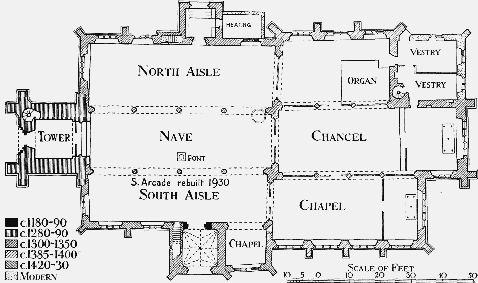
Plan of Wellingborough Church
In 1086 there were two mills paying 16s. a year and a fishery on the abbey manor. (fn. 159) In 1267, these two water-mills and the fishery were farmed out. (fn. 160) In 1539, one mill was called East mill; another and a fulling-mill were called Staple Mills. (fn. 161) In 1674, when the town was growing and a great deal of corn coming into it, an attempt was made by the lessees of these mills to force the inhabitants not to use certain other mills, which had been established in some cases for a long time. (fn. 162)
Market
A weekly market at Wellingborough every Wednesday was granted in 1201 by King John to the Abbey of Crowland (fn. 163) and the privilege passed with the abbey's manor (q.v.). The market is still held on Wednesday. The abbot held a market court called 'Curia Selde', but as early as 1319 (fn. 164) the profits were farmed with the tolls. (fn. 165) The court is not mentioned at the dissolution of the Abbey. In the 18th century the tolls were let on lease, (fn. 166) but in 1782 the Earl of Warwick, as lord of the manor, gave up his rights of tolls and stallage and all goods were admitted freely. (fn. 167) The tenants of the manor formerly belonging to Irthlingborough College had always been free of toll for their goods. (fn. 168) Queen Elizabeth appears to have granted two fairs at Wellingborough to Sir Christopher Hatton, (fn. 169) but during the 18th century, (fn. 170) as at the present day, three fairs were held, the dates being the Wednesdays in Easter and Whit weeks and the 29th October.
Churches
The church of ALL HALLOWS (fn. 171) stands in the middle of the town, north of the market-place, and consists of chancel, 58 ft. by 20 ft. 6 in., with north and south chapels and north vestry; clerestoried nave, 59 ft. by 17 ft. 6 in.; north aisle, 20 ft. 3 in. wide; south aisle, 15 ft. wide; south transeptal chapel, 13 ft. 3 in. by 11 ft. 6 in.; north and south porches, and west tower, 12 ft. 9 in. square, all these measurements being internal. The tower is surmounted by a stone spire. The Corpus Christi chapel on north side of the chancel (now in part used as an organ-chamber) is 35 ft. long by 20 ft. in width, and the Lady Chapel on the south side 48 ft. by 20 ft. The vestry is east of the north chapel. The small transeptal chapel fills the space between the south porch and the Lady Chapel. The width across nave and aisles in 57 ft. 9 in.
The south doorway is all that is left of a church of the late 12th century which probably was aisleless and with a small square-ended chancel. The tower was begun c. 1280, but it and the spire were not completed till about twenty years later. The rebuilding of the nave, with north and south aisles, seems to have begun from the west end after the tower was finished c. 1300, both arcades being of that period, and was followed by the building of the chancel on its present plan, the east window of which, c. 1310, remains unaltered. The existence of chapels north and south of the chancel is shown by the west respond of an early-14th-century south arcade and the arch between the north chapel and nave aisle. The north aisle seems to have been widened later in the century and north and south porches added, the plan of the church then to a great extent assuming its present shape. By an arbitration of 1383–4 the abbot and convent of Croyland engaged to rebuild the chancel. The work was probably begun soon after; it comprised new chancel arcades and the rebuilding of both chapels on their present plan, that on the south side being increased in length, (fn. 172) but the east wall remained unaltered. New windows appear to have been inserted in the north aisle about this time, and shortly after, perhaps c. 1420–30, the south aisle west of the porch seems to have been rebuilt on the old foundation and the chapel erected to the east of it. (fn. 173) Late in the 15th century the church was new roofed, the chancel roof being then raised and the clerestory windows altered. The vestry is an enlarged rebuilding in modern times of a two-story 14th-century sacristy in the same position, the steps to the upper chamber of which remain. Some rebuilding on the south side of the church appears to have taken place in 1530, (fn. 174) and possibly some of the existing ashlar facing is of this period. In 1815 the church was uniformly paved, (fn. 175) and in 1861 underwent an extensive restoration when galleries on three sides erected in the previous century were removed (fn. 176) and the nave and aisles newly seated. The Lady Chapel was restored in 1907. The nave arcades were rebuilt in 1930.
With the exception of the tower the older parts of the building are of local ironstone, but the later work is faced with freestone, and the roofs are leaded and of low pitch. The lead of the nave roof overhangs, and the south porch has a plain parapet, but elsewhere the parapets are battlemented and of freestone.
The chancel has an east window of five lights, with moulded jambs and mullions and geometrical tracery, the circular centrepiece of which consists of three trefoiled triangles with the intervening spaces filled with ogee trefoils: the hollow moulding round the opening is enriched with sculptured animal figures and foliage, and the hood-mould terminates in a finial which serves to support the pedestal of a canopied niche breaking the battlement. The boldly carved symbols of the four evangelists are placed at the corners of the square of the window, the two upper, those of St. John and St. Matthew, serving as stops to the hood-mould. (fn. 177) On the south side the chancel stands free of the Lady Chapel by a bay and has an inserted three-light window similar to those of the chapels, but on the north its east end is covered by the vestry, the doorway to which is original. There are no sedilia or piscina, but there is an aumbry in the north wall. The chancel arcades consist of three arches on the north side and four on the south, all of two moulded orders on piers of four attached shafts with hollows between, on high plinths, the shafts having separate moulded capitals and bases. The responds are single attached shafts with the outer, wave-moulded, order carried to the ground on each side. The west respond in the south side is built in front of the respond of the early-14th-century arcade, which is of two hollow-chamfered orders with moulded capital, visible only from the chapel. The chancel arch is contemporary with and of the same detail as the north and south arcades, as is also the arch at the west end of the south chapel. The 14th-century arch between the north chapel and nave aisle is of two hollow-chamfered orders on half-octagonal responds with moulded capitals and bases. The chancel arcades are filled with good 15th-century oak screens: the rood-screen and loft and the screens at the west ends of the chapels are modern. (fn. 178) In the chancel are six return stalls, three on each side of the screen doorway, with carved misericords, the subjects of which are: north side, (1) ale-wife and customer, (2) eagle, (3) two lions; south side, (4) wood-carver at work, (5) mermaid, (6) fox and goose. The supporters are roses, eagles, lions, foliage, dolphins, and balls of foliage. The date of the stalls is fixed within a few years by the arms of White which occur on one of the elbows, John White having been rector 1361–92. (fn. 179)
The chancel has a good 15th-century roof of five bays with moulded principals, but the corbels of the earlier high-pitched roof remain. The roofs of the chapels, of three and four bays respectively, are equally good, with moulded beams and carved bosses: they have been recently restored.
The south chapel has an east window of five lights, but with this exception the windows of both chapels are lofty openings of three cinquefoiled lights with vertical tracery of two stages divided by a battlemented transom. (fn. 180) They are evenly spaced with intervening and diagonal angle buttresses. In the south chapel is a piscina and the altar rails are those formerly in the chancel.
The early-14th-century nave arcades are of four bays with pointed arches of two hollow-chamfered orders on octagonal piers of ironstone with moulded capitals and bases. The south jamb of a contemporary window remains in the west wall of the north aisle, but the existing window in that position is of four cinquefoiled lights with vertical tracery, all the other windows of the aisles being of the same type but of three lights.
The late-12th-century south doorway has a semicircular arch of two orders, the inner with chevron ornament, the outer with a roll and hollow moulding, on octagonal shafts with cushion capitals and moulded bases: the shafts are enriched with chevron ornament. The inner order rests on imposts with scroll volutes, below which the jambs are chamfered. The fourcentred north doorway is modern, but the covering porch has a 14th-century outer doorway of two chamfered orders on half-round responds with moulded capitals, (fn. 181) and above it is a plain niche. The porch has an upper chamber approached by a wall stair from the aisle and lighted by small windows east and west: there are also narrow openings on the north side, on either side of the niche.
The south porch is also of two stories, with a stairway in the west wall entered from the aisle. (fn. 182) The chamber may be an early-15th-century addition, the west wall of the porch being then rearranged for steps; if so, it was completed before the erection of the chapel on the east side. (fn. 183) The porch has diagonal angle buttresses and an elaborate 15th-century groined vault springing from angle shafts with moulded bases, (fn. 184) but without capitals. The outer doorway is of two continuous chamfered orders, and above it is a cinquefoiled niche containing a modern Pietà, with a small trefoil-headed window on each side lighting the chamber.
The small south chapel east of the porch opens from the aisle by an arch similar to, and no doubt copied from, that adjoining at the west end of the Lady Chapel. It has a four-light window in the south wall, and a squint cut through the north end of the east wall directed to the high altar. The bosses of the panelled oak roof have shields with the emblems of the Passion. The roof of the south aisle is also of the 15th century, but the roofs of the nave and north aisle are modern.
There are four clerestory windows on each side: three on the south and the westernmost on the north are 14th-century square-headed openings of two lights, but the others on the north have depressed arches and two of them are of three cinquefoiled lights.
The tower is of three stages, with moulded plinth, coupled buttresses to the height of the second story, and vice in the north-west angle. The two lower stages are faced with alternate bands of ironstone and oolite, above which the walls are of dressed freestone. The west doorway (fn. 185) has a pointed arch of three orders springing from nook-shafts with moulded capitals and bases, above which is a traceried circular window. The middle stage has pointed windows of two trefoiled lights with quatrefoil in the head, that on the west now blocked and covered with a clock dial, but the lower stage north and south is blank. The face of the upper story is slightly recessed, with shafted pilaster angle buttresses, and has double bell-chamber windows of two lights with arches of two moulded orders on shafts with moulded capitals and bases. The tower finishes with a bold corbel table and has tall pinnacles rising from the broaches of the spire, the angles of which are ribbed. The spire is 165 ft. in height, (fn. 186) and has gabled lights on the cardinal faces near the top and bottom. (fn. 187) The tower arch is of three chamfered orders towards the nave, the innermost order springing from halfround responds with moulded capitals and bases. The screen was erected in 1907.
The font appears to have been formed from the socket stone of a cross, worked from square to octagon shape by plain broaches, the centre hollowed to a circular bowl and lined with lead: the surface has been scraped or recut; it is mounted on a square stone base. (fn. 188)
The pulpit is modern and of wood.
Near the south doorway is an elaborate mural monument (fn. 189) with effigies of a man and a woman with no other inscription than the date '1570', which according to Bridges commemorates Lingar, Serjeant of the bakehouse to Queen Elizabeth. (fn. 190) A marble slab to Walter de Scaultorp, noted by Bridges (fn. 191) in the north chapel, has now disappeared, and several 'slabs of great antiquity' mentioned by Cole have likewise gone. There is a considerable number of memorial stones and tablets, a few of late-17th-century date but mostly belonging to the 18th century and later. (fn. 192) A tablet commemorating William Batley, architect, d. 1674, is built into the outer wall of the vestry.
There are eight bells, two trebles by Taylor & Co. of Loughborough having been added in 1884 to a former ring of six, one of which (now the fifth) was then recast. The third (old treble) was given by Sir Paul Pindar in 1640, the fourth is by Newcombe of Leicester 1604, the sixth by Islip Edmunds of London 1764, the seventh dated 1620, and the tenor 1639. (fn. 193) There is also a priest's bell, cast by Henry Penn of Peterborough in 1708.
The plate is all of silver gilt and consists of a cup (fn. 194) and cover paten of 1564, a cup, paten, and two flagons of 1634 given by Sir Paul Pindar in that year, a paten of 1719, a cup of c. 1730 purchased from a Spanish convent and given to the church in 1843, and an alms dish of 1874. (fn. 195) There are also three plated alms dishes, 1861.
The registers before 1812 are as follows: (i) all entries 1586–1623; (ii) baptisms 1628–74, (fn. 196) marriages 1624–71, burials 1624–74; (iii) baptisms 1675–1702, marriages and burials 1675–1701; (iv) baptisms and burials 1702–75, marriages 1702–54; (v) baptisms 1775–1811, burials 1775–1810; (vi) marriages 1754– 1812.
In the churchyard west of the tower is a memorial cross to those who fell in the war of 1914–18.
The church of ALL SAINTS, on the Midland road, was built in 1868 and enlarged in 1890. It is of stone, in the 14th-century style, and consists of apsidal chancel, clerestoried nave, aisles, south porch, and vestry.
The church of ST. BARNABAS, at the west end of the town, was erected in 1893 as a chapel of ease to the parish church. It is built of red brick with Bath stone dressings in the style of the 14th and 15th centuries and consists of chancel, nave, aisles, vestry, and south porch. Outside, at the west end, is a Weldon stone cross erected in 1920 as a War memorial.
The church of ST. MARY, serving an ecclesiastical parish formed in 1904, was built, at the expense of the late Misses Sharman, from designs by J. N. Comper. It is of local ironstone with Weldon dressings, and consists of chancel and nave with aisles and north and south chapels, two-storied north porch with bell turret, and west tower. The three western bays of the nave and the tower were completed in 1930; there is a classical screen carrying a rood loft, and some good modern glass.
Advowson
The church is said to have been granted with the manor of Wellingborough (q.v.) to the abbey of Crowland in the 10th century. (fn. 197) A priest is mentioned among the abbey tenants in 1086. (fn. 198) The church was appropriated to the abbey before 1229 (fn. 199) and was valued at £40 in 1291. (fn. 200) At the time of the Dissolution, the rectory was leased to John Peke for £33 6s. 8d., while another £5 was received from the tithe hay let from year to year. (fn. 201) The rectory was granted for life in 1543 by Henry VIII to William, Lord Parr, who had been steward of the manor under Crowland, and two years later the grant was extended to 8 years after his death. (fn. 202) It passed on the division of the Hatton property to Sir Robert Rich and his wife (fn. 203) and, except for a short period in the 19th century, has been owned by the lord of Wellingborough Manor (q.v.). (fn. 204) In 1837 the impropriator was the Rev. Charles Pasby Vivian, when the lord of the manor was Quintus Vivian. (fn. 205)
The advowson of the vicarage, which was instituted before 1229, (fn. 206) was held by Crowland Abbey until its dissolution. (fn. 207) It was granted with the rectory to Princess Elizabeth, (fn. 208) and has since belonged to the impropriators of the rectory. (fn. 209) In 1802, however, Earl Brooke sold the next presentation to William Price, (fn. 210) whose executor, William Davis, presented to the living in 1810. (fn. 211) The advowson now belongs to Major Strafford Byng-Maddick.
In 1229 the vicarage consisted of the small tithes, the altar dues, and half a virgate of land, (fn. 212) which still was attached to the vicarage in the 16th century. (fn. 213) In the 13th century a pension of 46s. was paid yearly to Crowland Abbey, (fn. 214) but in 1535 40s. was paid to the abbot and 6s. 8d. to the almoner. (fn. 215) During the Commonwealth, the living was increased from the first-fruits and tenths. (fn. 216) In 1555 William Blinko, the vicar, was deprived of his living under Queen Mary. (fn. 217) In 1633, another vicar, Thomas Jones, was chosen by the Bishop of Peterborough to be present at the translation of Archbishop Laud to Canterbury. (fn. 218) Complaint was made of his preaching alternate Sunday afternoons at Higham Ferrers for a salary of 20l. a year and so giving his parishioners an excuse 'to gad after Mr. Perne of Wilbye'. (fn. 219) He was a staunch royalist and was twice imprisoned under the Commonwealth, finally dying in gaol. (fn. 220)
With the growth of the town, new parishes have been formed: All Saints, in the gift of the vicar of Wellingborough, in 1872; St. Mary, in the gift of trustees, in 1904; and St. Barnabas, in the gift of the Bishop of Peterborough, in 1910. The Roman Catholic church was built in 1885 and there are a Friends' meeting house, (fn. 221) two Congregational, one Baptist, and three Methodist chapels.
The CHANTRY of St. Mary was endowed in 1328 by John de Surflet, vicar of Wellingborough, with an annual rent of 5 marks to provide a chaplain to say mass in the 'church' of St. Mary. (fn. 222) Possibly a separate chapel of St. Mary then existed, as a road called St. Mary Lane is mentioned in the 16th century (fn. 223) and in 1500 Richard Clerke bequeathed 6s. 8d. for the repair of the chapel of St. Mary. (fn. 224) More probably the 'church' was the chapel of St. Mary in the parish church.
The GUILD of St. Mary (fn. 225) was founded in the parish church of Wellingborough and was formally constituted and endowed with lands and rent in 1392. (fn. 226) It consisted of brothers and sisters who yearly elected two wardens or aldermen. (fn. 227) Further endowments were made by Sir John Gubben, priest, William Elyott, and Simon Blewitt. (fn. 228) The last-named left by will, in 1505, 8 acres of copyhold land for a chaplain to celebrate mass in the chapel of St. Mary, (fn. 229) but after some years John Smart, claiming to be Blewitt's heir, recovered possession of the land. In spite of the intervention of Lord Parr and other Wellingborough inhabitants in 1544, Smart seems to have been in possession in 1551. (fn. 230) At the sup- pression of the chantries the income was partly applied to the repair of the town bridges, (fn. 231) but a stipend of £3 6s. 8d. was paid to Thomas Castelyn, who had served as organist in the parish church for 30 years and kept a song school. (fn. 232) On petition, he recovered his stipend and was receiving it in 1554. (fn. 233) Payments were made about 1537 for 3 years out of the Guild funds to Sir John Holland, clerk, who also kept a school. This is possibly the first surviving reference to a pre-reformation grammar school here. (fn. 234) It lends force to the suggestion found in the chantry certificate that the king should establish a free school, out of the income of the Guild lands, the vicar and town undertaking to augment the endowment. (fn. 235) In 1549, the Guild lands were granted to John Monson and probably the school was then established, although the governing statutes were not issued till 1595. (fn. 236)
The origin of the Fraternity of Corpus Christi (fn. 237) or Corpus Christi and St. George (fn. 238) is unknown, but it existed in 1500. (fn. 239) It is said to have been united before 1522 with the Guild of St. Mary (q.v.), (fn. 240) but in 1539 the provost paid the rent due from the lands in Wharldyke and Barwellend, held by the Fraternity, as if it was still a separate body. (fn. 241) It is not mentioned in the Chantry Certificate for Wellingborough, (fn. 242) nor were its lands included in the grant of Guild lands to John Monson in 1549. (fn. 243) It seems, therefore, to have survived the Dissolution of the Chantries and, under Queen Mary, bequests were made to it in 1557. (fn. 244)
The Fraternity of St. Catherine is mentioned in the will of William Fisher in 1518, when a chapel of St. Catherine was in existence, (fn. 245) probably in the parish church of Wellingborough. The Fraternity is not mentioned at the Dissolution of the Chantries, (fn. 246) although it received bequests certainly as late as 1539. (fn. 247) In 1518, William Fisher left 10s. to the Fraternity of the Jesus Mass, (fn. 248) but though other bequests are recorded for maintaining the Mass of Jesus (fn. 249) this appears to be the only mention of a fraternity. In 1549, lands and rents given to maintain certain obits, lights, and lamps in various townships included a yearly rent of 4d. in Wellingborough. (fn. 250) In 1551, however, the Light land in Wellingborough was said to be of the yearly value of 3s. 4d., which was used to maintain a light before the rood of the parish church. (fn. 251)
Charities
The Church Lands. Some 12 acres were allotted in 1768 by the Inclosure Commissioners in lieu of certain headlands which had from time immemorial been let for the repairs of the church. The land was sold in 1920 and the proceeds invested, producing about £120. The income is applied by the churchwardens in the maintenance of the church and churchyard.
William Peake by will dated 9 January 1596 gave a yearly rent of £5 4s. charged upon lands at Hoxton in London to the poor. The charge was redeemed by the transfer of £208 2½ per cent. Annuities to the Official Trustees. The income is distributed in bread and blankets.
By his will, 27 July 1665, John Orlebar gave £100 to the poor. This legacy was invested in land which has been sold and the proceeds invested, producing £15 14s. 8d. yearly in dividends. The income is applied by the vicar and churchwardens and two trustees appointed by the Urban District Council in the distribution of blankets.
Edward Cheney by will dated 4 April 1662 gave a yearly rentcharge of 6s. out of his house and ground in Chelsea for distribution in bread to the poor. The charge has been redeemed by the transfer of £12 2½ per cent. Annuities to the Official Trustees.
John Pulley by his will in 1693 gave a rentcharge of £5 4s. to be distributed in bread to 24 poor inhabitants. This charge is paid by the Wellingborough Iron Company out of land in Finedon.
Samuel Knight by his will in 1728 gave a rentcharge of £2 for distribution in bread to the poor. This charge is paid out of property in Wellingborough.
Thomas Sheppard in 1733 gave £20 to the vicar and churchwardens, the interest thereon to be distributed in bread on St. Thomas' Day. This legacy produces about 11s. yearly in dividends.
Mrs. Ann Glassbrook by will dated 11 September 1790 bequeathed £20 yearly to be equally divided by the vicar and churchwardens among four poor widows. This endowment now produces £10 10s. yearly in dividends.
The following charities are in connexion with the United Wellingborough Congregational church:
John Gibbs founded by declaration of trust dated 14 May 1834 endowment producing £3 annually in dividends which are applied for the benefit of the minister of the said church.
Elizabeth Whitworth founded by will dated 9 September 1854 endowment producing £4 2s. 4d. annually in dividends which are applied for the benefit of the poor of the said church and the Sunday school.
James Whitworth and Sarah Swannell comprised in a declaration of trust dated 17 October 1877 endowments producing £18 yearly in dividends which are applied for the benefit of the minister of the said church.
William Brown founded by will proved on the 17 October 1900 endowments, the dividends on which are applied for the benefit of sick members of the said church and for the benefit of the Band of Hope in connexion with the said church.
Janet Kincaid founded by will proved on the 6 September 1878 endowment for the benefit of the poor of the said church.
Adam Corrie founded by will proved on the 18 December 1846 endowment for the benefit of the minister and poor of the said church.
The sums of Stock constituting these endowments are invested in trustees.
Frederick William Bradshaw founded by indenture dated 28 March 1906 endowment consisting of four cottages with gardens, the rents of which are applied in repairing the said cottages and for the general purposes of the School chapel.
Elizabeth Goodman by will dated 8 May 1728 gave a rent-charge of £3 per annum to the vicar and churchwardens for distribution in prizes to scholars in All Saints School and Freeman's School, Wellingborough.
The Charity of George Lawrence founded by will proved on the 13 October 1914 is regulated by a Scheme of the Charity Commissioners dated 19 September 1916. The endowment produces about £39 yearly. One-eleventh of the income of the charity is applied by three trustees for the general purposes of the Wellingborough Cottage Hospital and the residue for the benefit of not more than ten aged married couples.
The Charity of Richard Fisher for the poor, founded by will dated 9 May 1711, is regulated by a Scheme of the High Court of Chancery of the 24 March 1819. The endowment originally consisted of land which was sold, and is now represented by Stock with the Official Trustees. The dividends amounting to £25 18s. 6d. annually are distributed by trustees appointed by deed to two poor aged inhabitants not having received parish relief.