A History of the County of Northampton: Volume 4. Originally published by Victoria County History, London, 1937.
This free content was digitised by double rekeying. All rights reserved.
'Parishes: Cransley', in A History of the County of Northampton: Volume 4, ed. L F Salzman (London, 1937), British History Online https://www.british-history.ac.uk/vch/northants/vol4/pp162-167 [accessed 2 May 2025].
'Parishes: Cransley', in A History of the County of Northampton: Volume 4. Edited by L F Salzman (London, 1937), British History Online, accessed May 2, 2025, https://www.british-history.ac.uk/vch/northants/vol4/pp162-167.
"Parishes: Cransley". A History of the County of Northampton: Volume 4. Ed. L F Salzman (London, 1937), British History Online. Web. 2 May 2025. https://www.british-history.ac.uk/vch/northants/vol4/pp162-167.
In this section
CRANSLEY
Cransley, Cranesle (xi cent.); Cranesley (xvi cent.).
Cransley, 12 miles north from Northampton, lies on the road from Northampton to Kettering, which skirts it on the south-east. Kettering lies to the east of Cransley, and Walgrave to the west. It includes the hamlet of Little Cransley, near its southern boundary. The village lies along a branch road running north-west from the Northampton road. There is an old tramway for ironstone south of the village; and to the north of the village the Cransley and Loddington tramway now runs across the parish from west to east, the Cransley Iron Works being situated at its eastern end.
St. Andrew's Church lies south of the village street with the vicarage on the other side of the road, where two roads meet. The vicarage house was enlarged in 1858. The school stands at a little distance from the church, to the west of the Three Cranes Inn.
The manor-house, (fn. 1) now known as Cransley Hall, stands in a pleasant situation to the north-east of the church, with gardens on the south side above a small brook, here expanded into two large fish-ponds. It is a house of two stories, faced with wrought ironstone, with barred sash windows, wooden cornice, and hipped roofs covered with Colleyweston slates, much altered and added to in the 18th century and subsequently, but still retaining portions of a 16th-century building. The main fronts face west and east, and over the west doorway are the arms of Sir Thomas Cecil, (fn. 2) who may have rebuilt this part of the house before 1595, though the character of the existing elevation is somewhat later. The east and south fronts appear to belong to the rebuilding and enlargement of 1708–9 referred to by Justinian Isham in his Diary, (fn. 3) and over the east doorway, which is centrally placed with two windows on each side, are the arms and crest of Sir Henry Robinson (d. 1727). (fn. 4) A bay window has been added in the middle of the south front, and a new two-story wing containing housekeeper's room and servants' hall in character with the 18th-century work was built on the north side by William Somerset Rose (1845–84). (fn. 5) More recently (1905) a further large one-story addition has been made on the north side, on the site of various outbuildings.
At the western end of the village is Cransley Wood, almost due west of which on the western boundary of the parish is the windmill, with Ragsdale Spinney to the south of it; and farther south still Cransley Lodge, Squire Lodge, and Old Lodge.
Outlying farms are North Field Farm in the extreme north, and about half a mile south-west of it Bottom Lodge Homestead near the old ironstone pits, east of which is Bottom Lodge Farm.
The population of Cransley, which was 217 in 1801 and 329 in 1871, was 296 in 1931. The parish has an area of 2,094 acres of land and 19 acres of water. The soil, which varies, is good red and black loam; subsoil lime and ironstone; land arable and grass in equal proportions.
Manors
Cransley appears in the hands of three owners in the Domesday Survey. Two hides and 1 virgate of land in Cransley were a member of the king's manor of Rothwell; (fn. 6) 1½ hides were included among the lands of Gunfred de Cioches in Orlingbury Hundred, and were valued as before the Conquest at 30s.: (fn. 7) and among the lands of the Countess Judith, in Wilebrook Hundred, a hide is entered with 1½ hides of socland in Broughton and 3 virgates in Hannington. (fn. 8) By the 12th century these lands were in the hands of four owners and appear to have been redistributed. (fn. 9) Hugh Kyde held 1½ hides and 1½ bovates in Cransley of the fee of Chokes; Ralf Meschin held 5 small virgates of the fee of Geddington; John le Bauld 1 great virgate; and Foliot (evidently the Robert Foliot, owner of the Peverel fee) 2½ hides and I small virgate of the fee of Huntingdon.
An inquiry held on 24 May 1247 as to homages and knight services held by Robert, advocate of Bethune, when he gave the land of Gayton to Robert de Gisnes mentions a knight's fee in Cransley held by William de Lisle, (fn. 10) to whom the services of William de Gorham, in Cransley and Flore, had been conveyed by fine in 1233. (fn. 11) In 1252 Baldwin de Betune sold Gayton (q.v.) to Ingelram, lord of Fienes, with all the homages and services of those who had held of Robert, advocate of Arras, lord of Bethune, or of Baldwin, Count of Gisnes. It was returned at an inquiry held in 1252, as to dues from the lands of Ingelram de Fiennes, that there was due from the fee of Chokes in Cransley 18d. for sheriff's aid, watch, view of frankpledge, and aid for the Serjeant, and for castle guard at Northampton 10s., (fn. 12) the payment for which the service of one knight had been commuted. The heirs of Ingelram de Fiennes were holding this fee in Cransley in 1284; (fn. 13) under them Roger de L'Isle; (fn. 14) under Roger, William de Gorham; and under William de Gorham, Hugh son of Simon de Cransley. When in 1316 Thomas Wake was returned as holding this fee, (fn. 15) the intermediate Lisle and Gorham lordships recorded in 1284 seem to have lapsed, as in 1343, at the death of William de Ros of Hamlake, Thomas Wake of Blisworth was returned as holding the fee of him in right of his wife, (fn. 16) the daughter of Hugh de Cransley. William de Ros of Hamlake married Margery, sister and heir of Giles de Badlesmere, another of whose sisters married William Earl of Northampton, a descendant of Maud daughter of Ingelram de Fiennes, (fn. 17) and it was probably to some connexion with the de Fiennes family that William de Ros owed this overlordship. At the death of Margery in 1363, she was holding this fee in dower as of Beauvoir Castle, and it passed from her to her son and heir Thomas de Ros. (fn. 18)
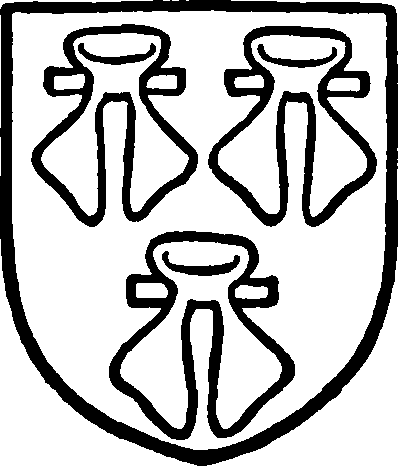
Ros. Gules three water-bougets argent.
Members of the de Cransley family whose heiress married Thomas Wake had been undertenants of this fee at an early date. Hugh de Cransley in 1166 was holding of Robert de Chokes one knight's fee, then held in dower by the wife of Walter Disel (possibly Hugh's mother). (fn. 19) He had been succeeded before 1203 by Peter his son, between whom and Henry de Gorham (his superior lord evidently) a fine of the fee was levied in that year. (fn. 20) Hugh de Cransley presented to the church in 1226. (fn. 21) A certain Stephen de Cransley made a grant of lands to St. James's Abbey in Northampton, (fn. 22) and a Sir Thomas de Cransley was reported in an inquiry as to rebels in 1265 as believed to be dead, after being at the battle of Evesham with Sir Simon de Montfort and Sir Henry de Hastings. This Thomas had married Maud de Hardwick, the widow of Sir Bartholomew de Rakelinton, and had no land except of her dower. (fn. 23) Simon, who presented to the church in 1277, (fn. 24) and whose son Hugh was holding Cransley in 1284, (fn. 25) may be assumed to have been lord of the manor. Either Hugh himself or a successor of that name was lord in 1312, when a grant was made to Hugh, lord of Cransley, and to Agnes his wife, and to Alice daughter of William de Wyleby, of the reversion of a messuage and land in Cransley which Stephen Elis and Stephen his son held. (fn. 26) A fine was levied of the manor and advowson in 1312– 13 between Hugh,lord of Cransley, and Reynold, parson of the church, (fn. 27) who, as Master Reynold son of Hugh de Cransley, had received a grant of land from Lyna daughter of Robert le Somenur of Cransley, in 1287. (fn. 28) Next year Hugh and Agnes received a grant from Geoffrey de Orlingbury of a croft called 'le Madecroft' in Cransley, and tillages at Wolemeresmede and Blyndyswyks by the rectory of the church, for their lives. (fn. 29)
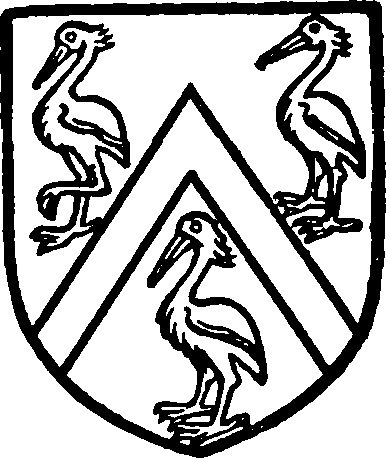
Cransley. Argent a cheveron gules between three cranes azure.
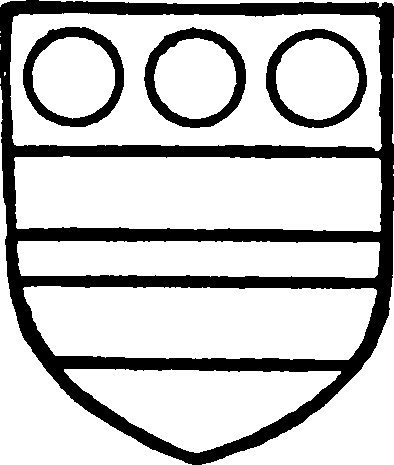
Wake. Or two bars gules with three roundels gules in the chief.
In 1316 Thomas Wake had succeeded Hugh. Elizabeth Cransley, wife of Sir Thomas Wake, had been first married to John son of Roger de Heigham, upon whom, and his heirs by her, her father Hugh de Cransley settled the manor and advowson in 1313–14. They had a son John, who married the daughter of Robert de Thorp, and a daughter Agnes; but this Agnes, and the two children of her brother, being carried off by the plague in 1348–9, together with their mother, at that date remarried to John de Gayton, the manor remained in the hands of Elizabeth, whose husband Sir Thomas Wake had been holding it in her right. (fn. 30)
In 1330 Thomas Wake of Deeping claimed free warren in his demesnes of Blisworth, Cransley, and Helpston under a charter of 1330. (fn. 31)
Thomas Wake with his wife Elizabeth in 1340 settled the Cransley estate upon themselves for their lives, with remainder to Agnes and Elizabeth (sic), the daughters of Elizabeth by her first marriage, for their lives, with remainder to their son Hugh. (fn. 32) Hugh Wake died s.p., and Sir Thomas Wake, who on 20 February 1343 was returned as holding this knight's fee in Cransley, in right of his wife, (fn. 33) died in 1347. (fn. 34) Thomas son of Sir Thomas Wake released to John Pyel, citizen and merchant of London, on 29 March 1350 all his right in the manor and advowson of Cransley, with a mill and a plot called 'le Newemanere' and other lands in Cransley and Broughton which John had previously held of the grant of Elizabeth the mother and of Hugh the brother of Thomas. The witnesses included Walter Turk, then Mayor of London, and Adam de Bury and Ralf de Lenne, sheriffs. (fn. 35) In 1355 John Pyel of Irtlingborough, citizen of London, made a settlement of the manor and advowson of Cransley, (fn. 36) which were still held under Thomas Wake of Blisworth, who was returned in 1363 as holding a fee in Cransley at the death of Margery, widow of William de Ros of Hamlake. (fn. 37) In 1377 the manor, and the advowson of the church there, were apparently in the hands of Thomas de Melburn, (fn. 38) but on 12 January 1380 they were alienated in mortmain by Simon Symeon and Peter Monslee, parson of Willoughby (co. Lincoln), to the dean and chapter of the new collegiate church of St. Mary's, Leicester, to celebrate divine service there daily for the soul of Henry, late Duke of Lancaster, and for the good estate of the said Simon and Peter while living, and their souls after death. (fn. 39) In 1428 the New College of St. Mary, Leicester, paid for half a fee in Cransley formerly held by Thomas Wake, (fn. 40) who in the following year quit-claimed lands in Cransley and the advowson to the college. (fn. 41) These, which constituted the manor later known as NEWARKS, were in their hands at the Dissolution, the lands bringing them in £14 yearly. (fn. 42)
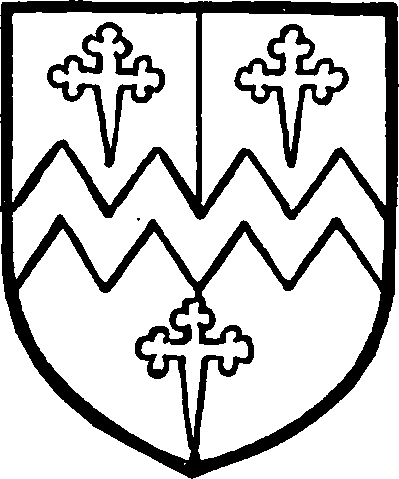
Barnwell. Party sable and azure a fesse dancetty between three crosslets fitchy or.
Certain mills and meadow land in Cransley were in 1528 granted by the College of St. Mary, Leicester (the College of the New Work), to Thomas Barnwell of Cransley for 51 years at a rent of 34s.; (fn. 43) and in 1545 Giles Poulton, senior, Giles Poulton, junior, and Elizabeth his wife conveyed their interest in the manor to Thomas Barnwell. (fn. 44) The latter was still tenant of the manor in 1549 when it, with a water-mill, a horse-mill, a messuage called the Mellholme, view of frankpledge, &c, was granted to John Hasylwood of Maid well. (fn. 45) John Hasylwood died on 28 June 1550 leaving a wife Catherine, and a son and heir John, aged 28. (fn. 46) John Hasylwood and Catherine his mother, who had married Thomas Claughton, alienated the manor, held in chief, to Thomas Barnwell in 1556. (fn. 47)
This manor remained in the hands of the Barnwells until 1586, in which year the manors of Cransley, Newark, and Pultons were conveyed to William Cecil, (fn. 48) esq., and Boniface Pickering, gent., by Edward Barnwell (probably the grandson of Thomas and son of Edward) and by his wife Anne, by Stephen Barnwell, William Allen, and Miles Barnwell, (fn. 49) a separate conveyance of the property being made later by Roger Charnock and his wife Helen, (fn. 50) possibly the remarried mother of Edward Barnwell. (fn. 51)
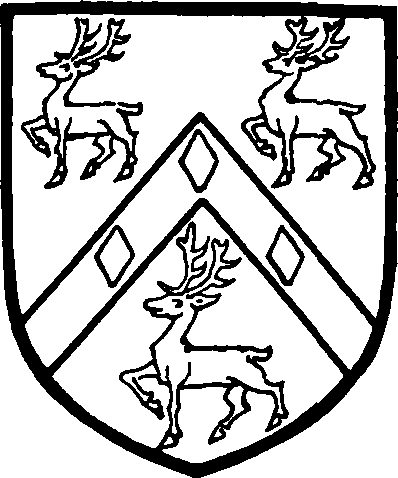
Robinson. Vert a cheveron between three harts or with three lozenges gules on the cheveron.
In 1595 Sir Thomas Cecil and his wife Dorothy with their sons William and Edward were dealing with all the four manors of Cransley, Newark, Marstons, and Pultons, and the rectory and advowson, which they conveyed to trustees (fn. 52) for sale to Alice Elkin, widow. This lady, who, according to Bridges, quoting from Robinson documents, had been first married to Henry Robinson, and in her second widowhood married Thomas Owen, justice of the Common Pleas, divided the manor equally between her five children by Henry Robinson, two of whom, Alice Robinson (married to John Washburne of Knights Washburne) (fn. 53) and Margaret (married to Sir John Bretts) retained their fifths, the remaining three-fifths being ultimately held by her son Sir Henry Robinson. In 1615 Sir John Bretts and his wife Margaret conveyed their fifth to Robert Riche and William Bretts, (fn. 54) and Sir Robert Riche, Margaret Scott, widow, and Owen Scott conveyed it in 1627 to Francis Downes, senr., Roger Downes, and Francis Downes. (fn. 55) Alice Downes, widow (probably Alice Robinson, remarried), and John Washburne in 1652 were dealing with the manor of Pultons, (fn. 56) probably representing the Washburne, and possibly also the Brett, share of the Cransley estate, but no more is heard of this property. Sir Henry Robinson in 1629, in which year he was sheriff of the county, settled his three-fifths on Martha Sherington, widow of John Sherington, merchant of London, whom he married at Cransley on 31 August following. He died on 9 December 1637, leaving no issue by Martha, and was succeeded by his son by his first wife (Mary, daughter of Sir William Glover) Henry, aged 12. (fn. 57)
The young lord of the manor, who espoused the Royalist cause, and suffered accordingly, died in 1665. His son Sir Henry Robinson married Susanna, daughter of the Rt. Hon. Sir John Ernie, Under-Treasurer of the Exchequer, and in 1681 a settlement of the whole of the manor and advowson in trust was made at their marriage. (fn. 58) The manor was then valued at £900 yearly, out of which an annuity of £20 for life was payable to Charles Riche, £12 yearly to the vicarage of Cransley, and £8 yearly to the king; but Sir Henry was burdened with debt and, after various transactions for raising money, the manor was in 1702 put in the custody of his wife, Dame Susanna, after Sir Henry Robinson had been found a lunatic on 8 December 1701. An Act of Parliament was obtained in 1710 to vest the estate of Sir Henry Robinson in Cransley in trustees to enable them to make a settlement on the marriage of his son John, (fn. 59) who, after his father's death, was holding the manor, rectory, and advowson of Cransley in 1746. (fn. 60) His son, another John Robinson, died in 1791, when he was succeeded by John Capel Rose. He died in 1845 and his son William Somerset Rose in 1884. The latter's son William Robinson Rose was succeeded in 1889 by his brother Walter Wollaston Rose who sold the manor and advowson in 1905 to Major Arthur Hugh Thurburn, the present owner. (fn. 61)
The lands in Cransley held of the royal manor of Rothwell in 1086 seem to be represented in part by PULTONS MANOR. In 1230 Thomas de Braybrook granted to Philip de Kelmarsh land in Kelmarsh and a mill and 2½ virgates in Cransley. (fn. 62) Philip's son Ralph married Mabel, daughter of Hugh son of Peter de Cransley, (fn. 63) and in 1266 was holding 2½ virgates and a mill in Cransley with lands in Kelmarsh, Clipston, and Oxenden, all held of the king in chief of the soke of Geddington; (fn. 64) and this property in Cransley was so held in 1284 by Simon de Kelmarsh, (fn. 65) his son, who in 1329 claimed view of frankpledge in Kelmarsh, Clipston, and Cransley by prescription. (fn. 66) Simon son of Ralph de Kelmarsh was returned at an inquisition held at Rothwell in 1337 (fn. 67) as having held at his death tenements in Cransley held of the manor of Geddington as of the ancient demesne of the king; in free marriage with Mabel his wife lands in Cransley held of Thomas Wake of Blisworth; and half a virgate of land, parcel of those which John de Verdun, kt., held in Holcote, Walgrave, and Cransley of the honor of Huntingdon as of the manor of Yardley: his heir being his son Simon. The third of the properties of which he then died seised evidently corresponded to the lands in Cransley held of the Countess Judith in 1086, and constituted the Manor of WYLEBY or WILLOUGHBY in Cransley which in 1329 was in the hands of Simon de Cransley, (fn. 68) who then claimed freedom from tolls, weyf, &c, from his tenants in Cransley, because these liberties had always belonged to a fifth part of the vill there known as Willoughby, which fifth part he held of Lawrence de Preston, who held of Lawrence son of John de Hastings, a minor and in ward to the King. He claimed view of frankpledge because this had always been held with this fifth part called Willoughby, when William de Willoughby or Wyleby and Margery his wife, being seised thereof in right of Margery, had enfeoffed of the same Ivo Fitzwaryn. Ivo Fitzwaryn had granted it to Peter his brother, who had then enfeoffed in it Simon de Hanington, from whom it descended to his son and heir Ralph, by whose enfeoffment Simon de Cransley was then holding.
These properties descended with the manor of Kelmarsh, with which they were in 1498 held by William Pulton at his death, as lands and tenements with a water-mill in Cransley, held of the manor of Geddington in burgage and worth £6 11s. 4d.; another messuage in Cransley held of the New College, Leicester, by knight service and worth 20s.; and a third part of a pasture with a grange called Sundurlond held of Maurice Osborn by knight service, and worth 20s. William Pulton's heir was his son Giles, upon whom and his wife Katharine settlement had been made in 1493 by William and his wife Emma. (fn. 69)
A manor of MARSTONS, later known as DALISONS, occurs in the 15th century. In 1474 Robert Tanfield of Gayton granted the manor of Merston or Marston in Cransley, held of the Duke of Buckingham, to William Tanfield, who bequeathed it to his wife Anne for life, and died on 26 November 1487, his heir being his kinsman Robert son of Robert Tanfield, late of Everton (Hunts.). (fn. 70) In 1489 Anthony Tanfield, son of Robert, released to Edward Goldesborough, baron of the Exchequer, and others, all his right in the lands in Cransley which he lately had by bequest from William Tanfield, his uncle, for life. (fn. 71) This manor next appears in the hands of George Dalison, who in 1514 settled it on his son Edward and his wife Elizabeth, and died on 28 June 1524, seised of the manor, which then passed to his grandson Thomas, Edward and Elizabeth being already dead. (fn. 72) Thomas Dalison and Joan his wife in 1540 conveyed it to John Lane and William Hypwell, (fn. 73) but in 1585 it was still in the hands of the Dalison family, and was conveyed to Sir Thomas Cecil by Edward Dalison and his wife Anne, and Robert Dalison, brother and heir of Edward Dalison. (fn. 74) After this date it descended with the other Cransley manors.
Tenements in Cransley held of the queen in chief by knight service and in the occupation of John Dexter and afterwards of Edward Longton, were held by Richard Warner at his death in 1570. (fn. 75)
Church
The church of ST. ANDREW consists of chancel, 31 ft. 6 in. by 15 ft. 6 in.; clerestoried nave, 52 ft. by 16 ft.; north aisle, 11 ft. wide; south aisle, 15 ft. wide; south porch, and west tower and spire, 10 ft. 6 in. square, all these measurements being internal. There was formerly a porch on the north side also. (fn. 76) The west end of the north aisle is screened off as a vestry and the organ is at the east end.
The first church on the site seems to have been a 12th-century aisleless building of which only the northwest angle remains on the north side of the tower, but this early structure was entirely rebuilt towards the end of the 13th century, beginning with the chancel c. 1290. The work was probably continued over a period of some years, but completed early in the 14th century.
In the first half of the 15th century (fn. 77) the tower and clerestory were added, the chancel walls heightened, and new windows inserted. The greater width of the south aisle suggests that it may have been rebuilt at the same time, but if so the old masonry, doorway, and the windows on either side were re-used and the porch re-erected. (fn. 78) The building was restored in 1870 and refloored with wood blocks on concrete in 1908.
With the exception of the tower the building is of rubble, plastered internally, and has plain parapets to chancel, clerestory, and aisles, with low-pitched leaded roofs. (fn. 79) The tower is faced with ashlar: the porch has a slated eaved roof.
The chancel has a pointed east window of four trefoiled lights with modern reticulated tracery and is divided into two bays, in each of which, north and south, is a 15th-century four-centred window of three cinquefoiled lights. In the north wall is a 13th-century continuous-moulded priest's doorway, (fn. 80) and on the south side, below the easternmost window, a rectangular aumbry, restored piscina with fluted bowl, and triple sedilia: the seats are on the same level below pointed arches on moulded shafts with capitals and bases. At the west end of each wall is a blocked low-side window, that on the north side having a segmental rear arch, the other a flat lintel. (fn. 81) Below the easternmost window in the north wall is a low moulded tomb recess, which probably was used also as the Easter Sepulchre: (fn. 82) the wall here seems to have suffered some disturbance as though the tomb had blocked an earlier doorway, and the scroll string-course which runs round the chancel at sill level is here omitted. This string is continued on the east wall of the north aisle, round the diagonal angle buttress and along the north wall of the aisle as far as the north doorway. The well-proportioned chancel arch is of two chamfered orders, with hood-mould on each side, springing from triple attached shafts with moulded capitals and bases.
The nave arcades are of four bays with pointed arches of two chamfered orders and hood-moulds with headstops, springing from octagonal piers with moulded capitals and bases and from responds of like character. On the north side the capitals have a species of early ball-flower ornament in the hollow, and both arcades have been a good deal restored. The almost continuous clerestory of six two-light cinquefoiled windows on each side and the absence of coloured glass make the interior of the building exceedingly light, and its pleasing regularity and excellent proportions give it eminence amongst the smaller churches of its type.
The late-13th-century window of the south aisle is of three trefoiled lights with a trefoiled circle in the head and a pointed trefoil over each of the side lights, and on each side of the south doorway is a contemporary two-light window with forked mullion. All the other windows of the aisles are 15th-century insertions similar to those in the chancel, except that at the west end of the north aisle which is of two lights. In the usual position at the east end of the south aisle is a plain 13thcentury piscina with fluted bowl, and farther west a low tomb recess with roll-edge moulding. The south doorway is of two continuous orders, the outer wavemoulded, and the hood-mould has notch ends. The outer doorway of the porch is of two hollow-chamfered orders on the outer face, the inner on half-octagonal responds with moulded capitals and bases. The porch has a coped gable with cusped apex-stone and modern cross, and circular quatrefoiled openings in the side walls. Built into the walls are a 13th-century coffin-lid, a bit of 14th-century canopy work, and two other fragments.
The north doorway was blocked when the porch was removed, and externally all traces of it have been effaced. The north-east diagonal buttress of the aisle has a traceried gabled head, above which it weathers back in a short second stage. (fn. 83)
The nave has a good 15th-century oak roof of six bays, with moulded principals and wall-pieces, embattled wall-plates, and angel corbels. The aisle roofs are of the same type with angel corbels against the outer walls only, but with carved bosses in addition. (fn. 84) A spout-head on the north clerestory is dated 1702, and one on the south side 'W. O., 1713'.
The tower is of four stages with clasping angle buttresses carried up as pinnacles, moulded plinth, and battlemented parapets. Its axis has a slight deviation to the south, and the lofty arch to the nave is of three continuous chamfered orders, stopped about 4 ft. above the floor. There is a vice in the south-west angle, and recesses in the north and south walls inside. The buttresses have an additional string below the pinnacles and on the north and south sides there is a band of quatrefoils beneath the parapet. The west doorway has a rectangular hood-mould and spandrels and over it in the second stage is a pointed window of three cinquefoiled lights and vertical tracery. On the north and south the walls are blank in the lower stages. The double bell-chamber windows are of two transomed lights with quatrefoil in the head, and the spire has plain angles and two tiers of lights in the cardinal faces. The top of the spire was rebuilt in 1927. (fn. 85)
The font in use dates from 1887, but there is an 18th-century baluster font (fn. 86) with spiral flutings and stone cover in the south aisle. The pulpit and seating are modern.
At the east end of the south aisle, against the wall, is a blue stone slab with brasses of Edward Dalyson (d. 1515) and Elizabeth his wife, with inscription and shields of arms in three of the corners: the fourth shield and the figure of a child are missing. Above this on the wall is a small marble monument with kneeling brass figures of Edward Dallison (d. 1589) and Ann Snagge, his wife, and in the recess of the east window a brass plate in memory of Edward Barnwell (d. 1602), 'sometyme Lord of ye manners of Newarks mannor and Pultons mannor here in Cranesley', and his two wives Eleanor Brooke and Ann Spencer: his arms are on a separate plate. A floor-slab close by bears the figure of a skeleton and border inscription to Edward Barnwell (d. 1557) and Helen his wife.
There is a little painted glass in the south-east window of the aisle: (i) arms of Ros; (fn. 87) (ii) four cranes separately leaded, no doubt from a shield of the arms of De Cransley; (iii) a piece of yellow glass with three fishes in pale.
There is a mutilated stone coffin in the south aisle, and also a late-17th-century parish chest with three locks. At the east end of the south aisle is an 18thcentury communion table with turned legs.
There is a ring of six bells by Matthew and Henry Bagley of Chacomb, 1683. (fn. 88)
The plate consists of a silver cup and cover paten of 1618, a flagon by John Fawdrey 1707, a bread-holder by Nat Gullion 1723, a chalice and paten of 1884, and a spoon of 1875. (fn. 89)
The registers before 1812 are as follows: (i) all entries 1561–1714, but irregular after 1683; (fn. 90) (ii) baptisms 1715–96, marriages 1715–64, burials 1715– 97; (iii) marriages 1759–1800; (iv) baptisms and burials 1797–1812; (v) marriages 1801–12.
Advowson
The church was valued at £8 in 1291. (fn. 91) The Cransleys and afterwards the Wakes held the advowson with their manor (q.v.) until the appropriation of the advowson with this manor to St. Mary's College, Leicester, in 1381. (fn. 92) The rectory in 1535 was returned as worth £18, the vicarage as £8 yearly. (fn. 93) After the Dissolution the rectory and advowson were annexed to the Duchy of Lancaster, and on 26 May 1579 granted to Edward Dalison for 21 years. (fn. 94) On 12 August 1591 they were granted by the Queen to Edward Downing and Roger Rante, (fn. 95) and had been acquired by Sir Thomas Cecil before 1595, being conveyed with Dalison's manor by the Cecils to Thomas Pagett, John Brett, and John Dyxson. (fn. 96) Since that date the advowson has continued to be held with the manor.
A petition was presented in 1642 for settlement of a competent allowance on the vicarage, which the inhabitants represented had only a yearly stipend of £8 from the lords of the manor; and it was stated that the executors having neglected to repair the vicarage house, though a legacy for the purpose had been left by Sir Henry Robinson about four years before, and certain of the holders of the manor, which was held in five parts, refusing to contribute their shares for the allowance of the vicarage, the inhabitants had been left without a vicar. (fn. 97)
Charities
Mr. Holled in 1650 gave £10, the interest to be distributed monthly in 2d. loaves.
John Warner in 1729 gave a rent-charge of 10s. to be distributed in bread.
In respect of these two charities a rent-charge of £1 0s. 2d. is paid out of two cottages on the Cransley Estate belonging to Major Thurburn. The charge is distributed monthly in 2d. loaves to 11 poor widows or widowers for 11 months in the year.
The school was founded in 1824 by the Rev. G. Anderson, the vicar, who endowed it with a rent-charge of £26 yearly. The site for new buildings was given in 1872 by the lord of the manor, W. Somerset Rose, esq., and these were erected by contributions from himself and others, the rent-charge being transferred to the new school and the old school-house being retained as a residence for the schoolmistress. The new buildings were enlarged in 1905 for 67 children.