A History of the County of Northampton: Volume 4. Originally published by Victoria County History, London, 1937.
This free content was digitised by double rekeying. All rights reserved.
'Parishes: Great Harrowden', in A History of the County of Northampton: Volume 4, ed. L F Salzman (London, 1937), British History Online https://www.british-history.ac.uk/vch/northants/vol4/pp178-185 [accessed 30 April 2025].
'Parishes: Great Harrowden', in A History of the County of Northampton: Volume 4. Edited by L F Salzman (London, 1937), British History Online, accessed April 30, 2025, https://www.british-history.ac.uk/vch/northants/vol4/pp178-185.
"Parishes: Great Harrowden". A History of the County of Northampton: Volume 4. Ed. L F Salzman (London, 1937), British History Online. Web. 30 April 2025. https://www.british-history.ac.uk/vch/northants/vol4/pp178-185.
In this section
GREAT HARROWDEN
Hargindone, Hargedone (xi cent.); Harudon (xii cent.); Magna Harwedone, Harewedon (xiii cent.); Much Harowdon, Harrodon (xvi cent.).
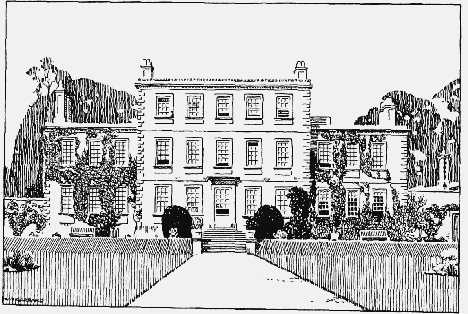
Great Harrowden: The Hall
Great Harrowden lies on the road from Kettering to Wellingborough and is bounded on the north by Little Harrowden, west by Hannington, and south by Hardwick. On the east the Ise brook (fn. 1) divides it from the Hundred of Huxloe, and the land near it is low and liable to floods. But the parish has an undulating surface, and the village stands at about 300 ft.
The L.M.S. railway has a station at Finedon, a mile and a half north-east of the village, which lies mainly to the east of the junction of the road from Kettering to Wellingborough with the road to Olney. The church of All Saints lies south of the Olney road. East of the church is Harrowden Hall, a spacious mansion in the simpler fashion, with beautiful gardens. Its predecessor, 'Mrs. Vawse's house at Harrowden', was a centre of the recusants during the minority of her son Edward, fourth Lord Vaux, and at the time of the Gunpowder Plot. In 1601 Henry Knowles wrote to Sir Robert Cecil of a refugee in this house, 'I am certainly informed that if I should see him go in and presently see the house there be such places for concealing him as except a man pull down the house he shall never find him'. (fn. 2) The present Hall appears to have been begun by Nicholas Knolles about 1687, which date is carved upon the stonework of the fireplace in the entrancehall, (fn. 3) but was probably renovated and perhaps enlarged by Thomas Watson alias Wentworth (fn. 4) after his purchase of the property in 1695, his arms occurring on the stone vases of the gate-piers and on metal shields over the gates. (fn. 5) The date 1712 is on the spout-heads of the house. In the grounds is a Roman Catholic chapel, built by the last Lord Vaux. It is a copy of Archbishop Chichele's School at Higham Ferrers. A private cemetery adjoins the chapel.
Harrowden Hall was at one time occupied as a boarding-school for young ladies by the wife of Samuel Sharp, F.S.A., the well-known geologist and antiquary (1814–82), the closing years of whose life were spent there. (fn. 6) It remained a girls' school until 1898, shortly before which date Lord Vaux had bought the Hall from George Fitzwilliam. On the death of the last Lord Vaux in 1935 the Hall passed to his grandson, John H. P. Gilbey, esq., second son of Grace, eldest daughter and coheir of Lord Vaux. (fn. 7)
To the west of the church is the manor-house. It stands on the road leading from the village to Orlingbury, and is a two-story ironstone building with projecting three-story porch taken up above the roof, in the gable of which is a panel with the date 1648 and initials R C A. Many of the mullioned windows have been altered or removed, and the roofs are covered with modern blue slates. It is in the occupation of J. D. Groome, esq. Just beyond it is the vicarage, a house of considerable charm. To the south of Great Harrowden Hall are old stone-pits, and the Red Hill Spinnies. Great Harrowden Mill lies at the northeastern end of the parish, on the Ise Brook.
The soil is of a good fertile mixed character; substratum loamy, Great Oolite, limestone, sand, and ironstone: the area of the parish is 1,476 acres of land and 5 acres of water; the land is chiefly pasturage.
The children attend school at Little Harrowden. The school in Great Harrowden was closed about fifty years ago, and is now used on Sundays only.
Manors
Lands in HARROWDEN were entered in the Domesday Survey among those held by the Bishop of Coutances: (fn. 8) 2 hides and 3 virgates there were held of him by Wakelin, and had been held before the Conquest by Edwin, evidently the son of Burred, the great English landowner and thegn, who held lands in Bedfordshire and Buckinghamshire as well as in this county. One and a half hides 'in another Hargindone' [Little Harrowden], with land for 3 ploughs, which Wakelin also held, were valued with this property; and the soc of 1 virgate in Wellingborough pertained to the bishop's manor of Harrowden. On the forfeiture of the bishop's fief this Harrowden property passed to the fee or honor of Huntingdon, and it was returned in the Northamptonshire Survey that Geoffrey held 2 hides less 1 bovate in Harrowden of that fee. (fn. 9) Two manors of Great and Little Harrowden, called LEWKNORS early in the 15th century, (fn. 10) probably originated in these estates, which seem to have been held by the family of Muschamp before the end of the 12th century. (fn. 11) A manor of Harrowden was granted in 1244 to Geoffrey de Leuknor by Robert de Muschamp, (fn. 12) and was clearly identical with the manor of Great Harrowden and its members the manors of Little Harrowden and Isham, returned as so granted in the Quo Warranto pleas of 1329–30. (fn. 13)
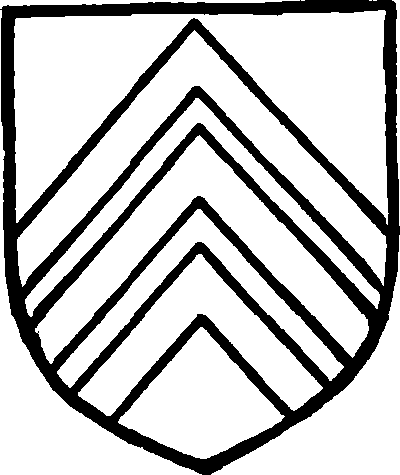
Leuknor. Azure three cheverons argent.
Though the distinctive terms Great and Little Harrowden were in use in the first half of the 13th century, the same owners held lands in both, and Harrowden must frequently be interpreted as covering both or either of the Harrowdens. In 1236 2 knights' fees in Harrowden were entered among the 9½ fees held by Simon 'Major' of the fee of Huntingdon, (fn. 14) while in 1242 among the fees which Isabel de Brus held of the honor of Huntingdon was a fee in Great Harrowden which Geoffrey de Leuknor held of her and 1½ fees which the same Geoffrey was holding of her in Little Harrowden and Clipston. (fn. 15) Geoffrey de Leuknor and Sibyl his wife granted a messuage in Great Harrowden to Sulby Abbey on condition of anniversary masses being said for them both. (fn. 16) Geoffrey was succeeded by his son Ralph, (fn. 17) who in 1284 was holding 2 knights' fees in Great and Little Harrowden of Walter de Huntercumbe, who had apparently married a daughter of Robert de Muschamp. (fn. 18) Ralph's son Geoffrey died s.p. (fn. 19) and had been succeeded by his brother John de Leuknor in 1316, when the said John was holding Harrowden. (fn. 20) In 1318 John de Leuknor and Elizabeth his wife were dealing with the manors of Great and Little Harrowden. (fn. 21) John de Leuknor was called upon in 1329–30 to prove his right to view of frankpledge and other franchises in Great Harrowden, Little Harrowden, and Isham. He stated that Robert de Muschamp and his ancestors had been seised of these liberties, and had granted them with the manor to Geoffrey de Leuknor his grandfather. His claim to view of frankpledge was allowed, but he failed in his other claims. (fn. 22)
In 1341–2 Simon Simeon was dealing with messuages, land, rent, and a mill in Great and Little Harrowden; (fn. 23) and the said Simon in 1356 was dealing with the manor of Great Harrowden by fine, together with the manors of Grafton, Finedon, and Nortoft. (fn. 24) Three years later the two manors of Great and Little Harrowden, with messuages, land, and rent in Clipston and Lowick, were conveyed by him by fine to John de Leuknor and his wife Elizabeth, and by them reconveyed to himself. (fn. 25) John de Leuknor seems to have been the last Leuknor tenant of these manors, though a Robert Lewknor was still described in 1367 as of Harrowden. (fn. 26) Simon Simeon and his wife Eliza- beth were dealing with both manors in 1377–8, (fn. 27) and the fees held of Edward, Prince of Wales, at his death in 1379 included fees in Great and Little Harrowden, Clipston, Isham, &c, formerly held by Geoffrey Lewknor, and at that date by Simon Simeon. (fn. 28)
On 8 August 1386 Simon and his wife Elizabeth received a grant of free warren, (fn. 29) and on 18 December 1387 Simon died seised of the manors of Great and Little Harrowden, both held of the honor of Huntingdon by knight service. (fn. 30) A year later Elizabeth granted the manors to Peter Muslee and others, (fn. 31) by whom the manors were conveyed to Sir John de la Warre and his wife Elizabeth, (fn. 32) the widow of Simon Simeon. (fn. 33) Sir John de la Warre in 1397–8 conveyed both manors to Master Thomas de la Warre, Canon of Lincoln, and others, to hold for life, (fn. 34) and on 27 July 1398 died seised of them in reversion, the said Thomas, his brother, being his heir. (fn. 35) In the following year, 1399, the said Thomas de la Warre made a grant to Sir William Thirnyng, Nicholas Bradshaw, John Welton, and William Vaus (Vaux) of the reversion of lands, &c., in Great and Little Harrowden and Finedon after the death of Maud, wife of Henry Burdon. (fn. 36)
In 1408 the manor was in the hands of Sir William Thirnyng, as Sir John Lovell was returned in the inquisition then taken after his death as holding Ochecote manor of Sir William Thirnyng as of his manor of Harrowden by knight service. (fn. 37) Next year Sir Thomas de la Warre, clerk, made a conveyance of the manors of Great and Little Harrowden called Lewkenores to Sir William Thirnyng and others. (fn. 38) In 1413 Sir William Thirnyng was dead, and his widow Joan in possession of these manors, which she granted in that year to Sir Gerard Braybrook and others in a deed witnessed, among others, by Sir Thomas Green. (fn. 39) This must have been followed by a grant of the manor to Sir Thomas Green of Green's Norton, as at his death on 14 December 1417 his son Sir Thomas Green was seised of a manor of Harrowden which had been granted to him and his wife Philippa by his father. (fn. 40) The Thirnyngs apparently retained the lordship, as in 1428 Alice Thirnyng, presumably a daughter of Sir William, was taxed 16s. 8d. for 2½ fees in Great and Little Harrowden which John de Lewknor had formerly held. (fn. 41) It would seem that her rights passed in some way to Sir William Vaux, who as a zealous Lancastrian was attainted in 1461, when his manor of Great Harrowden and its members in Little Harrowden, Isham, Orlingbury, &c., were among the lands forfeited by his attainder. (fn. 42) The manor was then granted to Ralph Hastings, Esquire of the Body, on 1 May 1462. (fn. 43) Sir Ralph Hastings of Harrowden, who, among other offices, was lieutenant of the castle of Guisnes in Picardy and constable of Rockingham, (fn. 44) received a fresh grant in 1483 to him and his wife Anne from Richard III. (fn. 45) Sir William Vaux had been slain at Tewkesbury, and on the accession of Henry VII in 1485 his son Nicholas immediately secured the reversal of his father's attainder and restoration to his lands. Sir Thomas Green, of Green's Norton, the fifth in succession of that name, died in 1506 leaving two daughters and co-heirs, the elder of whom, Anne, married, as his second wife, Sir Nicholas Vaux, (fn. 46) to whom she brought vast wealth and the Greens' interest in the manor of Harrowden; the younger daughter, Maud, married Sir Thomas Parr, of Kirkby in Kendal.
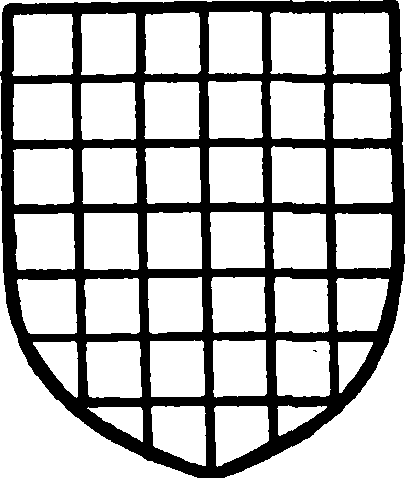
Vaux. Checky or and gules.
Sir Nicholas, who saw much service in France, was a prominent figure of the time, and on 27 July 1511 Henry VIII was his guest at Harrowden. (fn. 47) Both Sir Nicholas and his father-in-law, Sir Thomas Green, before him had been active in inclosing lands on their Harrowden property, and for his violations of the acts against inclosures he was repeatedly summoned before the Court of Exchequer, (fn. 48) but escaped penalties and was pardoned after his death, (fn. 49) which happened on 14 May 1523, less than a month after he had been created Baron Vaux of Harrowden. His wife Anne had predeceased him, and his heir, their son Thomas, who had reached the age of fourteen on the preceding 25 April, had married Elizabeth, then aged sixteen, the daughter of Anne Cheyne and of Sir Thomas Cheyne of Irtlingborough, whose heir she was, the manor of Harrowden being settled on the young pair at their marriage. (fn. 50) By his will (fn. 51) Sir Nicholas Vaux made provision for his unmarried daughters by his wife Anne, Margaret, Bridget, and Maud. His son Thomas, second Baron Vaux, succeeded him. 'The boke of the accompte of the household of Thomas Vaus, Kt., Lord Harowdon, kept at his manor of Harowdon from 2 August 27 Hen. VIII to 28 October following (1535): by Robert Downall, Steward of the household' gives the family and household as consisting of 46 persons. (fn. 52)
Lord Vaux, who has left specimens of his skill in verse-making and belonged to the more cultured circles of Henry VIII's court, lived until October 1556, when he was succeeded by his son William, who married as his first wife Elizabeth, daughter of John Beaumont, Master of the Rolls, and as his second Mary, daughter of John Tresham of Rushton. (fn. 53) In 1557 William, Lord Vaux, conveyed the manors and advowsons of Great and Little Harrowden to his wife's grandfather, Sir Thomas Tresham, evidently by way of a settlement. (fn. 54) Sir Thomas Tresham died in 1559, and was succeeded by his grandson, another Thomas, knighted in 1577. The Tresham Papers discovered at Rushton, (fn. 55) which show how much Lord Vaux leaned on his brother-inlaw in the management of his affairs, contain an account of the family disputes which resulted from a settlement of the manors of Great and Little Harrowden made by Lord Vaux in 1571, under which Sir Thomas stood security for the payment of £500 each to Eleanor, Elizabeth, and Anne, the three daughters of Lord Vaux by his first wife. (fn. 56) In 1581 Lord Vaux and Sir Thomas Tresham, both zealous Catholics, were summoned before the Star Chamber and committed to the Fleet Prison. After trial in November they were recommitted to prison. But though Lord Vaux suffered much for his religion, he and his friends were reported on by a Government spy, who declared them to be 'the most markable Catholics', as 'very good subjects and great adversaries of the Spanish practices'. (fn. 57) Henry Vaux, the eldest son of Lord Vaux by his first wife, intending to enter religion, resigned his birthright to his halfbrother George, to the great indignation of his sisters. (fn. 58) George married, without the approval of his father, Elizabeth daughter of Sir John Roper and she seems to have obtained entire ascendancy over her husband, and even over his brother Ambrose, the third son of Lord Vaux, to whom the heirship had been forfeited by George's marriage without his father's consent. (fn. 59) Ambrose was dealing with the manors in 1589 by fine, (fn. 60) and again in 1590. (fn. 61) George Vaux died on 13 July 1594 at Harrowden. His brother Henry was already dead, and the death of Lord Vaux followed on 20 August 1595. (fn. 62) His heir, his grandson Edward, son of George, (fn. 63) was brought up as a strict Catholic by his mother, who, as 'the widow Vaux', appears in the Tresham Papers to have been a cause of much trouble in the family. (fn. 64) She was under suspicion on account of the Jesuit company which, as in the case of her sister-in-law Anne Vaux, frequented her house at Harrowden for some years (fn. 65) both before and after she was put under examination there with her son, the young lord, on the discovery of the Gunpowder Plot. Their house, especially his closet, was narrowly searched, but no papers were found. (fn. 66)
Edward Vaux, 4th Lord Harrowden, is stated in these examinations to have been then starting to ride to London on 6 November to treat for his marriage with the daughter of Thomas Howard, Earl of Suffolk, when news of 'broils in London' caused him to postpone his journey. (fn. 67) He did not escape the consequences of being related to every one implicated in the Gunpowder conspiracy and was attainted. But in 1612 his lands were restored to him, (fn. 68) including the manors of Great and Little Harrowden, and in 1616 Lord Vaux received a grant of free warren here. (fn. 69) The lady for whose hand he was an aspirant in the memorable month of November 1605 had married before that year was out, she being then a girl of nineteen, and he nearly sixty, William Knollys, Earl of Banbury, (fn. 70) the marriage taking place less than two months after the death of the earl's first wife. On 10 April 1627 she gave birth to a son, Edward, at her husband's house, and on 3 January 1630–1 to another son, Nicholas, in the home of Lord Vaux at Harrowden. The earl, then aged 85, died at the house of his physician, Dr. Grant, in Paternoster Row, on 25 May 1632, having bequeathed all his possessions to his wife by a will which mentioned no children. Five weeks later she married Lord Vaux. The question of the paternity of his wife's sons, which was to remain in dispute for generations, the House of Lords refusing to acknowledge their right to the earldom of Banbury which the Law Courts declared they possessed, was raised in 1641, when a chancery suit instituted to recover for them the property of the late Earl of Banbury procured on 14 April 1641 the decision that Edward, the elder of the two, was son and heir of the late earl. In June 1645 Edward, returning from a tour in Italy, was slain in a quarrel on the road between Calais and Gravelines, and his brother Nicholas, who had journeyed to France with his mother in 1644, assumed the title of Earl of Banbury. In 1646 Lord Vaux with his wife Elizabeth settled the manors of Great and Little Harrowden, the rectories, advowsons, free warren, &c., to the exclusion of his own heirs, on his step-son Nicholas, Earl of Banbury, (fn. 71) heretofore, apparently, called Nicholas Vaux. (fn. 72) Nicholas, as Earl of Banbury, in 1651 made a conveyance of these manors by fine, (fn. 73) and on 27 February 1655 with his wife Isabella, daughter of Mountjoy Blount, Earl of Newport, his mother, and Lord Vaux, petitioned Cromwell to remove the sequestration on Lord Vaux's estate, (fn. 74) and allow them to compound or sell, the earl being then confined in the Upper Bench prison for debt. The Countess Isabella soon after died, and on 4 October 1655 Nicholas married Anne, daughter of William, Lord Sherard of Leitrim. His mother died on 17 April 1658, and her husband Lord Vaux on 8 April 1661, both being buried at Dorking. The barony of Vaux of Harrowden then descended to Lord Vaux's only surviving brother, Henry, on whose death s.p. in 1662 it fell into abeyance (to be revived on 12 March 1838 in the person of George Charles Mostyn (fn. 75) of Kiddington, who traced his descent to Mary Vaux, sister of Edward, 4th Lord Vaux, wife of Sir George Symeon of Britwell). The manors of Great and Little Harrowden passed into the hands of Nicholas, Earl of Banbury, who, as no writ of summons was issued to him for the new Parliament of 8 May 1661, petitioned the king for issue of the same. Though a committee of privileges reported on 1 July 1661 that Nicholas, Earl of Banbury, was legitimate, the House of Lords declined to accept the report, and he died on 14 March 1673–4 without having been summoned. His son Charles assumed the title and succeeded to the manors of Great and Little Harrowden. (fn. 76) He petitioned the House of Lords for a writ of summons on 10 June 1685 with no result; but his arraignment in Hilary term of 1693 as Charles Knollys, consequent upon his having killed his brother-in-law, Captain Philip Lawson, in a duel, resulted in his indictment being quashed on the ground that he was wrongly entered, he being Earl of Banbury. It was, however, as Charles Knollys, esq. alias Charles, Earl of Banbury, that with his wife Elizabeth in 1695 he conveyed the manor of Great Harrowden by fine to Thomas Watson, esq., and George Watson. (fn. 77) Thomas Watson was the third son of Edward Watson, second Lord Rockingham, by Anne, eldest daughter of Thomas Wentworth, first Earl of Strafford, and took the name of Wentworth in 1695 on inheriting the vast estates of his mother. In 1696 with his wife Alice, daughter of Sir Thomas Proby, bart., he was dealing with the manor of Great Harrowden, and advowsons of Great and Little Harrowden as Thomas Wentworth alias Watson, esq. (fn. 78)
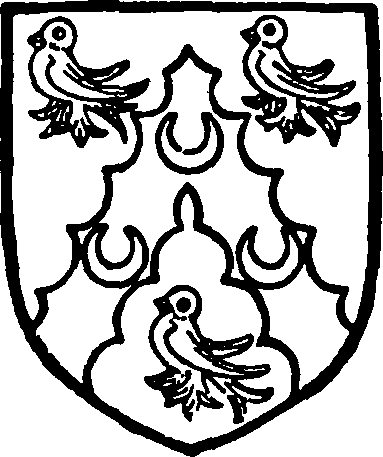
Watson. Argent a cheveron engrailed azure between three martlets sable with three crescents or on the cheveron.
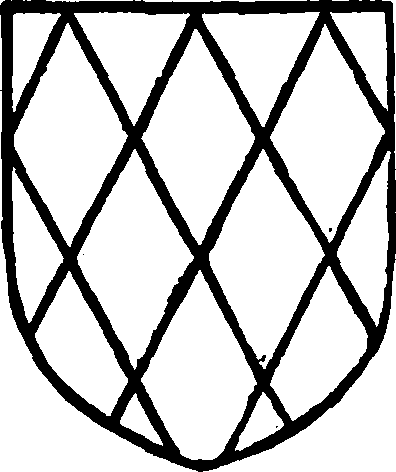
Fitzwilliam. Lozengy argent and gules.
His son Thomas was on 28 May 1728 created Baron Wentworth of Malton in Yorkshire, and on 19 November 1734 Baron of Harrowden and Viscount Higham of Higham Ferrers in Northamptonshire, and Baron of Wath and Earl of Malton in Yorkshire. In 1744 he with his mother, Alice Wentworth, widow, made a conveyance of the manor of Great Harrowden to Henry Finch, esq. (fn. 79) After the death of his cousin Thomas Watson, third Earl of Rockingham, unmarried, in 1745, he succeeded to the barony of Rockingham, and, the earldom and associated honours becoming extinct, was created Marquess of Rockingham on 14 April 1746. He married Mary, daughter of Daniel Finch, 2nd Earl of Nottingham and 6th Earl of Winchilsea, and at his death in 1756 was succeeded by their fifth but only surviving son, Charles Watson Wentworth, 2nd Marquess of Rockingham, the eminent Whig statesman. The second marquess was returned as lord of the manor of Great Harrowden in the Inclosure Act passed for Little Harrowden (q.v.) in 1781, and died s.p. in 1782, when he was buried in York Minster. His nephew William Wentworth, 2nd Earl Fitzwilliam, son of his eldest sister Lady Anne Watson Wentworth and of William, 1st Earl Fitzwilliam, created Viscount Milton and Earl Fitzwilliam (in England) in 1746, then succeeded him here and in estates valued at £40,000 a year, and kept up a princely establishment at Wentworth Woodhouse in Yorkshire. He married Lady Charlotte Ponsonby, youngest daughter of William, Earl of Bessborough. Their son Charles William Wentworth Fitzwilliam, commonly called Viscount Milton, was dealing with the manors of Great and Little Harrowden and Withmail Park, with the rectories, tithes, advowsons, free fishing, and free warren, courts leet and baron, mills and dovecots belonging to the same, by recovery in 1807, (fn. 80) and succeeded his father in 1833 in the earldom as 3rd Earl Fitzwilliam. He had then for the last two years represented Northamptonshire in Parliament, and was lordlieutenant of the county in 1853. He received the royal authorization to adopt the surname of Wentworth before that of Fitzwilliam in 1856, and died at Wentworth Woodhouse in 1857, when he was succeeded in the earldom by his second son, William Thomas Spencer, Viscount Milton. His third son, the Hon. George Wentworth-Fitzwilliam, M.P., of Milton Park, was the lord of the manor and sole landowner of Great Harrowden until his death in 1874, when the manor was held by his trustees until his son George Charles Wentworth-Fitzwilliam of Milton Park (q.v.) succeeded him as lord of the manor and sole landowner in Great Harrowden. In 1895 he sold the Hall to Lord Vaux but retained the manorial rights, which are now in the hands of his grandson William Thomas George Wentworth-Fitzwilliam, esq. (fn. 81)
One hide in Harrowden which Algar had held freely before the Conquest was returned in the Domesday Survey among the lands of Guy de Reinbuedcurt as held of him by Norgiot (fn. 82) (who also held a virgate in Wellingborough of the Bishop of Coutances, of which the soc pertained to the bishop's manor of Harrowden). The chief seat of the Reinbuedcurts was the manor of Wardon (q.v.), and the garrison of the castle of Rockingham was provided by making it a charge on that barony. (fn. 83) This service of castle guard was soon commuted for a payment of 5s. from each knight's fee, and a return of such payments, attributed to c. 1176, or considerably later, enters 5s. from Harrowden, presumably from this hide. (fn. 84) Margaret, the daughter and heir of Guy's son Richard, married Robert Foliot, whose son Richard Foliot left an only daughter and heir Margaret. She married Wyschard Ledet, son of Christiane Ledet, and Christiane their only daughter married, as her first husband, Henry de Braybrook, as'her second, Gerard de Furnival. Under the barony of Wardon, Gerard in 1235 was paying for one fee in Cogenho and Harrowden, &c. (fn. 85) The latter fee was presumably that which Nicholas de Cogenho held in 1242 of Christiane Ledet; (fn. 86) and the Harrowden portion of it probably corresponded to the hide in Harrowden which Nicholas de Cogenho held in the 12th century of the king's fee. (fn. 87) This fee appears next to have been held by the de Cogenhos with their manor of Cogenho (q.v.) as of the fee of Haversham: for in 1284 William de Cogenho, son and heir of Nicholas, (fn. 88) was holding one fourth part of a fee in Great Harrowden of John de Haversham, who held of the king. (fn. 89) In 1349 Giles de Cogenho died holding land, rent, and a water-mill at Harrowden, with his manor of Cogenho, (fn. 90) and his son John, who succeeded him, died in 1361 seised of the reversion of a manor in Harrowden held of Fulk de Birmingham as of the fee of Haversham. (fn. 91) His grandson William died without issue and his sister Agnes carried the property by marriage to John Cheyney, (fn. 92) and after this the Harrowden manor appears to have been absorbed into that of Cogenho (q.v.).
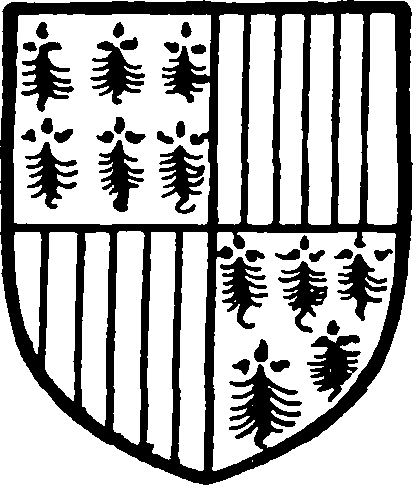
Knightley. Quarterly ermine and paly or and gules.
Another manor in Harrowden called HARROWDENS MANOR, held in 1486 of Nicholas Vaux, (fn. 93) originated in property which the Harrowden family were holding at an early date in both Harrowdens. In 1226–7 a fine was levied between Simon de Harrowden and Richard, parson of the church of Harrowden, of land in that parish. (fn. 94) This Simon was probably the Simon son of Adam of Harrowden who quitclaimed to the convent of Sulby the church of Great Harrowden. (fn. 95) In 1298 Adam son of Simon de Harrowden and his wife Alice received a grant of a messuage and virgate of land in Great Harrowden (fn. 96) from Sir Ralph de Leuknor. The Harrowdens, who frequently appear in public employment in Northamptonshire and elsewhere in the 14th century, (fn. 97) held manors in Great and apparently in Little Harrowden. A canopied brass in Great Harrowden church records the death in 1423 of William de Harrowden, who married Margaret (d. 1441), daughter and heir of Sir Giles St. John of Plumpton. Their son William married Margaret, daughter of William Vaux and aunt of Sir Nicholas Vaux, by whom he had two sons, Richard and Thomas. (fn. 98) By his will, dated 28 May 1447, he directed that his body should be buried in the south part of Great Harrowden church at the feet of William and Margaret Harrowden, his father and mother. He bequeathed to his wife Margaret all his lands and tenements called Horneres Key in London towards the maintenance of his son Thomas, with remainder to Richard Harrowden, his son and heir. (fn. 99) Both brothers must have died s.p. before their mother, who, on 2 October 1486, as Margaret Harrowden, widow, died seised of a manor of Great Harrowden called Harrowdens Manor, held of Nicholas Vaux. (fn. 100) Margaret, who also held the manors of Plumpton and Wold, was succeeded by her daughter Margaret Garnon, aged 60, (fn. 101) who had married as her first husband Henry Skenard, or Skinnerton, by whom she had a daughter Jane. (fn. 102) This daughter Jane married Sir Richard Knightley, and carried to her husband the manor or manors of Great and Little Harrowden, which she settled on her second son Edmund with the manors of Morton Pynkney and Plumpton. (fn. 103) Sir Edmund Knightley died on 12 September 1542, seised of these manors. At the death of his brother and heir male, Sir Valentine Knightley, in 1566 this Harrowden property descended to his son Richard, and was then returned as held of Sir Thomas Griffin, (fn. 104) by service unknown, as of his manor of Wardon. (fn. 105) Apparently the Knightley manors had been formed out of lands belonging to the Cogenhos and Harrowdens held partly of the barony of Wardon and partly of the honor of Huntingdon, and the Wardon overlordship had come to be regarded as applying to the whole. After this date the manor appears to have lost its identity and been absorbed into the Knightley property.
In 1286–7 Ralph de Leuknor granted a messuage and land in Great Harrowden to John son of Walter de Boketon (fn. 106) (Boughton), who in 1291 made a grant of a rent in Great Harrowden to Richard le Den and Joan his wife. (fn. 107) This was probably the property granted by Thomas de Boketon in 1324 to Sir John de Harrowden, parson of Stoke Bruerne, as a yearly rent of 8 marks from a messuage in Great Harrowden with the fourth part of a knight's fee. (fn. 108) It may possibly have been included in the messuages, lands, mill, and rent in Great and Little Harrowden, which together with the manor of Finedon were in 1339–40 granted to the same parson and to William de Thorp by Robert Everard of Lubenham, chaplain, and William de la Bruere of Finedon, (fn. 109) and in 1341–2 by William de Thorp to Simon Simeon. (fn. 110)
Licence was obtained in 1331 for John, parson of the church of Stoke Bruerne, to enfeoff Thomas Wake of Liddell of land and rent of the yearly value of £20 in Great and Little Harrowden, held in chief, for regrant to a house of religious men of any order he pleased, to be founded by him in the town of Great Harrowden; but it was cancelled on 20 June 1336. (fn. 111)
Church
The church of ALL SAINTS consists of chancel, 36 ft. 9 in. by 17 ft. 9 in., with vestry on the north side; clerestoried nave, 45 ft. by 19 ft. 4 in.; north aisle, 12 ft. 6 in. wide; north porch, and west tower, 12 ft. by 11 ft. 4 in., all these measurements being internal. The building had formerly a south aisle, which being very ruinous was taken down early in the 18th century. (fn. 112) The tower was originally surmounted by a spire. (fn. 113) The chancel was very extensively restored in 1845, the north wall and the upper part of the east and south walls being then rebuilt and a new roof erected, and the church was further restored in 1896. When the south aisle was taken down the new outer wall of the nave was erected on the line of the arcade, which was left standing, the old windows and doorway being inserted between the arches. These windows, which are of three lights with tracery formed by the forking and intersection of the mullions, and the arcade appear to be of late-13th-century date. (fn. 114) This indicates a 13th-century church with nave and south aisle the same size as at present, but evidence of a north aisle is wanting. The chancel was rebuilt on its present lines in the 14th century, and a north aisle was then added or rebuilt. The vestry, at the east end of the north wall of the chancel, is coeval with the chancel itself and was not rebuilt at the time of the restoration. The tower and clerestory are additions of about 1400. The parapets of the chancel are plain, but elsewhere they are battlemented, and the roofs are of low pitch leaded.
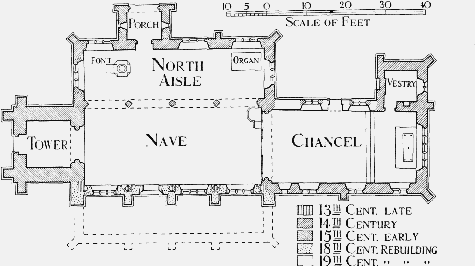
Plan of Great Harrowden Church
The east and south walls of the chancel are of grey rubble about two-thirds of their height, above which, like the north wall, they are faced with coursed ironstone. The east window is of five trefoiled lights with reticulated tracery and has a moulded arch and shafted jambs. In the south wall are three 14th-century ogeeheaded windows and two in the north wall, all of two trefoiled lights with a quatrefoil above, and the window of the vestry is of the same type. At the west end of the south wall is a blocked low-side window with pointed head breaking the string which runs round the chancel externally at sill level. Between the windows on the north side is a modern priest's doorway. The piscina and triple sedilia are original and form a single composition of four moulded trefoliated arches on triple shafts with moulded capitals and bases. The three seats are on the same level, and the arches are set below the moulded string which runs at sill level along the south and north walls. The pointed doorway to the vestry, or priest's chamber, has continuous moulded jambs and head, with bases to the middle round member. The 14th-century chancel arch is of two hollow-chamfered orders, the innermost on half-octagon responds with moulded capitals. In the north respond, facing east, is a narrow pointed recess, or niche, about 4 ft. 8 in. above the floor.
The oak rood screen remains, with wide middle opening and three upper traceried panels on either side and solid panels below. The screen is of late-14thcentury date, a very good example of the period, and has an original moulded rood-loft beam and modern oak vaulting carrying a vine pattern cornice.
The 14th-century north arcade consists of four pointed arches of two moulded orders springing from pillars and responds composed of four rounded shafts with hollows between, and with moulded capitals and bases. The north aisle windows are all of three cinquefoiled lights with four-centred heads, that at the west end being partly renewed, and the doorway has a continuous moulding. At the east end of the aisle is a mutilated 15th-century pillar piscina. The porch appears to be a 15th-century addition with flat-pitched gable and pointed arch of two rounded orders. There are four clerestory windows on each side, of two cinquefoiled lights with quatrefoil in the head, those on the south, since the removal of the aisle, being high above the windows of the nave.
The tower is of four stages with battlemented parapet and angle pinnacles, and is faced with closely jointed grey ashlar. On the west side is a pointed doorway and a two-light window in the third stage, but on the north and south the three lower stages are blank. The bellchamber windows are of two cinquefoiled lights with a small quatrefoil in the head, and the arch to the nave is of two chamfered orders. Above it is a blocked round-headed opening.
There are extensive remains of a painted Doom over the chancel arch, and fragments of wall painting with architectural and floral detail in the north aisle.
In the chancel are the mutilated remains of the splendid brass of William Harrowden, 1423, and Margaret his wife, daughter of Sir Giles St. John. The figures still remain in position, but the pilasters, canopy work, two shields, part of the inscription, and the labels above the figures have been removed. The man is in a complete suit of plate armour, his feet resting on a dog, and the lady wears a hooded veiled head-dress and cloak, or mantle open in front. (fn. 115)
In the north aisle is a grave-slab inscribed round the edge in lombardic characters 'Ici git une femme Luce de Asheby Deu de sa alme eit verroy merci', and another at the east end of the aisle retains part of an inscription of the same period. In the nave is a stone dated 1588 and in the chancel two large blue slabs the inscriptions of which are indecipherable, and one to Roger Charnock (d. 1651). (fn. 116) There is an oak chest in the vestry dated 1684.
There are three bells: the first an alphabet-bell, with a stamp used by Thomas Newcombe (1562–80), the second by Hugh Watts 1629, and the tenor by Thomas Clay 1715, (fn. 117) all cast at Leicester.
The plate consists of a silver cup of 1635, and a paten of 1695, the latter given by the Hon. Mrs. Wentworth. (fn. 118)
The registers before 1812 are as follows: (i) baptisms and burials 1672–1782, marriages 1672–1754; (ii) baptisms and burials 1782–1812; (iii) marriages 1754– 1812. There are churchwardens' accounts from 1683 to 1796.
Advowson
The rectory and advowson were granted to Sulby Abbey early in the 13th century by Mary de Muschamp and confirmed by Robert de Muschamp in 1227, (fn. 119) Simon son of Adam de Harrowden having also renounced his claims in favour of the abbey. (fn. 120) In 1227 Hugh, Bishop of Lincoln, with the consent of the dean and chapter granted a pension of two marks yearly from the church of Great Harrowden and chapel of Little Harrowden to Sulby Abbey as patrons of the advowson, the grant to take effect after the decease of the rector, Richard de Cantia. (fn. 121) In 1291 the church was taxed at £10. (fn. 122) The rectory was returned in 1535 as appropriated to the monastery of Sulby and the annual value of the vicarage as £13 6s. 8d. (fn. 123) On 13 July 1547 the rectory, church, and advowson of the vicarage of Harrowden were granted under the will of Henry VIII to the College of St. Mary the Virgin and All Saints of Fotheringhay. (fn. 124) After the dissolution of that college they were granted in 1549 to Edward Bury of Estwode, co. Essex, (fn. 125) but shortly after had passed into the hands of Wilgeford Tanfield, (fn. 126) widow, who in 1564 conveyed the rectories and advowsons of Great and Little Harrowden with all tithes of grain and hay to Sir Humphrey Stafford and Miles Orchard. (fn. 127) Her sale to Sir Humphrey of the same for £500 resulted in Chancery proceedings being instituted against her in 1569 by her brother-in-law Simon Harcourt of Staunton Harcourt, co. Oxon. (fn. 128) By Sir Humphrey Stafford the parsonage was leased to Roger Jarnock or Charnock, probably the same Roger Charnock of Great Harrowden who in 1588 contributed £25 to the defence of the country at the time of the Spanish invasion, (fn. 129) and this lease was also the subject of Chancery proceedings. (fn. 130) George Charnock, gent., made the presentation in 1622, (fn. 131) and in 1648 Nicholas Bacon of Gray's Inn, esq., brought a suit against Roger Charnock, younger brother of John Charnock of Islington, in connexion with a mortgage of the rectory. (fn. 132) Charnock of Harrowden appears in a list of delinquents of that year, (fn. 133) and in 1661 Francis Gray presented to the church. (fn. 134)
In 1665 John Heron and his wife Alice were holding the rectories and advowsons of Great and Little Harrowden, (fn. 135) of which in 1672 John Heron with his wife Susan made a conveyance to Francis Sherrard and John Hall. (fn. 136) The rectory next appears in the hands of Nicholas Bacon, and of William, Thomas, and Richard Bacon, who conveyed it to Robert Underwood and John Makernesse in 1680. (fn. 137) It was held with the manors of Great and Little Harrowden in 1683 by Charles called Earl of Banbury, (fn. 138) and since then has been held with the manor of Great Harrowden. The value of the vicarage was augmented in 1719 by a grant of tithes from the Hon. Thomas Wentworth and his son Thomas. (fn. 139)
Sir Nicholas Vaux, who died in 1523, directed by his will that a chantry of one priest should be established in Great Harrowden Church; (fn. 140) but there is no evidence of his wishes having been carried out.
Charities
The Wentworth Charity. A customary payment of 6s. a week is made by Earl Fitzwilliam out of his estate in this parish. Half the money is given to two poor widows and the other moiety to other poor of Great Harrowden and Higham Ferrers. This payment is ascribed by tradition to a gift by Mr. Thomas Wentworth. A sum of £1 1s. yearly is also paid on Lord Fitzwilliam's account in lieu of a treat or entertainment at Christmas. This sum is distributed among the other poor who participate in the weekly payment.
There are four almshouses in the parish occupied by poor widows and the buildings have been occasionally repaired at Lord Fitzwilliam's expense and occasionally at that of the parish.