A History of the County of Northampton: Volume 4. Originally published by Victoria County History, London, 1937.
This free content was digitised by double rekeying. All rights reserved.
'Parishes: Little Harrowden', in A History of the County of Northampton: Volume 4, ed. L F Salzman (London, 1937), British History Online https://www.british-history.ac.uk/vch/northants/vol4/pp185-187 [accessed 3 May 2025].
'Parishes: Little Harrowden', in A History of the County of Northampton: Volume 4. Edited by L F Salzman (London, 1937), British History Online, accessed May 3, 2025, https://www.british-history.ac.uk/vch/northants/vol4/pp185-187.
"Parishes: Little Harrowden". A History of the County of Northampton: Volume 4. Ed. L F Salzman (London, 1937), British History Online. Web. 3 May 2025. https://www.british-history.ac.uk/vch/northants/vol4/pp185-187.
In this section
LITTLE HARROWDEN
Hargedone (xi cent.); Little Harudone, Harewedone (xiii cent.).
Little Harrowden is an agricultural parish and village lying to the north of Great Harrowden and 3 miles north of Wellingborough on the road from Wellingborough to Kettering. In its eastern districts it is liable to floods from the River Ise, which for some distance forms its eastern boundary. Hill Top, near the centre of the parish, reaches a level of about 300 ft.; and about 350 ft. is reached in the west. It has an area of about 1,575 acres, of which a considerable proportion is arable land. The soil is of a good fertile mixed character; substratum loamy, Great Oolite, limestone, sand, and ironstone. The chief crops are cereals. The population, which in 1801 was 284, in 1931 was 698. It is mainly engaged in agriculture, but some shoemaking is done.
In the extreme north of the parish are Big Covert and Ashpole Plantation with Frisby Lodge between them. Finedon Iron Works on the eastern border of the parish were established in 1866 by the Glendon Iron Ore Company, and at one time had six blast furnaces in use, but now are disused. There are two good gravel pits, the soil, partly clay, being gravelly in the lower lands.
The village lies along a road branching from the main road to Kettering from Wellingborough, where the parish narrows to a mere strip. At its centre is St. Mary's Church, lying to the east of the road, with the manor house opposite it on the west. To the north of the church is the school, built in 1851, and enlarged in 1876 and 1899 to hold 220 children. South of it is the Methodist chapel and the infants' school. The chapel was built in 1882.
Manors
In the Domesday Survey LITTLE HARROWDEN was entered among the Harrowden properties included in the lands of the Bishop of Coutances. One and a half hides 'in another Hargedone' held of the bishop by Wakelin, valued with 2¾ hides which Wakelin held of him in Great Harrowden (q.v.), and 1 hide 1 virgate in the hands of Hardwin, a man of Wakelin's, which Siuerd had held freely in King Edward's time, and whose value had risen from 20s. to 40s., (fn. 1) appear to have corresponded, roughly, to Little Harrowden. The bishop's Harrowden lands had been forfeited and redistributed before the taking of the 12th-century Northamptonshire Survey, but the first property previously mentioned was apparently represented by lands still held with Great Harrowden (q.v.), and the second by a hide of the fee of William de Curcy which Reygold held, (fn. 2) and which seems to have been the origin of the manor of Little Harrowden, whose first recorded owner was William Raymond. (fn. 3) The distinctive appellation, Little Harrowden, was already in existence in 1227; (fn. 4) and Henry de Raunds, who succeeded William Raymond in the manor, made a conveyance of land in Little Harrowden to Robert son of Henry of Northampton in 1237. (fn. 5) In 1316 William de Raunds was entered with John de Leuknor as holding in Harrowden by knight service, (fn. 6) and his share included evidently the manor of Little Harrowden, for which in 1329 William de Raunds claimed view of frankpledge as appurtenant to this manor, of which his great-grandfather Henry de Raunds had been enfeoffed by William Raymond. (fn. 7) He stated that the manor was held of the honor of Huntingdon.
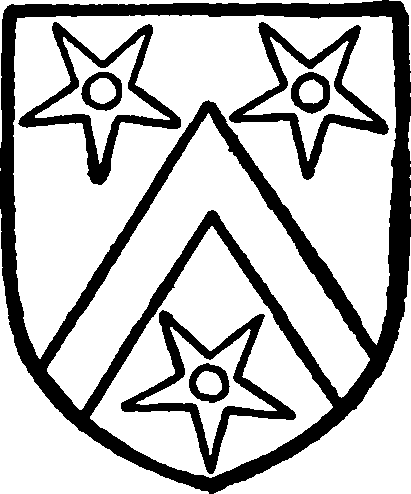
Shuckbrough. Sable a cheveron between threepierced molets argent.
Little Harrowden descended with the manor of Raunds (q.v.) to the Gages until 1553, when George Gage and Cecily his wife conveyed it to Anthony Shuckborough. (fn. 8) Thomas Shuckborough senior and Bridget his wife were dealing with the manor of Little Harrowden alias SHUCKBOROUGHS in 1611 (fn. 9) and 1619, (fn. 10) and Thomas Shuckborough junior and Eleanor his wife in 1623 granted it to John Sanderson, (fn. 11) who with his wife Cecily and John Sanderson junior in 1632 conveyed it to Edward Vaux, Lord Harrowden. (fn. 12) In 1646 he settled all his Harrowden property on his wife with remainder to her son Nicholas Knollys, Earl of Banbury; (fn. 13) and at the marriage of the latter with his second wife, Anne Sherard, he settled these manors in jointure on her with Orlingbury, Boughton (q.v.), &c. (fn. 14) Anne, his eldest daughter by his first wife Isabel, eldest daughter to Mountjoy, Earl of Newport, married Sir John Briscoe, who, according to Baker, purchased Little Harrowden Manor from his wife's half-brother Charles, called Earl of Banbury. (fn. 15) He mortgaged it with Boughton to John Lord Ashburnham, with whom and with others in 1718 he conveyed it with court leet, court baron, view of frankpledge, and free fishing to Richard Young, esq. (fn. 16) Since that date it has descended in the family of Young of Orlingbury (q.v.). (fn. 17)
The other manor of Little Harrowden previously referred to can be traced back to the fee and a half in Little Harrowden and Clipston which was held in 1242 with a fee in Great Harrowden of Isabel de Brus, of the honor of Huntingdon, by Geoffrey de Leuknor, (fn. 18) and in 1284 by Ralf de Leuknor. (fn. 19) This manor was a member of the manor of Great Harrowden (fn. 20) and has always been held with that manor (q.v.). In the 14th century the Greens of Green's Norton appear to have been already tenants in the manor under the Simeons, as a messuage and 3 virgates in Little Harrowden, which Sir Thomas Green had settled on his son Thomas, were delivered to the latter after his father's death in 1391. (fn. 21)
On 9 July 1607 Robert Syers, a recusant, being seised for term of his life of the manor or chief messuage of Isham and Little Harrowden, in the tenure of several persons and of a yearly value of £10, two-thirds of the same were granted to Edward Haselrigge or Heselrigg of Theddingworth (Leics.). (fn. 22)
A fee in Orlingbury and Harrowden which Simon de Loges was holding in 1242 of the barony of Margaret de Rivers (fn. 23) must have included land in Little Harrowden, as Richard de Loges was in 1227 in conflict with the Abbot of Sulby about the advowson of Little Harrowden; (fn. 24) and in 1282 a grant of land in Little Harrowden was made by Richard de Loges of Orlingbury to Roger atte Chyrche of Isham and Alice his wife. (fn. 25) It presumably descended with Orlingbury (q.v.), as messuages in Little Harrowden were held by Thomas Beavys with his manor in Orlingbury in 1469. (fn. 26)
Church
The church of ST. MARY stands on the north side of the main street and consists of chancel, 23 ft. by 18 ft.; clerestoried nave, 45 ft. by 18 ft.; north and south aisles, and west tower, 10 ft. 6 in. square, all these measurements being internal. The north aisle is 10 ft. wide and the south aisle 9 ft. 6 in., the width across nave and aisles being 41 ft. 8 in. The south aisle is continued eastward for about two-thirds the length of the chancel, its east end, formerly a chapel, being now used as a vestry and organ-chamber. The north aisle dates only from 1850, but takes the place of one demolished at some unknown date. The tower was originally surmounted by a spire, which fell in a storm in 1703, and has not been rebuilt.
The chancel and nave are under a single low-pitched roof with continuous plain parapets, and the chancel is faced with local ironstone. The south aisle is almost entirely covered with ivy, which completely hides a blocked doorway formerly opening to the chapel.
The oldest part of the building is the main south doorway, which dates from c. 1195, but is not in its original position. It was the south doorway of an aisleless 12th-century church, the nave of which covered the area of the existing two western bays and whose south-east angle is represented by the masonry pier of the south arcade. The doorway has a semicircular arch of four moulded orders, one of which is ornamented with chevrons, and has three jamb-shafts on each side with carved capitals and moulded bases. As rebuilt the doorway stands in front of the face of the wall, forming a kind of shallow porch. (fn. 27)
To this early building a south aisle was first added, and early in the 14th century the nave appears to have been extended eastward, a new chancel built, a north aisle added, and the tower and clerestory erected. The south aisle and arcade seem also to have been remodelled about this time, the aisle being shortly after extended eastward, the church then assuming substantially its present aspect.
The chancel has diagonal angle buttresses and a pointed east window of four lights with uncusped intersecting tracery and a sexfoiled circle in the head. At the west end of the north wall is a window of two trefoiled lights with quatrefoil in the head, and in the south wall near its east end an inserted 15th-century four-centred window of three cinquefoiled lights. The piscina is contemporary with the east window and has a trefoiled head and fluted bowl. At the west end of the south wall the chancel is open to the aisle by a 14th-century arch of two orders, the inner hollow-chamfered on halfoctagonal responds with moulded capitals and bases. The restored chancel arch is of two chamfered orders springing from half-round responds.
The 14th-century north nave arcade was left standing when the aisle was pulled down and was opened out when the present aisle was built. It consists of three pointed arches of two chamfered orders, springing from octagonal piers and corresponding responds with chamfered bases and moulded capitals similar to those of the chancel arch. On the south side the two western arches and the pier are of the same type but spring from a moulded corbel at the west end and from a halfround respond at the east attached to the masonry pier. The eastern arch is of two chamfered orders on halfoctagonal responds with moulded capitals.
At the east end of the south aisle, now within the vestry, is a trefoil-headed piscina similar to that in the chancel. The parapet of the aisle has a band of quatrefoils its full length and up the rake of its east wall; the windows are of two lights with forked mullion, but both end walls are blank.
The tower is of three stages, with clasping buttresses and battlemented parapet with gargoyles at the angles. The west doorway is a later insertion, or may take the place of a former opening; above it is a two-light 14thcentury window. The two lower stages on the north and south, and the short middle stage on the west, are blank. The bell-chamber windows are of two trefoiled lights with quatrefoil in the head, and above the hoodmoulds is a blank shield. Below the parapet is a band of quatrefoils enclosing sculptured faces and foliage. The lower part of the tower arch is filled with an oak screen erected as a War Memorial (1914–18). There is no vice.
The late-15th-century chancel screen has been much restored. The altar rails are of the 18th century, and the font is late in the same period. The pulpit is modern.
There are four bells, the first, third, and tenor cast by Hugh Watts of Leicester in 1624, and the second dated 1732. (fn. 28)
The plate consists of a silver cup and cover paten of 1569, and a paten and flagon of 1883. (fn. 29)
The registers before 1812 are as follows: (i) births 1654–61 (May), baptisms 1661 (November)–1722, marriages 1654–7, 1662–3, 1681–1720, burials 1653– 1727; (ii) baptisms and burials 1727–94; (iii) marriages 1754–1812; (iv) baptisms and burials 1795– 1812. There are churchwardens' accounts beginning in 1783.
Advowson
The church, as a chapel originally annexed to Great Harrowden, and now forming one vicarage with it, has no separate history for its advowson, having always been held with that manor.
Charities
On the inclosure of Little Harrowden in 1781 an allotment of about 2 acres was awarded, out of lands belonging to the Marquess of Rockingham, to the churchwardens and overseers in lieu of an annuity of 20s. payable to the poor by the marquis. The allotment is let for 18s. yearly, which is distributed in cash to the poor by the Parish Council.
An allotment of 44 a. 1 r. 33 p., now let for £19 2s. annually, was set out on the inclosure to the churchwardens in lieu of their rights in the common fields in the parish. The rent is applied to church expenses.
William Aylworth's Endowed School for Great and Little Harrowden and Orlingbury was founded in 1661, to commemorate the restoration of King Charles, under the will of William Aylworth, which directed that £20 a year should be paid towards the maintenance of this free school from the testator's estate at Gumley in Leicestershire, and his house and land in Little Harrowden conveyed for a habitation for the schoolmaster, who was to be a graduate in one of the two universities, a member of the Church of England, and of a sober, peaceable, and discreet behaviour and conversation. (fn. 30) It is attended by the children of Great and Little Harrowden.