
A History of the County of Northampton: Volume 4. Originally published by Victoria County History, London, 1937.
This free content was digitised by double rekeying. All rights reserved.
'Parishes: Castle Ashby', in A History of the County of Northampton: Volume 4, (London, 1937) pp. 230-236. British History Online https://www.british-history.ac.uk/vch/northants/vol4/pp230-236 [accessed 26 April 2024]
In this section
CASTLE ASHBY
Asebi, Esseby (xi cent.); Essheby David (xiii cent.); Asscheby Davy, Castel Assheby (xiv cent.).
Castle Ashby is a parish with its village seated on an eminence 8 miles east by south from Northampton, sharing a station with Earls Barton 1¾ miles north of the village, on the Northampton and Peterborough branch of the L.M.S. railway. The soil is of a fertile mixed character on a subsoil of clay. The chief crops are cereals. The population in 1931 was 236.
To the south-west of the village lies the hamlet of Chadstone, in which the rectory house is situated. (fn. 1)
The castle stands in the north overlooking the valley of the Nene having three parks with ornamental water, covering a total area of 645 acres. One entrance is reached by an avenue of trees which begins at Yardley Chase, and is nearly 4 miles in length.
The mansion, which is one of the seats of the Marquess of Northampton, has nothing of the castle about it; it is a fine house of the Elizabethan period, altered in many places by descendants of the original builder, Henry, 1st Lord Compton. But it was built near the site of the medieval castle which already in the time of Leland, early in the 16th century, was a ruin. It is 'now clene down', he says, 'and is made a septum for beestes'. A few years before Leland's visit the estate had been bought, in 1512, by William Compton, one of a family that had long been established at Compton Wynyates in Warwickshire. Henry, 1 st Lord Compton, presumably began the house before the death, in 1574, of his first wife, Lady Frances Hastings, whose arms are carved on a small doorway of the south-west turret.
The house, thus begun, followed the usual plan of the period. There was a main block containing the great hall, kitchens, and family rooms, and from it, on the south side, stretched two narrow wings, thus inclosing a courtyard. The fourth side was probably open, or only closed by a wall, but near the southern end of each wing was a staircase turret.
The suggested date of 1573–4 for the start of the house is confirmed by the evidence of the very interesting cellar under the dining-room at the east end of the hall. This is vaulted in stone and bears a general resemblance to the cellar at Drayton House which is beneath the wing dated 1584. But the detail of the work at Ashby, being of a very late Gothic type, may well indicate a date some ten or twelve years earlier than 1584. In both cases the rib-vaulting is of great interest as that form of construction had largely gone out of fashion. At Ashby the cellar is under one end of the dining-room and the floor over its vaulting used to be higher than the floor of the remainder of the room, so the whole cellar has been lowered in recent years to the requisite level, the stonework being rebuilt exactly as before.
At each end of the eastern wing the buildings project beyond its face, thus leaving a long recess which in 1624 was filled in, the ground floor forming an open arcade or loggia. But these open arcades, pleasant enough in Italy, were not suited to the English climate, and in many houses they have been enclosed. The loggia was converted in 1691 into drawing-rooms. Evelyn relates how, being on a visit to Althorp in 1688, he was taken to see Lord Northampton's house, whose owner, the young earl, had married a girl whom Evelyn had known since she was a child. His reception was not quite as cordial as he expected, for the visitors, instead of going into the house, were entertained in a lobby overlooking the garden, presumably the loggia in question, and they did not prolong their stay. There were other projections from other faces of the original house, leaving other recesses, but these also were eventually filled in, thus leaving the house the almost square mass which it is to-day.
Henry was succeeded in 1589 by his son William, who was created Earl of Northampton in 1618. However much there still remained to do, the house had so far progressed as to be fit to receive James I and his queen in 1605, not to mention the extreme probability that Queen Elizabeth had stayed in it in 1603. (fn. 2) The earl must have done much towards completing the house before his death in 1630, for the long parapet is dated 1624, as also is the parapet of the south-eastern turret. Within the house not much work of this time remains, but the fine ceiling of the room known as King William's, that of the Old Library, and that of the little room known as Lady Margaret's Bower, date from the first Earl's time. He had married in 1599 the daughter of the wealthy Sir John Spencer, who was Lord Mayor of London in 1594. He was no connexion of the Spencers of Althorp, and he bore different arms, which play a large part in the heraldry of the house. His daughter was a great heiress, a circumstance of which she seems to have been fully aware, for in a letter to her husband just before 1618 she is exceedingly peremptory as to what she would have and what she would not have. After indicating her very considerable wishes her final injunction is 'that you would pay your Debts, build up Ashby House, and purchase lands; and lend no money (as you love God) to the Lord Chamberlain'. This lady dwelt in a mansion at Canonbury, near London, from which in later years two fine chimney-pieces were removed to Castle Ashby.
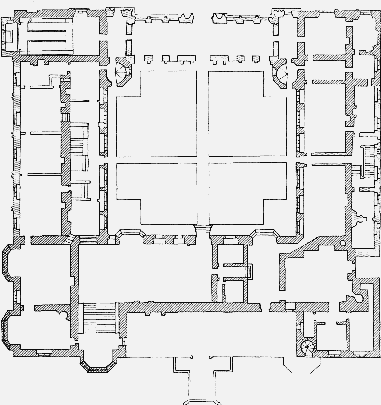
Plan of Castle Ashby
It is hard to say how much of the work at Ashby should be attributed to Henry Lord Compton, and how much to his son William the first Earl. But the latter was responsible for some of the upper rooms and the lettered parapet. This is a feature to be found on very few houses, but there are examples at Temple Newsam in Yorkshire and Felbrigge Hall in Norfolk. The legend on the east wing at Castle Ashby runs thus:
nisi dominus aedificaverit domum in vanum laboraverunt qui aedificant eam 1624: that on the west wing thus:
nisi dominus custos custodiverit domum frus and it is continued on the north side of the courtyard thus:
17 tra vigilat qui custodit eam 71.
The latter part was evidently reworked in 1771; the character of the letters and their less clever spacing are in keeping with their later date. The west wing has also at its south end the words ficant eam, which may be survivals of an original legend, corresponding with that on the east wing. The two staircase turrets have similar lettered parapets. That at the south-east corner has nisi dominus 1624 and that at the south-west corner nisi dominus 1635.
The difference in the figures raises the question of
the date and authorship of the entrance screen that
joins the two wings at their southern end. This has
always been attributed to Inigo Jones on the authority
of Colin Campbell in his Vitruvius Britannicus. But
the rather inexpert detail of the work hardly points to the
accomplished Inigo as its designer, and taking into
account the beginning and growth of the Italian
manner in England, the date of 1635 would seem
more reasonable than 1624 were it not that it bears
the arms of the first earl, who died in 1630. The
screen carries on the idea of the lettered parapet, for
over the front entrance there is:
dominus custodiat introitum tuum,
and on the courtyard side:
dominus custodiat exitum tuum.
The same kind of ornament was revived in much later
times as part of some improvements, for on the north
front, with a return on the east and west, is the legend
beati omnes qui timent deum qui ambulant in viis
ejus laudate nomen domini amen 1827,
and of much the same date, on two bay-windows occurs
salus est in domino.
During the 17th century the original recess on the west front must have been filled in and the handsome staircase contrived within it. The loggia on the east front was converted into rooms in 1691, as already mentioned, and near it was introduced another large staircase. Many of the rooms were finely panelled, and some of them were adorned with carving. The decoration of Lady Margaret's bower was carried out by the son of the first earl, who succeeded in 1630 and was slain at the battle of Hopton Heath in 1643. This is established by the presence of his arms impaling those of his wife, who was a daughter of Sir Francis Beaumont of Cole-Orton, and the work may be part of that to which the date of 1635 applies. The decoration consists largely of a painted wood dado divided into large arched panels, over each of which is affixed a small landscape picture inscribed with a sign of the Zodiac. But in this decoration Inigo Jones could have had no part; it is probably due to a local craftsman, except for the pictures, which look as though they came from a Dutch or Flemish brush of no great skill.
In the early years of the 18th century the recess on the north front was filled in, and further work was done in 1748, as indicated by certain spout-heads bearing that date. Then in 1771–2 a new roof was given to the great hall and its parapet was rebuilt and dated 1771, as already mentioned. Early in the 19th century the eighth earl and first marquess did much work in the house, Britton remarking that 'it has been wholly renovated, and adapted to the comforts of refined society, by the present noble proprietor'. The refinement of the age was inimical to the ancient decorations and they suffered accordingly. The third marquess did further work in the great hall, restoring its Elizabethan character, and brought the two chimney-pieces from Canonbury, putting one in the Hall and one in King William's Room. He also laid out the gardens in their present form and built the entrance lodges. Before his time the original noble lay-out of the gardens and their surroundings had been sadly changed (about the year 1764) by 'Capability' Brown, whose aim was to sweep away the formality of the old lay-outs in favour of something more natural and sylvan. He completely ruined the old scheme at a great cost, which was met by a sale of land, one of the deeds being endorsed with a satirical note by the owner: 'I take the manor of Fen Stanton to belong to Lawrence Brown Taste, Esq., who gave Lord Northampton Taste in exchange for it.'
Manor
In 1086 one Hugh held of the Countess Judith 2 hides less one virgate in ASHBY, including woodland, and a mill rendering 6s. 8d. yearly. Attached to this holding was 1 virgate of socland in Grendon. (fn. 3) At the time of the 12thcentury Survey William Fitz-Clarembald had 3½ hides in Ashbyand Gladstone, (fn. 4) and in 1235 1 fee in Ashby was part of the honor of Huntingdon with which the overlordship remained. (fn. 5) The family of Ashby was already well established here, (fn. 6) and by 1242 1 fee in Ashby and Grendon was held of Henry de Hastings by Sir David de Ashby, (fn. 7) who had presented Simon de Ashby to the church in the previous year. (fn. 8) His tenure gave the name of ASHBY DAVID to the manor, which descended to David, son of William de Ashby by Amabel daughter of Roger de St. Martin. William had died before 1243 (fn. 9) and in 1249 Henry Muschett still had the wardship of his land and heir. (fn. 10) David son of William appears to have been slain at Evesham in 1265 (fn. 11) and in the following year the king made a grant to Isabel his widow, and her children, from David's lands in Ashby, Grendon, and Chadstone, extended at £89 11s. 9d. a year, which had been given to Imbert Guy. (fn. 12) David had apparently mortgaged this holding to Moses the Jew of London (fn. 13) whose son Elias in 1267 confirmed to Alan la Zouche a yearly fee of £124 and a debt of £100 in 'which David de Ashby had been bound. (fn. 14) This resulted in an inquisition two years later between Isabel daughter of Stephen, son and heir of David de Ashby, and Alan la Zouche, concerning David's estate at the time of the war and the battle of Evesham. (fn. 15) That the property was confirmed to Alan is clear from the facts that in 1276 his widow Ellen had view of frankpledge in Ashby (fn. 16) and in 1284 her son Oliver held of John de Hastings the fee in Ashby and Grendon. (fn. 17) Before 1306 Oliver la Zouche had enfeoffed Walter de Langton, Bishop of Coventry and Lichfield, (fn. 18) treasurer and chief minister of Edward I, who in that year received licence to crenellate the house he was then building at Ashby David, (fn. 19) which caused the manor to be known as Castle Ashby. He also had a grant of free warren in his demesne lands there. (fn. 20) During Langton's imprisonment under Edward II, William Trenchefoill was keeper of the manor in 1311. (fn. 21) Langton afterwards settled it upon Robert Peverel and his wife Alice with remainder to their son Edmund. (fn. 22) In 1325 the two fees in Ashby were held by Robert's widow Alice. (fn. 23) She married Thomas de Verdon with whom, in 1329, she claimed to have view of frankpledge and free warren in the manor, (fn. 24) and he was said to hold half a fee in Ashby and Grendon in 1346. (fn. 25) Alice de Verdon and her grandson John, son and heir of Edmund Peverel, both died in 1349, probably from the Black Death. The manor then included 160 acres in demesne, but was not worth more than 40s. for want of servants because of the pestilence, only six out of twenty-four bondmen surviving. (fn. 26) John son of Edmund Peverel, when 21, had demised all his lands in the county to John de Lyle of Rougemont, (fn. 27) from whom the manor passed into the possession of William de la Pole, the husband of Margaret sister and heir of John Peverel, (fn. 28) and he, in 1358, settled it on himself and his wife in tail male. (fn. 29) He was succeeded in 1366 (fn. 30) by his son Sir John de la Pole of Chrishall, Essex, who married Joan daughter of John Lord Cobham. (fn. 31) His right passed to their daughter Joan, afterwards Lady Cobham, (fn. 32) who in 1390 with Sir Robert Hemenale, her first husband, levied a fine of the manors of Ashby David and Chadstone to members of the Braybroke family. (fn. 33) In 1392 this property was settled on Gerard Braybroke sen. and his wife Isabel with reversion to the said Joan and her second husband Sir Reynold Braybroke. (fn. 34) Gerard died in 1403 seised of the castle and manor, held of Reynold de Grey of Ruthin, (fn. 35) which then passed successively from Sir Reynold Braybroke to Sir Nicholas Hawberk and Sir John Oldcastle (fn. 36) the third and fourth husbands of Joan Lady Cobham. When Oldcastle was executed as a lollard and traitor in 1417, (fn. 37) the manor, including one water-mill worth 40s., was seised into the king's hands, but restored to his widow in 1418. (fn. 38) In 1419 Joan demised the manors of Ashby and Chadstone to Sir Gerard Braybroke for thirty years at a rent of £10, which term he assigned to the chief lord, Sir Reynold de Grey of Ruthin, in December 1423. (fn. 39) In September of this year he had already conveyed the reversion of the property held by Joan and her fifth husband, Sir John Harpenden, to John de Grey of Ruthin and others. (fn. 40) After her death in 1434 it appears to have descended with the rest of the possessions of this family for several generations, (fn. 41) until Richard Earl of Kent wasted the estate, which in 1506 was conveyed to his brother-in-law Lord Hussey (fn. 42) and in 1512 to Sir William Compton, a distinguished courtier and soldier, son of Edmund Compton of Compton Wynyates in Warwickshire, (fn. 43) who also acquired other property of the earl.
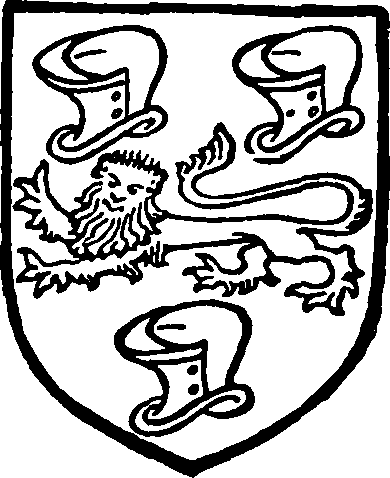
Compton. Sable a leopard or between three helms argent.
Sir William Compton married Werburga daughter and heir to Sir John Brereton and widow of Sir Francis Cheyney, and died in 1528 leaving lands in eighteen counties. The manor of Ashby David, with 20 messuages and a watermill, passed to his son Peter, a minor in the wardship of Cardinal Wolsey. (fn. 44) He died under age in 1539 leaving a son Henry by his wife Anne daughter of George Talbot, 4th Earl of Shrewsbury. (fn. 45) Henry became Lord Compton by writs of summons to Parliament, 1572 to 1589, and was one of the peers for the trial of Mary Queen of Scots in 1586. The successor to his title and property three years later was his son William by his first wife Frances daughter of Francis Hastings, Earl of Huntingdon; he was created Earl of Northampton in 1618. (fn. 46) From this date the manor has remained in the possession of the family and it is the seat of the present Marquess of Northampton. (fn. 47)
The manor of CHADSTONE, rated in 1086 at 1 hide and 3 virgates, was then held in chief by Dru de Bevrere. (fn. 48) He is said to have fled the country for the murder of his wife, and his lands were given to Odo de Champagne. (fn. 49) The overlordship therefore descended with the earldom of Aumale. (fn. 50) In 1235 it was held by Reynold de Ashby as 1/12 fee, and in 1242 similarly by William de Bussepay and Amabel his wife (presumably the widow of William de Ashby), (fn. 51) but Oliver la Zouche held it in 1284 as a quarter fee. (fn. 52) From this time it descended with the main manor of Castle Ashby.
Church
The parish church of ST. MARY MAGDALENE stands in the park, south-east of the castle, and consists of chancel, 41 ft. 3 in. by 18 ft. 6 in. with chapel on its north side; nave of three bays, 49 ft. 6 in. by 17 ft.; north and south aisles respectively 15 ft. 6 in. and 14 ft. 3 in. wide; north and south porches, and west tower 13 ft. square, all these measurements being internal. The width across nave and aisles is 52 ft. The chapel forms the east end of the north aisle and covers the chancel for nearly half its length.
The building throughout is of limestone rubble with ironstone dressings, and all the walls are plastered internally. The roofs are of low pitch and leaded. There are straight parapets to the chancel, aisles, and porches, but the lead of the nave roof overhangs. Between 1836 and 1849 alterations, chiefly in the chancel, were carried out by the 2nd Marquess of Northampton, (fn. 53) and in 1870, during the incumbency of Lord Alwyne Compton, the building was extensively restored under the direction of George Edmund Street. (fn. 54) The tower was repaired in 1935.
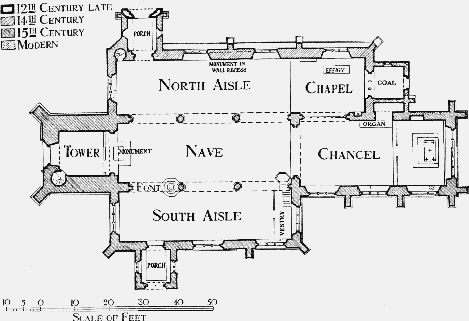
Plan of Castle Ashby Church
The outer doorway of the north porch is of late 12th-century date, but there is no other work of this period, and the doorway is not in its original position. Whether it belonged to an earlier building on the site or was brought here from elsewhere cannot now be determined. (fn. 55) The existing structure can only be regarded in the light of a 14th- and r 5th-century rebuilding. The north aisle is of the former period, but in the 15th century the nave arcades were entirely rebuilt, the south aisle added or widened, and the present chancel, south porch, and tower erected. In the main, therefore, the building is of 15th-century date, though the windows of the north aisle are excellent examples of 14th-century work.
The outer north doorway, which is characteristically Transitional in style, has a wide semicircular arch of three orders, separated by lines of four-leaved ornament, the outer order enriched with chevron and the middle order with lozenge moulding, in each case on both the wall and soffit planes. The inner order has a simple quarter-round on the edge, and the hood an enriched indented moulding. All three orders rest on nook-shafts, the capitals of which are carved with stiff plantain-like leaves, the jambs between the outer shafts being enriched with round studs. The two larger shafts on each side have been renewed, and the arch generally has been much restored, especially the outer orders. (fn. 56)
The north porch, of which the doorway forms the 'frontispiece', is sometimes claimed to be of the 13th century, apparently on the evidence of its plain pointed lateral windows and one, wholly restored, above the arch. These windows are, however, of a rather rough and nondescript character, (fn. 57) and in the upper part of the east wall, originally lighting a chamber, the floor of which has been removed, is an unrestored singlelight window with trefoiled ogee head of c. 1400. The present doorway from the aisle to the porch is apparently of the same period, (fn. 58) and the porch is probably not earlier. Access to the porch-chamber was from the north aisle by a circular stone stair, which is still in position.
The chancel is of three bays, marked externally on the south side by buttresses, and is lighted by a fourcentred east window of five cinquefoiled lights with vertical tracery, and on the south by three windows of similar character but of three lights; all these windows have double-chamfered jambs, and hood-moulds with head-stops. In the middle bay, below the window, is a chamfered priest's doorway with four-centred arch, the original oak door of which remains, though not used. There are no windows in the north wall, but near to its east end is the blocked doorway of a former sacristy. The piscina is of an unusual type, with cinquefoiled ogee head, stone shelf, and two lower compartments, the bottom one containing two trefoil-shaped bowls, and the upper a plain circular bowl. There are no sedilia. On the north side the chancel is open to the chapel by a pointed arch (fn. 59) of two chamfered orders, the inner order on half-octagonal responds with moulded capitals and chamfered bases. The much-restored chancel arch (fn. 60) is of the same character, except that both orders spring from moulded capitals. The arches are without hood-moulds. There is no chancel screen nor any traces of the rood-loft. (fn. 61)
The nave arcades consist of three lofty pointed arches of two chamfered orders, without hood-moulds, springing from octagonal pillars with moulded capitals and bases, and from responds of similar character but with chamfered bases. The 14th-century north aisle is lighted by three pointed windows in the north wall, each of three trefoiled lights with reticulated tracery, and at each end by a pointed window of rather later character, of three cinquefoiled lights and decorated tracery, the jambs of which are moulded. All these windows, the easternmost of which light the chapel, have hood-moulds. The doorway and porch, in each aisle, occupy the westernmost bay. In the west wall of the north aisle, near its south end, is a plain pointed recess 6 ft. 10 in. wide, the sill of which is about 15 in. above the floor. (fn. 62) There is no structural or other division between the chapel and aisle, but its floor is raised one step, and in the usual position in its south wall is a pointed piscina with plain ogee head and circular bowl. The lean-to roof of the aisle and chapel is continuous, but externally there is a low-pitched gable at each end. (fn. 63)
The south aisle has diagonal angle buttresses and is lighted by pointed windows of three lights similar to those in the chancel. Internally, on each side of the east window is an image-bracket, that on the south side moulded, the other in the form of a man's head, and between the latter and the window is a niche with trefoiled ogee head and square hood-mould. Another and larger niche in the south wall was brought here from Grendon church in 1848. (fn. 64) The plain trefoilheaded piscina of the aisle altar has a circular bowl and stone shelf. The pointed south doorway has a simple, continuous hollow moulding and hood with returned ends.
The lofty south porch has a low-pitched gable and moulded four-centred outer doorway, above which is a niche with cusped ogee head. The lateral windows are square-headed and of two trefoiled lights. (fn. 65)
The tower is of three stages, with moulded plinth, diagonal buttresses, and battlemented ashlar parapet with angle pinnacles. The pointed west doorway has a continuous-moulded arch within a square frame, and traceried spandrels; above it is a tall pointed window of three cinquefoiled lights and vertical tracery. The lower stage is blank on the north and south, and the middle stage on the north and west, except for a clock dial, but on the south and east is a restored single-light window. The pointed bell-chamber windows are of two cinquefoiled lights with a quatrefoil in the head, and the tower has a pyramidal leaded roof and iron vane. There is a vice in the south-west angle. The lofty pointed arch to the nave is of two chamfered orders, the inner order on half-octagonal responds with moulded capitals and bases. The lower part of the opening is filled with a modern oak screen.
The font has a plain octagonal bowl and stem on a moulded base, and is probably contemporary with the nave arcades.
The hexagonal oak pulpit is of the early Jacobean period with panelled sides and elaborate canopy. (fn. 66) A contemporary panelled reading-desk was converted in 1870 into a screen for a small vestry at the east end of the south aisle, two of its narrow panels being replaced by new ones a little wider, and small balusters added at the top for height. (fn. 67)
The effigy of Sir David de Esseby (1265) in the north chapel has already been described. (fn. 68)
The beautiful monumental brass of Walter Ermyn, rector (1401), had originally a shield at each corner of the slab and was surrounded by a marginal inscription, (fn. 69) but the figure of the priest alone now remains. He is represented vested in a cope, upon the borders of which are engraved small figures of St. Peter, St. Paul, St. Andrew, St. Nicholas, and St. Lawrence on one side, and on the other St. Anne, St. Katharine, St. Margaret, St. Mary Magdalene, and St. Elena. (fn. 70)
On the east jamb of the chancel doorway is a scratch dial.
There are several monuments to members of the Compton family. Of these the most notable are (1) a marble group in bas-relief by Pietro Tenerani, in memory of Margaret wife of the 2nd Marquess of Northampton, who died in 1830; (fn. 71) (2) the large marble figure of the Angel of the Resurrection, by the same sculptor, (fn. 72) in memory of Spencer, 2nd Marquess of Northampton (d. 1851), at the west end of the nave; and (3) the recumbent marble figure, in a recess in the north wall of the north aisle, of Lady Margaret Leveson-Gower (d. 1858), 2nd daughter of the 2nd Marquess of Northampton, the work of Baron Marochetti. There are also memorials to Charles, 1st Marquess of Northampton (d. 1828), and his wife (d. 1843); (fn. 73) to Lord Alwyne Compton (d. 1906) who was rector of Castle Ashby 1852–78; (fn. 74) John Segrave, rector (d. 1836); and to six men of the parish, including Lord Spencer Compton, killed in the war of 1914–18.
No ancient glass now remains. (fn. 75)
There is a ring of five bells, the first and second dated 1610, the third inscribed 'Sancta Agatha ora pro nobis', and the fourth and tenor by R. Taylor & Son, Oxford, 1826. (fn. 76)
The plate is all silver-gilt and consists of two cups and patens, a flagon, a bread-holder, and an alms dish, made in 1713 by Pierre Platel, each inscribed 'Given by Mary Countess of Northampton to Ashby Church'. (fn. 77)
The registers before 1812 are as follows: (i) all entries 1564–1650; (ii) 1653–97; (iii) 1698–1720; (iv) burials 1678–1744; (v) all entries 1683–1706; (vi) 1721–1812; (vii) marriages 1754–1812.
In the churchyard is a cross erected in 1883 as a memorial to Charles, 3rd Marquess of Northampton (d. 1877).
Advowson
The first known presentations to this rectory were by David de Ashby in 1240 (fn. 78) and Henry Muschet, as guardian of the younger David, in 1249. (fn. 79) From this time it passed with the manor. During the minority of an heir in 1356, the king granted this rectory to Thomas de Brantingham who later became Lord Treasurer and Bishop of Exeter. (fn. 80) In the reign of Henry VIII John Baker, the new parson, complained that the servants of the executors of his predecessor had negligently destroyed two great barns while sheep branding. (fn. 81)
Charity
James Burgess, who died in 1802, left £100 3% Consols to the poor of the parish. The endowment is now represented by a sum of £100 2½% Consolidated Stock held by the Official Trustees and the dividends amounting to £2 10s. are distributed by the rector and two trustees.