A History of the County of Somerset: Volume 3. Originally published by Victoria County History, London, 1974.
This free content was digitised by double rekeying. All rights reserved.
A P Baggs, R J E Bush, Margaret Tomlinson, 'Pitney hundred', in A History of the County of Somerset: Volume 3, ed. R W Dunning (London, 1974), British History Online https://www.british-history.ac.uk/vch/som/vol3/pp14-15 [accessed 30 April 2025].
A P Baggs, R J E Bush, Margaret Tomlinson, 'Pitney hundred', in A History of the County of Somerset: Volume 3. Edited by R W Dunning (London, 1974), British History Online, accessed April 30, 2025, https://www.british-history.ac.uk/vch/som/vol3/pp14-15.
A P Baggs, R J E Bush, Margaret Tomlinson. "Pitney hundred". A History of the County of Somerset: Volume 3. Ed. R W Dunning (London, 1974), British History Online. Web. 30 April 2025. https://www.british-history.ac.uk/vch/som/vol3/pp14-15.
THE HUNDRED OF PITNEY
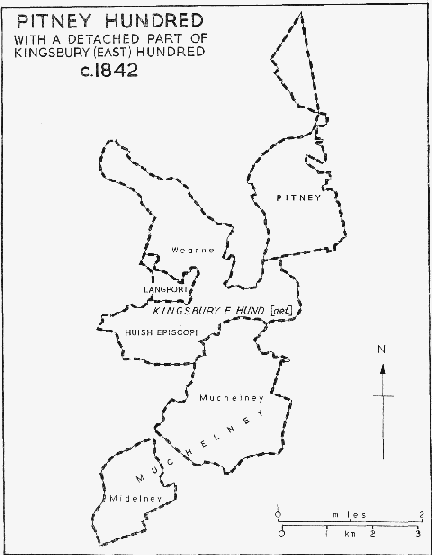
Pitney hundred, c.1842
The hundred of Pitney occupies the Langport Gap, where the Parrett, its waters increased by the Isle and the Yeo, flows north-west in a narrow valley between the Curry Rivel ridge and the lower promontory on which the Saxon burh of Langport was built. The flat 'moors' south and east of Langport, now drained and forming rich pasture land, were formerly subject to severe flooding, and are characterized by scattered settlements on small 'islands' of higher ground. In striking contrast are the scarps of the northern parts of Huish and Pitney, once devoted to open-field arable. The rivers have been the key both to the character of much of the surrounding land and to the origin and prosperity of Langport through river-borne traffic.
The hundred is not of ancient foundation and appears to have been a fiscal development of the 16th century from two free manors and a borough which happened to be adjacent to one another. From as early as 1219 the phrase 'free manor' was used to describe land in Pitney, which from 1225 was associated with the manor of Pitney Lorty. (fn. 1) Beer, in High Ham, later known as Berelorty, which owed tithe to the rector of Pitney, (fn. 2) was considered part of the free manor by 1225. (fn. 3) By 1316 the manor also included the hamlet of Knole, in Long Sutton, but only for fiscal, not for jurisdictional purposes. (fn. 4) Knole was a possession of Henry Lorty, lord of Pitney. (fn. 5) In 1327 Downhead, in West Camel, also Lorty property, was part of Pitney manor. (fn. 6) In 1384 the successor of the Lortys, Sir Robert Ashton, died in possession of an estate described as the manor and hundred of Pitney Lorty, a phrase first used a year earlier. It was held of the Crown for the same rent as the manor alone. (fn. 7) Ownership of the hundred then descended with the manor of Pitney Lorty. (fn. 8)
In 1431 the hundred comprised Pitney Lorty in Pitney, Knole, Bineham, and Corbyns, in Long Sutton, (fn. 9) and Beer in High Ham. (fn. 10) Pitney, Beer, and Knole tithings made up the hundred in 1522–3. (fn. 11) Lands in Somerton were also said to be in Pitney hundred. (fn. 12) By 1569 the hundred comprised the tithings of Pitney, Knole, and Muchelney, the last also including Midelney, locally in Drayton parish. (fn. 13) The liberty of Muchelney had anciently included the hamlets of Thorney and Ham. (fn. 14) The men of Langport were grouped with those of Pitney in 1588, (fn. 15) and the borough was included in the 'hundred and liberty' of Pitney by 1624. (fn. 16) In a rating dispute in 1635 Pitney and Knole tithings were rated at half the value of the combined tithings of Muchelney, Midelney, and Langport borough. (fn. 17) In the mid 18th century parts of Huish, presumably the lands of the manor of Pitney Wearne, were regarded as part of the hundred. (fn. 18)
No more than a normal manorial jurisdiction was exercised by Pitney court until 1608. In that year what appears to be the manor court of Pitney Lorty ordered every constable to submit his accounts to the curia legalis at the end of each year before the steward 'and the hundred', and at the same time claimed jurisdiction over Pitney Wearne manor. (fn. 19) Records of courts leet and views of frankpledge 'in and for the hundred' from 1696 to 1703 form part of the normal run of manorial records for Pitney Lorty manor, and business beyond the appointment of constable of the hundred, who in two cases came from tithings in Muchelney manor, is indistinguishable from normal manorial proceedings.